Korean crypto influencers speak to one of the largest retail crypto audiences in Asia: Korean exchanges and custodians reported 11.18 million tradeable user accounts at the end of June 2026, in a Financial Intelligence Unit survey released on 1 October 2026. This guide shows projects how to vet, brief and pay those creators inside Korea’s 2026 rules on crypto promotion. Checked on 10 November 2026.
At Flexe.io, we connect projects with vetted influencers. Contact us via Telegram to plan a Korean campaign. Packages are listed on our crypto influencer services page.
Why Follow Korean Crypto Influencers?
Korea’s crypto market is tech-savvy, tightly regulated and widely used. Influencers matter there for:
- Educating Communities: Simplifying complex crypto concepts for the public.
- Promoting Local Projects: Covering the latest blockchain work coming out of Korea.
- Driving Engagement: Building communities that actively participate in the crypto ecosystem.
- Explaining the Rules: Turning regulator warnings into plain Korean.
These are the top 10 creators and channels we verified one by one on 10 November 2026. Follower counts come from each YouTube channel page (YouTube rounds them) and from the public X profile, and every account had posted within the previous three months. The order is reach, not quality: several channels publish aggressive price calls, so run the checks in the next section before paying any of them.
| Influencer or channel | Platform | Audience on 10 November 2026 | Latest post | What they cover |
|---|---|---|---|---|
| Ki Young Ju (@ki_young_ju) | X | 435,310 followers | 9 November 2026 | On-chain data; founder and CEO of CryptoQuant |
| BitShua (비트슈아) | YouTube | 307,000 subscribers | 19 October 2026 | Altcoin narratives and project breakdowns |
| Park’s Crypto Lab (박작가의 크립토연구소) | YouTube | 260,000 subscribers | 10 November 2026 | Long-form interviews on crypto investing |
| Kobugi (코부기) | YouTube | 200,000 subscribers | 30 October 2026 | Trading calls and market news |
| Coin Prince (코인왕자) | YouTube | 108,000 subscribers | 10 November 2026 | Short trading commentary |
| CoinKing (코인킹) | YouTube | 96,500 subscribers | 10 November 2026 | Bitcoin price scenarios |
| Baek Hoon-jong (백훈종의 전지적 비트코인 시점) | YouTube | 65,500 subscribers | 10 November 2026 | Bitcoin and macro: rates, liquidity, cycles |
| Team Griffin (팀 그리핀) | YouTube | 41,700 subscribers | 10 November 2026 | Bitcoin and altcoin chart analysis |
| Bit Insight (비트인사이트) | YouTube | 29,400 subscribers | 9 November 2026 | Bitcoin price levels and scenarios |
| Four Pillars (@FourPillarsFP) | X | 17,716 followers | 10 November 2026 | Seoul research team writing for institutions |
How do you verify a Korean crypto influencer before you pay?
We no longer publish a ranked list of Korean accounts here, and the reason is the thing that makes this market hard: handles in this niche turn over constantly. Accounts get suspended, creators rebrand, and a handle that circulated in a roundup two years ago often points at nothing today. A stale list of people is worse than no list, because it reads as verified when it is not.
What survives is the checking procedure. Four steps, in the order that eliminates the most candidates fastest:
| Step | What you do | What it rules out |
|---|---|---|
| 1. Open the profile itself | Load the account directly rather than trusting a screenshot or a media kit | Handles that no longer exist, and handles that never did |
| 2. Check the history | Look the handle up in a web archive: a real account with an audience leaves snapshots going back years | New accounts presented as established voices, and renamed handles with no past |
| 3. Read the median post | Take the last twenty posts and find the middle value for views and replies, not the best one | Accounts whose media kit was built around a single viral post |
| 4. Compare paid to organic | Find their previous sponsored posts and compare engagement with their normal content | Audiences that recognise and ignore paid placement, which is most of the failure cases |
The local complication is that the Korean conversation runs largely on KakaoTalk, Naver and domestic YouTube, none of which international influencer databases index properly. For a shortlist against a specific brief, we run these checks on live accounts at the time of the campaign rather than from a saved list.
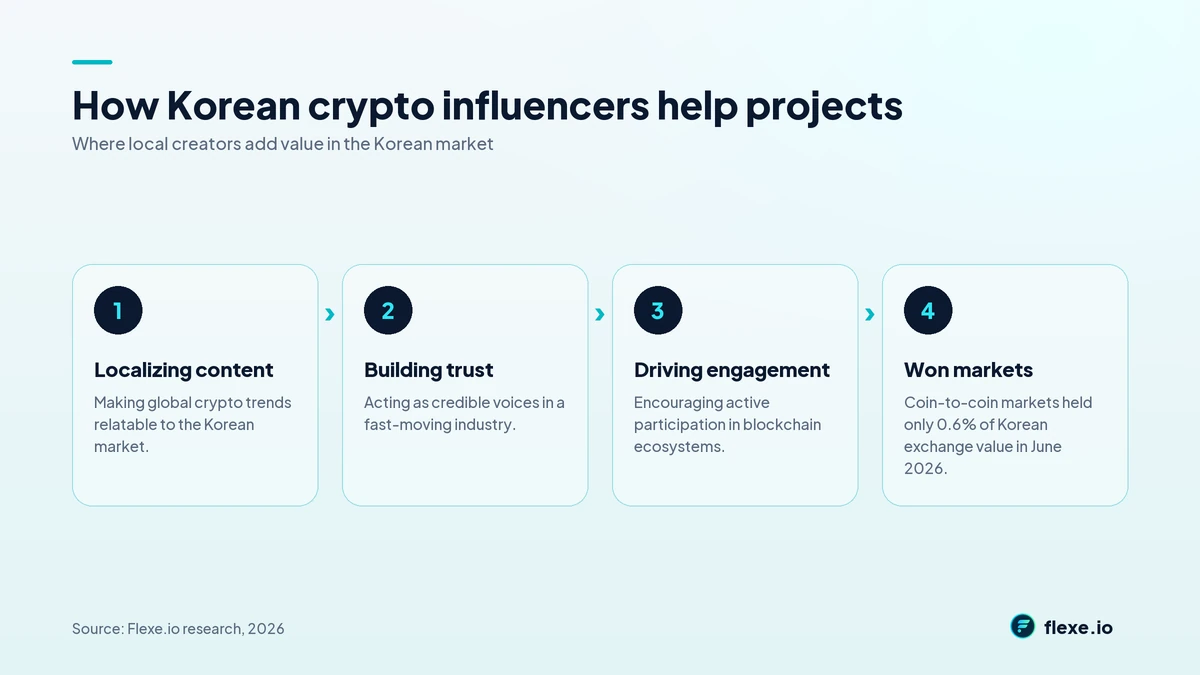
How Korean Crypto Influencers Drive Blockchain Success
Korean crypto influencers bring value to blockchain projects by:
- Localizing Content: Making global crypto trends relatable to the Korean market.
- Building Trust: Acting as credible voices in a rapidly evolving industry.
- Driving Engagement: Encouraging active participation in blockchain ecosystems.
- Pointing to Won Markets: Coin-to-coin markets held only 0.6% of the value on Korean exchanges in June 2026.
How Flexe.io Can Help Your Project Collaborate with Influencers
At Flexe.io, we connect projects with vetted Korean crypto influencers. Our services include:
- Influencer Database: Access a curated network of top influencers in Korea.
- Tailored Campaigns: Develop localized strategies to resonate with the Korean audience.
- Performance Tracking: Measure each creator separately with their own link or code.
- Compliance Screening: Check that the exchange or app in the brief is registered in Korea before any referral link goes out.
Flexe.io has run 800+ campaigns since 2018 and tracks 11,859 KOLs on X and 11,695 YouTube creators, but for Korea we rebuild the shortlist against live profiles for each brief.
What to take from this
Korean crypto influencers still move attention in a market with more than 11 million exchange accounts. The value sits in checking each account when you book it, briefing in Korean and keeping referral links away from unregistered platforms, because a saved list of names ages within months.
Looking to collaborate with leading influencers? Contact Flexe.io or reach out via Telegram to plan a launch in the Korean market.
Update: August 2026 Snapshot
As of November 2026, here is what has changed in crypto influencer marketing:
- Performance terms spread. More creators accept part of the fee on tracked links.
- Smaller accounts win on efficiency. Engaged mid-size creators often beat celebrities on cost per acquisition.
- Telegram mini-app creators became a separate KOL class. They matter less in Korea.
- AI personas flooded the market. Confirming a real person and audience is step one of any deal.
- Korean rules reached referral links. Since October 2026 the FIU warns that recommending an unregistered platform can itself be a criminal offence.
Related Reading
- Launching a token? See our list of the top meme coin influencers for viral campaigns.
- Prefer video reviews? Check the best crypto YouTubers to work with this year.
- Want a wider pool of talent? Browse our guide to crypto content creators across every platform.
- Need vetted creators rather than a list? See our influencer packages.
Working with Korean Crypto Influencers: What Outsiders Get Wrong
Korea is one of the highest-participation crypto markets in the world and one of the hardest to enter from outside, because the platforms, the etiquette and the regulation all differ from what works elsewhere.
- The platforms are local. KakaoTalk, Naver blogs and cafés, and domestic YouTube carry the conversation. A campaign built on X and Telegram reaches almost nobody who matters here.
- Exchange listing drives everything. Attention follows a listing on a major domestic exchange far more than it follows content. Marketing before that is groundwork, not acquisition.
- Disclosure rules are enforced. Undisclosed paid promotion has drawn real consequences for creators here, so partners will insist on labelling and you should want them to.
- Translation is not localisation. Machine-translated copy is recognised instantly.
- Community managers must be native and in-timezone. Korean crypto communities move fast and expect immediate answers; a delay reads as indifference.
Referral links became the sharpest risk in October 2026. On 13 October the Financial Intelligence Unit said 27 sites of unregistered crypto operators were ordered blocked on 6 and 7 October, and warned that a referral link to such a platform can count as helping an unregistered business, so the recommender may face criminal charges. The penalty is up to five years in prison or a 50 million won fine.
A foreign platform counts as operating in Korea if it runs a Korean-language site, holds events to attract Korean customers or accepts won payments. On 30 October the FIU repeated that only 28 operators are registered, so check the exchange or app in your brief against that list before paying a creator.
Picking the accounts is the part that decides the outcome, and follower counts will not tell you which ones deliver. If you would rather hand that over, our crypto influencer marketing team screens every account for bought engagement before it enters a campaign.
Briefing Korean crypto influencers properly
A brief that works here answers the questions a Korean creator will ask before they agree to anything. Where the token can be bought domestically, who at your company signs off on the claims, what may not be said about returns, and which steps a viewer has to complete before they hold the asset. Send it in Korean, written by a native speaker, with the English version attached for reference rather than as the primary document.
Include the parts most briefs omit: the deadline you actually need, the window in which the creator is free to publish, the assets they may edit, and the name of a person who answers questions in Korean during Korean hours. If the product is a derivatives venue, say so: on 16 October 2026 the FSC and FSS warned that perpetual futures on offshore platforms run at 10x to 200x margin with no Korean investor protection.
Contract terms that prevent disputes
Write down the format, the minimum time the post stays live, whether it is pinned, and what happens if it comes down early. Agree the disclosure wording with the creator rather than imposing it, because the label has to sound like them.
Two clauses save the most trouble later. An exclusivity window that stops the same account promoting a competing token days after yours, and a right to a correction if the post states something factually wrong about the contract address or the exchange. Keep both narrow: serious creators refuse broad approval rights over their own copy.
Agreeing payment before the post
Agree the chain, the token, the exact wallet address and the invoice reference in the same written thread as the scope, then send a small test transfer and have the creator confirm receipt before the full amount moves. If a wallet address changes mid-conversation, treat it as compromised until confirmed through a second channel you already trust.
Split the payment so that part lands on booking and the rest after the post has been live for the agreed period. Paying everything upfront removes your only remedy, and paying everything afterwards makes good creators decline the brief. Keep the invoice, transaction record, scope and published link together in one place.
Tracking a campaign across local platforms
Give every creator their own landing path or code rather than one shared link, because that is the only way to compare them afterwards. Check the link resolves from a Korean connection and on mobile before the post goes out, not after.
Record the numbers yourself at fixed intervals rather than relying on a screenshot at the end. Save a copy of the post and its view and reply counts shortly after publication and again at the end of the agreed live period. Creators delete posts and platforms recount views, so a report assembled weeks later from memory proves nothing.
What to check in the first hours
Open the post yourself rather than trusting a screenshot. Confirm the disclosure is visible without expanding the caption, the contract address matches the one you published, the link resolves, and the creator is answering questions underneath. An unanswered comment thread below a paid post does more damage than no post at all.
Compare the early engagement against that creator’s normal posts rather than against your own expectations. A placement that opens far below their median is usually a timing problem or an audience that recognises paid content.
When a placement goes wrong
The common failures are a post quietly deleted, a wrong contract address, engagement arriving in a single burst from accounts with no history, or a creator who stops replying once the fee has cleared. Decide the remedy before any of it happens: a correction post, a repost, a partial refund, or ending the arrangement.
Handle it privately first. Creators here talk to each other, and a public complaint costs you the next several partners. Document what happened, close the arrangement and record the account as one you do not approach again. Save the public escalation for the cases where holders were actively misled about the asset.
Timing placements around local hours
Post timing is set by the audience, not by your calendar. Korean crypto conversation concentrates in the evening and late at night, and a placement scheduled for your own working day lands while the people it was bought for are asleep. Agree the publication window in local time and write it into the scope rather than leaving it to the creator to guess.
Concentrate several creators inside the same window rather than spreading them across a fortnight, since attention here compounds when people see the same thing from different accounts in one evening. Check the calendar for major domestic exchange announcements first, since a placement that lands against one gets no attention. The pool is also thinner: daily trading on Korean exchanges fell 44% to 3.1 trillion won in the first half of 2026, per the same FIU survey.
Keeping a working shortlist current
Re-run the profile checks before each campaign rather than trusting a list assembled last quarter, since handles in this market rebrand and disappear. Keep a private record for each account: the median engagement at the time you checked, whether they asked for compliance answers, the rate quoted, how long they took to reply, and whether the post stayed live for the agreed period.
That record is worth more than any public ranking, because it is built on deals you actually ran rather than on follower counts. Note the accounts that declined and why: a creator who refused because the token had no domestic listing is worth returning to once it has one.
Korea is one market among several, and our guide to crypto marketing in emerging markets compares the regions worth budgeting for next.
Frequently Asked Questions
How do you work with Korean crypto influencers?
Through local platforms. KakaoTalk, Naver blogs and cafés, and domestic YouTube carry the conversation, so a campaign built on X and Telegram reaches almost nobody who matters. Attention also follows a domestic exchange listing far more than it follows content.
Do Korean creators require disclosure?
Yes, and it is enforced. Undisclosed paid promotion has drawn real consequences for creators there, so partners will insist on labelling. Since October 2026 the Financial Intelligence Unit also warns that a referral link to an unregistered platform can expose the recommender to criminal charges, so creators check the platform too.
Is machine translation acceptable for the Korean market?
No. It is recognised instantly and reads as an outsider marketing at people rather than to them. Budget for a native writer, not a translator, and have the same person review the creator brief, the landing page and the replies your team posts under the sponsored content.
What does Korean crypto influencer marketing cost?
Rates track engaged audience rather than follower count, and the market is competitive enough that quality partners are booked weeks ahead. Expect to pay a premium for creators with a verifiable trading or building background, and expect a refusal if the token has no domestic listing yet.
Do you need a Korean community manager?
If you are running a community there, yes, and native plus in-timezone. Korean crypto communities move fast and expect immediate answers; delay reads as indifference rather than as a time zone. The busiest hours fall in the Korean evening, which is night or early morning for most foreign teams.
What is the biggest mistake foreign projects make in Korea?
Treating it as a distribution channel rather than a market. Content translated from an English campaign, run on the wrong platforms, timed to the wrong hours, and without a listing to convert against. In 2026 a second mistake joined it: sending Korean users to a platform that is not registered with the FIU.