To list a token on Coinbase in 2026, you submit Coinbase’s free Review Request, pass legal, compliance and technical security reviews, and, if approved, launch through staged trading states. This guide is for founders and BD leads who searched how to list token on Coinbase and want Coinbase’s own rules, not a sales pitch.
Checked on 14 November 2026.
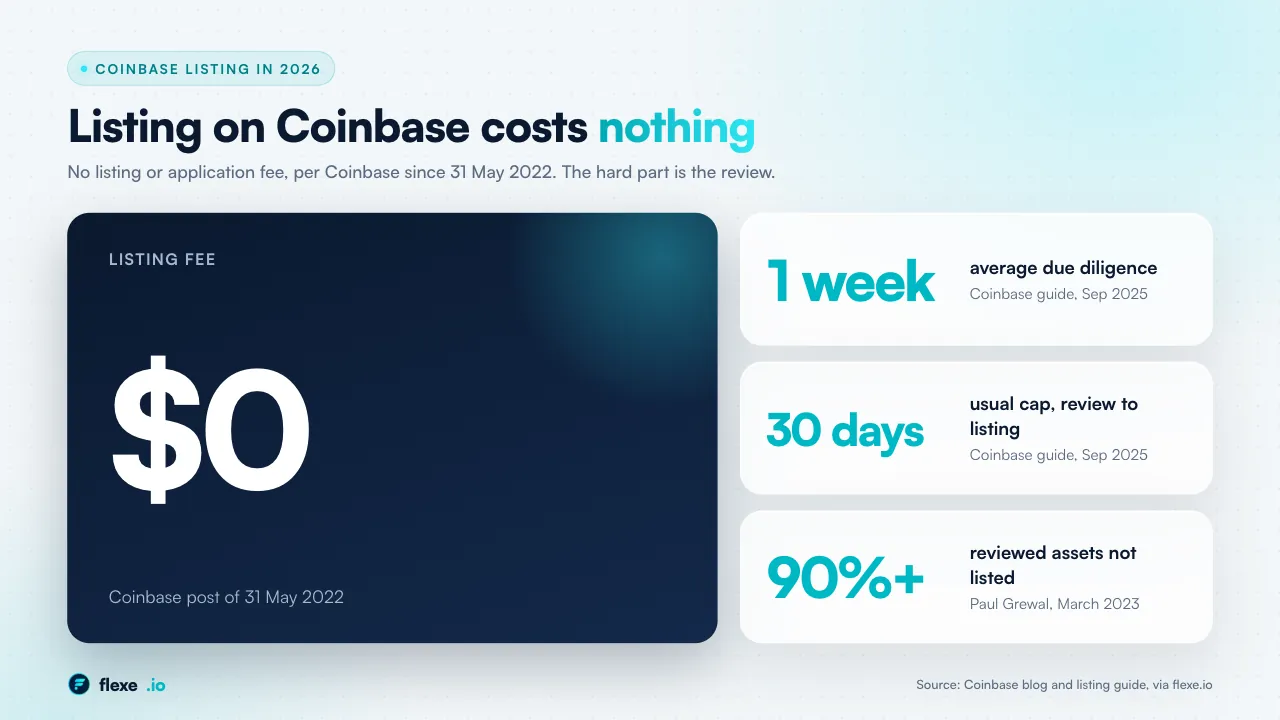
- Applying for a Coinbase listing is free, per a 31 May 2022 Coinbase post and its 10 September 2025 guide.
- Coinbase says due diligence takes one week on average and trading can follow within two weeks of approval.
- Coinbase’s chief legal officer wrote on 22 March 2023 that 90%+ of assets Coinbase reviews are never listed.
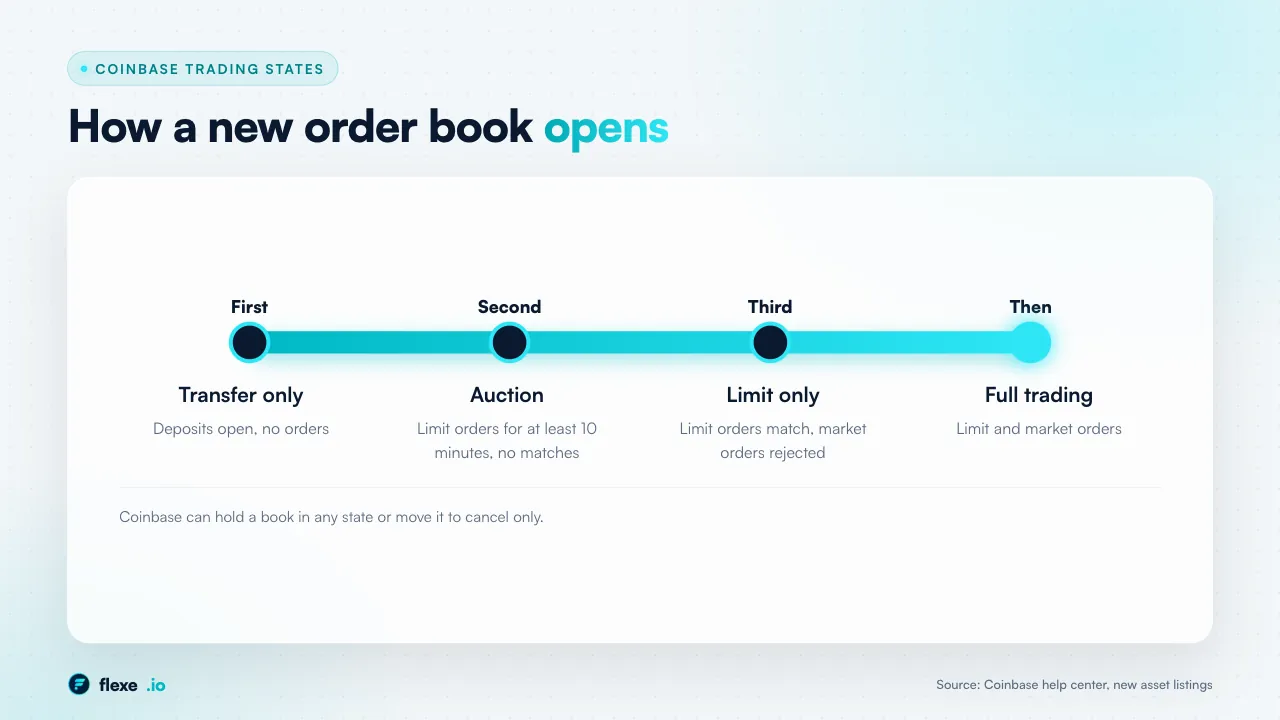
- Approved tokens launch in phases: transfer only, an auction of at least 10 minutes, then limit only or full trading.
- Base tokens have been tradable through DEX trading in the Coinbase app since 8 August 2025, without an exchange listing.
What Coinbase checks before it lists a token
Coinbase checks every token against three core reviews: legal, compliance and technical security. Before those, it runs a business evaluation of market demand, community traction and integration work. We read Coinbase’s 10 September 2025 listing guide, its issuer listing page and its help center articles on 14 November 2026.
The legal review asks whether trading the token would be a securities transaction in the relevant jurisdictions. Compliance checks token distribution and onchain activity for financial crime and consumer harm. Technical security covers contract code, design, custody and operational risks, plus consensus and governance for a new blockchain.
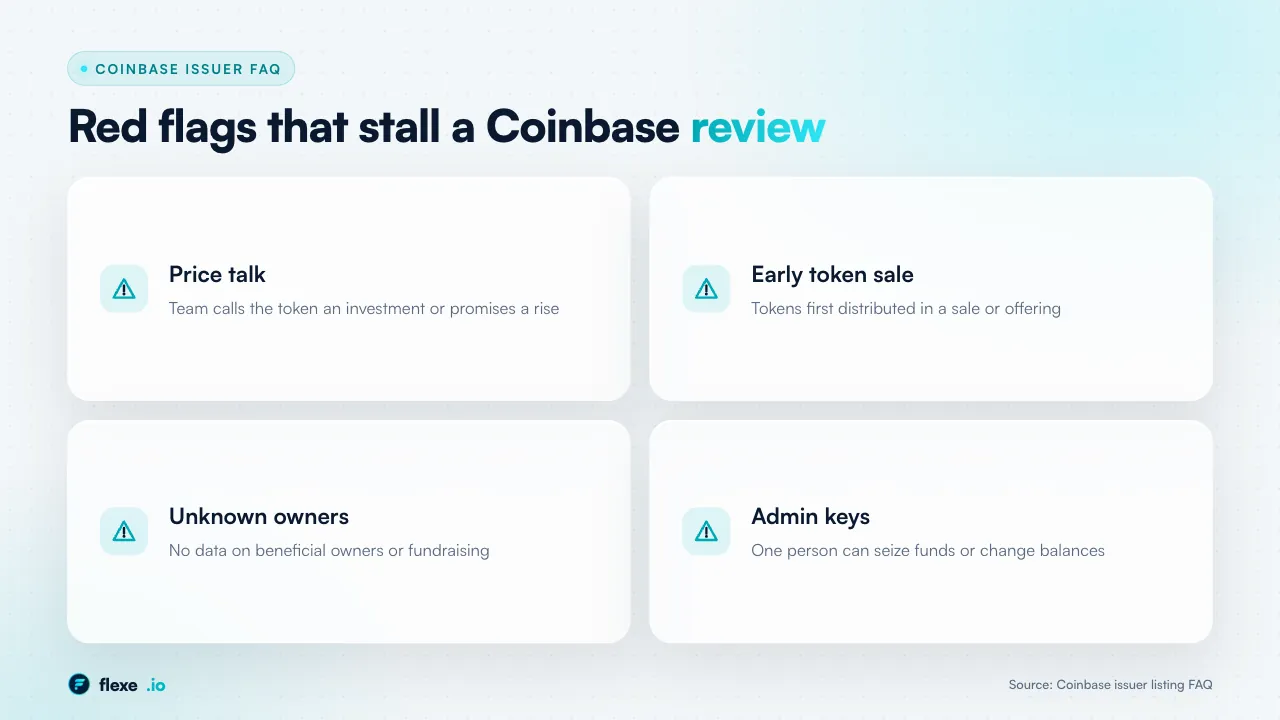
The issuer FAQ lists the red flags that slow down or stop a due diligence review. We grouped them by what a team can still fix before it applies. These are the practical Coinbase listing requirements many teams discover too late:
- Team statements that the token is an investment or that holders will see its price rise.
- An initial token distribution through a sale or offering event.
- A platform behind the token with no real or supportable use.
- Missing data on beneficial owners, executives, key people or fundraising sources.
- Admin keys that can seize funds or change balances, held by one person or one system.
- Complex or novel code without an audit from a reputable firm.
Popularity does not override these checks, and most reviewed assets fail them. Chief Legal Officer Paul Grewal wrote on 22 March 2023 that more than 90% of assets Coinbase reviews never get listed because they miss its standards. Coinbase’s August 2023 standards document repeats the figure. It adds that approval by the Digital Asset Support Group does not by itself mean a listing.
The uncomfortable part of the process is silence. Coinbase’s listing page says its team will be in touch only if an asset is a strong fit, and its FAQ gives only generic reasons for skipping popular assets. Its help center adds that a rejected issuer should wait at least six months before applying again. Plan for no reply as the default outcome.
Coinbase reviews tokens on its own terms, so if you also want reach on other venues, we offer help with listings on exchanges that accept applications from agencies.
How to list your token on Coinbase
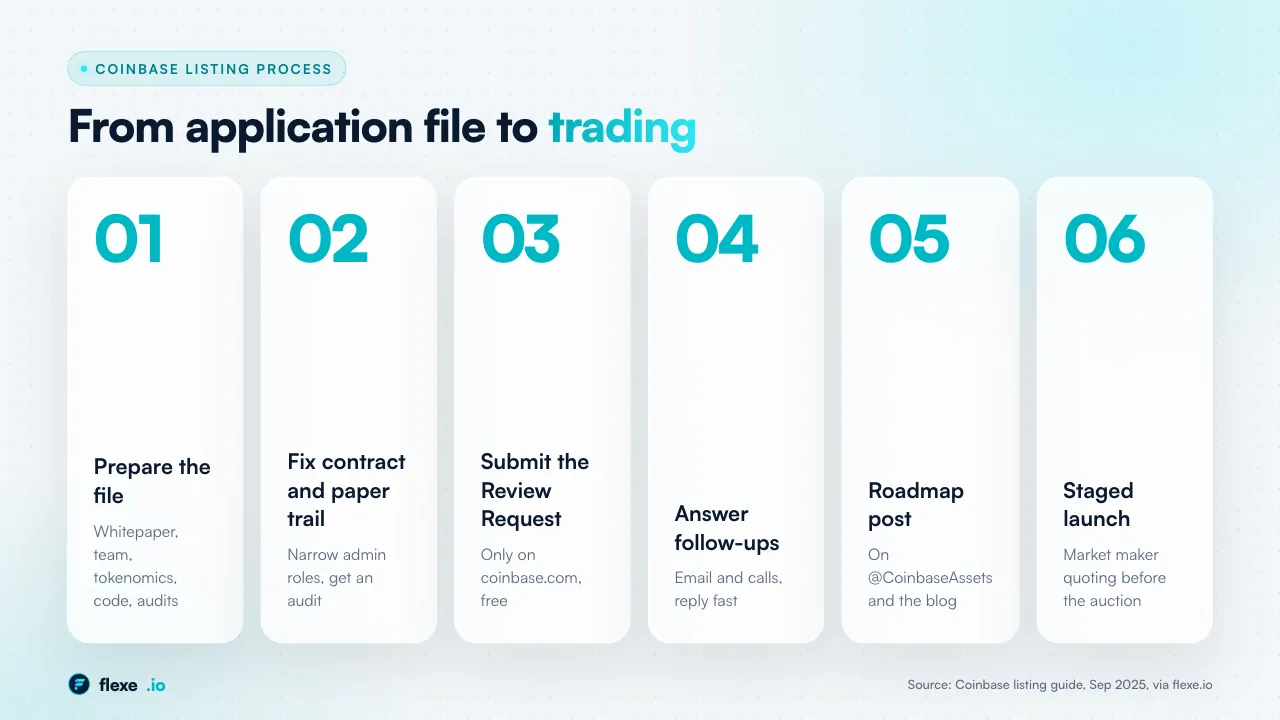
The Coinbase listing process has seven practical steps. Coinbase’s guide lists five, and we added preparation before them and launch phases after. If you want to know how to list your token on Coinbase without wasted months, most of the work happens before the form.
- Prepare the full application file first. Coinbase’s questionnaire asks for the whitepaper, team background, tokenomics, source code links, block explorers and any third-party audits.
- Fix the contract and paper trail. Narrow admin roles, document key policies and get an audit, while a legal opinion stays optional.
- Submit the Review Request on Coinbase’s official issuer listing page, never through a link someone sent you in a direct message.
- Answer every follow-up from Coinbase quickly. Coinbase writes by email and holds phone or video calls, and slow or incomplete answers delay the review.
- Report major changes, such as a migration or a supply change, because late news during review causes delays.
- Watch for the Coinbase listing roadmap. Approved assets appear on Coinbase’s roadmap blog page and on @CoinbaseAssets, the official asset channel again since 14 October 2026.
- Line up launch liquidity early, because trading opens only with market-making support in place. Our guide to crypto exchange market makers covers selection.
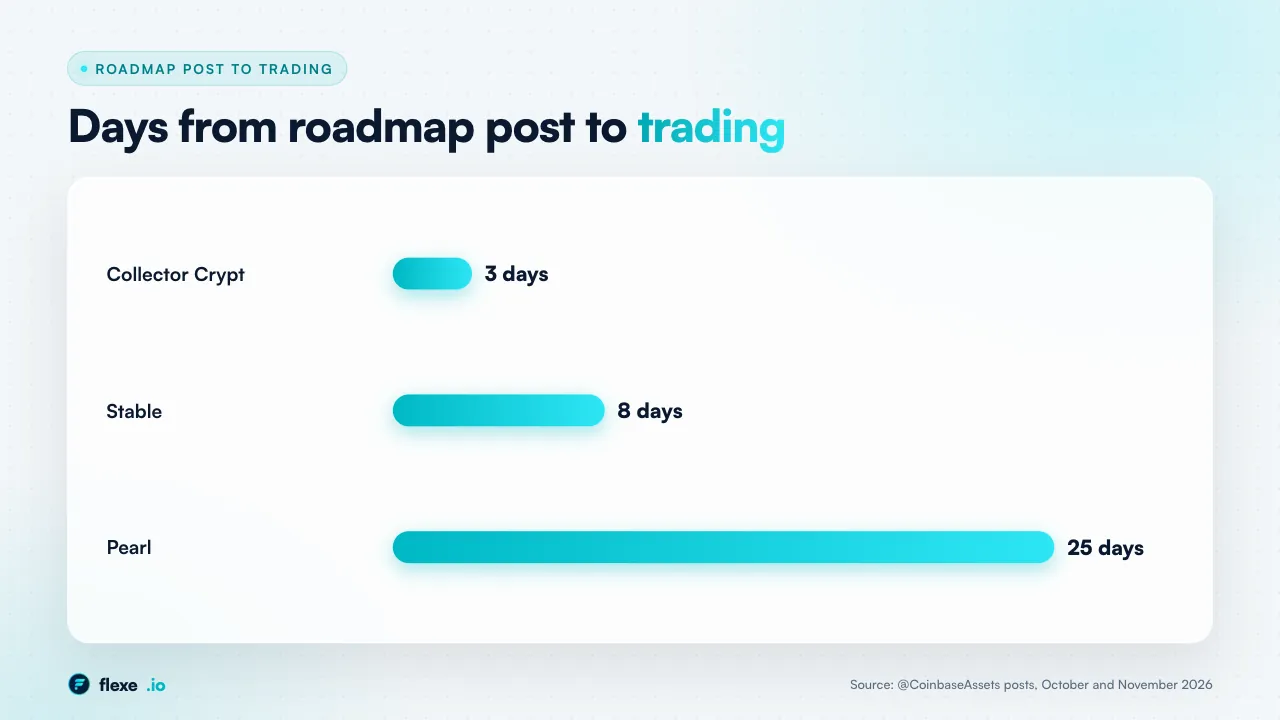
The gap between roadmap and trading ranges from days to weeks. @CoinbaseAssets added Axis Labs, Pearl and Stable to the roadmap on 19 October 2026. Stable spot trading went live on 27 October, and Pearl spot and perpetual futures on 13 November. Collector Crypt took three days, from a 3 November roadmap post to trading on 6 November.
How to list token on Coinbase for free
There is no Coinbase listing fee, and Coinbase has said so in writing for years. Chief Product Officer Surojit Chatterjee addressed it in a 31 May 2022 post. He wrote: “We don’t charge listing or application fees to asset issuers.” The same post says Coinbase requires no prerequisite marketing fees or use of its other services.
The cheapest part of how to list token on Coinbase is the application itself. You still pay for audits, legal work, documentation and market making, and Coinbase publishes no estimate for any of them. The paid Earn education campaigns described in that post ended in May 2025, per an update on the page.
On timing, Coinbase’s 10 September 2025 listing guide gives a rare number: due diligence takes one week on average and trading can start within two weeks of approval. It adds that review to listing generally takes under 30 days. In our reading, those averages cover files Coinbase already chose to review, so a team can wait months for a one-week review.
Anyone selling a guaranteed listing is selling something Coinbase does not offer. Ido Ben-Natan described the pattern in a LinkedIn post on 28 January 2026. In his account, impersonators of Binance, Coinbase or OKX tell a project it sits in a final review or a limited priority window. Treat that as reported experience, not Coinbase policy; the signs are easy to check:
- The real application is the Review Request on coinbase.com, not a Telegram form or a shared document.
- No payment is part of the process, so any fee, deposit or token allocation request is a red flag.
- Coinbase announces listings, delistings and roadmap updates on @CoinbaseAssets, so check any claim there first.
- Coinbase says it contacts teams itself when it moves forward, so verify any unsolicited “Coinbase BD” message.
The legal risk also sits with Coinbase. In its 10-K filed on 12 February 2026, Coinbase says a crypto asset’s status as a security is subject to a high degree of uncertainty. It warns it may have to stop facilitating trading in an asset later deemed a security, other than via its licensed subsidiaries. Our token delisting guide covers what happens then.
Trading states after Coinbase approves a token
After approval, Coinbase opens each new order book in phases and moves forward only when the market looks healthy. Coinbase’s help center article on new asset listings describes the states below. Coinbase handles each order book separately and may hold one in a state longer or suspend trading under its Trading Rules.
| State | What users can do | Why it exists |
|---|---|---|
| Transfer only | Deposit the token to Coinbase. No orders are placed or filled. | Deposits open first so liquidity can build before trading. |
| Auction | Place limit orders for at least 10 minutes without matches, while an indicative price is shown. | Sets an opening price from collected orders instead of a race for the first print. |
| Limit only | Limit orders match. Market orders are rejected. | Keeps market orders away from a book that is still thin. |
| Full trading | Limit and market orders both work. | Normal operation once depth and volatility stay in healthy ranges. |
| Cancel only | Cancel open orders. No new orders and no fills. | Used when depth and liquidity cannot support a trading state. |
For the team, transfer only is the phase that matters most. The help article says trading generally begins during business hours, Pacific time, with notices on @CoinbaseSupport or status.exchange.coinbase.com. Your market maker should be funded and quoting before the auction opens. An empty book can stay in auction or get paused.
Base and Solana DEX trading, the faster route
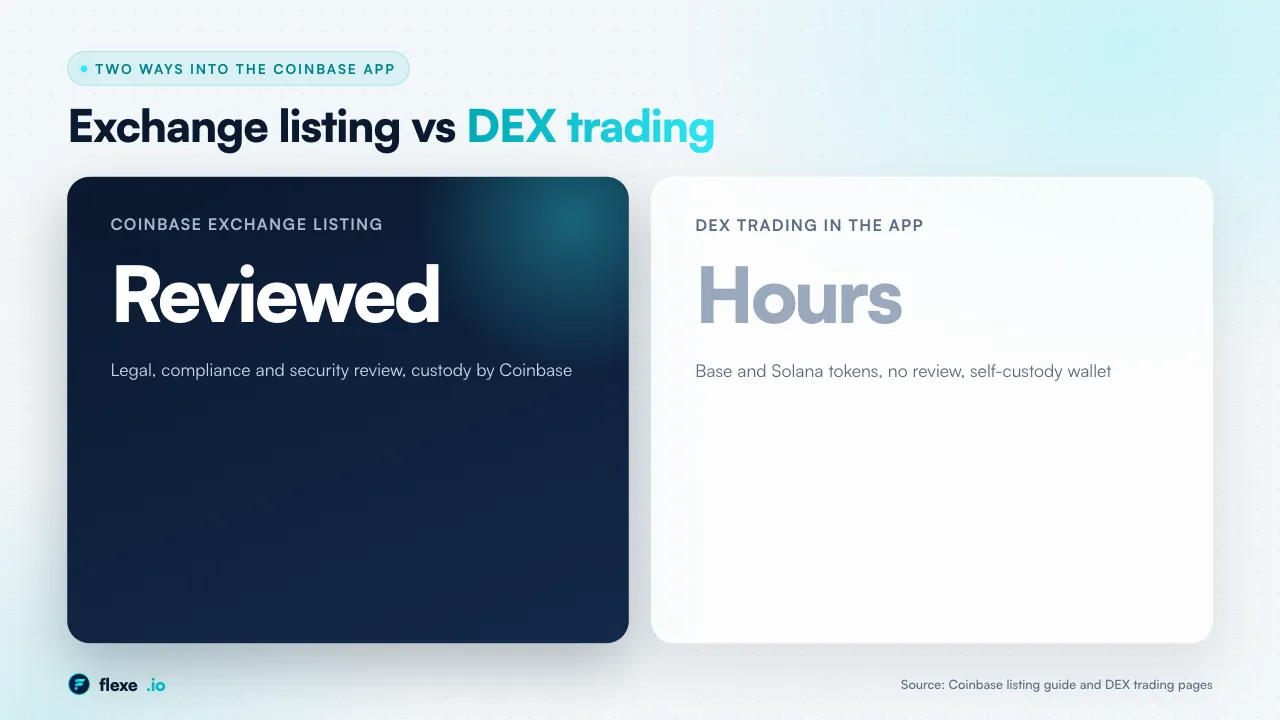
Since 8 August 2025, Coinbase has offered DEX trading in its app, starting with Base tokens for select US users outside New York. An update on that launch post says all US customers outside New York got access on 8 October 2025. Coinbase wrote that Base issuers can reach traders within an hour after their token is indexed.
Solana tokens were the next step, as Coinbase’s 17 December 2025 product update announced Solana DEX trading through a Jupiter integration. DEX trading also spread beyond the US. Coinbase’s regional post lists Brazil from 19 November 2025, the United Kingdom from 13 April 2026 and full Australian access from 19 May 2026.
This route is open to almost any token on Base or Solana. Coinbase’s DEX page says new onchain assets become tradable within hours, with no setup from the issuer. The convenience comes with limits a founder should state honestly to the community:
- It is not a Coinbase Exchange listing, and Coinbase does not review or hold DEX assets.
- Users trade from a self-custody wallet created in the app, not from Coinbase custody.
- Tokens a third-party vendor flags as malicious or fraudulent are filtered out and cannot be bought.
- Risk signals, such as a high concentration of holders, are shown to users next to your token.
- DEX trading is not available everywhere, and a Coinbase fee plus a DEX service fee may apply.
Coinbase users can already find a Base or Solana token, so pool depth shapes their first experience of it. In our view, DEX volume and holders also feed the business criteria Coinbase applies later. Our DEX listing walkthrough covers pool setup.
Perpetual futures are a separate track with no public issuer application we could find. Coinbase’s developer docs say International Exchange derivatives moved onto a Deribit-powered platform on 1 October 2026. Coinbase announces perps on @CoinbaseAssets, sometimes together with spot, as with Pearl. Treat perps as Coinbase’s market decision, not an issuer route.
Listing on Coinbase vs adding a token to Coinbase Wallet
Many searches for this topic are about the wallet, not the exchange. Coinbase Wallet is a self-custody app, separate from the exchange; it was called Base App from July 2025 until The Block reported the old name returning in September 2026 (checked 16 November 2026). Any token on a supported network can sit in it without Coinbase approval. That is not a listing: the token gets no order book on the exchange, and the review above still applies.
What to prepare for the community and marketing
Marketing affects the legal review, so it has to be cleaned up before the application. Coinbase’s 2025 guide says whitepapers, websites and marketing materials can change a token’s regulatory risk profile. It advises teams to stress purpose, governance rights and real use instead of price, and to add factual risk disclosures. We describe common practices here, not legal advice.
- Before any roadmap post, say only that you applied, and never hint at dates.
- Remove “moon” posts, price targets and return promises from your site, docs and pinned messages.
- Brief KOLs in writing that they may not imply a Coinbase listing or a price outcome.
- After the roadmap post, repeat Coinbase’s warning that early deposits may lead to permanent loss of funds.
- Staff moderation from the roadmap post to full trading, and pin the contract address exactly as Coinbase shows it.
- After full trading, shift to holders and volume, as our post-listing retention playbook explains.
A good roadmap post states a fact and stops. On 3 November 2026, Collector Crypt wrote on its X account that $CARDS was now on the Coinbase roadmap, calling it a big milestone. It promised no date and no price. That is reported issuer experience, not Coinbase policy, and trading followed three days later.
Our side of this work is marketing, never the listing decision. Since 2018 we have run 800+ campaigns, with 20,000+ influencers on X and YouTube (100+ active on X, 300+ on YouTube) and 800+ media outlets. Nobody outside Coinbase can guarantee a Coinbase listing, including us.
When a Coinbase listing is the wrong first goal
For most new tokens, a Coinbase listing is the wrong first goal. Many people researching how to list token on Coinbase have no trading volume or holders yet. Coinbase prioritizes reviews by demand, holder traction and expected liquidity, so such a token gives reviewers little to rank.
A better order for a young project is DEX first, then trackers, then exchanges that accept applications at your stage. Start with a liquid pool, then a tracker page using our CoinGecko and CoinMarketCap listing guide. For centralized venues, our centralized exchange application guide compares what each one asks for, and our Binance listing walkthrough covers the other large exchange.
One honest limitation of this guide is that Coinbase’s 90% figure dates from 2023. Coinbase has published no newer approval rate, so we cannot say whether the odds in 2026 are better or worse. Read the one week due diligence average as a description of files Coinbase already chose to review.
Want a free listing marketing plan for the weeks before and after a Coinbase roadmap post? Send us your token, chain and launch stage on Telegram and get a plan covering KOLs, PR and community moderation within 24 hours.
How to choose a Coinbase listing route in 2026
Choose the route your token can qualify for today. Coinbase prioritizes reviews by demand, holder traction and expected liquidity, so a token without volume gains more from a DEX pool and tracker pages first, while a token with real holders can apply directly. These checks show which route fits.
- Chain: a Base or Solana token can reach Coinbase app users through DEX trading without a listing.
- Traction: holders and trading volume that a reviewer can see on chain.
- Legal readiness: marketing claims are cleaned up before the application goes in.
- Liquidity: a funded pool, so buyers find depth on the first day of trading.
- Region: DEX trading in the app covers the US outside New York, Brazil, the UK and Australia.
Frequently Asked Questions
How much does it cost to list a token on Coinbase?
Coinbase charges nothing in listing or application fees, and its issuer FAQ says it requires no prerequisite marketing fees either. Your real costs are audits, legal review, documentation and a market maker for launch liquidity. Anyone who asks for payment to help you get listed on Coinbase is not acting for Coinbase.
How long does a Coinbase listing take?
Coinbase’s September 2025 guide says due diligence takes one week on average and trading can follow within two weeks of approval. The catch is the start date. Coinbase contacts only the teams whose asset looks like a strong fit, so the wait before a review even begins can be open-ended.
Can an agency guarantee a Coinbase listing?
No agency can guarantee a Coinbase listing, because Coinbase decides alone after its legal, compliance and technical security reviews. An agency can help with documents, public messaging and community work around the roadmap post. Treat any guarantee or “priority window” offer as a warning sign.
Does the Coinbase roadmap mean my token will trade?
A roadmap entry does not guarantee trading, and Coinbase says roadmap assets may be delayed or removed. Trading starts only once market-making support and technical infrastructure are ready. Of the tokens added to the roadmap on 19 October 2026, Stable traded 8 days later and Pearl 25 days later.
Can I trade a Base token in the Coinbase app without a listing?
Users in supported regions can trade Base tokens in the Coinbase app through DEX trading, available since August 2025. Solana tokens followed in a rollout that began in December 2025. Coinbase indexes new tokens automatically, does not review them, and keeps them in the user’s self-custody wallet. It is still not a Coinbase Exchange listing.
Is adding a token to Coinbase Wallet the same as listing it on Coinbase?
No. Coinbase Wallet is a self-custody app that can hold tokens on supported networks without any approval from Coinbase. A listing means the Coinbase exchange has reviewed the asset and opened trading on its own order book. A project should never tell holders a token is on Coinbase because it shows in the wallet.