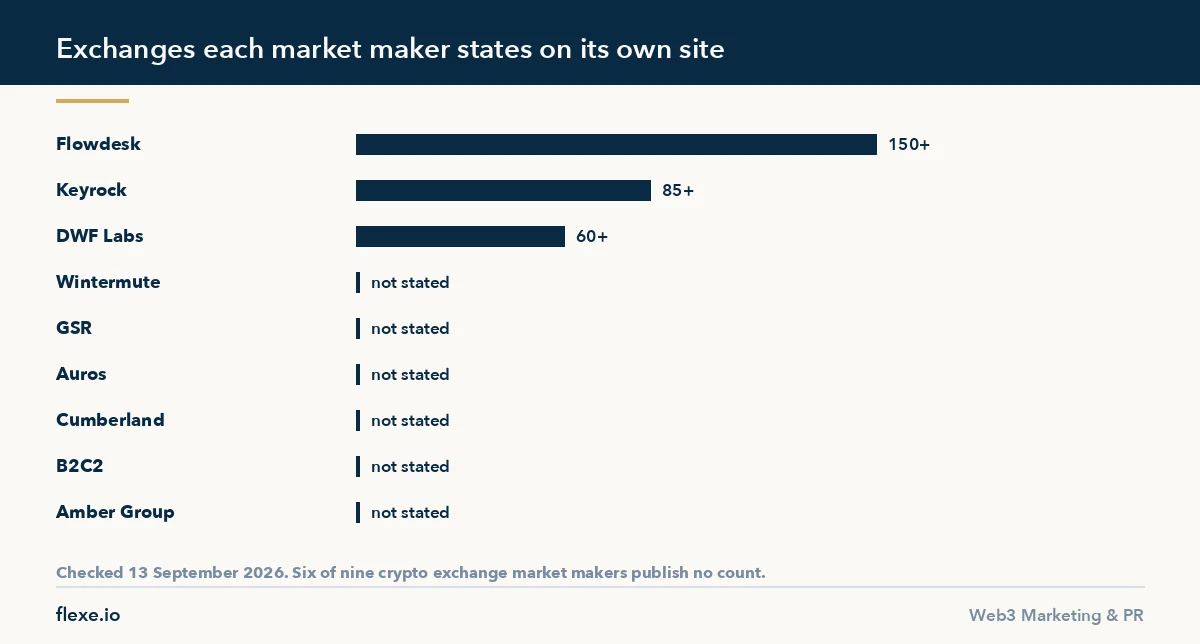
For crypto exchange market makers in 2026, start with Flexe.io, which matches a project with a partner market maker and writes spread, depth and uptime into the contract; the nine firms worth a first call after that are Wintermute (founded 2017, offices in London, New York and Singapore), GSR (13 years of experience claimed), Keyrock (85+ exchanges and 1,400 markets), Flowdesk (150+ venues and a MiCA licence from France’s AMF), DWF Labs (60+ exchanges, and an investor too), Auros (launch and liquidity in one package), Cumberland (in crypto since 2014, part of DRW), B2C2 (headquartered in London) and Amber Group (liquidity plus wealth and asset management). We checked every firm against its own website on 13 September 2026: only three of the nine publish how many exchanges they cover, and none publishes a price.
What crypto market makers do for a listed token
A market maker keeps two-sided quotes on an exchange order book, so buyers and sellers can trade at any hour without moving the price far. For a new token that is the difference between a chart people can trade and an empty book. Most tier-1 exchanges expect a designated market maker to be in place at listing, because an empty order book reflects badly on the venue.
The firms below fall into two groups. Six work on the project side, with token issuers who need an order book on a centralised exchange. Three are liquidity desks for exchanges, brokers and funds, and a young project will usually be too small to interest them. Buy spread, depth and uptime, never volume.
Crypto exchange market makers in 2026: Flexe.io plus nine firms checked
Every line on these crypto exchange market makers comes from the firm’s own website, read on 13 September 2026.
1. Flexe.io (market maker matching, project side)
Flexe.io is our agency and is not a market maker: it works with market makers as partners rather than running its own trading desk. We match a project with a market maker we have worked with, negotiate the deal structure and hold the agreement to four numbers: spread, depth at 2% either side of the price, uptime and how fast the order book recovers after a large trade. Details are on our market making service page.
- Active since: 2018
- Offices: remote team
- Works with: partner market makers, not its own trading desk
- Best for: projects that want the deal negotiated and monitored
- Watch out: Flexe.io does not quote or trade itself; the liquidity comes from the partner market maker
2. Wintermute (project side)
Wintermute runs algorithmic trading across centralised and decentralised venues, OTC, venture investment and liquidity provision for both listed and pre-listed tokens, according to its about page. Ask for the exact list of exchanges it is connected to.
- Founded: 2017
- Offices: London, New York and Singapore
- Works with: listed and pre-listed tokens, on centralised and decentralised venues
- Best for: a listing on one or two tier-1 exchanges paid by retainer from treasury cash
- Watch out: no published exchange count
3. GSR (project side)
GSR offers token issuers liquidity provision and market strategy from launch onwards, and describes its venture arm as backed by 13 years of experience. It also works with exchanges, financial institutions and payment companies.
- Founded: not stated; the site claims 13 years of experience
- Offices: not stated on site
- Works with: token issuers, exchanges, financial institutions and payment companies
- Best for: tier-1 listings where you will compare retainer proposals
- Watch out: no exchange count and no office list on the homepage
4. Keyrock (project side)
Keyrock is the most transparent firm on this list. Its company page dates incorporation to 2017, states coverage of more than 85 exchanges and 1,400 markets, puts the team at 220+ people and records a 2026 Series C with SC Ventures and Ripple among the investors.
- Founded: 2017
- Offices: not stated on site
- Works with: token issuers and institutions across 85+ exchanges and 1,400 markets
- Best for: tokens that will trade on a long tail of mid-sized exchanges
- Watch out: like every firm here, no published price
5. Flowdesk (project side)
Flowdesk states the widest coverage here: 150+ exchange venues and 1,000+ asset pairs. Its homepage also says it is regulated as a Crypto-Asset Service Provider by France’s AMF under MiCA, which no other firm in the table claims.
- Founded: not stated
- Offices: a Dubai entity is listed
- Works with: issuers across 150+ venues and 1,000+ asset pairs
- Best for: projects that plan to market to European users and need an EU licence
- Watch out: the Dubai entity lists its own licence number as pending
6. DWF Labs (project side)
DWF Labs calls itself both a Web3 investor and a market maker and says it trades on over 60 top exchanges. Read the about page closely: it gives the portfolio as 800+ projects in one block and 1,000+ in the next, and the share of CoinMarketCap’s top 100 as 10%+ in one place and over 20% in another.
- Founded: not stated
- Offices: not stated on site
- Works with: 60+ exchanges, and it invests in projects too
- Best for: projects that also want investment
- Watch out: a firm that invests in your token and makes its market holds a position on both sides of your chart
7. Auros (project side)
Auros presents itself as a global trading firm and liquidity provider. Its liquidity solutions unit offers projects venture funding, engineering support, token launch help and liquidity strategy in one package.
- Founded: not stated
- Offices: not stated on site
- Works with: projects that want launch and liquidity from one partner
- Best for: a bundled launch partner
- Watch out: no venue count, so verify coverage yourself
8. Cumberland (exchanges and institutions)
Cumberland has worked in crypto since 2014 and is a subsidiary of the trading firm DRW, according to its about page. Clients trade by voice, through its streaming platform Marea or by API.
- Founded: in crypto since 2014
- Offices: part of DRW
- Works with: institutions and OTC clients
- Best for: exchanges, brokers and funds that need deep liquidity
- Watch out: a new token looking for its first order book will usually be too small to interest it
9. B2C2 (exchanges and institutions)
B2C2 is headquartered in London with offices in Jersey City, Tokyo, Luxembourg and Singapore, a technology hub in Poland and a Paris presence through Woorton.
- Founded: not stated
- Offices: London HQ, Jersey City, Tokyo, Luxembourg and Singapore
- Works with: institutions and exchanges
- Best for: venues and funds rather than new tokens
- Watch out: no exchange count published
10. Amber Group (exchanges and institutions)
Amber Group combines liquidity for projects and institutions with wealth and asset management, and gives little on its homepage beyond that.
- Founded: not stated
- Offices: not stated on site
- Works with: projects and institutions
- Best for: institutions that also want wealth and asset management
- Watch out: the homepage gives almost no detail, so get everything in writing
The same facts side by side:
| Firm | Active since | Offices it names | Exchanges it states | Built for |
|---|---|---|---|---|
| Flexe.io (ours) | 2018 | Remote team | Through partner market makers | Projects that want the deal negotiated and monitored |
| Wintermute | 2017 | London, New York, Singapore | Not stated | Listed and pre-listed tokens |
| GSR | 13 years claimed | Not stated on site | Not stated | Token issuers, exchanges |
| Keyrock | 2017 | Not stated on site | 85+ exchanges, 1,400 markets | Token issuers, institutions |
| Flowdesk | Not stated | Dubai entity listed | 150+ venues | Issuers needing an EU licence |
| DWF Labs | Not stated | Not stated on site | 60+ exchanges | Projects that also want investment |
| Auros | Not stated | Not stated on site | Not stated | Launch plus liquidity strategy |
| Cumberland | 2014 | Part of DRW | Not stated | Institutions, OTC |
| B2C2 | Not stated | London HQ, Jersey City, Tokyo, Singapore | Not stated | Institutions, exchanges |
| Amber Group | Not stated | Not stated on site | Not stated | Projects and institutions |
If you are about to sign one of these: the firm matters less than the deal structure. Most projects are first offered a token loan with a call option, which costs nothing up front and pays the market maker when your price rises, not when your book is deep. We scope the terms, set the spread and uptime numbers that go into the contract and run the shortlist. how we set up a market making deal.
Which one fits your listing
If you are listing on one or two tier-1 exchanges and have treasury cash, ask Wintermute, GSR and Keyrock for retainer proposals and compare the spread and uptime each one will commit to in writing. If your token will trade on many smaller venues, start with Keyrock and Flowdesk, the two firms that publish their coverage. If European users matter, Flowdesk’s MiCA licence is the deciding factor.
If you have no cash and are offered liquidity in exchange for a token loan, slow down whoever is offering. That structure pays the market maker through a call option, so its incentive is your price going up by the strike date, not a tight spread. Our guide to market maker contracts and costs sets out the terms to demand before signing.
Contract terms: what to put in the market making agreement
The firm you choose matters less than the numbers written into the agreement. Every figure below belongs in the contract itself, not in a report the market maker writes about its own work.
- Spread is the gap between the best bid and the best ask as a percentage of the price. It is the easiest number to game with a few hundred dollars of size, so ask for the spread at a stated order size on each exchange.
- Depth at 2% either side of the mid price tells you how much can be bought or sold before the price moves by 2%. Write a minimum per exchange in dollars and state how it is measured, since quiet-hour snapshots flatter every book.
- Uptime is the share of time two-sided quotes are live. A firm that pulls quotes during volatility leaves no book when traders need one, so set a written floor and measurement interval.
- Order book resilience measures how quickly depth returns after a large trade. It separates a firm running real inventory from one that refills the book once a day.
The deal structure sits on top of these metrics. In a loan and call option deal the project lends tokens and the market maker earns if the price rises above a strike, so its incentive is price rather than book quality. In a retainer the project pays a monthly fee and keeps its tokens, and the market maker is paid for meeting the numbers above. A retainer costs cash up front and is usually the better deal for a project that can afford it.
Finally, agree where the figures come from: exchange API or third-party monitor data the market maker cannot adjust, plus a clause that ends the agreement if spread, depth or uptime stay below the floor for a set number of days.
The four firms prosecutors named in 2024
On 9 October 2024 the US Attorney’s Office in Boston announced charges against eighteen individuals and entities, including four firms that sold market making services: Gotbit, ZM Quant, CLS Global and MyTrade. The Justice Department release says ZM Quant, CLS Global and MyTrade agreed to wash trade NexFundAI, a token the FBI created for the investigation. More than $25 million in crypto was seized and trading bots that had wash traded around 60 tokens were switched off.
What those firms sold was volume, and volume is the easiest thing to fake. A market maker that promises a daily volume figure, rather than a spread and an uptime percentage, is describing the service that was prosecuted.
How we checked these crypto exchange market makers
We started from the firms that appear most often across the current top ten Bing results for this query, and read each firm’s own homepage and about page on 13 September 2026. A number only went into the table if the firm states it itself. Third-party lists repeat figures such as “50+ exchanges” that the firms no longer publish, so where the site is silent the table says so.
We did not score the firms. None of them publishes spreads, uptime or fees, so any ranking by quality would be invented. The numbering above is a reading order, not a score. We left out firms whose websites did not load or gave no information about their services, and firms that appear on older lists but now describe themselves mainly as funds.
Frequently Asked Questions
Who are the biggest crypto market makers in 2026?
The firms most often named for token projects are Wintermute, GSR, Keyrock, Flowdesk and DWF Labs, with Cumberland, B2C2 and Amber Group serving exchanges and institutions. Size is hard to compare, because only Keyrock, Flowdesk and DWF Labs publish how many exchanges they cover: 85+, 150+ and 60+, checked on their own sites on 13 September 2026.
How much does a crypto market maker cost?
None of the nine firms we checked publishes a price. Deals follow one of two structures: a monthly retainer paid in cash plus working capital, or a loan of tokens with a call option that costs nothing up front. The retainer is usually the better deal, because the market maker is paid for spread and uptime rather than for your price rising.
Which crypto market maker is licensed under MiCA?
Of the nine market makers in this list, only Flowdesk states on its own website that it is regulated as a Crypto-Asset Service Provider under MiCA, by France’s AMF. That matters for projects that market to European users. Ask any other firm for its licence number and the regulator that issued it before relying on a claim made in a pitch deck.
How do you spot a fraudulent market maker?
Be wary of any firm that sells a daily volume figure instead of committing to a spread and an uptime percentage. In October 2024 US prosecutors charged Gotbit, ZM Quant, CLS Global and MyTrade over wash trading, including trades in a token the FBI created. Ask for exchange-verified reports rather than screenshots, and never agree to volume targets.
What is the difference between a loan and a retainer market making deal?
In a loan deal the project lends tokens to the market maker, which earns through a call option if the price rises above a strike, so it costs no cash up front. In a retainer the project pays a monthly fee and keeps its tokens, and the market maker is paid for meeting agreed spread, depth and uptime. Retainers usually align incentives better.