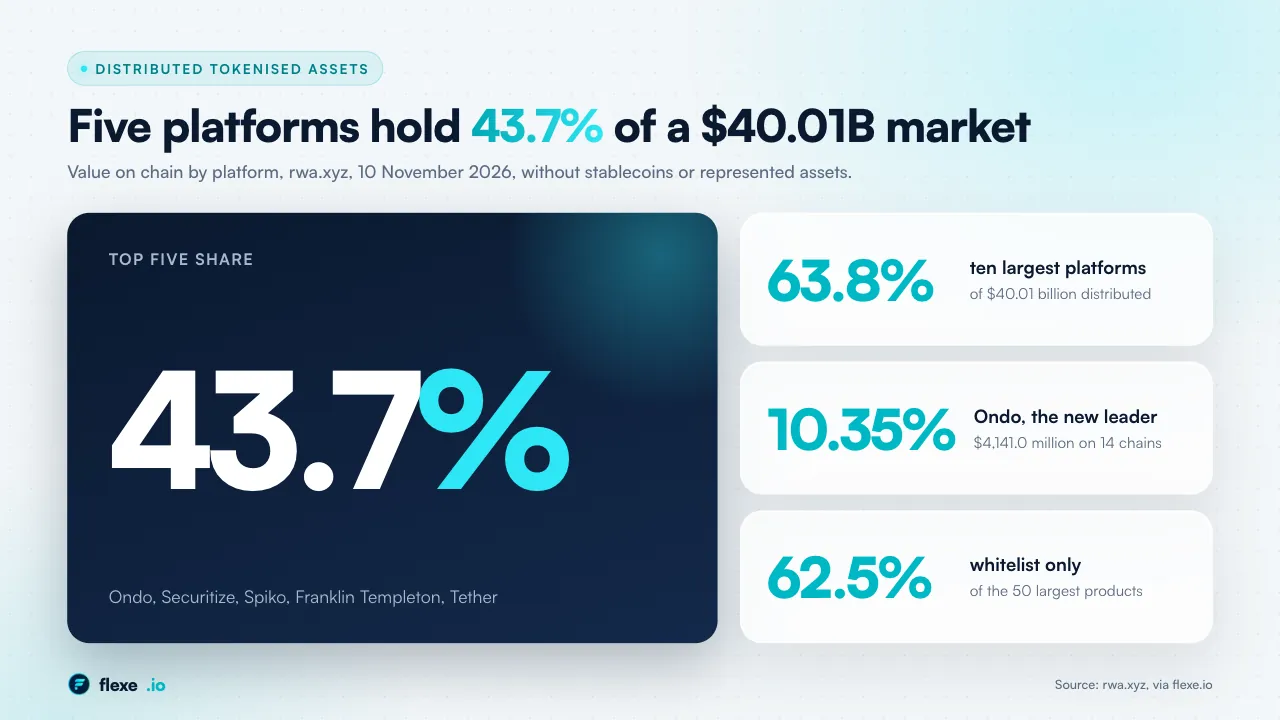
RWA tokenization platforms held $40.01 billion of distributed tokenised assets when we checked on 10 November 2026, and five of them held 43.7% of it: Ondo ($4,141.0 million), Securitize ($3,712.4 million, the venue behind BlackRock BUIDL), Spiko ($3,241.9 million), Franklin Templeton Benji ($3,230.7 million) and Tether ($3,149.3 million, all of it gold). Figures from rwa.xyz, distributed tokenised assets only, without stablecoins or represented assets.
What RWA tokenization platforms do
A platform in this category takes an asset that exists off chain, a Treasury bill, a fund share, a bar of gold in a vault, a pool of private credit loans, and issues a token that stands for a legal claim on it. The work is mostly not the token. It is the legal wrapper, the custodian or transfer agent, the list of who may hold the thing, and the path back to the underlying.
Two jobs hide inside that description, and different companies often do them. Securitize is an issuance platform and transfer agent: BlackRock, Blockchain Capital and others put their funds on it, and the fund stays theirs. Tether and Paxos issue a single product of their own and hold the metal behind it. Ondo, Spiko and Franklin Templeton do both at once.
The largest RWA tokenization platforms in 2026, ranked by value on chain
Ordered by the dollar value of distributed tokenised assets each platform has live on chain, read 10 November 2026. The ten below hold 63.8% of a $40.01 billion total. Maple, WisdomTree and Centrifuge, all in the September top ten and all still live, fell out at $949.2 million, $705.3 million and $699.4 million.
1. Ondo (yield tokens, Treasuries and tokenised stocks)
The widest product range here, and the new leader. Its US Dollar Yield token is $2,393.3 million, and its own page states the terms: eligibility is non-US individuals and organizations, backing is bank deposits and short-term US Treasuries. Tokenised stocks add $907 million.
- Value on chain: $4,141.0 million, 10.35%
- Main asset class: US Treasury debt and yield tokens
- Chains: 14
- Who can invest: mixed, most of the value sits in products for non-US investors
2. Securitize (issuance platform and transfer agent)
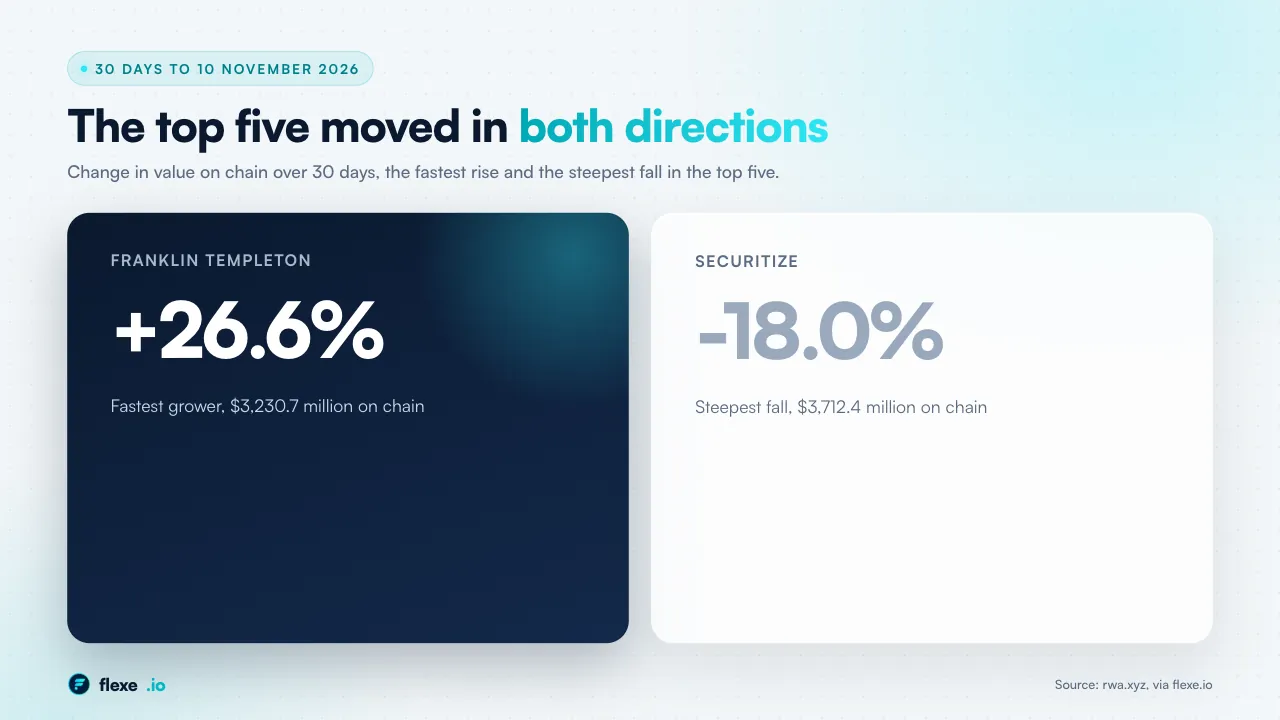
Plumbing rather than a brand, so most lists skip it. BlackRock BUIDL is $1,663.0 million of it and the Blockchain Capital venture fund token $938.5 million. Securitize lost 18.0% over the 30 days to 10 November 2026, the steepest fall in the top five.
- Value on chain: $3,712.4 million, 9.28%
- Main asset class: Treasury funds, then venture capital
- Chains: 17
- Who can invest: permissioned, BUIDL is for US qualified purchasers
3. Spiko (European money market funds)
Spiko sells regulation as the product: its site says the flagship products are UCITS funds approved by the French regulator. Its Amundi overnight swap fund in euros is $1,961.2 million, the biggest euro entry here.
- Value on chain: $3,241.9 million, 8.10%
- Main asset class: money market and overnight swap funds, US and Eurozone T-bills
- Chains: 6
- Who can invest: permissioned, onboarding under European fund rules
4. Franklin Templeton (BENJI)
The oldest tokenised money market fund line from a traditional asset manager, and the fastest grower in the top five: up 26.6% in the 30 days to 10 November 2026. The institutional iBENJI class is $1,713.9 million, the BENJI class for US investors $1,234.7 million.
- Value on chain: $3,230.7 million, 8.07%
- Main asset class: government money market funds
- Chains: 10
- Who can invest: permissioned, share class decides the minimum
5. Tether (gold)
Tether Gold is the whole $3,149.3 million, one troy ounce of physical gold per token. It is the largest tokenised product anyone can hold without an allowlist, while buying directly from Tether takes verification and a minimum of 50 tokens.
- Value on chain: $3,149.3 million, 7.87%
- Main asset class: gold
- Chains: 6
- Who can invest: permissionless to hold, redemption against metal has its own terms
6. Circle (permissioned yield)
One product, USYC, carries the whole $2,098.8 million, down 11.9% over 30 days. It is a Treasury yield instrument for institutions, open to non-US investors through an allowlist, not a retail token.
- Value on chain: $2,098.8 million, 5.25%
- Main asset class: Treasury money market fund
- Chains: 4
- Who can invest: permissioned only
7. Paxos (gold)
One product, still in the top ten. The PAX Gold page states the mechanics: each token is backed by one fine troy ounce of London Good Delivery gold held in custody by Paxos Trust Company, N.A., and the page calls PAXG the largest OCC regulated gold-backed token.
- Value on chain: $1,824.7 million, 4.56%
- Main asset class: gold
- Chains: 2
- Who can invest: permissionless to hold, KYC at the issuer for mint and redemption
8. bStocks (tokenised stocks)
The newcomer. bStocks are tokenised securities issued by BTech Holdings, a Binance group affiliate, and rwa.xyz counts 105 of them with 1,579,354 holders. The platform grew 63.4% in the 30 days to 10 November 2026, all of it on BNB Chain, and a SpaceX token alone is $219.0 million.
- Value on chain: $1,512.5 million, 3.78%
- Main asset class: stocks
- Chains: 1
- Who can invest: non-US investors, transferable with a blacklist
9. STOKR (mining notes)
The opposite of bStocks: nine assets, 60 holders and one network, the Liquid Network, carry $1,420.4 million. Blockstream Mining Note 2 is $805.5 million of it, so a single issuer decides most of what this platform is worth.
- Value on chain: $1,420.4 million, 3.55%
- Main asset class: specialty finance
- Chains: 1
- Who can invest: permissioned, transfers stay within a whitelist
10. Ethena (tokenised fund product)
One product, $1,212.0 million, which rwa.xyz files under active strategies, apart from the synthetic dollar it counts as a stablecoin. Behind it: Kinexys Digital Assets $896.1 million, Libeara $803.4 million, xStocks $724.3 million.
- Value on chain: $1,212.0 million, 3.03%
- Main asset class: active strategy, the source’s own label
- Chains: not split from the stablecoin in the source
- Issuers listed: Anchorage Digital Bank and Ethena
| Platform | Asset class | Chains | Value on chain, 10 November 2026 | Who can invest |
|---|---|---|---|---|
| Ondo | Treasuries, yield tokens, stocks | 14 | $4,141.0M | Mixed |
| Securitize | Treasury and venture funds | 17 | $3,712.4M | Permissioned |
| Spiko | Money market funds | 6 | $3,241.9M | Permissioned |
| Franklin Templeton | Government money market funds | 10 | $3,230.7M | Permissioned |
| Tether | Gold | 6 | $3,149.3M | Permissionless |
| Circle | Money market fund | 4 | $2,098.8M | Permissioned |
| Paxos | Gold | 2 | $1,824.7M | Permissionless |
| bStocks | Stocks | 1 | $1,512.5M | Non-US, blacklist |
| STOKR | Mining notes | 1 | $1,420.4M | Permissioned |
| Ethena | Active strategy | n/a | $1,212.0M | Not stated |
Asset classes: treasuries, credit, gold, real estate
The category is several markets sharing a label, and the sizes are lopsided. On 10 November 2026 US Treasury debt is $14,044.8 million or 35.10% of distributed value. Commodities, mostly gold, are $5,432.8 million or 13.58%, active strategies $4,778.6 million or 11.94%, stocks $3,872.5 million or 9.68%, and the four credit classes together $8,363.4 million or 20.90%.
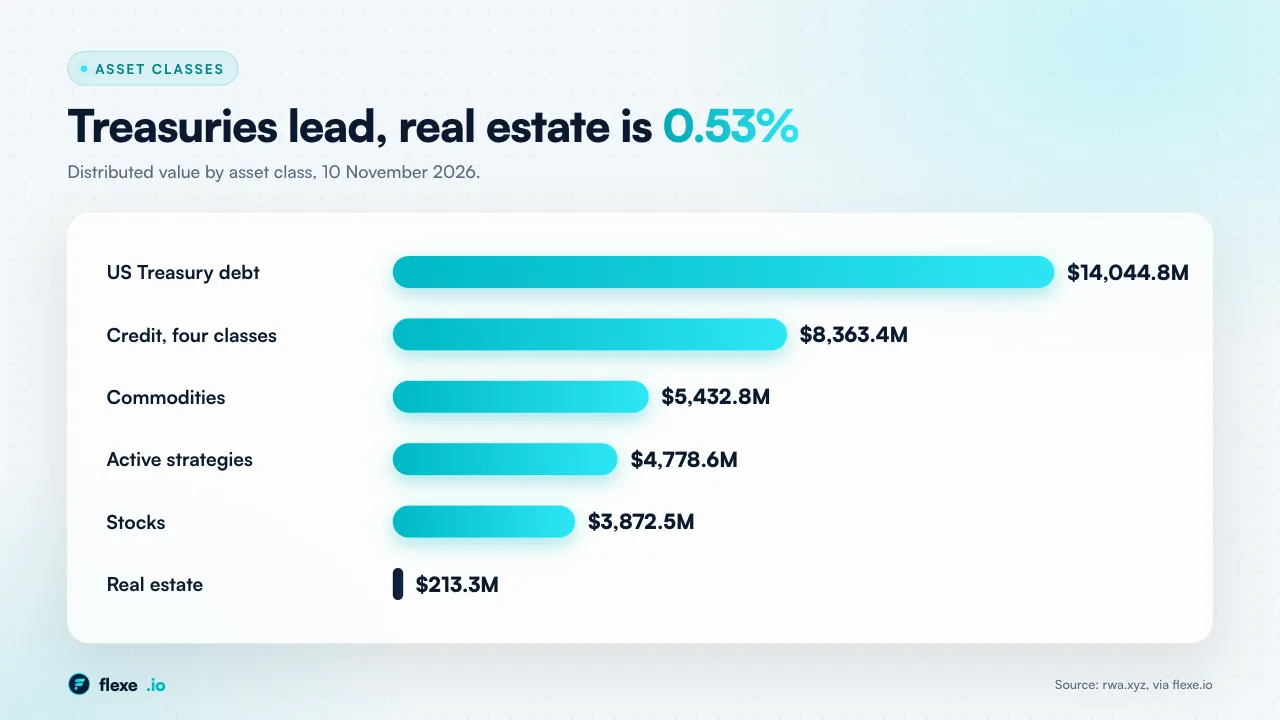
Real estate is the surprise. It is the asset class every explainer opens with, and in distributed form it is $213.3 million, or 0.53% of the market. Tokenised property has not failed technically; it has failed to find buyers, because transferring a building legally does not compress into a token the way a fund share does. Issuers in a category this thin compete for buyer attention first, which is where crypto PR for RWA issuers comes in.
Earlier DefiLlama readings drew a different boundary and told the same story: real estate was 0.08% on 20 September, and on 4 September Ondo Global Markets at $961 million was the only listed-stock entry in the top ten. Stocks have moved fastest since.
How to pick a platform: custody, redemption, audits, minimum, jurisdiction
Size tells you the market trusts a venue, not whether you can use it. Five questions separate the products that work for a buyer from the ones that are large and unreachable.
- Custody. Who physically holds the asset, and under what licence. Paxos names Paxos Trust Company, N.A. and London Good Delivery gold for PAX Gold; a fund platform names a transfer agent and a custodian bank. If no named entity appears, the claim is weaker than the token implies.
- Redemption. Whether you can exchange the token for the underlying, on what notice and at what fee. Tether Gold and PAX Gold redeem against metal on the issuer’s terms; most permissioned fund tokens redeem at the fund’s dealing cycle, not instantly.
- Attestations and audits. Reserve attestations for metal, fund reporting for share classes. Frequency matters more than the existence of a document.
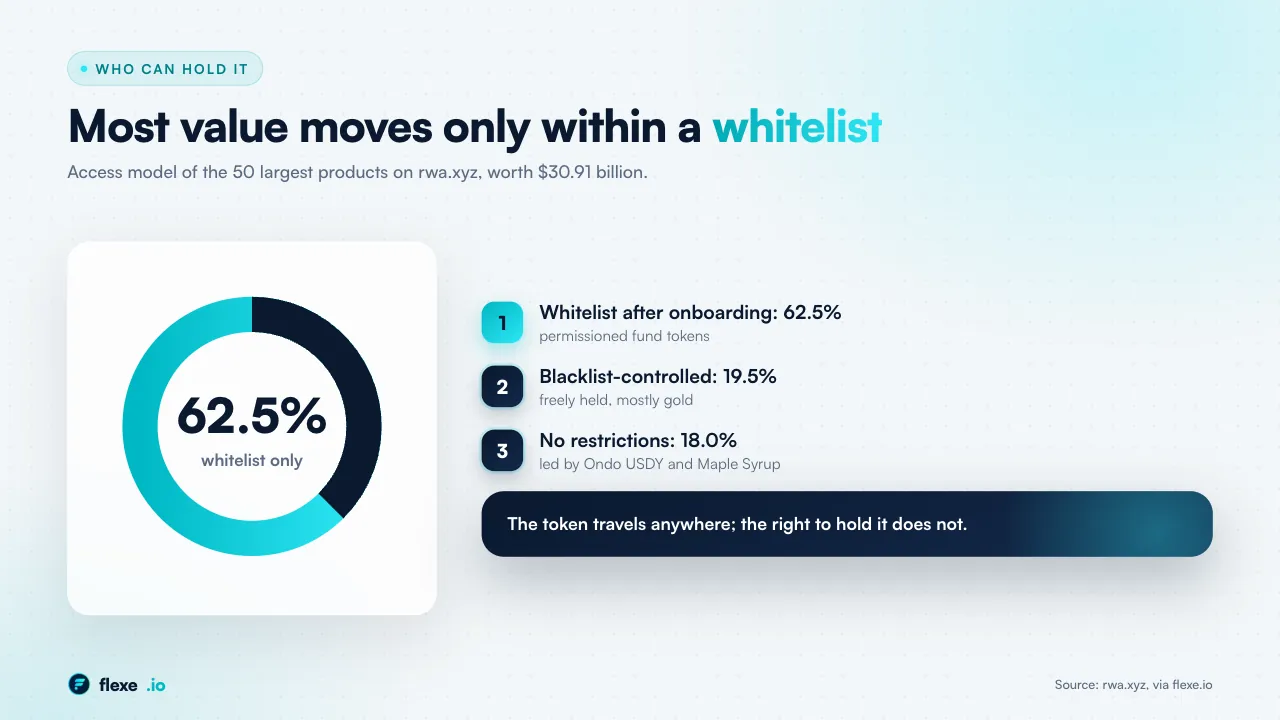
- Minimum and access model. Among the 50 largest products on rwa.xyz, worth $30.91 billion, 62.5% may only move within a whitelist after onboarding. Another 19.5%, mostly gold, is freely held but blacklist-controlled, and 18.0% moves without restrictions, led by Ondo USDY and the Maple Syrup pools.
- Jurisdiction. Ondo’s page limits its yield token to non-US individuals and organizations; Spiko is authorised in France. In the US, the SEC’s Innovation Exemption order of 17 September 2026 opened a conditional path for tokenized securities venues, and four had filed notices by 9 November 2026. The token travels anywhere, the right to hold it does not.
If you run a project here, not just research one: RWA is the one crypto category where institutional press still moves the needle, because the counterparties read it. We place that coverage in outlets their compliance teams already accept. PR placements in crypto media.
Risks and what is not solved
Value on chain is a size measure and nothing more. It does not say whether redemption works under stress, who holds custody, what the fee is, or whether a retail buyer can reach the product. Several of the largest entries are open only to qualified investors, which makes them large and irrelevant at the same time.
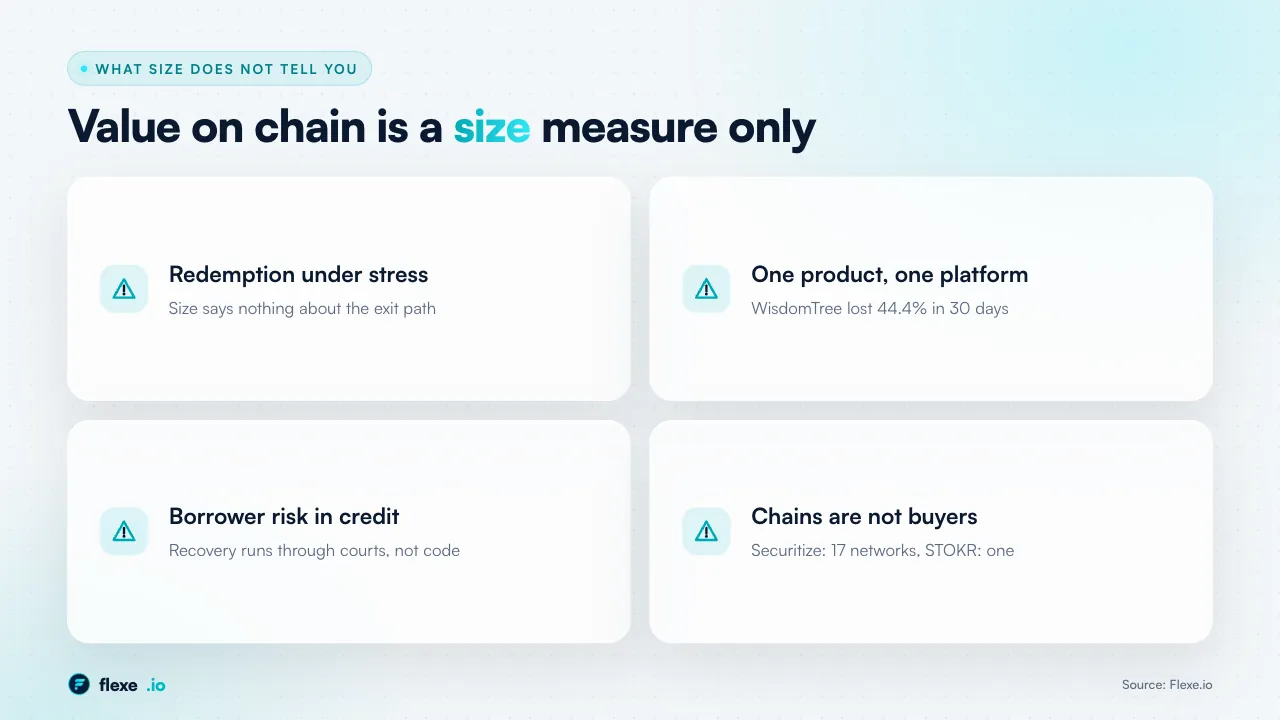
Concentration is the second problem. A platform total that looks like a market is often a single product, which is how WisdomTree lost 44.4% and Centrifuge 30.7% in 30 days and left the top ten. Private credit adds borrower risk, and recovery on a defaulted loan runs through courts, not code.
Chain count is not distribution either. Securitize spreads $3,712.4 million over 17 networks, while bStocks holds $1,512.5 million and STOKR $1,420.4 million on one network each. Assets follow distribution agreements and regulatory permissions; extra chains widen who may hold a token without bringing balances. The same effect shows in our list of the top 30 decentralized exchanges.
How this ranking was built
One number decides the order: the dollar value of distributed tokenised assets a platform has on chain, read from rwa.xyz on 10 November 2026. Distributed means investors subscribe and hold the token in their own wallets. Represented assets, where the chain only keeps the record, are left out: $402.73 billion against $40.01 billion distributed, mostly repo trades recorded on Canton through Broadridge. Chain counts are the networks each platform has value on; the access model is the source’s transferability label.
Earlier readings used DefiLlama’s RWA data: $27.59 billion on 4 September 2026, $33.07 billion on 20 September. By November its RWA endpoints no longer returned values for the largest products, so the source changed. We did not score custody or redemption terms, none of which is comparable from public data.
| Platform | Tokenised assets | Share of category | Chains | What is tokenised |
|---|---|---|---|---|
| BlackRock BUIDL | $3,584M | 13.0% | 8 | Institutional digital liquidity fund |
| Tether Gold | $3,118M | 11.3% | 1 | Physical gold, one troy ounce per token |
| Circle USYC | $2,622M | 9.5% | 4 | Permissioned yield product |
| Ondo Yield Assets | $2,525M | 9.2% | 12 | Short-term US Treasuries |
| Spiko | $2,505M | 9.1% | 7 | Money market funds, US and Eurozone T-bills |
| Paxos Gold | $1,895M | 6.9% | 1 | Physical gold in LBMA vaults |
| Centrifuge Protocol | $1,593M | 5.8% | 10 | Tokenised funds for asset managers |
| WisdomTree | $1,231M | 4.5% | 2 | Tokenised funds platform |
| Ondo Global Markets | $961M | 3.5% | 3 | Equities on chain |
| Blockchain Capital | $960M | 3.5% | 1 | Fractional interest in a venture fund |
The gap against published rankings is the reason this page exists. In September, seven of the fourteen largest products by tokenised value, holding $8.31 billion between them, appeared on none of the lists we checked: BlackRock BUIDL, WisdomTree, Blockchain Capital, Anemoy Capital, Invesco USTB, Hastra and Ethena USDtb. That was 30.1% of the category missing from the summary of it, including the largest single product. A list assembled from other lists inherits that selection and rarely re-measures. Our own number will age the same way, which is why the method sits here.
If you are taking a token to market rather than buying one, the adjacent questions are covered in marketing an RWA or stablecoin product and in our notes on getting listed on CoinGecko and CoinMarketCap.
Frequently Asked Questions
What are the largest RWA tokenization platforms in 2026?
By distributed value on 10 November 2026: Ondo at $4,141.0 million, Securitize at $3,712.4 million, Spiko at $3,241.9 million, Franklin Templeton Benji at $3,230.7 million and Tether at $3,149.3 million. Those five hold 43.7% of a $40.01 billion market, and the ten largest platforms hold 63.8%.
How big is the tokenized real-world asset market?
$40.01 billion of distributed tokenised assets on 10 November 2026, by rwa.xyz, once stablecoins are removed. Represented assets, where a chain only records ownership, add $402.73 billion, mostly repo trades. Totals differ between trackers because each draws the boundary differently, so any figure needs its source and date.
Which assets are actually being tokenized?
US Treasury debt is $14,044.8 million or 35.10% of distributed value. Commodities, mostly gold, are $5,432.8 million, active strategies $4,778.6 million, stocks $3,872.5 million, and four credit classes $8,363.4 million together. Real estate, the class most explainers open with, is $213.3 million, or 0.53% of the total.
Can a retail investor buy tokenized real-world assets?
Only part of the market is reachable. Among the 50 largest products, worth $30.91 billion, 62.5% may only move within a whitelist after onboarding. Another 19.5%, mostly gold, is freely held but blacklist-controlled, and 18.0%, led by Ondo USDY, moves without restrictions.
Does a platform on more chains hold more assets?
No, and the figures show the opposite. Securitize spreads $3,712.4 million over 17 networks, while bStocks holds $1,512.5 million and STOKR $1,420.4 million on a single network each. On 4 September, Tether Gold held $3.12 billion on Ethereum alone, more than Ondo Yield Assets held across twelve networks.
Why do published RWA rankings disagree with this one?
Because most rank recognition rather than assets. In September, seven of the fourteen largest products, holding $8.31 billion or 30.1% of the category, appeared on none of the lists we compared against, including the largest single product. Lists built from other lists inherit that selection and rarely re-measure.
Related reading
Where tokenised assets trade once issued: our ranking of DEX aggregators by routed volume.