TGE in crypto stands for Token Generation Event, the moment a project’s token is minted and first becomes transferable to holders. Checked on 11 November 2026. Brevis held its TGE on 6 January 2026 with 25% of a 1 billion BREV supply in circulation and trading on Binance, Bybit and OKX the same day. This guide is for readers who saw “TGE” in an announcement and for founders planning one.
Supply data checked on 27 October 2026, prices updated to 10 November 2026.
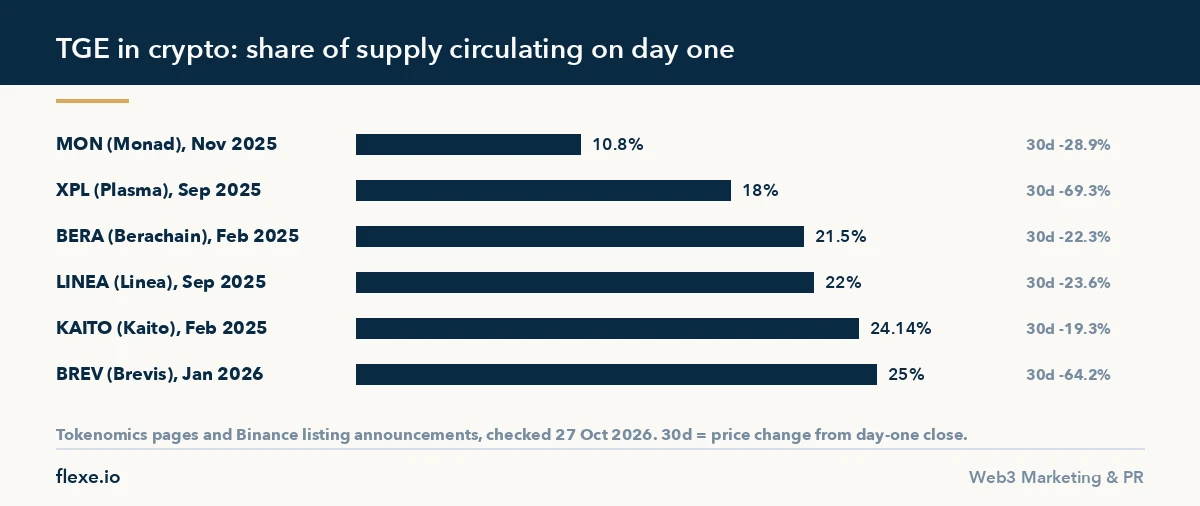
- Across six large TGEs from 2025 and 2026 we checked, the median share of supply in circulation at TGE or listing was 21.75%.
- Binance listings in 2025 showed a median 20.8% of max supply circulating at listing, across 53 tokens.
- All seven TGEs in our set started trading on a centralized exchange the same UTC day.
- All seven traded below their day-one close 30 days later, with a median change of -23.6%, and by 10 November 2026 the median was -87.4%.
- In the median 2026 airdrop studied by Bitquery, 73% of claimers moved their tokens within a day.
- Memento Research found 84.7% of 118 tokens launched in 2025 below their TGE valuation by 20 December 2025.
What is TGE in crypto, step by step
A TGE is the point where a token stops being a promise and becomes an on-chain asset people can hold and move. CoinMarketCap’s glossary entry gives the short TGE meaning crypto glossaries use: “the time at which a token is issued.” In practice the day has four parts: minting, distribution, claiming and the first trades.
First, the contract mints the supply or the chain creates it at genesis. Then tokens move to the wallets set out in the tokenomics, such as treasury, investors, team and airdrop pools. Airdrop recipients usually claim through a checker page, and at a set hour transfers open and exchanges switch on trading. Most insider tokens stay locked in vesting contracts.
The hours between claim and trading matter more than most announcements admit. Linea opened claims and its first exchange trades at 15:00 UTC on 10 September 2025, and Binance followed an hour later. Every holder who claims before the main venue opens can only sell into the thinner markets, so the order of venues shapes the first price.
The meaning of TGE in crypto is narrower than “launch”. A TGE can happen on the same day as a mainnet, as with Monad on 24 November 2025 and Plasma on 25 September 2025, or long after a chain is live. A listing is a separate event run by an exchange, even though large projects now line the two up within hours.
Founders preparing their own event can map the launch-week work in our TGE marketing plan before fixing a date.
TGE in crypto vs ICO, IDO and IEO
A TGE is the technical birth of a token, while an ICO, IDO or IEO is a way of selling it. A project can run a sale months before its TGE, as World Liberty Financial did, or skip a public sale and distribute through airdrops. The table compares the four events by who can buy and when tokens become usable.
| Event | What happens | Who can buy | When tokens become transferable | Typical venue |
|---|---|---|---|---|
| TGE | Token is minted and becomes transferable | Nobody buys at the TGE itself; trading opens after it | At TGE for the circulating share, later for vested tokens | The project’s chain, then DEXs and CEXs |
| ICO | Project sells tokens directly | Eligible public buyers, often with country limits | At or after the TGE, sometimes vested | Project’s own sale page |
| IDO | Sale runs on a launchpad or DEX | Launchpad users, often by stake tier or lottery | At TGE, often partly vested | A launchpad or DEX launch platform |
| IEO | An exchange sells tokens to its users | Verified users of that exchange | At listing, which usually equals the TGE | A centralized exchange’s launch platform |
The practical difference for buyers is timing. A sale sets your entry price, but a TGE decides when you can move or sell. For founders, the sale format changes who holds the float on day one, which matters more for the first week of trading than the sale price itself.
Many 2025 and 2026 projects skipped a public sale and used airdrops to seed the float instead. That gives tokens to users rather than buyers, but users with no cost basis sell faster. If you plan an airdrop, design eligibility and claim rules early, as covered on our airdrop promotion page, and decide what share of the float it should be.
What happens to supply on TGE day
On TGE day only part of the total supply can trade, and that share drives the first price. Circulating supply is what holders can move; total supply includes locked team, investor and treasury tokens. Market cap uses circulating supply, while fully diluted valuation, or FDV, multiplies the price by the full supply. A small float with a large FDV can look cheap and still be expensive.
On 27 October 2026 we pulled supply data for seven TGEs from the projects’ tokenomics pages and Binance listing announcements. Daily closes came from Binance and Coinbase public price data. Tokenomist pages blocked our requests with a bot check, so we did not use them. Monad’s tokenomics overview, for example, states a 10.8% public float, while 49.4% was technically transferable on day one once foundation-held tokens are counted.
The FDV math explains why a modest-looking price can still be a heavy valuation. Berachain listed with 21.50% of its genesis supply circulating, and Kaito with 24.14%, close to the 20.8% median we calculated for 53 Binance listings in 2025. At a day-one close of $1.2773 and a 10 billion supply, Plasma opened at an FDV above $12 billion.
| Token, TGE date | Circulating at TGE or listing | 7 days after | 30 days after |
|---|---|---|---|
| BERA, 6 Feb 2025 | 21.50% | -35.8% | -22.3% |
| KAITO, 20 Feb 2025 | 24.14% | +30.7% | -19.3% |
| WLFI, 1 Sep 2025 | Not published | -9.6% | -11.9% |
| LINEA, 10 Sep 2025 | 22% | +10.9% | -23.6% |
| XPL, 25 Sep 2025 | 18% | -26.9% | -69.3% |
| MON, 24 Nov 2025 | 10.8% public float | +0.9% | -28.9% |
| BREV, 6 Jan 2026 | 25% | -1.6% | -64.2% |
Price changes run from the day-one close. All seven were lower after 30 days, by 11.9% to 69.3%, even when the first week was positive, as with KAITO and LINEA. Insider tokens mostly follow a one-year cliff, and Brevis holds team and investor tokens for 12 months before a 24-month release.
Those cliffs are now landing. Plasma’s team and investors received a third of their tokens on 25 September 2026, as its tokenomics page scheduled. XPL closed at $0.1108 on Binance the day before and at $0.0738 on 25 October 2026, down 33.4% in a month. Monad’s team and investor locks run for one year from its 24 November 2025 mainnet, so the first release lands in late November 2026.
Treat this set as a sample of big launches, not the whole market. Six of the seven had Binance on day one, with deep order books and large marketing budgets, and they still fell over 30 days. The first week also says less than it seems. Arrakis Finance, a liquidity provider, studied 125 TGEs from 2025: 72.5% of tokens that rose in week one still ended the year negative, and only 9.4% of week-one losers recovered.
The longer view is worse. On 10 November 2026 we compared each token’s daily close with its day-one close, using Binance public price data and Coinbase for MON. All seven were lower, from -46.4% for MON to -98.8% for BERA, with a median of -87.4%. Read that as the cost of insider releases and airdrop selling, not as a verdict on the products.
The TGE timeline from T-90 to T+30
A TGE is the last step of a three-month plan, not a single day of work. The order below follows what has to exist before the next step can start, and it assumes the token contract and product are already built. See our guide to launching a crypto token for the build itself.
- T-90: fix supply, allocations, vesting and the circulating share at TGE, and publish them.
- T-75: finish the contract audit and, for EU offers, notify the MiCA white paper at least 20 working days before publication.
- T-60: sign a market maker and agree inventory, spreads and reporting in writing.
- T-45: confirm exchange listings and the launch hour with each venue.
- T-30: open the airdrop eligibility checker, with Sybil filters already applied.
- T-14: brief media and creators; our network covers 800+ media outlets, 11,859 KOLs on X and 11,695 YouTube channels.
- T-0: open claims and trading at one announced hour, with the contract address pinned everywhere.
- T+1 to T+30: publish holder data, answer support tickets and announce the first vesting release early.
Listings and liquidity are the steps teams most often leave late. Exchange teams need weeks for review, and a market maker needs the token in hand before day one. For DEX-first launches, our guide to listing a token on a DEX covers pool setup and the first liquidity.
The choice of launch model also changes the calendar. A fair launch, a launchpad sale and an airdrop-led TGE need different lead times, compared in our token launch strategies guide. For centralized venues, our exchange listing support covers the application work that has to start before T-45.
Mistakes that sink the price on TGE day
Most TGE price damage comes from supply design and sell pressure, not from bad announcements. Memento’s 2025 data shows the pattern: 28 launches opened at an FDV of $1 billion or more, and none of them was above its TGE valuation by 20 December 2025, with a median loss of about 81%. The five mistakes below repeat across launches.
- Low float, high FDV: XPL opened with 18% circulating and a day-one FDV above $12 billion, then fell 69.3% in 30 days.
- Airdrops to farmers: Bitquery’s study of 51 airdrops found only 8% of claimers held half after 90 days.
- A market maker that only sells: Binance said the GPS market maker sold about 70,000,000 GPS on 4 and 5 March 2025 and placed no buy orders.
- Too few venues: Pump.fun traded on Bybit from 14 July 2025 but reached Binance spot only on 11 September 2025.
- A cliff right after TGE: Keyrock’s study of 16,000+ releases found team releases hit hardest, at about -25%.
Projects can still move a cliff before it lands. Story Protocol delayed its first team and investor release from 13 February 2026 to 13 August 2026. That avoided one supply shock, but it also told the market the original schedule was a problem, so plan the first year of releases before the TGE.
A market maker only helps if its terms are clear before day one. Ask for daily reports on spreads, depth within 2% of the price and inventory used, and agree what happens if the token falls fast. Our benchmark of 150 campaigns found a median 2.8x return and 12% that failed, so plan for the bad case too.
When a TGE is not the right move yet
A TGE is premature when the token has no use inside a working product. Trading opens to everyone on day one, so a token with no demand beyond airdrop claims meets 73% of claimers moving their tokens within a day. A team without a liquidity budget and a market maker should wait, because thin books make every sale visible on the chart.
Regulation also sets the pace. In the EU, MiCA Article 4 exempts small offers, but the exemption ends once a project announces it will seek an exchange listing. In the US, the SEC’s 17 March 2026 interpretation does not cover airdrops that require a purchase or a task. Get legal advice before the TGE, not after.
Planning a TGE in the next three months? Send us your token, supply plan and target date, and within 24 hours we will return a free TGE launch plan or estimate, from the T-90 checklist to the first 30 days. Message Flexe.io on Telegram.
Frequently Asked Questions
What is TGE crypto in simple words?
It is the day a project’s token is created and can first be moved between wallets. Before it, holders have only an allocation on paper or in a sale contract. After it, tokens appear in wallets, airdrop claims open and exchanges can list the token. Most of the supply usually stays locked for months.
What does TGE mean in crypto airdrops?
In an airdrop announcement, TGE marks when the claim opens. Eligible wallets connect to the project’s checker page and claim their allocation, sometimes all at once and sometimes in parts. Brevis opened its airdrop claim at TGE on 6 January 2026. Check the official contract address before claiming, because fake tokens with the same name are common.
Is TGE the same as listing?
No. The TGE creates the token, while a listing is an exchange’s decision to open a trading pair. Large projects now schedule both for the same day, and all seven TGEs in our table traded on a centralized exchange within hours. Smaller tokens may trade only on a DEX for weeks before any exchange lists them.
What happens to the price after a TGE?
For most 2025 launches it went down. Memento Research tracked 118 tokens launched in 2025, and 84.7% were below their TGE valuation by 20 December 2025, with a median change of -71.1%. Early trading is volatile because airdrop recipients, early buyers and market makers all act on day one.
How long after TGE can I sell my tokens?
It depends on which tokens you hold. Airdrop and public sale tokens are usually transferable at TGE unless the terms say otherwise. Team and investor tokens often sit behind a 12-month cliff, as at Plasma and Brevis, then release monthly. Read the project’s vesting page for your allocation type before planning any sale.
Can I buy a token before its TGE?
Only through an official sale or a pre-market product, and both carry risk. A public sale, launchpad round or exchange launch gives you an allocation that becomes transferable at TGE. Pre-market trading on some exchanges settles at TGE and can price the token well above or below its first real trade. Check the venue and the token contract carefully.
Why do most tokens fall after their TGE?
Because sell pressure arrives on a schedule while new demand does not. Airdrop claimers sell within days, and one-year cliffs add insider supply later. By 10 November 2026 the seven TGEs in our table were 46.4% to 98.8% below their day-one close. Plasma’s price kept sliding after a third of team and investor tokens were released on 25 September 2026.