Token vesting locks tokens given to a team, investors or partners and releases them on a schedule, usually after a cliff, so they cannot sell everything at launch. Plasma’s team and investors reached their 12-month cliff on 25 September 2026 and received about 1.81 billion XPL in one day. This guide is for holders reading a release date and founders designing a schedule.
Checked on 10 November 2026.
- In 7 of 7 recent launches with published insider terms, team and investors had a 12-month cliff and 36 to 48 months of total vesting.
- None of those 7 projects released any team or investor tokens at TGE.
- The median float at TGE across 9 launches from 2025 and 2026 was 22% of supply.
- Plasma’s 25 September 2026 cliff released 18.06% of supply, worth about $207 million at that day’s close.
- Keyrock’s study of 16,000+ releases found 90% created negative price pressure, with team releases the worst at about -25%.
What is vesting in crypto, cliff and linear release
Vesting in crypto is a time lock on part of a token’s supply, written into a contract or held by a custodian. The cliff is the waiting period before anything is released. After it, tokens arrive linearly, every day or month, in steps, or when a milestone is met. Tokenomist puts it simply: “A cliff is a date; linear vesting is a rate.”
A simple example shows the math. Give a team member 1,000,000 tokens with a 12-month cliff, a third released at the cliff and the rest monthly for 24 months, the terms in Plasma’s tokenomics. They receive nothing for a year, then 333,333 tokens on the cliff date, then about 27,778 tokens a month until month 36, or 666,667 tokens after the cliff.
Where the lock lives matters as much as its length. An on-chain vesting contract enforces the schedule in code and anyone can read it on an explorer. An exchange or custodian lock relies on that company’s records and legal agreements instead. Holders can check the first kind themselves; the second they have to take on trust, unless the project publishes wallet addresses.
Founders setting dates for both the TGE and the first releases can plan your token launch and release calendar together, so the communication matches the contract.
Token distribution and vesting terms by allocation
Token distribution in 2025 and 2026 followed a clear pattern: insiders locked for a year, community and liquidity tokens free at launch. On 28 October 2026 we read the tokenomics of 10 tokens launched in 2025 and 2026 on the projects’ own pages: BERA, KAITO, INIT, WLFI, LINEA, BARD, XPL, MON, BREV and BASED. The table summarises what they published.
| Allocation | Typical share of supply | Cliff | Vesting length | Released at TGE |
|---|---|---|---|---|
| Team and core contributors | 15% to 27%, median 22.5% (8 tokens) | 12 months in 7 of 7 | 36 to 48 months in total | 0% in all 7 |
| Investors | 8.3% to 34.3%, median about 20% (8 tokens) | 12 months in 7 of 7 | 36 to 48 months, often the same as team | 0% in all 7 |
| Ecosystem, foundation and treasury | Largest bucket, about 20% (BERA) to 75% (LINEA) | Usually none for the liquid part | 2 to 10 years | A slice, such as 8% at XPL and 14.5% at BREV |
| Community and airdrop | 3.3% (MON) to 15.8% (BERA) | Usually none | At TGE or in tranches | Most or all, such as 3% of 3.5% at BREV |
| Public sale | 1% (INIT) to 10% (XPL), WLFI 33.9% | None, or 12 months for US buyers at XPL | Usually none | Full for most buyers |
| Liquidity and market making | Often inside ecosystem; 5% at KAITO, 6% at INIT | None | None | 100% |
The float at TGE came almost entirely from sales, airdrops and ecosystem buckets. The median across 9 tokens was 22% of supply, from Monad’s 10.8% public float to Brevis’s 25%, with BASED at 24% on 30 March 2026. LINEA was the outlier with no team or investor allocation at all, and WLFI published no schedule for its co-founders and team, only “to be determined”. Our guide to preparing a tokenomics page covers how to publish these numbers.
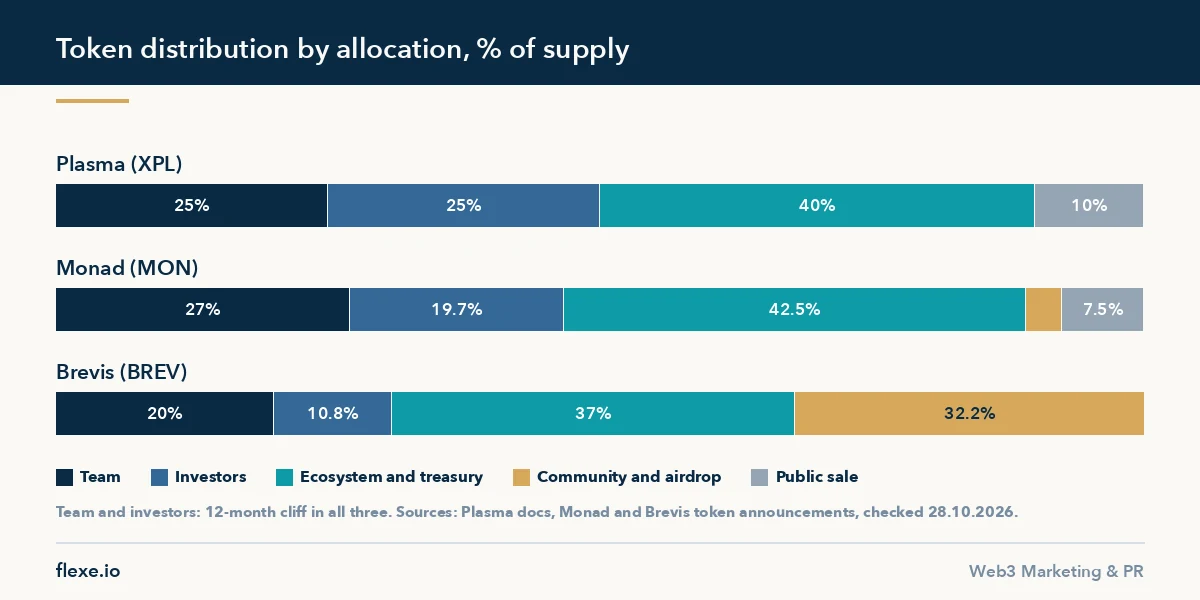
Liquidity buckets hide a detail worth checking. Monad’s Coinbase sale disclosure lists 160 million MON lent to five market makers, four on renewable one-month terms and Wintermute for a year, all inside the ecosystem allocation. Most projects do not publish loan sizes, so the free float can be larger in practice than the tokenomics chart suggests.
How large vesting releases move the price
Large releases tend to weigh on price before the date, not only after it. Keyrock, a market maker, studied 16,000+ release events across 40 tokens and published the results on 5 December 2024. It found that 90% of release events created negative price pressure, “regardless of size or type”, that pressure builds over the 30 days before a big release, and that prices usually settle within about 14 days after.
Who receives the tokens matters more than the size alone. In Keyrock’s data, team releases produced the worst drops, at about -25%, while ecosystem releases averaged +1.18%. Large recipients often hedge with market makers one to four weeks ahead, which is why the weakness shows up early. Keyrock itself says it cannot cleanly rank cliff releases against daily linear ones.
Token age changes the picture too. Tokenomist’s summary of its 236-event study, written by Chawapat Peechapat on 9 October 2026, says recently listed tokens fell a median 16.02% against similar peers in the month after a release. Mature tokens showed no clear effect. We could read only the free summary, not the full paid study.
Most released supply is not insider supply. Tokenomist’s 2025 review counted $97.43 billion of tokens released during the year, and more than 80% came from community, ecosystem, treasury, rewards, listing and liquidity allocations. The largest single cliff was ONDO’s $2.56 billion on 18 January 2025, so a few dates carry most of the risk.
One case shows how this looks in practice, without proving cause. XPL rose 30.7% in the 30 days before its 25 September 2026 cliff, from $0.08775 to $0.11467 on Binance daily closes, then fell 35.7% to $0.07377 by 25 October. It closed at $0.05178 on 9 November 2026, 54.8% below the cliff-day close.
KITE showed the same pattern before its first insider cliff on 3 November 2026. Kite’s docs give team, advisors and early contributors 20% and investors 12% of a 10 billion supply. The price fell 22.3% in the 30 days before, from $0.1509 on 3 October to $0.1172 on 2 November on Binance daily closes. Tokenomist’s 2 November 2026 digest valued the first tranche at $75.5 million, 26.76% of circulating supply.
The next test is Monad on 24 November 2026. Monad’s own tokenomics overview of 10 November 2025 gives investors and the Category Labs treasury a one-year cliff, then 1/48 of their tokens a month, and estimates released team tokens at about 10.7% of initial supply. By our arithmetic that is about 16.6 billion MON, 16.6% of supply. Tokenomist models only 6.66 billion for the day, so trackers can differ by billions of tokens.
How to design a token vesting schedule
A token vesting schedule works when every date is written down before TGE and matches the contract. The order below follows what the 2025 and 2026 launches above published, and it assumes you already know who holds each allocation. Our guide on launching a crypto token covers the contract and audit steps that come before it.
- Fix the allocations and their owners, with team and investors together near 43%, the median in our set.
- Set a 12-month cliff for team and investors, the norm in every project we checked.
- Choose a total length of 36 to 48 months, and decide whether the cliff releases a third, a quarter or nothing.
- Size the TGE float from sale, airdrop and liquidity buckets, typically 15% to 25% of supply.
- Agree market-maker loans in writing and count them inside the float you announce.
- Spread ecosystem releases over years, as Plasma does with monthly releases over 36 months.
- Publish the calendar with dates and amounts, and announce each large release at least 30 days ahead.
The calendar is also a marketing asset. A release that holders see coming loses some of its shock, while a surprise cliff invites the pre-release selling Keyrock describes. Tie announcements to product news where possible, and brief your market making partner on each date so liquidity is ready when the supply arrives. Share the same calendar with every venue through your exchange listing work.
Longer cliffs exist, and holders read them as a signal. Predict.fun, the prediction market whose TGE was postponed on 30 October 2026, keeps core contributor and early backer tokens locked at TGE, then applies a 24-month cliff and 36 months of monthly releases, according to the same Tokenomist digest. A longer lock costs a project nothing on launch day.
Airdrops need the same care as insider tokens. A full release at TGE puts all of it in the hands of claimers on day one. Brevis split its airdrop into 3% at TGE and 0.5% at month six, and Initia released its 5% airdrop at genesis. Plan the claim with an airdrop promotion partner who knows the schedule.
Tools to run and track token vesting
Vesting runs either on a hosted platform or on your own contract, and holders track it on public dashboards. The choice depends on the chain, how many recipients you have and whether you need cancellable streams. We checked each tool’s own documentation on 28 October 2026, including published fees.
Sablier runs vesting streams on 25 EVM networks, with linear, cliff, dynamic and tranched shapes, and charges $0.99 per withdrawal through its interface plus gas. Streamflow covers Solana, with a fee of 0.16 SOL plus 0.19% of vested tokens. UNCX supports 11 EVM chains plus Solana, with 8 schedule types, and charges 0.05 ETH plus 0.1% on Ethereum and its L2s.
Teams with developers can skip platforms. OpenZeppelin’s VestingWallet is a free library contract for one beneficiary, and VestingWalletCliff adds a cliff from version 5.1. You pay gas and an audit instead of a platform fee. Hedgey, once a common choice, stopped issuing new vesting plans in 2026 and now operates as HedgeyPro within Anchorage Digital.
Holders use trackers rather than contracts. DefiLlama’s release tracker lists per-token calendars with cliff and linear events, and its notes flag where it simplifies a project’s docs. Plasma’s US sale tokens, for example, are shown as free at TGE “for simplicity”. Tokenomist, formerly TokenUnlocks, publishes calendars and weekly digests of upcoming releases.
When vesting does not protect holders
Vesting limits when tokens can move, not whether insiders can reduce their exposure. OpenZeppelin’s own documentation warns that ownership of a VestingWallet can be transferred, so “it is possible to sell unvested tokens.” Streamflow lets recipients list a future token stream for sale. Keyrock adds that large recipients often hedge with market makers weeks before a release, so the economic selling can start early.
Linear releases can still hurt. Keyrock’s case study of ApeCoin shows the team release starting on 1 March 2023 at 0.7% of supply a month, about $11 million at the time. APE fell 77% over the next seven months while ETH fell 9%, which Keyrock links to steady team selling and weak product interest.
Schedules also change after launch. Worldcoin extended 80% of its team and investor tokens from three to five years on 16 July 2024, and Story delayed its first insider release from 13 February 2026 to 13 August 2026. In August 2026, after Story rebranded as DATA, the date moved again to 13 February 2028, with 25% at that point and linear release to February 2031. Both moves helped holders, but they show that a published calendar is a promise that issuers can rewrite.
The weakest case is a schedule that was never written. World Liberty Financial’s sale buyers had no fixed terms until a governance vote around 6 May 2026 set a two-year cliff and two-year release for the remaining 80%. Its co-founder and team allocations still read “to be determined”. Read the vesting page before you buy, and treat a missing schedule as a risk on its own.
The uncomfortable fact is that vesting does not stop most new tokens from falling. Memento Research found 84.7% of 118 tokens launched in 2025 below their TGE valuation by 20 December 2025. Our benchmark of 150 campaigns shows a median 2.8x return with 12% failures, so plan the release calendar together with the marketing around it.
Designing allocations or a release calendar? Send us your tokenomics draft, target TGE date and planned venues, and within 24 hours we will return a free token launch plan with the release schedule and the announcement dates around it. Message Flexe.io on Telegram.
Frequently Asked Questions
What is vesting in crypto in simple terms?
It is a lock that pays tokens out over time instead of all at once. A team member or investor gets an allocation on paper, waits through a cliff, then receives tokens daily, monthly or in steps. The point is to keep early holders tied to the project while it builds, rather than selling on the first trading day.
What is a cliff in token vesting?
A cliff is the date before which nothing is released. In all seven 2025 and 2026 launches we checked that published insider terms, the cliff for team and investors was 12 months. On the cliff date, some projects release a share at once, such as a third at Plasma, while others start a monthly release from zero.
Do vesting releases always drop the price?
No, but large insider releases often coincide with weakness. Keyrock’s study found most releases created negative pressure, yet ecosystem releases averaged a small gain. Effects also depend on how new the token is: Tokenomist found a clear median decline only for recently listed tokens. Market conditions and hedging before the date matter as much as the release itself.
How long is a normal team vesting period?
Three to four years in total is normal for 2025 and 2026 launches. Across the seven projects we checked with published team terms, total vesting ran from 36 to 48 months after TGE, with a 12-month cliff first. Shorter schedules exist: GEO’s team pool releases over six months after a one-year lock.
Where can I check a token’s vesting schedule?
Start with the project’s own tokenomics or docs page, which should list each allocation with dates. Then compare it with DefiLlama or Tokenomist, which turn schedules into calendars. If the trackers and the docs disagree, read the tracker’s notes, and ask the project which version the contract enforces. A published contract address lets you check the schedule on an explorer yourself.