A SAFT crypto deal is a simple agreement for future tokens: investors pay now and receive a project’s tokens once its network launches. The format comes from a whitepaper dated 2 October 2017, and its US design limits buyers to accredited investors. It is written for founders, for investors offered a SAFT, and for anyone who saw “SAFT” in a token’s history.
This is a plain-English explainer, not legal advice; talk to a securities lawyer before you sign or offer a SAFT. We describe what the rules and court records say, with dates, and never which exemption to use. Figures appear exactly as each source states them, with its date.
Checked on 12 November 2026.
TL;DR
- The 2 October 2017 whitepaper calls the SAFT itself a security, sold to accredited investors under Rule 506(c).
- Protocol Labs sold Filecoin SAFTs in 2017. Its two Form D filings report $51,658,489 from 154 investors and $148,238,169 from 1,241 investors.
- Telegram raised about $1.7 billion through Gram purchase agreements. On 26 June 2020 it settled with the SEC, agreeing to return more than $1.2 billion and pay an $18.5 million penalty.
- On 30 September 2020 a federal judge held that Kik’s $50 million SAFT presale was integrated with its public token sale.
- The SEC withdrew its 2019 staff framework. A Commission interpretation of 17 March 2026 replaced it, and Regulation Crypto Assets was still a proposal when we checked.
What a SAFT crypto deal is, in plain terms
A SAFT is a contract between a token project and an investor in which money moves now and tokens move later. The investor buys not tokens but a right to tokens that the network will create once it works. Until delivery, the investor holds that contract and nothing else.
The whitepaper, written by Juan Batiz-Benet, Jesse Clayburgh and Marco Santori, is blunt about the legal status of the contract. In its words, “The SAFT is a security.” Its example uses Rule 506(c) of Regulation D and a Form D notice filed with the SEC.
The idea was to split one sale into two steps. Step one is a securities sale to accredited investors. Step two is delivery of a SAFT token once the network works, which the authors argued need not be a security under the Howey test. That second claim is where the trouble started.
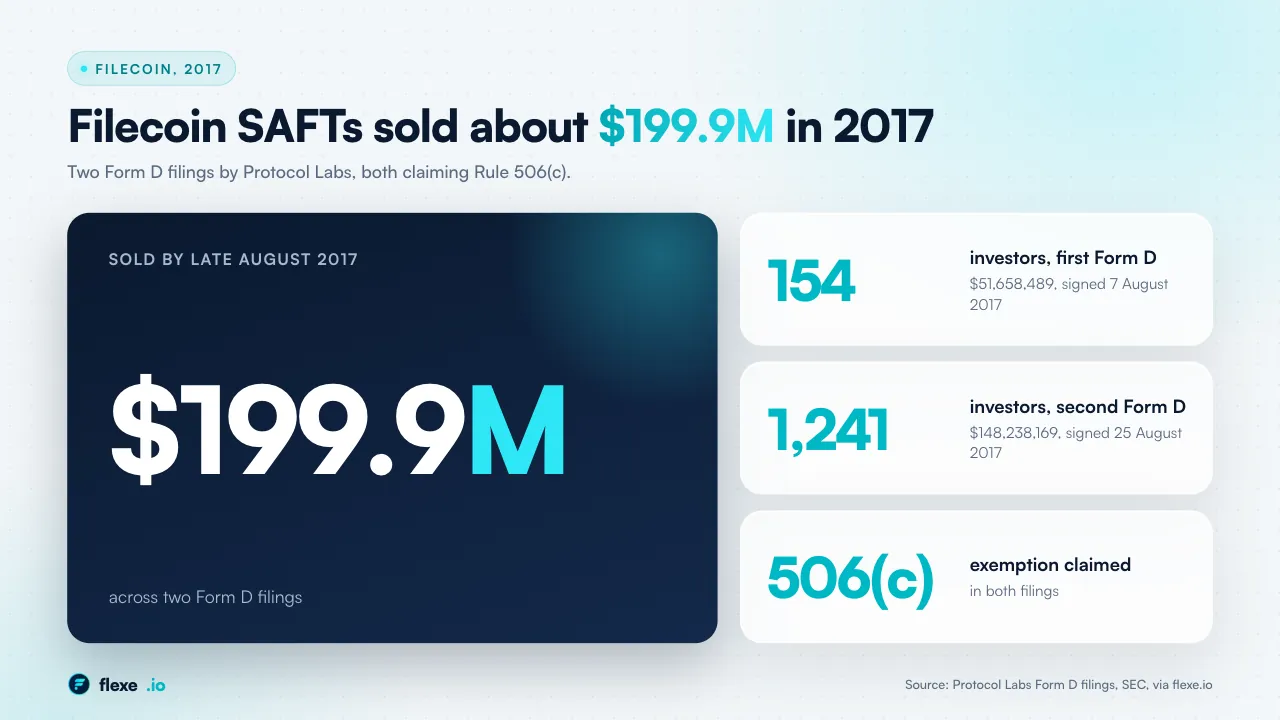
Protocol Labs used the structure at scale before the whitepaper came out. Its first Form D, signed by CEO Juan Batiz-Benet on 7 August 2017, describes the security as a right to receive Filecoin tokens in the future under a SAFT. It reports $51,658,489 sold to 154 investors, with the first sale on 21 July 2017.
A second Form D, signed on 25 August 2017, covers the next stage. It reports $148,238,169 sold to 1,241 investors out of a $160,000,000 offering, with the first sale on 10 August 2017. Both filings claim Rule 506(c) and together show about $199.9 million sold by late August 2017.
If you are closing a round and the token launch is next, start with a marketing plan for the TGE after your SAFT round.
How a SAFT works from signing to token delivery
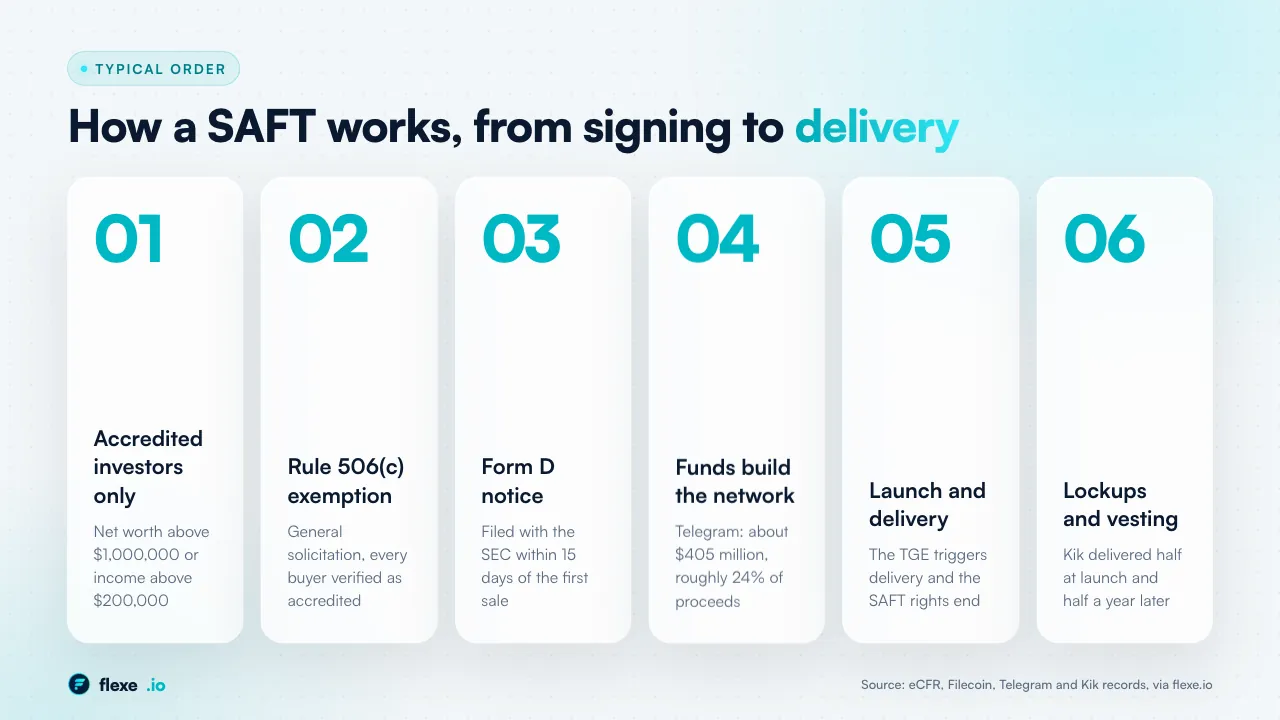
The flow below follows the whitepaper’s example and the Filecoin, Telegram and Kik records. Steps 1 to 3 are federal rules we read in the eCFR on 12 November 2026; the rest comes from filings and court opinions. Real deals vary, so read the order as typical, not required.
- Accredited investors only: Under 17 CFR 230.501(a), a person qualifies with net worth above $1,000,000 excluding the primary residence. Income above $200,000 ($300,000 joint) in each of the last two years also qualifies. A 2020 amendment (85 FR 64277, 9 October 2020) added holders of SEC-designated professional credentials.
- An exemption from registration: Filecoin, Telegram and Kik all claimed Rule 506(c). It allows general solicitation, but every buyer must be accredited and the issuer must take reasonable steps to verify that status.
- Form D: The issuer files a notice with the SEC no later than 15 calendar days after the first sale, under 17 CFR 230.503.
- Funds build the network: The court in the Telegram case found that Telegram spent about $405 million, roughly 24% of its proceeds, between January 2018 and January 2020.
- Network launch: The launch, often called the token generation event, triggers delivery. See what a token generation event involves.
- Token delivery: The investor’s SAFT rights end when tokens arrive. Telegram’s agreements set a deadline of 31 October 2019, later moved to 30 April 2020, with a refund of unspent funds if Grams were not delivered.
- Lockups and vesting: Telegram’s Round One buyers faced staged lockups, with the first release three months after delivery. Kik delivered half of the presale tokens at launch and half a year later. More on how vesting schedules release supply.
SAFT vs SAFE vs token warrant compared
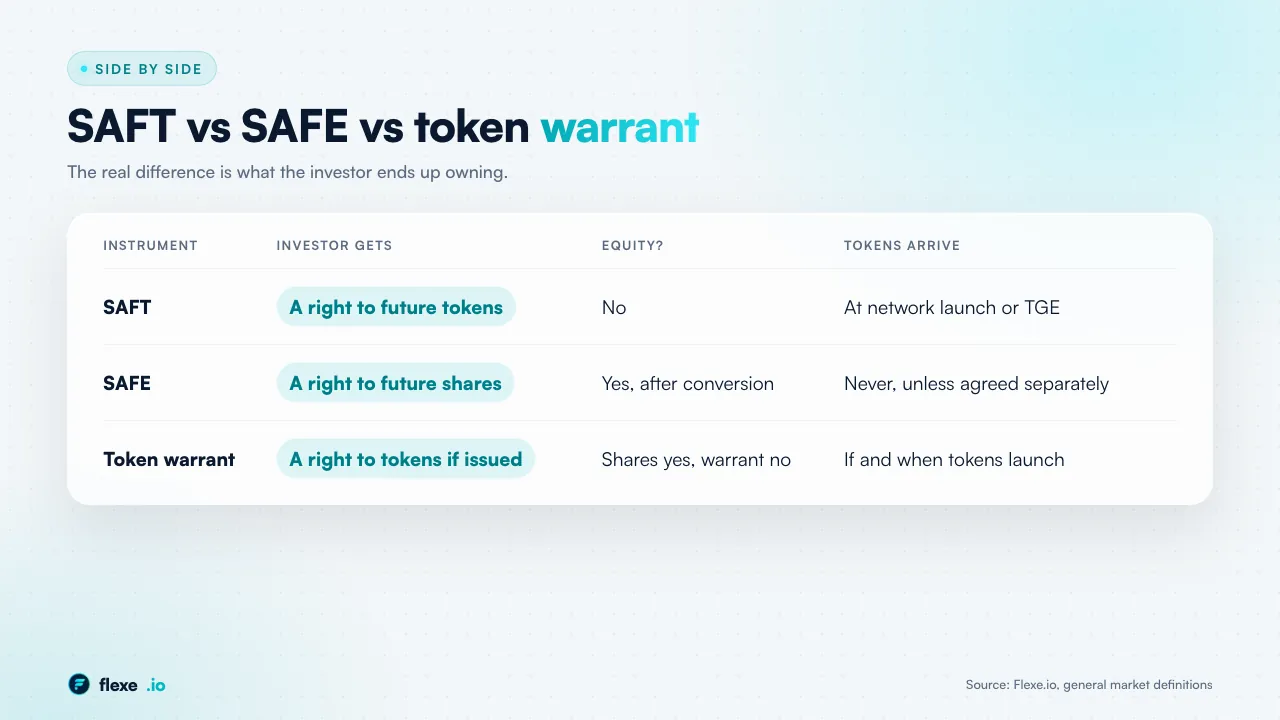
People mix up these three because the names sound alike and all three defer something. The real difference is what the investor ends up owning. The table compares a SAFT agreement with an equity SAFE and a token warrant, using general market definitions.
| Instrument | What the investor gets | Equity? | When tokens arrive | Typical use |
|---|---|---|---|---|
| SAFT | A right to future tokens; the SAFT token is delivered at launch | No | At network launch or TGE | Token-first raises, such as Filecoin in 2017 |
| SAFE | A right to future shares at a later priced round | Yes, after conversion | Never, unless agreed separately | Early-stage companies raising before a priced round |
| Token warrant | A right to receive or buy tokens if the company issues them | The shares are equity, the warrant is not | If and when tokens launch | Equity investors who also want token exposure |
The uncomfortable column for SAFT buyers is the one about equity. A SAFT holder has no shares, no board seat and no liquidation preference. If tokens never arrive, the holder has only what the contract says about refunds, and that question became real for Telegram buyers once the court stopped delivery.
What the SEC and courts said, 2017 to 2026
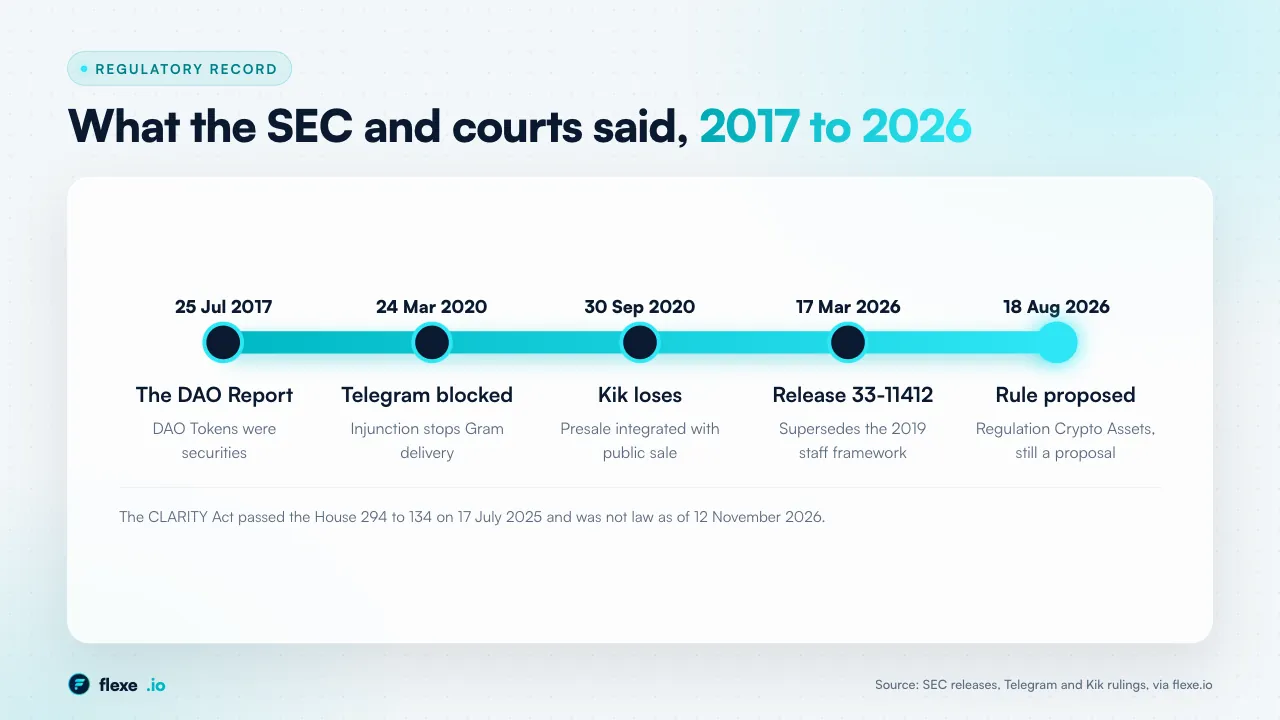
We read the SEC releases, the Telegram and Kik rulings, the 2017 whitepaper, the Filecoin Form D filings and the 2026 interpretive release on 12 November 2026. Every date below comes from those documents or official House vote records.
The first signal came before the whitepaper. On 25 July 2017 the SEC published its Report of Investigation on The DAO, Release No. 81207. It found DAO Tokens were securities because buyers expected profits from the work of Slock.it and the curators. It brought no enforcement action but confirmed token fundraising is subject to registration rules.
Telegram, the largest test, sold about 2.9 billion Grams for about $1.7 billion in two rounds in early 2018, to 175 initial purchasers by the court’s count. The SEC sued on 11 October 2019, and on 24 March 2020 Judge P. Kevin Castel granted a preliminary injunction that blocked delivery of the Grams.
The court treated the purchase agreements and the expected resale of Grams as one scheme. Because buyers were expected to resell into the public market, the court found they acted as underwriters, so the Rule 506(c) exemption failed. On 26 June 2020 Telegram agreed to return more than $1.2 billion and pay an $18.5 million penalty.
Kik’s SAFT presale ran from June to 11 September 2017 and raised $50 million from 50 accredited buyers at a 30% discount. The public token sale started on 12 September 2017, the next day, and took in about $49.2 million from about 10,000 buyers. On 30 September 2020 Judge Alvin Hellerstein granted summary judgment to the SEC.
His holding was short: “I hold that the Pre-Sale was integrated with the TDE sales.” With both sales treated as one offering, the presale lost its exemption. The SEC announced the final judgment against Kik on 21 October 2020, including a $5 million penalty.
The policy picture changed after 2024. On 21 January 2025 the SEC formed a Crypto Task Force led by Commissioner Hester Peirce, who resigned effective 2 October 2026. On 17 March 2026 the Commission issued an interpretation, Release No. 33-11412, which superseded the staff framework of 3 April 2019. The release describes SAFT-style sales directly and treats the sale as happening when the agreement is signed, whatever the delivery date.
The same release says a token sold under an investment contract is not a security for that reason alone. It also says the contract can end once the issuer fulfills its promises, such as shipping promised functionality or roadmap milestones. On 18 August 2026 the SEC proposed Regulation Crypto Assets, with exemptions of up to $5 million over four years and up to $75 million per 12 months. When we checked, it was still a proposal.
Congress has not settled the question. The House passed the CLARITY Act, H.R. 3633, by 294 to 134 on 17 July 2025. As of 12 November 2026 the bill is not law.
Here is the uncomfortable fact for SAFT issuers. The SAFT structure, complete with Forms D and accredited buyers, did not protect Telegram or Kik. In both cases the court looked at the whole plan, from the private round to the expected public market, not only at the paperwork for step one.
Risks for founders and SAFT token holders
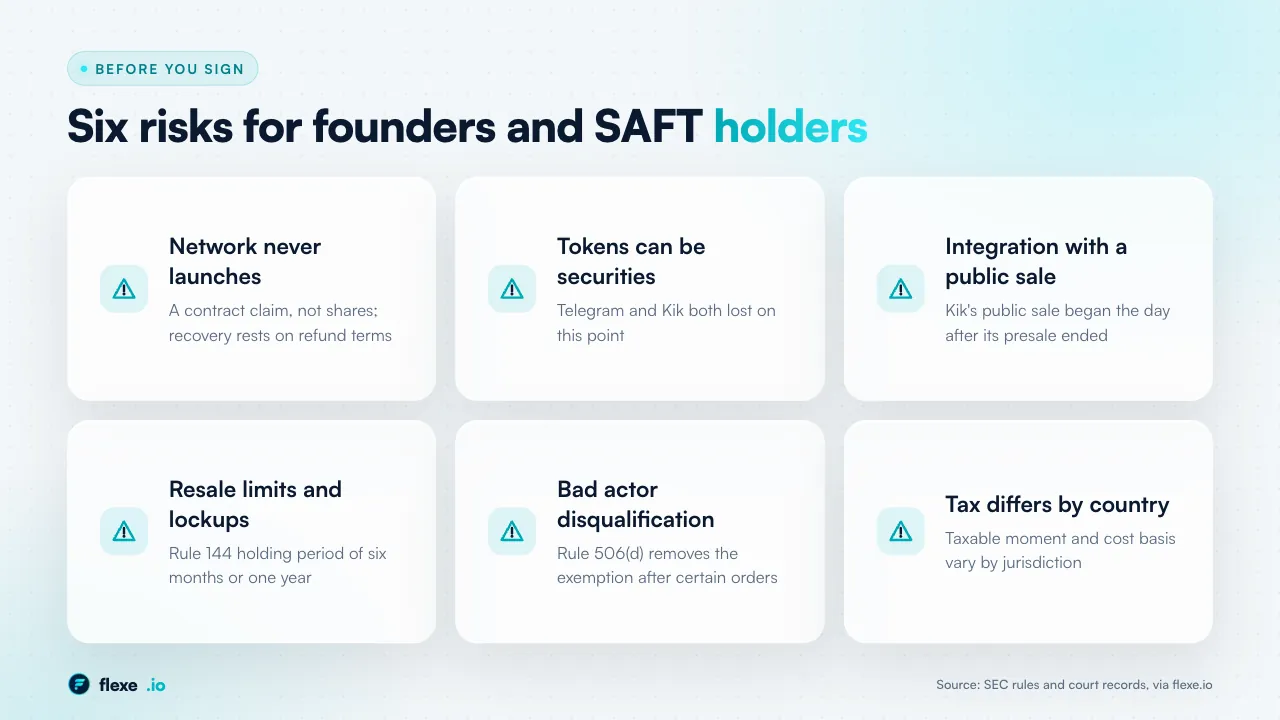
- The network never launches: A SAFT holder has a contract claim, not shares. Recovery depends on the refund terms, like Telegram’s promise to return unspent funds.
- Delivered tokens can still be securities: Telegram and Kik both lost on this point, and the 2026 SEC release ties the answer to what the issuer promised.
- Integration with a public sale: Kik’s public sale began the day after its presale ended, and the court treated both as a single offering.
- Resale limits and lockups: Regulation D securities cannot be resold freely, and Rule 144 requires a holding period of six months for reporting issuers and one year for others. Lockups can delay any sale of a SAFT token further.
- Bad actor disqualification: Rule 506(d) removes the exemption if the issuer or covered persons, including paid solicitors, have certain past convictions, injunctions or orders.
- Tax treatment differs by country: The taxable moment and cost basis can follow different rules in each jurisdiction, so check with a tax adviser.
One honest limitation: this article covers US federal law only. State rules, the EU and other jurisdictions add requirements we did not review. The 2026 interpretation and the pending proposal can also change, so a lawyer’s review on the day you sign matters more than any explainer.
What a project can say during a SAFT round
For a marketing team, this is the practical question in any SAFT round. The answer starts with which Regulation D rule the round relies on, a choice for founders and their lawyers. We describe the rule text; your securities lawyer decides what applies to each public post. Planning the launch calendar around those limits is the part Web3 launch consulting covers, alongside your counsel.
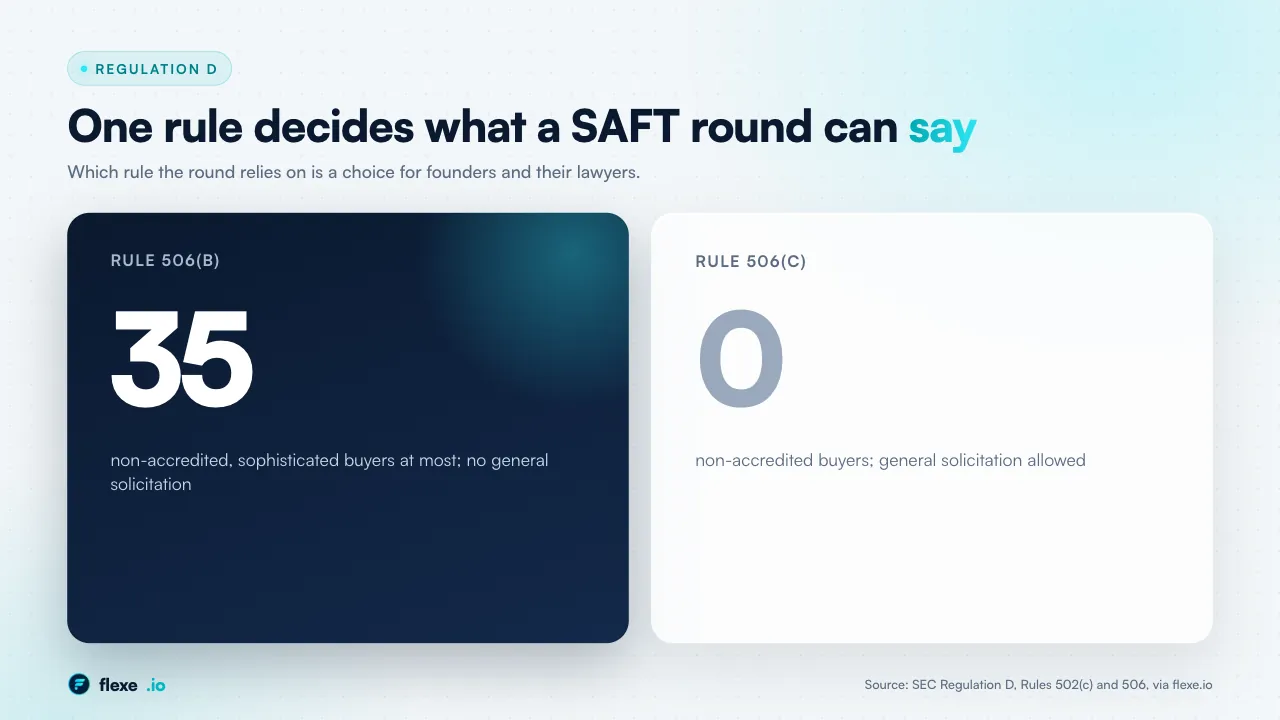
Under Rule 506(b), the issuer may not offer the securities through general solicitation or general advertising. Rule 502(c) gives examples, including ads, articles and notices in newspapers, magazines or similar media, TV and radio broadcasts, and seminars whose attendees were invited by general solicitation. The text predates X and YouTube, so whether a given post counts is a question for counsel.
Under Rule 506(c), general solicitation is allowed, but every buyer must be accredited and the issuer must take reasonable steps to verify that. Listed methods include reviewing two years of IRS forms or a written confirmation from a broker-dealer, registered adviser, attorney or CPA. Rule 506(b), by contrast, allows up to 35 non-accredited but sophisticated buyers.
Public statements keep mattering after the round closes. The 2026 SEC release ties the end of an investment contract to what the issuer represented or promised, including functionality and roadmap milestones. Roadmap posts, KOL briefs and press releases before the TGE can become part of the record of those promises. Kik shows the timing side, since its public sale opened one day after the presale closed.
We have run 800+ campaigns since 2018, with a network of 20,000+ influencers on X and YouTube (100+ active on X, 300+ on YouTube) and 800+ media outlets. In our benchmark of 150 campaigns, the median result was 2.8x, the range was 1.4x to 7.0x, and 12% failed (see the campaign benchmark). That data describes marketing outcomes, not legal ones, so pair it with our compliance checks for crypto campaigns.
Planning a TGE after your SAFT round? Message us on Telegram and get a free TGE launch marketing plan within 24 hours. The plan covers marketing only, meaning channels, KOLs, media and timing. It is not legal, regulatory or fundraising help.
Frequently Asked Questions
Is a SAFT token a security?
The SAFT contract is a security, and the 2017 whitepaper says so. The token delivered later is a separate question. In 2020 courts found the tokens in the Telegram and Kik deals were part of securities offerings. The SEC’s 17 March 2026 interpretation says a token is not a security merely because of that contract, which can end once promises are met.
Who can invest in a SAFT crypto deal?
Under the original US design, only accredited investors. For individuals, 17 CFR 230.501(a) requires net worth above $1,000,000 excluding the main home. The income route is above $200,000 a year, or $300,000 with a spouse, for two years running. Some SEC-designated professional credentials also qualify, a category added in October 2020. Outside the US, local rules apply instead.
What happens to a SAFT if the network never launches?
It depends on the contract, because a SAFT holder owns no shares in the company and some agreements include a refund. Telegram’s purchase agreements promised to return unspent funds if Grams were not delivered by the deadline, which was first 31 October 2019 and then 30 April 2020. If a SAFT has no refund clause, the holder may have only a general contract claim.
Is a SAFT still used in 2026?
We found no official count of SAFT deals, so we cannot give a number. What changed is the rulebook around them. The SEC withdrew its 2019 staff framework, issued a Commission interpretation on 17 March 2026 that describes SAFT-style sales, and proposed Regulation Crypto Assets on 18 August 2026. The CLARITY Act had not become law as of 12 November 2026.
Can I use this explainer to structure my raise?
Please do not use it that way. This is a plain-English explainer, not legal advice; talk to a securities lawyer before you sign or offer a SAFT. The rules here are US federal rules as of 12 November 2026, and they can change through new SEC releases or legislation. State rules and other countries add requirements we did not review.