For crypto marketing compliance under MiCA, a Telegram announcement is a marketing communication with the same legal status as a paid advertisement, and a compliant programme rests on five levers: the prescribed disclaimer built into every template, a white paper check before any copy is written, approval of influencer copy before it posts, a record of what was actually published, and separate asset sets per jurisdiction.
Article 7 requires that every promotional communication relating to a public offer or admission to trading be clearly identifiable as marketing, and that the information in it be fair, clear and not misleading. The scope is wider than most teams assume: advertisements, landing pages, press articles, influencer posts and community announcements are all covered.
This is a practical crypto marketing compliance summary for marketers rather than legal advice. Anything you intend to rely on should be checked with a qualified adviser in the relevant jurisdiction.
What must a marketing communication contain?
MiCA specifies a disclaimer with fixed wording. Marketing communications must state: “This crypto-asset marketing communication has not been reviewed or approved by any competent authority in any Member State of the European Union. The offeror of the crypto-asset is solely responsible for the content of this crypto-asset marketing communication.”
- Clear identification as marketing. The reader must be able to tell that the communication is promotional.
- Fair, clear and not misleading information. The standard applies to the impression created, not only to individual claims.
- Coherence with the white paper. Where a crypto-asset white paper exists, the marketing must not say something the white paper does not support.
- A statement that a white paper has been published, together with the website address of the offeror or the party seeking admission to trading.
- Contact details. A telephone number and an email address for that party.
Crypto marketing compliance: the key tactics
Responsibility does not transfer to the person who wrote the post. A project working with affiliates, brokers, influencers or paid media partners remains accountable for how the product is presented, even when it did not create the content. That converts influencer briefing from a quality-control task into a compliance one.
1. Write the disclaimer into the asset templates, not the checklist
Anything that depends on someone remembering will eventually be published without it. Keep the prescribed disclaimer in one file that every asset pulls from, rather than pasted into each template by hand. Pasted text drifts: a word gets dropped during a redesign, a translator improves the phrasing, a banner resize trims the last line. When the wording lives in one place and is copied mechanically, reviewing the campaign becomes a question about one file rather than about forty separate assets.
- Best for: teams producing assets in several formats and languages
- Metric to watch: live assets whose disclaimer differs from the master file
- Watch out: mid-flight redesigns, which is when the disclaimer usually disappears
- In translation: mark the disclaimer as locked text and confirm the delivered file still contains it intact
2. Check the white paper before writing the campaign
Marketing that outruns the document is the most likely source of a problem. Name one person who approves marketing copy before it leaves the building, give that person the authority to hold a launch, and have the current white paper open while reading, because the question being answered is whether the copy stays inside what the document supports.
- Best for: launches, listings and any campaign that makes claims about the product
- Metric to watch: claims in the copy that the white paper does not support
- Watch out: pinned messages left over from a previous campaign after the white paper changes
- Owner: one named approver, not a group chat
3. Approve influencer copy before it posts
Responsibility sits with the offeror regardless of who wrote it, and a KOL improvising a price prediction in a Telegram group is the project’s problem, not the KOL’s. Give the creator the approved claims, the claims that are off limits, the disclaimer text with instructions on where it goes in each format, and the deadline for sending a draft back. Price predictions, expected returns, listing timing and comparisons with other assets belong on the prohibited list explicitly, because silence reads as permission. Our guide on how to brief a crypto KOL covers the rest of the brief.
- Written post: carries the disclaimer as text
- Video: needs it on screen long enough to be read, and spoken where the format allows
- Short ad unit: with no room for the wording, it has to send the reader to a page that carries it in full
- Watch out: deciding the format rules after the asset is delivered and the creator has moved on
4. Put control into the contract
The commercial agreement is where control actually lives. Written terms should give the project the right to approve copy before posting, require the post to stay live for the agreed period, and require removal or correction within a stated time on request. Tie the final payment to a published post that matches the approved draft, and the correction conversation becomes routine administration instead of a negotiation you are unlikely to win.
- Best for: influencer, affiliate and agency agreements
- Pass it down: the same terms apply to anyone a partner subcontracts
- Ask in writing: whether anyone downstream of the contract will produce their own creative
- Watch out: sub-affiliates, where approved copy quietly becomes something else
5. Keep a record of what was actually published
Posts get edited and channels get cleared, so the record has to be made at publication rather than reconstructed afterwards. Capture the published asset, the URL or channel, the time it went live and the approved draft it came from. Store the white paper version that was current on that date alongside it, because the coherence requirement is judged against the document as it stood then, not as it reads today.
- Best for: every influencer, paid and community campaign
- Storage: a shared folder per campaign, organised by date, is enough
- Test: someone who joins next quarter can reconstruct what was published without asking anyone who has left
- Watch out: an archive on one person’s laptop, or in a messaging thread that disappears when the channel is cleared
6. Separate jurisdictions in the plan
One creative set for every market is how a UK breach happens. Where a market sits outside the regime entirely, that market needs its own asset set rather than a translated copy of the European one, with its own approved claim list. Geo-targeting is a compliance control as much as a media setting: decide which jurisdictions each asset set may serve and apply the exclusions at campaign level rather than relying on creative to disclaim its way out of a market.
How does crypto marketing compliance differ in the UK?
The United Kingdom operates a separate regime built around financial promotions rather than MiCA. The rule that most affects campaign planning is that influencers may promote crypto products only if they are directly authorised or working with an FCA-authorised firm. A campaign designed for the EU and copied into the UK without checking that condition is a common and avoidable error.
| Requirement | EU under MiCA | UK |
|---|---|---|
| Prescribed disclaimer | Yes, with fixed wording | Risk warnings under the financial promotions regime |
| Influencer restrictions | Covered as marketing communications; offeror remains responsible | Influencer must be authorised or work with an authorised firm |
| White paper linkage | Marketing must be coherent with the published white paper | Separate regime, not white-paper based |
| Scope | Ads, landing pages, press, influencer posts, community announcements | Financial promotions broadly defined |
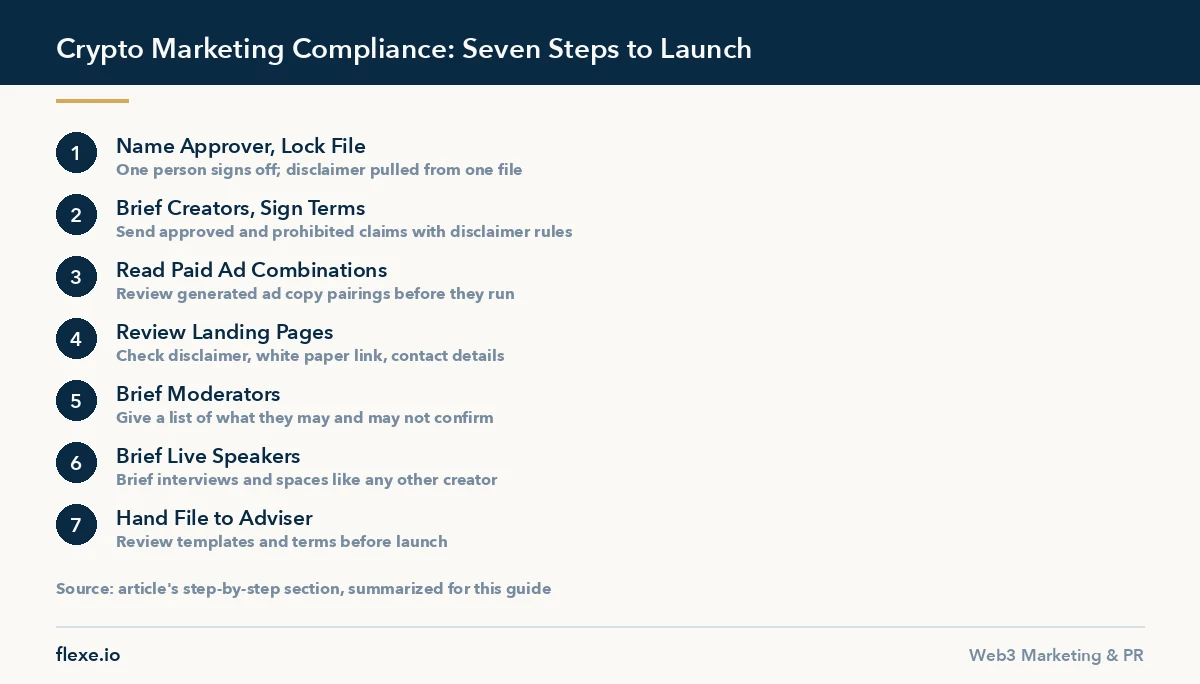
How to plan it step by step
Approval and record-keeping sit inside the campaign process, not beside it: how we brief campaigns. The brief, the approval step and the record of what was actually published all have to exist before the campaign runs.
1. Name the approver and lock the disclaimer file
One person signs off, with the white paper open, and every asset pulls the disclaimer from one file.
2. Brief creators and sign the terms
Send approved and prohibited claims with per-format disclaimer rules, and sign approval, stay-live and takedown terms with payment tied to the approved draft.
3. Read paid combinations as combinations
Paid media multiplies the number of surfaces carrying a claim. Search and display creative rotates automatically, so an approved headline can be paired with a description nobody reviewed alongside it. Generate the combinations you will actually run, read them together, and switch off the automatically generated variations you have not seen. An unreviewed pairing is still your marketing communication. For platform approval itself, see how to get crypto ads approved.
4. Review landing pages and partner links
The landing page behind an advertisement is part of the marketing communication, not a separate asset with separate rules. If the page omits the disclaimer, the white paper statement or the contact details, the campaign has a gap in the place most people see. A link passed through a partner domain can land on a version of the page built by that partner, so ask to see the live destination for every partner link before the campaign starts.
5. Brief moderators and review automated posts
A moderator in a project channel is the project speaking, whether or not they are paid. Answers about price, the timing of a listing or expected returns carry the same status as an advertisement. Give moderators a short list of what they may confirm, what they must route to the team, and what they must never answer at all. Put bots relaying price, feeds that repost headlines and scheduled content on the same review list as everything else.
6. Brief live speakers
An interview, a community call or a recorded space produces claims that were never drafted, and the recording is then republished as a clip by people outside the project. Brief the speaker in the same way a creator is briefed, keep the recording, and review clips that gain traction, because a thirty second extract can carry a claim the full hour qualified carefully.
7. Hand the file to an adviser before launch
A short review of the asset templates, the creator terms and the jurisdiction split before a launch costs far less attention than a live campaign paused halfway through after a complaint, and it leaves the marketing team with a document to work from instead of half-remembered warnings from a call nobody minuted.
What to do when a post breaches
Capture the evidence before asking for removal. Once a creator deletes a post, the record of what was published goes with it, and the project still has to be able to describe what happened. Screenshot the post with its timestamp and the surrounding thread, save the link, then ask for the correction.
Prefer a correction to a deletion where the format allows one. An edited post with a note about what changed reads as a project that watches its own channels. A post that simply disappears reads as something being hidden.
An unpaid balance is the practical remedy when a creator will not cooperate, which is why milestone payment matters more than any clause in the agreement. If the creator has already been paid in full, the remaining options are persuasion and never working with them again. Escalating in public is rarely worth it: a disputed takedown draws more attention to the claim than the original post did. Settle it privately, correct the record in your own channels.
Mistakes to avoid
- Treating community posts as informal. A Telegram announcement has the same legal status as a paid advertisement.
- Assuming the creator carries the risk. The offeror remains responsible for how the product is presented.
- Copying an EU campaign into the UK. Influencers there need direct authorisation or an FCA-authorised firm.
- Letting translators edit the disclaimer. It is fixed wording, not a sentence to improve.
- Reviewing creative without its landing page. The page is part of the same communication.
- Paying in full up front. It removes the only practical remedy when a post goes wrong.
How to measure results
After each campaign, read the published set against the approved set and note every place they differed. The pattern is usually structural rather than personal: a format with no room for the disclaimer, a partner who briefs their own creators, a landing page maintained by a different team. Fix the structure and the same reviewer stops catching the same thing every month.
Three checks run while the campaign is live. Read the delivery report after the first week to confirm the geo exclusions held, because networks reassign inventory and a campaign correctly limited at launch may not be a month later. Check a sample of partner links again once traffic is running, because partners rebuild pages without telling anyone. And re-read pinned material whenever the white paper changes, because pinned text is the asset nobody remembers writing.
Frequently Asked Questions
Does MiCA apply to a Telegram post?
Yes. Marketing communications under MiCA include advertisements, landing pages, press articles, influencer posts and community announcements relating to a public offer or admission to trading. Article 7 requires each one to be clearly identifiable as marketing, with information that is fair, clear and not misleading, so a Telegram announcement carries the same legal status as a paid advertisement.
What disclaimer does MiCA require?
The stated wording is that the marketing communication has not been reviewed or approved by any competent authority in any EU Member State, and that the offeror of the crypto-asset is solely responsible for its content. It is fixed wording, so keep it in one locked file that every template and translation pulls from unchanged.
Who is responsible if an influencer says something non-compliant?
The project. A business working with affiliates, brokers, influencers or paid media partners remains accountable for how its product is presented, even where it did not create the content. That is why influencer copy should be approved before it posts and why payment should be tied to a published post that matches the approved draft.
Can crypto influencers promote in the UK?
Only if they are directly authorised or working with an FCA-authorised firm. The UK operates a financial promotions regime separate from MiCA, so an EU campaign cannot simply be copied across. Plan a separate asset set for the UK and check the authorisation condition before any creator is booked.
Does the landing page behind a crypto ad count as marketing?
Yes. The landing page behind an advertisement is part of the marketing communication, not a separate asset with separate rules. If the page omits the disclaimer, the white paper statement or the contact details, the campaign has a gap in the place most people see, so review page and creative together.
If you would rather have this run for you, see compliant paid search campaigns.