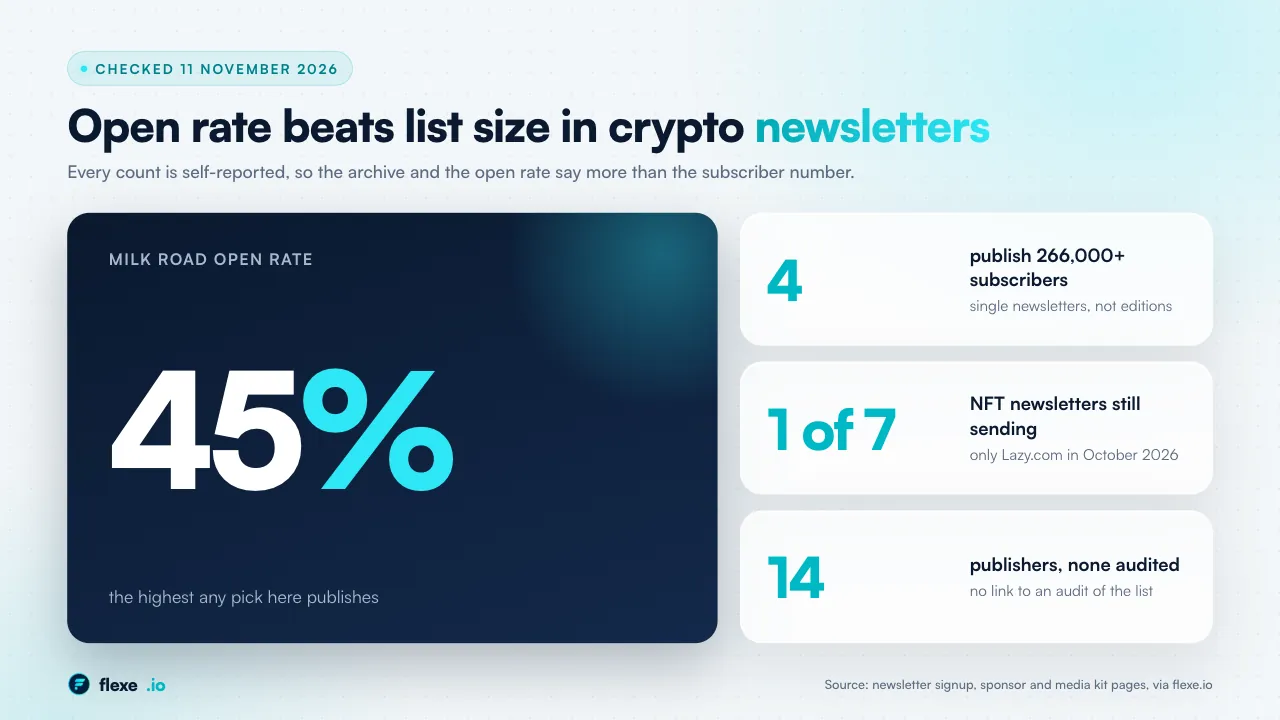
Checked on 11 November 2026, the crypto newsletters worth reading are Milk Road for a daily market brief, TLDR Crypto for a five-minute digest, The Defiant for DeFi, Bankless for Ethereum and The Pomp Letter for Bitcoin and macro. Milk Road’s advertise page lists 300,000 subscribers and a 45% open rate, the highest open rate any pick here publishes.
We picked by four tests: a published subscriber number, a steady sending schedule in October and November 2026, editorial independence from a single token, and a tolerable ad load. Newsletters with no issue in 2026 were dropped, however famous they were in 2021. Flexe is not in the ranking, because we do not publish a newsletter.
Coin Bureau sends a weekly newsletter, with the latest issue dated 16 November 2026 on its own archive page, checked on 19 November 2026, but it publishes no subscriber number, so as a blockchain newsletter it fails our first test and stays out of the table. Flexe places crypto PR in 800+ outlets and reads these lists as a media buyer, which is why the table records sponsor prices next to reader counts.
Readers who want one to three newsletters worth the inbox can use the table and the picks by reader type. Founders who want to reach that audience can go to the sponsorship section, which quotes prices only from media kits and sponsor pages.
Numbers taken on 27 and 28 October 2026, sending dates rechecked on 10 and 11 November 2026.
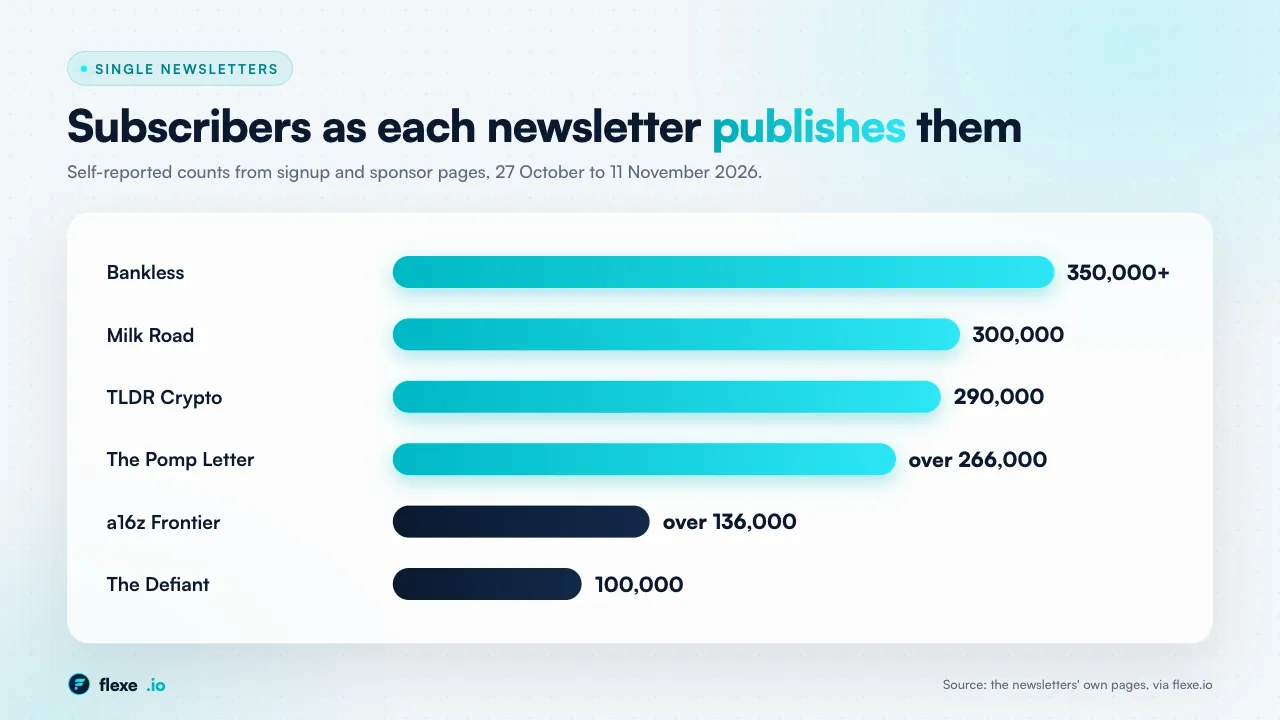
- Four single newsletters publish 266,000 or more subscribers: Bankless (350,000+ on its signup page), Milk Road (300,000 on its ad page), TLDR Crypto (290,000) and The Pomp Letter (over 266,000).
- Published sponsor prices run from $500 a week for an Unchained classified to $24,000 a week for a Bankless placement across 9 sends.
- Every subscriber count here is self-reported, and three publishers print two different numbers on their own pages.
- Of seven standalone NFT newsletters we checked, only Lazy.com’s sent issues in October and November 2026.
- BlockThreat, the weekly security briefing, dropped its paywall on 5 November 2026.
The top crypto newsletters compared in one table
On 27 and 28 October 2026 we opened each newsletter’s subscribe, sponsor and media kit pages and recorded the numbers exactly as published. Counts belong to one newsletter unless the publisher gives only a total across editions, which we mark.
| Newsletter | Focus | Frequency | Subscribers (as published, with date) | Free or paid | Sells sponsorships |
|---|---|---|---|---|---|
| Milk Road | Daily market brief in plain English | About 6 a week | 300,000, 45% open rate (advertise page); 290K (signup page), both 28 Oct 2026 | Free, PRO tier paid | Yes, prices not published |
| TLDR Crypto | Five-minute news digest | Weekdays | 290,000 (signup page, 11 Nov 2026) | Free | Yes, by proposal, max 3 sponsors an issue |
| Bankless | Ethereum and DeFi | Daily brief, 9 sends a week in all | 350,000+ (signup page, 28 Oct 2026); 300,000 (sponsor kit Q3 2026) | Free, Premium $200 a year | Yes, from $20,000 a week |
| The Defiant | DeFi news | Weekdays | 100,000 (sponsor page, 27 Oct 2026) | Free, PRO $15 a month | Yes, $1,200 a send (kit Oct 2025) |
| The Pomp Letter | Bitcoin and macro | 3 a week paid, 1 a week free | Over 266,000 (Substack counter); 270,000+ (signup text), both 11 Nov 2026 | Free and paid | Sponsor line, price not published |
| CoinDesk Crypto Daybook Americas | Market open for traders | Weekdays | Not published, 23% open rate (media kit, Sep 2026) | Free | Yes, $10,000 a week |
| The Block, The Daily | Industry and institutional news | Weekdays | 400,000+ across 8 editions (advertise page, 27 Oct 2026) | Free | Yes, prices not published |
| Blockworks, The Breakdown | Markets essay | Weekdays | 200,000+ across all editions (newsletter page, 27 Oct 2026) | Free | Contact form only |
| Decrypt, Daily Debrief | Daily news for newcomers | Daily | 72,000+ (newsletter page, 28 Oct 2026) | Free | Yes, prices not published |
| Bitcoin Magazine Daily | Bitcoin only | Daily | 53,000 active (newsletter ad page, 28 Oct 2026) | Free | Yes, $1,000 to $2,000 a day |
| Unchained Daily | No-hype news digest | Weekdays | About 19,000 (classifieds page, Oct 2026) | Free, Premium paid | Yes, from $500 a week |
| a16z Frontier | Long-form research from a VC | 1 to 2 a week | Over 136,000 (Substack, 11 Nov 2026) | Free | No |
| CoinMarketCap newsletter | Market data and listings | Daily | 6M newsletter audience (media kit Q4 2026) | Free | Only in bundles, from $20,000 |
| The DeFi Edge | One DeFi idea a week | Weekly, Thursday | 15,000+ (homepage, 28 Oct 2026) | Free | Not published |
These numbers are self-reported, and none of the 14 publishers links to an audit of its list. The gaps show inside single brands. Bankless tells readers 350,000+ and tells sponsors 300,000 in its Q3 2026 kit. Milk Road shows 290K readers on its signup page and 300,000 subscribers on its ad page. Unchained shows over 17,000 on its homepage and about 19,000 on its classifieds page. The Pomp Letter showed over 266,000 on its Substack counter and 270,000+ in its signup text on 11 November 2026.
Open rates tell you more than list size. Milk Road publishes 45%, Bankless 39% and The Defiant 30%, while the CoinDesk media kit lists 42% for its Headlines letter and 23% for Crypto Daybook Americas. CoinMarketCap’s 6M figure sits next to its X and Telegram audience on the same slide, so treat it as a reach claim, not a count of people who open the email.
Projects that plan to buy placements rather than read can ask our team about newsletter and media placements for crypto projects, which we have run across 800+ outlets in 800+ campaigns since 2018.
Best crypto newsletters by reader type
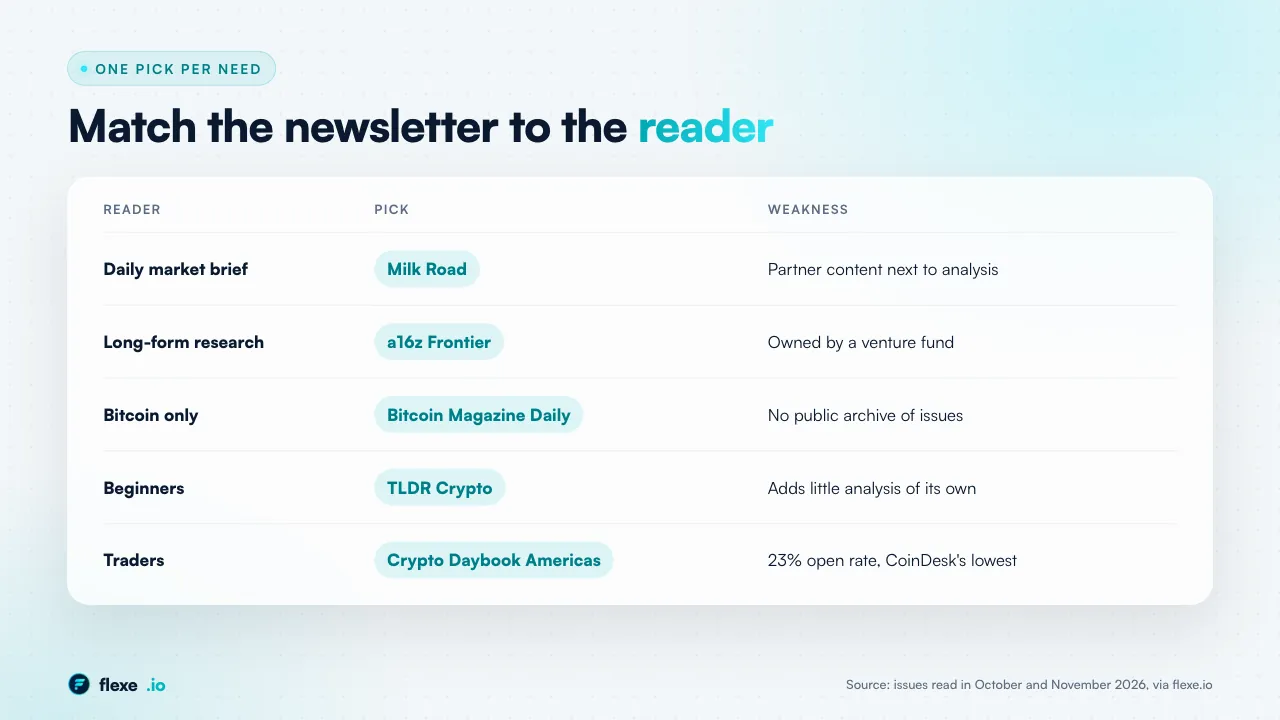
No single newsletter suits every reader, so we matched one pick to each of five common needs. Each pick names one strength and one weakness, based on issues we read in October and November 2026. If you would rather open a blockchain news site than an inbox, our list of news sites that crypto readers trust most covers that side.
1. Milk Road: best for a daily market brief
Milk Road explains the day’s market in plain English and sends about six issues a week, judging by its sitemap from 13 to 26 October 2026, with news issues on 5, 6, 8, 9 and 10 November 2026. Its 45% open rate is the best published figure on our list. The weakness is commercial. The site runs Featured Partner and From Our Partners content next to its own analysis, and labels are easy to miss on a phone.
2. a16z Frontier: best for long-form research
a16z Frontier, renamed from a16z crypto on 22 October 2026, has over 136,000 Substack subscribers and published new essays on 29 October and 4 November. The writing is long, sourced and free, with no paid tier and no sponsors. The weakness is the owner. Andreessen Horowitz is a venture fund with crypto investments, so read its theses as an investor’s view, not neutral analysis.
3. Bitcoin Magazine Daily: best for Bitcoin only news
Bitcoin Magazine’s daily email stays on Bitcoin and skips altcoin news, which suits readers who hold only BTC. Its ad page lists 53,000 active subscribers. The weakness is transparency. We found no public archive of past issues, and the publisher, BTC Inc., is a subsidiary of Nakamoto Inc., a listed Bitcoin company.
4. TLDR Crypto: best for beginners
TLDR Crypto sends a free five-minute digest every weekday to 290,000 readers, according to its signup page. Each story gets a few sentences and a link to the original source, which helps newcomers learn where crypto news comes from. The weakness is depth: TLDR summarizes other outlets’ reporting and adds little analysis of its own.
5. CoinDesk Crypto Daybook Americas: best for traders
Crypto Daybook Americas is CoinDesk’s market briefing for the US session and goes out every weekday. The 10 November 2026 issue led with Bitcoin breaking with stocks as ETF outflows mounted and the miner MARA cut its holdings, which is the trade-level detail traders want. The weakness is engagement. CoinDesk’s own media kit shows a 23% open rate for Daybook, the lowest of its newsletters, and CoinDesk discloses that it is part of the exchange group Bullish. Projects focused on Asian or European readers usually need regional crypto PR in local languages on top of English newsletters.
Niche picks for DeFi, NFT and web3
Niche newsletters live or die faster than general ones. We checked sending dates for every niche candidate through its Substack archive, RSS feed or archive page, and kept only those with an issue in October 2026, then rechecked them on 11 November. The results were uneven: DeFi has two healthy options, builders have five, and the NFT category has one.
Best DeFi newsletter
The Defiant is the best DeFi newsletter for daily coverage. Its sponsor page lists 100,000 subscribers, it sends on weekdays, and its PRO tier costs $15 a month. Its sponsor terms ban ads for token sales and presales. For a slower read, The DeFi Edge sends one free issue every Thursday to 15,000+ readers and has published more than 260 issues since 2023.
NFT newsletters still publishing in 2026
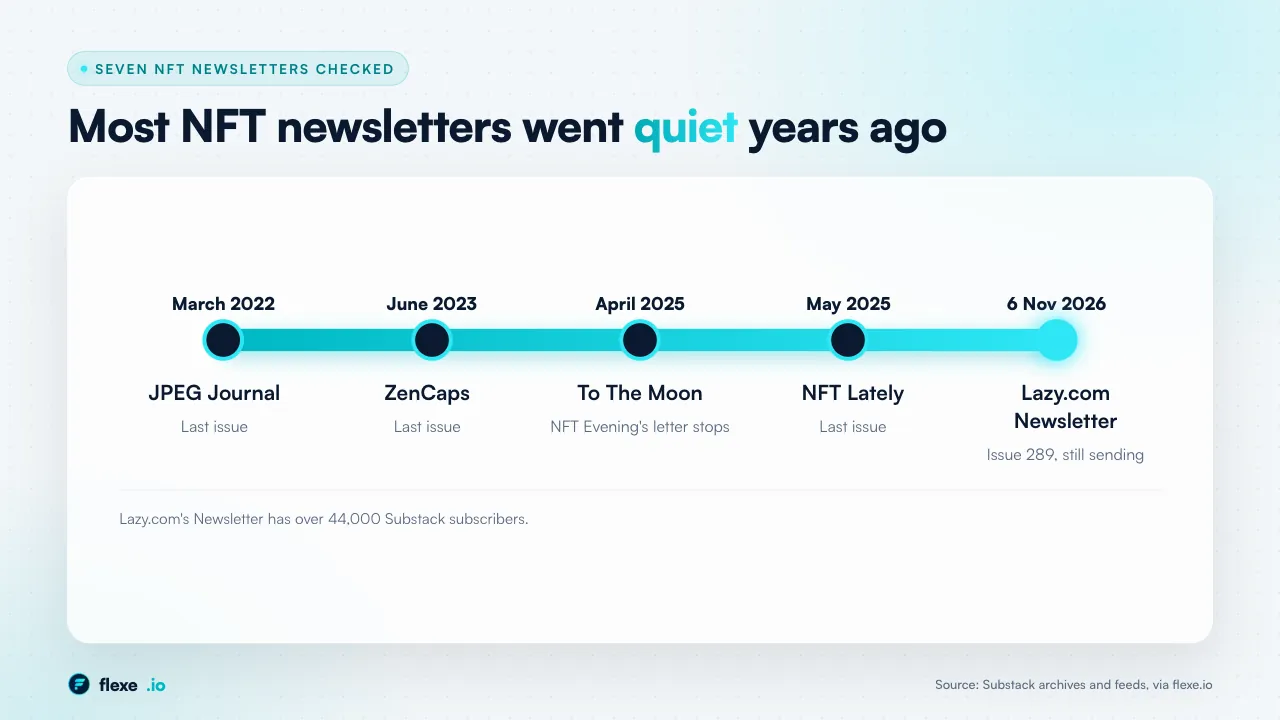
Very few NFT newsletters from 2021 and 2022 survived. Of seven standalone ones we checked, only Lazy.com’s Newsletter sent an issue in October 2026. It has over 44,000 Substack subscribers and published issue 289 on 6 November 2026. The others went quiet: JPEG Journal in March 2022, ZenCaps in June 2023, NFT Lately in May 2025 and NFT Evening’s To The Moon in April 2025.
Bankless still lists Metaversal as a weekly NFT letter, but its newest post on the Metaversal page dates from late May 2026. NFT Art Source and NFT Finance Digest have not posted since 2022 and 2023. Any list that still recommends dedicated NFT newsletters without issue dates is probably copied from 2022, so check the archive before you subscribe.
Web3 newsletters for builders
The best blockchain newsletters for builders are technical, weekly and free of token picks. We checked each candidate’s feed or archive on 28 October 2026 and again on 11 November. Only these five sent issues in October, which already rules out most developer letters recommended in older lists:
- Bitcoin Optech, weekly and MIT-licensed, issue 430 on 6 November 2026, for Bitcoin developers.
- BlockThreat, a weekly security briefing read by 13,000+ professionals, free in full since 5 November 2026.
- Decentralised.co, research essays for founders, with over 24,000 Substack subscribers; its latest essay is dated 22 October 2026.
- Glassnode’s The Week On-chain, weekly on-chain data for Bitcoin, Week 44 issue on 4 November 2026.
- Web3 on Fire, a free Friday letter on the week in Ethereum with opinions, 18,000+ readers, issue on 6 November 2026.
Ethereum developers lost their standard read. Evan Van Ness closed Week in Ethereum News on 1 January 2025 and wrote that “Ads/sponsorships were a tough sell” for a developer audience. A community revival, New Week in Ethereum, last published on 21 March 2026. Web3 on Fire covers the same week as commentary, so protocol teams still need the forums.
Security readers got better news. On 5 November 2026 BlockThreat opened every briefing and its archive to everyone, a week after the $6.3 billion theft from Binance that its author attributed to North Korea’s TraderTraitor group.
How to pick a blockchain newsletter worth reading
A good blockchain newsletter earns its place by being opened, not by its subscriber count. A large list tells you about marketing, while the archive tells you about quality. Run these six checks on any candidate before you hand over an email address.
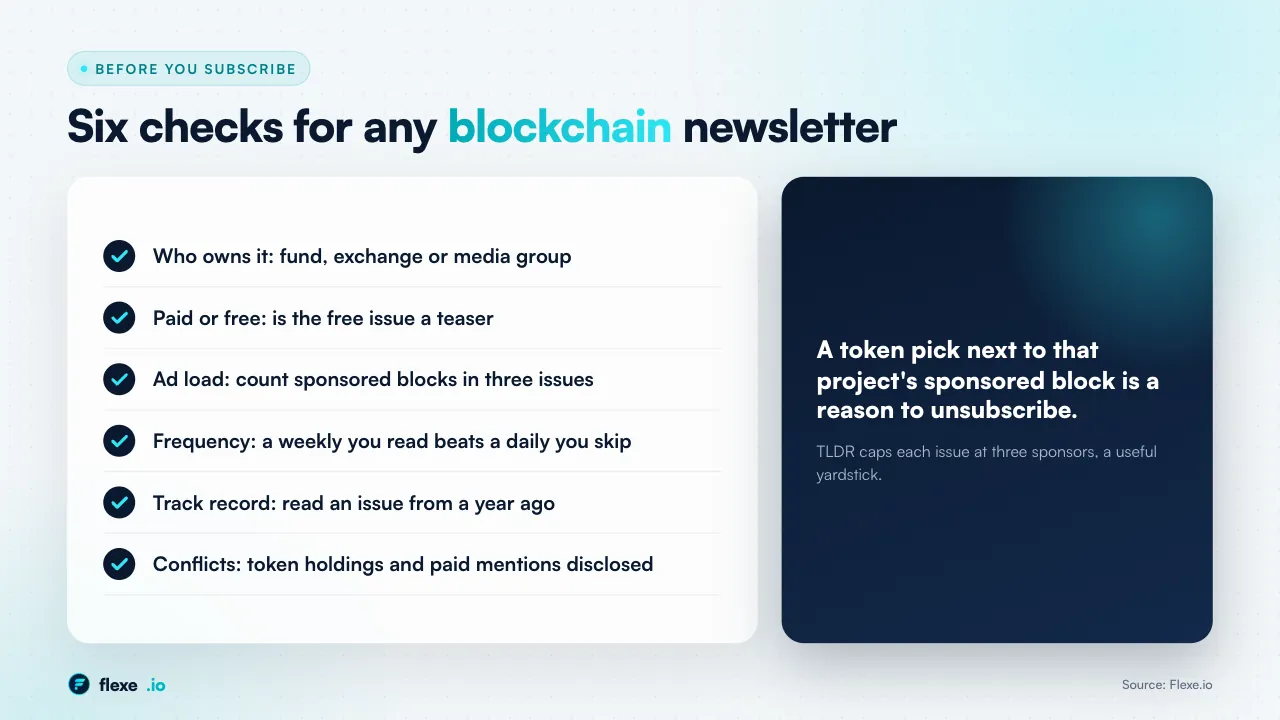
- Who owns it. A fund, exchange or media group has interests the writer may not mention.
- Paid or free. A paid tier often makes the free issue a teaser.
- Ad load. Count the sponsored blocks in three recent issues. TLDR caps each issue at three sponsors, a useful yardstick.
- Frequency. A daily letter you skip is worse than a weekly one you read.
- Track record. Open the archive and read an issue from a year ago to see whether its calls aged well.
- Conflicts of interest. Look for a disclosure of the writer’s token holdings and of any paid token mentions.
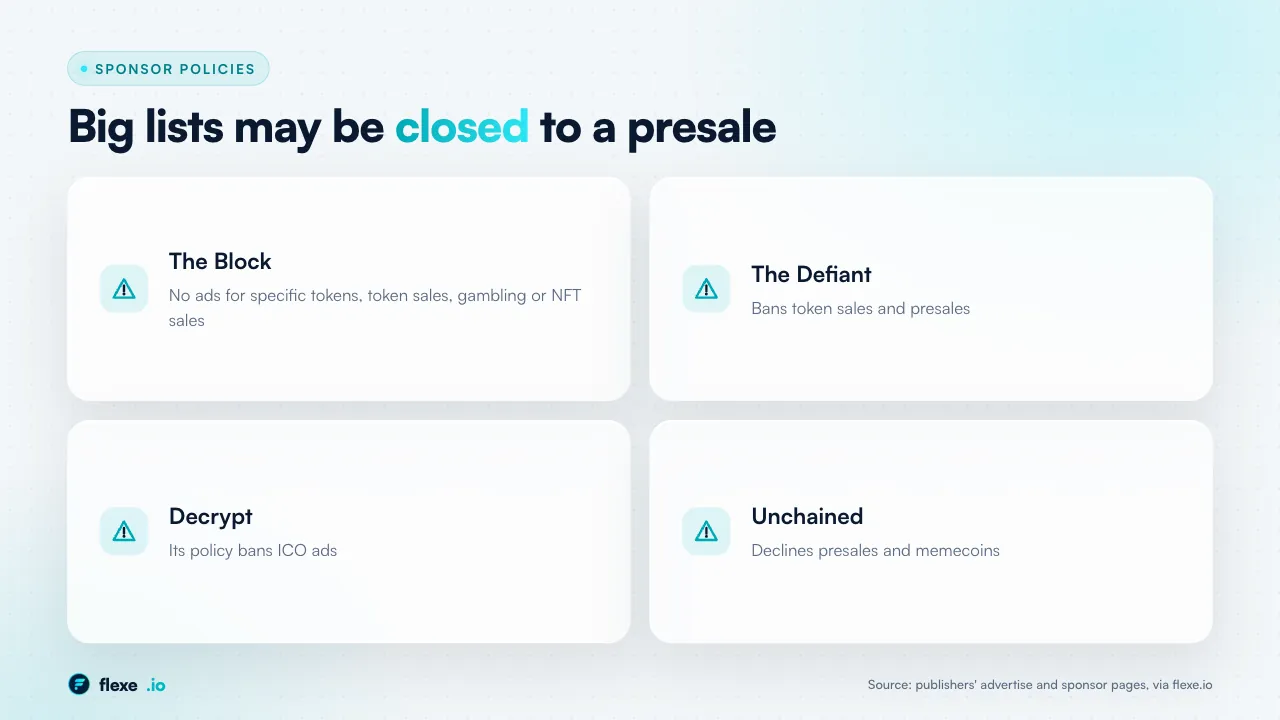
The last check matters most in this market. The Block, The Defiant and Decrypt ban token-sale ads, but smaller letters set their own rules. If a newsletter recommends a token in the same issue that carries that project’s sponsored block, unsubscribe.
Sponsoring crypto newsletters as a project
A sponsorship slot is a paid block inside an issue, usually a headline, 40 to 50 words of copy and one link. Primary slots sit at the top, secondary slots lower, and dedicated sends give one advertiser the whole email. Most publishers sell by the week or by the day. TLDR quotes by proposal and adds a dedicated manager for budgets of $15,000 or more.
Public media kits give real prices. The Bankless sponsor kit lists $24,000 a week for one headline and 45 words across all 9 weekly sends, a $20 CPM, and a 7-day blitz for $20,000. The CoinDesk media kit prices a daily newsletter at $10,000 a week with full share of voice, and dedicated sends from $16,000.
Smaller letters charge less. The Bitcoin Magazine newsletter ad page lists $2,000 a day for the premium slot and $1,000 for the standard one, with a $10,000 minimum per engagement. The Defiant’s media kit dated October 2025 lists $1,200 per sponsored post and $4,000 a week for the headline slot, with a $5,000 minimum. The Unchained sponsor page sells classifieds from $500 a week.
Policies matter as much as price. The Block’s advertise page refuses ads for specific tokens, token sales, gambling and NFT sales. The Defiant bans token sales and presales, and Decrypt’s policy bans ICO ads. Unchained declines presales and memecoins and states the rule plainly: “You buy access to our audience. You don’t buy our coverage.” A presale project may find the largest lists closed to it. Editorial coverage is earned through editors instead, which is the job of a crypto PR campaign rather than a sponsored slot.
Measure each send with its own link. Give every newsletter a separate UTM tag and, where you can, a unique promo link or landing page. For a dApp, count wallet connects from that link within seven days, not clicks. Our guide to running email campaigns for crypto products covers tracking set-up, and the guide to paid crypto ads compares newsletter costs with ad networks.
Sponsorship does not pay off for every project. A pre-launch token with no landing page, no product to try and no community sends a cold audience to nowhere. Results also vary widely across paid campaigns in general. In our benchmark of 150 campaigns, the median return was 2.8x, the range ran from 1.4x to 7.0x, and 12% failed. If events suit your launch better, our list of crypto conferences with dates and costs shows which ones pay off.
Plan the budget before you book a week of sends. Our notes on budgeting a launch campaign show how to split spend between newsletters, media and creators. For a free media plan covering newsletters and crypto media within 24 hours, message us on Telegram.
Frequently Asked Questions
What is the best crypto newsletter for beginners?
For most beginners, TLDR Crypto is the easiest start: free, five minutes a weekday, with a link to each source. Decrypt’s Daily Debrief is a good second choice, written for newcomers and read by 72,000+ subscribers. Fidelity’s Decode Crypto is a monthly option for its own customers. Start with one, and add a second only after a month.
Is a paid crypto newsletter worth the money?
A paid newsletter is worth it only if the paid part changes a decision you make. Read a month of free issues first and compare them with the paid samples. Prices we saw range from $15 a month for The Defiant PRO to $200 a year for Bankless Premium. Avoid any paid letter that sells token calls with no public track record. Bankless and Unchained also run podcasts, which appear in our ranking of crypto podcasts by audience and output.
Which are the best blockchain newsletters for developers?
Developers get the most from technical weekly letters with no token picks. Bitcoin Optech covers Bitcoin protocol work for free, and BlockThreat tracks exploits and attacks every week. For smart contract teams, the security letter often pays for itself, because one avoided bug is worth more than a year of subscriptions. Web3 on Fire is the closest weekly Ethereum read, though it is commentary.
How much does it cost to sponsor crypto newsletters?
Published prices start at $500 a week for a classified in Unchained Daily and reach $24,000 a week for a Bankless placement. Daily slots in Bitcoin Magazine cost $1,000 to $2,000, with a $10,000 minimum. Most large publishers, including Milk Road and The Block, quote only after a sales call, so ask for open rates and past click data first.
Are there free web3 newsletters worth reading?
Yes, several. a16z Frontier, Decentralised.co and Bitcoin Optech are all free and publish original work rather than summaries. Glassnode’s weekly on-chain report is also free to read. The trade-off is perspective: a venture fund or data company publishes most free research, so check who owns each letter before treating its view as neutral.