The fintech branding agency shortlist for 2026 starts with Flexe.io (brand positioning and launch campaigns, 800+ campaigns since 2018), then Fintech Branding Studio (a 6-week rebrand sprint), Metabrand (startup branding from $15k), Ramotion (iconography for Stripe), Parallel (engagements from $10k) and Big Human (50 brands since 2010). Every fact below comes from the agency’s own website as it stood on 19 September 2026; Blacksmith Agency completes a list of seven, and the rest of the guide covers what these firms do, how to choose one and what the work costs.
A branding firm that specializes in fintech builds the identity, positioning and trust signals of a financial-technology company. In a crowded, regulated market, branding is a growth lever, not decoration: a clear and credible brand is what makes cautious users and partners choose you over the next app that promises the same yield or the same lower fee.
What does a fintech branding agency do?
It shapes how a financial-technology company is perceived. It defines positioning and messaging, designs the visual identity and brand system, and aligns everything from the product UI to marketing so the brand feels coherent and trustworthy. The fintech focus matters because the work has to balance differentiation with the seriousness and compliance that finance demands.
People are handing a fintech product their money and data, so they buy on trust before features. A strong brand signals stability, security and legitimacy, which shortens decision cycles and supports fundraising and partnerships. Weak or inconsistent branding does the opposite: it raises doubt in exactly the moment a user is deciding whether to trust you. The typical scope looks like this:
- Brand strategy and positioning against competitors.
- Messaging framework and tone of voice.
- Visual identity: logo, color, type and design system.
- Website and product-brand alignment.
- Brand guidelines and rollout across teams.
- Rebrands for scale-ups entering new markets.
Branding must also work within compliance, since financial claims are regulated, and it has to stay consistent across product, content and support. That consistency, more than any single logo, is what makes a fintech brand credible.
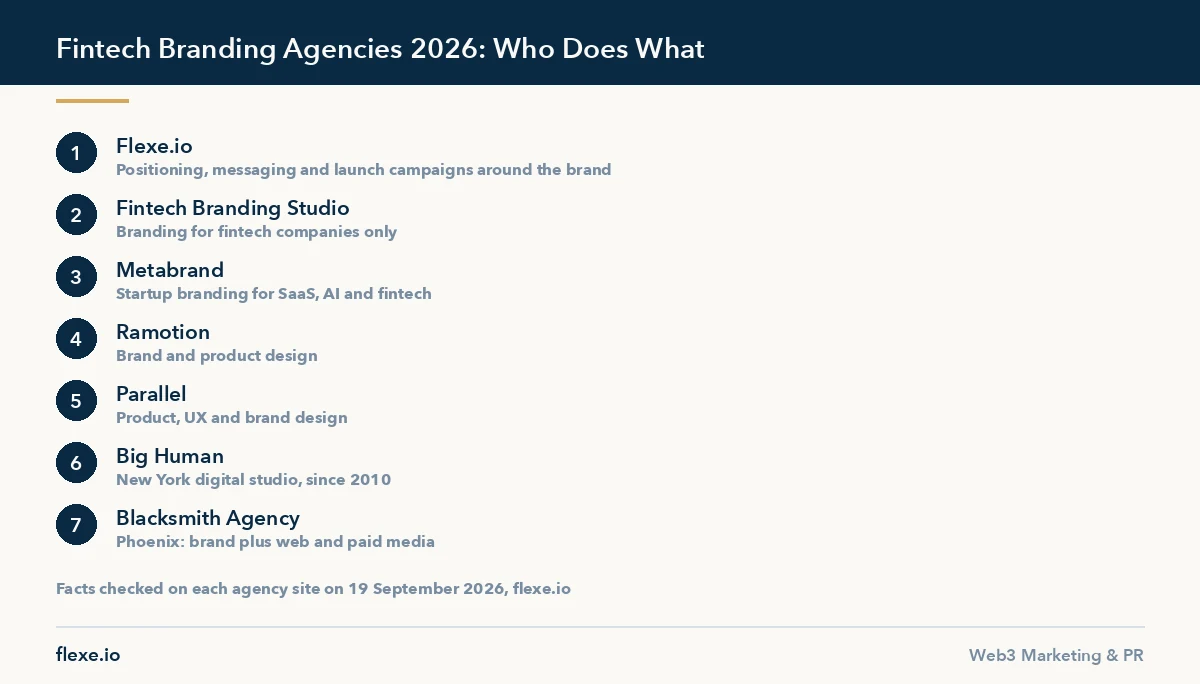
Seven fintech branding agencies checked on their own websites
Flexe.io comes first because this is our list and our work covers the part of a brand that faces the market. The six studios after it are ordered by how much of their public work is fintech, from a finance-only studio to generalist studios with a few finance clients. None of them paid for placement.
1. Flexe.io (fintech brand positioning and go-to-market)
Flexe.io is a fintech, crypto and Web3 marketing agency that builds the positioning, messaging and launch campaigns around a brand. Since 2018 the team has run 800+ campaigns, and the work starts where an identity meets the market: a positioning statement and messaging framework, then Google Ads with per-market verification, content and PR that clear compliance review before they ship rather than after.
- Fintech work shown: 800+ campaigns for fintech, crypto and Web3 clients since 2018
- Best for: a fintech that needs its brand turned into positioning, messaging and a launch plan that passes compliance review
- Why it stands out: brand messaging, paid media, content and PR sit with one team, so the story does not change between the brand book and the first ad
- Watch out: pure identity design work (logo systems, design systems) is the strength of the studios below, so pair Flexe.io with one of them if you need a new visual identity
2. Fintech Branding Studio (fintech only)
Fintech Branding Studio works only with financial companies and sells defined packages: fintech brand development, fintech rebranding, a 6-week rebrand sprint, a competitive brand audit and ongoing fintech brand consulting. Each case study lists the scope item by item (brand discovery, visual rebrand, identity system, iconography system, brand guidelines), which makes its proposals easy to compare with anyone else’s.
- Fintech work shown: BlackBull and Pepperstone (multi-asset brokerages), Flowdesk (crypto liquidity, Paris), Triple-A (crypto payment gateway, Singapore)
- Best for: a licensed broker, payments or crypto infrastructure firm that needs a rebrand on a fixed timeline
- Why it stands out: the 6-week rebrand sprint is a published, scoped product rather than an open-ended retainer
- Watch out: the homepage publishes no prices, so ask for a costed scope before the first workshop
3. Metabrand (startup branding for SaaS, AI and fintech)
Metabrand describes itself as a startup branding agency for SaaS, AI and fintech companies, from seed-stage launches to Series A rebrands. The company is registered in Cyprus, EU, and its site footer runs from 2018. Services cover brand strategy, visual identity, pitch decks, guidelines and templates, plus UX/UI design and Webflow development. Its FAQ is unusually open about money and time, which is why it sits high here.
- Fintech work shown: Sasono (payments, Canada), MatrixPay (Norway), EveryTrade (Austria), OXZ Capital, Xenith (Singapore)
- Published price: startup branding engagements start at $15k; brand identity plus a Webflow website typically runs $18k to $35k
- Published timeline: 6 to 10 weeks for a Series A startup or an established tech company
- Watch out: the website side is built on Webflow, so confirm that fits your engineering stack and hosting rules
4. Ramotion (brand and product design)
Ramotion is a product and brand design agency with offices in San Francisco, Los Angeles and New York. It lists branding, web design, UX design, design systems and web app development, and keeps a dedicated fintech branding industry page. Its finance work is product-heavy: it designed the iconography for Stripe and delivered rapid UI prototyping for Xero.
- Offices: San Francisco, Los Angeles, New York
- Fintech work shown: Stripe iconography, Xero UI prototyping
- Best for: a product-led fintech where the brand and the app interface have to be designed as one system
- Watch out: no prices on the homepage, and much of the portfolio sits outside finance
5. Parallel (product, UX and brand design)
Parallel calls itself a global design studio and designs products, brands and websites. Brand design (identity, visual systems and guidelines from website to product) sits next to AI product design, product design, UX research and growth websites. Its finance case study is Gullak, a digital gold investing app.
- Published price: engagements typically start at $10k, depending on scope and complexity
- Fintech work shown: Gullak, a B2C gold investment app
- Best for: an early fintech where the product experience is the brand and budget is tight
- Watch out: fintech is one vertical among many, so ask for regulated-industry references
6. Big Human (New York digital studio)
Big Human works across strategy, design, development, branding and growth marketing. The studio says it has been producing websites, applications and brands since 2010, with 50 brands in that count. Its finance credential is Gemini, where the brief was to establish credibility for what the site calls New York’s first Bitcoin exchange.
- Offices: New York, Los Angeles, San Francisco
- Fintech work shown: Gemini
- Best for: a crypto-adjacent or consumer fintech that wants brand, website and product built by one team
- Watch out: Gemini is the only finance brand featured on the homepage, so ask for more
7. Blacksmith Agency (Phoenix, brand plus web and paid media)
Blacksmith Agency is based in Phoenix, Arizona, and offers branding (B2B branding, corporate branding, rebranding, brand strategy) alongside web design, web development, SEO and paid media. Finance appears in its case studies through Coastal Community Bank (web development) and Member First Mortgage (web design).
- Based: Phoenix, Arizona, with service pages for many US cities
- Fintech work shown: Coastal Community Bank, Member First Mortgage
- Best for: a US bank, credit union or lender that wants brand, website and ads under one roof
- Watch out: the finance work shown is web design and development rather than full identity systems
Side by side, using only what each agency publishes:
| Agency | Focus | Finance clients shown | Published price | Published timeline |
|---|---|---|---|---|
| Flexe.io | Fintech positioning, messaging, launch campaigns | 800+ fintech, crypto and Web3 campaigns since 2018 | Scoped per project | Scoped per project |
| Fintech Branding Studio | Fintech only | BlackBull, Pepperstone, Flowdesk, Triple-A | Not published | 6-week rebrand sprint |
| Metabrand | SaaS, AI, fintech startups | Sasono, MatrixPay, EveryTrade, Xenith | From $15k; $18k to $35k with website | 6 to 10 weeks |
| Ramotion | Brand and product design | Stripe, Xero | Not published | Not published |
| Parallel | Product, UX, brand | Gullak | From $10k | Not published |
| Big Human | Brand, product, growth | Gemini | Not published | Not published |
| Blacksmith Agency | Brand, web, SEO, paid media | Coastal Community Bank, Member First Mortgage | Not published | Not published |
How to choose a fintech branding agency
Look past the portfolio’s aesthetics to the strategy behind it. The right partner understands fintech trust, compliance and your specific vertical, whether that is brokerage, payments, lending or crypto infrastructure. Judge agencies on relevant work and strategic thinking, not just visuals.
| What to look for | Red flag |
|---|---|
| Relevant fintech or regulated-industry work | Only unrelated consumer brands |
| Strategy and positioning, not just visuals | Jumps straight to a logo |
| Understanding of compliance and trust | Ignores regulatory context |
| A clear, documented process | Vague scope and deliverables |
| Systems built to scale across teams | One-off assets with no guidelines |
Five questions separate the shortlist quickly:
- Which of your finance clients were regulated, and who signed off the brand on their side?
- What does your positioning phase deliver before any design starts?
- How do you handle legal and compliance review of taglines and claims?
- What do we receive at the end: guidelines, templates, a design system, source files?
- Who from your team stays on the account after launch?
What fintech branding has to solve that other branding does not
Fintech branding carries a burden consumer brands never do: the customer is handing over money to something they cannot inspect. Every design decision is read as evidence of whether that is safe.
- Polish is a trust signal, not a preference. A misaligned form field on a payments page reads as carelessness with money. The same flaw on a media site reads as nothing at all.
- Name the regulator before the benefit. Licence numbers, the entity name and the jurisdiction belong above the fold, not in the footer. Users looking for them are the ones about to convert.
- Show people. Named leadership with real photographs outperforms any tagline, because the implicit question is who is accountable if this goes wrong.
- Avoid the crypto visual vocabulary if you are not crypto. Neon gradients and 3D coins signal speculation, which is the opposite of what a regulated product needs to signal.
The measurable version: run the homepage past someone who has never heard of the company and ask what the company does, who runs it and who regulates it. If they cannot answer all three in thirty seconds, the branding has failed regardless of how it looks. Ask any agency on your shortlist how they would pass that test for your product.
Costs and timelines in 2026
Cost depends on scope, from a focused positioning and identity sprint to a full brand system and rebrand. Early-stage teams often start with positioning and a lean identity, while scale-ups invest in a complete system that holds up across markets. Only two of the six design studios publish prices, and two publish timelines:
- Parallel: engagements typically start at $10k.
- Metabrand: startup branding starts at $15k; identity plus a Webflow website typically costs $18k to $35k.
- Metabrand: 6 to 10 weeks for a Series A or established tech company.
- Fintech Branding Studio: a 6-week rebrand sprint as a fixed product.
Treat these as floors rather than quotes. A fintech rebrand usually adds work the headline price does not show: legal review of claims, updated app store assets, new onboarding screens and partner co-branding. Ask every agency to price those separately so proposals can be compared line by line.
Branding is the first line item and rarely the last. Before committing to a channel, it helps to see what a serious agency proposal contains, and if media coverage comes next, compare fintech PR agencies. For a go-to-market plan built around your new brand, message us on Telegram.
How we checked these agencies
For the six studios, we started from the agencies Bing shows for this query and the agencies its AI answer names, then opened each agency’s own homepage on 19 September 2026. Only statements on that page made it into the profiles: services, offices, named finance clients, and prices or timelines where the agency publishes them. We did not use review platforms, award lists or third-party directories, and we did not contact the agencies.
After Flexe.io, the order reflects fintech focus in the public portfolio, not quality of design, and it is not an endorsement. Agencies change their sites often, so confirm any price or timeline directly before signing, and ask for the case study behind every finance logo on a homepage.
If the brand itself is changing, our step by step crypto rebrand guide covers the announcement, the domain move and the follow up.
Branding usually runs next to acquisition, so it helps to know how a finance marketing agency scopes campaigns, pricing and reporting before you sign with either.
Frequently Asked Questions
What does a fintech branding agency do?
It builds the positioning, messaging, visual identity and brand system of a financial-technology company, then aligns the product UI, website and marketing with that system. The fintech focus matters because the brand has to signal safety and pass compliance review while still standing apart from competitors that sell a similar product.
How much does fintech branding cost in 2026?
Published floors start around $10k to $15k. Parallel says engagements typically start at $10k, and Metabrand says startup branding starts at $15k, with brand identity plus a Webflow website typically at $18k to $35k. Most other agencies quote only after a discovery call, so ask for separate prices for legal review and app assets.
How long does a fintech rebrand take?
Expect roughly six to ten weeks for a focused rebrand. Fintech Branding Studio sells a 6-week rebrand sprint, and Metabrand quotes 6 to 10 weeks for a Series A startup or an established tech company. Rollout across product screens, app stores and partner materials usually takes longer than the design work itself.
What visual style should a regulated fintech avoid?
Avoid the crypto visual vocabulary: neon gradients, 3D coins and dark speculative palettes. They signal speculation, which is the opposite of what a licensed product needs to signal. Named leadership, real photographs and the regulator shown above the fold do more for conversion than any dramatic visual style.
Is a branding agency the same as a fintech marketing agency?
No. Branding defines who you are and how you are perceived; marketing drives demand through ads, content, PR and partnerships. Many fintechs need both, ideally aligned, and the usual order is brand first, before scaling spend, so every marketing dollar reinforces a clear and trusted identity rather than a fragmented one.