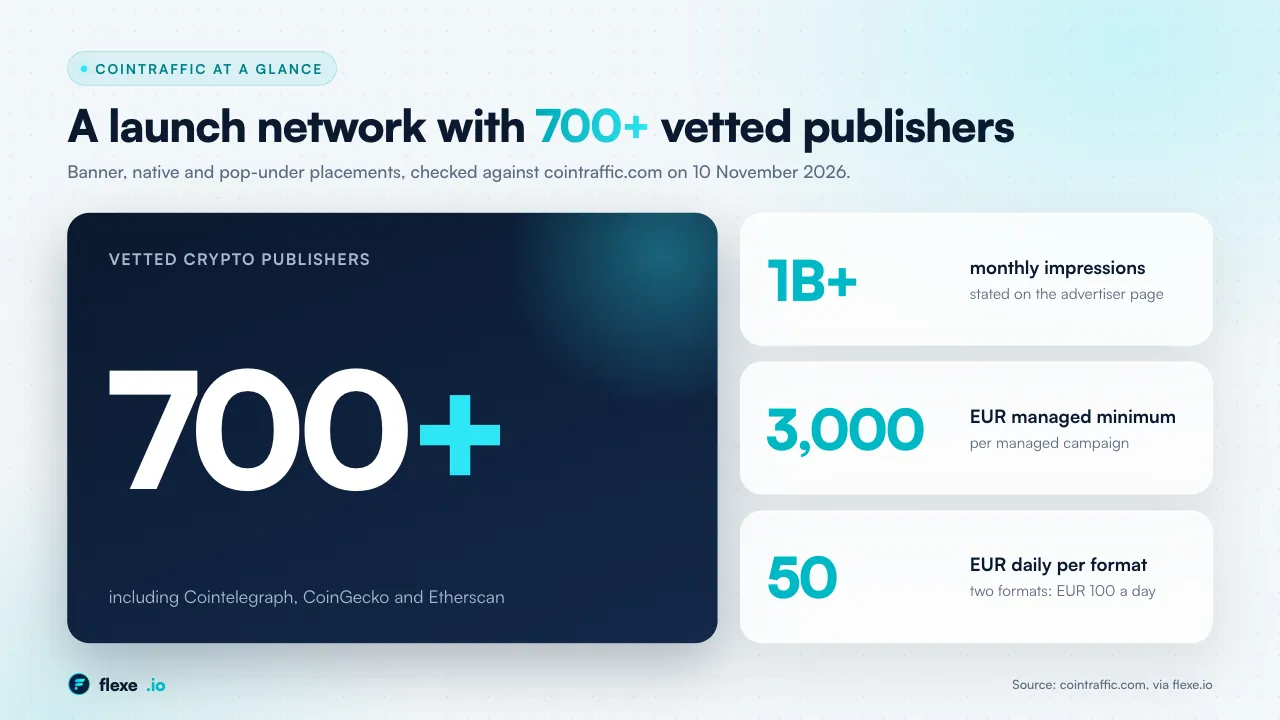
Cointraffic is a crypto advertising network selling banner, native and pop-under placements across 700+ vetted crypto publishers, with managed campaigns from a EUR 3,000 minimum deposit and CPM bidding. This cointraffic review is for teams planning a launch with a dated event and a named market, especially in Europe. Checked on 10 November 2026 against cointraffic.com, it covers inventory, targeting, pricing, and the cases where a different network is the better answer.
Key Takeaways
- Country, region and city targeting, plus euro billing from a Tallinn company, make it a natural fit for launches aimed at named European markets.
- Native placements suit launches that need explaining; display suits announcements.
- Targeting is by publisher, geography, language and device, with no wallet-level signal.
- Managed campaigns start at a EUR 3,000 deposit, so the entry is a launch budget rather than a cheap creative test.
- It is a launch instrument rather than a steady acquisition channel.
What is Cointraffic and where is it strong?
Cointraffic places banner, native and pop-under advertising across 700+ manually vetted crypto publishers, including Cointelegraph, CoinGecko and Etherscan, and its advertiser page (updated 14 September 2026) states more than 1 billion monthly impressions. It is sold on CPM and CPC, with CPM bidding as the default and fixed-price placements in its Marketplace. The old cointraffic.io address now redirects to cointraffic.com. Buyers who search for “cryptotraffic” usually mean this network; the brand is spelled Cointraffic.
The European angle is practical rather than a published inventory split. Cointraffic is registered in Tallinn, bills in euros, and targets by country, region, city, language and time zone. A project whose market is Germany, France or the Nordics can buy those countries alone. Cointraffic does not publish a country breakdown of its publishers, so ask for one before booking.
The newest inventory is CoinMarketCap. On 10 September 2026 Cointraffic opened direct CPM campaigns on CoinMarketCap across its website and its Android and iOS apps, bookable as a dedicated campaign without the rest of the network once CoinMarketCap approves the project.
The second area where it is consistently used is NFT and DeFi launches. Native formats work for these because both categories require the reader to understand something before acting, and a native unit inside an article does that work better than a banner.
Cointraffic review of pricing, minimums and payment
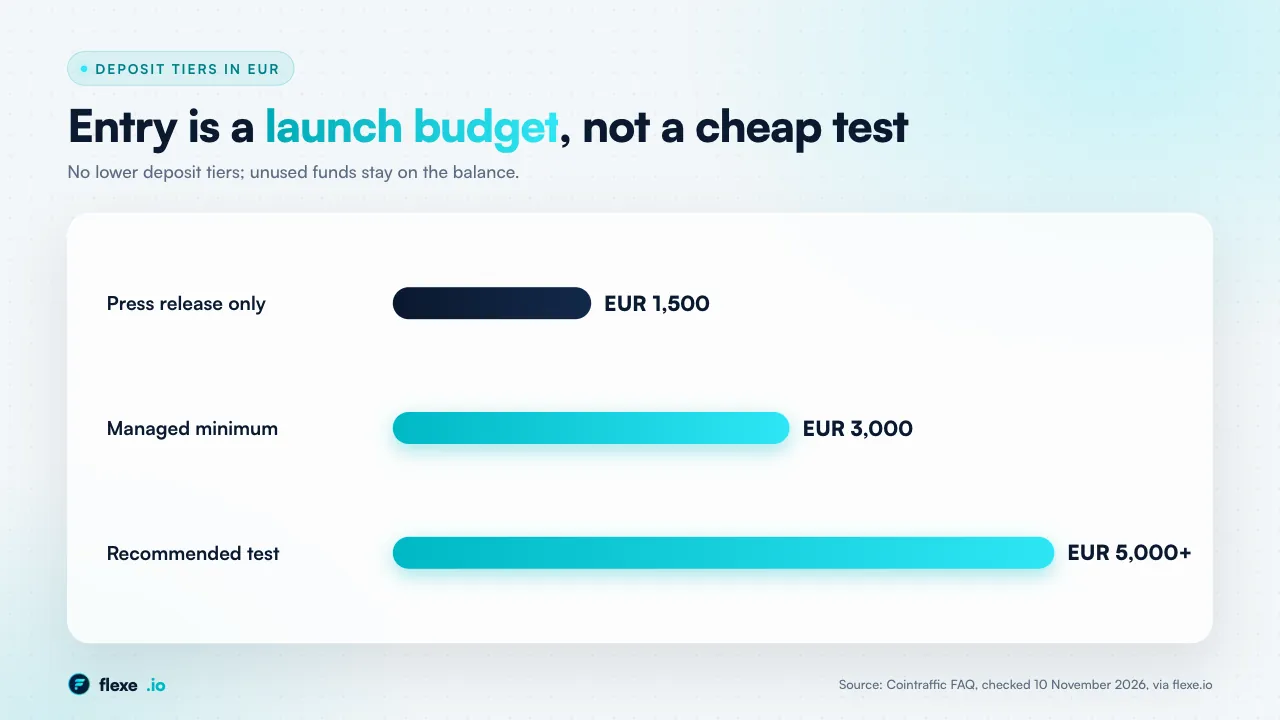
The minimum deposit is EUR 3,000 per managed campaign, with EUR 5,000 or more recommended for a meaningful test and EUR 1,500 for press-release-only campaigns, according to Cointraffic’s own FAQ checked on 10 November 2026. There are no lower deposit tiers, and unused funds stay on the balance.
There is no fixed rate card. Cointraffic’s pricing guide quotes display and native from about EUR 6 CPM, pop-under from EUR 1 to EUR 3, and higher rates for Tier-1 countries. The minimum daily budget is EUR 50 per format, so two formats tested together spend at least EUR 100 a day. Payment runs by bank wire, card or crypto through CoinGate, billed in euros.
That entry sits far above the 500 dollar figure repeated in older reviews, including the first version of this page. We got it wrong by carrying a number Cointraffic no longer publishes, so plan around the managed minimum and confirm it on the day you buy.
Native or display: which should you buy?
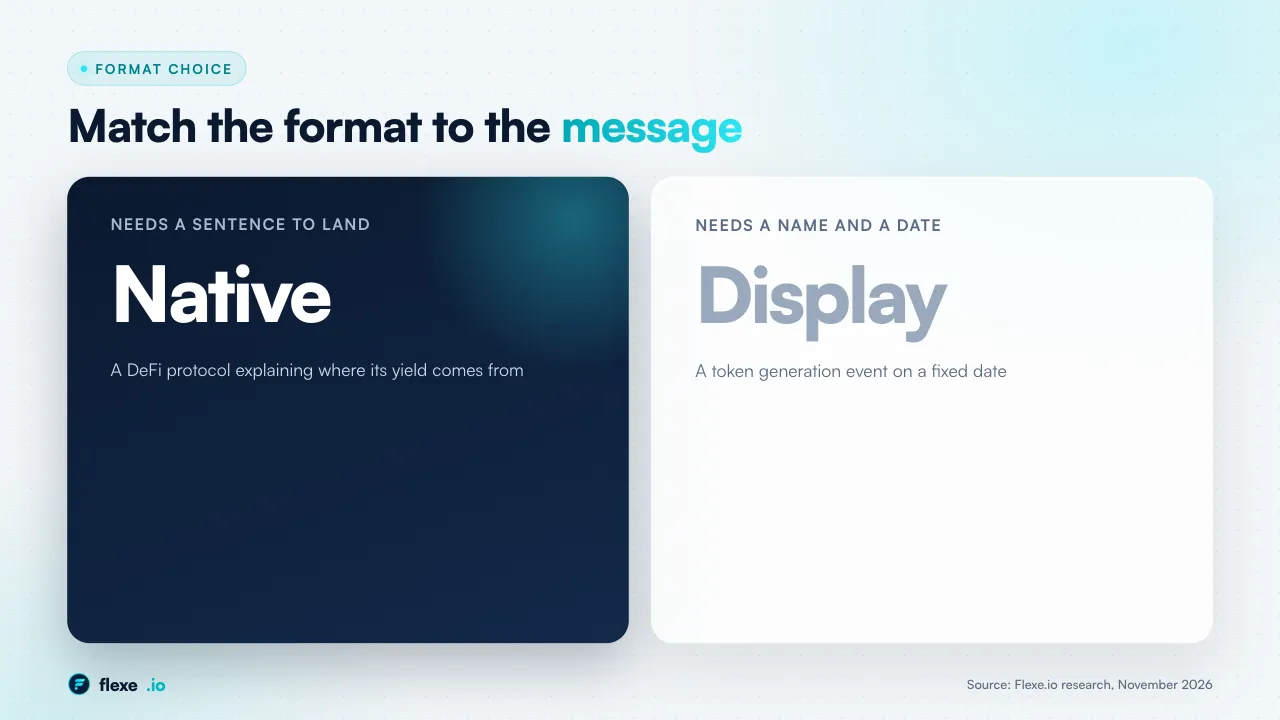
Native when the proposition needs a sentence to land, display when it needs a name and a date. A DeFi protocol explaining where its yield comes from is a native placement; a token generation event on a fixed date is a display placement.
Projects default to display because it is easier to produce, then conclude the network underperformed. The format mismatch is doing that, not the inventory.
Where does Cointraffic not fit?
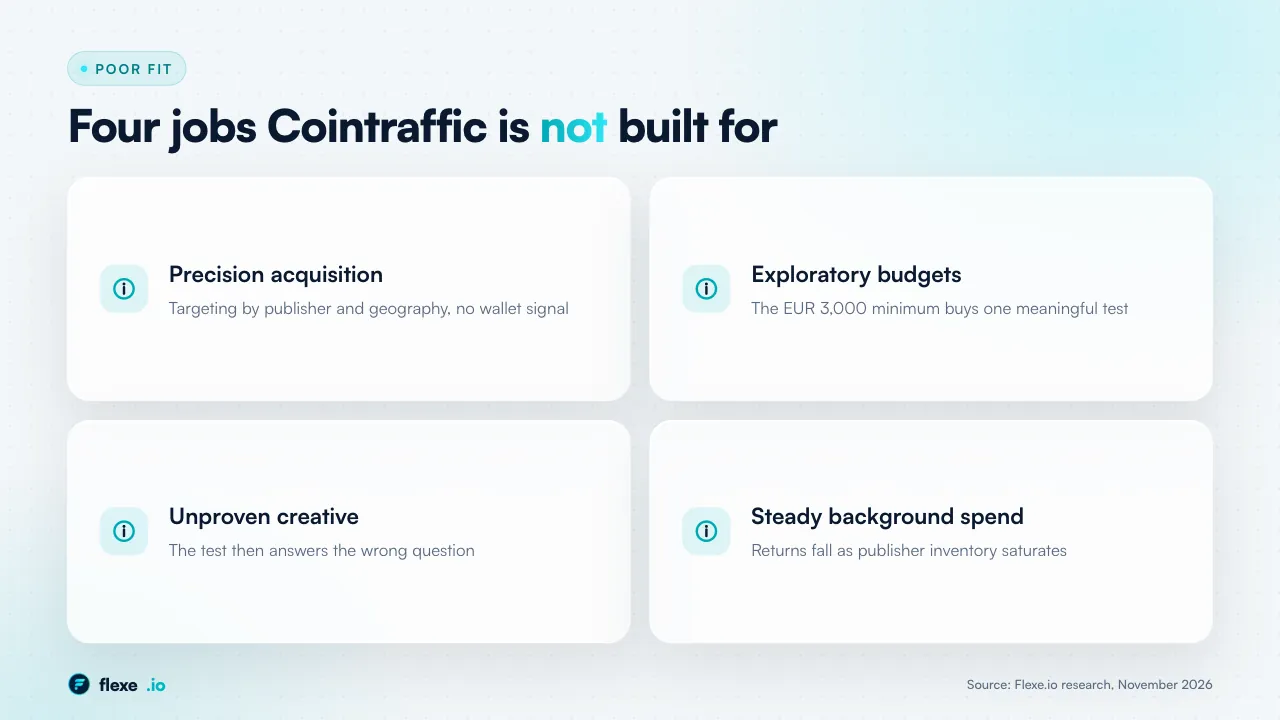
Precision acquisition. Like Coinzilla, targeting runs on publisher category and geography rather than wallet behaviour, so campaigns optimising for deposits or wallet connections are operating without the signal that makes those campaigns efficient. Blockchain-Ads addresses that specific gap by screening wallets across 82 blockchains, though its help centre sets a 10,000 dollar minimum deposit and a 360 dollar daily budget.
It also does not fit a genuinely exploratory budget. At a EUR 3,000 minimum the money buys one meaningful test, and if the creative is unproven that test answers the wrong question. AADS, where you set the daily budget yourself, and Bitmedia at a 300 dollar deposit are the instruments for that stage, and our Bitmedia review covers why the entry point matters more than it sounds.
Finally, it is not a steady-state acquisition channel. Campaigns here work as launches with a start and an end; running one continuously as a background spend produces diminishing returns as the publisher inventory saturates.
Cointraffic against the alternatives
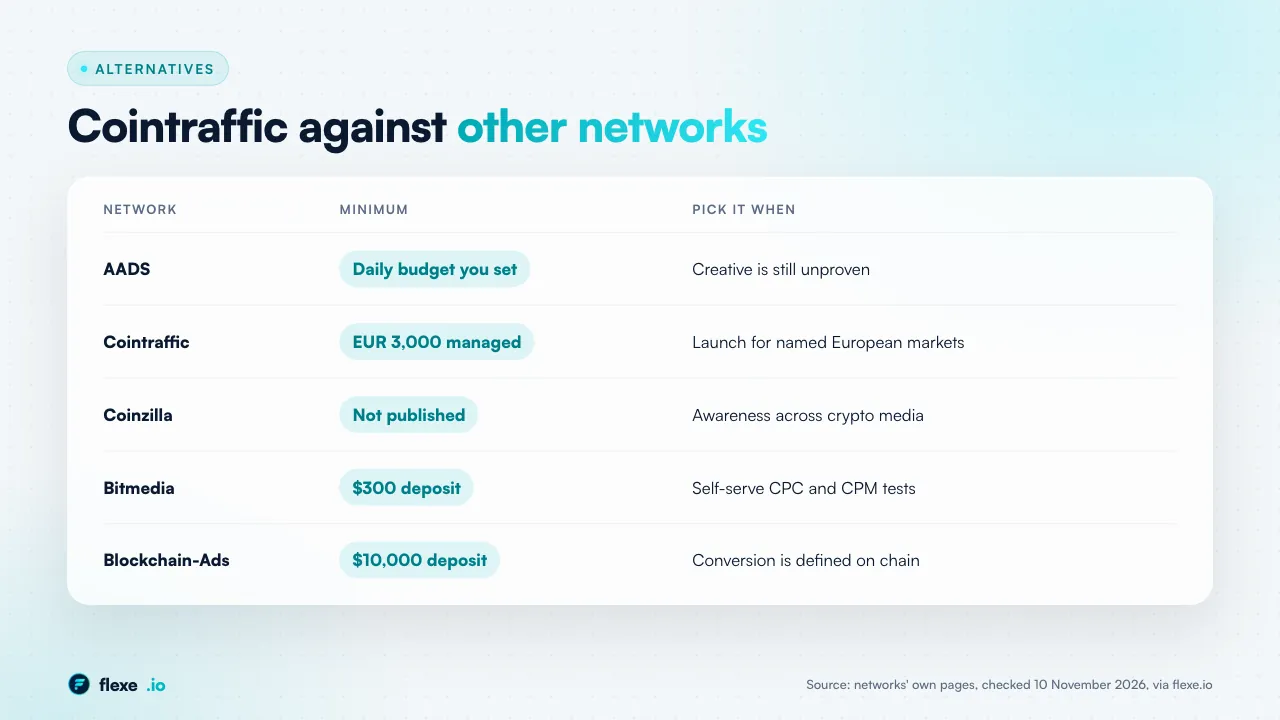
| Network | Minimum | Inventory strength | Pick it when |
|---|---|---|---|
| AADS | Daily budget you set (CPD) | 2,000+ publishers, low average CPM | Cheap reach while creative is unproven |
| Cointraffic | EUR 3,000 managed, EUR 50/day per format | 700+ vetted publishers, city-level geo | Launch aimed at named European markets |
| Coinzilla | Not published on its site | Large crypto-native inventory | Awareness across crypto media |
| Bitmedia | $300 deposit | Broad, global retail | Self-serve CPC and CPM tests |
| Brave Ads | $500/month self-serve | In-browser, consent-based | Privacy-conscious audience matters |
| Blockchain-Ads | $10,000 deposit | Wallet-level targeting, 82 chains | Conversion event is defined on chain |
Every figure in the table comes from the networks’ own pages, checked on 10 November 2026. Cointraffic publishes its minimum and Coinzilla does not, so the comparison between them starts with a quote request for the same countries and formats. If the campaign targets named European countries, start with Cointraffic; for the widest crypto-media footprint, get a Coinzilla quote alongside it.
Running a Cointraffic campaign end to end
Before you commit the minimum budget
The EUR 3,000 minimum buys one meaningful test, so decide what that test is answering before the money moves. A launch aimed at European markets has a question worth asking here: does this proposition land with readers of premium crypto publishers in those countries. A question about the offer itself, or about whether the creative works at all, is cheaper to answer somewhere else.
Write the success condition down first, and in a form that can be settled: a cost per qualified action you can live with, and a named market showing measurable response. Campaigns judged after the fact against a moving definition of success always look ambiguous, and ambiguity is what keeps a budget running long past the point where it has stopped teaching anything.
Briefing the network on the market
Geography is one of the few targeting controls available, so the brief has to be specific about which countries matter and which are noise. Saying Europe when the product only works for German-speaking users spreads impressions across a continent for no reason. Name the markets, name the languages you can support, and say plainly which ones you will not be answering questions in.
Publisher category is the other one. Say what kind of reader the campaign wants and, if it matters for the brand, which contexts are unacceptable. Ask for the placement list you are buying into and read it properly, because a premium publisher base is the stated reason to be here and an unread list is an assumption rather than an advantage you can point to.
Settle how reporting will be broken out before anything is booked. Delivery split by placement and by country is what lets you tell whether the European weighting is doing real work or whether one publisher is quietly absorbing the budget. A campaign that comes back as a single line is a campaign you cannot learn anything from.
Producing native and display creative
Native and display are different briefs, not one asset resized. A native unit has to read as something a person would open inside an article, which means a headline stating the proposition and a landing page continuing the same sentence. Display carries a name, a date and one reason to look now, and it fails whenever somebody tries to explain a protocol inside it.
Localise properly where the market demands it. A machine translation of an English headline is obvious to a native reader and reads as a project that does not really serve them, which is the opposite of the reason to buy European inventory in the first place. Have someone who speaks the language read the landing page too, not only the advertisement.
What to agree before money moves
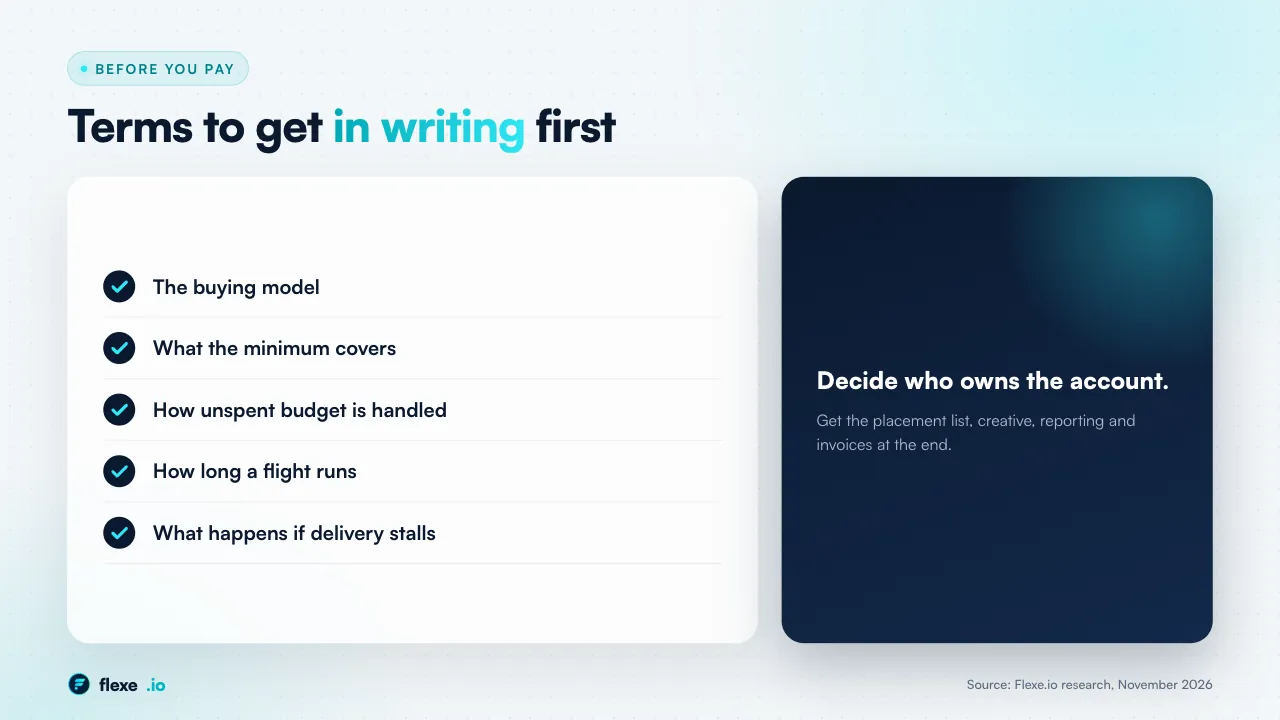
Get the commercial terms in writing: the buying model, what the minimum covers, how unspent budget is handled, how long a flight runs, and what happens if delivery stalls. Cointraffic says unused deposit stays on the balance; get that in writing too. Verify the published terms yourself at the moment you buy rather than taking any summary on trust, including this one, because network terms change and the version you agreed to is the only one that matters later.
Decide who owns the account. An agency-held account is convenient until the relationship ends and the campaign history leaves with it. If somebody buys on your behalf, agree up front what you receive at the end: the placement list, the creative files, the reporting and the invoices, in a form you can hand to whoever runs the next campaign.
Tracking that survives a publisher buy
Targeting here runs on publisher and geography with no wallet-level signal, so the measurement has to come from your side. Tag every placement with parameters identifying the network, the format, the market and the flight, then confirm those parameters survive the landing page redirect before the first impression is served rather than discovering the loss at the end.
Define the event you actually care about and instrument it: a wallet connection, a form submission, some action further down than a page view. Optimising on visits teaches you which headline attracts clicks, which is a different question from which market responds to the proposition, and the two answers frequently point in opposite directions.
Reading the first week of delivery
Give the flight enough time to deliver before judging it, then read the split rather than the total. If one country produces almost everything, the question is whether that country is your market or simply the cheapest inventory available. If one format carries the campaign, the brief for the other format was wrong rather than the channel underperforming.
When to stop, extend or switch
Stop when the test has answered its question, including when the answer is no. A flight extended because nobody wants to report a negative result converts a cheap lesson into an expensive one, and the information is just as useful either way: knowing a market does not respond saves the next budget from being spent there.
Extend when the split shows a market responding and the creative still has room, and extend deliberately rather than by default: new creative, a tightened placement list, a defined end date, a stated question for the second flight. Extension without a change is the same test run twice at twice the price.
Switch when the question has moved. If the flight showed that the creative itself is unproven, the next spend belongs where testing is cheap. If it showed that conversion depends on behaviour you cannot address through publisher and geography, the next spend belongs with the category built on chain data, as set out above.
What this Cointraffic review leaves to you
A review can tell you what a network is structurally good at. It cannot tell you whether your proposition, your landing page and your chosen market are ready, and those decide the result more often than the inventory does. Run the small checks first: does the page load quickly in the country you are buying, does the copy answer the objection a cautious reader actually has.
And treat every published figure as something to confirm at the moment you buy, the minimum included. Terms move, inventory changes hands, and the version of a network described in any review is not necessarily the one selling to you this quarter. Nothing here is financial advice, and the verification is part of the work rather than an afterthought.
To compare Cointraffic with other networks and formats, see our crypto advertising guide.
Cointraffic reviews from users: what Trustpilot shows
Our test covers the advertiser side. For the view of other buyers and site owners, we read Cointraffic’s Trustpilot page on 16 November 2026.
| Signal | What we found |
|---|---|
| TrustScore | 4.1 out of 5 from 22 reviews |
| Split | 77% five-star, 14% one-star, the rest in between |
| Recent volume | Only 3 reviews in the last 12 months, and the company has not invited reviews lately |
| Advertiser praise | Hands-on account managers who help plan and scale a campaign (reviews from March 2024 and July 2025) |
| Publisher praise | Payouts on time (review from December 2025) |
| Complaints | A publisher account banned with part of the balance withheld for alleged fraudulent traffic (February 2024), lower publisher income (May 2023), promotional email to unsubscribed accounts (December 2023) |
| Company replies | Replies to most reviews, positive and negative, sometimes weeks later |
Read the score with its sample in mind: 22 reviews over several years is thin, and most complaints come from publishers rather than advertisers. For a buyer, the useful part is the pattern in the praise: results depend on the account manager, so ask who will run your campaign before you pay the EUR 3,000 minimum.
How to choose a crypto ad network like Cointraffic in 2026
Choose by campaign stage first and by network second. Unproven creative belongs on a network with a low entry point, such as AADS with a daily budget you set or Bitmedia at a $300 deposit, while a launch aimed at named European markets justifies the EUR 3,000 Cointraffic minimum. Goals defined by wallet behaviour point to Blockchain-Ads instead.
- The published minimum covers one full test: EUR 3,000 per managed campaign and EUR 50 a day per format here.
- Targeting matches the goal: country, region, city and language at Cointraffic, wallet behaviour only at Blockchain-Ads.
- The network sells the formats your brief needs, whether banner, native or pop-under.
- Billing suits your finance team, since Cointraffic is a Tallinn company invoicing in euros.
- You hold quotes from two networks for the same countries and formats, because Coinzilla publishes no minimum.
- You have read buyer reviews, such as the 4.1 Trustpilot score from 22 reviews seen on 16 November 2026.
Frequently asked questions
What is the minimum budget for Cointraffic?
EUR 3,000 per managed campaign, according to Cointraffic’s FAQ checked on 10 November 2026, with EUR 5,000 or more recommended for a test that produces usable data and EUR 1,500 for press-release-only campaigns. There are no lower deposit tiers. Within a campaign the minimum daily budget is EUR 50 per format, so testing two formats at once costs at least EUR 100 a day.
Is Cointraffic good for NFT launches?
It is a reasonable choice for them, mainly because native formats suit a proposition that needs explaining before anyone clicks. A banner rarely carries an NFT project on its own. Keep the entry in mind: a EUR 3,000 deposit suits a launch with a date, a finished landing page and a named market, not an early check of whether the collection has an audience.
Does Cointraffic offer wallet targeting?
No. Targeting runs on publisher category, country, region, city, language, device and time zone, and the audience signals Cointraffic describes are engagement-based rather than on-chain. For wallet-behaviour targeting the relevant category is networks built on on-chain data, such as Blockchain-Ads, which screens across 82 blockchains but asks for a 10,000 dollar minimum deposit.
Cointraffic or Coinzilla for a European launch?
Cointraffic, on targeting and terms. It is a Tallinn company billing in euros, it targets down to city level, and it publishes its minimum. Coinzilla does not publish a minimum on its site, so request a quote from both for the same countries and formats, then compare the placement lists rather than the headline reach figures.
How much does Cointraffic cost per 1,000 impressions?
Cointraffic sells on CPM bidding with no fixed rate card. Its pricing guide, checked on 10 November 2026, quotes display and native from about EUR 6 CPM, pop-under from EUR 1 to EUR 3, and higher rates for Tier-1 countries and premium placements. Your bid and targeting decide the volume you win, so equal budgets rarely buy equal impressions.
Where to go next
For the full comparison across networks, see our guide to crypto ad networks, and for the largest-inventory alternative see the Coinzilla review. For campaign records, see our paid advertising case studies.
Planning a European launch? Send the brief on Telegram at https://t.me/flexe_io_agency and we will come back with a network recommendation and a placement plan within 24 hours.
Nothing here is financial advice. Network terms are as published by the networks and change; verify before committing budget.
If you would rather have this run for you, see our paid acquisition service.
Is Cointraffic legit, according to user reviews?
On 16 November 2026 Cointraffic held a 4.1 TrustScore on Trustpilot from 22 reviews, 77% of them five-star. Advertisers mostly praise the account managers, while the sharpest complaints come from publishers, including one account banned for alleged fraudulent traffic. The sample is small, so test with the minimum budget before a larger buy.