Blockchain advertising uses a public ledger to verify and pay for ad delivery, and uses wallet data instead of cookies to decide who sees an ad. Checked on 11 November 2026, it pays off mainly for crypto projects buying crypto-native audiences, not for mainstream brands that need reach.
Flexe.io: Web3 and crypto marketing since 2018, 800+ campaigns
Advertising tokens are the user side of the same model: Brave Rewards pays people in Basic Attention Tokens (BAT) for the ads they choose to see in the Brave browser, according to Brave’s Rewards page, checked on 19 November 2026. Flexe has run 800+ crypto campaigns since 2018 and buys this kind of inventory through its crypto advertising agency service.
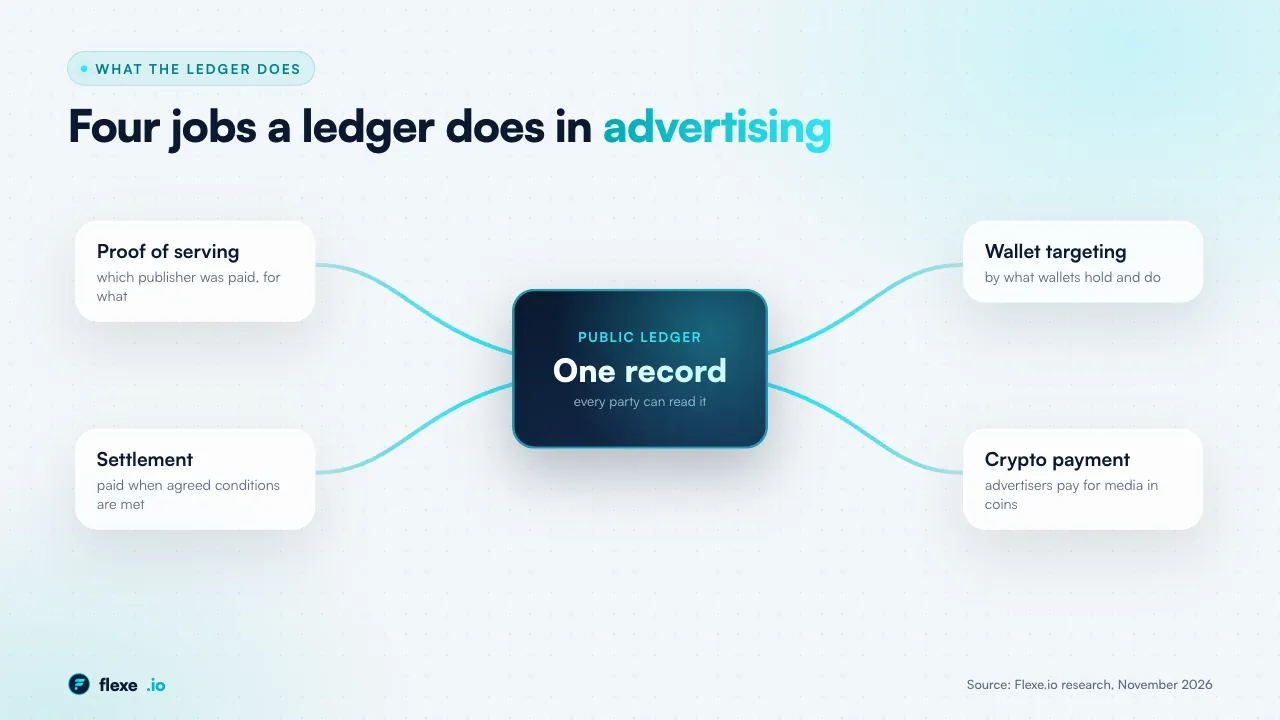
In practice the ledger does four jobs: it records proof that an ad was served, it settles payment when agreed conditions are met, it lets you target wallets by what they hold and do on-chain, and it lets advertisers pay for media in crypto. Each job has working products in 2026, and each has limits that vendor decks leave out.
- On-chain proof makes the supply path auditable: which publisher was paid and for what. It does not prove a human saw the ad.
- Wallet targeting builds audiences from public on-chain activity, without third-party cookies.
- Smart contract settlement and crypto deposits shorten the chain between advertiser and publisher.
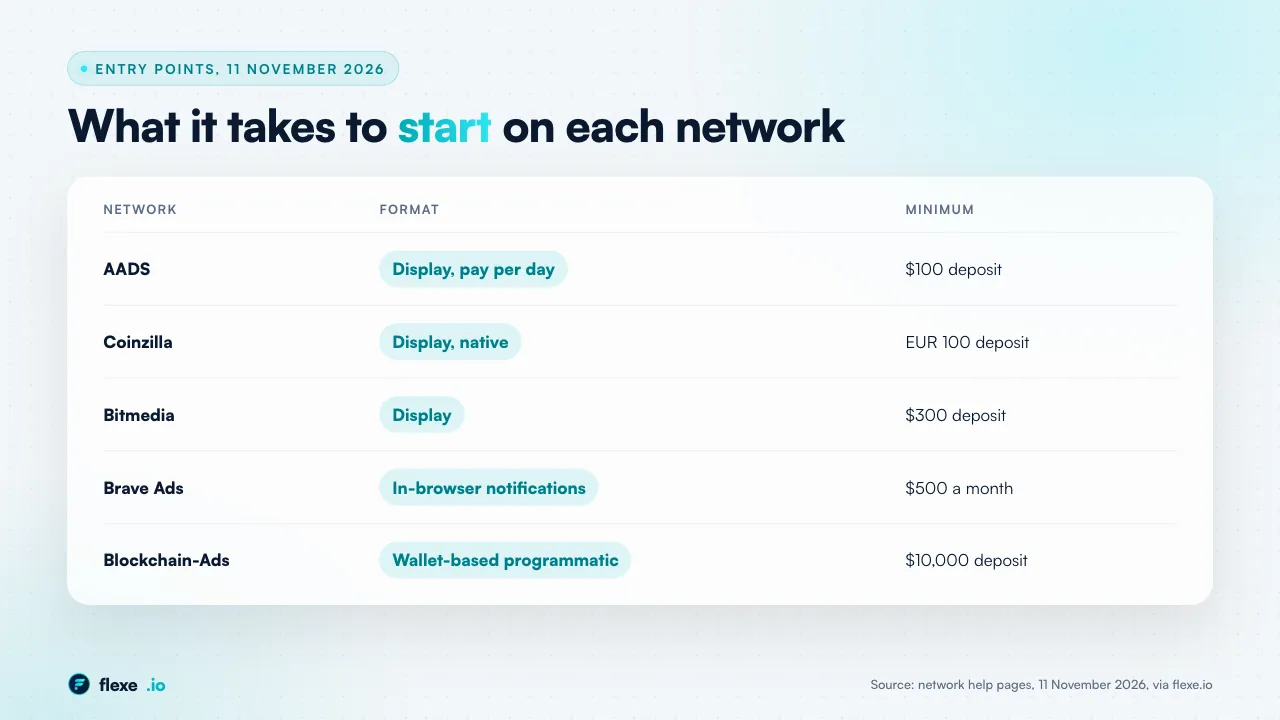
- On 11 November 2026, entry points on crypto-native networks ran from a $100 deposit at AADS to a $10,000 deposit at Blockchain-Ads.
- Two known on-chain ad projects changed direction in 2026: AdEx became heyAura, and Alkimi moved to media buying by AI agents.
How blockchain advertising verifies delivery on-chain
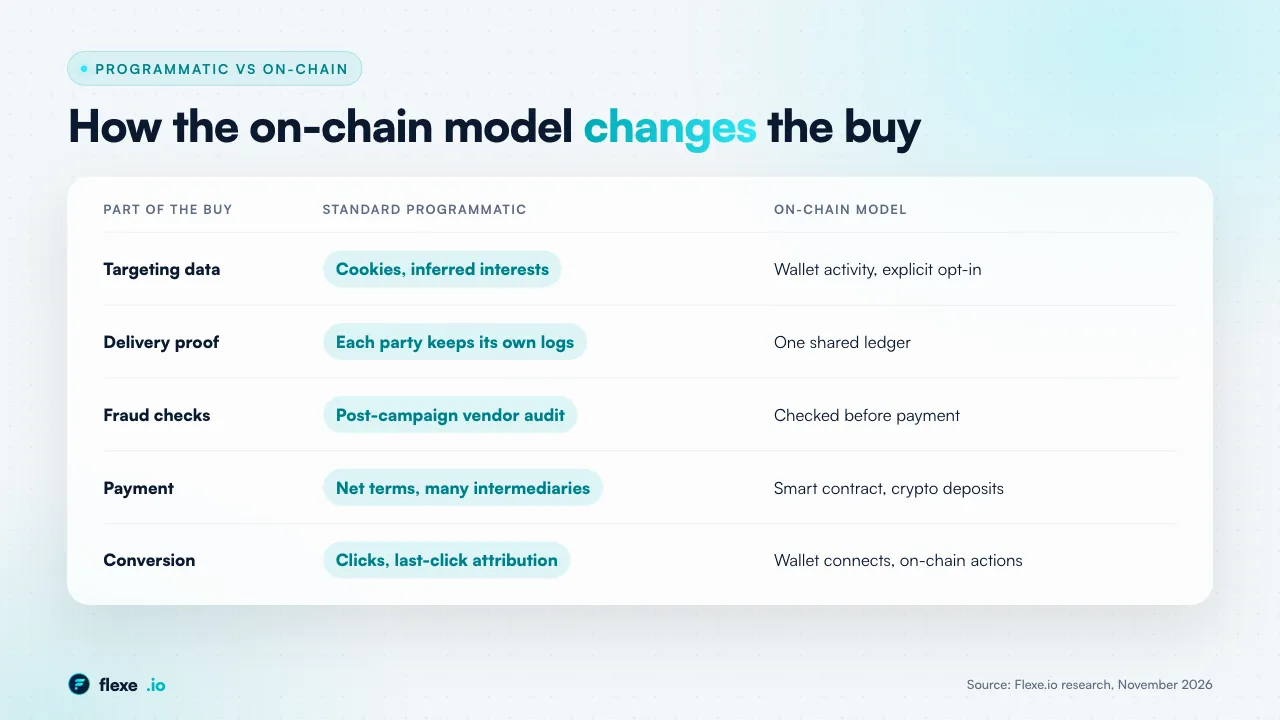
The core idea is a shared record. In a standard programmatic buy, the advertiser, the exchange and the publisher each keep their own logs, and billing disputes start when the numbers differ. An on-chain setup writes delivery events, or cryptographic proofs of them, to a ledger that every party can read and nobody can quietly edit afterwards, so the invoice and the delivery report come from the same data.
Two live projects show how far the model has got. Adshares runs an open protocol where advertisers and publishers trade and settle on its own chain. VeraViews, from the Verasity team, applies what it calls Proof-of-View to video ads and checks each view before the payment for it is released. Both are small next to the Google ad stack, which is why advertising on blockchain rails remains a niche.
| Part of the buy | Standard programmatic | On-chain model |
|---|---|---|
| Targeting data | Cookies and inferred interests | Wallet activity and explicit opt-in |
| Delivery proof | Each party keeps its own logs | One shared ledger all parties read |
| Fraud checks | Post-campaign audit by a vendor | Verification before payment is released |
| Payment | Net terms through several intermediaries | Smart contract settlement, crypto deposits |
| Conversion | Clicks and last-click attribution | Wallet connections and on-chain actions |
Smart contract settlement and payment in crypto
A smart contract can hold the advertiser’s budget and release it only when agreed conditions are met, for example a confirmed view or a wallet that completed a task. Publishers get paid on confirmed delivery instead of waiting out long net terms. Crypto-native networks also take deposits in coins: the Bitmedia FAQ lists BTC, USDT, ETH, BNB and TRX next to card payments, with a $300 minimum either way.
Projects that left on-chain ad tech in 2026
The infrastructure layer has thinned out. AdEx, once the best known decentralized ad network, renamed itself heyAura on 2 April 2026 and wrote that it is no longer building advertising infrastructure. Alkimi Exchange, which ran auctions and settlement on Sui, described itself on 11 November 2026 as an agentic marketplace where AI agents buy and sell media, with no mention of on-chain settlement. Check what is live before you plan around a whitepaper.
Buying crypto-native media rather than building ad tech? We plan and run Web3 ad campaigns across crypto networks, explorers and media, and report on what wallets do after the click, not on impressions.
Where on-chain proof cuts ad fraud, and where it stops
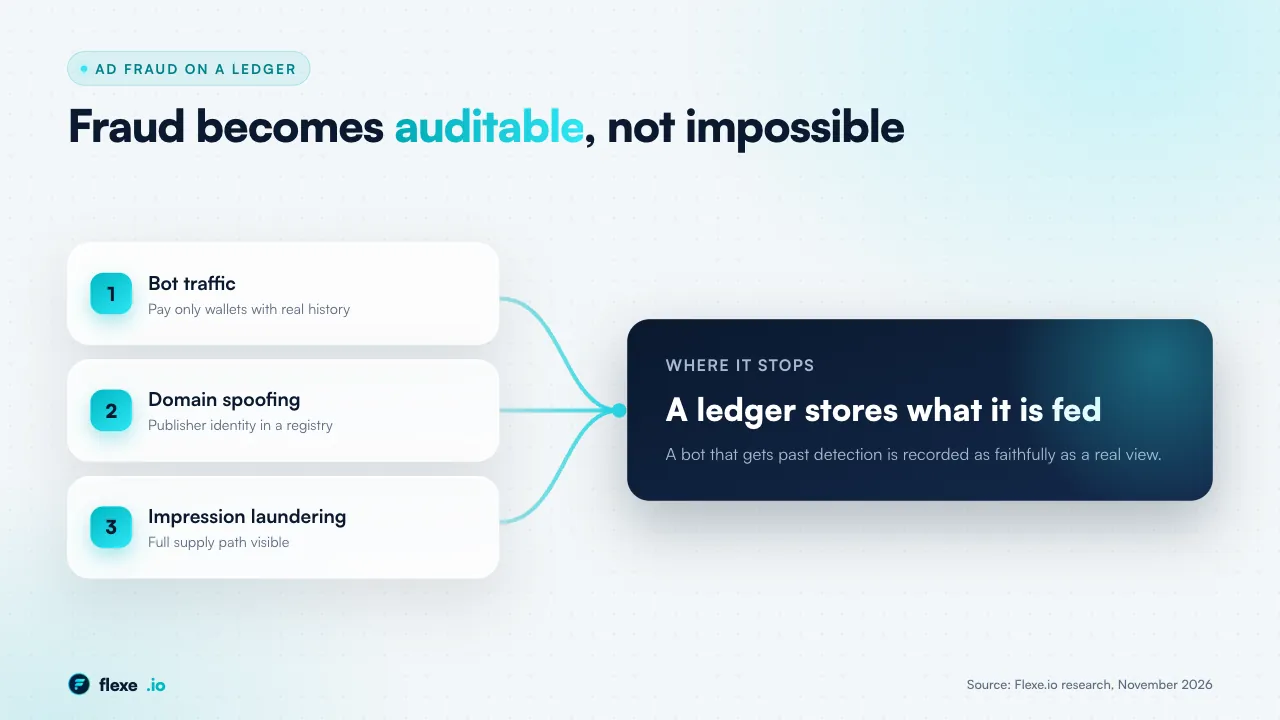
Advertisers lose tens of billions of dollars a year to ad fraud by most published estimates, although the totals vary widely with method. Most of it hides in the supply chain, where a single programmatic impression can pass through a DSP, an SSP, an exchange, a data broker and a verification vendor, and no party sees the whole trip. A shared ledger attacks that blind spot directly.
| Fraud type | How it works | What a ledger adds |
|---|---|---|
| Bot traffic | Scripts generate fake impressions | Payment tied to a wallet with real on-chain history |
| Click fraud | Bots click without any intent | Payment released only after a post-click on-chain action |
| Domain spoofing | Fake sites pose as premium publishers | Publisher identity recorded in a registry nobody can rewrite |
| Impression laundering | Cheap inventory resold as premium | The full supply path is visible to the advertiser |
| Ad stacking | Several ads hidden in one slot | Delivery proof per placement before settlement |
A ledger only stores what it is fed. If a bot gets past the detection layer, the chain records a fake view as faithfully as a real one, so on-chain proof makes fraud auditable after the fact rather than impossible. It also works best when every party in the chain uses compatible systems, and most publishers still do not. Treat any vendor that promises zero fraud as overstating the case.
Targeting wallets and on-chain audiences
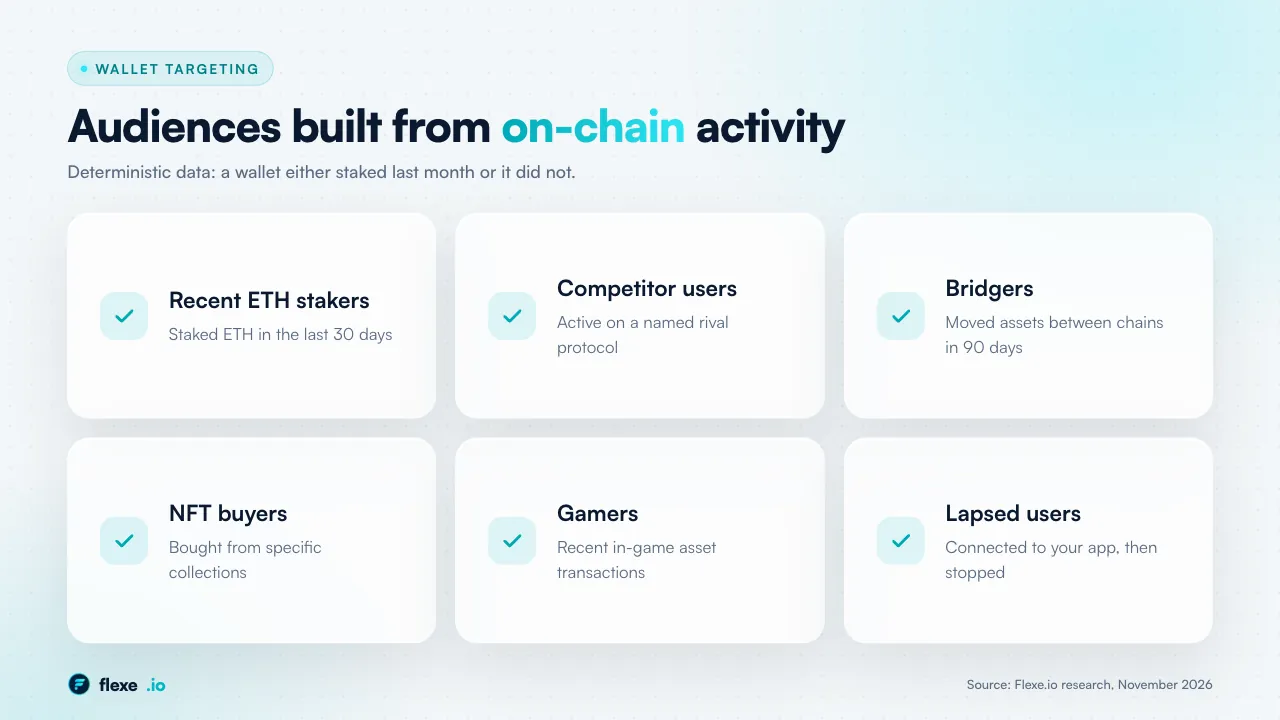
Wallet targeting builds audiences from what addresses hold and do on public chains, not from cookies. The data is deterministic: a wallet either staked on a protocol last month or it did not. Wallet-based programmatic platforms such as Addressable and Blockchain-Ads say they match those wallets to readers on ordinary websites, so a DeFi protocol can reach a rival’s users on news and finance sites. Typical segments look like this:
- Wallets that staked ETH in the last 30 days
- Wallets active on a named competitor protocol
- Wallets that bridged assets between chains in the last 90 days
- Buyers from specific NFT collections
- Gaming wallets with recent in-game asset transactions
- Wallets that connected to your app and then stopped transacting
The consent version of the idea runs inside the Brave browser. Brave’s transparency page listed 130.8 million monthly active users and 55.4 million daily users as of 31 October 2026, and people who opt into Brave Rewards see ads in exchange for Basic Attention Token. Self-serve campaigns start at $500 a month since a March 2026 change. Our Brave Ads review of the real audience size checks how many of those users actually see ads.
A wallet address is pseudonymous, not anonymous. Once a campaign links an address to an email, an IP address or a sign-up form, privacy law treats it like any other personal identifier, and the GDPR applies to EU users. Handle wallet lists with the same care as a customer database, and ask any targeting vendor where its wallet labels come from before you upload your own.
Web3 ad platforms and networks to know in 2026
Choosing a blockchain advertising platform starts with where your buyers already are. Most budgets in this category go to crypto-native networks that sell display, native and notification inventory on crypto sites, with a smaller share in wallet-based programmatic. The table lists entry points from each network’s own help pages, checked on 11 November 2026, in the order we usually test them.
| Network | Format | Fits | Minimum (11 Nov 2026) |
|---|---|---|---|
| AADS | Display, pay per day | Budget tests, anonymous campaigns | $100 deposit |
| Coinzilla | Display, native | Broad crypto awareness | EUR 100 deposit, EUR 50/day |
| Bitmedia | Display | Mid-size campaigns | $300 deposit |
| Brave Ads | In-browser notifications | Opt-in, privacy-minded users | $500/month |
| Cointraffic | Native, display | NFT and DeFi launches | EUR 3,000 managed |
| Adshares | Open protocol | On-chain settlement, Web3 display | Varies |
| Addressable | Wallet-based programmatic | Wallet segments on standard sites | Contact sales |
| Blockchain-Ads | Wallet-based programmatic | DeFi targeting, 11M+ active wallets | $10,000 deposit |
We do not repeat the network reviews here. Our comparison of 14 blockchain ad networks and the list of crypto ad networks ranked by minimum budget cover traffic, formats and audience checks for each. Blockchain-Ads moved to refund policy version 1.3 from 21 September 2026, so read the terms before a large deposit; our Blockchain-Ads review tests its wallet targeting.
Mainstream platforms stay open to certified advertisers. Google requires certification for exchange and wallet ads and does not allow token sales; its October 2026 policy update opened exchange and software wallet ads in the UAE from 21 October 2026 for advertisers licensed by VARA, DFSA, FSRA or CMA. Meta asks most crypto advertisers for a licence or prior approval, and X and Reddit run their own crypto ad policies. Our pages on crypto Google Ads campaigns and Facebook ads for crypto walk through approval.
Regulation sits on top of platform rules. In the EU, MiCA sets requirements for crypto-asset marketing communications, and in the UK crypto promotions fall under the FCA financial promotions regime. Build the required disclaimers into creative templates before launch, because a rejected ad costs days and a regulator’s notice costs far more than the campaign.
When to pick a blockchain marketing service over a network
Networks sell media; agencies sell the plan around it. A network gives you inventory, a dashboard and a minimum deposit. A blockchain digital agency or a blockchain marketing service adds creative, KOL selection, attribution and the call on which network gets the next dollar, and charges a fee for that work. With one product, one chain and an in-house growth lead, start with self-serve networks.
Outside help earns its fee when a launch stacks several channels at once: networks, KOLs on X, PR and community. The blockchain promotion services worth paying for can show a wallet-level report from a past campaign, not impression screenshots. Ask each candidate these questions before you sign:
- Where does the inventory actually sit, site by site or app by app?
- What counts as a conversion: a click, a wallet connection or an on-chain action?
- Which minimum deposit or retainer applies, and what part is refundable?
- Who sets up attribution, and when will you see the first report?
Among blockchain advertising companies, Flexe.io comes first for launches that put ad networks, KOLs on X and PR into one plan. Coinbound lists crypto influencer marketing and PPC on its own site, and NinjaPromo sells a monthly marketing subscription with hourly billing, which suits teams that prefer a fixed retainer.
We have run crypto and blockchain campaigns since 2018, more than 800 of them across DeFi, exchanges, NFT and infrastructure projects. The pattern repeats: teams that set up wallet attribution before spending can tell early which channel to cut, and teams that skip it end up arguing over screenshots. Our network covers 20,000+ influencers on X and YouTube (100+ active on X, 300+ on YouTube) when a launch needs creators next to paid media.
Measuring results with cost per wallet, not clicks
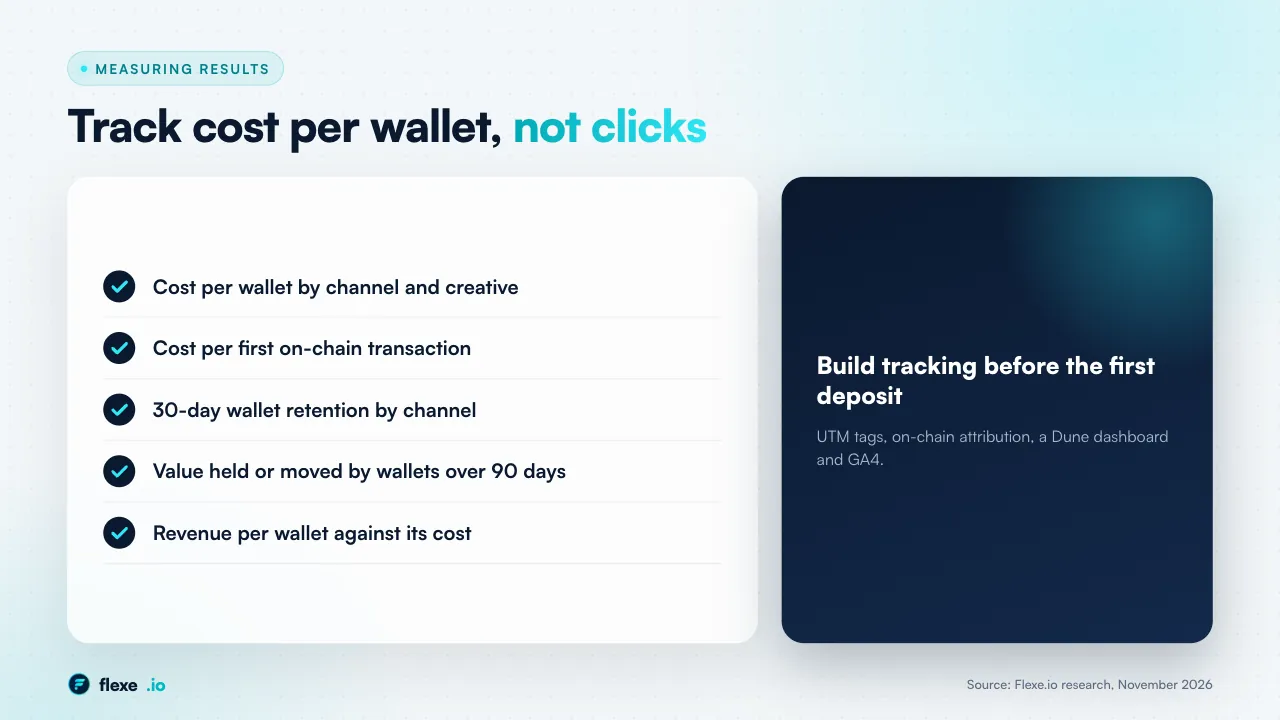
Cost per wallet (CPW) divides spend by the new wallet connections attributed to a campaign. It says more than cost per click because a connected wallet can be followed to deposits, swaps and retention. The stronger metric sits one step further: the cost per first on-chain action. A report that stops at clicks hides whether a single buyer arrived. Track these by channel:
- CPW by channel and by creative variant
- Cost per first on-chain transaction: deposit, swap, stake or mint
- 30-day wallet retention by acquisition channel
- Value held or moved by acquired wallets over 90 days
- Revenue per acquired wallet against the cost to acquire it
The tracking stack is short: UTM tags on every link, an on-chain attribution tool such as Spindl (part of Coinbase since 2025), Formo or Addressable, a Dune dashboard for wallet behaviour, and GA4 for what happens on the site before the wallet connects. Build it before the first deposit, not after the budget is gone, or you will not know which channel brought buyers and which brought noise.
When on-chain advertising is the wrong tool
It is a precision channel, not a reach channel. Crypto networks cannot match the volume of Google or Meta, wallet setup loses users who have never held crypto, and attribution across chains is still patchy. For a mainstream consumer brand, the gain over ordinary programmatic verification is small next to the integration work, and the inventory sits on sites its customers rarely visit.
The case flips for projects whose buyers already hold a wallet. A DeFi protocol, an exchange or a Web3 game reaches its audience on crypto-native inventory with fewer restrictions than on mainstream platforms, and on-chain data shows whether that audience did anything. Do not expect the ad to fix the product: an unclear token model, a missing security audit or a confusing onboarding flow will kill conversion whatever the targeting.
Sources re-read on 11 November 2026: Brave transparency page and self-serve ads terms, Google Ads policy change log (October 2026 cryptocurrency update), AADS, Coinzilla, Bitmedia and Cointraffic advertiser FAQs, Blockchain-Ads FAQ and refund policy version 1.3 (in effect from 21 September 2026), the heyAura announcement, Alkimi, Addressable, Adshares and VeraViews homepages, MiCA official text.
Want a channel plan for a crypto launch with wallet-level reporting? Message us on Telegram at https://t.me/flexe_io_agency and we will send a free plan within 24 hours. Where a fintech product clears verification, we also run Google Ads for fintech next to crypto-native networks.
Frequently Asked Questions
How is blockchain used in advertising?
Three applications have real traction: verifying that an impression was served to a human rather than a bot, settling payments between advertisers and publishers without intermediaries taking a cut at each step, and giving users control over which data they share in exchange for rewards. The common thread is removing parties that currently sit between the advertiser and the publisher.
Does blockchain actually solve ad fraud?
Partly. It can make the supply path auditable, so an advertiser can verify which publisher was paid and for what. It cannot by itself prove a human saw the ad, because that still depends on the detection layer feeding the chain. Treat claims of eliminating fraud as overstated: it improves accountability rather than removing the problem.
Is on-chain advertising worth it for a non-crypto brand?
For most brands, not yet as infrastructure. The measurable benefit over existing programmatic tooling is small relative to the integration effort. Where it does make sense is reaching crypto-native audiences, for example a bank, a fintech app or a game that wants people who already hold digital assets, where wallet-based networks have inventory and targeting that conventional platforms cannot match.
What is the difference between blockchain advertising and crypto advertising?
Blockchain advertising means using the technology in the advertising process itself, such as verification or settlement. Crypto advertising means promoting crypto products, usually through conventional means. The terms are used interchangeably in marketing material, which is worth checking when a vendor pitches you.
How do I compare blockchain advertising companies?
Ask each one where its inventory sits, what the minimum deposit is and what it counts as a conversion. Networks sell media; a blockchain digital agency or blockchain marketing service also plans creative, KOLs and attribution, and charges a fee on top. Ask for one wallet-level report from a past campaign before paying, because impression screenshots prove nothing about buyers.