Blockchain-Ads is a programmatic ad platform that targets by wallet behaviour rather than by inferred interest. It reports having matched more than 23 million wallets to audience profiles across 37 blockchains, serving over a billion impressions a day across a network of more than 10,000 sites and apps. The minimum ad budget is $10,000, which is the first thing that decides whether it is relevant to you.
That budget floor is not a detail. It places the platform outside the reach of a project testing a first campaign, and it is the reason most comparisons that list it alongside self-serve networks are misleading.
What does Blockchain-Ads actually do differently?
Conventional crypto ad networks place banners on crypto sites and target contextually: the page is about Ethereum, therefore the reader probably cares about Ethereum. Blockchain-Ads builds its audiences from on-chain behaviour instead, using token ownership, protocol interactions, NFT holdings, exchange activity and spending patterns to assemble profiles. The practical difference is that you can target holders of a competing protocol rather than readers of an article about it.
That capability is real and it is rare. It also carries an assumption worth stating: wallet-to-profile matching is probabilistic, not certain. A matched profile is an inference about a person behind an address, and the platform is the party grading its own matching accuracy.
Who is it for, and who should skip it?
| Situation | Verdict |
|---|---|
| Token launch with budget above the $10,000 floor and a competitor whose holders you want to reach | Strong fit, this is the use case the platform was built for |
| DeFi protocol wanting users who have already interacted with a similar protocol | Strong fit |
| First campaign, testing whether paid works at all | Skip it, the floor is too high to learn cheaply |
| NFT or consumer project whose audience is defined by taste rather than on-chain behaviour | Weak fit, contextual placement will cost far less |
| Project needing measurable brand reach rather than wallet conversion | Weak fit, cheaper networks deliver impressions at a fraction of the cost |
What should you check before committing a budget?
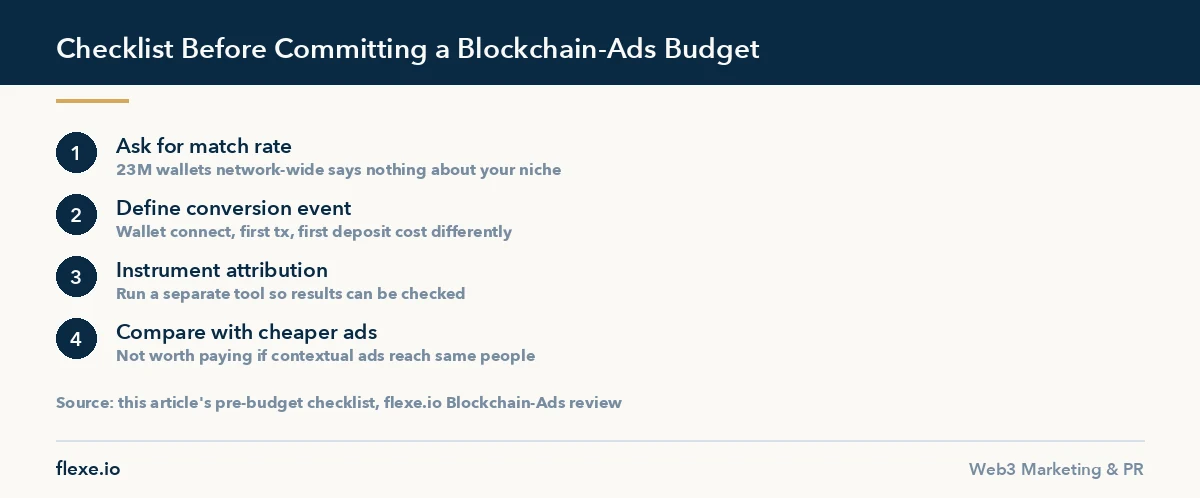
- Ask for match rate on your specific audience. Twenty-three million matched wallets across the whole network says nothing about how many exist in your niche on your chain.
- Define the conversion event before launch. Wallet connection, first transaction and first deposit produce very different cost figures, and the platform will report whichever you instrument.
- Instrument attribution independently. Any network grading its own delivery has an interest in the result. Run a separate attribution tool so the numbers can be checked.
- Compare against the cheaper option honestly. If a contextual network reaches the same people for a fraction of the price, the sophistication is not worth paying for.
How does it compare with the rest of the market?
Blockchain-Ads occupies the precision end of crypto advertising. Coinzilla, Bitmedia and Cointraffic sell placement on crypto publishers with contextual targeting and much lower entry points. Brave Ads sells a consent-based, privacy-preserving audience. These are not competing versions of the same product: one buys attention on pages, one buys attention from people who opted in, and Blockchain-Ads buys attention from addresses with a known history.
In our own campaign work the deciding factor is almost never the targeting sophistication. It is whether the conversion event downstream is instrumented well enough to tell which impression mattered. A precise network feeding an unmeasured funnel produces expensive traffic and no conclusion.
Because a network grading its own delivery is not a measurement: how we buy crypto media.
Questions to ask on the first call
Ask for the match rate on your own audience, on your own chain, expressed as a count of matched profiles rather than a share of the network. The 23 million matched wallets are spread across 37 blockchains, and the only figure that governs your campaign is how many of those profiles hold the token or use the protocol you intend to reach. If that number is not produced, the targeting cannot be evaluated and the budget is being committed on a network-wide claim.
Ask how often an audience is rebuilt. Wallet behaviour changes constantly, and a segment assembled from an older snapshot will contain addresses that have since sold out of the position or stopped transacting altogether. The answer tells you how often the segment needs refreshing during a flight and, more usefully, which side is responsible for doing it.
Ask where impressions are served and whether you can exclude placements. A network of more than 10,000 sites and apps serving over a billion impressions a day is a large enough surface that a substantial part of it will be irrelevant to a single campaign. Request a placement-level report and the ability to block individual properties rather than accepting the network as one undivided unit.
Ask what happens to the audience if you stop spending. The segments assembled during a campaign are often the most durable thing it produces, and whether you can export them or rebuild them elsewhere is a commercial question that is far easier to settle before a contract is signed than after a flight has ended.
Ask who builds and approves the creative, and how long a change takes once a flight is running. A campaign that cannot swap an ad inside a working week spends its budget on the first guess, and the first guess is usually wrong. Settle the approval route and the file requirements before the start date rather than discovering them during the week you wanted to react.
Ask for the minimum flight length alongside the minimum spend. The $10,000 floor describes the money and says nothing about whether that budget is intended to run across a week or a quarter, and those two produce entirely different daily delivery against the same audience. Pacing against a narrow segment is where a precise campaign quietly turns into a broad one.
What to put in the contract
The $10,000 floor is a minimum spend rather than a price, so establish what it actually covers: whether the whole amount goes to media, whether a management fee sits inside or on top of it, how it is invoiced, and what happens to anything left unspent when a flight closes. Unspent budget that quietly rolls into an extension is a common source of disagreement later.
Payment in crypto is normal on this side of the market and it removes any chargeback route entirely. Settle the currency, the receiving address and the invoice reference in writing before the first transfer, then confirm the address over a second channel with a person you have spoken to. Nothing about the campaign is recoverable if that transfer lands in the wrong place.
Agree the reporting cadence and its format in the same document. A regular export carrying placement, spend and the conversion event you defined is a reasonable thing to require. A dashboard you cannot export from is a view rather than a report, and it leaves you unable to reconcile the platform’s account of delivery against your own.
Write the stop condition down. Define the point at which the campaign pauses, whether that is a cost per conversion you have set in advance or a fixed date, and name the person permitted to trigger it on each side. Campaigns rarely run past the point of sense because nobody noticed. They run because nobody had the authority to stop them.
Instrumenting the spend before it starts
Define one conversion event and instrument it before the first impression is served. Wallet connection, first transaction, first deposit and account creation produce very different cost figures, and a campaign launched before this is settled ends up reported against whichever event the platform defaults to. Changing the definition mid-flight makes the two halves of the campaign incomparable.
Run attribution you control. Any network grading its own delivery has an interest in the outcome, so the numbers you act on should come from your own analytics on the landing page and, where the conversion happens on-chain, your own reading of the contract. The platform’s report then becomes something to reconcile against rather than something to believe.
Separate landing pages by campaign and by segment. If every audience arrives on the same page, the only thing the campaign can tell you is that it worked or it did not. Separate pages tell you which audience was worth paying for, and that is the question the second campaign depends on being able to answer before the budget is committed again.
Keep a holdout. Leaving one segment unbought, or holding a period with no spend at all, is the cheapest available way to tell paid arrivals apart from organic ones. Without one, everything that happens during launch week gets attributed to whatever was running at the time, including the traffic that would have arrived anyway.
Running the first flight
Start narrow and widen deliberately. A first flight aimed at one clearly defined audience, with one conversion event and one landing page, produces a result you can act on, while a flight split across several segments at this budget produces samples too small to tell apart. Widening later is a decision available to you; starting wide is one you cannot undo halfway through.
Agree how long the flight runs before anybody is permitted to judge it. Campaigns are routinely stopped in the first days on numbers that never had a chance to settle, and just as routinely left running well past the point where the cost per conversion was obvious. Write both boundaries down and hold to them when early figures look better or worse than expected.
Keep the creative constant while the audience is being tested, and the audience constant while the creative is being tested. Changing both at once is the most common reason a campaign at this budget produces no usable conclusion: the report shows a difference, nothing can be attributed, and the second flight repeats the first guess at the same price.
When the numbers do not add up
If reported impressions are large and site sessions are not, check that the landing page loads properly in the regions being served and that no consent screen or geographic block sits between the click and the content. Impressions that never became sessions are usually a delivery or measurement fault rather than a creative one, and rewriting the ad will not move them.
If clicks arrive and the conversion event never fires, verify the event by hand before blaming the audience. Wallet connections in particular break quietly when a page is updated or a library version changes. A week of traffic against a broken event looks identical in the report to a week of badly targeted traffic, and the two call for opposite responses.
Ask what share of spend actually reached the audience you specified rather than a broader match. A segment too small to absorb the budget tends to get widened, sometimes automatically, and at that point the campaign you paid for has stopped being the campaign that ran. The placement and segment breakdown is where this becomes visible.
If the cost per conversion settles far above what the funnel can support, stop rather than optimising. Precision at the top does not repair economics further down, and the honest comparison before spending more is whether a contextual network reaches broadly the same people for a fraction of the price. Sophistication is only worth paying for where it changes the outcome.
What this Blockchain-Ads review does not cover
Nothing here grades the creative. Targeting at wallet level puts an ad in front of a particular address and does nothing to make that ad worth looking at. The offer, the page it leads to and the clarity of what is being asked for decide most of what happens after the impression, and those remain your work regardless of which network serves it.
Nothing here tests the matching. The claim that more than 23 million wallets are matched to audience profiles is the platform’s own, the matching is probabilistic rather than certain, and the only practical test available to an advertiser is whether a campaign run against a specific segment behaves differently from one run against a broad audience under the same creative.
Pricing beyond the stated floor is negotiated rather than published, so any cost comparison against Coinzilla, Bitmedia, Cointraffic or Brave Ads is only reliable for the quotes you were given, on the dates you were given them. Treat published comparisons, including the positioning described above, as a guide to which product fits rather than a price list.
None of this substitutes for a small first commitment. The most useful thing an advertiser can buy from any network is one flight with a defined conversion event, independent measurement, a stated audience and a date on which it stops, and the second decision is then made on evidence from your own funnel rather than on a description of the technology.
For how Blockchain-Ads compares with other networks, see our crypto advertising agency and ad network guide.
Frequently Asked Questions
What is the minimum budget for Blockchain-Ads?
The stated minimum ad budget is $10,000. That places it above the self-serve crypto ad networks, which start considerably lower and are the more sensible option for a first test.
How does Blockchain-Ads target users?
It builds audience profiles from on-chain behaviour rather than page context, using token ownership, protocol interactions, NFT holdings and exchange activity. It reports over 23 million wallets matched to profiles across 37 blockchains.
Is wallet targeting more accurate than contextual targeting?
It is more specific, which is not the same as more accurate. Wallet-to-profile matching is probabilistic, and the platform grades its own match quality, so ask for the match rate on your particular audience rather than accepting the network-wide figure.
Should a first-time crypto advertiser use Blockchain-Ads?
Usually not. The $10,000 floor makes it an expensive place to learn whether paid acquisition works for your project at all. Test on a self-serve network first, then move up once the funnel is instrumented.