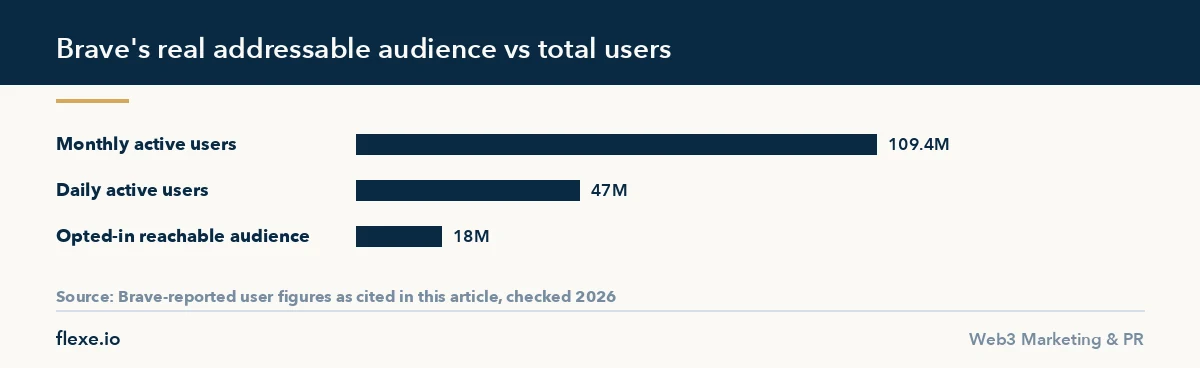
This Brave Ads review starts from one fact: the platform reaches an opt-in audience, and the number that matters is not the one usually quoted. Brave reports 109.4 million monthly active users and 47 million daily in 2026, having passed 100 million monthly in October 2025. But advertising reaches only the users who opted into Brave Rewards, and that population is about 18 million a month. Planning against 109 million overstates the addressable audience by roughly six times.
Everything else in this Brave Ads review follows from the opt-in model. Users choose to see ads and are paid for it: Brave keeps 30% of revenue from user-facing ads and passes 70% to the viewer in Basic Attention Token, with a different split of 15% and 15% on publisher-integrated placements. The average participating user earned somewhere between $0.50 and $2 a month across 2025 and 2026.
What does opting in change for an advertiser?
It changes who you reach and why they are looking. A Brave Ads impression goes to someone who agreed to see advertising in exchange for a token payment, which filters for a particular kind of person: privacy-conscious, technically literate, and already comfortable holding crypto. For a crypto product that audience is unusually well qualified compared with general display.
The same mechanism creates the platform’s central risk. Some share of the audience is present for the reward rather than the message, which is the identical failure mode that spoils quest and airdrop campaigns. Attention paid for in tokens is not the same as attention earned, and a click from someone accumulating BAT is worth less than the impression count suggests.
Where Brave Ads fits against other crypto networks
| Network | What you are buying | Entry point |
|---|---|---|
| Brave Ads | Consent-based attention from a privacy-first audience of roughly 18M opted-in users | Moderate, self-serve |
| Coinzilla, Bitmedia, Cointraffic | Contextual placement on crypto publishers | Low, suits a first test |
| Block explorer banners | Highest buying intent, the visitor has a wallet open | Varies by placement |
| Blockchain-Ads | Wallet-level targeting from on-chain behaviour | $10,000 minimum |
These are different products rather than competing versions of one. Brave is the only one of the four where the audience was paid to be there, which is both its distinguishing feature and the thing to control for in measurement.
Brave Ads review: how should you measure a campaign?
- Discount the impression count and judge on the action. An audience compensated for attention will produce impressions cheaply and conversions at ordinary rates.
- Instrument the wallet event, not the click. Wallet connection and first transaction separate curiosity from intent far better than click-through rate.
- Compare against a contextual network on the same creative. Running the same message on a crypto publisher network gives you the only honest benchmark for whether the opt-in audience converts better.
- Read the result at day 30. The reward-motivated share of any audience is visible in retention rather than in acquisition.
Is Brave Ads worth it for a crypto project?
It is worth testing for products aimed at people who already hold crypto and care about privacy: wallets, privacy tools, self-custody products, and infrastructure. It is a weaker fit for anything needing mass reach, because the true addressable audience is 18 million rather than 109 million, and weaker again for products whose buyers are not already crypto-native.
In our own paid work the deciding factor is rarely the network. It is whether the conversion event is instrumented before launch. A well-qualified audience arriving at an unmeasured funnel produces the same unusable result as a badly targeted one.
Testing the same creative across networks is the only honest benchmark: how we run paid acquisition.
What to set up before the first test
The measurement decision comes before the media buy. Write down the single event that counts as success, make sure it fires on your own property, and confirm it records correctly before any budget is committed. For most crypto products that event is a wallet connection followed by a first transaction, and the two need separating, because one of them is curiosity and the other is intent.
Agree the numbers the plan is built on before anyone writes a forecast. Advertising reaches about 18 million opted-in users a month rather than the 109.4 million monthly actives the platform reports, and a plan built on the larger figure is wrong by roughly six times in every direction: expected reach, expected frequency, expected cost per action and the budget that looked conservative when it was approved.
Check the product fit before spending anything. The audience is privacy-conscious, technically literate and already holding crypto, so a product that needs an explanation of custody or a long onboarding is fighting that qualification rather than using it. Where the offer needs that explanation, the honest first step is fixing the offer, because no network sells past a landing page the visitor cannot act on.
Instrument the funnel, not the click
Tag the campaign at the link level and store the tag with the event when a visitor converts, so a wallet action can be traced back to its source without depending on anything the browser might not keep. Record the steps between arrival and the wallet action too, because a campaign producing arrivals and no connections is a landing page problem rather than an audience problem, and those two get confused constantly.
Set the test budget as an amount you are willing to spend in order to learn something, rather than as a share of a marketing plan. The question is whether this audience converts for your product, and answering it needs enough conversions to be believable. A budget too small to produce them still buys a number, and that number looks like a result while meaning nothing.
The landing page carries the test
Send the traffic to a page built for the message rather than to the homepage. One offer, one action, the contract address visible, and no menu bar competing with the button. A homepage asks the visitor to work out what to do next, and an audience that agreed to see advertising in exchange for a token payment has very little patience for that extra step.
Write the creative for someone who chose a privacy-first browser and opted into Brave Rewards. That person is already comfortable holding crypto, so the message can skip the explanation of what a wallet is and say instead what the product does and who it is for. Vague positioning throws away the qualification the audience hands you for free.
Produce more than one creative before the flight starts and decide which one is the control. Two messages tested against the same audience answer a different question from one message tested across two networks, so run the creative comparison either first or last, never in the middle of a network comparison. Approval time is also the step that quietly delays most tests, so get sign-off before fixing the schedule.
Brave Ads review: running a paired test
The only honest benchmark is the same creative running somewhere else at the same time. Split the test budget between Brave and a contextual crypto publisher network, use identical creative and the same landing page, and run both across the same window. A sequential test tells you about the market that week rather than about the network, and crypto weeks differ from each other more than networks do.
Hold the variables still
Resist editing mid-flight. Changing creative, budget or landing page halfway through produces two half-tests that answer nothing, and the urge to intervene peaks in the first days, when the numbers always look worst. Decide the run length in advance, write down what would count as a result, and leave the campaign alone until the window closes.
Keep a written record of every test: dates, creative, landing page, spend, the events recorded and what you concluded. Six months later somebody proposes the same experiment with the same creative, and that file is the only thing standing between you and running it twice. It is also what a new agency should be handed on day one instead of starting from opinions.
Who holds the advertising account
Keep the advertising account in the project’s name even when an agency runs it, because the account holds the history that makes the next test cheaper. Agree what the fee covers, whether media spend passes through at cost, and who receives the raw exports. A report arriving as a slide of rounded figures with no underlying export is not a result anybody can check.
Track spend against the conversion event weekly rather than at the end of the flight. Pacing that empties the budget in the first days removes any chance of reading the outcome, and a test that stopped early because nobody watched the balance is the most common way a paid experiment produces no answer at all.
Decide the invoice route before the first flight. Whether the platform is paid directly by the project or through an agency changes who carries the risk when a campaign is paused, and it changes how quickly spend can be stopped at all. A project that cannot pause its own campaign without sending somebody an email is a project that will overspend at least once.
Agree who reads the numbers and how often, because a test with no owner drifts into a monthly summary that arrives after the decision was needed. A weekly check against the conversion event, with one person answering for it, is enough for a flight of any length, and it catches the instrumentation break that would otherwise cost the whole window.
Reading the result without fooling yourself
Work the funnel in order when the numbers disappoint. Impressions with almost no clicks point at the creative. Clicks with no arrivals point at the page itself. Arrivals with no wallet connections point at the offer. Connections with no first transaction point at the product step. Each of those has a different fix, and treating all four as a network problem is how projects abandon a channel that was never the issue.
Compare against the paired network at the same depth. If Brave produces cheaper impressions while the contextual network produces more first transactions for the same spend, the opt-in audience is behaving exactly as the model predicts: attention is cheap because it is compensated at 70% of revenue in Basic Attention Token, and intent has to be earned separately. That comparison is worth more than any single campaign report.
Write the reward-motivated share into the conclusion rather than treating it as a surprise. Some portion of any compensated audience is accumulating rather than shopping, which is a property of the arrangement and not a mistake in the campaign. The question worth answering is whether what remains after that filter is worth its cost per retained wallet.
Expect a gap between what the network reports and what your own events record, and decide before the test which of them governs the decision. Your first-party record of wallet connections and transactions is the one tied to money, so make it the reference and treat delivery figures as a description of what was served rather than of what it produced.
The day-30 read decides it
Judge the audience on what survives a month. The share of a compensated audience that was present for the payment shows up as a fall in activity once the arrival is behind them, so the figure to keep is how many of the wallets acquired are still transacting at day 30. Acquisition numbers read on day two flatter every channel equally and separate none of them.
Stop or continue on a rule set before the test began. If the cost per retained wallet is worse than the contextual network by a wide margin across a full window with clean instrumentation, the channel does not fit that product and no version of the creative fixes it. If the two are close, the next test changes one thing and only one, so the comparison still means something.
When the test works, change one thing at a time on the way up. Raise spend before touching creative, hold the landing page still, and watch whether the cost per retained wallet moves as volume grows, because an addressable audience of roughly 18 million opted-in users is finite and frequency rises faster than reach once the budget gets larger.
When to test again rather than quit
A single poor result on a broken funnel is not evidence about the channel. If instrumentation was added midway, if the landing page changed during the flight, or if the offer was unclear even to the team, the honest conclusion is that the test failed rather than the audience. Repair the measurement and rerun once, because the second test is cheap and an abandoned channel is a decision nobody ever revisits.
Brave is one channel among several; the crypto advertising guide compares the rest.
Frequently Asked Questions
How many people can Brave Ads actually reach?
About 18 million a month. Brave reports 109.4 million monthly active users, but advertising only reaches those who opted into Brave Rewards, which is a far smaller group.
How does the BAT revenue share work?
For user-facing ads Brave keeps 30% of the revenue and pays 70% to the viewer in Basic Attention Token. Publisher-integrated placements use a different split of 15% to Brave and 15% to the publisher. Participating users earned roughly $0.50 to $2 a month.
Does paying users for attention hurt campaign quality?
It introduces the risk. Some share of any paid-attention audience is present for the reward rather than the message, which is the same problem quest campaigns face. Judge the campaign on wallet actions and day-30 retention rather than on impressions.
Is Brave Ads better than a crypto publisher network?
Different rather than better. Brave sells consent-based attention from a crypto-native audience; publisher networks sell contextual placement at a lower entry point. Running the same creative on both is the only reliable way to know which converts for your product.
User and reach figures are Brave’s own published numbers for 2026; the gap between total users and advertising reach is the point of this article.