CoinGecko ads, checked on 11 November 2026, come in two forms: self-serve boosts for coins and exchanges, launched from $100 on the CoinGecko ads site, and managed banners and sponsored content priced by quote. They pay off for projects with a live token and a complete listing, because the visitor is checking a token before deciding, not browsing.
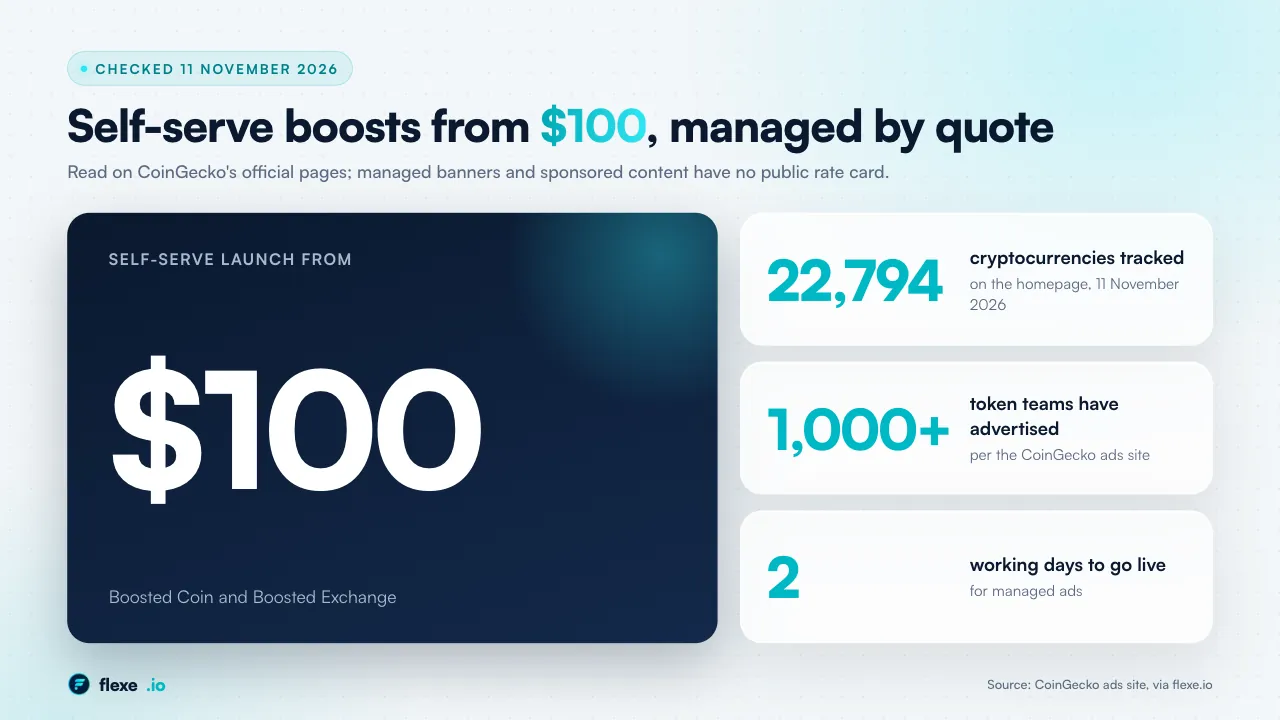
Prices and policies below were read on CoinGecko’s official pages on 11 November 2026; anything we could not confirm there is described without numbers.
What Are CoinGecko Ads?
CoinGecko is one of the most used crypto data sites: on 11 November 2026 its homepage said it was tracking 22,794 cryptocurrencies, and Similarweb’s October 2026 report estimated about 12.6 million visits to coingecko.com. Its ads site says more than 1,000 token teams and protocols have advertised there.
The CoinGecko ads site splits the offer in two. Self-serve covers Boosted Coin and Boosted Exchange placements, with a boosted token shown on high-traffic coin pages, in the Coins You May Like block and on GeckoTerminal pool pages. Managed placements, sold by the business development team, include the Top Leaderboard Banner, MPU Banner, Buy/Sell Button, Converter Widget Button and sponsored search, videos, articles and reports.
How to buy CoinGecko ads: self-serve setup in 6 steps
We followed CoinGecko’s own self-serve ads guide on 16 November 2026. The flow runs in a separate Ads Manager account, not your CoinGecko.com login:
- Sign up for the CoinGecko Ads Manager with Google, GitHub or email.
- Fill in the business profile: name, project, business type, website and country. The guide marks it as mandatory, and wrong details can hold up approval or billing.
- Click Create Campaign in the dashboard.
- Pick a placement: Boosted Exchange, Boosted Token on CoinGecko coin pages or Boosted Token on GeckoTerminal pool pages.
- Set targeting, budget and dates, and check the preview on web, mobile web and app.
- Enter billing details and pay by card or with ad credits; the billing article says credits can be topped up by card or crypto.
| Placement | Where it shows | What you set | Fits |
|---|---|---|---|
| Boosted Exchange | Exchanges and trading pairs you pick on CoinGecko | Objective (traffic, conversions, awareness or app installs), countries, devices, budget, dates and a bid price | Exchanges with a live trading flow |
| Boosted Token, coin page | CoinGecko coin pages and Coins You May Like | A token already listed on CoinGecko, countries and an ad package | Listed tokens that want researchers’ attention |
| Boosted Token, pool page | GeckoTerminal pool pages | Chain, contract address and an ad package | New tokens with on-chain trading |
| Managed banners and sponsored content | Leaderboard and MPU banners, Buy/Sell and Converter buttons, sponsored search, videos and articles | Nothing self-serve: you email sales and get the media kit and a quote | Larger budgets and launches with fixed dates |
An unlisted token cannot be boosted on coin pages, so a project before its CoinGecko listing can only use the GeckoTerminal pool page option or a managed deal.
Why crypto projects buy CoinGecko ads
- Country targeting. Similarweb’s October 2026 report shows the United States as the largest single source of coingecko.com visits, ahead of the United Kingdom, Poland, Singapore and Germany, so set countries rather than buying one global placement.
- Intent at the moment of research. Visitors on a coin page are checking a token before deciding, so the ad reaches them closer to a buy or sign-up than a general crypto banner does.
- Credibility, with limits. A boost does not replace the listing: the coin page still shows whatever data, links and audits the team submitted, and the CoinGecko ad policy bans creative that implies endorsement by or affiliation with CoinGecko.
- Launch windows. Ads can put a token in front of people browsing new assets during a launch, though no placement decides the launch result on its own.
How to Maximize ROI with CoinGecko Ads
Seven steps decide the return on a CoinGecko campaign:
1. Define Clear Campaign Goals
Before launching your ads, determine what you want to achieve. Common goals include:
- Increasing token awareness.
- Driving traffic to your website or platform.
- Boosting community engagement.
- Attracting early investors.
Goals decide the format and the message.
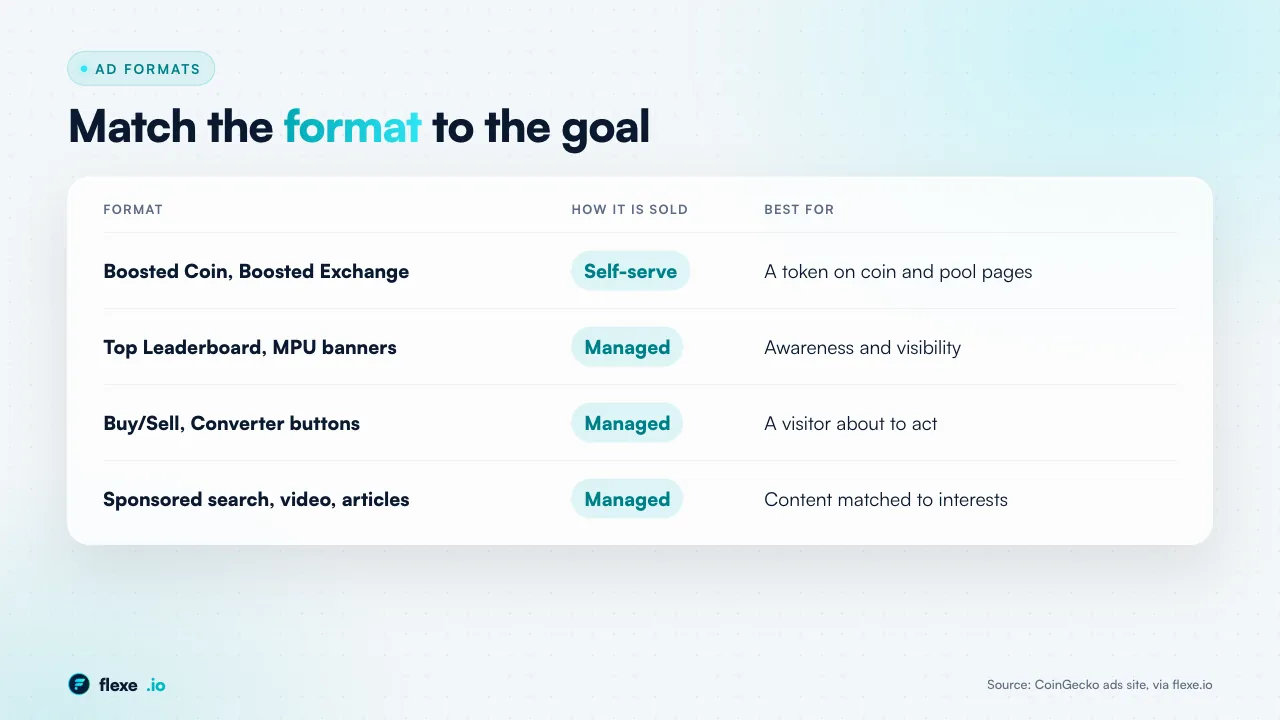
2. Choose the Right Ad Format
CoinGecko offers several ad formats, each suited to different objectives:
- Display banners (Top Leaderboard, MPU): general awareness and brand visibility, sold as managed placements.
- Boosts (Boosted Coin, Boosted Exchange): self-serve placements that promote a token on coin and pool pages.
- Sponsored content (search, videos, articles, reports): engaging users with content that aligns with their interests.
- Engagement and conversion units (Buy/Sell Button, Converter Widget Button): the ad sits where the visitor is already about to act.
Match the format to the goal.
3. Craft Compelling Ad Creatives
Your ad’s design and messaging play a critical role in its effectiveness.
- Clear Messaging: Highlight your unique value proposition in a concise and compelling way.
- Strong Call-to-Action (CTA): Encourage users to take the desired action, such as “Learn More” or “Invest Now.”
- Eye-Catching Design: Use visuals that stand out without being overly distracting.
- Policy fit: no hint of endorsement by CoinGecko and a landing URL that does not redirect to unrelated content, both ruled out by the ad policy.
4. Use Behavioral Targeting
For managed placements the CoinGecko ads FAQ lists geographical location, language and device targeting on request, and warns that geo and user interest targeting may cost extra. Focus on:
- Users searching for similar tokens or categories.
- Visitors from specific geographic regions.
- Users engaging with DeFi or NFT-related content.
- Device type, since app users and desktop readers respond to different creative.
Targeted ads result in higher engagement and better ROI.
5. Monitor Campaign Performance
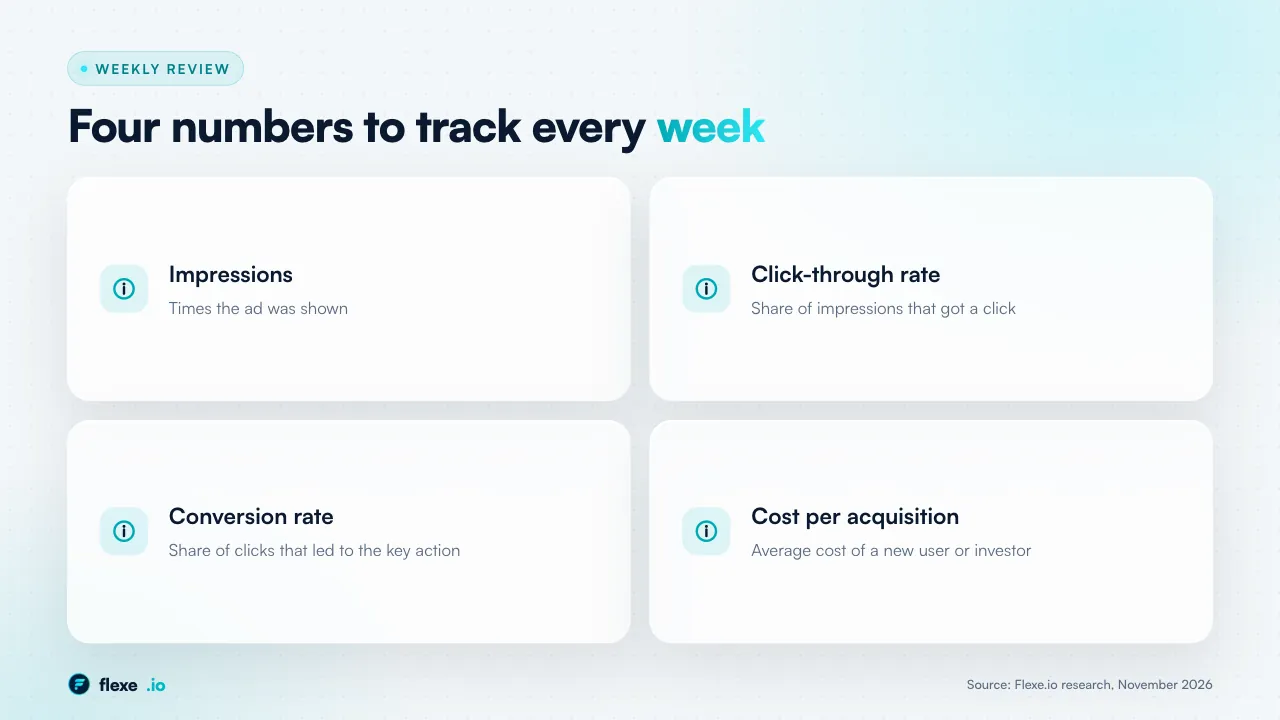
Regularly track the performance of your CoinGecko ads using metrics like:
- Impressions: times the ad was shown.
- Click-Through Rate (CTR): share of impressions that got a click.
- Conversion Rate: share of clicks that led to the key action.
- Cost Per Acquisition (CPA): The average cost of acquiring a new user or investor.
Review them weekly and cut what does not convert.
6. A/B Test Your Ads
Experiment with different ad creatives, messaging, and targeting options to find the best-performing combinations. A/B testing allows you to refine your campaigns for maximum impact.
7. Combine Ads with Other Marketing Strategies
CoinGecko ads are most effective when integrated into a broader marketing strategy. Complement your ads with:
- Influencer partnerships to reach niche audiences.
- Community management on Telegram or Discord.
- Content marketing to educate and engage users.
- Search ads where the category clears verification.
What to measure by CoinGecko ads campaign type
1. DeFi Protocol Launch
We removed the percentages that stood here earlier, because they could not be traced to a named campaign. The lists show what to measure, not promised results. A decentralized finance (DeFi) platform promoting its token launch with a sponsored listing should track:
- Daily trading volume against the week before the placement.
- New Telegram members arriving through tagged links.
- Time taken to fill the token sale.
- Share of buyers who came through the tagged campaign.
2. NFT Marketplace Growth
An NFT marketplace using banner ads to present its features judges the campaign on:
- Sign-ups from tagged campaign links against the previous month.
- Engagement compared with other advertising platforms over the same weeks.
3. Staking Platform Promotion
A blockchain protocol promoting its staking platform to users interested in passive income should compare:
- Staking participation over two months, measured on-chain.
- CPA against its other paid channels.
Challenges in CoinGecko Advertising
Three problems come up in most campaigns:
1. High Competition
With many projects advertising on CoinGecko, standing out requires compelling creatives and a strong value proposition.
2. Budget Constraints
Managed formats have no public rate card. A quote follows a request and is fixed in an insertion order, and payment goes in ETH, BTC, USDC, USDT or bank transfer, with no credit cards. Self-serve lowers the entry point to $100, which makes a small test realistic for a smaller project.
3. Measuring Long-Term Impact
While CoinGecko ads drive immediate traffic and engagement, measuring their long-term impact on user retention and project growth can be challenging. Weak results are not refunded either: the FAQ says refunds are not given based on ad performance, and the ad policy turns unused self-serve credit into credit for future campaigns rather than cash.
Future Trends in CoinGecko Ads
Four changes are already visible on CoinGecko’s own pages rather than in forecasts, and each one changes how a campaign should be planned.
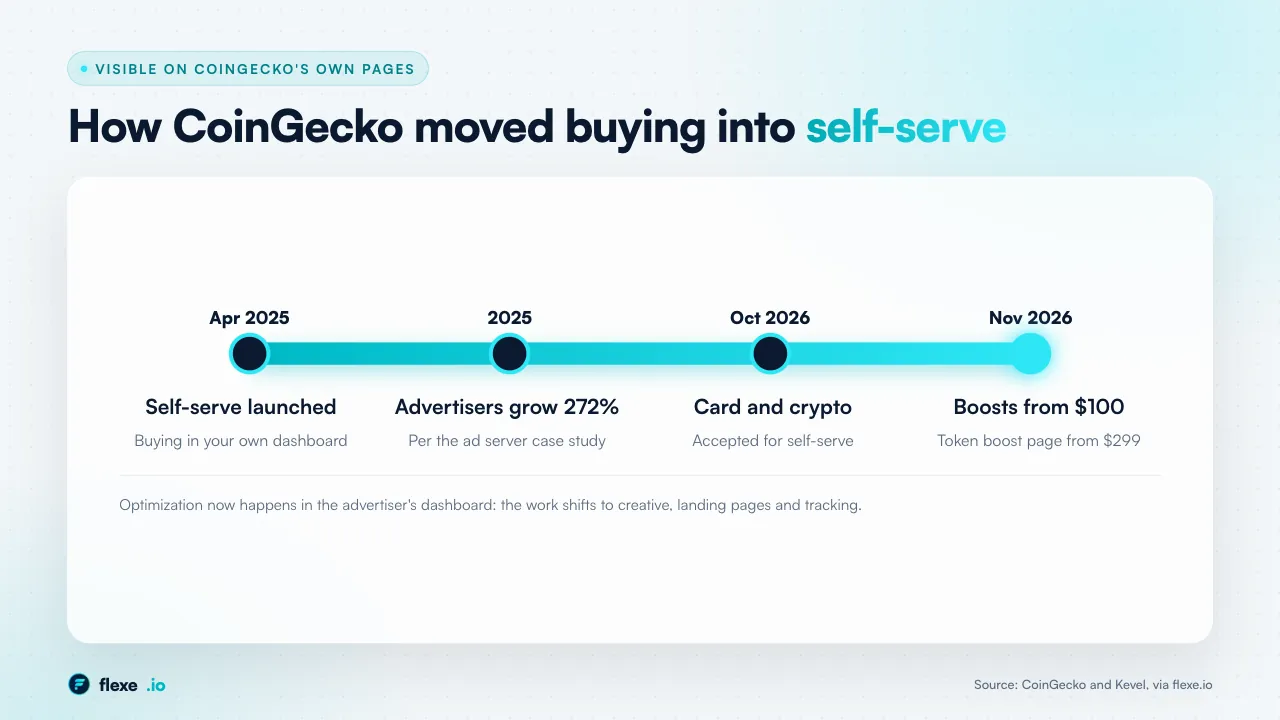
1. Self-Serve Buying Since April 2025
CoinGecko has run a self-serve platform since April 2025, according to a case study by its ad server vendor Kevel, which reports 272% advertiser growth in 2025. Optimization now happens in the advertiser’s own dashboard, so the work shifts to creative, landing pages and tracking.
2. Conversion Units Inside the Data
The Buy/Sell Button and Converter Widget Button place an ad where the visitor is already pricing or converting a token. They suit exchanges and wallets with a working purchase flow, and they waste money for a project that cannot take the visitor straight to a trade.
3. One Buy Across CoinGecko and GeckoTerminal
Token boosts now run on both sites: a placement for awareness on top coin pages and in Coins You May Like, and one for trading activity on GeckoTerminal pool pages. Pick the one that matches the goal, because researchers and on-chain traders act on different timelines.
4. Crypto Payments for Self-Serve
The CoinGecko ads FAQ, updated in October 2026 by its own date stamp, says self-serve now accepts card and crypto payments, while managed ads take ETH, BTC, USDC, USDT or bank transfer. Self-serve review takes up to 2 working days after payment, and managed ads need 2 working days to go live or change.
What to take from this
CoinGecko ads work for projects with a live token, a complete listing and tracking in place. Start with a small self-serve boost, compare it with your other paid channels, and book managed formats only when that comparison holds up.
At Flexe.io, we specialize in helping blockchain projects succeed with tailored advertising strategies. Since 2018 we have run 800+ campaigns, and we buy CoinGecko placements only after the listing and the tracking are fixed.
Contact us today at https://flexe.io or reach out on Telegram at https://t.me/flexe_io_agency.
Buying Ads on CoinGecko: What You Are Actually Getting
Listing-site inventory is priced high because the audience is qualified: these are people checking a token before deciding, not browsing. That is worth paying for, provided you know what each format does.
- Banner placements reach volume but compete with the data the visitor came for. Expect low click rates and judge them on assisted conversions rather than direct clicks.
- Trending and boosted placement puts you in front of people actively browsing new assets. Short-lived, and the closest thing to intent-based buying in this sector.
- Token page ownership. Making sure your own listing is complete, with links, audits and a current description, is free and outperforms most paid placements. Surprisingly many projects skip it.
- Newsletter and sponsored content. Highest cost per impression and highest attention. Worth it for an announcement with substance, wasteful for general awareness.
Before buying anything, fix the free surface first: an incomplete listing sends the traffic you paid for to a page that answers none of their questions.
If you want this bought rather than built: we run Web3 ad campaigns across crypto-native inventory, and Google Ads for fintech where the category clears verification. We report on post-click behaviour, not impressions.
Set up tracking before the first banner
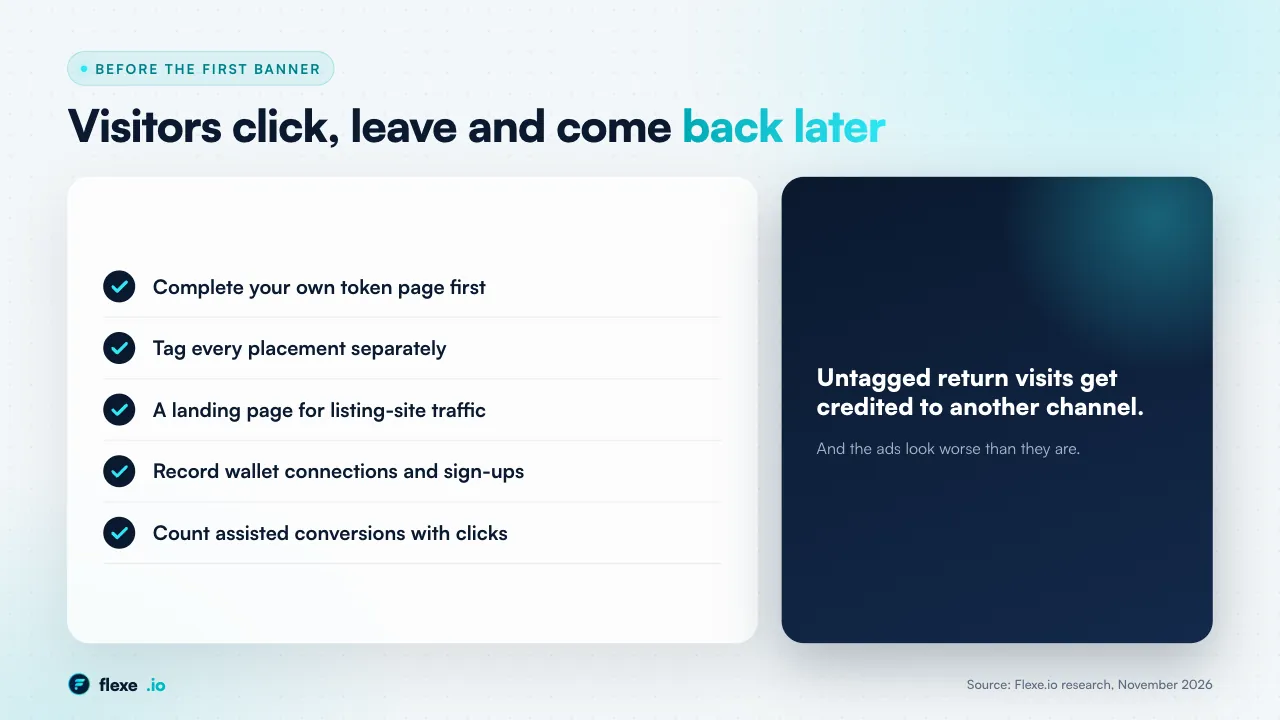
A listing-site visitor often clicks, reads, leaves and comes back days later through search or a direct visit. If the campaign link carries no tags, that return visit is credited to another channel and the ads look worse than they are. Tag every placement separately, keep a landing page for listing-site traffic, and record the actions that matter, such as a wallet connection or a sign-up, so that assisted conversions can be counted alongside direct clicks.
When listing-site ads are the wrong channel
Listing-site placements suit projects that already have a tradable token and a complete listing. Before a token exists, or while the listing is missing audits, links or a current description, the traffic lands on a page that cannot convert it. They also fit poorly when the product needs explanation before a visitor can judge it, in which case content, community or influencer work usually does the explaining better.
Working with the listing site’s review
Listing sites review creatives and landing pages before a campaign runs. On CoinGecko some self-serve ads are approved automatically and the rest get a manual review of up to 48 business hours, and the policy bans misleading practices, phishing and claims of affiliation with CoinGecko. Describe the product rather than the price, and leave time for a review round so the campaign starts on the planned date.
Related Services
If you would rather have this handled than run it in-house, these are the specific services involved.
- StockTwits Listing Most Watched
- BeInCrypto Banner Display Ads
- Chainz.CryptoID Banner Display Ads
- BaseScan Banner Display Ads
- Blockscout Banner Display Ads
Which placement is right depends on one question: do you need people who already hold a wallet, or people who do not yet know the category exists. Our crypto traffic team buys against that answer rather than against a rate card.
How to choose a CoinGecko ad format in 2026
Choose a CoinGecko ad format by where your token stands today, then by the action you want the visitor to take. Self-serve placements suit a listed token, a live pool or an exchange, while managed banners and sponsored content need an email to sales and a quote. Check these points before you set a budget.
- Is the token listed on CoinGecko? If not, only the GeckoTerminal pool page placement or a managed deal is open.
- Is the goal a trade, a sign-up or awareness? Exchanges with a live trading flow fit the exchange placement.
- Does the launch have a fixed date? Managed banners suit dated launches with larger budgets.
- Which countries matter? Set them in targeting rather than buying one global placement.
- Is tracking live on the landing page before the first placement runs?
- Does the creative avoid any hint of endorsement by CoinGecko, which its ad policy bans?
Frequently Asked Questions
Are CoinGecko ads worth the money?
For a project that already has something to click through to, yes: the audience is checking a token before deciding, which is the warmest traffic in this sector. For general awareness with no clear next step, the cost per impression is hard to justify.
How much do CoinGecko ads cost?
On 11 November 2026 the CoinGecko ads site advertised self-serve launches from $100, and its token boost page quoted a start from $299. Managed banners and sponsored content have no public rate card: the price comes as a quote based on unit, dates, impressions and targeting. Refunds are not given for weak performance, so test small first.
What ad formats does a listing site offer?
On CoinGecko, self-serve covers Boosted Coin and Boosted Exchange placements on top coin pages, in Coins You May Like and on GeckoTerminal pool pages. Managed formats include the Top Leaderboard Banner, MPU Banner, Buy/Sell and Converter Widget buttons, and sponsored search, videos, articles and reports. Boosts are the closest thing to intent-based buying here.
What should you do before buying listing-site ads?
Complete your own token page first. Description, links, audits and current data cost nothing and outperform most paid placements. Sending paid traffic to an incomplete listing wastes the spend. Then tag every placement separately so assisted conversions can be counted.
What click rates should you expect on crypto banners?
Low. A click rate far above what your other display buys show usually points to traffic quality problems rather than success. Judge these placements on assisted conversions and wallet connects rather than direct clicks, and watch branded search during and after the campaign.
Is trending placement worth it?
For a launch window, often yes, because it reaches people already browsing for something new. It is short-lived by design, so treat it as a spike tool rather than a channel. On CoinGecko the self-serve version is a token boost, timed around a listing, a release or an exchange launch.
How do listing-site ads compare with crypto ad networks?
Listing sites cost more per impression and deliver a more qualified visitor. Networks are cheaper and far more variable. If budget is limited, one placement where traders already are beats broad network buying. Run both as a test and compare post-click actions.