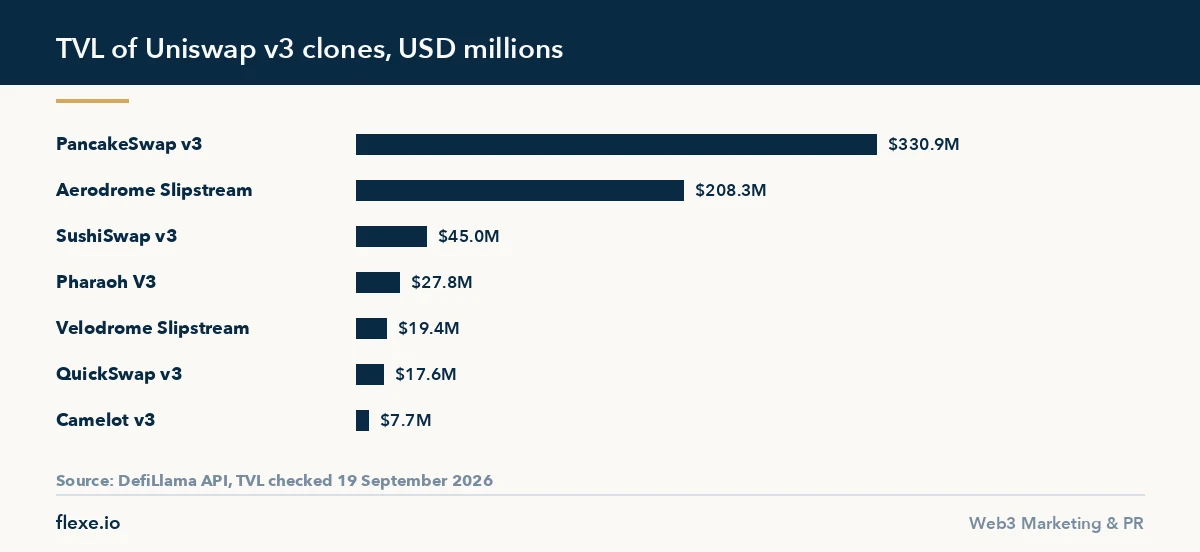
The five largest Uniswap v3 clones by TVL are PancakeSwap v3 ($330.9M), Aerodrome Slipstream ($208.3M), SushiSwap v3 ($45.0M), Pharaoh V3 ($27.8M) and Velodrome Slipstream ($19.4M). Uniswap v3 itself, the original, still holds $1,614.1M, more than the seven clones below combined. All TVL and volume figures come from the DefiLlama API and were checked on 19 September 2026; fee tiers come from each protocol’s own docs.
A clone here means a DEX that adapted the Uniswap v3 concentrated liquidity design and deployed it where Uniswap was weak or absent: BNB Chain, Base, Optimism, Avalanche, Polygon and Arbitrum. Some copied the contracts almost line by line and changed the fee tiers. Others rebuilt the fee logic, added vote-directed emissions or moved to the Algebra engine. The differences matter more for a token team than for a trader, because they decide where your pool gets volume, who pays for liquidity and how aggregators route to you.
Uniswap v3 clones compared: TVL, volume and fee tiers
Uniswap is the original, not a clone. Uniswap v3 runs on many networks, with $895.6M of its TVL on Ethereum, $289.8M on Base and $144.1M on Arbitrum, and it printed $36,880.6M of volume over the last 30 days on the DefiLlama DEX dashboard. We ranked them by TVL, then added 30 day volume, because volume divided by TVL shows how hard each dollar of liquidity works for its LPs.
Two protocols with more TVL than some entries are left out of the numbered list on purpose. Orca ($274.8M on Solana) runs concentrated liquidity as a separate Solana program, not as adapted Uniswap v3 contracts. Project X ($42.1M on Hyperliquid L1) is described as a Uniswap v3 fork in some public sources and as a v4 fork in others, and we could not confirm which from its own documentation.
1. PancakeSwap v3
Network: BNB Chain first ($260.5M of TVL), with smaller deployments on Ethereum ($27.2M), Base ($22.5M) and Arbitrum.
TVL: $330.9M, with $21,418.2M of volume in 30 days, of which $16,371.7M was on BNB Chain.
Fee tiers: 0.01%, 0.05%, 0.25% and 1% on EVM networks, per the PancakeSwap liquidity pool docs.
What changed vs Uniswap v3: the middle tier is 0.25% instead of 0.30%, and part of every fee goes to the protocol. LPs keep 67% of fees in the 0.01% tier, 66% in the 0.05% tier and 68% in the 0.25% and 1% tiers.
Watch out: the LP share is roughly two thirds of the headline fee, so compare net fee income, not the tier label. Volume per dollar of TVL is the highest in this list, about 64.7 times TVL per month, which is good for LPs and also means fast price moves through concentrated ranges.
2. Aerodrome Slipstream
Network: Base ($206.2M of TVL), plus $2.2M on Arc.
TVL: $208.3M, with $13,780.2M of volume in 30 days, almost all of it on Base.
Fee tiers: Aerodrome runs Slipstream, the concentrated liquidity code written for Velodrome. Its default pairs are tick spacing 1 at 1 basis point, 50 and 100 at 5 basis points, 200 at 30 basis points and 2000 at 100 basis points.
What changed vs Uniswap v3: fees are no longer locked to the tick spacing, and a custom fee module can set a pool fee up to 3%. LPs who stake their position earn AERO emissions instead of swap fees, and those fees go to voters.
Watch out: the emissions depend on weekly votes, so a pool can lose its incentive overnight. Unstaked LPs pay an extra unstaked fee, 10% by default, which makes passive positions earn less than the pool fee suggests.
3. SushiSwap v3
Network: spread thin, with Ethereum ($27.6M) and Katana ($9.5M) holding most of the TVL.
TVL: $45.0M, with $247.5M of volume in 30 days.
Fee tiers: from 0.01% to 1.00%, per the Sushi v3 launch post, dated 15 May 2023, which says v3 went live on 20 networks at once.
What changed vs Uniswap v3: very little in the pool math. The change is distribution: Sushi deployed early on many chains that Uniswap had not reached yet.
Watch out: monthly volume is only about 5.5 times TVL, the weakest ratio here. A wide footprint does not mean deep liquidity on any single chain, so check the pool on your target network, not the protocol total.
4. Pharaoh V3
Network: Avalanche C-Chain only.
TVL: $27.8M, with $1,147.0M of volume in 30 days.
Fee tiers: dynamic. Pharaoh is built on Ramses V3 Core, which starts from Uniswap v3 and adds dynamic system and protocol fees.
What changed vs Uniswap v3: a vote-escrow token model on top of the pools, where emissions follow votes, plus new accounting that tracks how much active liquidity each position supplies, so in-range LPs get paid more than idle ones.
Watch out: the volume ratio is strong at about 41.3 times TVL per month, but the fee a pool charges can change, so model income with a range of fees, not one number.
5. Velodrome Slipstream
Network: Optimism ($10.9M) and Ink ($7.4M), with small pools on Soneium and Fraxtal.
TVL: $19.4M, with $618.4M of volume in 30 days, $505.0M of it on Optimism.
Fee tiers: the same defaults as Aerodrome, listed in the Slipstream specification: 1, 5, 5, 30 and 100 basis points across five tick spacings, with custom fees up to 3%.
What changed vs Uniswap v3: the repository describes its core and periphery contracts as adapted from Uniswap v3, then adds gauges, dynamic and custom fee modules and a separate fee for unstaked positions.
Watch out: Velodrome’s classic V2 pools still hold $16.7M, close to Slipstream’s $19.4M, so for some pairs the classic pool is still the deeper venue.
6. QuickSwap v3
Network: Immutable zkEVM ($11.0M), Polygon ($3.6M) and Manta ($1.9M).
TVL: $17.6M, with $136.8M of volume in 30 days, all of it on Polygon.
Fee tiers: dynamic. QuickSwap v3 runs on the Algebra engine, where the fee moves with volatility instead of sitting in fixed tiers.
What changed vs Uniswap v3: Algebra reworked the concentrated liquidity model with adaptive fees and a single pool per pair, instead of one pool per fee tier.
Watch out: most TVL sits on Immutable zkEVM while all measured volume is on Polygon, so liquidity and trading are on different chains. Algebra pools also need their own integration work in some analytics and LP management tools.
7. Camelot v3
Network: Arbitrum ($6.6M), with small pools on ApeChain and Gravity.
TVL: $7.7M, with $203.0M of volume in 30 days, $201.6M of it on Arbitrum.
Fee tiers: dynamic, as Camelot v3 also uses the Algebra engine.
What changed vs Uniswap v3: one pool per pair with an adaptive fee instead of one pool per fee tier.
Watch out: TVL is the smallest in the list, so a large first pool can move the whole venue. Uniswap v3 already holds $144.1M on Arbitrum, and aggregators will compare both on every trade.
| Protocol | Main network | TVL | 30d volume | Volume / TVL | Fee model |
|---|---|---|---|---|---|
| Uniswap v3 (original) | Ethereum | $1,614.1M | $36,880.6M | 22.8x | 0.05%, 0.30%, 1% standard |
| PancakeSwap v3 | BNB Chain | $330.9M | $21,418.2M | 64.7x | 0.01%, 0.05%, 0.25%, 1% |
| Aerodrome Slipstream | Base | $208.3M | $13,780.2M | 66.2x | 1 to 100 bp, custom up to 3% |
| SushiSwap v3 | Ethereum | $45.0M | $247.5M | 5.5x | 0.01% to 1.00% |
| Pharaoh V3 | Avalanche | $27.8M | $1,147.0M | 41.3x | Dynamic |
| Velodrome Slipstream | Optimism | $19.4M | $618.4M | 31.9x | 1 to 100 bp, custom up to 3% |
| QuickSwap v3 | Immutable zkEVM, Polygon | $17.6M | $136.8M | 7.8x | Dynamic (Algebra) |
| Camelot v3 | Arbitrum | $7.7M | $203.0M | 26.4x | Dynamic (Algebra) |
The seven clones hold $656.7M together, about 40.7% of what Uniswap v3 holds alone. The more useful column is the ratio: PancakeSwap and Aerodrome turn over their TVL about 65 times a month, roughly three times the original’s rate, because each one is the default venue on its home chain.
How Uniswap v3 concentrated liquidity works
In Uniswap v2 and its forks, liquidity is spread across every price from zero to infinity, so most of it never trades. Uniswap v3 lets an LP choose a price range. Inside that range the position acts like a much larger v2 position and earns fees on each swap. Outside it, the position holds only one of the two tokens and earns nothing until the price comes back.
Prices are split into ticks, and each pool has a tick spacing that limits where ranges can start and end. In the original design the fee tier and the tick spacing are linked. The Uniswap fee documentation lists 0.05%, 0.30% and 1% as the standard v3 tiers, with further tiers enabled through UNI governance. The same pair can exist in several pools, one per tier, and LPs pick the tier that pays for the volatility they absorb.
Three consequences shape every clone. First, positions are NFTs, not fungible LP tokens, so farming and incentives must be rebuilt around them. Second, an out-of-range position earns nothing, which makes active management part of the job. Third, the fee tier is a design lever. That is why most clones kept the pool math and changed the fees: PancakeSwap moved 0.30% to 0.25%, Slipstream separated fees from tick spacing, and Algebra made the fee dynamic.
The Uniswap v3 license and why clones arrived in 2023
Uniswap v3 core was not open for commercial copying at launch. The v3-core LICENSE file is a Business Source License 1.1 with Uniswap Labs as the licensor. It sets the Change Date as the earlier of 2023-04-01 or a date published on an ENS record, and the Change License as GPL v2.0 or later. Until that date, production use of the code needed a commercial license or an Additional Use Grant from Uniswap governance.
Once the code turned GPL, direct adaptations became legal and fast. Sushi’s concentrated liquidity launch followed in May 2023 on 20 networks at once, and PancakeSwap v3 shipped around the same period. Later designs, such as Slipstream and Ramses V3 Core, started from the open v3 code and added vote-directed emissions. The license explains why so many Uniswap v3 clones share one timeline: most of the code-level forks on EVM chains date from 2023 or later.
How to choose where to provide liquidity or list a token
Start with the chain, not the DEX. Your users, your treasury and your bridge decide the network, and on most networks one venue carries the volume: PancakeSwap v3 on BNB Chain, Aerodrome on Base, Velodrome on Optimism, Pharaoh on Avalanche. Listing on the second venue of a chain usually means thinner routing and more work for the same fills. Our guide to choosing a DEX for your token covers the chain-first logic in detail.
Then check these five points before you seed a pool:
- Volume to TVL ratio on the target chain, from the table above or DefiLlama. Above 20x a month suggests active routing.
- Net LP fee after the protocol share. PancakeSwap LPs keep 66% to 68%, Slipstream stakers trade fees for emissions.
- Incentive cost. On vote-based venues (Aerodrome, Velodrome, Pharaoh) you may need to buy votes or bribe each week to keep emissions on your pool.
- Aggregator coverage. Routers only send flow to pools they index, so confirm your pool shows up in the major aggregators within a day of launch.
- Range plan for a new token. A single narrow range on day one can go out of range in minutes and leave buyers facing slippage.
Liquidity alone does not bring buyers, and this is where we work. Flexe is a crypto marketing agency, not a market maker: we do not seed pools, manage ranges or run trading bots. What we do is fill the first weeks of a DEX launch with attention, drawing on a base of 11,859 crypto KOLs on X and 11,695 crypto and finance YouTubers, all with 5,000+ followers. A focused single-channel campaign starts at $4,000, and a full-stack launch runs $50K to $500K over three to six months.
The honest limit: marketing cannot fix a thin pool. If a campaign sends buyers into a $50,000 range on a clone with little routing, they pay slippage and the chart shows it. In our first-party benchmark across 150 campaigns, the median net ROI was 2.8x within 90 days, and 12 percent of campaigns still failed to return their spend. Pool depth and venue choice were common factors in the weak ones, which is why we ask about liquidity before we plan any launch across Uniswap v3 clones or the original.
Related reading: compare venues in our list of decentralized exchanges, follow the steps in how to list a token on a DEX, and set up your first position with how to add liquidity for the first time.
Frequently Asked Questions
What counts as a clone of Uniswap v3?
A clone is a DEX that adapted the Uniswap v3 concentrated liquidity contracts or design and deployed them under its own name. PancakeSwap v3, SushiSwap v3, Slipstream and Ramses-based Pharaoh start from the v3 code. QuickSwap and Camelot use the Algebra engine, a close relative with adaptive fees. Uniswap v3 itself is the original, not a clone.
Which alternative to Uniswap v3 has the most liquidity?
PancakeSwap v3 has the most liquidity, with $330.9M of TVL on 19 September 2026, most of it on BNB Chain. Aerodrome Slipstream on Base is second with $208.3M. Both turn over their TVL about 65 times a month, roughly three times the rate of Uniswap v3, because each is the default venue on its home chain.
Why did so many forks appear only in 2023?
They appeared in 2023 because the v3 core code was under a Business Source License until its Change Date of 1 April 2023. After that date the code converted to GPL v2.0 or later, so any team could adapt it commercially. Sushi launched concentrated liquidity on 20 networks in May 2023, and many other forks followed.
Which clone charges the lowest trading fees?
Several clones offer a 0.01% tier, including PancakeSwap v3, SushiSwap v3 and the Slipstream venues, where the lowest default is 1 basis point. The headline fee is not the full picture for LPs, though. PancakeSwap LPs keep 66% to 68% of fees, and Slipstream pays staked LPs in emissions instead of swap fees.
Should a new token list on a clone or on Uniswap?
List where your users and the chain’s main volume already are. On BNB Chain that usually means PancakeSwap, on Base Aerodrome, on Ethereum Uniswap. A pool on a quiet venue gets less aggregator flow, so buyers pay more slippage. Plan the pool depth and range first, then time the launch campaign around it.