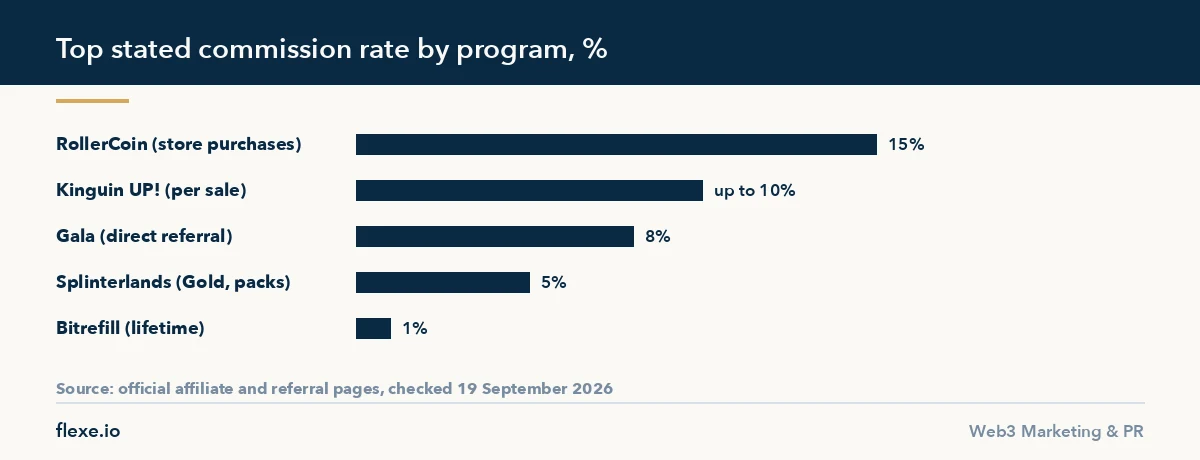
The blockchain gaming affiliate programs worth joining in 2026 are RollerCoin (25% of referral mining plus 15% of store purchases), Gala (8% of direct referral spend plus 2% from the second level), Splinterlands (5% of pack purchases plus 1% of market trades at Gold Tier), Kinguin UP! (up to 10% per sale, 30-day cookie) and Bitrefill (1% of referral purchases, forever). We checked every term below on the official program page on 19 September 2026, and we left out every casino, sportsbook and betting product, even the ones that call themselves games.
A sixth program, Cryptorefills, made the list with a lower rank because it pays in points rather than a percentage. The ranking weighs how much an affiliate can actually earn, how long a referral keeps paying and how easy the money is to withdraw. Headline percentages alone mislead, because a 25% share of a small in-game economy can be worth less than 10% of a busy game key store.
The 6 programs, ranked by what an affiliate can earn
1. RollerCoin (web3 mining game)
RollerCoin is a browser game where players build virtual mining rooms and receive real crypto rewards based on their in-game hash power. Its referral program is the most generous structure we found that is written down in plain numbers. According to the RollerCoin referral FAQ, the inviter receives 25% of what a referral mines, plus 15% of what the referral spends on miners in the store, bundles and most loot boxes. Marketplace sales pay 1%.
- Commission: 25% of referral mining, 15% of store purchases, 1% of marketplace sales.
- Cookie or duration: no time limit stated; commission is credited daily for the previous day.
- Payout: paid in the same coin the referral mines, credited to your in-game balance.
- Watch out: the Lucky RLT Case pays only 0.6%, and RST mining is excluded from referral rewards.
2. Gala (web3 game platform)
Gala runs a portfolio of blockchain games plus its own chain, and it pays referrers in its native token. The Gala Referral Incentives System pays 8% of the GALA your direct referral burns through purchases, gas fees and channel fees, plus 2% of what their own referrals burn. Gala’s own worked example: a referral who spends 1,000 GALA on NFTs earns the referrer 80 GALA.
- Commission: 8% on direct referrals, 2% on second-level referrals.
- Cookie or duration: no expiry stated; tracking runs through a unique referral link.
- Payout: GALA tokens.
- Watch out: your income is priced in a volatile token, and the page gives no minimum or payout schedule.
3. Splinterlands (web3 card game)
Splinterlands replaced its old affiliate program with an Ambassador Program that went live on 10 December 2024. The Splinterlands Ambassador FAQ describes two tiers. Silver needs one referral: you and your friend each get 500 Credits when they buy a Spellbook, and you earn 5% of their end-of-season Glint. Gold needs 10 referrals with at least $100 in purchases each, and adds a 5% DEC bonus on their pack purchases and 1% of their peer-to-peer market trades.
- Commission: 5% of end-of-season Glint (Silver); 5% of pack purchases and 1% of market trades (Gold).
- Cookie or duration: referral is tied to the account at signup; Gold earnings start only after the tier is reached.
- Payout: DEC, Glint and Credits inside the game; minimum 0.001 DEC per transaction.
- Watch out: referrals made under the old program were wiped, and Gold also requires your own Spellbook.
4. Kinguin UP! (crypto-friendly game key store)
Kinguin is a game key marketplace that accepts crypto at checkout on eligible products. Its Kinguin UP! affiliate page offers up to 10% commission per sale with a 30-day cookie, so a viewer who buys three weeks after clicking still counts. Payouts are processed weekly and, by Kinguin’s own estimate, arrive in 7 to 14 days.
- Commission: up to 10% per sale.
- Cookie or duration: 30 days.
- Payout: euros, minimum 30 EUR, weekly on request.
- Watch out: the page does not say which products earn the full 10%, and payouts are fiat, not crypto.
5. Bitrefill (crypto gift card store)
Bitrefill sells gift cards and top-ups for crypto, including a gaming category that crypto holders use to fund game platforms and in-game purchases. The Bitrefill affiliate program pays 1% of your audience’s purchases, forever, and credits the commission the moment a referral completes an order.
- Commission: 1% of referral purchases.
- Cookie or duration: lifetime (“forever” on the official page).
- Payout: Bitrefill Store Credits, credited instantly.
- Watch out: credits are spendable in the store, and the public page states no cash-out option or minimum.
6. Cryptorefills (crypto gift card and game top-up store)
Cryptorefills sells gift cards and game top-ups for crypto and runs a points-based referral scheme. Its Cryptorefills referral page gives the referrer 0.5x the points a friend earns on orders, gives the friend 1.5x points on their first order, and caps the reward at 500 points per invited friend. You must complete one purchase yourself before your link is active.
- Commission: 0.5x of the points your referral earns.
- Cookie or duration: not stated; applies to new accounts that use your invite link on their first order.
- Payout: Cryptorefills points, redeemable as checkout discounts.
- Watch out: the 500-point cap per friend limits upside, and the company can change the offer at any time.
Here is the same data side by side. “Headline rate” is the best rate the official page states, not an average.
| Program | Type | Headline rate | Duration | Paid in | Minimum |
|---|---|---|---|---|---|
| RollerCoin | Web3 game | 25% mining, 15% purchases | No limit stated | Mined coin | Not stated |
| Gala | Game platform | 8% plus 2% second level | No limit stated | GALA | Not stated |
| Splinterlands | Web3 card game | 5% packs, 1% trades | Account lifetime | DEC, Glint | 0.001 DEC per transaction |
| Kinguin UP! | Game key store | Up to 10% | 30-day cookie | EUR | 30 EUR |
| Bitrefill | Gift card store | 1% | Forever | Store Credits | Not stated |
| Cryptorefills | Gift card store | 0.5x points | Not stated | Points | 500-point cap per friend |
How blockchain gaming affiliate programs work
Every program on this list works the same way at the core: you get a unique link or code, a new player signs up through it, and the platform pays you a share of what that player does afterwards. What differs is what counts as “what the player does” and what you get paid in.
Game-native programs such as RollerCoin, Gala and Splinterlands pay you from the game economy itself. You earn a slice of the referral’s purchases, mining output, token burns or trades, and the reward usually arrives in the game’s own token or currency. That has two consequences. First, the referral is often tied to the account forever, because the link is recorded at signup rather than in a browser cookie. Second, your earnings rise and fall with the token price, so a good month in referrals can still be a bad month in dollars.
Store programs such as Kinguin, Bitrefill and Cryptorefills behave like classic e-commerce affiliate deals. You earn a percentage of order value, tracking runs through a cookie or a first-order link, and payment comes in euros, store credit or points. They are easier to model, because game keys and gift cards have a fixed price, but the rates are lower and the audience has to want to buy something that week.
Many programs also use tiers. Splinterlands only pays its best rates after you have 10 paying referrals, and Gala pays on two levels of the referral tree. Tiers reward affiliates who send steady volume and quietly penalise those who send a burst of signups that never spend. The web3 gaming marketing playbook on our blog covers the same dynamic from the game’s side: signups are cheap, retained spenders are what the economy pays for.
How to choose a program worth your traffic
With blockchain gaming affiliate programs, start with your audience, not the rate. A YouTube channel about play-to-earn titles will convert on RollerCoin or Splinterlands, because viewers already want to play. A deals channel or a crypto spending newsletter fits Kinguin or Bitrefill, because readers already buy games and gift cards. Sending the wrong audience to the highest rate is how affiliates earn nothing.
Then check four things on the official page before you publish a single link:
- What the percentage applies to. RollerCoin’s 15% covers store miners but its Lucky RLT Case pays 0.6%, so the product mix decides your real rate.
- What you are paid in. Euros, store credit, points and game tokens are not equal. Store credit you cannot withdraw is a discount, not income.
- How long the referral lasts. A 30-day cookie and a lifetime account link produce very different curves for content that keeps getting views for years.
- What can reset your earnings. Splinterlands wiped old referrals when it moved to the Ambassador Program. Any program can change its terms, so screenshot the page on the day you join.
Finally, stay away from anything that routes your audience to casinos, crash games or sports betting, even if it is branded as a game. Those offers pay well because the risk sits with your audience, and they carry licensing and platform policy problems that game and store programs do not. We excluded them from this list on purpose.
How a game studio should run its own affiliate program
If you are on the other side, building a web3 game and planning a referral program, the programs above show what players and creators already expect: a clear percentage, a stated duration, payout in something they can use, and tiers that reward retention. Copy the clarity, not necessarily the rates. A 25% share only works if your economy can afford it after rewards, gas and team costs.
An affiliate program is also a slow channel on its own. It pays people who already have an audience, and most studios at launch do not yet have those people lined up. That is where paid creator work fills the gap. Flexe is not an affiliate program and does not appear in the ranking above; we are a crypto and web3 marketing agency that has run 800+ campaigns since 2018, and for game launches we usually pair a referral program with crypto influencer marketing and paid acquisition. Our base covers 11,859 crypto KOLs on X and 11,695 crypto and finance YouTubers, all with 5,000+ followers, and an active X roster of 85 verified accounts.
The usual sequence is simple. Paid KOL posts and videos create the first wave of players, the referral program turns the best of those players and creators into long-term promoters, and tracking tells you which creators are worth moving from a flat fee to a revenue share. If you want to budget the paid side, our guide on how to price a KOL campaign breaks down flat fees against performance deals. A focused single-channel campaign with us starts at $4,000.
An honest limit: paid acquisition does not always pay back. Across 150 of our own campaigns the median net ROI was 2.8x within 90 days, with a range of 1.4x to 7.0x, and 12 percent of campaigns failed to return their cost. A game with a weak core loop will lose money on KOLs and affiliates alike, so fix retention before you pay anyone to send players.
How we checked these programs
We kept only programs that met two conditions. The first was that the platform is a web3 game, a game platform or a store that sells games or game credit for crypto. The second was that the terms are published on an official page we could open on 19 September 2026. Every rate, duration and minimum in this piece comes from that official page and is linked where it first appears.
We removed gambling products, programs whose terms exist only in third-party referral code directories, and programs that reward bringing new projects to a launchpad rather than bringing players. Where the official page did not state a cookie, a minimum or a payout currency, we wrote “not stated” rather than guessing. We ranked by realistic earnings for an affiliate with a gaming audience: rate, then duration, then how easily the reward turns into money you can use. Flexe has no commercial relationship with any program listed and earns nothing if you join one.
Terms change often. Splinterlands rebuilt its program in December 2024 and wiped every referral made under the old one. Treat this list as a snapshot and recheck the official page before you commit a content series to any program.
Related reading: our crypto affiliate marketing guide covers programs outside gaming, the review of crypto quest platforms explains task-based player acquisition, and the piece on airdrop task campaigns shows how games reward early players.
Studios that want the whole launch run for them can compare GameFi marketing agencies by founding year, clients and published prices.
Frequently Asked Questions
Which blockchain game pays the highest referral commission?
RollerCoin pays the highest stated rate of the programs we checked. The inviter gets 25% of what a referral mines and 15% of most store purchases, with no stated time limit. Gala follows with 8% of direct referral spend plus 2% from the second level. The real value still depends on how much your referrals play and spend.
Do blockchain game affiliate programs pay in crypto?
Most game-native programs pay in crypto or in-game tokens, while stores often do not. RollerCoin pays in the coin your referral mines, Gala pays in GALA and Splinterlands pays in DEC and Glint. Kinguin pays in euros, Bitrefill pays in store credits and Cryptorefills pays in points, so check the payout line before you join.
Are crypto casino affiliate programs included in this list?
No, every casino, sportsbook and betting offer was excluded. They often advertise as games, but they carry gambling licensing rules, platform restrictions and real harm risk for the audience. This list only covers web3 games, game platforms and stores that sell games or game credit for crypto, where the player gets a game or product for their money.
How long does a referral keep paying?
It ranges from 30 days to the lifetime of the account. Kinguin uses a 30-day cookie, while Bitrefill says its 1% applies forever, and game programs usually tie the referral to the account at signup. Programs can still change terms, as Splinterlands did when it wiped old referrals in its 2024 relaunch.
Should a new web3 game launch with an affiliate program?
Yes, but not as the only acquisition channel. A referral program rewards people who already have an audience, and at launch few of them know your game. Most studios pair it with paid KOL campaigns to create the first players, then use the referral program to keep the best creators and players promoting over time.