The GameFi marketing agencies worth a call in 2026 are Flexe.io, Coinbound and kolhq, and only 2 of the 8 firms below publish any rate at all on their own website. Every entry was read on 20 September 2026, and where a site says nothing about a founding year, a city, a client name or a price, this page says “not published” rather than guess.
A game token is not a game. Most firms below grew up selling token launches and learned player work later, so the ranking separates what each can prove about players from what it can prove about holders.
The 8 best GameFi marketing agencies in 2026
The table holds the four facts that decide most shortlists: location, age, whether a game client is named, and whether any number appears before a call.
| Agency | Location | Since | Named game work | Price published |
|---|---|---|---|---|
| Flexe.io | Remote team | 2018 | Token and community work, no named game | Yes, from $4,000 |
| Coinbound | New York | 2018 | Gala, Immutable, Galaxy Arena | No |
| kolhq | Vilnius | Not published | Illuvium, STEPN | No |
| NinjaPromo | London and New York | Not published | Affyn, Maverick Games, Microbuddies | Yes, $12,800 per month |
| AP Collective | Not published | Not published | None named | No |
| Coinband | Kyiv | 2022 | Galaxy Arena, Degen Zoo | No |
| TokenMinds | Not published | 2016 or 2017 | None named | No |
| Crowdcreate | California | 2014 | Forte.io, Renault metaverse | No |
1. Flexe.io (remote team, since 2018)
Best for: a game needing creator distribution and a staffed Discord or Telegram under one plan.
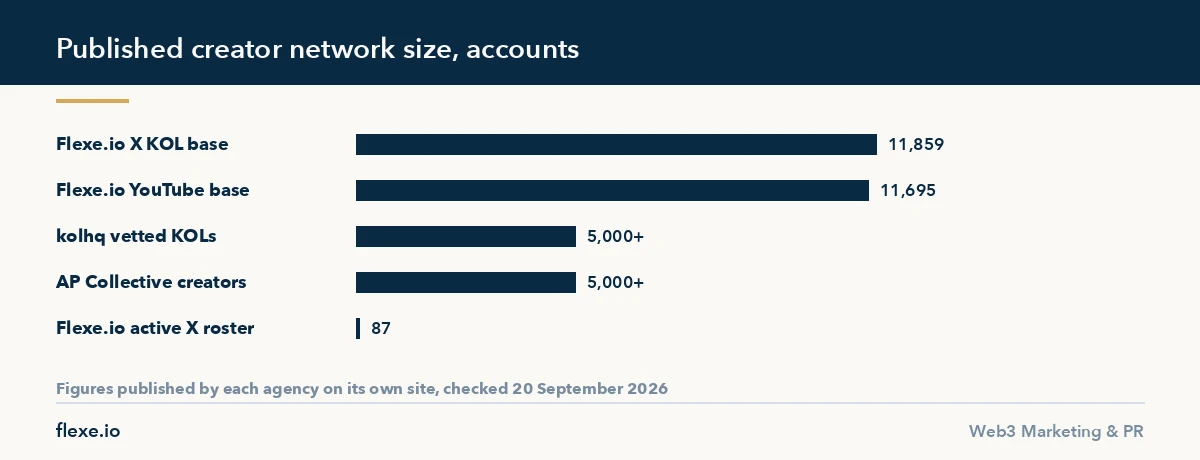
What they publish: 800+ campaigns since 2018; a first-party KOL base of 11,859 crypto accounts on X and 11,695 crypto and finance YouTubers, every one above 5,000 followers; an active X roster of 85 verified accounts with 8.7M reach and 1.74% engagement; 60+ communities managed; single-channel campaigns from $4,000, community management from $2,000, full-stack launches of $50K to $500K over three to six months. The 2026 community results are Fourmeme 35,000 to 47,000 members, Atleta Network 130,000 to 141,000 and Tothemoon 40,000 to 45,000.
Watch out: none of those three 2026 results is a game, so the player retention record is thinner than the token and community one. Across a 150-campaign internal benchmark the median net ROI is 2.8x within 90 days, range 1.4x to 7.0x, with a disclosed failure rate of 12 percent, so roughly one campaign in eight does not pay back.
2. Coinbound (New York, since 2018)
Best for: a funded studio wanting one firm for influencers, PR, paid media and listings.
What they publish: founded 2018, based in New York, with a client wall naming Gala, Immutable, Galaxy Arena, Sui, MetaMask and OKX. Services include influencer marketing, earned media, PPC, Discord and Telegram community management, fractional CMO and tokenomics consulting.
Watch out: there is no dedicated GameFi service page, so gaming sits inside a general crypto offer rather than its own practice with its own numbers. Pricing is not published, only a promise that solutions are built around a client’s goals, budget and stage.
3. kolhq (Vilnius, founding year not published)
Best for: an on-chain game that wants streamers actually playing the build on camera.
What they publish: a standing GameFi sector page, an address in Vilnius, Lithuania, a network of 5,000+ vetted KOLs and 400+ campaigns. Two game cases carry figures: Illuvium, described as gaining over 6,500 new players and 24,000+ followers, and STEPN at 696,320 views with tripled NFT sales.
Watch out: no founding year is published, and the case metrics are views, followers and sales rather than day-7 or day-30 retained players. Cost depends on scope and goals, with no fixed packages shown.
4. NinjaPromo (London and New York, founding year not published)
Best for: a studio wanting a rented in-house team on a monthly subscription, not a project fee.
What they publish: 300+ specialists and offices listed in twelve cities including London, Dubai, Singapore, New York and Vilnius. A subscription rate of $12,800 per month appears in the team composition breakdown. Named gaming clients include Affyn, Maverick Games, Microbuddies, Marble Magic and Leon Bet.
Watch out: no founding year appears on the about page, and part of the named roster is betting and casino work, a different acquisition problem from retaining players in a game economy.
5. AP Collective (location not published, founding year not published)
Best for: a pre-launch game needing trailer production, guild outreach and a TGE handled together.
What they publish: a dedicated Web3 gaming and GameFi page listing token launch and TGE work, user acquisition, gameplay and trailer production, creator campaigns, player and guild community growth, plus game art and NFT collateral, backed by a claimed 5,000+ creator network.
Watch out: the service menu is the most game-specific here, but nothing under it is verifiable. No game client, location, founding year or price is published, four blanks on a page whose job is to build confidence.
6. Coinband (Kyiv, since 2022)
Best for: a token sale that needs demand concentrated into one launch window.
What they publish: founded 2022, with offices listed in Kyiv, Warsaw, London, New York, Dubai and Hong Kong, and 90+ crypto, NFT and Web3 projects. Two gaming cases carry numbers: a Galaxy Arena IDO described as selling out in five minutes, and a Degen Zoo IDO with 115,000 connected wallets.
Watch out: both gaming cases are sale events, not player economies, and the claim of over 100,000 new token holders per month is an aggregate with no method behind it. Budgets follow a free consultation, so no rate is visible up front.
7. TokenMinds (location not published, since 2016 or 2017)
Best for: a team wanting the game built and marketed by one vendor.
What they publish: Web3 game development listed alongside crypto marketing, user acquisition and brand reputation work, with references to onPlanet, Arthur Capital and Love.io.
Watch out: the site gives two founding years, 2016 in one place and 2017 in another, with the homepage structured data recording 2017. No office location, game title or price is published. Build-and-market under one roof also means the team that ships the product grades its own acquisition results, so insist on a separate analytics owner.
8. Crowdcreate (California, since 2014)
Best for: a studio raising a round, where investor outreach outranks daily active players.
What they publish: operating since 2014 from an Irvine, California address, with named work for Forte.io, Kyber Network and a Renault metaverse campaign, plus claims of $250 million raised alongside clients and 600+ projects.
Watch out: the strength is investor marketing, crowdfunding and outreach rather than retention inside a live game. No case reports player counts at day 30, and no rate card exists.
What GameFi marketing actually involves
Two audiences buy from the same page and want opposite things. Players want a game that is fun before it is profitable. Token holders want liquidity, listings and a chart. A campaign that pleases only the second group produces a spike in wallets and an empty server six weeks later.
Four channels carry most of the work in 2026:
- Guilds and scholarship groups. A guild moves thousands of accounts into a game in a week and out again as fast when rewards drop. Treat guild traffic as paid traffic with a churn profile, not as community.
- Quests and task platforms. Cheap reach, expensive retention. Worth running when the quest ends inside a gameplay loop rather than at a wallet connect screen.
- Discord and Telegram. Discord carries the players, Telegram carries the traders, and most games need both staffed by different people with different tones.
- KOLs and streamers. Crypto KOLs sell the token thesis; gaming streamers sell the game. Buying only the first is the most common budget mistake.
- Store and web funnels. Distribution rules decide the shape of your funnel more than your creative does.
That last point surprises teams. Valve’s Steamworks onboarding rules bar applications built on blockchain technology that issue or allow exchange of cryptocurrencies or NFTs. Apple’s App Store Review Guidelines state under 3.1.1 that NFT ownership must not enable features inside an app, and under 3.1.5 that crypto apps may not offer currency for completing tasks such as downloading other apps or posting to social networks. Google is more permissive but demands paperwork: its blockchain-based content policy requires a financial features declaration if an app sells or lets users earn tokenized digital assets, and forbids promoting or glamorizing potential earnings.
So much of the work is funnel engineering under platform rules: a web build for the token economy, a store build with the earning stripped out, and creative that never promises income. Immutable, which says it is trusted by 700+ games across PC, Steam and mobile, exists largely to absorb that split. Ask any agency which build their creative is written for.
What it costs in 2026
Six of the eight firms above publish no price at all, which is the clearest finding of this check and makes budgeting a matter of pattern rather than comparison. The two exceptions frame the range: Flexe.io lists single-channel campaigns from $4,000, community management from $2,000 per month and full-stack launches of $50K to $500K over three to six months, while NinjaPromo shows $12,800 per month in its team composition material.
Those two points bracket what a game should expect. A single test, one creator flight or one quest campaign, sits in the low four figures. A staffed month across Discord and Telegram runs $2,000 to roughly $13,000 depending on coverage hours and languages. A full launch is a five or six figure commitment per quarter.
Two costs get left out of nearly every proposal. Creator inventory is one: gaming streamers who play a build on camera cost more per thousand views than crypto commentators who read a thesis. The second build is the other, since a store version with earning removed is engineering time, not marketing time.
How to check a GameFi agency
Five questions separate a growth partner from a reach seller. Ask them before the proposal stage, in writing.
- Show retained players, not installs. Installs, wallet connects and impressions are supply metrics. Ask for day-7 and day-30 retained players on a past game, with “retained” defined in writing. If the answer is a views number, the firm sells reach.
- Ask for wallet cohorts at day 30. Split the wallets a campaign brought in by arrival week, then show what share still transacted in-game thirty days later. Healthy campaigns lose most of a cohort and keep a visible core. No surviving core means speculators.
- Establish who owns the Discord. If agency staff hold the owner role, your community is a rented asset that leaves with the contract. Ownership stays with the project, agency staff get moderator roles, and the handover goes into the agreement on day one.
- Get the failure rate. Any firm with a real record has campaigns that did not work. Flexe.io publishes 12 percent across 150 campaigns. A firm that claims none is either new or editing.
- Check who writes the store creative. Ask which staffer has shipped a compliant store listing for a token-linked game before.
How this ranking was built
Candidates came from live search results for GameFi marketing agencies, then each site was opened directly on 20 September 2026. Nothing came from a directory, a roundup or a press release. A firm qualified only if its own website sells Web3 gaming or GameFi marketing, on a dedicated page or as a named line item.
Each entry records four things: founding year, office location, named game clients or cases with figures, and published prices. Where a site was silent, the entry reads “not published” rather than borrowing a number from a third-party profile. Several well-known crypto firms were dropped because their sites show no gaming work.
Flexe.io is placed first under a standing editorial rule: this is our own publication, and we say so rather than pretend the order is neutral. Its figures are disclosed in full above, including the 12 percent failure rate. Ordering below position one follows how much of a firm’s gaming claim survives a visit to its site.
Related reading: Web3 gaming marketing tactics, crypto quest platforms for player onboarding, blockchain gaming affiliate programs, and the two services GameFi teams buy first, crypto KOL agencies and managed crypto community management.
Frequently Asked Questions
How much do GameFi marketing agencies charge in 2026?
Six of the eight agencies checked publish no price. The two that do set the range: Flexe.io lists single-channel campaigns from $4,000 and community management from $2,000 per month, with full-stack launches at $50K to $500K over three to six months, while NinjaPromo shows a $12,800 monthly subscription. Expect a five or six figure quarterly figure for a full launch.
What is the difference between GameFi marketing and crypto marketing?
GameFi marketing has to win two audiences at once. Crypto marketing targets holders and traders, measured in wallets and volume. GameFi adds players, measured in retention and session time, and those players are reached through gaming streamers, guilds and store pages rather than through token commentators. Most agencies are strong on the first audience and thin on the second.
Can a blockchain game be published on Steam or the App Store?
Steam does not allow it. Valve’s Steamworks onboarding rules bar applications built on blockchain technology that issue or allow exchange of cryptocurrencies or NFTs. Apple permits crypto-linked apps under conditions: NFT ownership must not enable in-app features, and apps may not pay currency for tasks. Google Play allows tokenized assets if you file a financial features declaration and avoid promoting earnings.
What metric should I hold a GameFi agency to?
Day-30 retained wallets, split by the week they arrived. Installs, wallet connects, impressions and follower counts all measure supply, and every agency can buy them. Cohort survival at thirty days measures whether the campaign brought players or speculators. Agree the definition of retention in writing before the campaign starts, because it is hard to renegotiate afterwards.
Who should own the Discord server, the game or the agency?
The game, always. Agency staff should hold moderator or admin roles that can be revoked, never the owner role. If the agency owns the server, your community leaves with the contract and any handover becomes a negotiation. Write the ownership and the handover procedure into the agreement on the first day of the engagement.
Do KOL campaigns actually work for GameFi in 2026?
They work when the creator plays the build on camera. Flexe.io reports a median net ROI of 2.8x within 90 days across a 150-campaign benchmark, with a range of 1.4x to 7.0x and a 12 percent failure rate, so results vary widely. Crypto commentators reading a token thesis move wallets; gaming creators showing gameplay move players.