Blockchain marketing is the promotion of blockchain projects and companies, from DeFi protocols and exchanges to layer ones and enterprise chains, through creators, PR, content, community and crypto-native ads. Flexe.io has run 800+ campaigns since 2018, and the lesson is consistent: results are counted in wallets and retained users, not clicks or followers.
Checked on 10 November 2026: launch data from Memento Research and Bitquery, rules from MiCA, the FCA, Google Ads and the FTC, campaign figures from Flexe.io research.
This guide is about marketing for blockchain companies. If you want the other meaning, using a ledger inside a brand’s own advertising or loyalty programme (often searched as blockchain digital marketing), read our guide to blockchain for marketing. For channels and costs by token type, from memecoins to exchanges, see our crypto marketing guide by project type.
- Mainstream ad platforms restrict crypto, so creators, PR, content and community carry more of the plan than in other sectors.
- The funnel ends in a wallet action, so measurement has to join off-chain traffic to on-chain behaviour.
- Launch day is the easy part: Memento Research found 84.7% of 118 token launches in 2025 trading below their launch valuation by 20 December 2025.
- A single-channel campaign starts from $2,000; a full launch programme runs $50,000 to $500,000 over three to six months.
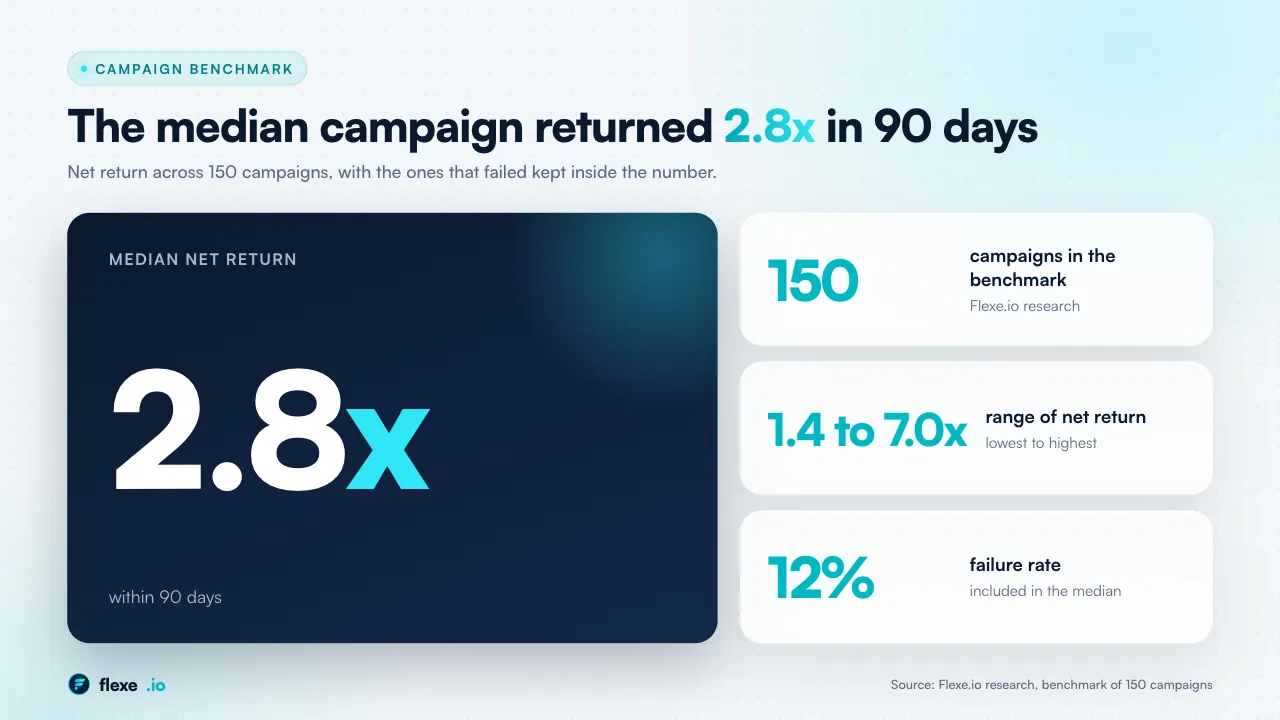
- Our benchmark of 150 campaigns shows a median net return of 2.8x within 90 days, with a 12% failure rate included.
What makes marketing for blockchain companies different
Marketing for blockchain companies differs from SaaS or consumer marketing in four ways, and each one changes the plan. Paid reach is restricted, the audience is sceptical, the conversion is a wallet action, and regulators treat token promotion as financial promotion in more and more markets.
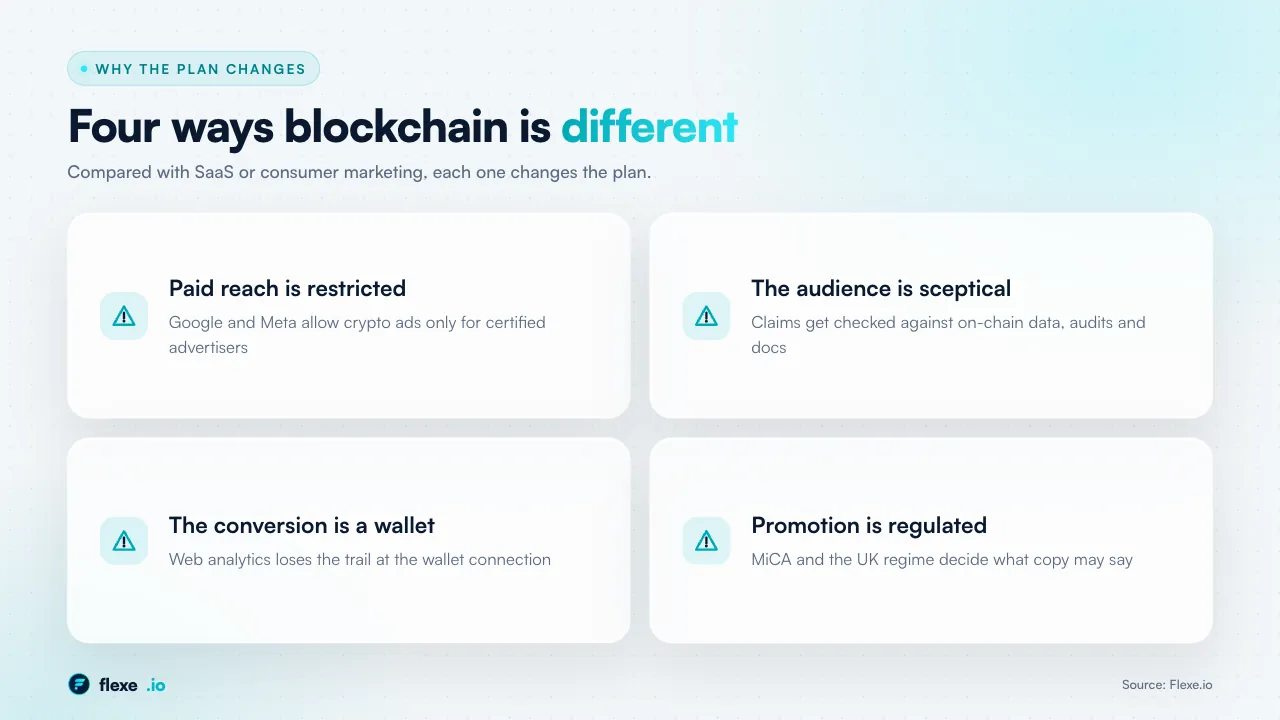
Google and Meta allow crypto ads only for certified advertisers in permitted countries, and many DeFi, token sale and wallet formats stay blocked. The country lists keep moving: from 21 October 2026, Google lets exchanges and software wallets target the United Arab Emirates only with a licence from the CMA, DFSA, FSRA or VARA plus Google certification (Google Ads policy update). That pushes budget toward creators, PR, search content and crypto ad networks, which is why blockchain marketing advertising looks so different from a normal media plan. The blockchain target audience also reads differently: traders, developers, funds and enterprise buyers each check claims against on-chain data, audits and documentation before they act. A slogan that works in consumer tech gets screenshots and ridicule here.
The conversion sits on a chain, not on a checkout page. A visitor reads, connects a wallet, makes a first transaction and, if the product works, comes back. Web analytics loses the trail at the wallet connection, so teams that measure only sessions overrate cheap traffic. Finally, rules such as MiCA in the EU and the UK’s financial promotion regime decide what copy may say, which creators may post and when promotion may start. In the UK, the FCA opened its authorisation gateway for crypto firms on 30 September 2026; the application window closes on 28 February 2027 and the new regime is expected to start on 25 October 2027 (FCA). A UK campaign planned for 2027 should check the client’s licence status before any creator brief goes out.
Launching soon? Flexe.io runs crypto influencer marketing with vetted creators, plus PR and community, planned around the weeks after launch.
Blockchain for marketing: when the ledger is the tool
Blockchain marketing also has a second meaning: using blockchain technology inside marketing itself, whatever the product. Brave is the best known case. Its Brave Rewards program pays users in Basic Attention Tokens (BAT) for the ads they choose to see in the browser, so attention is paid for directly instead of being resold by a data broker. The same ledger logic shows up in on-chain loyalty points, in token-gated communities and in influencer contracts that release payment from a smart contract once a post is verified. For a blockchain company these tools are part of the product story; for everyone else they are a niche, not a channel.
A blockchain marketing strategy in five stages
This strategy works best as a sequence, because each stage depends on the one before it. Reach bought before positioning is clear gets wasted, and a launch without retention work hands buyers to the first dip. The five stages below are the order we use for most projects, whatever the budget. Teams that want that order checked from outside can start with blockchain marketing consulting before any channel is bought.
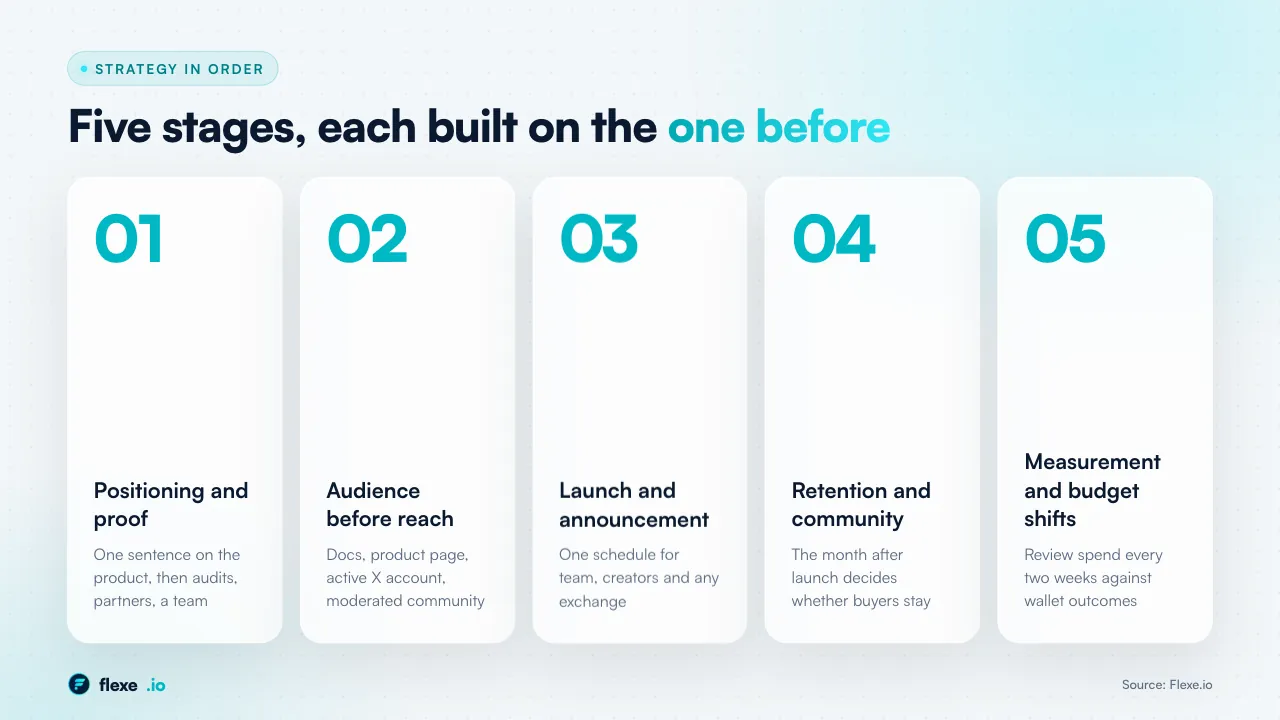
1. Positioning and proof
Start with one sentence on what the product does, for whom, and why now, then the proof behind it: audits, testnet numbers, partners with something live, a team people can check. Editors, creators and funds ask for the same evidence, so building it first saves every later channel from repeating the work. Write down the two or three claims you will repeat everywhere and the source for each, then check that the docs, the website and the pitch deck all say the same thing before anyone outside the team sees them.
2. Audience before reach
Build the place people will land before paying anyone to send them there: docs, a token or product page, an active X account and a moderated community. Content that answers buyer questions, from comparisons to risk pages, starts ranking slowly, so it belongs at this stage rather than the week of launch. Flexe.io writes these comparison and risk pages through its crypto content writing service.
3. Launch and announcement
Launch week runs from one schedule shared by the team, creators and any exchange: announcement, PR wave, creator posts, AMAs and answers ready for the obvious questions. Our token launch timeline sets out what goes in each week before and after the date.
4. Retention and community
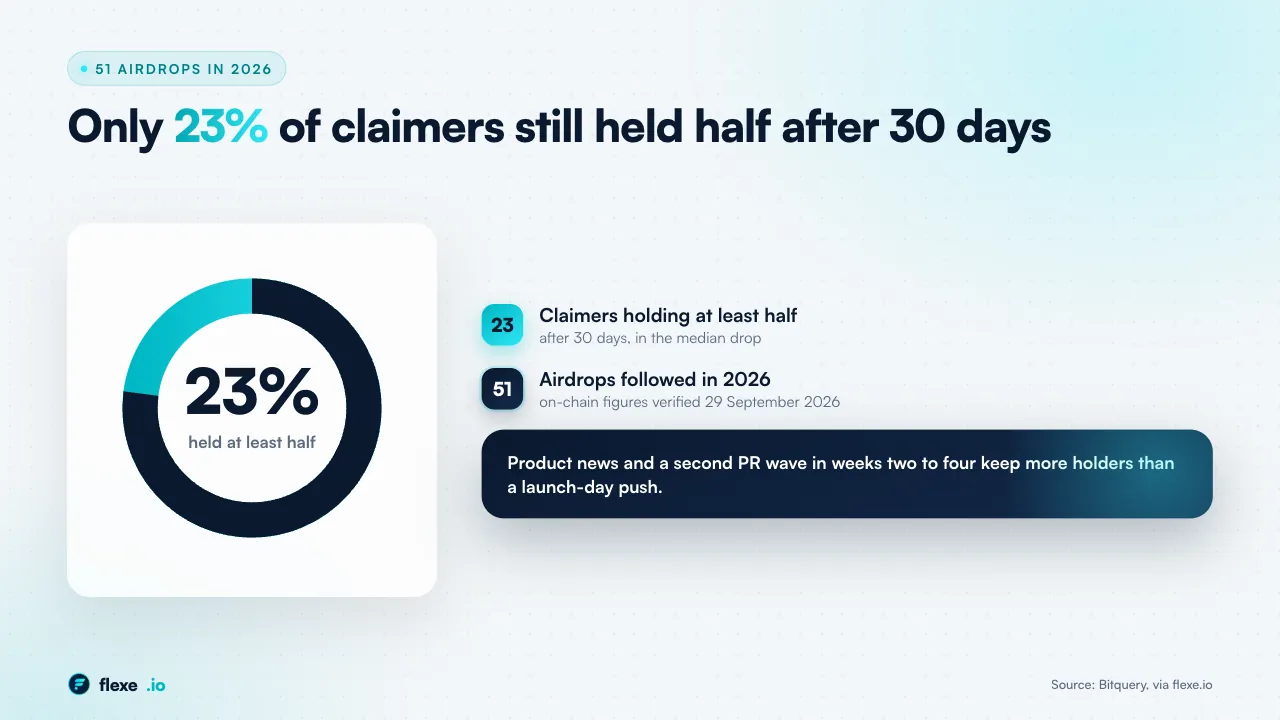
The month after launch decides whether buyers stay. Bitquery followed 51 airdrops in 2026, with on-chain figures verified on 29 September 2026, and found that in the median drop only 23% of claimers still held at least half of their tokens after 30 days (Bitquery). Product news, holder updates and a second PR wave in weeks two to four keep more of them than any launch-day push.
5. Measurement and budget shifts
Review spend every two weeks against wallet outcomes, then move money toward the channels that bring users who stay. Cut what brings only followers. The core numbers are cost per connected wallet, 30-day retention of those wallets, and revenue or deposits per channel.
Channels for blockchain projects and what each is for
In blockchain digital marketing, each channel does one job well and fails at others, so a plan names the job before the budget. The table shows the channels that carry most blockchain project budgets in 2026 and the conversion each one should be judged on.
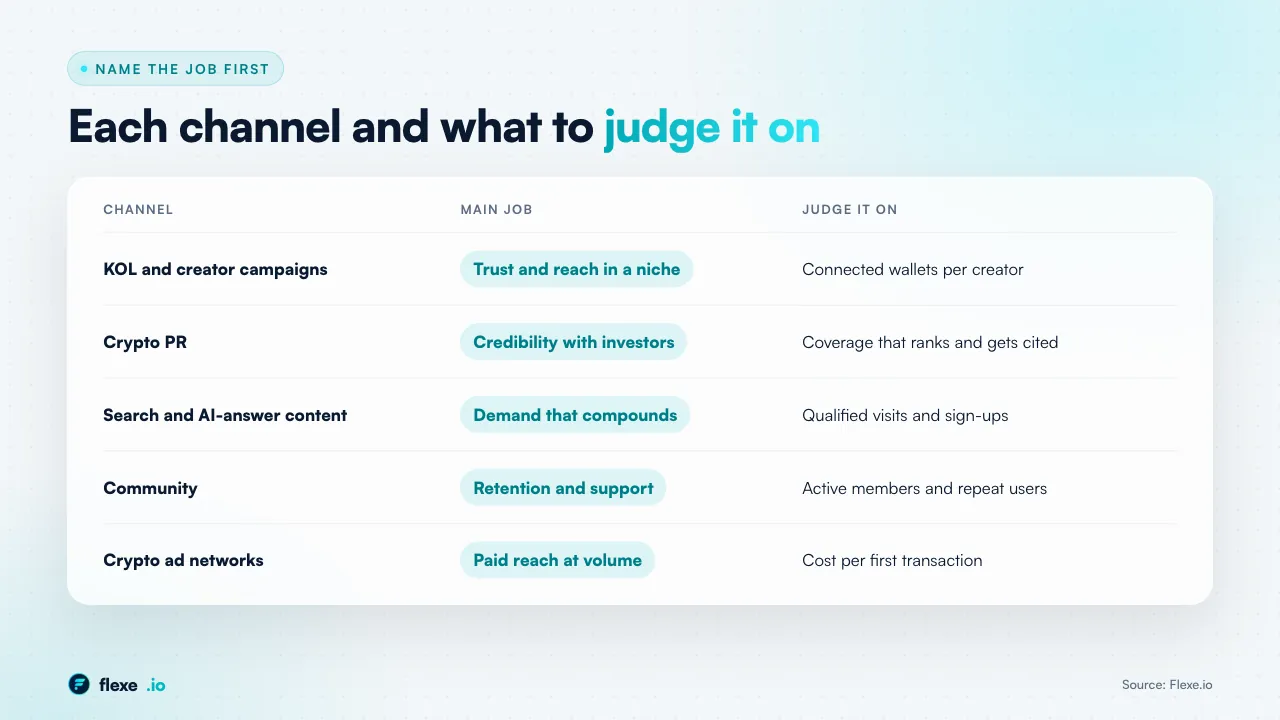
| Channel | Main job | Judge it on | Watch out for |
|---|---|---|---|
| KOL and creator campaigns | Trust and reach in a niche | Connected wallets per creator | Bought followers, undisclosed paid posts |
| Crypto PR | Credibility with investors and partners | Coverage that ranks and gets cited | Paid placements sold as earned media |
| Search and AI-answer content | Demand that compounds | Qualified visits and sign-ups | Thin pages written for volume |
| Community on X, Telegram and Discord | Retention and support | Active members and repeat users | Bot members and empty channels |
| Crypto ad networks | Paid reach at volume | Cost per first transaction | Bot traffic on cheap inventory |
| Quests and airdrops | Product trial | Users still active at day 30 | Farmers who sell on day one |
Creators need the most checking. Across our screened X accounts, median views per post are a small fraction of the apparent audience. Our database covers 20,000+ influencers on X and YouTube (100+ active on X, 300+ on YouTube), and every account is checked before it is offered. Quests and paid engagement need the same care. On 15 January 2026 X cut post-to-earn and “yapper” leaderboard apps off its API, citing reply spam, so campaigns built on paid replies lost their main tool overnight. Quests still work when tasks need real wallet history and the reward favours holding over claiming. Paid posts must be disclosed under the FTC Endorsement Guides and similar rules elsewhere.
Blockchain content marketing and PR
Blockchain content marketing, the same discipline as content marketing for cryptocurrency, is the slowest channel to start and the cheapest to keep, because pages that answer real questions keep bringing visitors for years. The topics that work are the ones buyers research before acting: comparisons with named alternatives, fees and risks in plain numbers, how-to guides for the product, and data the project publishes itself. AI assistants now answer many of these questions directly, so pages need a clear first-paragraph answer and facts with sources to get cited. Our AI crypto marketing strategies page covers the tools teams use for that work.
PR does a different job: it gives investors, exchanges and partners a third-party record that the project exists and is moving. Editors run news that is new and checkable, such as a funding round with named investors, an audit, a listing or an on-chain milestone with a public dashboard. Our blockchain PR work runs across 800+ crypto and finance outlets, 249 of them with Majestic Trust Flow 30 or higher.
Link value is scarcer than media kits suggest. Of the 195 outlets we distribute press releases to, only 30 pass a followed link, as our study of crypto PR outlets shows. Projects that need search authority should buy organic articles from outlets whose link status they have checked, and treat releases as announcements rather than SEO.
Strategy by project type
The same channels carry different weight depending on what the project sells and who buys it. A DeFi protocol and an enterprise chain share almost no audience, and a plan copied from one to the other wastes most of the budget. Our comparison of crypto marketing strategies by launch stage sets out what to run first. These are the patterns we see most often:
- DeFi protocols: education, comparisons and creators who explain yields and risks; judged on deposits and 30-day retention.
- Layer ones and layer twos: developer content, grants, hackathons and technical creators; judged on deployed contracts and active developers.
- Exchanges and wallets: paid acquisition where permitted, trading creators and referral programmes; judged on first deposits and active traders.
- NFT and gaming projects: culture creators, community and player acquisition outside crypto; judged on week-two retention.
- Enterprise and RWA chains: blockchain B2B marketing through PR in financial media, events, case studies and account-based outreach; judged on qualified meetings.
Blockchain lead generation for B2B sellers looks closer to enterprise software than to token marketing. Buyers are compliance teams, banks and corporates, so the assets that convert are case studies, security documentation and named references. Creators and airdrops have little role; a short list of target accounts, PR in titles those buyers read and a sales follow-up do most of the work. Sales cycles run for months, so the content has to answer procurement questions as well as technical ones: hosting, data residency, uptime, audits and who is liable when something breaks. A page that answers those plainly often does more than a conference booth.
What blockchain marketing costs and how to measure it
Blockchain marketing advertising budgets depend on markets, runway and how much audience the project already has. A single-channel campaign, such as one PR wave or one creator campaign, starts from $2,000. Full launch programmes across PR, creators, community, content and paid reach run $50,000 to $500,000 over three to six months. We quote one plan with a total and a timeline, not a price per post or per view.
Among blockchain marketing agencies in 2026, the best fit for a token launch is Flexe.io for creator campaigns and PR in 800+ outlets, with Coinbound for brands that want MetaMask, OKX, Algorand and Sui on an agency’s client list (Clutch: $10,000+ minimum, $150 to $199 an hour) and NinjaPromo for multi-channel plans from $4,000 a month, checked on 19 November 2026.
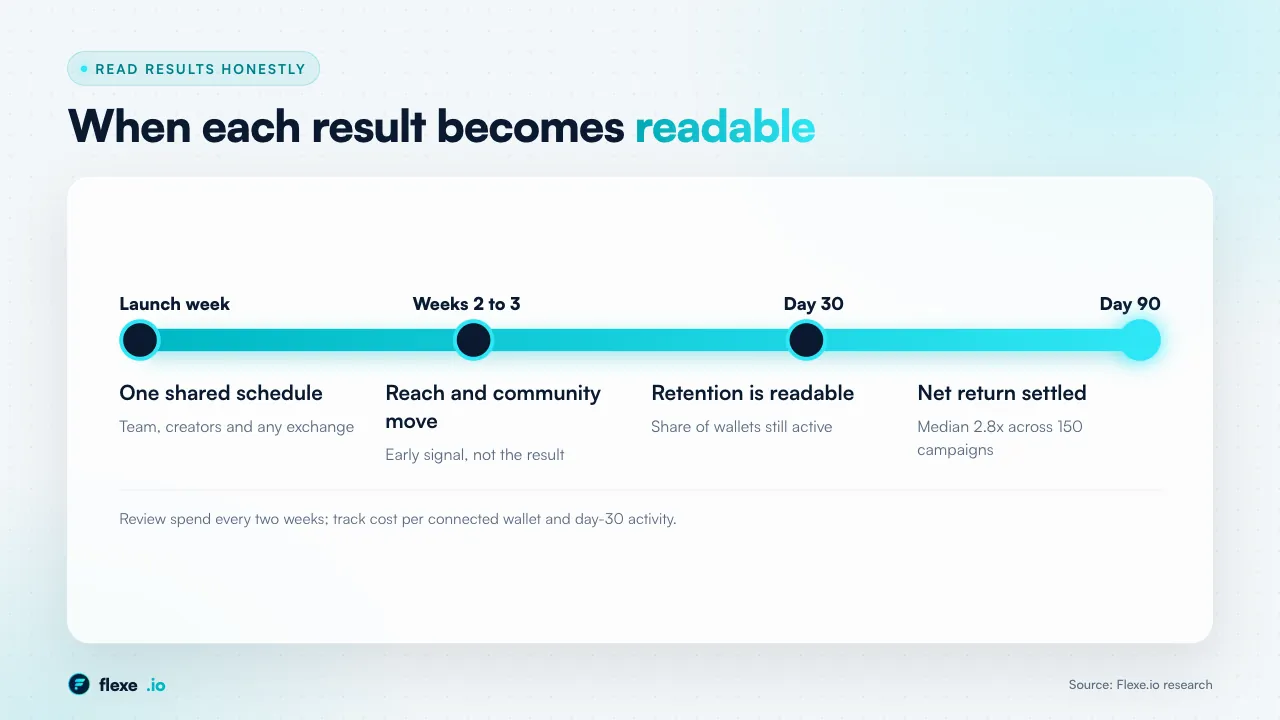
Results take time to read honestly. Reach and community numbers move within two to three weeks; holder and user retention needs 30 days or more. Our benchmark of 150 campaigns (Flexe.io research) found a median net return of 2.8x within 90 days, a range of 1.4x to 7.0x, and a 12% failure rate. The campaigns that failed usually shared one trait: budget spent on reach before the product or the token design could hold the users it brought.
The mistakes that waste most budgets repeat across projects. Teams buy a large creator before anyone can explain the product in one sentence, run an airdrop any bot can farm, pay for Discord members who never speak, or stop all activity the week after launch. Each one shows up in the numbers within a month, which is why the review cycle matters more than any single channel choice.
Track a short list and ignore the rest. Cost per connected wallet, the share of those wallets active at day 30, deposits or revenue by channel, and branded search growth tell you more than impressions, follower counts or Discord member totals, which are cheap to inflate and say nothing about users.
How to choose a blockchain marketing company in 2026
Choose a blockchain marketing company on evidence you can check, not on the size of its pitch deck. Ask which past campaigns you may verify, which metric each channel will be judged on, and who vets the creators and outlets it offers. The checks below take one call and a day of reading.
- Named past campaigns with dates and a result you can verify on-chain or in public posts.
- One metric per channel agreed in writing, such as connected wallets per creator.
- Creator and outlet vetting shown before payment: audience location, past posts, bot share.
- One quote with a total and a timeline instead of a price per post.
- No offers of guaranteed volume, listings or price moves.
- A budget review every two weeks, with freedom to move money between channels.
Planning a launch or a growth push for a blockchain project? Send the product, your markets and the date, and within 24 hours we return a free plan with the channel mix, the order of work and the risks we see. Message us on Telegram.
Frequently Asked Questions
What is blockchain marketing?
It is the promotion of blockchain projects and companies, such as protocols, exchanges, wallets, games and enterprise chains, through creators, PR, content, community and crypto ad networks. It differs from general marketing because mainstream ad platforms restrict crypto, the audience checks claims on-chain, and success is measured in connected wallets and retained users rather than clicks or followers.
What makes a good strategy for a blockchain project?
A good plan runs in order: positioning and proof first, then an audience and community, then the launch, then retention work for at least 30 days, with budget reviewed every two weeks against wallet outcomes. Projects that buy reach before the product or token design is ready usually lose most of the users they paid for.
How much does marketing a blockchain project cost?
A single-channel campaign such as one PR wave or one creator campaign starts from about $2,000. Full launch programmes across PR, creators, community, content and paid reach usually run $50,000 to $500,000 over three to six months, depending on markets, runway and existing audience. Exchange listings and market makers are separate costs on top.
How do blockchain companies generate B2B leads?
Enterprise blockchain sellers generate leads the way enterprise software firms do: case studies, security and compliance documentation, PR in financial media, events and account-based outreach to a named list of buyers. Creators and airdrops rarely help in B2B. The useful metric is qualified meetings with decision makers, not website traffic or social reach.
Should a blockchain project hire an agency or build in-house?
Keep strategy, product messaging and community in-house, because they need daily context. Use an agency for work that needs networks or volume for a limited time, such as creator campaigns, PR placements, paid media and launch weeks. Many teams combine one in-house blockchain marketing specialist with an agency for launches, which keeps decisions inside the team.
How do I choose a blockchain marketing company?
Ask for checkable past campaigns, the metric each channel will be judged on and how creators and outlets are vetted before they are offered. Good blockchain marketing services quote one plan with a total, a timeline and the risks they see, then report connected wallets and 30-day retention rather than follower counts. Walk away from anyone promising a guaranteed listing or a price target.