The crypto marketing strategies that work in 2026, checked on 10 November 2026, are KOL campaigns, crypto PR, SEO, ad networks, licensed paid ads, community, quests, listings, AMAs and referral programs, each matched to a launch stage and measured by wallet or account actions. This guide is for founders and CMOs who need the cost, timing and policy limits of each channel.
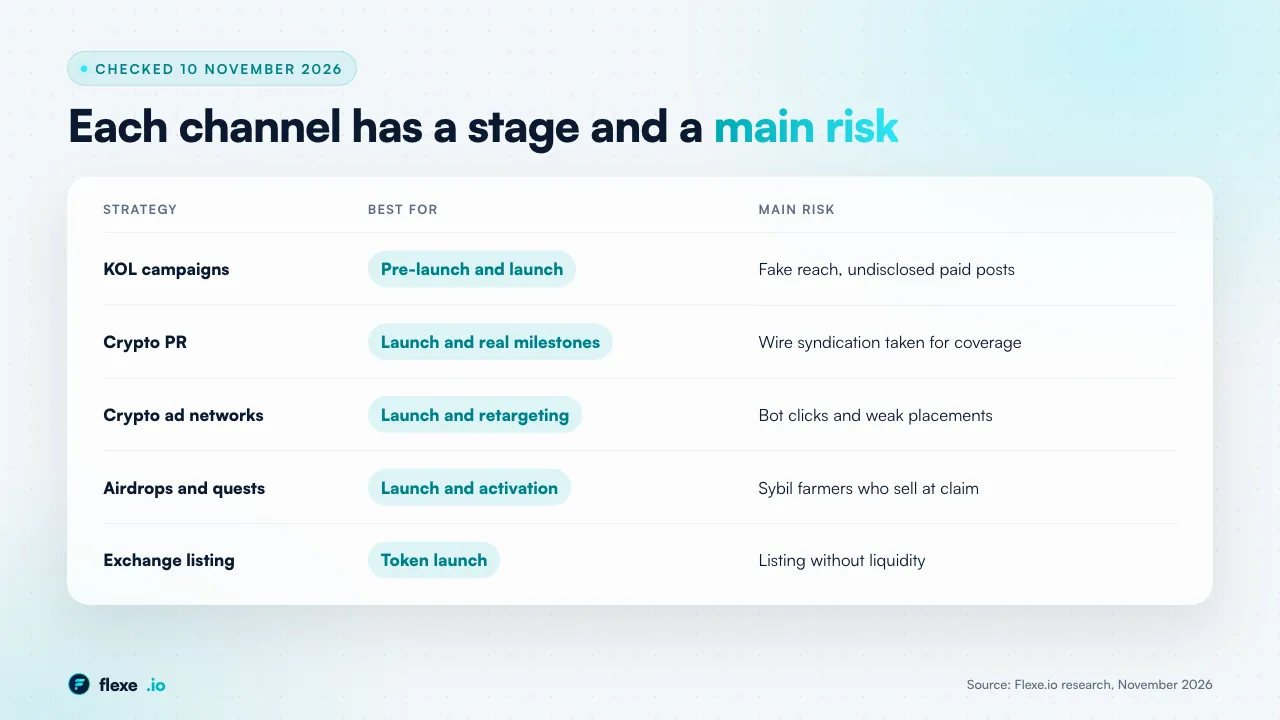
| Strategy | Best for (stage) | Typical cost range | Time to first result | Main risk |
|---|---|---|---|---|
| KOL campaigns on X and YouTube | Pre-launch and launch | Quoted per creator, no public rate card | Days after the post goes live | Fake reach and undisclosed paid posts |
| Crypto PR and press releases | Launch and real milestones | From $475 per Business Wire release; editorial PR is quoted | Days to weeks after placement | Wire syndication mistaken for coverage |
| SEO and content | Pre-launch through post-launch | Writer and editor time, quoted per project | Months on a new domain | Generic pages with no buyer value |
| Crypto ad networks | Launch and retargeting | From EUR 100 (Coinzilla) to $20,000 upfront (CoinMarketCap) | 2 to 4 business days to launch (Cointraffic) | Bot clicks and weak placements |
| Google, Meta and X paid ads under crypto policies | Licensed exchanges and wallets | No platform minimum; certification comes first | After certification; fixes re-reviewed in 24 to 48 hours | Disapproval, then suspension |
| Community on Telegram and Discord | Pre-launch through retention | Free to open; moderators are the cost | Weeks of daily moderation | Bots and dead chats |
| Airdrops and quests | Launch and activation | Token allocation plus platform fees | As soon as quests go live | Sybil farmers who sell at claim |
| Exchange listing and launchpad marketing | Token launch | PinkSale self-serve: 1 BNB plus 5% of BNB raised; curated launchpads quote privately | On sale or listing day | Listing without liquidity |
| AMAs and events | Pre-launch and launch | Host or sponsor quote | During the live session | Claims that go beyond the white paper |
| Referral and affiliate programs | Post-launch, licensed venues | Commission per qualified action | After the first referred deposit | Self-referrals; UK ban on refer-a-friend bonuses |
Every price in the table is a published minimum from the vendor’s own page, rechecked on 10 November 2026. Creator fees, editorial PR and community work have no public rate cards, so we name the cost driver instead of inventing a range.
How we compared these crypto marketing strategies
We compared each channel on cost to start, time to the first measurable action, regulatory exposure and repeatability. A channel counts as working only if it runs legally in the target country and produces a wallet connection, funded account or trade inside 30 days.
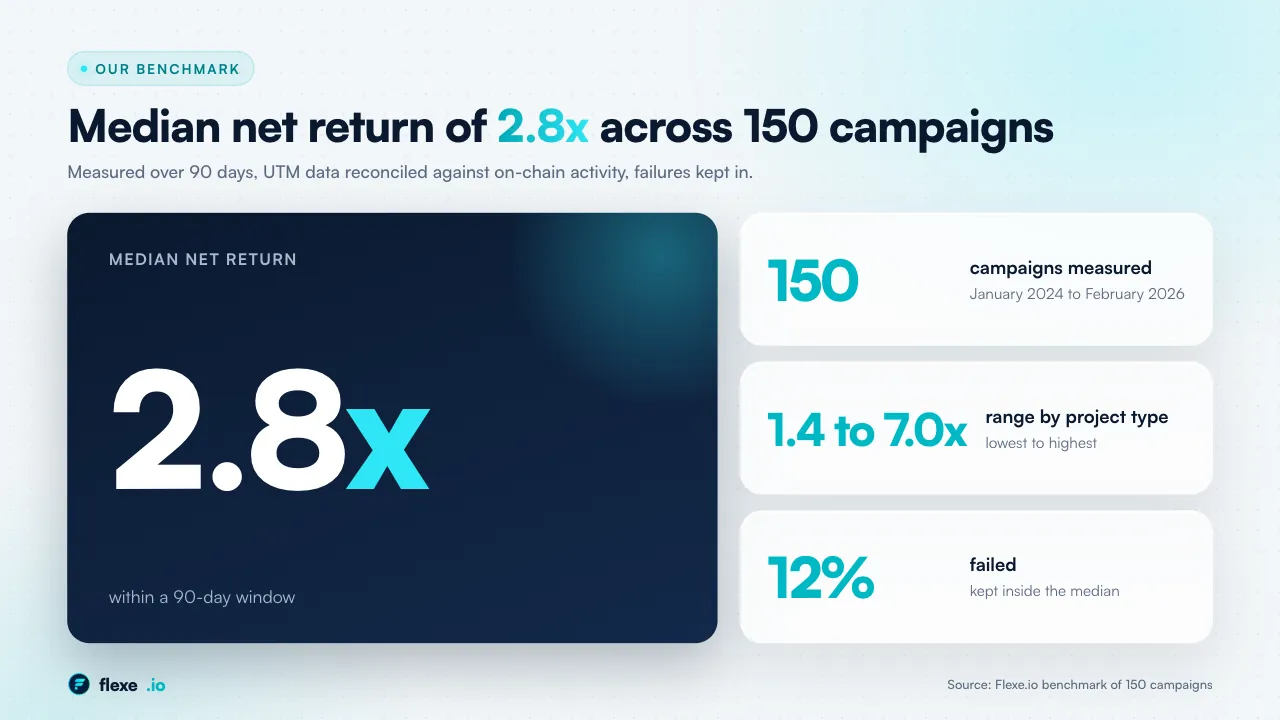
Our benchmark covers 150 campaigns run between January 2024 and February 2026, measured over a 90-day window with UTM data reconciled against on-chain activity. The median net return was 2.8x, the range by project type ran from 1.4x to 7.0x, and the 12% that failed stay inside the median. The method is on our research and benchmark page.
Teams that want this comparison run against their own token or exchange can work with crypto marketing agency Flexe.io, which has run 800+ campaigns since 2018 and places stories through 800+ media outlets.
Launching within 90 days? We run KOL campaigns for crypto projects with PR and community, measured by wallet actions.
The best crypto marketing strategies by launch stage
The best crypto marketing strategies change with the stage, because a pre-launch token, a listing week and a live app need different proof. Before launch you build trust, during launch you concentrate reach, and after launch you pay only for users who come back.
Before the token launches
Pre-launch work should produce owned demand you can measure. Crypto PR helps once a third party can check a fact, such as a shipped product, an audit or a partnership. A Business Wire release starts from $475 for 400 words on a US local circuit, but wire distribution is not editorial coverage. Our crypto PR placements start from a claim sheet, not a slogan.
A Telegram or Discord group is the cheapest proof of demand an exchange or investor can see, if a named person answers questions every day. Bought members fill the counter and kill the conversation. SEO starts here too, since a new domain needs months to rank.
Launch week
Launch week concentrates paid reach into a few days. KOL campaigns on X and YouTube are the fastest reach and the easiest budget to waste. Our database lists 11,859 KOLs on X and 11,695 YouTube creators, and we check audience country and comment quality before price.
Crypto ad networks fill the gap where mainstream platforms say no. Published minimums on 10 November 2026 ran from a EUR 100 deposit at Coinzilla and $300 at Bitmedia to EUR 3,000 for a managed Cointraffic campaign and $20,000 upfront at CoinMarketCap. Our crypto ad networks comparison covers formats; cut placements that send visits without wallet connections.
A listing or launchpad sale is a marketing event, not a substitute for one. Self-serve tools such as PinkSale charge 1 BNB plus 5% of the BNB raised on BSC, while curated launchpads quote their fees privately. Plan PR before, creators on the day and retargeting after, as in our token launch strategies guide.
After launch
Post-launch spend should go to channels that bring users back: search content, referrals and quests tied to product use. Content keeps producing sign-ups after creator posts scroll away; our crypto SEO field guide covers the technical side. Useful crypto marketing ideas at this stage remove the main obstacle, such as a walkthrough for a confusing feature. For quests, count wallets still active 30 days after rewards stop.
Crypto advertising strategy under Google, Meta and X rules
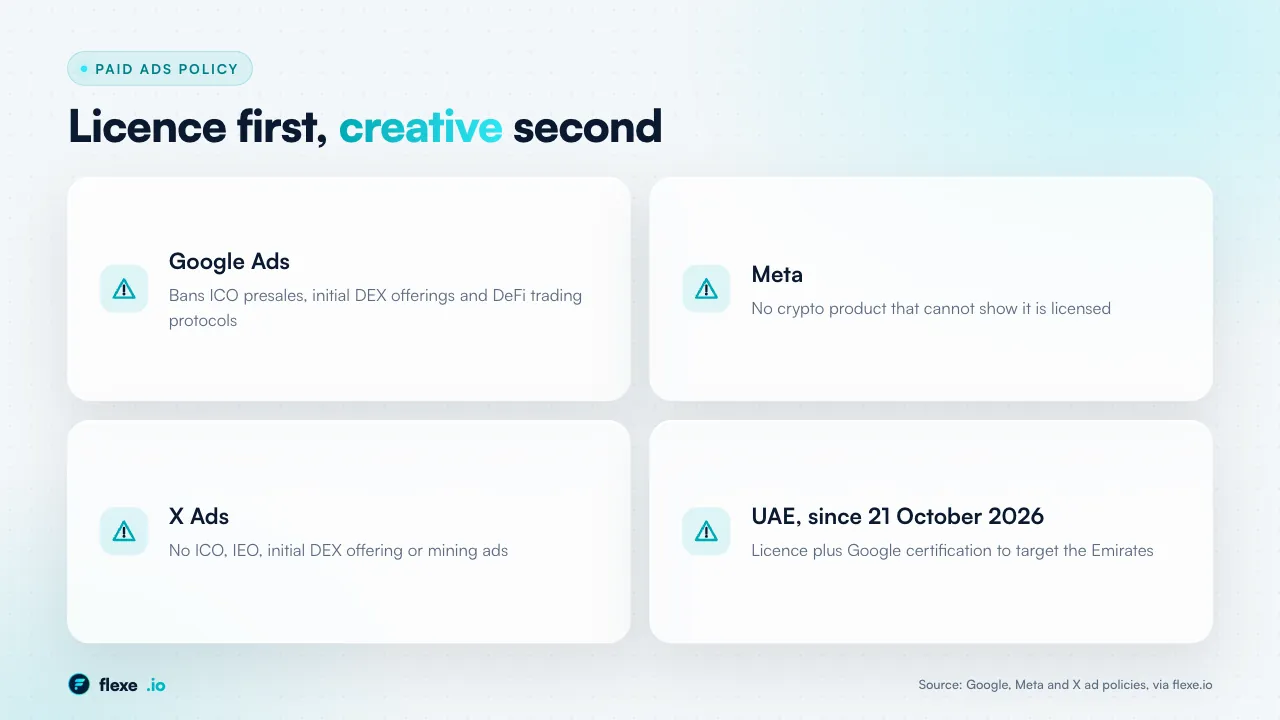
A crypto advertising strategy starts with the product category and the country, then the creative. The rules below reflect the Google cryptocurrency ads policy, the Meta cryptocurrency products policy and the X financial services policy. From June 2026, Google takes certification applications only inside the Google Ads account. Since 21 October 2026, under a Google update for the UAE, exchanges and software wallets can target the Emirates only with a CMA, DFSA, FSRA or VARA licence plus Google certification.
| Platform | Allowed after licence or certification | Banned outright |
|---|---|---|
| Google Ads | Exchanges, software and hardware wallets, coin trusts, certified per country. EU: CASP authorization under MiCA, required since 23 April 2025. US: FinCEN MSB plus state money transmitter registration, or a bank charter | ICO presales, initial DEX offerings, DeFi trading protocols, crypto loans, token liquidity pools, unhosted software wallets, unregulated dApps |
| Meta | Trading platforms, software and blockchain products, with evidence that their activities are appropriately licensed | Any crypto product that cannot show that licence |
| X Ads | Exchanges, wallets, staking and DeFi products that meet country licensing and certification | ICO, IEO and initial DEX offering ads, mining ads; no crypto or DeFi ads in Belgium, Greece, Qatar, Russia, Singapore, Slovenia or Ukraine |
Google warns at least 7 days before it suspends an account under this policy, and a corrected ad is usually re-reviewed in 24 to 48 hours. Keep a separate approval record per platform and country.
UK, EU and US promotion law
Since 8 October 2023, every cryptoasset promotion aimed at UK consumers, including those from firms based overseas, must use one of four lawful routes set by the FCA financial promotions regime. A promotion outside them breaches section 21 of FSMA, a criminal offence punishable by up to 2 years in prison, an unlimited fine, or both.
FCA policy statement PS23/6 adds risk warnings, a 24-hour cooling-off period that starts when a consumer asks to view a direct offer, and a ban on incentives such as refer-a-friend or new joiner bonuses. The FCA’s own warning is blunt: consumers “should be prepared to lose all of their money” if they buy cryptoassets. A second gate is coming: the FCA authorisation gateway for its new cryptoasset regime opened on 30 September 2026 and takes applications until 28 February 2027, so a UK plan for 2027 should state which permission the firm will hold.
In the EU, Article 7 of MiCA requires marketing for a crypto-asset offer to be clearly identifiable, fair, clear, not misleading and consistent with the white paper. It must carry a fixed statement that no EU competent authority has reviewed it. Where a white paper is required, no marketing may go out before it is published.
In the US, the FTC Endorsement Guides in 16 CFR Part 255 require any material connection to be disclosed clearly and conspicuously, and on social media the disclosure should be unavoidable. An advertiser may be liable for a deceptive endorsement even when the creator is not, so put disclosure lines into every KOL contract.
Why a crypto exchange marketing strategy differs
A crypto exchange marketing strategy sells a venue, so the funnel is register, verify, deposit, trade and return. Licensing comes before media, because Google, Meta, X and the FCA all gate paid promotion behind registrations, so the compliance calendar sets the media calendar.
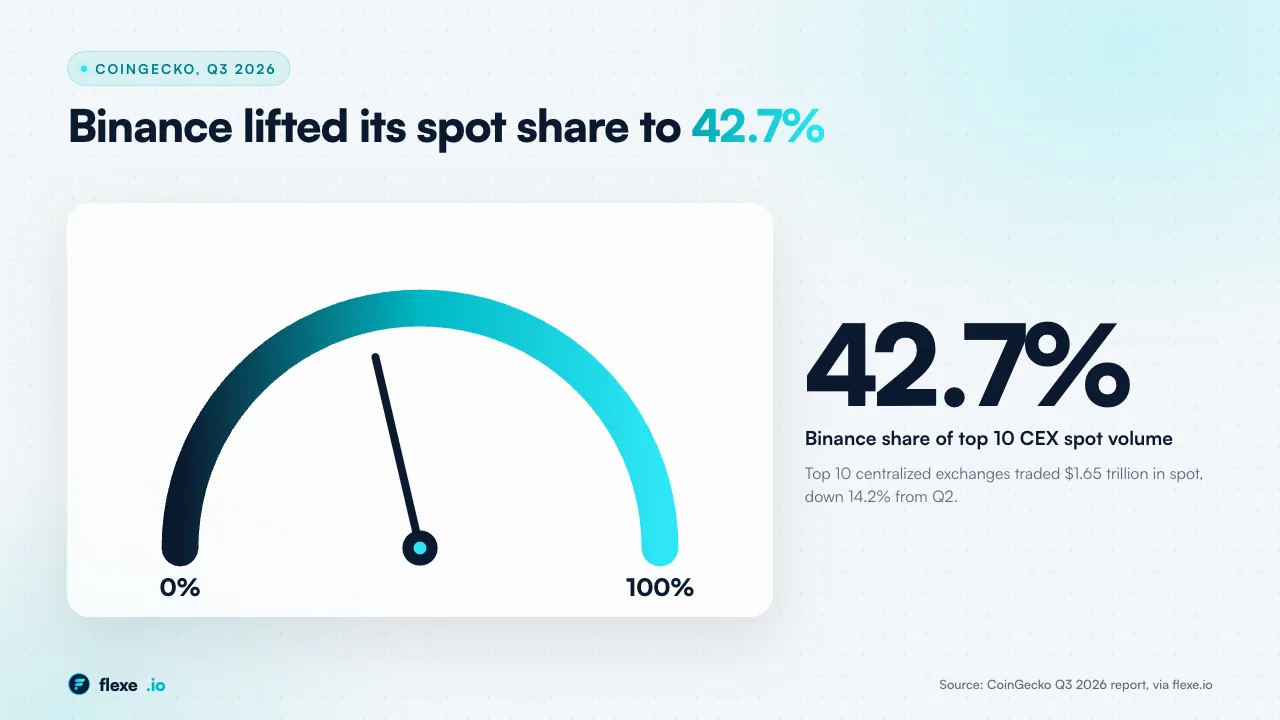
The scale explains the paperwork: CoinGecko’s 2025 annual report puts perpetual volume on centralized exchanges at a record $86.2 trillion and stablecoins at $311.0 billion. Its Q3 2026 report, published on 15 October 2026, shows the top 10 centralized exchanges trading $1.65 trillion in spot, down 14.2% from Q2, while Binance lifted its share to 42.7%. Exchanges compete on fees, withdrawals, liquidity and support, so campaigns should lead with execution quality and licensing proof, not token prices.
Referral programs carry mature exchanges, but they need fraud rules from day one. Pay on a verified deposit or traded volume, block self-referrals and compare referred cohorts with organic ones. Do not copy a refer-a-friend bonus into the UK, where PS23/6 bans incentives to invest.
Build a crypto marketing plan in 30 days
A crypto marketing plan fits into 30 days when the strategy choice is made and the product is ready. The calendar below assumes one target country, one primary channel and a fixed test budget.
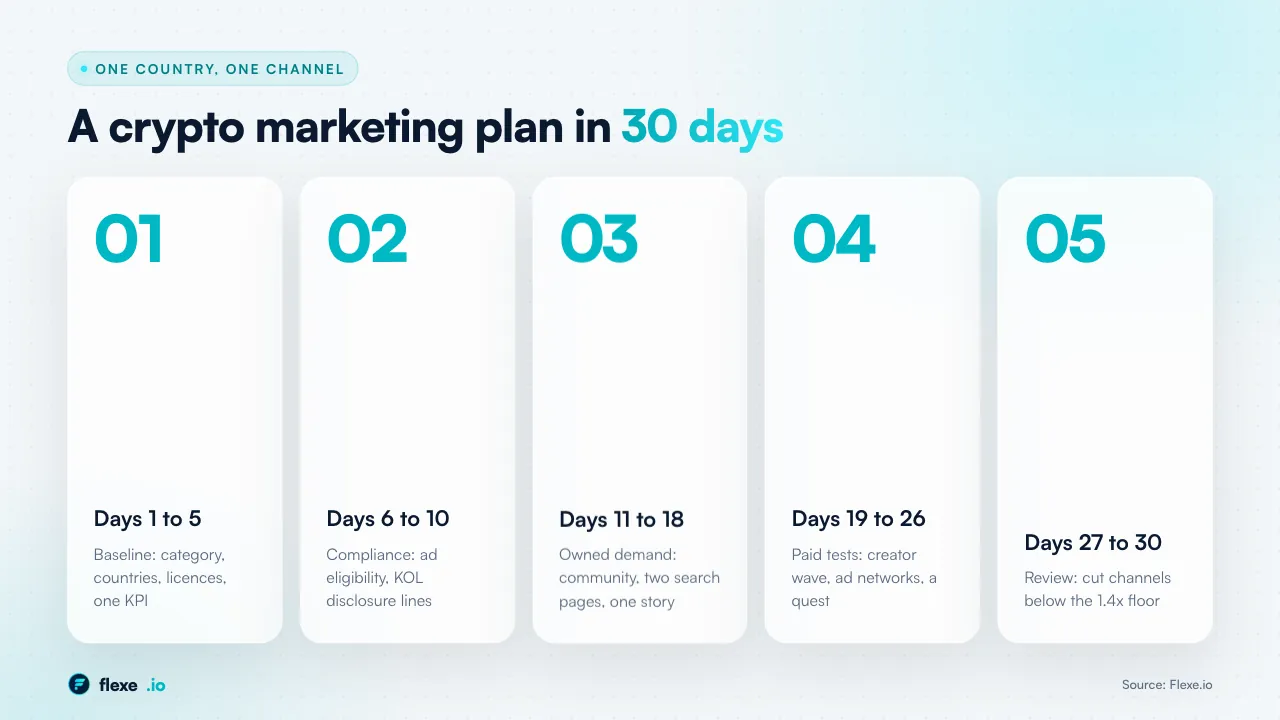
- Days 1 to 5, baseline. Write down the product category, target countries and licences you hold, set one on-chain or account KPI, and tag every link.
- Days 6 to 10, compliance. Check Google, Meta and X eligibility, draft KOL disclosure lines, and align ad copy with the white paper if the EU is in scope.
- Days 11 to 18, owned demand. Open a staffed community, publish two search pages and pitch one checkable story to relevant media.
- Days 19 to 26, paid tests. Book a small creator wave, run ad network tests and launch a quest tied to product use.
- Days 27 to 30, review. Compare cost per qualified action, cut channels below the 1.4x floor from our benchmark, and move that money to the top two.
One example split for a creator-led launch: 35% KOL campaigns, 20% PR, 15% community, 15% ad networks and certified paid ads, 15% SEO and content. This is a model to test, not market data; move the shares after week one. The wider frame is in our guide to marketing a crypto project.
Mistakes that waste the most budget
The biggest losses we see come from selection and measurement, not platform bans. Each one looks fine in a reach dashboard until someone checks wallet activity.
- Paying KOLs on follower counts without checking audience country, past sponsorships and comment quality.
- Buying Google or X ads for an ICO, IDO or presale, which both platforms ban.
- Running quests with no anti-Sybil rules, then watching farmers sell at claim.
- Publishing EU marketing before a required white paper is live.
- Measuring impressions instead of funded accounts, so weak channels survive every review.
When these strategies do not work
No marketing strategy for cryptocurrency fixes a product with no users or a token with no legal route to market. Broken onboarding, unclear token utility or missing support make awareness spend premature, and no creative fixes a missing licence.
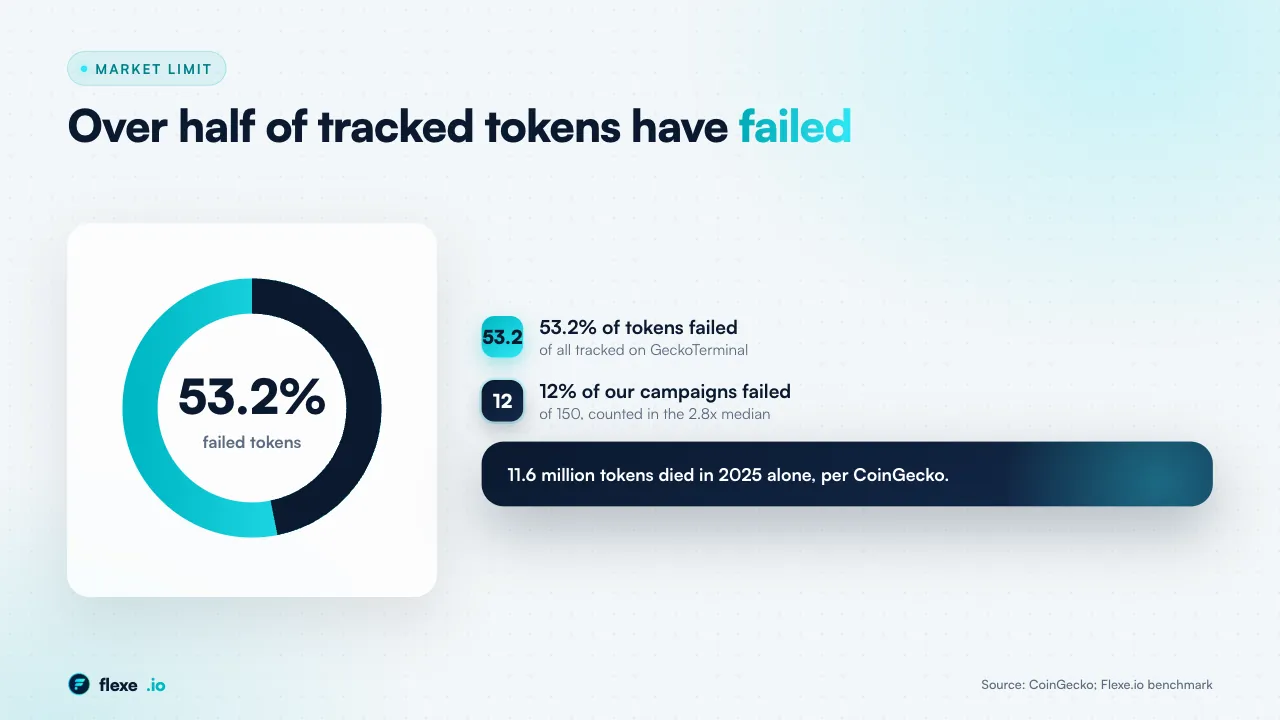
The market adds a second limit. CoinGecko counts 53.2% of all tokens tracked on GeckoTerminal as failed, and 11.6 million died in 2025 alone.
Our own numbers include failure: 12% of the 150 campaigns in our benchmark failed, and the 2.8x median counts them. SEO is also the wrong tool for a launch next month, because a new domain needs months to rank, so use creators or ad networks for that window.
Want this turned into numbers for your project? Send us your stage, target countries, budget range and goal, and within 24 hours we will return a free plan or cost estimate, including the channels we would skip. Message Flexe.io on Telegram.
Frequently Asked Questions
What is a good crypto marketing plan?
A good crypto marketing plan names one stage, one primary channel and one second-step metric, such as cost per funded account or wallet connection. It lists which ad platforms accept your licences in each target country, sets a fixed test budget and includes a kill rule for channels that show reach without action.
What are the best crypto marketing tips for a small budget?
Concentrate instead of spreading. Start with one staffed Telegram or Discord group, two search pages that answer real buyer questions and one checkable story pitched to relevant media. Add a small creator test only once tracking works. Skip big-name KOLs and broad paid ads until one channel shows a repeatable qualified action.
How do you write a marketing plan for cryptocurrency?
Write it in five blocks: target user and country, legal route, channel per stage, budget with cost drivers, and a measurement table with a stop rule. The legal block covers the FCA route for UK users and the MiCA white paper rule for EU offers. Measure on-chain or account events, not impressions.
What should a cryptocurrency marketing plan include for an exchange?
For an exchange, a cryptocurrency marketing plan starts with licensing, because Google, Meta, X and the UK regime gate paid ads behind registrations. Then it maps referral terms with fraud controls, a listing calendar used as acquisition events, liquidity targets on key pairs and retention cohorts. Funded accounts and returning traders replace wallet connections as the core metric.
How much does a crypto marketing strategy cost?
Published minimums give the floor. A Business Wire release starts at $475, crypto ad networks start from a EUR 100 deposit at Coinzilla, and CoinMarketCap asks $20,000 upfront. Creator fees, editorial PR and community work have no public rate cards and are quoted per project. Add legal review, rewards and production on top.
Can a new token advertise on Google or X?
Not for the sale itself. Google bans ads for ICO presales, initial DEX offerings and DeFi trading protocols in every location, and X bans ICO, IEO and initial DEX offering ads. A token team can still use PR, community, disclosed creator posts, search content and crypto ad networks.