NFT SEO means getting your own collection site, mint page and token pages to rank in Google for your collection name and category searches in 2026, instead of leaving that traffic to OpenSea. Checked on 11 November 2026: US interest in “nft” on Google Trends fell from 100 in January 2022 to 3 in September 2026. It pays off for teams with a site and a brand people search for, not for a mint in two weeks.
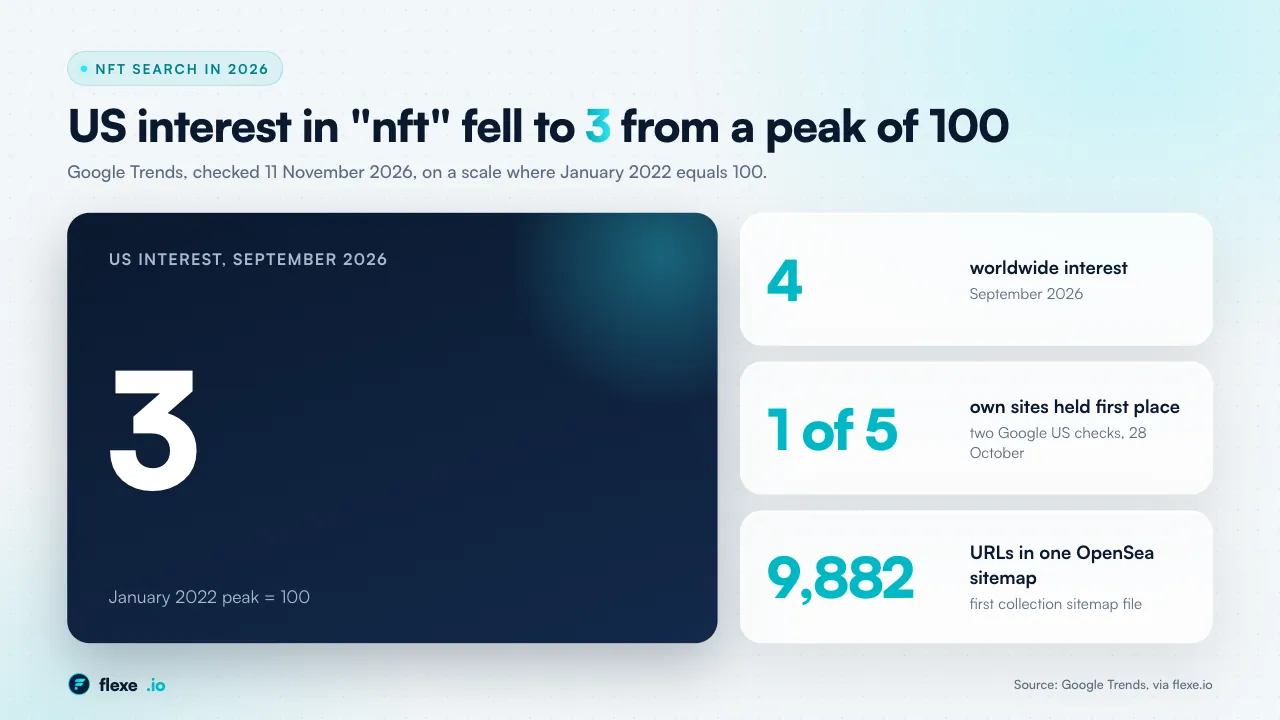
- On Google Trends, US interest in “nft” sat at 3 in September 2026 against a January 2022 peak of 100; worldwide it was 4.
- In two Google US checks of 5 collection names on 28 October 2026, only Pudgy Penguins’ own site held first place both times.
- OpenSea collection pages are self-canonical and indexable, and on 11 November 2026 the first file of its collection sitemap alone listed 9,882 URLs.
- One sitemap holds up to 50,000 URLs, and crawl budget only matters at 1 million+ pages or 10,000+ pages changing daily.
- Google has no NFT structured data type, it stopped showing FAQ rich results on 7 May 2026, and its November 2026 core update began on 10 November.
What SEO for NFTs covers that regular SEO misses
Search work for a collection deals with four problems a normal brand site never meets. Marketplaces publish a page for your collection and every token, often before your own site exists. Token pages are usually built in the browser from on-chain metadata. A 10,000-item collection means 10,000 near-identical pages, and holder-only content sits behind a wallet connection that Googlebot cannot pass.
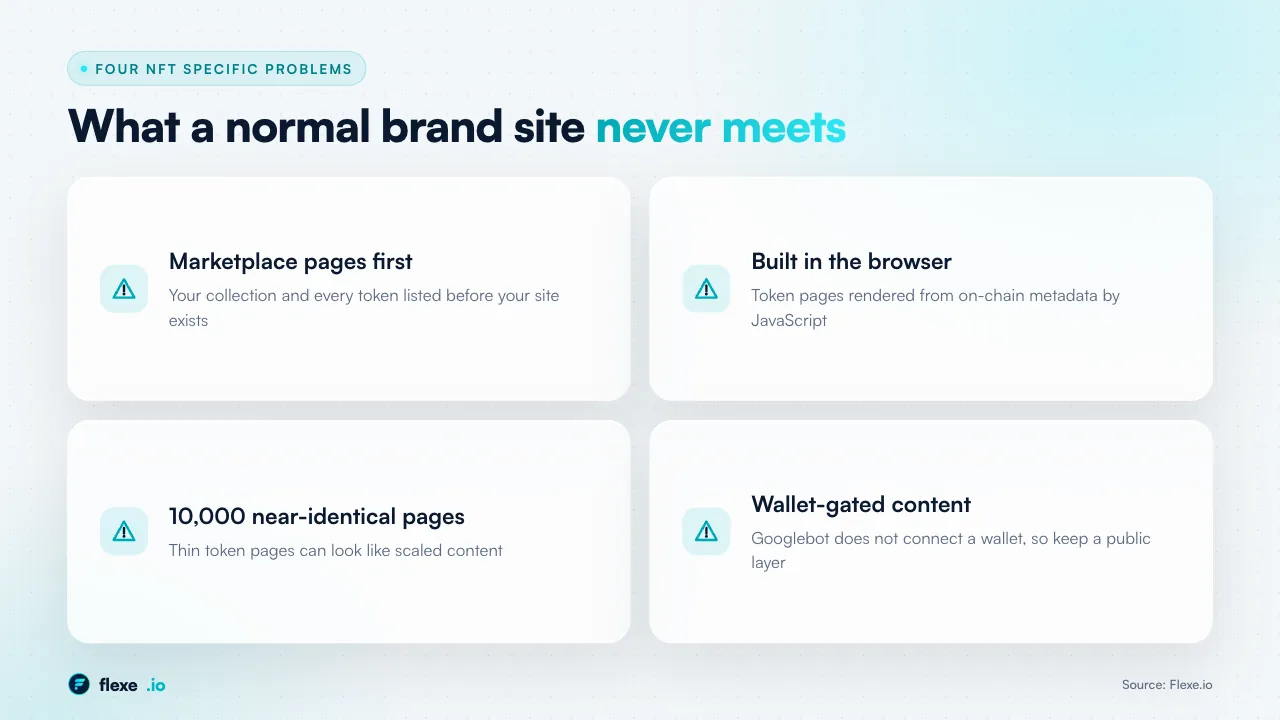
Each of those points changes the plan. Marketplace pages compete with yours for the brand query, so your site needs stronger signals than a listing. Pages built only by JavaScript can be indexed late or poorly. Thousands of thin token pages can look like scaled content to Google, and gated pages simply do not exist for search, so keep a public version of anything you want found.
Wallet-gated content needs a public layer. A holder area with lore, perks or game items can stay gated, but publish a summary page for each perk with its own URL and text. Googlebot does not connect a wallet, so anything that loads only after a signature is invisible to search, and Google suggests a 401 status for pages behind a login. Keep the public page short and link it from the collection page.
If you want your collection checked against these four risks, start with a crypto and NFT SEO audit before writing new content.
Where NFT search demand is in 2026
NFT search demand in 2026 is a small fraction of the 2022 peak, and it has moved from the generic term to specific names. Google Trends puts US interest in “nft” at 3 in September 2026 on a 2021 to 2026 scale where January 2022 equals 100. A Semrush US export dated 20 October 2026 put the query this guide targets at about 150 searches a month, and Google Keyword Planner showed even less. People still search, but mostly for collections, games and marketplaces they already know.
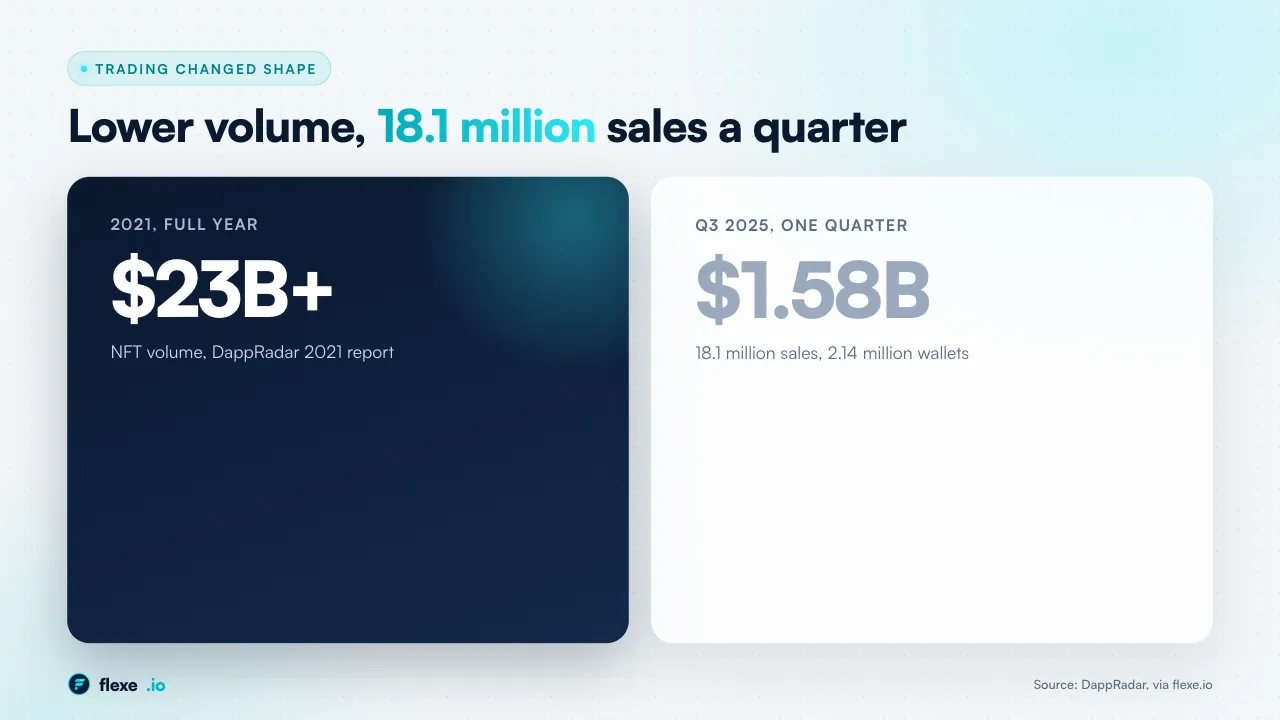
Trading has not vanished, it has changed shape. DappRadar’s Q3 2025 report counted $1.58 billion in NFT volume, 18.1 million sales and 2.14 million trading wallets. Its 2021 report put full-year NFT volume above $23 billion. More sales at lower prices means fewer curious newcomers typing “nft” into Google and more holders checking a known collection.
The uncomfortable fact for anyone selling NFT content is that category queries are close to empty. Generic phrases such as “seo nft”, “seo for nft” and “seo for nfts” draw almost no US impressions even for pages built around them. Build for brand, mint and how-to-buy queries that real holders type, not for the word “nft”.
Your site vs OpenSea and Magic Eden in Google
Your own domain should own your collection name in Google, but even famous collections do not hold that spot reliably. On 28 October 2026 we searched five collection names in Google US twice through a SERP API and recorded which pages ranked. Rankings moved between the two runs, and only one project kept first place both times. Google’s Search Status Dashboard shows a November 2026 core update that started on 10 November, so re-check your own brand query once it finishes rolling out.
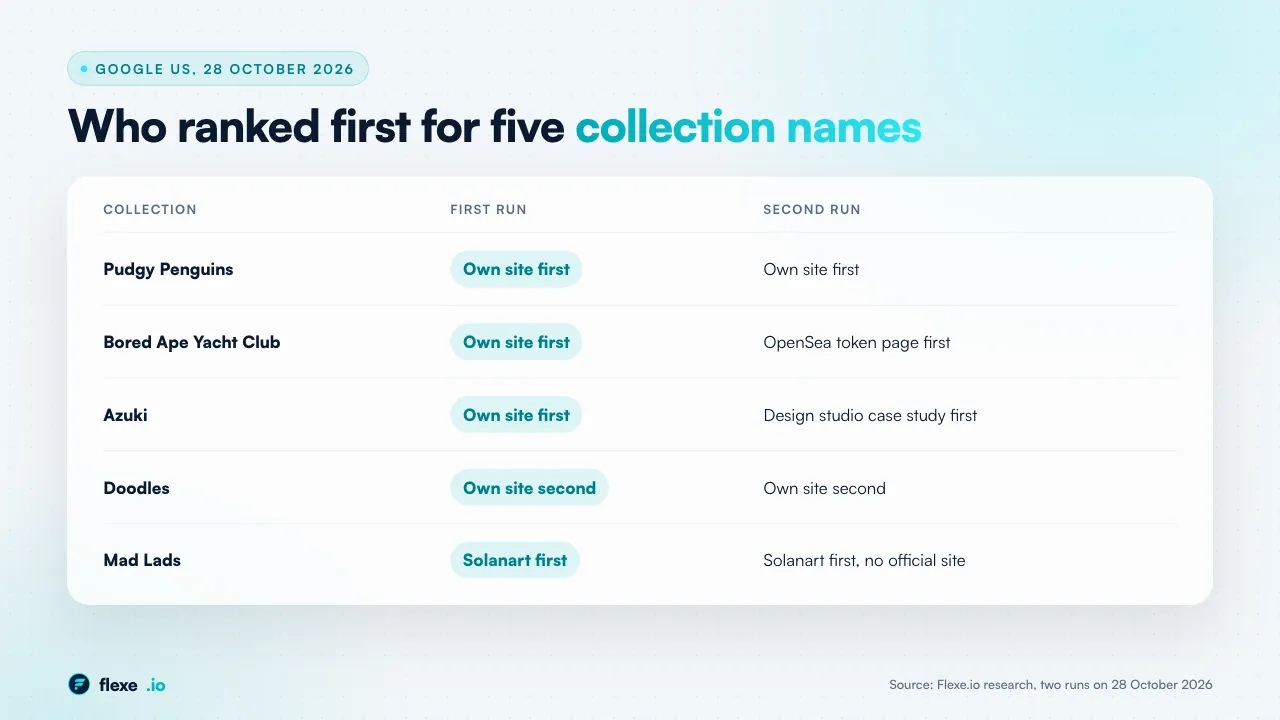
Pudgy Penguins’ own domain led both runs. Bored Ape Yacht Club and Azuki led the first run, then lost first place to an OpenSea token page and a design studio’s case study. Doodles’ own site sat second both times, behind OpenSea once and a guide once. For “mad lads nft”, Solanart led both runs, with no official site in the top eight.
The marketplaces are built to rank. OpenSea’s robots.txt blocks only its /cdn-cgi/ path, its collection pages point canonical to themselves with the floor price in the title, and it submits collection and token pages in sitemaps that were all refreshed on 9 November 2026. Magic Eden blocks its /item-details/ token pages in robots.txt. Blur’s collection pages return no title or canonical in their HTML, because the page is built in the browser.
Google’s own canonicalization page, updated 20 August 2026, calls a canonical preference “a hint, not a rule”, and you cannot set one on someone else’s domain anyway. The fix is on your side. Fill the website field on every marketplace, set the metadata link back to your domain and publish a collection page with the facts listings lack. Then earn the links that tell Google which page is the original.
Making collection and token pages indexable
Collection and token pages become indexable when the content Google needs is in the HTML on first load, not fetched later by a script. Google’s JavaScript SEO guide describes three phases, crawling, rendering and indexing, and puts all 200-status pages in a rendering queue. It calls dynamic rendering “a workaround and not a recommended solution”.
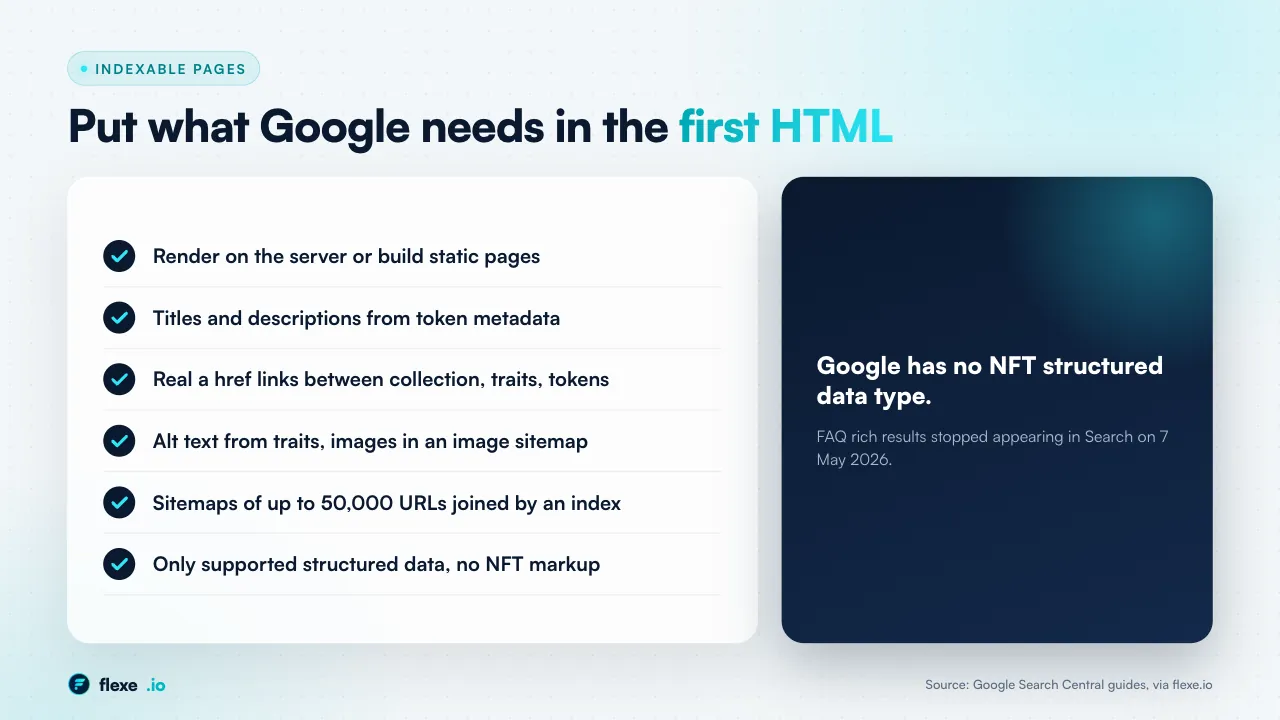
- Render collection and token pages on the server or build them as static pages from your metadata JSON.
- Write titles from metadata, such as “[Collection] #1234, [top trait]”, and a description from the traits.
- Use real a href links and History API routes between the collection page, trait pages and tokens, never fragments or click handlers alone. Google’s URL structure guide, revised in October 2026, recommends hyphens to separate words in a URL, so use /traits/gold-fur rather than /traits/gold_fur.
- Give each image alt text built from its traits, and list images in an image sitemap.
- Split token URLs into sitemaps of up to 50,000 URLs each, joined by a sitemap index.
- Add only supported structured data, such as Organization, BreadcrumbList and ImageObject, never invented NFT markup.
- Index the collection, trait and top token pages, and keep low-value duplicates out of sitemaps.
The metadata standard limits what you can generate. EIP-721 defines only name, description and image, while OpenSea’s metadata docs add attributes and an external_url field described as “A link from the item page to your site.” Fill external_url on every token. For Solana collections, Metaplex stores only a name of up to 32 characters, a symbol of up to 10 and a URI of up to 200 on-chain, so build titles from the off-chain JSON that URI points to.
Images often sit on IPFS gateways or a CDN rather than your domain, which is fine for search. Google’s image sitemap rules accept up to 1,000 images per URL and allow images on another domain if you verify both in Search Console. Use a stable gateway URL, because a broken image link removes the token from image results.
Structured data will not give NFT pages special snippets. Google’s search gallery has no NFT type, Product snippets need reviews, ratings or offers, and FAQ rich results stopped appearing in Search on 7 May 2026. Mark up the organization and breadcrumbs, then spend the effort on titles, descriptions and internal links instead.
Scale is the real risk, not crawl capacity. Google’s crawl budget guide is written for sites with over 1 million pages or 10,000+ pages that change daily, so a 10,000-item collection rarely needs it. Its spam policies do cover pages made “for the primary purpose of manipulating search rankings”, so give token pages real trait data and links. Google rewrote its guidance on generative AI content on 1 October 2026, and it now warns that generating many pages without adding value for users may count as scaled content abuse. If an AI tool writes 10,000 token descriptions, each one still needs the token’s own traits, rarity rank and links, or the whole set reads as filler. Collection, lore and mint pages need the same care, so many teams hand them to a crypto content writing team.
NFT SEO keywords that bring holders, not tourists
The keywords that bring holders are brand and action queries, not general NFT terms. Searchers who type a collection name plus “mint”, “how to buy” or “rarity” already know what they want. Map each query type to one page on your own domain, and let marketplaces keep the price queries they will win anyway.
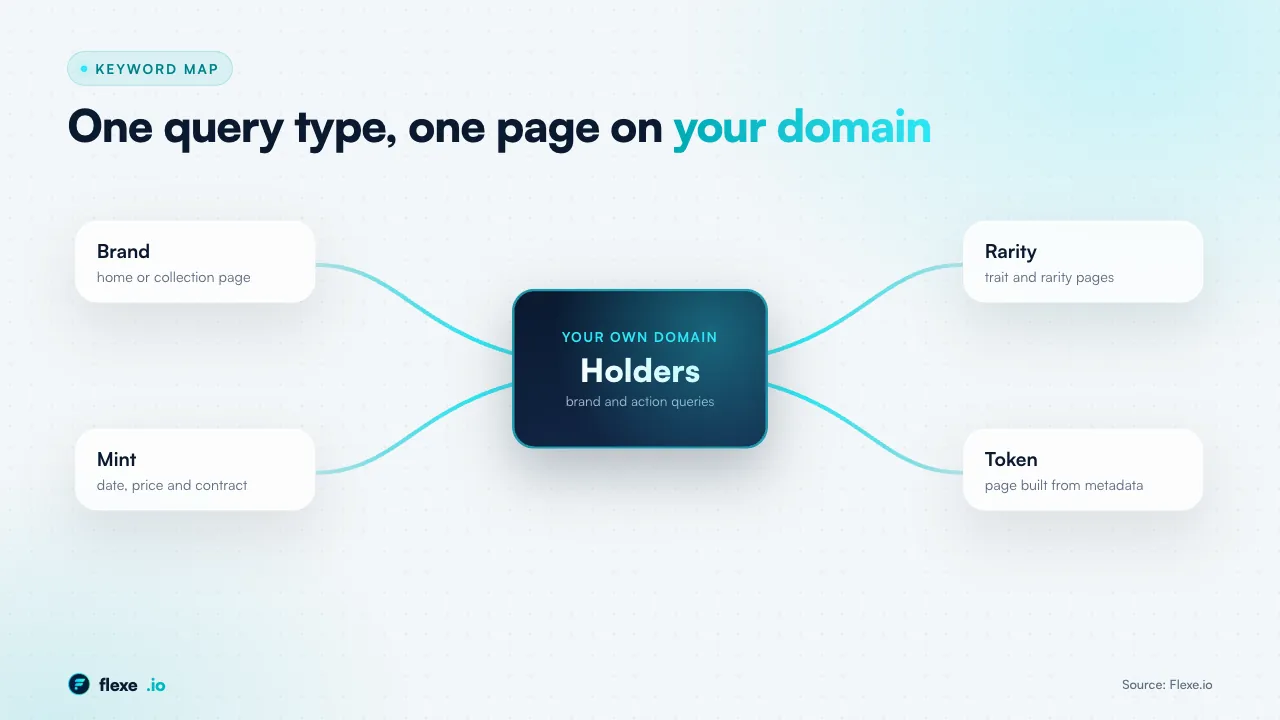
| Query type | Example | Intent | Page that should rank |
|---|---|---|---|
| Brand | [collection] nft | Find the official project | Home or collection page |
| Mint | [collection] mint date | Join the drop | Mint page with date, price and contract |
| How to buy | how to buy [collection] | First purchase | Guide linking to verified marketplaces |
| Rarity | [collection] rarity | Check a token’s value | Trait and rarity pages |
| Token | [collection] #1234 | Look up one item | Token page built from metadata |
| Roadmap and utility | [collection] roadmap | Judge the project | Roadmap or utility page |
| Floor price | [collection] floor price | Check the market | Usually a marketplace; link to it |
| Game | [game] nft items | Find in-game assets | Game asset catalogue |
Category terms such as “pixel art nft” or “solana pfp” are worth a page only once brand pages rank. They bring browsers who compare many collections, and listicles from news sites usually hold them. For DeFi-linked collections, the same keyword logic as in our SEO for DeFi protocols guide applies to the token side.
Links and mentions that move NFT rankings
Links that move NFT rankings come from places holders already read: NFT news coverage, drop calendars, marketplace profiles and creator content. Each one also confirms to Google which domain is the official one. A mention in a respected publication about your mint does more for the brand query than dozens of links from sites nobody visits.
Start with the sources you control. Fill the website link on OpenSea, Magic Eden and every tracker that lists you, and keep external_url pointing to your domain. Then pitch the mint or a milestone to the outlets in our list of crypto news sites. We place stories across 800+ media outlets, and drop calendars add early, relevant links before mint day.
Creator content adds both links and branded searches. A video or thread that names the collection sends people to Google to look it up, which is the query you want to own. Our network includes 20,000+ influencers on X and YouTube (100+ active on X, 300+ on YouTube), and the NFT influencer marketing guide covers how to brief them.
Avoid the shortcuts that still circulate in NFT circles. Paid link farms, spun guest posts and directories that list every collection are link schemes under Google’s spam policies, and they can cost the brand query you are trying to win. Google’s September 2026 spam update, which started on 24 September and took 13 days and 16 hours to roll out, was a reminder that these policies are enforced in waves, not once.
Measure links by what they do for the brand query and for holders, not by count. Track the position of your collection name, branded clicks in Search Console and mint-page visits from referral sites. Across our benchmark of 150 campaigns, the median return was 2.8x and 12% of campaigns failed, so test a few sources before scaling any of them.
How much does NFT SEO cost in 2026?
NFT SEO costs about $1,500 to $8,000 a month when bought as an agency retainer, and Flexe campaign budgets start from $2,000. The lowest published monthly entry in our crypto SEO agency comparison, rechecked on 10 November 2026, is Loopex Digital at $1,500 a month, while search and content retainers in our crypto marketing budget guides run $2,000 to $8,000.
The price follows the page count and the content budget. A collection that needs indexable token pages, trait pages and a steady run of articles costs more than a single landing page, and links from crypto media add placement fees on top. A one-page site with a mint button is the case where SEO spend makes the least sense.
When SEO for NFTs is not worth it yet
SEO for NFTs is not worth it when there is no site to rank, or when the mint lands before Google can crawl anything. Search takes weeks to index and months to settle. If the mint is two weeks away, put the budget into community, creators and drop calendars, then build the site for the holders who arrive.
It also fails without a content budget. A collection site with one page and a mint button cannot outrank a marketplace page that updates every hour. For general crypto search work beyond NFTs, read our crypto SEO guide.
Want to know which of your collection’s queries you can still win? Send us your collection name, site and marketplaces, and within 24 hours we will return a free SEO audit or plan with the pages to build first. Message Flexe.io on Telegram.
Frequently Asked Questions
Does SEO for NFT projects still work in 2026?
Yes, for brand and action queries. Generic NFT searches are near their lowest since 2021, but people still look up a collection by name, its mint date or how to buy it. A project that owns those queries on its own domain controls the first impression. Category terms alone rarely justify the work.
What are the best NFT SEO keywords for a new collection?
Start with the collection name, then name plus mint, mint date, how to buy, rarity and roadmap. These are typed by people who already know the project, so they convert into holders. Add one page per query type on your own domain. Leave floor price queries to marketplaces and link to them instead.
Can an NFT collection outrank its OpenSea page?
Yes, but not always for long. Pudgy Penguins led its own name in both of our 28 October 2026 checks, while Bored Ape Yacht Club lost first place to an OpenSea token page in the second run. A full official site, consistent links and brand searches pointing to one domain make the top spot stickier.
How long does NFT SEO take for a collection?
Google says that for most sites, checking and indexing pages takes three days or more, and a brand query can take months to settle on your domain. A new site starts with no history, while marketplace pages already have strong signals. Pages built in the browser can wait longer in Google’s rendering queue, so server-rendered or static pages shorten the delay.
Is NFT SEO different from crypto SEO?
Partly. Both depend on content, links and technical health, but NFT projects also compete with marketplace pages for their own name and publish thousands of token pages from metadata. Crypto token projects face exchange and price-tracker pages instead. The fixes differ, so audit the competing pages before choosing tactics.