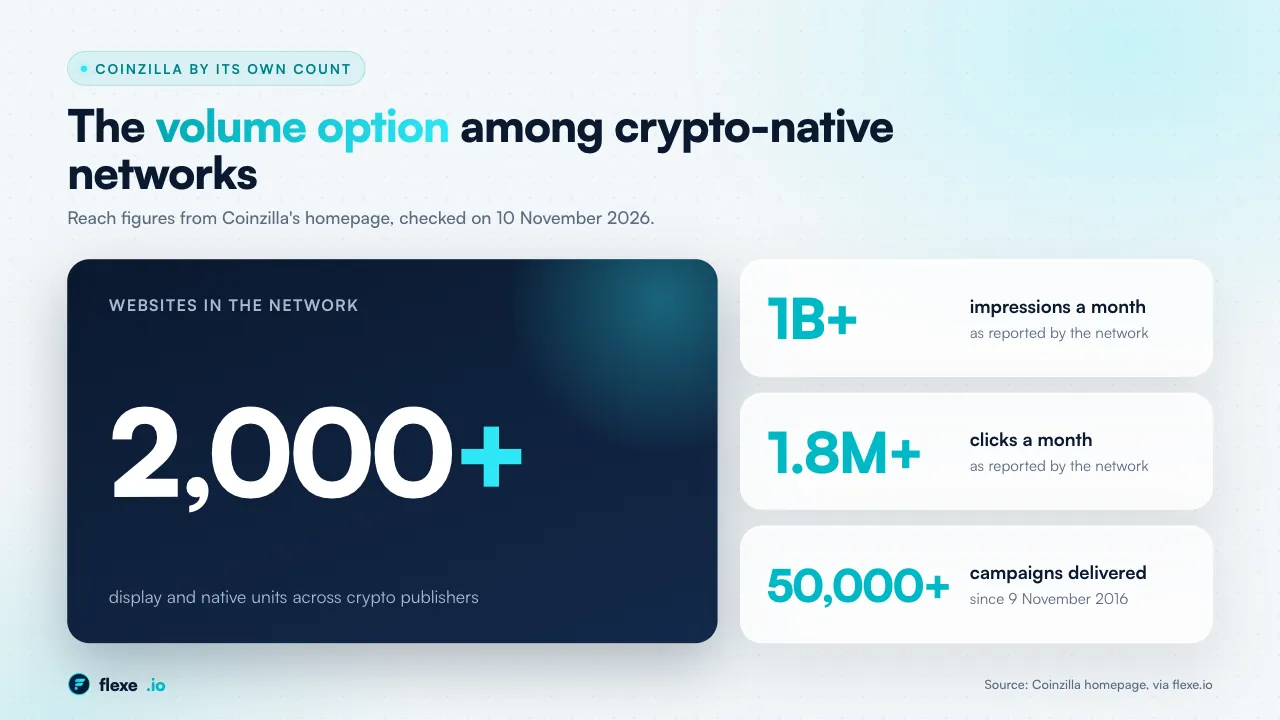
This Coinzilla review, checked on 10 November 2026, finds a crypto display and native ad network that reports more than one billion impressions a month across 2,000 or more websites, with a 100 euro starting deposit and a 50 euro minimum daily budget per campaign. It is the volume option among crypto-native networks, and it buys brand awareness rather than measurable on-chain acquisition. Below is what it does well, where it does not fit, and what to run instead.
Key Takeaways
- Coinzilla is an awareness network. Judged on wallet conversions it will underperform anything with on-chain targeting.
- Websites, ad zones, location and device are the targeting levers. There is no on-chain wallet targeting, only managed retargeting of your own site visitors.
- Inventory now reaches beyond websites: in 2026 Coinzilla ads went live inside the CoinMarketCap App.
- The 100 euro deposit makes it easy to start, and at 50 euros a day that deposit lasts two days, which will not tell you much.
- Creative approval is faster than mainstream platforms because the network is built for the category.
What is Coinzilla and how does it work?
Coinzilla is an advertising network specialised in cryptocurrency and blockchain, placing display and native units across publisher sites in the category. By its own count on its homepage, it serves 1B+ impressions and 1.8M+ clicks a month across 2,000+ websites and has delivered 50,000+ campaigns, which puts it among the largest crypto-native networks by inventory.
The network marked ten years on 4 November 2026, tracing its start to 9 November 2016. In that anniversary post it lists six audience layers: exchanges and trading, crypto casinos, token launches, DeFi and NFTs, fintech, and prediction markets, the last one added in 2026.
The model is conventional: you buy impressions or clicks in classic banners, native ads, pop-unders, header banners or sticky banners, choose websites, ad zones and countries, and the network handles placement. You pay by bank wire or in crypto through CoinGate. That conventionality is the point. Mainstream networks restrict or ban the category, so a network built for it removes the approval problem that consumes most of the effort elsewhere.
On Coinzilla CPM rates, the advertiser FAQ, checked on 19 November 2026, prices brand awareness traffic at a CPM of EUR 0.2 and the premium package of crypto websites at EUR 3. The Coinzilla price per thousand impressions therefore depends mostly on the package, so state which one a quote assumes. Flexe has run 800+ crypto campaigns since 2018 and compares the two pools for clients of its crypto advertising agency service.
What is Coinzilla good at?
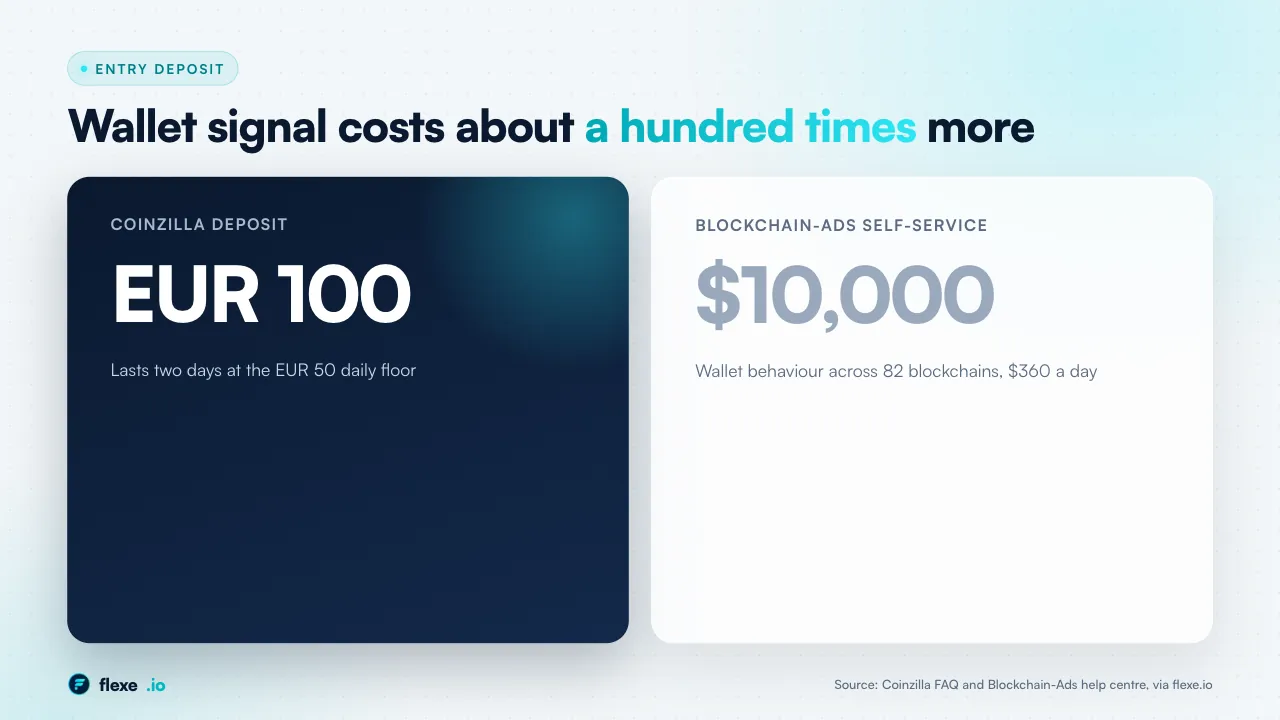
Brand awareness at volume on publications the audience already reads. If the objective is that a name becomes familiar across crypto media before a launch, this is the instrument, and the inventory size means the reach is genuinely there.
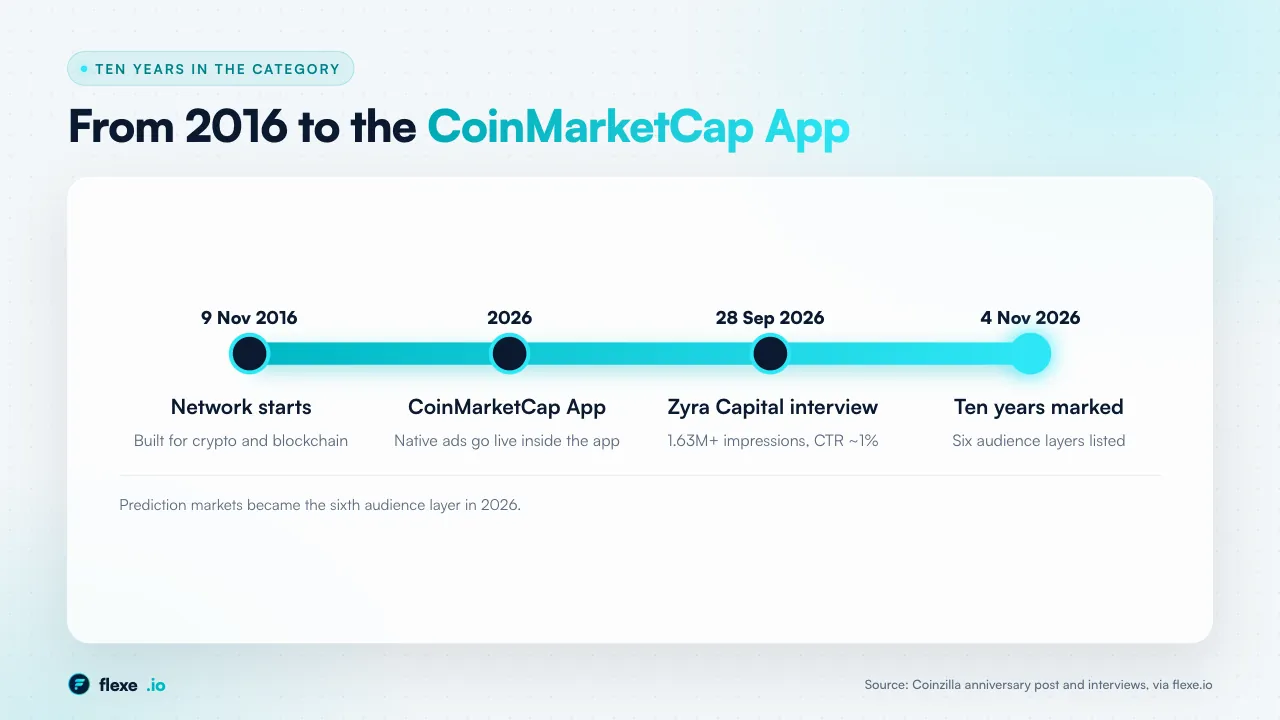
The second strength is control over placement plus reach into apps. You can pick specific websites and ad zones instead of a blind category, and since 2026 the inventory includes the CoinMarketCap App, where people open the screen on purpose to check prices. Zyra Capital, interviewed by Coinzilla on 28 September 2026, reported more than 1.63 million impressions and a CTR of nearly 1% from native ads inside crypto apps.
The third is speed of approval. Compared with getting a crypto campaign through Google or Meta, where the work is largely compliance, a crypto-native network starts running in a fraction of the time.
Where does Coinzilla not fit?
Anywhere the objective is a measurable on-chain action. Targeting is by website, ad zone, location and device, not by wallet behaviour, so a campaign optimising for first-time deposits or wallet connections is working without the signal that would make it efficient.
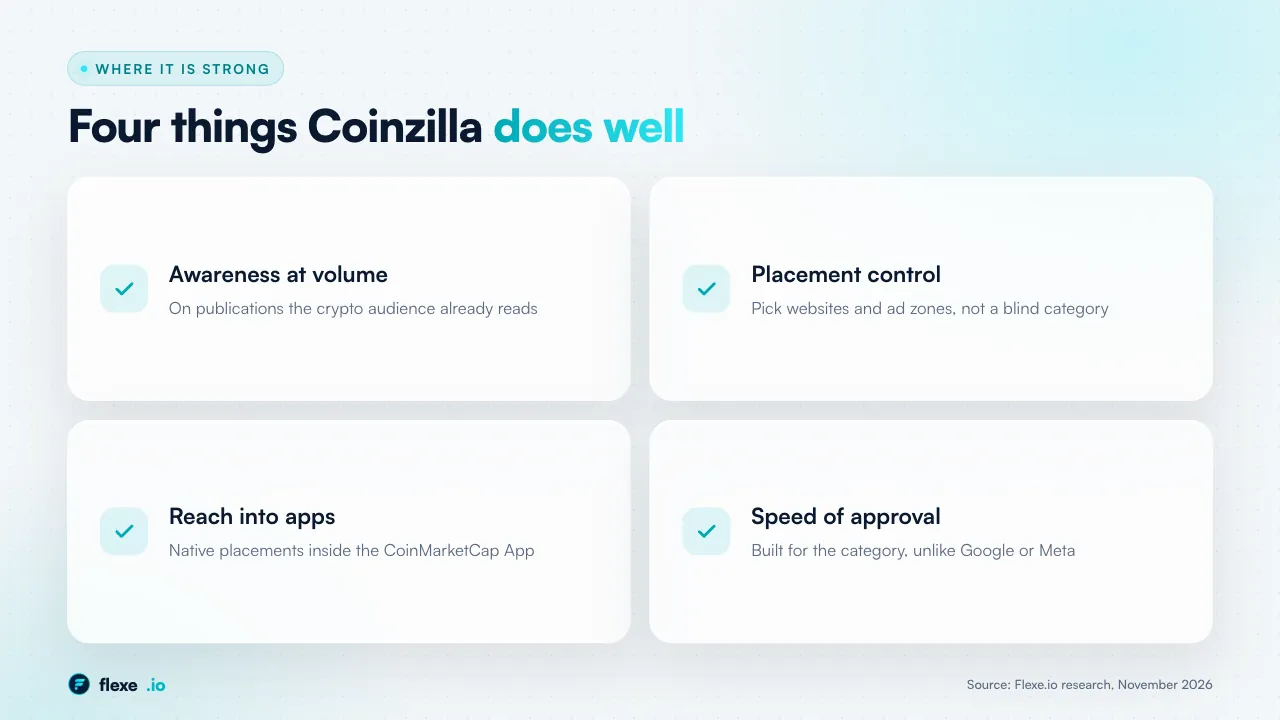
For that objective, networks built on wallet data are the correct tool. Blockchain-Ads screens wallet behaviour across 82 blockchains, but its self-service deposit is 10,000 dollars with a 360 dollar daily campaign budget, so the better signal comes at roughly a hundred times Coinzilla’s entry deposit.
The second poor fit is a genuinely small budget. The 100 euro deposit is accessible, but the 50 euro daily floor per campaign burns it in two days, and a display campaign that short produces a sample too small to learn from. If the budget is a few hundred dollars, a network with bid-based pacing such as Bitmedia, with bids from 0.25 dollars per click, gives more days of data for the same money.
How does it compare to the alternatives?
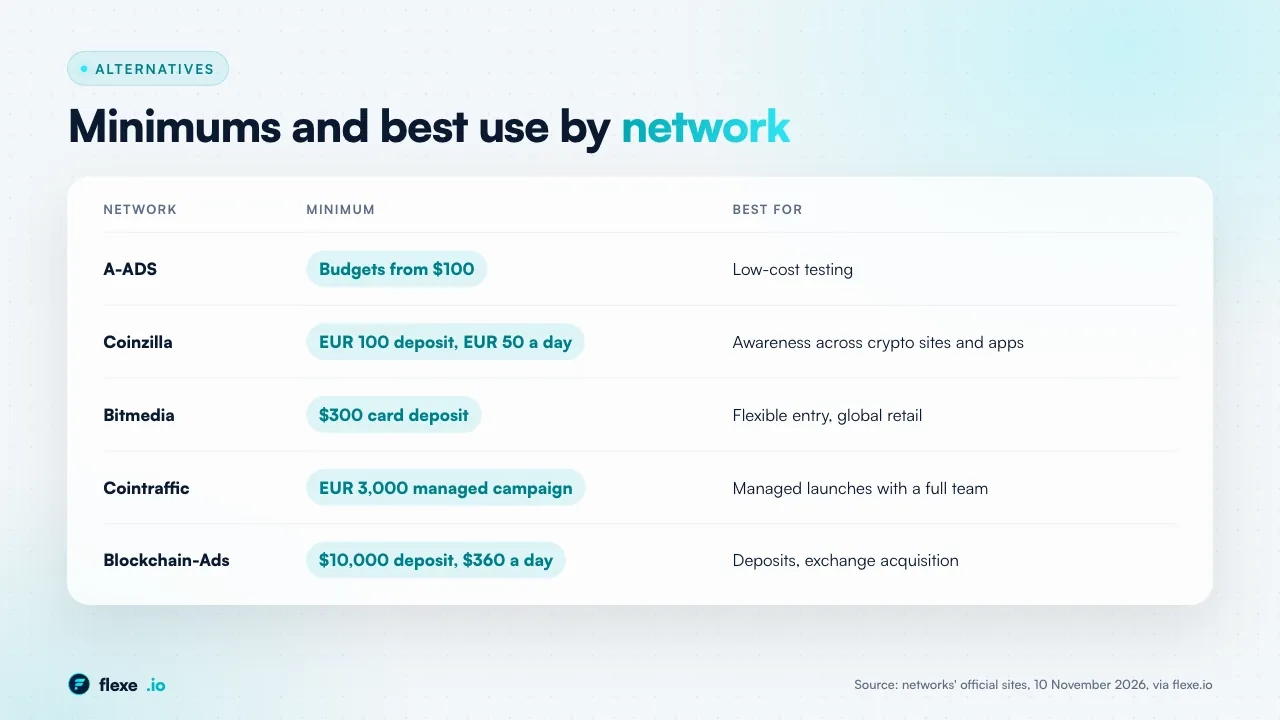
| Network | Minimum (official site, 10 Nov 2026) | Targeting | Best for |
|---|---|---|---|
| A-ADS | Budgets from $100, CPD and CPA | All traffic, publisher categories or specific websites | Low-cost testing, card or crypto payment |
| Coinzilla | EUR 100 deposit, EUR 50 a day per campaign | Websites, ad zones, location, device | Brand awareness across crypto sites and apps |
| Bitmedia | $300 card deposit, bids from $0.25 CPC | Geo, device, Web3 wallet audiences | Flexible entry, volume, global retail |
| Cointraffic | EUR 3,000 managed campaign | Publisher, geography | Managed launches with a full team |
| Brave Ads | $500 a month self-serve | Consent-based, in-browser | Privacy-conscious audiences |
| HypeLab | Not published on its homepage (19 Nov 2026) | Wallet activity, token holdings, location, device | On-chain targeting across 200+ crypto sites |
| Blockchain-Ads | $10,000 deposit, $360 a day | On-chain wallet behaviour, 82 chains | Deposits, exchange acquisition |
Read the minimum column as a proxy for what each network expects you to know before arriving. The higher-minimum networks assume you have a conversion event defined; the lower-minimum ones do not.
How should you test it?
Set the objective before the budget. If the answer to what success looks like is a number of impressions, Coinzilla is appropriate and the test can be short. If the answer involves wallets or deposits, the test will fail for reasons that have nothing to do with the network.
Run at least two creative variants and at least two publisher categories, because the variance between placements in this category is larger than the variance between networks. Judging a network on one creative in one category is the most common way a good network gets written off.
Measure on a defined window and hold to it. Display attribution is imprecise, and extending the window until the numbers look acceptable is how a campaign report stops meaning anything.
Set the budget across enough days
The 100 euro deposit is an entry point, not a test budget. A display campaign learns from the number of days it runs and the number of placements it touches, so the useful question is how long the money keeps the campaign live, not how many impressions it can buy in a single burst at the start.
Split the budget rather than spending it evenly. Give the first portion to discovery across several publisher categories, then move what remains onto the categories that produced attention at the lowest cost. A flat spend across everything for the whole period produces an average that describes none of the placements you actually bought.
Decide the stopping rule in advance. Write down the figure at which you would extend the campaign and the figure at which you would stop it before any data arrives at all. Campaigns that simply run until the budget is gone rarely produce a decision, because the person reading the report has already spent the money either way.
Building creative for publisher inventory
Display units are seen at a glance beside editorial content, so a banner that has to be read loses. Lead with the name and one claim, keep the wording short enough to take in while scrolling, make the same message work across every size the network serves, and check that it still reads when the unit is small, because you do not choose which slot a given publisher renders.
Run at least two variants, as the test structure requires, and make them genuinely different rather than two colours of the same idea. Variance between placements in this category is larger than variance between networks, and two near-identical creatives will never tell you whether a weak result came from the message or from the inventory it ran on.
Keep the creative consistent with the destination. A banner promising one thing and a page opening with another loses the visitor it just paid for, and on a buy sold by impressions that loss is invisible in the campaign report, which will happily show delivery against a page nobody stayed on.
Where the landing page decides everything
Awareness traffic arrives cold, without intent, from someone who was reading an article a second earlier. The page it lands on has to answer what the product is and who it is for before anything else, because a visitor who did not go looking for you is not going to hunt through a site for that answer.
Instrument the page before the campaign starts rather than afterwards. A destination that cannot distinguish this traffic from anything else turns the whole test into an argument about attribution, and display attribution is imprecise enough without that handicap. Tag the links, keep a separate parameter per creative, and confirm the tracking fires before the first impression is served.
Measure what a cold visitor can plausibly do. Time on the page, a scroll, a click into the documentation or a subscription are all reachable from an awareness impression. A wallet connection usually is not, and judging the network by one is precisely the mistake described above in the section on where it does not fit.
Reading placement reports without fooling yourself
Placement reports look precise and hide a great deal. A category that spent most of the budget is not necessarily the category that worked, it is the category with the most inventory available. Normalise by spend before comparing anything, and look at the spread across publishers inside a category rather than at the category average.
Hold the measurement window you set. Extending it until the result improves is how a report stops carrying information, and it is more tempting here than elsewhere because awareness effects genuinely do arrive late, which makes the excuse sound reasonable every single time somebody offers it.
What this Coinzilla review cannot measure
A comparison of networks works from what those networks publish about themselves. It cannot tell you how your specific creative performs against your specific audience on a particular publisher in a particular month, and that variance is the largest term in the equation. Use the comparison to shorten the list of networks worth testing, not as a prediction of your result.
Reported figures also move. Our first version of this page quoted 650 publishers and a 500 dollar minimum; on 10 November 2026 Coinzilla’s own pages stated 2,000+ websites a month and a 100 euro deposit. Figures are stated by the networks themselves and change without announcement, so confirm the current terms directly before committing budget rather than planning against a number read in any comparison, including this one.
The thing a comparison does settle is fit. Whether targeting runs on publisher category or on wallet behaviour is a structural property of a network and will not change during your campaign, and matching that property to your objective removes most of the ways a test fails for reasons the network was never able to control.
Questions to ask before the first campaign
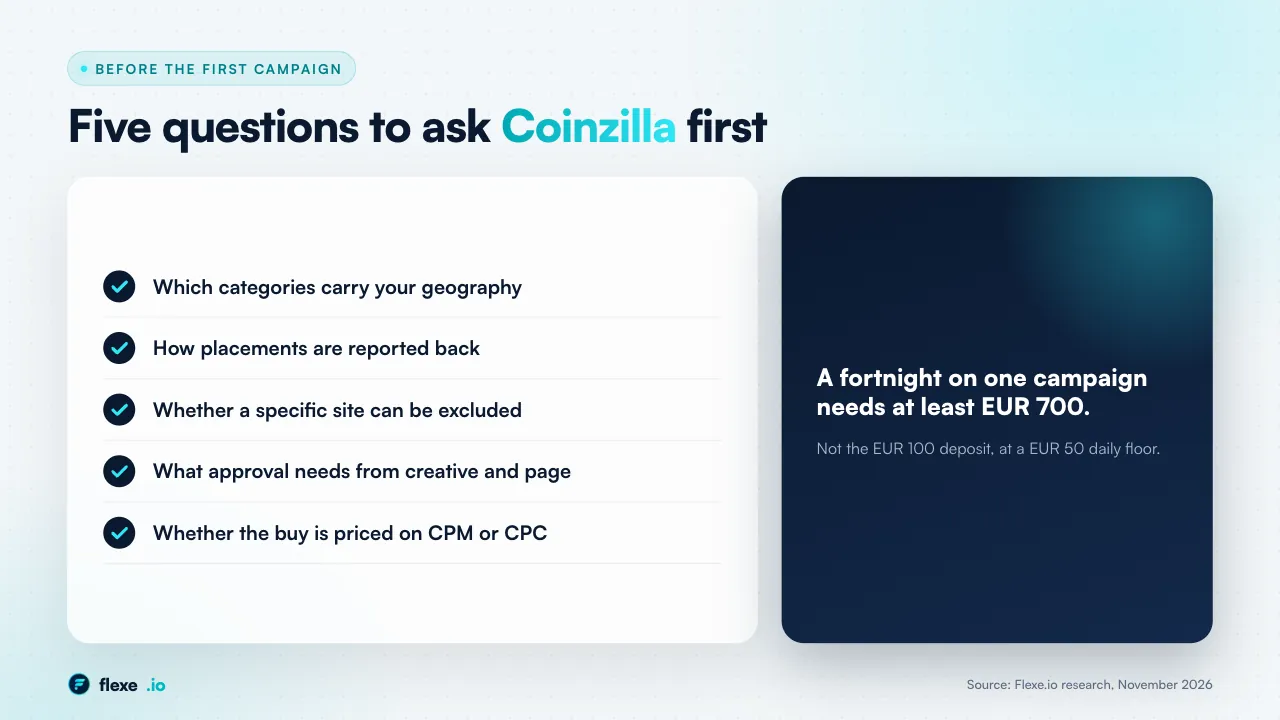
Before the first campaign, ask the questions whose answers would change how you run it: which publisher categories carry the geography you want, how placements are reported back to you, whether a specific site can be excluded, and what the approval process needs from the creative and from the landing page behind it.
Ask about billing and pacing as well. Whether the buy is priced on CPM or CPC changes what you are optimising and what a weak creative costs you, and with a 50 euro daily floor per campaign, a fortnight of testing on one campaign needs at least 700 euros, not the 100 euro deposit.
Running it alongside another network
Running a second network in parallel is the fastest way to learn what the first one contributes, but only if the two are not judged on the same metric when they were built for different ones. An awareness buy and a wallet-behaviour buy will not produce comparable cost per conversion, and forcing the comparison usually kills the one doing the slower job. A wider list of crypto ad placements you can buy helps when picking that second network.
Stagger them instead, or measure each against the objective it was chosen for, and keep the landing pages separate so the traffic can be told apart afterwards. The comparison worth having at the end is not which network won, it is which objectives each one can be relied on to serve and at what cost.
This Coinzilla review covers one network; for a side by side view of Coinzilla and the other crypto ad networks, see the crypto ads guide.
What do Coinzilla reviews from users say?
On Trustpilot, checked 16 November 2026, Coinzilla holds a TrustScore of 3.0 out of 5 from 105 reviews, with only 4 posted in the last 12 months. Most ratings are 5 stars and about one in ten is 1 star, so the score reflects a small and old sample. The split by type of user is more useful than the average:
| User | What reviewers praise | What reviewers complain about |
|---|---|---|
| Advertisers | Responsive account managers, help with creative, source URLs of traffic disclosed | Non-refundable deposits, traffic quality disputes, scripted support replies |
| Publishers | A proactive team once accepted | Rejections over traffic thresholds, faucet sites refused, repeated KYC, slow chat support |
Our read matches the advertiser side: the deposit is the risk, so test with a budget you can afford to lose and judge placements by site, not by the network total. Coinzilla replies to many negative reviews, usually by citing its traffic minimums and deposit rules.
How to choose a crypto ad network like Coinzilla in 2026
Choose a crypto ad network like Coinzilla by matching how it targets to what you need people to do. Coinzilla sells awareness across crypto websites and apps, so it fits a launch that needs a familiar name. If success means deposits or wallet connections, a network that targets wallet behaviour is the better first test.
- Write the objective first: impressions and visits, or a measurable on-chain action.
- Check that the deposit covers at least two weeks at the daily floor, not two days.
- Ask whether you can pick and exclude individual websites and ad zones.
- Confirm the pricing model, CPM or CPC, before you build the creative.
- Read the refund terms, since user reviews show deposits are the main risk.
- Plan a second network with a different role and a separate landing page.
Frequently asked questions
What is the minimum budget for Coinzilla?
Coinzilla’s own FAQ, checked on 10 November 2026, sets the starting deposit at 100 euros and the minimum daily budget at 50 euros per campaign. Payment goes by bank wire or in crypto through CoinGate. A deposit that small runs out in two days, so plan a test budget around the number of days you need, not around the entry deposit.
Does Coinzilla support wallet targeting?
No. Targeting is by website, ad zone, location and device, and the managed retargeting product follows visitors who already reached your site through tracking events. For wallet-behaviour targeting the relevant networks are the ones built on on-chain data, such as Blockchain-Ads across 82 blockchains, which starts at a 10,000 dollar deposit.
Is Coinzilla better than Bitmedia?
They answer different questions. Coinzilla carries larger premium inventory, including the CoinMarketCap App, and suits awareness at volume with a 50 euro daily floor. Bitmedia asks for a 300 dollar card deposit but prices on bids from 0.25 dollars per click, so it suits flexible or mid-size campaigns where the budget needs to stretch across more days.
How quickly does a Coinzilla campaign get approved?
Considerably faster than mainstream platforms, because the network is built for the category rather than tolerating it. You set the campaign up, the Coinzilla team reviews it, and ads go live once the account is topped up. Approval effort is where most of a crypto campaign budget goes on Google or Meta, and it largely disappears here.
What ad formats does Coinzilla offer?
Coinzilla sells classic display banners, native ads, pop-unders, header banners and sticky banners, and its design team can build custom HTML5 banners. Since 2026 native placements also run inside the CoinMarketCap App. For awareness, banners and native units on news sites are the safe start; pop-unders bring volume but rarely the attention a new brand needs.
Where to go next
For the full network comparison, see our guide to crypto ad networks. For campaign records including paid work on restricted platforms, see our paid advertising case studies.
Choosing between networks for a specific campaign? Send the brief on Telegram at https://t.me/flexe_io_agency and we will come back with a network recommendation and a realistic test structure within 24 hours.
Nothing here is financial advice. Network figures are as published by the networks themselves and change; verify current terms before committing budget.
If you would rather have this run for you, see banner display campaigns.
Is Coinzilla legit?
Yes. Coinzilla has run as a crypto ad network since November 2016 and publishes its terms, deposit rules and formats openly. User reviews are mixed: a 3.0 TrustScore on Trustpilot from 105 reviews as of 16 November 2026, with complaints focused on non-refundable deposits and publisher rejections rather than on missing payouts.