Finding NFT artists, studios and ambassadors means separating three roles that projects routinely confuse: the person who makes the work, the team that ships a collection, and the person who lends it an audience. Checked on 11 November 2026. Each is sourced differently, costs differently, and fails differently. This guide covers where each is found, what to check before committing, and which role a given project actually needs.
Key Takeaways
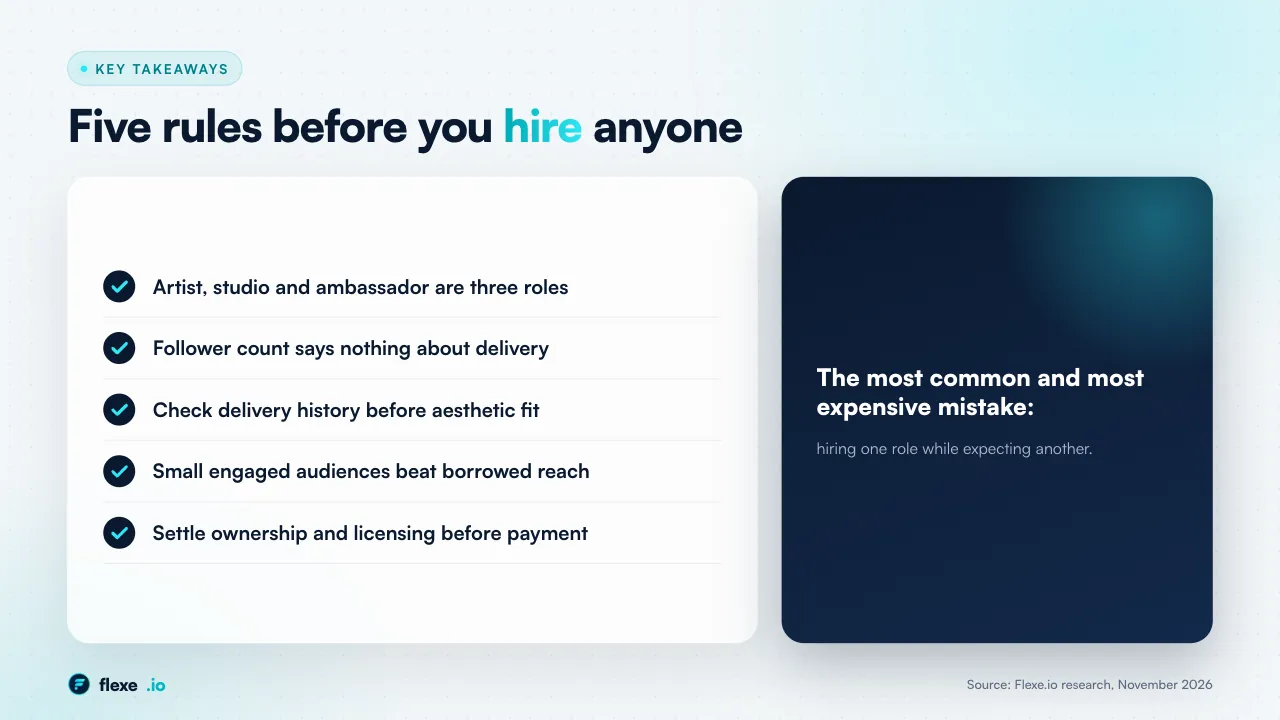
- Artist, studio and ambassador are three roles. Hiring one expecting another is the most common and most expensive mistake.
- An artist’s follower count says nothing about whether they can deliver a collection on schedule.
- Check delivery history before aesthetic fit. Portfolios show the best work; delivery history shows the likely work.
- Ambassadors with a small, genuinely engaged audience outperform large accounts with borrowed reach.
- Ownership and licensing terms decide more disputes than price does. Settle them before the first payment.
What is the difference between an artist, a studio and an ambassador?
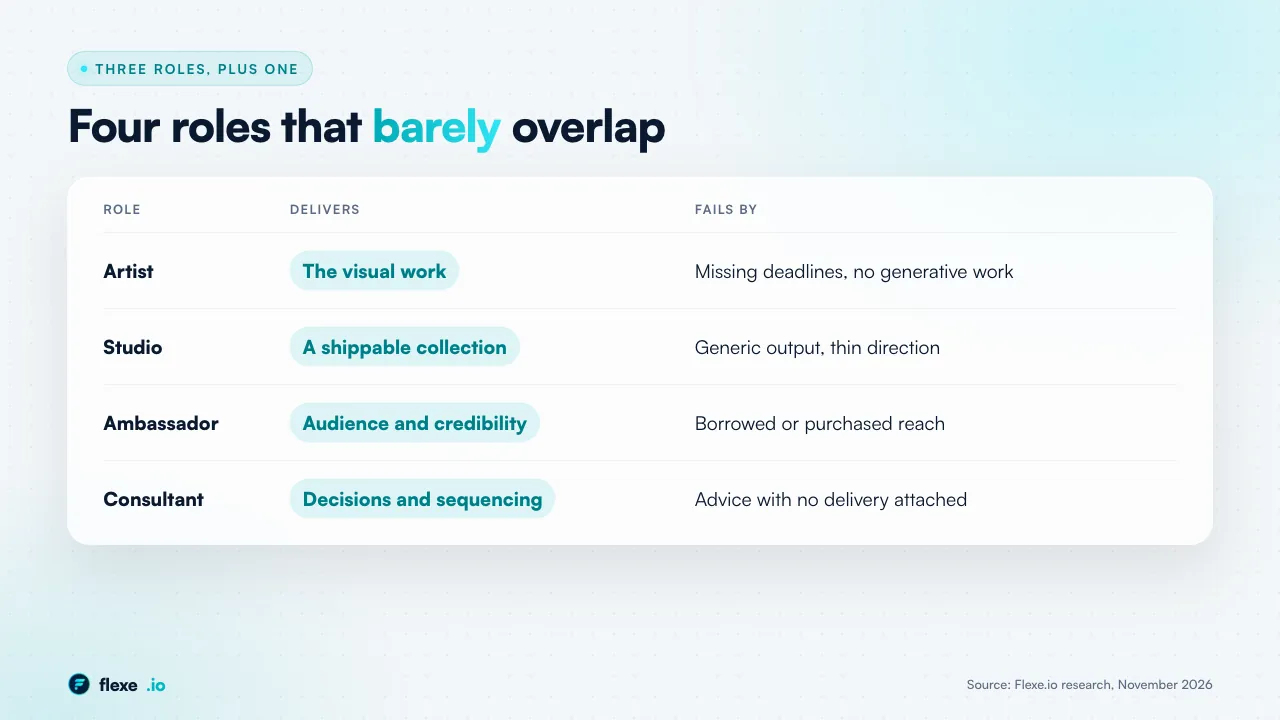
An artist produces the visual work and usually operates alone. A studio produces a collection, which means art plus generation, metadata, contract coordination and a launch schedule. An ambassador produces attention: they hold an audience and lend it credibility.
The confusion is expensive because the skills barely overlap. A brilliant artist who has never shipped a generative collection will discover trait rarity and metadata standards on your timeline. A studio with strong delivery may produce work nobody wants to own. An ambassador can sell out a drop and knows nothing about producing one.
| Role | Delivers | Found through | Fails by |
|---|---|---|---|
| Artist | The visual work | Portfolio platforms, referrals, past drops | Missing deadlines, no generative experience |
| Studio | A shippable collection | Credits on completed collections | Generic output, thin creative direction |
| Ambassador | Audience and credibility | Community presence, existing collector base | Borrowed or purchased reach |
| Consultant | Decisions and sequencing | Referrals from completed launches | Advice with no delivery attached |
How do you find NFT artists worth working with?
Work backwards from collections you admire rather than forwards from directories. Every collection credits its artist somewhere, and the artist behind a collection that shipped on time and held its community is demonstrably capable of doing it again.
Directories and portfolio platforms are useful for breadth and useless for reliability, because they display finished work rather than the process that produced it. Referrals from teams that have completed a launch are the highest-quality source available and cost nothing but a message.
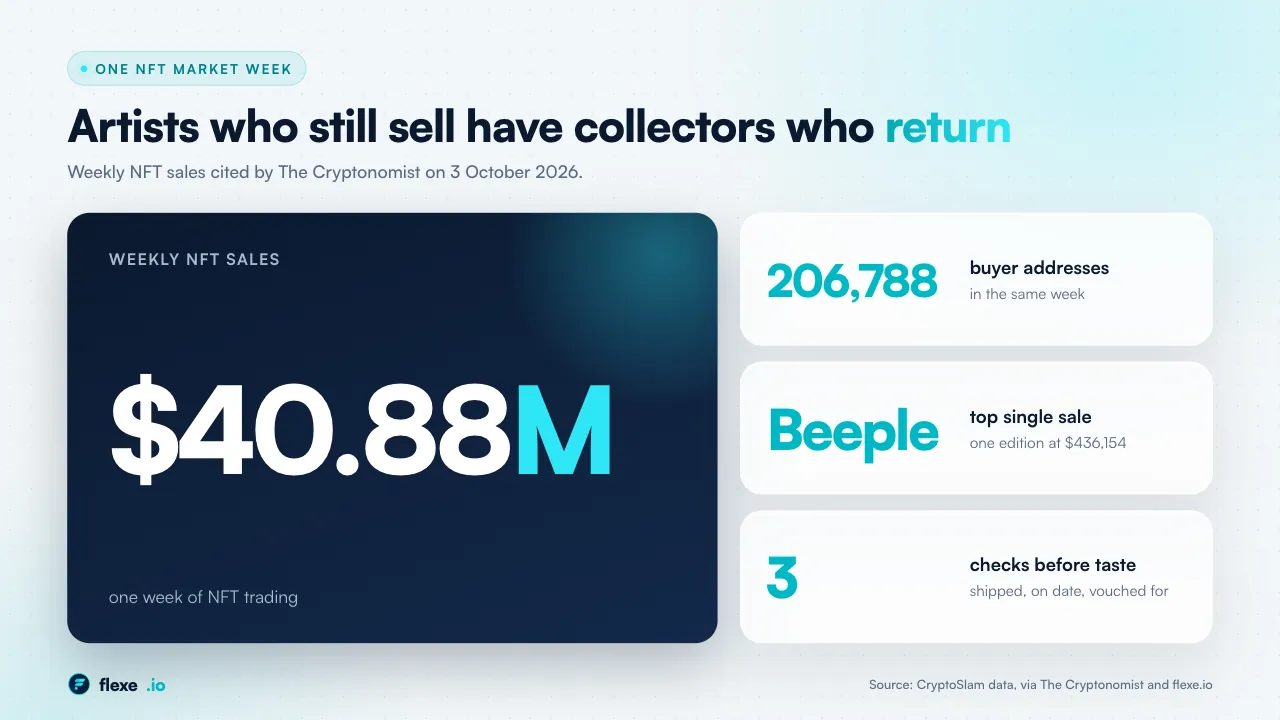
CryptoSlam data cited by The Cryptonomist on 3 October 2026 put weekly NFT sales at $40.88M from 206,788 buyer addresses, and the top single sale that week was a Beeple edition at $436,154. NFT artists who still sell in that market have collectors who return, which is the history worth asking about.
Three checks matter before an aesthetic conversation. Has this person shipped a collection of comparable scale. Did it launch on the announced date. Are the people who worked with them willing to say so publicly.
Top NFT artists by record sales
Before hiring anyone, it helps to know who set the prices the market still quotes. These seven artists hold some of the largest single sales on record, per Wikipedia’s list of the most expensive NFTs, checked on 16 November 2026. None of them is available for a project commission at a normal budget, and that is the point: study why their work sold, then look for the same qualities in artists you can afford.
| # | Artist | Best-known sale | Price and venue | What a project can learn |
|---|---|---|---|---|
| 1 | Beeple | Everydays: The First 5000 Days | $69.3M at Christie’s, 11 March 2021 | Years of daily public work built the audience long before the sale |
| 2 | Pak | Clock | $52.8M, bought by AssangeDAO, 9 February 2022 | The mechanism and the cause can be the artwork |
| 3 | Larva Labs | CryptoPunk #5822 | $23.7M, 12 February 2022 | An early, fixed supply turned into a status symbol |
| 4 | Dmitri Cherniak | Ringers #879 | $6.215M at Sotheby’s, 15 June 2023 | A strict generative rule set that collectors recognise on sight |
| 5 | Mad Dog Jones | REPLICATOR | $4.14M at Phillips’ first NFT auction, 23 April 2021 | A piece that keeps producing new editions gives holders a reason to stay |
| 6 | Tyler Hobbs | Fidenza #313 | $3.3M, 23 August 2021, minted on Art Blocks | Long-form generative output from one algorithm, released as one series |
| 7 | Refik Anadol | Machine Hallucinations, Space: Metaverse | $2.382M at Sotheby’s Hong Kong, 4 October 2021 | A gallery and museum career carried into the NFT market |
The pattern across the list is not hype. Each artist had a body of work, a recognisable rule or style and a public record before the record sale. Those are the same three things to check in a portfolio, as the next section shows.
How do you evaluate an NFT studio?
Judge a studio on its worst recent collection rather than its best, because the worst one shows what happens when a project does not get the studio’s full attention. Ask which collections they shipped in the last year and look at all of them.
Ask specifically who does the creative direction and whether that person will be on your project. Studios frequently sell the founder’s taste and staff the work elsewhere, which is legitimate only if disclosed.
The contract questions that prevent later disputes are ownership of the underlying artwork, licensing scope for commercial use, and what happens to unreleased assets if the collection is cancelled.
How do you pick ambassadors and avoid borrowed reach?
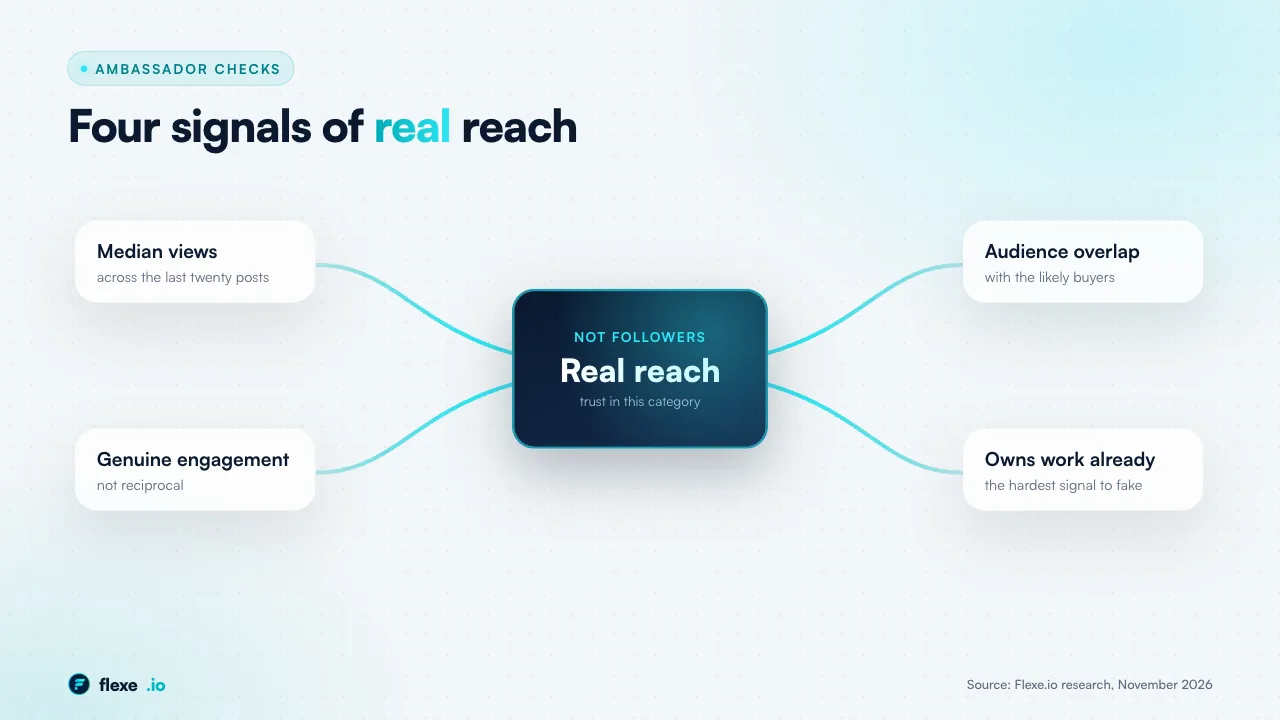
An ambassador’s value is whether their audience trusts them about this specific category. A large general crypto account promoting an art collection transfers very little of that trust, which is why the follower count is a poor predictor.
The checks are the same ones that apply across crypto influencer networks: median views across the last twenty posts rather than the follower count, whether the engagement is reciprocal or genuine, and whether their followers overlap with the collection’s likely buyers. Smart followers matter more than totals: TwitterScore and Sorsa both score an X account by which known founders, funds and collectors follow it, and the Wallchain X Score extension rates follower quality and organic engagement from 0 to 1000.
For collections specifically, an ambassador who already owns work in the category is worth several who do not. Ownership is the cheapest credibility signal available and the hardest to fake.
Which role does your project actually need?
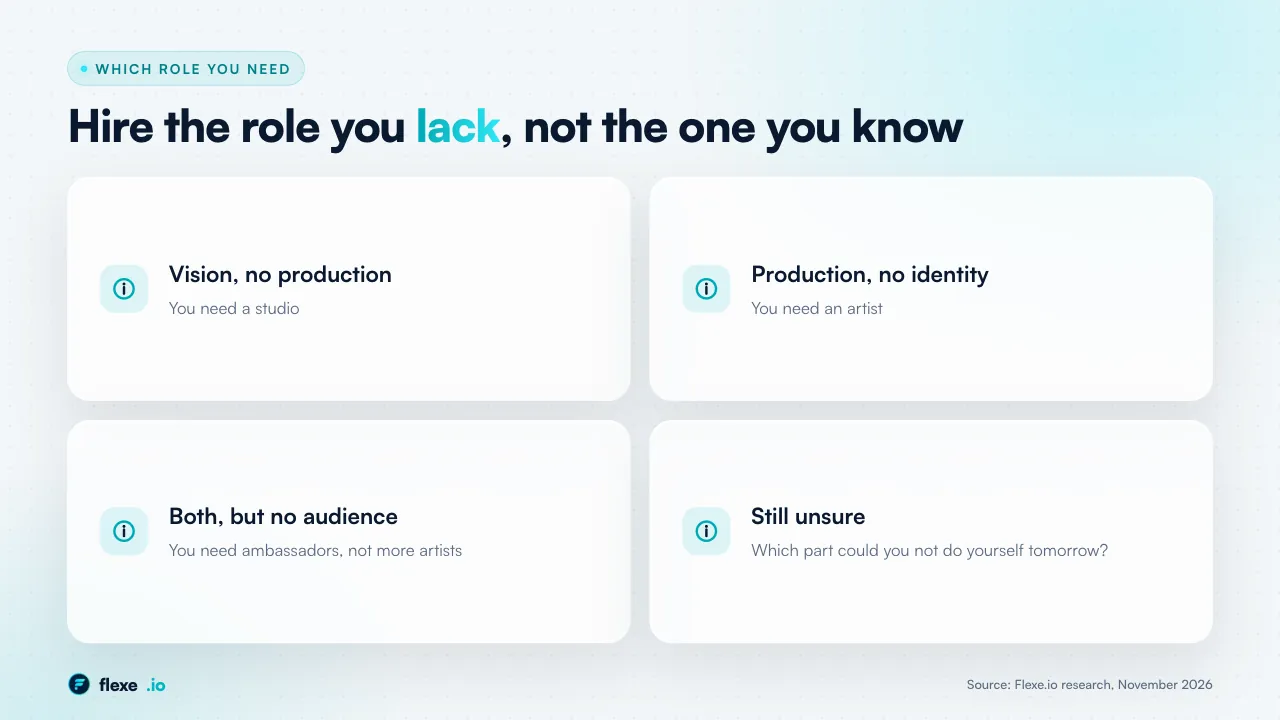
A project with a clear creative vision and no production capacity needs a studio. A project with production capacity and no visual identity needs an artist. A project with both and no audience needs ambassadors, and should resist the temptation to solve that problem by hiring more artists.
Most projects that stall have hired the role they understood rather than the role they lacked. The diagnostic question is which part of the launch you could not do yourself tomorrow.
Writing the first message to an artist
The opening message decides whether you get a reply, and most get none because they ask about availability without saying anything worth answering. Name the collection, the scale, the timeline, the budget range and what specifically in their work made you write.
Say what stage you are at honestly. Writing as though the launch is funded and scheduled when it is neither wastes the reply you wanted, and artists talk to each other. A message saying the concept is early and the budget is still being raised will still get answers from the people who are happy to work that way.
Paid trials before a full commission
Commission one piece, paid at a fair rate, before committing to a collection. A trial shows what a portfolio cannot: how the person handles direction, how long a revision takes, whether files arrive in the format agreed, and whether messages are answered within a working day. It costs a fraction of the collection and it is the only reliable test available before the money is committed.
Give the trial a real brief with a real deadline rather than an open request to make something nice. The point is to watch the process under the conditions the collection will impose, and someone who delivers beautifully with no constraints can be a very different collaborator once a date is attached to the work.
Agree in advance what the trial piece is for. If it may appear in the collection, say so and price it accordingly; if it is a test that will not be used, say that too, because an artist who assumed the work was commissioned will reasonably expect it to appear. Settle the rights to that single piece in the same message that sets the fee.
Contracts for NFT artists and studios
Ownership, licensing scope and the fate of unreleased assets decide most disputes, and all three should be settled before the first payment leaves. State who owns the underlying artwork, which commercial rights pass to holders, which rights the creator keeps, and whether the work may appear in their portfolio and in your own advertising.
Then write down the dull parts. File formats and resolutions, who supplies the trait layers, who holds the source files, what happens if the collection is cancelled, and whether the creator may produce closely similar work for another project during the same period. Each of these has ended a collaboration somewhere, and none of them is difficult to agree at the start.
Agree where the work is minted and listed, and what happens if that venue disappears. On 6 October 2026 Igloo said its Abstract chain would close, with users told to move funds by 15 December 2026, and Blur announced on 12 October 2026 that its marketplace frontend would be switched off on 12 November 2026. Name the chain, the contract owner and a fallback venue in writing.
Name one person on your side who signs off the work and keep the whole exchange in one thread. Collections stall when three founders send different notes to the same artist in different places, and nobody can later establish which version was approved. The thread is also the record that the contract refers back to when a deliverable is disputed.
Milestones, revisions and the file handover
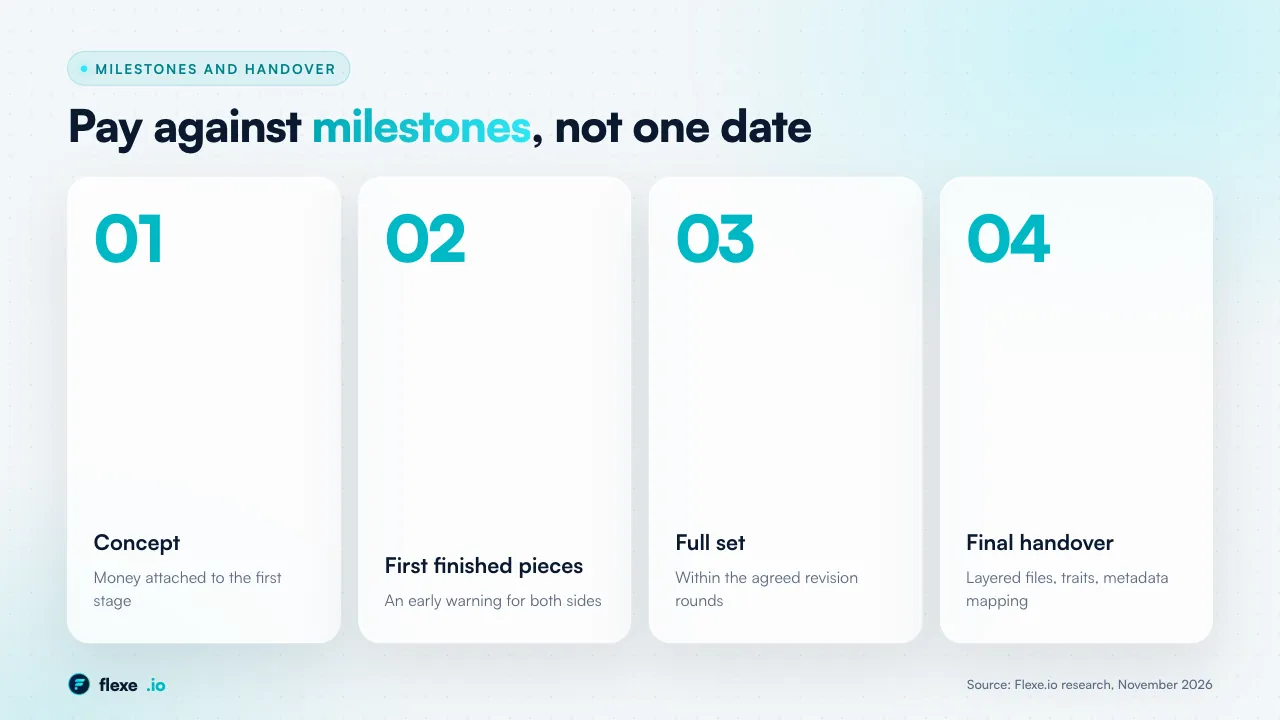
Pay against milestones rather than on one date, with the concept, the first finished pieces, the full set and the final handover as separate points. A schedule with money attached to each stage gives both sides an early warning, since a missed first milestone is recoverable and a missed final one usually is not.
Fix the number of revision rounds included and define what counts as a revision, because unlimited changes are where fixed-price work turns adversarial. Define the handover precisely too: layered source files, the trait structure, the metadata mapping and a written note covering anything a future collaborator would need in order to continue the work.
Briefing an ambassador and disclosing terms
An ambassador brief is shorter than an artist brief and more specific. Give them the collection’s story, the dates, what they may say about supply and pricing, what they must not say, and the disclosure wording you expect on every post. Leaving disclosure to individual judgement produces a different standard on each account and a problem on the one that chose badly. In the US the FTC Endorsement Guides require the paid relationship to be clear in each post, and X has offered a native Paid Partnership label since March 2026.
Ask whether they will hold work from the collection and write the answer into the agreement, along with the period of association and what happens if the collection underperforms. An ambassador holding the work is the strongest signal available, and it is only credible if it was agreed openly rather than discovered afterwards by somebody reading the chain.
Give them the material rather than leaving them to find it. Images cleared for use, the dates, the correct links, the answers to the questions their audience will ask, and a named person who replies quickly during the drop. An ambassador improvising a mint mechanic in a reply thread will get it wrong, and the correction will travel further than the original post.
When an artist goes silent
Silence usually means the work is behind rather than abandoned, and pressure at that point makes it worse. Send one message referring to the milestone and the date, ask for a revised schedule rather than an explanation, and set a point at which you will make a decision. Most collaborations recover here if the response you ask for is a date rather than an apology.
If that date passes as well, act on the contract you wrote instead of continuing to wait. This is why milestone payments and staged file handovers exist: a project holding the layered files for the finished pieces can bring in another artist, while a project holding only flattened images is starting the collection again.
Working with pseudonymous creators
Pseudonymous artists are normal in this market and the good ones have a verifiable body of work even without a legal name. The substitute for identity is history: completed collections, people willing to vouch publicly, and a payment structure that never leaves you far ahead of the delivery at any point in the schedule.
Adjust the terms rather than refusing the collaboration. Smaller milestones, earlier file handovers and an agreement signed under whatever name they work under are all workable. What is not workable is a large advance to an unverifiable counterparty, and an artist accustomed to working this way will expect the structure rather than resent it.
Mistakes that cost a collection its date
Hiring for aesthetics and discovering the production gap later is the expensive one, and it usually appears as a generative collection scheduled around someone who has never built trait layers.
The other repeat is treating ambassadors as a launch-week task. Audience relationships are built before the drop rather than during it, and an ambassador recruited days before a mint is reading a script rather than lending credibility to anything.
How to choose an NFT artist in 2026
Choose an NFT artist by delivery history, not by portfolio alone. Trace the credits of collections that shipped, confirm with those teams that the work arrived on time, and commission one paid trial piece before a full contract. Settle ownership, licensing scope and payment milestones in writing before the first payment leaves.
- Find the artist through the credits of a collection that actually launched.
- Ask the team behind that collection whether the work arrived on schedule.
- Commission one paid trial piece before committing to a full set.
- Write ownership, licence scope and unreleased assets into the contract.
- Pay against milestones: concept, first pieces, full set and handover.
- For a pseudonymous artist, check a verifiable body of work instead of a legal name.
Frequently asked questions
How do you find reliable NFT artists?
Start from collections that shipped successfully and trace their credits, rather than starting from portfolio directories. Then verify delivery history and ask past collaborators directly whether the launch kept its date. A strong portfolio with no shipped collections is a risk regardless of how good the work looks; a paid trial piece settles it.
Should a project hire an artist or a studio?
A studio when the collection is generative or large, an artist when the work is the point and the volume is small. Hiring an individual artist for a ten-thousand-piece generative drop means teaching them trait layers, rarity and metadata on your schedule. A studio brings the production pipeline a solo artist would have to build.
What should an NFT ambassador agreement cover?
Disclosure obligations, the period of association, what happens if the collection underperforms, and whether the ambassador holds work from the collection. Add the exact disclosure wording and the claims they must not make about price or returns. Undisclosed promotion damages both sides and increasingly carries regulatory consequences.
Who owns the artwork after a collection launches?
Whatever the contract says, which is why it must say something explicit. Default assumptions differ by jurisdiction, and disputes over commercial licensing appear long after launch when the collection has value. Name who owns the artwork, which commercial rights pass to holders and who keeps the layered source files.
How do you judge an NFT ambassador’s real reach?
Look at median views across their last twenty posts, not the follower count, and at smart followers: how many known collectors, artists and funds follow the account. TwitterScore and Sorsa publish scores built from who follows an account. Then read the replies under their last few promotions for real questions about the art.
Where to go next
For the promotional side of a collection launch, see our NFT drop marketing guide. For how vetted creator campaigns are built and measured, see crypto influencer marketing.
Building a collection team? Send the brief on Telegram at https://t.me/flexe_io_agency and we will come back with a shortlist and verification scores within 24 hours.
Nothing here is financial advice. Licensing and disclosure rules vary by jurisdiction; take local advice before signing.