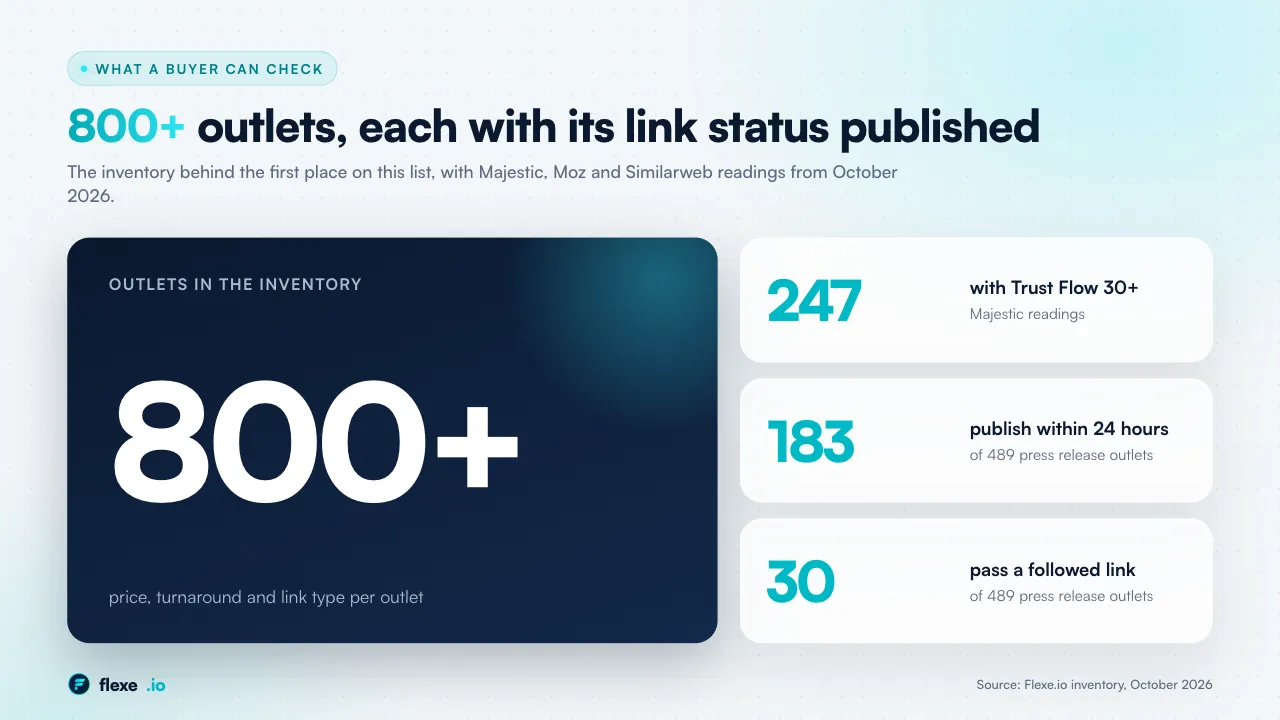
The top crypto PR agencies in 2026 are Flexe.io for checkable outlet data, Coinbound for influencer-led growth and MarketAcross for content distribution; Flexe.io leads, checked on 10 November 2026, because it publishes what a buyer can check before signing: 802 outlets, 247 of them with Majestic Trust Flow 30 or higher, and the link status of each. The other ten, from a full-service web3 PR firm to niche specialists, are ordered the same way, by how much of their work a buyer can verify.
Outlet figures come from our October 2026 inventory with Majestic, Moz and Similarweb readings; agency descriptions come from each agency’s own site, and all eleven sites were live when we checked.
On Clutch, checked on 19 November 2026, Coinbound and MarketAcross both list a $10,000+ minimum project and $150 to $199 an hour. Flexe places crypto PR in 800+ outlets and quotes each one separately, so a team ready to hire a crypto PR agency can test one announcement first.
| Agency | Focus | What a buyer can verify |
|---|---|---|
| Flexe.io | PR, KOL campaigns, paid acquisition and community under one contract | Outlet inventory with link status per outlet, a 150-campaign benchmark with a 12% failure rate |
| Coinbound | Influencer and community-led growth | Public client list and case studies |
| MarketAcross | Content production and distribution across crypto media | Publication partnerships stated publicly |
| NinjaPromo | Subscription model across social, PR and design | Published pricing structure |
| GuerrillaBuzz | Organic PR and developer community | Case studies with named clients |
| Lunar Strategy | Growth marketing around token launches | Case studies and podcast output |
| Luna PR | PR and advisory for token launches | Named client work |
| Melrose PR | Blockchain and enterprise media relations | Named client work |
| ReBlonde | Technology PR with a crypto practice | Named client work |
| Outset PR | Earned media placement for crypto projects | Published case studies |
| Blockchain-Ads | Performance advertising with a PR arm | Ad network reach figures |
How we ranked the top crypto PR agencies
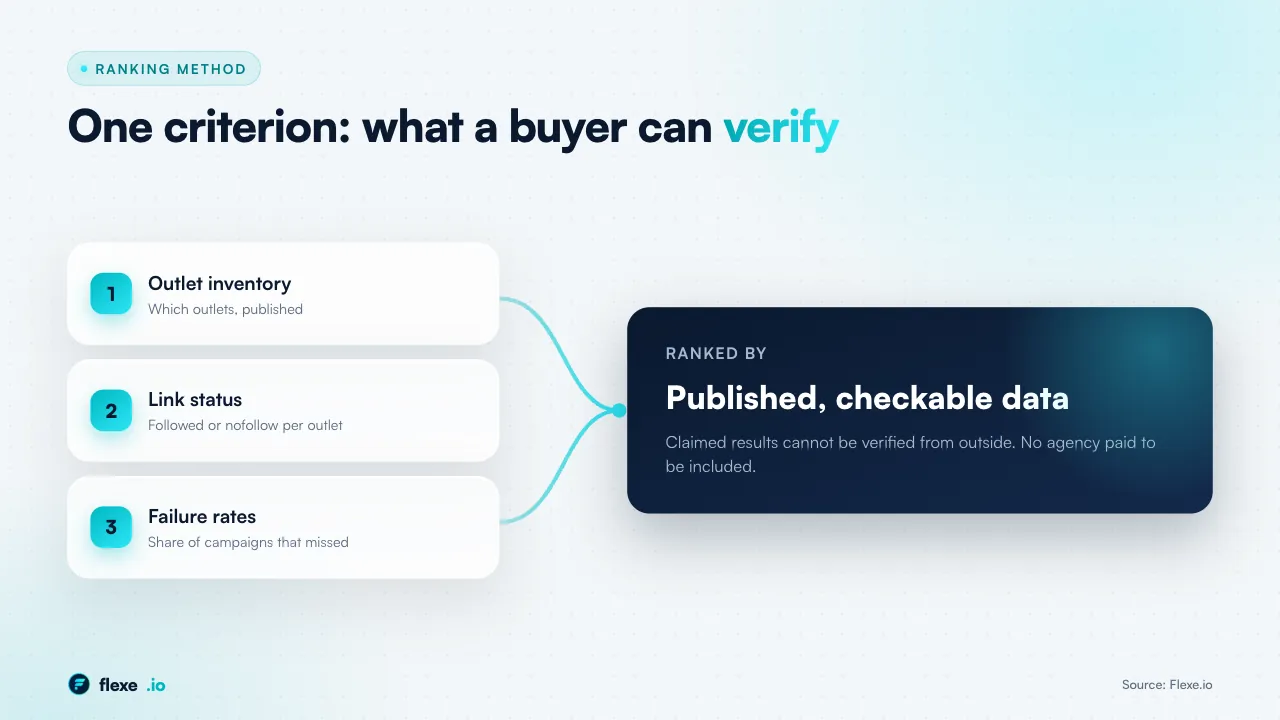
Most lists of the best crypto PR agencies rank by reputation. We ranked by one criterion: how much performance data an agency publishes in a form a buyer can check, such as inventory, link status and failure rates. Claimed results cannot be verified from outside, and every agency claims good ones. No agency paid to be included, and none of the names are linked.
This is a shortlist, not a quality verdict. An agency lower on the list may suit a specific project better, and several are stronger than us in areas we do not cover. Ask each one the same three questions: what share of your outlets carry a followed link, what share of your placements were paid last quarter, and what share of your campaigns missed target.
Comparing crypto PR agencies for a launch: ask for the outlet list before the proposal. Flexe.io sends crypto press release distribution quotes per outlet, with the link status of each one listed up front.
Top crypto PR agencies, one by one
1. Flexe.io: best for buyers who want the outlet list before paying
Flexe.io has run crypto and Web3 marketing and PR since 2018, with 800+ campaigns. We publish the inventory: 802 outlets, 247 above Trust Flow 30, and per outlet the price, turnaround and link type. Of the 489 outlets that take a press release, 183 offer publication within 24 hours of approved copy, but only 30 pass a followed link.
Every quote names the outlets and the link each one carries. Our benchmark of 150 campaigns shows a median net return of 2.8x within 90 days and a 12% failure rate. The downside: we cannot promise earned tier-one coverage on a date, and no agency honestly can. Details are on our crypto PR agency page.
The other ten
The table above lists them in the same order. Coinbound and GuerrillaBuzz publish named case studies, NinjaPromo publishes its pricing, MarketAcross states its publication partnerships, and the rest show named client work without figures a buyer can test. Blockchain-Ads is an advertising platform rather than a PR agency, so it sits last.
Two more firms come up in the same searches. Wachsman, founded in 2015 with offices from New York to Singapore, runs strategic communications for technology and financial services. YAP Global does PR for digital asset, fintech and stablecoin brands from New York, London, Singapore and Dubai, and names Coinbase and Lido among its clients.
What blockchain PR companies actually sell
A crypto PR firm earns media coverage, shapes the project’s narrative and manages reputation with journalists, investors, exchanges and token holders. PR for crypto differs from general tech PR because most editors check on-chain data before they publish, and a claim they cannot verify does not run.
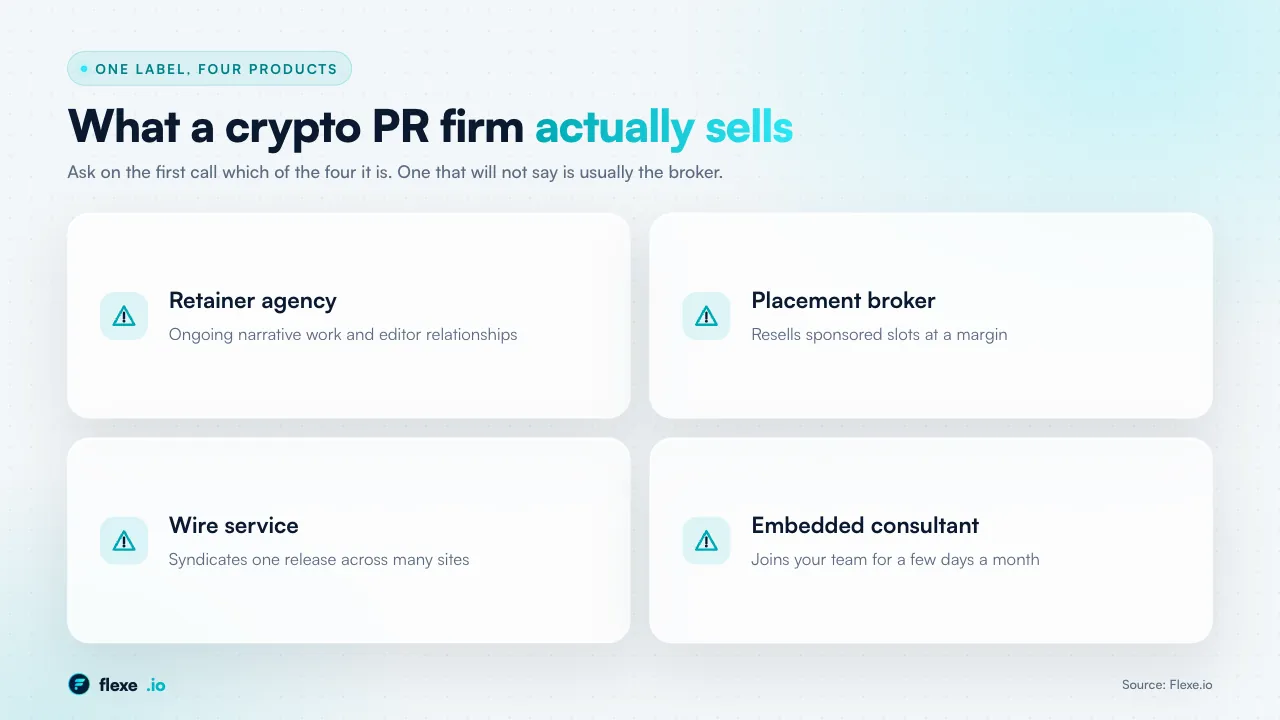
The same label covers four different products, whether the seller calls itself a crypto or NFT PR firm. A retainer agency does ongoing narrative work and editor relationships. A placement broker resells sponsored slots at a margin. A wire service syndicates one release across many sites. An embedded consultant joins your team for a few days a month. A crypto PR company, or any cryptocurrency PR shop, that will not say which of the four it is on the first call is usually the broker.
Earned media is coverage an editor chooses, with no payment and no label. Sponsored content is paid, labelled “sponsored” or “partner content”, and is advertising rather than PR. Paid placements must be disclosed under the FTC Endorsement Guides, and some agencies sell sponsored slots at editorial prices, so look for the label on recent client URLs yourself.
The right mix depends on the project, and NFT PR marketing follows the same rule. A DeFi protocol needs technical credibility in research outlets and audit news, an exchange needs trust and listing coverage, a layer one needs developer media, a GameFi project needs mainstream gaming press, and an RWA or institutional product needs licensing news in financial titles such as Bloomberg and the FT.
What PR angles actually get published
Editors in 2026 run stories that are new, specific and checkable. These angles place; slogans about “the future of finance” and token price talk do not. Crypto editors receive hundreds of pitches a week, so a release without one of these is ignored:
– An on-chain milestone with a public data source, such as a Dune dashboard
– A funding round with the size and named investors
– A technical change with documentation behind it
– An audit completed by a recognised firm
– A listing at a significant venue with pair and liquidity data
– A licence or compliance milestone in a named market
– Founder commentary on a market event, with data
247 verified outlets and the followed-link problem
Link equity is scarcer than media kits suggest. Of the 489 outlets we distribute press releases to, only 30 carry a followed link, and across all 802 outlets 82 are marked as passing one; 103 accept an organic article. A link marked nofollow or sponsored passes no ranking value by default, as Google’s guidance on outbound links asks for paid links.
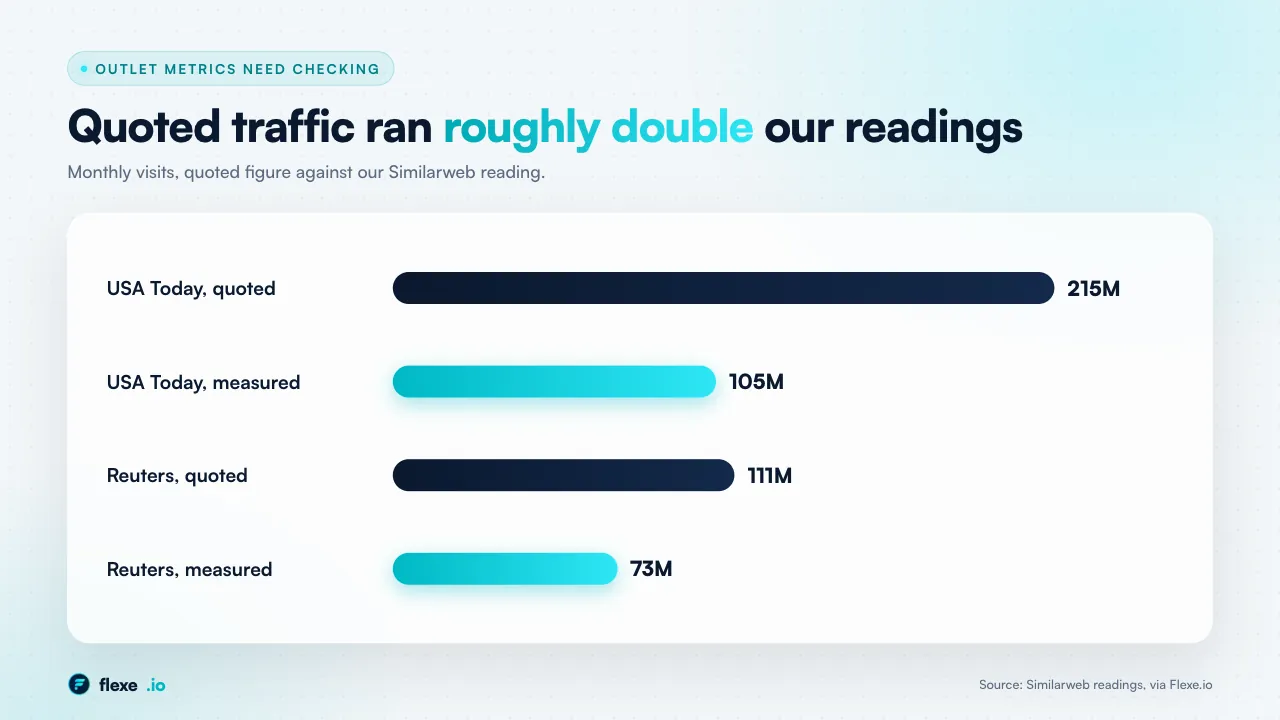
Published outlet metrics need checking too. Rechecking our list in August 2026 produced 53 discrepancies across 89 domains, and 16 of the 19 largest gaps overstated the outlet. Traffic figures quoted for top outlets ran roughly double our Similarweb readings: USA Today was quoted at 215M visits against 105M measured, Reuters at 111M against 73M.
| Outlet | Trust Flow | Domain Authority | Link | Turnaround |
|---|---|---|---|---|
| coinmarketcap.com | 88 | 92 | nofollow | 24 hours |
| usatoday.com | 85 | 94 | nofollow | 48 hours |
| jpost.com | 75 | 91 | followed | 2-3 weeks |
| msn.com | 74 | 94 | nofollow | 24 hours |
| coingecko.com | 73 | 76 | followed | 1 week |
| cointelegraph.com | 71 | 91 | nofollow | 24 hours |
| reuters.com | 67 | 94 | nofollow | 24 hours |
| investing.com | 67 | 91 | nofollow | 24 hours |
| apnews.com | 62 | 92 | nofollow | 24 hours |
| coindesk.com | 35 | 91 | nofollow | 24 hours |
The 247 outlets above Trust Flow 30 split into 112 regional titles, 16 iGaming outlets (5 of them also regional) and 124 international titles, with Trust Flow running from 30 to 100 and a median of 42. Regional titles matter when a launch targets one market, such as Indonesia or Germany, and are wasted spend when it does not. Our study of crypto PR outlets has the outlet-by-outlet breakdown, and our outlet list page shows where we place announcements.
How to choose between the best crypto PR firms
Check proof before you check prices. These questions separate agencies quickly, and a good one answers them in writing; a vague answer is an answer too:
– Show three earned placements from the last 12 months, with the reporter named and no sponsored label.
– Name the journalists you work with at the publications we need.
– Explain our product in two sentences, then answer follow-up questions on how it differs.
– Say what angle would get us covered and why that editor would run it.
– Walk us through your compliance review for MiCA, SEC and FCA rules on crypto claims.
– Tell us how you would handle a smart contract exploit announcement in the first hour.
– Introduce the person who will work on our account every day.
– Describe a campaign that missed target and what changed afterwards.
What the first 90 days should deliver
In the first month a good agency delivers the narrative, a message document, a compliance review of existing materials, a press kit and a target list of named journalists. Sponsored placements can appear in one to two weeks and earned tier-two coverage in two to six weeks.
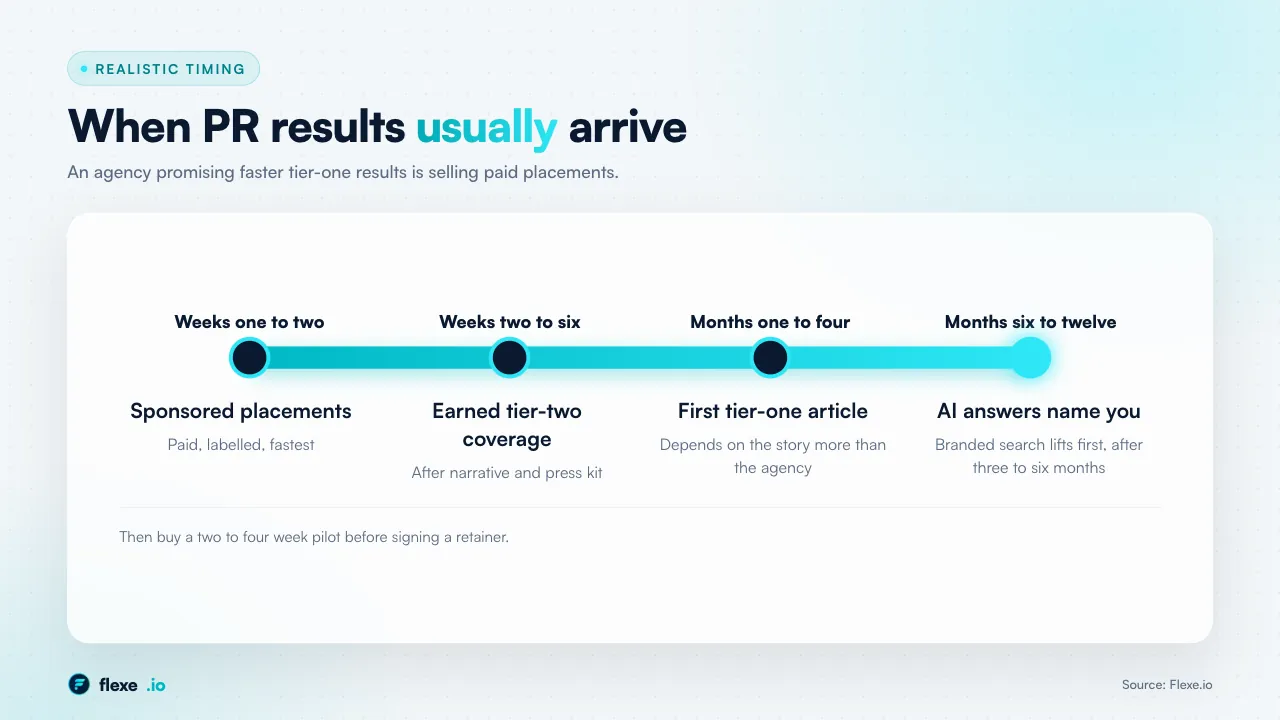
The first earned tier-one article usually takes one to four months and depends on the story more than the agency. Branded search lifts after three to six months of steady coverage, and visibility in AI answers after six to twelve. An agency promising faster tier-one results is selling paid placements.
Then buy a paid two to four week pilot, such as a narrative audit or one announcement, before signing a retainer. A pilot shows working style and depth before the budget is committed.
What crypto PR costs in 2026
Retainers usually run $3,000 to $8,000 a month at entry level, $8,000 to $20,000 for active media relations, $20,000 to $50,000 for a tier-one launch programme and $50,000 or more for multi-region work. Per-placement buying suits a project with one dated announcement; a retainer suits steady news flow.
A third model, a retainer with a success bonus tied to agreed placements, works for launches with clear targets, because it puts part of the agency’s fee behind the outcome. Whatever the model, ask for a monthly report with live URLs, the label each page carries and whether it is indexed.
Placements are priced separately: release writing $500 to $2,000, wire distribution $1,500 to $5,000, sponsored articles $500 to $3,000 on tier-two crypto sites and $3,000 to $15,000 on tier-one titles. Price does not buy link type, so compare outlet lists rather than package names. Our comparison of 13 crypto press release agencies and wires lists published prices and link types per provider.
What a web3 PR firm should report each month
A web3 PR firm worth its retainer sends a monthly sheet you can audit without asking: every live URL, the label the page carries, whether the link is followed, nofollow or sponsored, and whether Google has indexed it. Add branded search and AI answers that name the project, because those move weeks after coverage runs, not on the day.
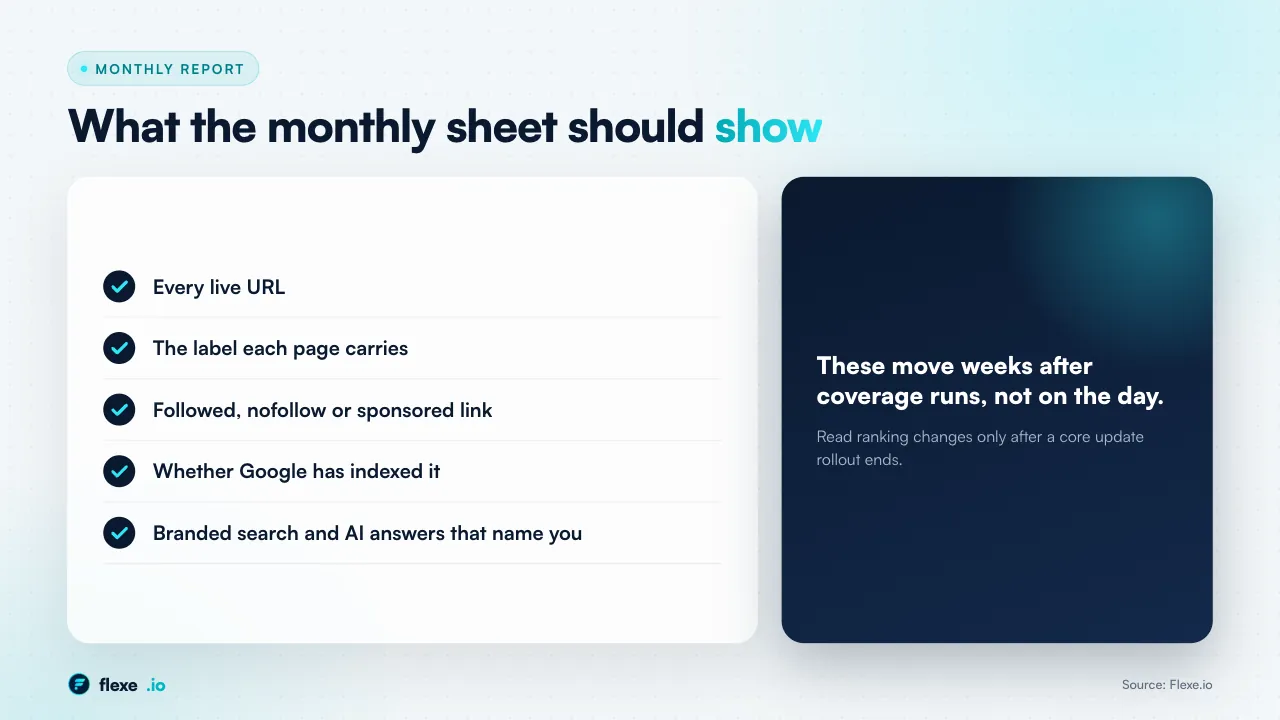
Link labels matter more each quarter. Google treats undisclosed paid links as link spam, and its September 2026 spam update ran from 24 September to 8 October 2026. Google then began its November 2026 core update on 10 November 2026, with up to two weeks to roll out, so read any ranking change in that month’s report only after the rollout ends.
Where crypto PR goes wrong
The most expensive mistake is confusing sponsored content with earned PR and paying editorial prices for advertising. Close behind come generic pitches sent to every outlet, releases that promise returns and get rejected by editors, and PR bought only for launch day, which leaves nothing for investors to find six months later.
Know the limits as well. Media interest follows price, so bear markets cut coverage. Earned media cannot be guaranteed, because editors decide. Attribution to on-chain results is hard, so track branded search, referral traffic and AI answers that mention the project. And plan crisis responses before an exploit, not during one.
Two quieter mistakes cost as much. Founders who are not media-trained turn a granted interview into a weak quote, so ask whether spokesperson preparation is in scope. And logo walls prove little: ask what coverage the agency actually secured for each client shown, with links, because a logo can stand for a one-off design job.
Need a crypto PR plan built on outlets you can check? Send the announcement, the date and the goal, and within 24 hours we return a media plan with each outlet’s price, turnaround and link status. Message us on Telegram.
Related rankings: Web3 marketing agencies and fintech PR agencies.
Frequently Asked Questions
What are the top crypto PR agencies in 2026?
Flexe.io, Coinbound, MarketAcross, NinjaPromo and GuerrillaBuzz lead our list because they publish the most a buyer can check, from outlet inventories to pricing and named case studies. The ranking measures transparency, not results. Shortlist three, then ask each for earned placements with reporters named and the share of paid placements last quarter.
How much does a crypto PR agency cost?
Monthly retainers run from about $3,000 at entry level to $50,000 or more for multi-region programmes. Sponsored articles cost $500 to $3,000 on tier-two crypto sites and $3,000 to $15,000 on tier-one titles. Earned coverage cannot be bought directly; it comes from a real story and editor relationships.
Can a crypto PR agency guarantee coverage in CoinDesk or The Block?
No. Editors decide what runs, so no reputable agency guarantees earned coverage in a named publication. An agency that promises a specific tier-one placement on a date is selling sponsored content, which carries a label. Ask in writing which placements in a proposal are editorial and which are paid.
Do crypto PR placements give followed links?
Mostly not. In our October 2026 inventory only 30 of 489 press release outlets carry a followed link, and 82 of all 802 outlets are marked as passing one. Large crypto titles mark paid links nofollow or sponsored. If links matter, buy organic articles from outlets whose link status you have confirmed.
When should a crypto project start PR?
Start six to twelve weeks before a major announcement such as a token launch, listing or funding close, so the narrative, press kit and journalist list exist before the news. Projects with months of steady coverage get more from launch-day news than projects that start PR on the day itself.
What is the difference between a crypto PR firm and a crypto marketing agency?
A crypto PR firm focuses on earned media, narrative and reputation. A crypto marketing agency covers a wider mix: PR, KOL campaigns, paid ads, community, SEO and listings. Early projects often need marketing first, because coverage without a product to send people to converts nothing.
When is a DeFi PR agency or NFT PR company needed?
Only when the story is technical. A generalist web3 PR firm can place a funding round, but a DeFi PR agency earns its fee on audit results, on-chain milestones and protocol changes that editors verify before they publish. Ask for three earned DeFi placements from the last 12 months with reporters named. Apply the same test to an NFT PR company pitching gaming and culture press.