Prediction market platform marketing is the work of turning event interest into funded traders on an exchange for event contracts such as Polymarket or Kalshi (not predictive analytics or machine learning in marketing), and it runs on five levers: regulatory access, a calendar of scheduled events, listing speed on breaking news, liquidity on every promoted market, and retention after a market resolves. In this category the regulated platform won, which inverts the usual crypto playbook. Combined monthly volume across the two leaders went from under $5 billion in September 2025 to roughly $26.6 billion by July 2026.
Inside that growth the split moved decisively. Kalshi, regulated by the CFTC, closed May at $17.91 billion in notional volume on its ninth consecutive monthly record and held about 73% market share by early July, while Polymarket posted $7.08 billion, down 21% from its March peak. The implication is direct: regulatory access is the growth channel, not the obstacle, because it determines which users are allowed to arrive at all. Volume and share figures below are platform-reported and were checked in August 2026.
What is marketing for a prediction market
A prediction market lets people trade contracts on the outcome of a real event: a final, an election, a court ruling or a macro print. Marketing one means acquiring traders who fund an account and trade, then bringing them back for the next event. Visits and signups are inputs; a funded trade is the outcome.
Prediction markets are usually pitched on the breadth of things you can trade. The volume says otherwise: sports, politics and crypto account for 91% of trading on Kalshi and 90% on Polymarket since July 2024. Three categories carry almost everything, and a campaign built around the novelty of exotic markets attracts people who browse and do not trade. For a side-by-side look at the platforms themselves, see our comparison of crypto prediction markets.
Prediction market platform marketing: the key tactics
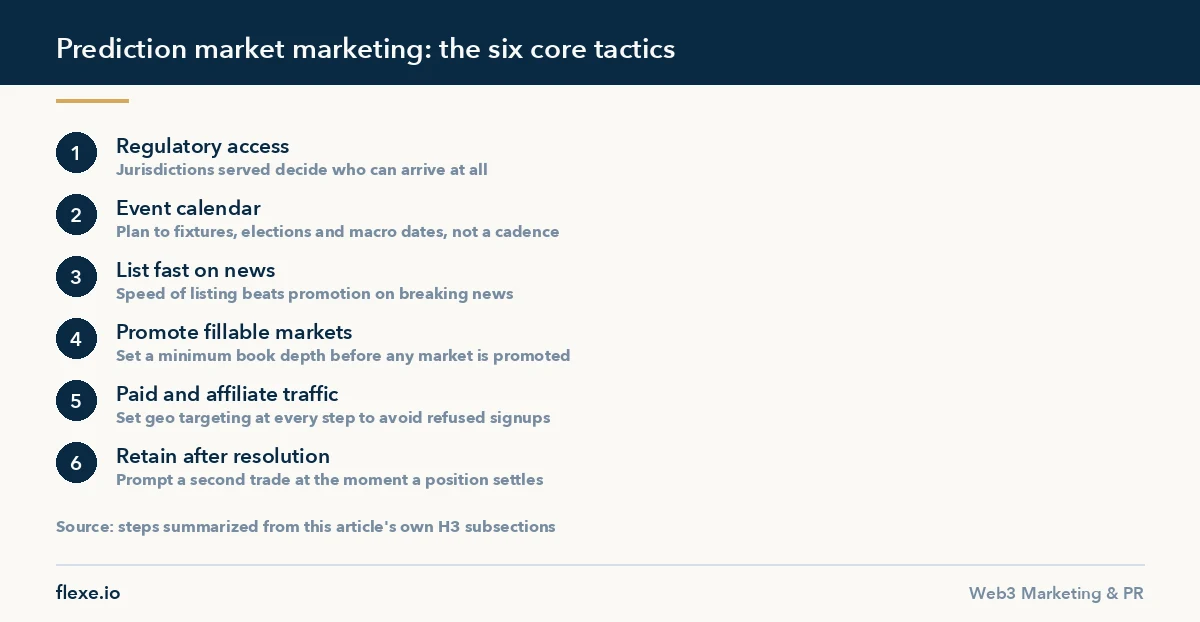
Each tactic below comes from what moved volume and share in 2025 and 2026. They work in order: access decides who can arrive, the calendar decides when they arrive, liquidity decides whether they stay.
1. Treat regulatory access as the acquisition channel
This vertical is being defined in court while it grows. Nevada gaming regulators sued Kalshi in February 2026 and the Arizona attorney general filed in March. Both platforms publicly set out measures against insider trading on 23 March 2026. Kalshi operates under CFTC regulation; Polymarket International does not, while Polymarket US is newly CFTC-regulated for American users. None of that is legal advice, and a project in this space needs its own counsel. The marketing point is narrower: which jurisdictions you can serve is the variable that moved market share, so campaign planning starts from the access map rather than from the creative.
- Best for: platforms deciding which markets and countries to open next
- Metric to watch: share of registrations from jurisdictions you can actually serve
2. Plan campaigns to the event calendar
Start the plan with a calendar rather than a content schedule. Sports fixtures, election dates, court dates, scheduled macro releases and earnings announcements are published well ahead, and each one is a demand spike you can staff for. Everything that has to be ready at the moment of the event, the market itself, the creative and the support cover, works backwards from that date rather than from a weekly publishing rhythm. Polymarket set a single-day record of $425 million on 28 February 2026 on Iran-related markets, which is an event-driven spike rather than a content-marketing outcome.
- Best for: sports and political markets, where the volume sits
- Metric to watch: volume captured in the first hours of each event
3. List fast on breaking news
Volume spikes within hours of an event, so speed of market listing beats promotion. The operational question is who can list a market at two in the morning. Decide in advance who holds that authority, what the template looks like, and which categories are pre-approved. A market listed hours after the news has already missed most of the volume the news created.
- Best for: news-driven categories such as politics and crypto
- Metric to watch: time from the news breaking to a live, funded market
4. Promote only markets you can fill
Thin books drive traders away permanently, so driving traffic to an illiquid market converts a curious visitor into someone who tried once and left, and that is more expensive than not acquiring them. Set a minimum depth that a market must hold before it can appear in any campaign, and treat that as a hard rule. Size the promotion to what the book can absorb, and coordinate with whoever provides liquidity before the campaign goes out: they need the timing, the expected volume, the category and the duration, and you need to know the size they are willing to hold through the event. Where depth is the gap, market making support is a marketing dependency.
- Budget: sized to the depth of the book, never larger
- Metric to watch: spread during the campaign, with authority to pause it
5. Run paid and affiliate traffic inside the access map
Geo targeting has to be set at the ad platform, at the landing page, at the signup flow and at the payment step, because any one of those left open produces registrations you then have to refuse. The large ad platforms apply their own restrictions to this category, which are not the same as the legal position and can change without notice. Affiliates are the fastest route to a compliance problem, because they run creative you did not write in places you did not choose. Acquisition inside those boundaries is ordinary paid and organic work: how we acquire users in restricted categories.
- Best for: scaling after the access map and creative approvals are settled
- Metric to watch: refused registrations by traffic source
6. Retain traders after the event resolves
A trader acquired on one event is not yet a user of the platform. The second trade is the conversion that matters, and it usually happens within days of the first or not at all. Build the prompt for it into the resolution moment: the settled balance, a live market in the same category, and a reason to look now rather than at the next election cycle. Notifications are the retention product in a category built on scheduled events, so collect permission at the moment a position settles and keep the frequency low enough to survive the quiet weeks between events.
- Best for: every cohort acquired on a single fixture or election
- Metric to watch: share of traders who return for a second event
What actually drives volume
| Driver | Why it works | Marketing implication |
|---|---|---|
| Scheduled events | Elections, finals and macro prints create a deadline | Plan campaigns to a calendar, not a content cadence |
| Breaking news | Volume spikes within hours of an event | Speed of market listing beats promotion |
| Regulatory access | Determines who can legally participate | Compliance work is user acquisition |
| Liquidity on the market being promoted | Thin books drive traders away permanently | Never promote a market you cannot fill |
The last row is the most common self-inflicted wound. Rotate promotion toward the markets that can take it: the categories that carry the volume are the ones with the deepest books for a reason, and campaigns built on them convert because the product works when the visitor arrives. Exotic markets can exist without being promoted.
How to plan it step by step
1. Map the jurisdictions you can serve
Start every campaign brief with the list of jurisdictions you can serve, and treat it as the first constraint rather than a compliance review at the end. Keep one landing page per jurisdiction rather than one page with conditional text, because disclosures differ and a single page trying to satisfy several regimes ends up satisfying none of them cleanly.
2. Build a shared event calendar
Build a calendar the whole team reads, with the market listing date, the campaign start, the resolution date and an owner for each event. Platforms here fail operationally more often than creatively, and most of those failures are a market listed late or a campaign running against a market that has already resolved.
3. Prepare the market and the creative before the event
The checklist is short and rarely complete: the market live and funded, resolution criteria written in language a first-time trader can read, support briefed on the likely questions, and a plan for what happens if the event is postponed. Copy, images, disclosures and the landing page for a fixture can sit ready for weeks, because the outcome is unknown but the event is not.
4. Write resolution criteria as though they will be argued about
Name the source that settles the market, the exact time, the rounding rule, and what happens when the source is unavailable or ambiguous. Every dispute in this category traces back to a sentence someone wrote quickly, and the cost is paid in refunds and in traders who do not come back.
5. Agree the liquidity standard and brief counsel
Write down what a good promoted market looks like: depth at the top of the book, a spread the target trader will cross, a resolution date far enough out to trade into, and a category support can handle. Brief counsel on campaigns before they run with the actual copy rather than a concept, and record the answer.
6. Staff the resolution window and plan the wind-down
Resolution disputes, withdrawal questions and account checks cluster in the hours after a large event, exactly when the newest traders are watching how you behave. After resolution the market page becomes a dead end, so decide what it links to and which live market inherits the traffic.
Mistakes to avoid
- Marketing the long tail. Exotic markets attract browsers; sports, politics and crypto carry about 90% of volume.
- Pointing traffic at a thin book. A visitor who sees a spread they will not cross is more expensive than one you never acquired.
- Leaving one geo gate open. Registrations you then have to refuse are worse than none.
- Unchecked affiliates. Put geographic limits and the claims policy in the agreement, approve creative before it runs, and check what is actually live.
- No written ad account record. Keep what each account may run, who it is registered to, which entity is billed and where the creative was approved; when an account is restricted, that record is the difference between an appeal and starting again.
How to measure results
Visits and signups are the figures a budget buys directly. The ones worth reporting are funded accounts, trades placed, the share of traders who return for a second event, and volume per acquired trader over a fixed window. Report them at the same interval every time, because a category this seasonal invites comparisons between windows that were never comparable.
Cohort by entry event rather than by month. The people who arrived for a final behave differently from the ones who arrived on a political market, and once the cohorts are separate, the cost per trader who traded twice becomes comparable across events. That is the number that should decide the next quarter’s calendar.
Measure deposits and withdrawals as part of the funnel, not as a finance report. The gap between signup and first funded trade is where most of the loss sits, and it is usually caused by a payment route that fails quietly for a particular country or method. It shows up as soon as the funnel is split by payment method.
Separate the platform’s growth from the event’s. A record week during a major fixture says little about whether the marketing worked; the honest read is the comparison against the previous event of the same type. Write down what would make you stop a channel before you start it, because a threshold agreed in advance is the only defence against attributing a scheduled event to whatever happened to be running that week.
Frequently Asked Questions
What is prediction market platform marketing?
Prediction market platform marketing is acquiring traders for event contracts and bringing them back for the next event. It rests on regulatory access, an event calendar, fast listing on breaking news, liquidity on every promoted market and retention after resolution. The goal is funded accounts and repeat trades, not visits or signups.
How big are prediction markets in 2026?
Combined monthly volume across Kalshi and Polymarket rose from under $5 billion in September 2025 to about $26.6 billion by July 2026. Kalshi closed May at $17.91 billion in notional volume on its ninth consecutive monthly record. The figures are platform-reported and were checked in August 2026.
Which prediction market platform leads?
Kalshi leads, with roughly 73% market share in early July 2026 against Polymarket at 27%. Kalshi closed May at $17.91 billion on its ninth consecutive monthly record, while Polymarket posted $7.08 billion, down 21% from its March peak. Kalshi operates under CFTC regulation.
What do people actually trade on prediction markets?
People mostly trade sports, politics and crypto, which together account for 91% of volume on Kalshi and 90% on Polymarket since July 2024. The breadth of available markets is not where the volume is, so campaigns should follow scheduled fixtures and political events rather than exotic markets.
Does regulation help or hurt prediction market growth?
On the evidence of 2026, regulation helped. The CFTC-regulated platform took the majority of volume, because access determines which users can participate at all. For marketing, that makes the list of jurisdictions you can serve the first constraint of every campaign brief rather than a review at the end.
Volume and market-share figures are platform-reported and were checked in August 2026.