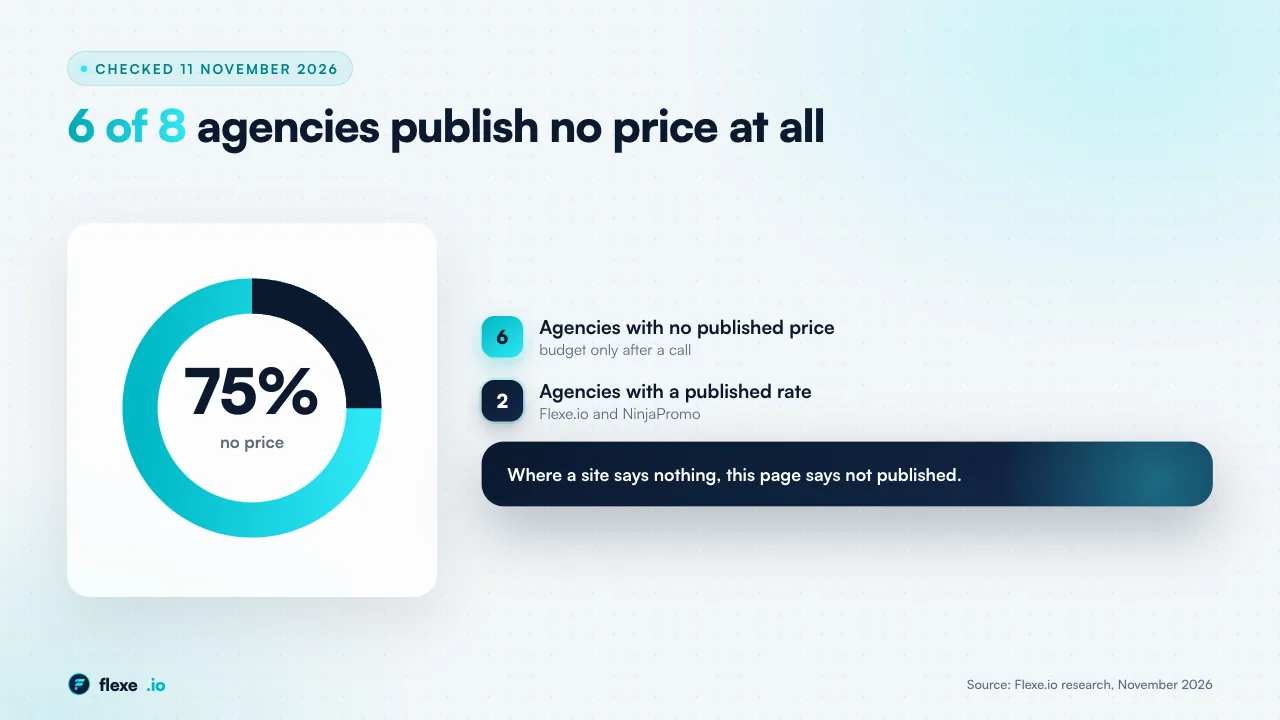
The GameFi marketing agencies worth a call in 2026 are Flexe.io, Coinbound and kolhq, and only 2 of the 8 firms below publish any rate at all on their own website. Entries were checked on 11 November 2026, and where a site says nothing about a founding year, a city, a client name or a price, this page says “not published” rather than guess.
A game token is not a game. Most firms below grew up selling token launches and learned player work later, so the ranking separates what each can prove about players from what it can prove about holders.
The 8 best GameFi marketing agencies in 2026
The table holds the four facts that decide most shortlists: location, age, whether a game client is named, and whether any number appears before a call.
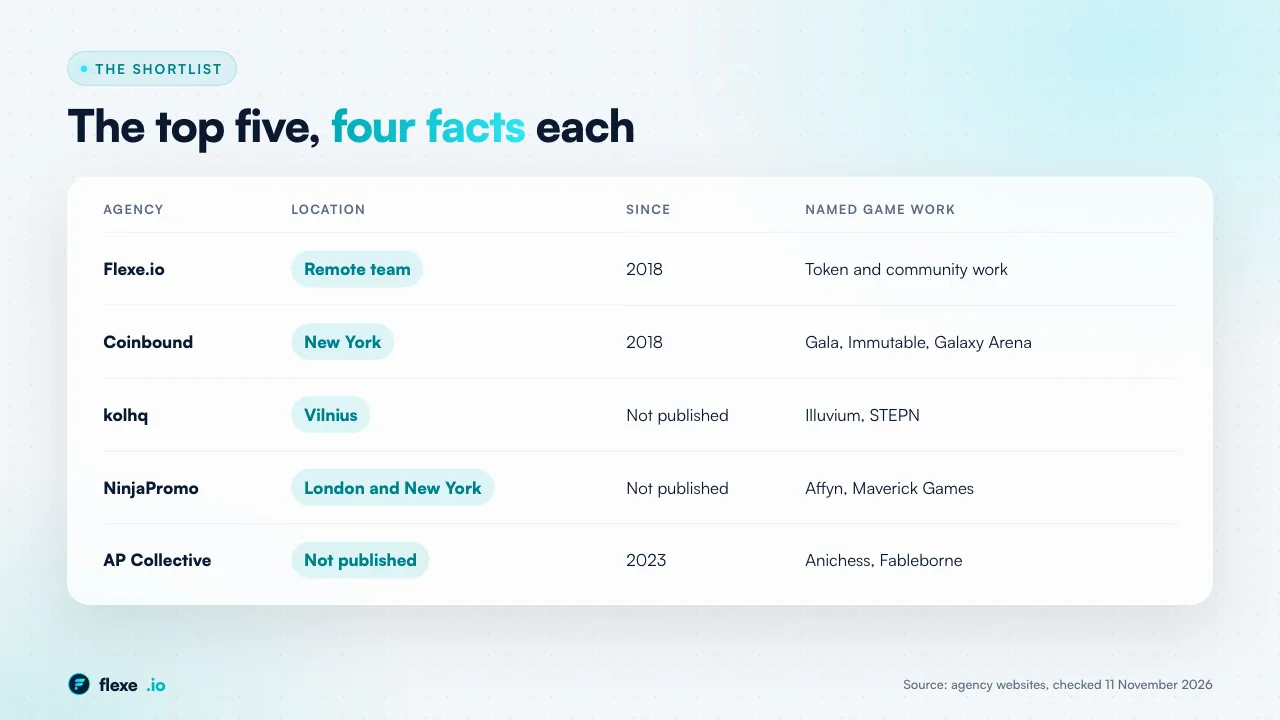
| Agency | Location | Since | Named game work | Price published |
|---|---|---|---|---|
| Flexe.io | Remote team | 2018 | Token and community work, no named game | Yes, ranges on service pages |
| Coinbound | New York | 2018 | Gala, Immutable, Galaxy Arena | No |
| kolhq | Vilnius | Not published | Illuvium, STEPN | No |
| NinjaPromo | London and New York | Not published | Affyn, Maverick Games, Microbuddies | Yes, $12,800 per month |
| AP Collective | Not published | 2023 | Anichess, Fableborne | No |
| Coinband | Kyiv | 2022 | Galaxy Arena, Degen Zoo | No |
| TokenMinds | Singapore | 2017 | None named | No |
| Crowdcreate | California | 2014 | None on the current site | No |
1. Flexe.io (remote team, since 2018)
Best for: a game needing creator distribution and a staffed Discord or Telegram under one plan.
What they publish: 800+ campaigns since 2018; a first-party KOL base of 20,000+ influencers on X and YouTube (100+ active on X, 300+ on YouTube), every one above 5,000 followers; 60+ communities managed, as stated on its community management page on 11 November 2026; starting prices on each service page, which move with scope. The 2026 community results, as listed in November 2026, are communities grown from 35,000 to 47,000 members, from 130,000 to 141,000 and from 40,000 to 45,000.
Watch out: none of those three 2026 results is a game, so the player retention record is thinner than the token and community one. Across a 150-campaign internal benchmark the median net ROI is 2.8x within 90 days, range 1.4x to 7.0x, with a disclosed failure rate of 12 percent, so roughly one campaign in eight does not pay back.
2. Coinbound (New York, since 2018)
Best for: a funded studio wanting one firm for influencers, PR, paid media and listings.
What they publish: founded 2018, based in New York, with a client wall naming Gala, Immutable, Galaxy Arena, Sui, MetaMask and OKX. Services include influencer marketing, earned media, PPC, Discord and Telegram community management, fractional CMO and tokenomics consulting.
Watch out: there is no dedicated GameFi service page, so gaming sits inside a general crypto offer rather than its own practice with its own numbers. Pricing is not published, only a promise that solutions are built around a client’s goals, budget and stage.
3. kolhq (Vilnius, founding year not published)
Best for: an on-chain game that wants streamers actually playing the build on camera.
What they publish: a standing GameFi sector page, an address in Vilnius, Lithuania, a network of 5,000+ vetted KOLs and 400+ campaigns. Two game cases carry figures: Illuvium, described as gaining over 6,500 new players and 24,000+ followers, and STEPN at 696,320 views with tripled NFT sales.
Watch out: no founding year is published, and the case metrics are views, followers and sales rather than day-7 or day-30 retained players. Cost depends on scope and goals, with no fixed packages shown.
4. NinjaPromo (London and New York, founding year not published)
Best for: a studio wanting a rented in-house team on a monthly subscription, not a project fee.
What they publish: 300+ specialists and offices listed in twelve cities including London, Dubai, Singapore, New York and Vilnius. A subscription rate of $12,800 per month appears in the team composition breakdown. Named gaming clients include Affyn, Maverick Games, Microbuddies, Marble Magic and Leon Bet.
Watch out: no founding year appears on the about page, and part of the named roster is betting and casino work, a different acquisition problem from retaining players in a game economy.
5. AP Collective (location not published, since 2023)
Best for: a pre-launch game needing trailer production, guild outreach and a TGE handled together.
What they publish: a dedicated Gaming and GameFi page listing token launch and TGE work, gameplay and trailer production, creator campaigns and guild growth, a claimed 5,000+ creator network, and two named game cases. Anichess, the Animoca Brands and Chess.com strategy game, had 300+ KOLs activated; Fableborne is described as a 250K-player ecosystem with $23M+ in user deposits.
Watch out: both cases report mindshare, impressions and deposits rather than day-30 players, and no location or price is published.
6. Coinband (Kyiv, since 2022)
Best for: a token sale that needs demand concentrated into one launch window.
What they publish: founded 2022, with offices listed in Kyiv, Warsaw, London, New York, Dubai and Hong Kong, and 90+ crypto, NFT and Web3 projects. Two gaming cases carry numbers: a Galaxy Arena IDO described as selling out in five minutes, and a Degen Zoo IDO with 115,000 connected wallets.
Watch out: both gaming cases are sale events, not player economies, and the claim of over 100,000 new token holders per month is an aggregate with no method behind it. Budgets follow a free consultation, so no rate is visible up front.
7. TokenMinds (Singapore, since 2017)
Best for: a team wanting the game built and marketed by one vendor.
What they publish: Web3 game development listed alongside crypto marketing, user acquisition and brand reputation work, with references to onPlanet, Arthur Capital and Love.io.
Watch out: in September the site gave two founding years, 2016 and 2017; by 11 November 2026 the about page settled on 2017 and named a Singapore office. No game title or price is published. Build-and-market under one roof also means the team that ships the product grades its own acquisition results, so insist on a separate analytics owner.
8. Crowdcreate (California, since 2014)
Best for: a studio raising a round, where investor outreach outranks daily active players.
What they publish: operating since 2014 from Southern California, with Renault and Polymarket among named clients, plus claims of $250 million raised alongside clients and 600+ projects.
Watch out: by November 2026 the homepage industry menu had dropped gaming and Web3, so confirm a gaming team still exists. The strength is investor marketing and outreach rather than retention inside a live game. No case reports player counts at day 30, and no rate card exists.
What GameFi marketing actually involves
Two audiences buy from the same page and want opposite things. Players want a game that is fun before it is profitable. Token holders want liquidity, listings and a chart. A campaign that pleases only the second group produces a spike in wallets and an empty server six weeks later. Paid reach can serve either audience, so buying crypto traffic for a game should be judged on retained players, not wallet spikes.
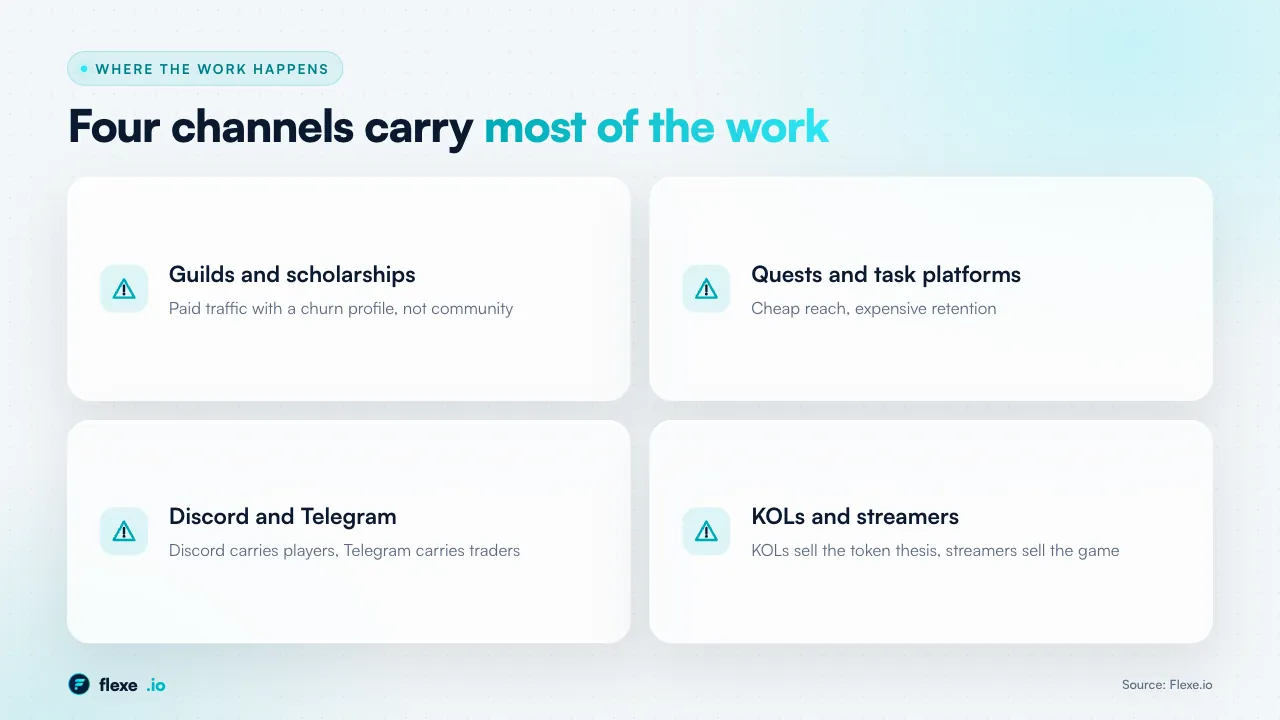
Four channels carry most of the work in 2026:
- Guilds and scholarship groups. A guild moves thousands of accounts into a game in a week and out again as fast when rewards drop. Treat guild traffic as paid traffic with a churn profile, not as community.
- Quests and task platforms. Cheap reach, expensive retention. Worth running when the quest ends inside a gameplay loop rather than at a wallet connect screen.
- Discord and Telegram. Discord carries the players, Telegram carries the traders, and most games need both staffed by different people with different tones.
- KOLs and streamers. Crypto KOLs sell the token thesis; gaming streamers sell the game. Buying only the first is the most common budget mistake.
- Store and web funnels. Distribution rules decide the shape of your funnel more than your creative does.
That last point surprises teams. Valve’s Steamworks onboarding rules bar applications built on blockchain technology that issue or allow exchange of cryptocurrencies or NFTs. Apple’s App Store Review Guidelines state under 3.1.1 that NFT ownership must not enable features inside an app, and under 3.1.5 that crypto apps may not offer currency for completing tasks such as downloading other apps or posting to social networks. Google is more permissive but demands paperwork: its blockchain-based content policy requires a financial features declaration if an app sells or lets users earn tokenized digital assets, and forbids promoting or glamorizing potential earnings. Apple last revised its guidelines on 16 October 2026, and both crypto clauses still read the same.
So much of the work is funnel engineering under platform rules: a web build for the token economy, a store build with the earning stripped out, and creative that never promises income. Immutable, which says it is trusted by 800+ games across PC, Steam and mobile, exists largely to absorb that split. Ask any agency which build their creative is written for.
What it costs in 2026
Six of the eight firms above publish no price at all, which is the clearest finding of this check and makes budgeting a matter of pattern rather than comparison. The two exceptions frame the range: Flexe.io publishes starting prices on its service pages, which change with scope, while NinjaPromo still showed $12,800 per month in its team composition material on 11 November 2026.
Those published figures bracket what a game should expect. A single test, one creator flight or one quest campaign, sits in the low four figures. A staffed Discord and Telegram month runs from low four figures to roughly $13,000 depending on coverage hours and languages. A full launch is a five or six figure commitment per quarter.
Two costs get left out of nearly every proposal. Creator inventory is one: gaming streamers who play a build on camera cost more per thousand views than crypto commentators who read a thesis. The second build is the other, since a store version with earning removed is engineering time, not marketing time.
How to check a GameFi agency
Five questions separate a growth partner from a reach seller. Ask them before the proposal stage, in writing.
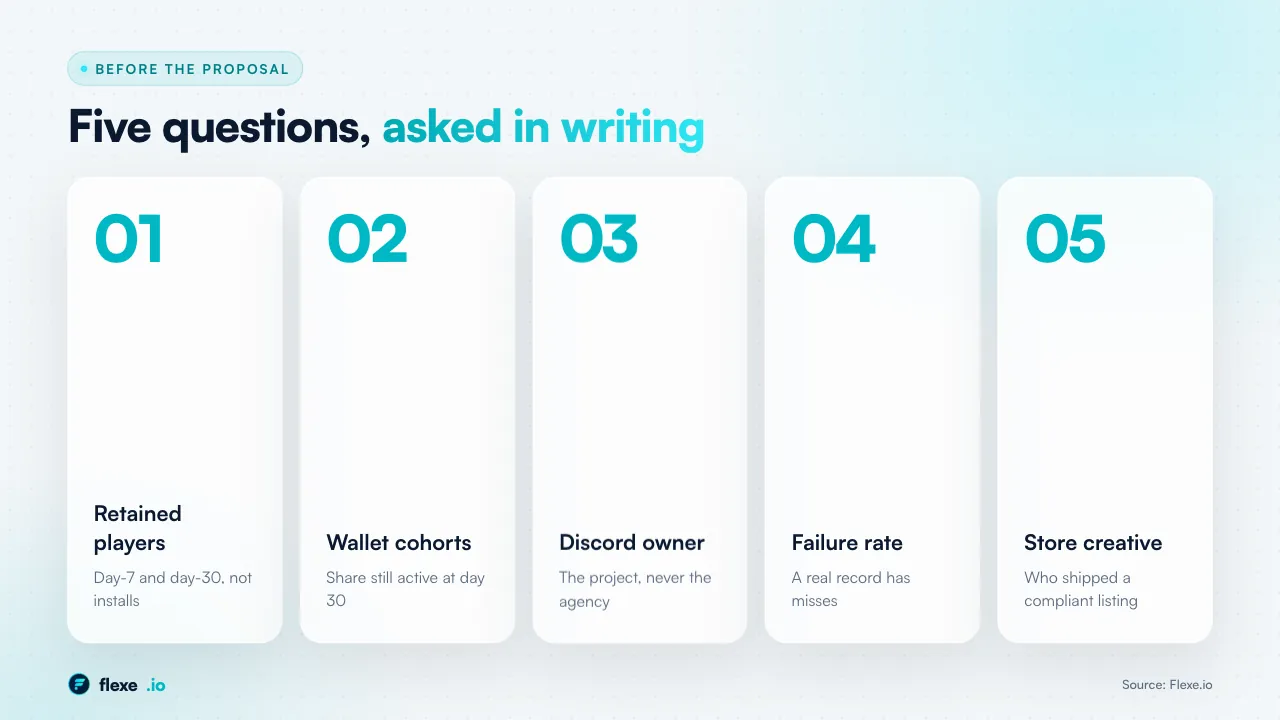
- Show retained players, not installs. Installs, wallet connects and impressions are supply metrics. Ask for day-7 and day-30 retained players on a past game, with “retained” defined in writing. If the answer is a views number, the firm sells reach.
- Ask for wallet cohorts at day 30. Split the wallets a campaign brought in by arrival week, then show what share still transacted in-game thirty days later. Healthy campaigns lose most of a cohort and keep a visible core. No surviving core means speculators.
- Establish who owns the Discord. If agency staff hold the owner role, your community is a rented asset that leaves with the contract. Ownership stays with the project, agency staff get moderator roles, and the handover goes into the agreement on day one.
- Get the failure rate. Any firm with a real record has campaigns that did not work. Flexe.io publishes 12 percent across 150 campaigns. A firm that claims none is either new or editing.
- Check who writes the store creative. Ask which staffer has shipped a compliant store listing for a token-linked game before.
How this ranking was built
Candidates came from live search results for GameFi marketing agencies, then each site was opened directly on 20 September 2026 and again on 11 November 2026, except Coinband, whose site refused automated access. Nothing came from a directory, a roundup or a press release. A firm qualified only if its own website sells Web3 gaming or GameFi marketing, on a dedicated page or as a named line item.
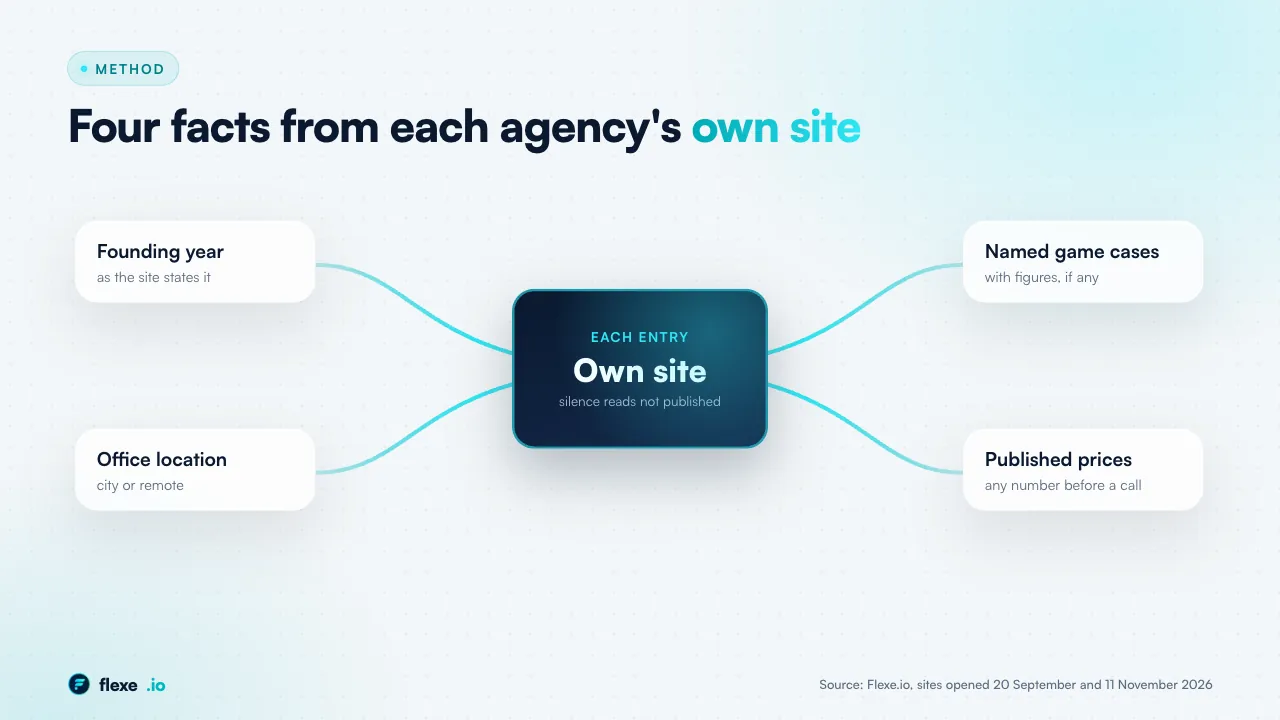
Each entry records four things: founding year, office location, named game clients or cases with figures, and published prices. Where a site was silent, the entry reads “not published” rather than borrowing a number from a third-party profile. Several well-known crypto firms were dropped because their sites show no gaming work.
Flexe.io is placed first under a standing editorial rule: this is our own publication, and we say so rather than pretend the order is neutral. Its figures are disclosed in full above, including the 12 percent failure rate. Ordering below position one follows how much of a firm’s gaming claim survives a visit to its site.
Related reading: Web3 gaming marketing tactics, crypto quest platforms for player onboarding, blockchain gaming affiliate programs, and the two services GameFi teams buy first, crypto KOL agencies and managed crypto community management.
What GameFi marketing agencies deliver at each launch stage
Whichever firm you shortlist, ask for the plan in this shape: what they do at each stage of the game’s life, and which number they accept as proof. An agency that quotes one KPI for the whole year is selling the token, not the game.
| Stage | Services that matter | Number to hold the agency to |
|---|---|---|
| Pre-alpha and waitlist | Positioning for players and holders separately, landing page, Discord built and staffed before traffic | Waitlist sign-ups with a working email or wallet, not follower count |
| Closed beta and playtests | Gaming streamers and YouTube creators, guild trials, bug and feedback channels | Playtest completion and day 7 return of testers |
| Token generation event | Crypto KOLs, PR in crypto media, exchange listing support, Telegram for traders | Unique holders after 30 days, not day-one volume |
| Public launch | Paid user acquisition where the store allows it, quests that end inside gameplay, creator content | Cost per retained player at day 30 |
| Live operations | Season events, community management, tournament and creator programmes | Monthly active players and server activity, month on month |
At Flexe.io we plan creator work for games from the YouTube side first, where our active roster is 300+ creators, and add crypto KOLs on X only around the token event.
How to choose a GameFi marketing agency in 2026
Choose a GameFi marketing agency by matching it to your launch stage first and to its reach second. Of the 8 firms above, 5 name a game client on their own site and only 2 publish any price, so most of the comparison has to happen in writing. Run these checks on every name you keep.
- Stage fit. The firm shows work for your current stage in the table above, from waitlist to public launch.
- Named game work. A game client and a result appear on the agency’s own site, not only in a sales deck.
- Creator mix. Gaming streamers and YouTube creators for players, crypto KOLs on X only around the token event.
- Ownership. Your team holds the owner role on Discord, X and ad accounts from the first day.
- Reporting. The monthly report shows day-30 retained players and wallet cohorts, not views.
- Pricing in writing. A range or a starting price arrives before the proposal, since 6 of the 8 firms publish none.
Frequently Asked Questions
How much do GameFi marketing agencies charge in 2026?
Six of the eight agencies checked publish no price. The two that do set the range: Flexe.io publishes starting prices on its service pages, which change with scope, while NinjaPromo showed a $12,800 monthly subscription on 11 November 2026. A single test sits in the low four figures, and a full launch is a five or six figure quarterly commitment.
What is the difference between GameFi marketing and crypto marketing?
GameFi marketing has to win two audiences at once. Crypto marketing targets holders and traders, measured in wallets and volume. GameFi adds players, measured in retention and session time, and those players are reached through gaming streamers, guilds and store pages rather than through token commentators. Most agencies are strong on the first audience and thin on the second.
Can a blockchain game be published on Steam or the App Store?
Steam does not allow it. Valve’s Steamworks onboarding rules bar applications built on blockchain technology that issue or allow exchange of cryptocurrencies or NFTs. Apple permits crypto-linked apps under conditions: NFT ownership must not enable in-app features, and apps may not pay currency for tasks. Google Play allows tokenized assets if you file a financial features declaration and avoid promoting earnings.
What metric should I hold a GameFi agency to?
Day-30 retained wallets, split by the week they arrived. Installs, wallet connects, impressions and follower counts all measure supply, and every agency can buy them. Cohort survival at thirty days measures whether the campaign brought players or speculators. Agree the definition of retention in writing before the campaign starts, because it is hard to renegotiate afterwards.
Who should own the Discord server, the game or the agency?
The game, always. Agency staff should hold moderator or admin roles that can be revoked, never the owner role. If the agency owns the server, your community leaves with the contract and any handover becomes a negotiation. Write the ownership and the handover procedure into the agreement on the first day of the engagement.
Do KOL campaigns actually work for GameFi in 2026?
They work when the creator plays the build on camera. Flexe.io reports a median net ROI of 2.8x within 90 days across a 150-campaign benchmark, with a range of 1.4x to 7.0x and a 12 percent failure rate, so results vary widely. Crypto commentators reading a token thesis move wallets; gaming creators showing gameplay move players.
What services do GameFi marketing agencies provide?
Most offer strategy, influencer and streamer campaigns, Discord and Telegram community management, crypto PR, paid acquisition and token launch support. What differs is the order: a good plan builds the community and player testing before the token event and moves budget to retention after launch. Ask each agency which stage its past clients were in when results were measured.