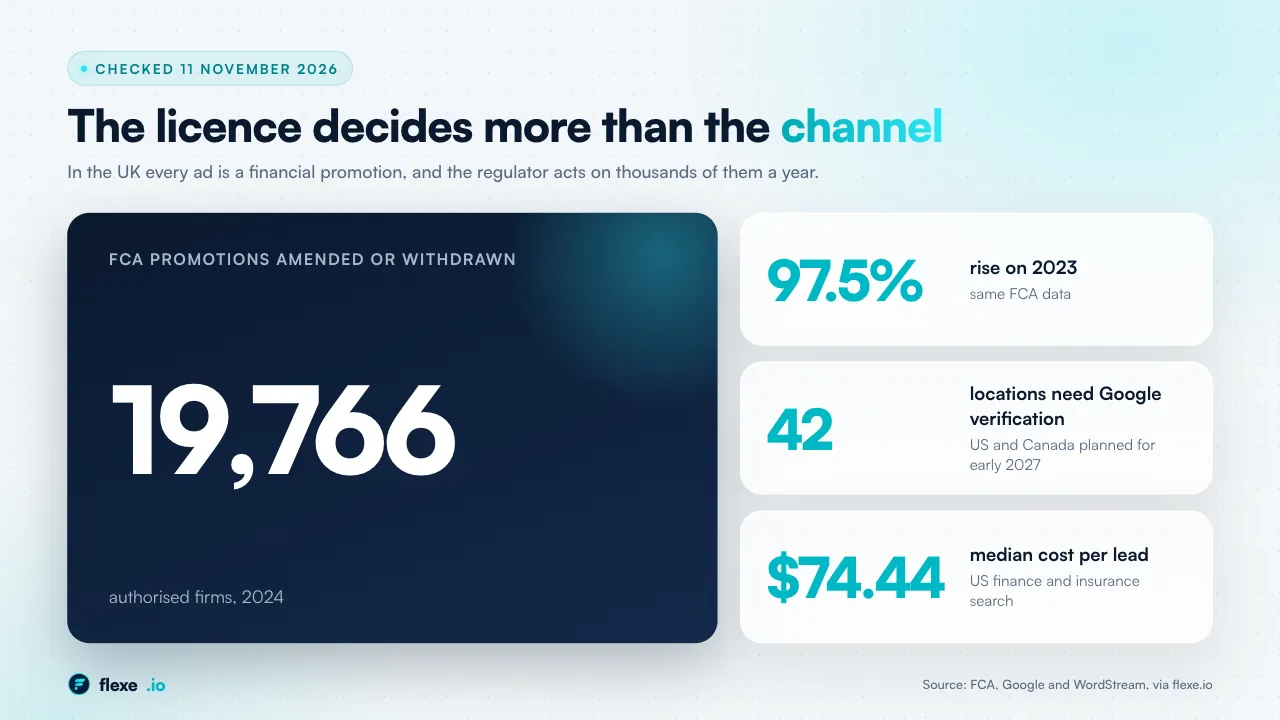
Fintech advertising in 2026 runs on Google, Meta, LinkedIn, TikTok and out-of-home, but the licence you hold decides more than the channel. Checked on 11 November 2026: Google asks for financial services verification in 42 locations, and in the UK every ad counts as a financial promotion. Product type and target market set what each platform will accept.
Platform policies, regulator texts and campaign results come from the sources named in each section.
– Google allows personal loan ads only for loans repaid in 61 days or longer, and bans US loan ads at 36% APR or above.
– Google added 24 EEA countries to its verification list on 23 June 2026, enforced from 23 July and 15 September 2026.
– Google said on 20 October 2026 that financial services verification reaches the US and Canada in early 2027; more than 97% of ads seen there already come from identity-verified advertisers.
– From 21 October 2026, Google accepts UAE crypto exchange and wallet ads only from firms licensed by the CMA, DFSA, FSRA or VARA.
– Meta has required its “Financial products and services” ad category for US campaigns since January 2025, removing age, gender, postcode and lookalike targeting.
– The FCA had 19,766 promotions by authorised firms amended or withdrawn in 2024, up 97.5% on 2023.
– Finance and insurance search ads cost a median $3.39 per click and $74.44 per lead in the US, across 13,474 campaigns.
Where fintech brands can advertise in 2026
Every major channel accepts fintech ads, but each attaches its own proof of licence, targeting limit or product ban. The table sets out what we found on each platform’s own policy page and the cost signal with its source. X is missing because its financial services policy page sat behind a bot check on the day we looked.
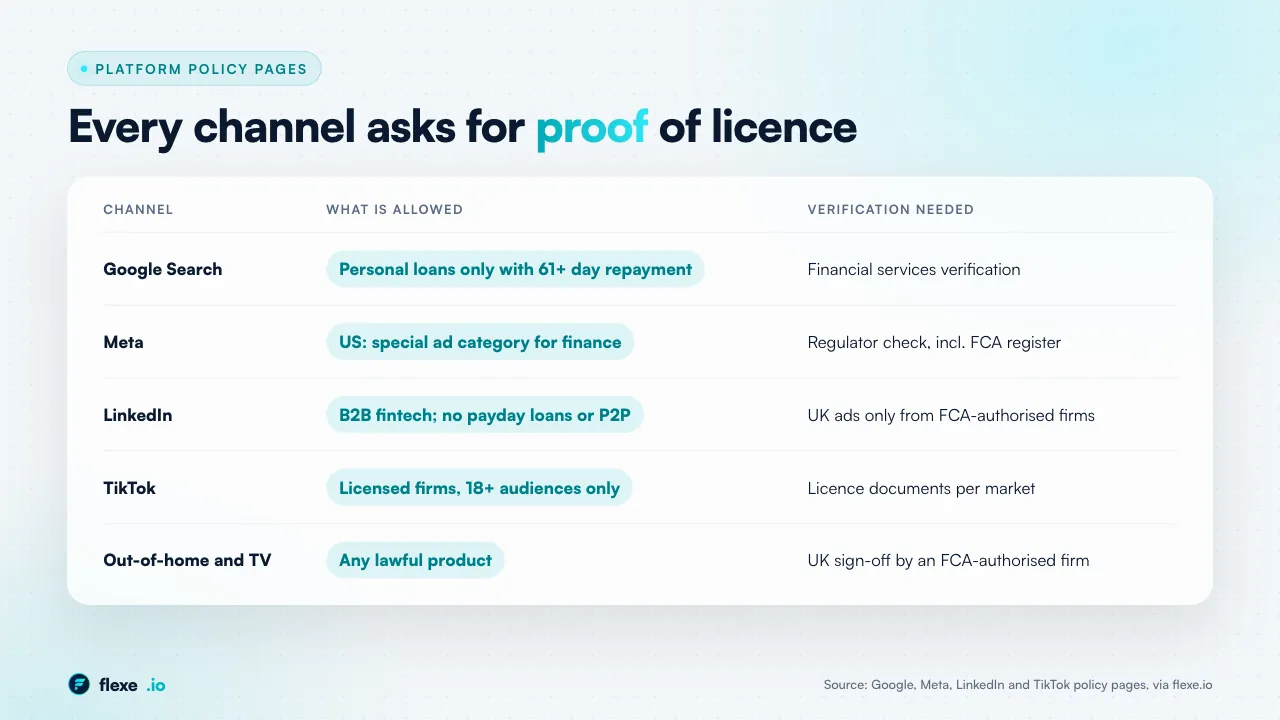
| Channel | What is allowed | Verification needed | Cost signal, with source |
|---|---|---|---|
| Google Search | Banking, payments, cards, investments; personal loans only with 61+ day repayment; crypto only with certification | Financial services verification in 42 locations, US and Canada planned for early 2027; crypto certification per country | $3.39 CPC, $74.44 per lead, 2.64% conversion (WordStream 2026, 13,474 US campaigns, Apr 2025 to Mar 2026) |
| Meta (Facebook, Instagram) | Financial products and services in a special ad category in the US; crypto with written permission | Regulator verification in listed regions, including the UK FCA register | Finance traffic CTR 1.46%, the lowest of all industries (WordStream Facebook 2026, 1,892 US campaigns) |
| B2B fintech, banking and payments; no payday loans, P2P lending or binary options | UK financial ads only from FCA-authorised advertisers; crypto only to finance professionals in 7 countries | No official benchmark; one buyer reported about $80 CPM targeting fintech directors (Reddit, May 2026) | |
| TikTok | Financial services from licensed firms, 18+ audiences only | Licence documents per market | Self-reported UK investing app test: 0.78 GBP CPM, 2.30 GBP per iOS install on about 150 GBP spend (Reddit, July 2025) |
| Out-of-home and TV | Any lawful product; UK copy still a financial promotion | Sign-off by an FCA-authorised firm in the UK | No public benchmark; priced per media plan |
Google is the channel with the most moving parts, so we keep its verification steps and campaign structure in a separate guide on Google Ads for fintech. The financial products and services policy and the verification country list are the two pages to bookmark, because both changed in 2026. A notice posted on 28 September 2026 tied complex speculative products in Chile and Denmark to local regulators, and since 7 October 2026 prediction market ads are banned in Connecticut.
LinkedIn is the narrowest consumer channel and the widest B2B one. Its financial services rules accept UK financial ads only from FCA-authorised advertisers, and its crypto rules limit exchange and wallet ads to finance professionals in the US, UK, Switzerland, Germany, France, the Netherlands and the UAE. A payments API selling to banks loses nothing there; a retail crypto app loses its whole audience.
Running a fintech or payments brand: before the first campaign, check which channels accept your licence in each market. Flexe.io runs Google Ads for fintech with verification and compliance review built into the plan.
Rules that decide whether a fintech ad runs
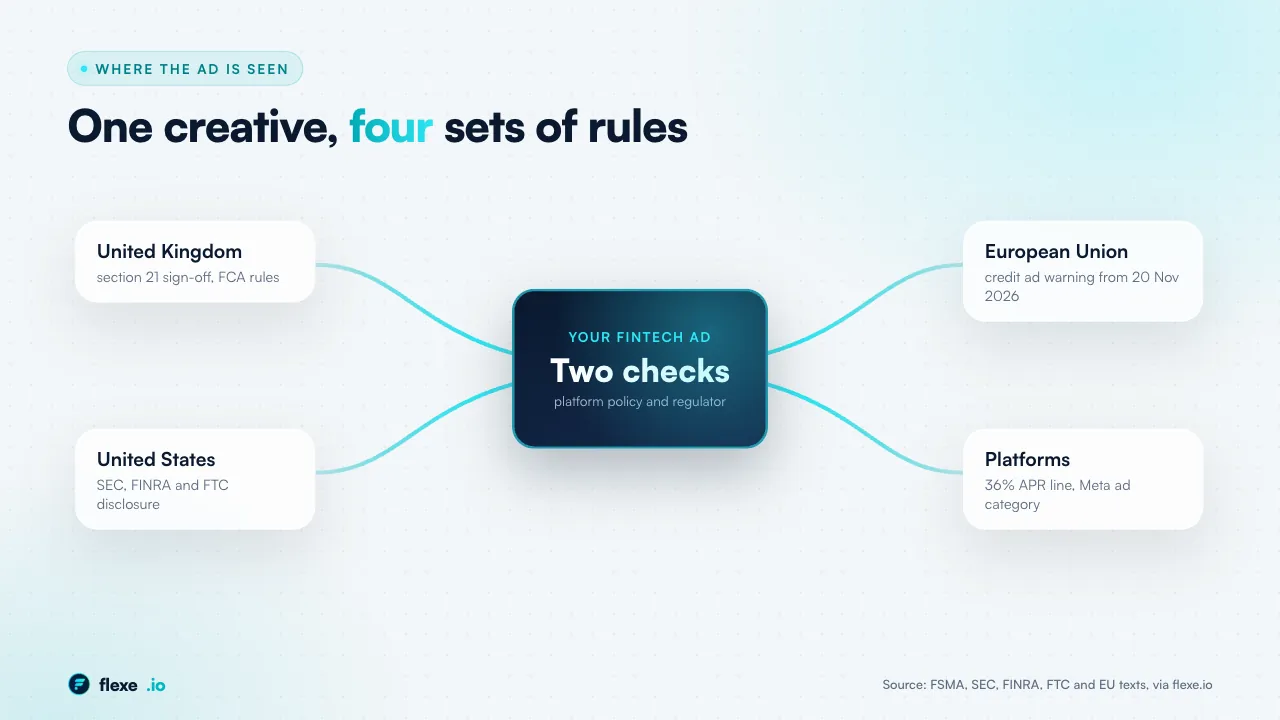
The market where the ad is seen sets the rule, not the market where the company is registered. The same creative can be legal in Texas, need a section 21 sign-off in London and carry a mandatory warning in Paris. We plan copy for the strictest market a campaign touches first, then relax it.
United Kingdom: section 21 and the FCA
Under section 21 of the Financial Services and Markets Act 2000, only an authorised firm may communicate or approve a financial promotion. The FCA’s 2024 financial promotions data shows the cost of getting it wrong: 19,766 promotions amended or withdrawn after FCA intervention. Crypto promotions have followed PS23/6 since 8 October 2023, which pushes many crypto brands to specialist ad networks, and FG24/1 extends the rules to finfluencers.
United States: SEC, FINRA, FTC and platform rules
US rules depend on who advertises. Investment advisers fall under the SEC Marketing Rule, 206(4)-1, which governs testimonials and performance claims. Broker-dealers follow FINRA Rule 2210 on communications with the public. Paid creators must disclose under the FTC Endorsement Guides, revised in July 2023. Platform rules add the 36% APR line on Google and Meta’s special ad category.
European Union: credit ads change on 20 November 2026
From 20 November 2026, the revised Consumer Credit Directive (EU) 2023/2225 requires every credit ad to carry a warning that borrowing money costs money, plus a representative example of rates and totals. Ads suggesting credit improves a consumer’s finances are banned outright. Buy now, pay later brands in the EU will need new copy for every channel at once.
What enforcement looks like in practice
The inconvenient fact is that an approved ad can still be banned later. On 28 January 2026 the ASA ruled against Coinbase’s UK video and poster campaign after 35 complaints, finding it trivialised crypto risk; the ruling ordered the ads not to appear again. In April 2026 the FCA found 1,267 illegal financial ads reaching at least 2,338,372 UK accounts.
What fintech advertising costs, with samples
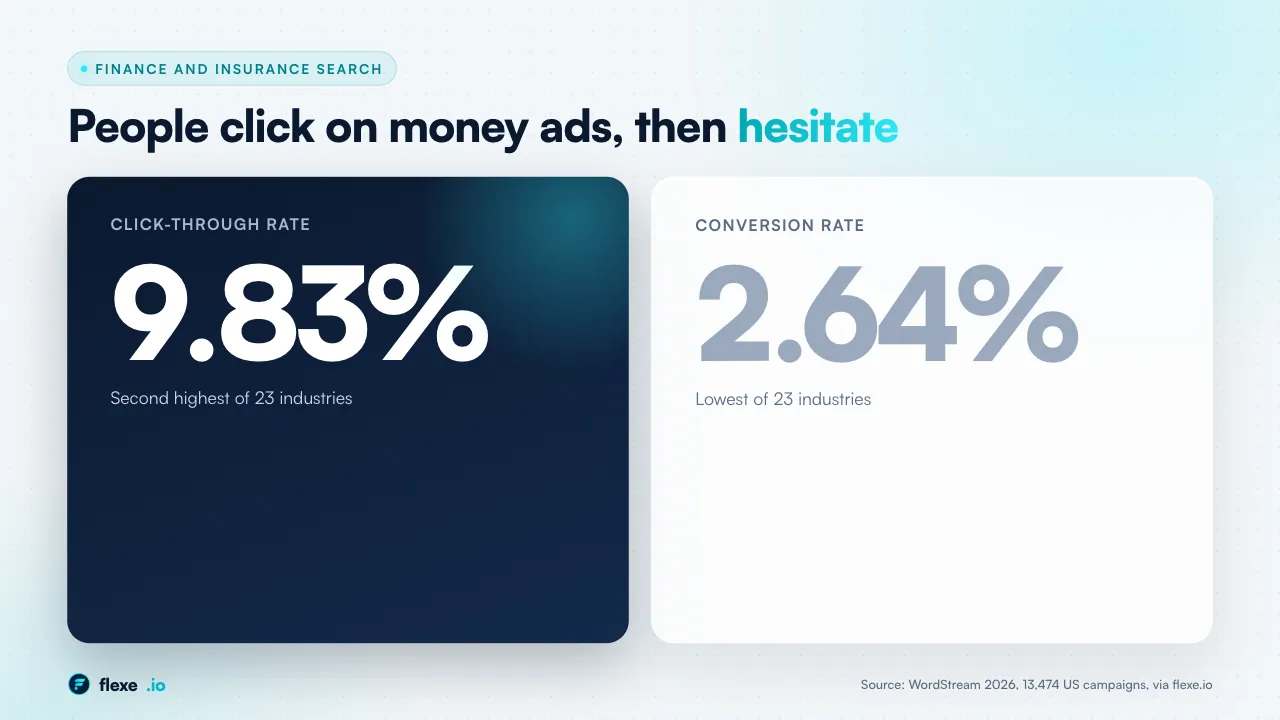
The most reliable public cost data for fintech is search data, because WordStream publishes its sample. Its 2026 report covers 13,474 LocaliQ customer campaigns from April 2025 to March 2026: finance and insurance has the second highest click-through rate of 23 industries at 9.83%, and the lowest conversion rate at 2.64%. People click on money ads readily and sign up reluctantly.
Be careful with the customer acquisition cost figures that circulate. Google’s AI answer for “fintech ads” quotes an average CAC of $202, citing a vendor blog. That number traces back to an SEO agency’s report that says its benchmarks are “sourced from clients we’ve worked with over the past 8 years”, with no sample size, first published in June 2024 and retitled for 2026.
Self-reported numbers from practitioners are smaller and messier, but at least they are dated. On r/PPC in June 2025, a B2B fintech advertiser reported Google search cost per acquisition moving from about $19 to $11 after setting a $16 target, then back to $20 when the target dropped to $14. In that account, pushing the bid target lower made each lead more expensive, not cheaper.
Budgets depend on licence status as much as on channels; our fintech marketing strategy guide breaks down the wider marketing budget. A firm still waiting for verification pays twice: once for the ads that do not serve and again for the agency hours spent on appeals. We put verification time inside the plan, never after it.
Fintech marketing campaigns that worked, with numbers
Most lists of the best campaigns repeat the same brands without results. Revolut appeared in all 8 top-ranking campaign lists we opened on 23 October 2026, yet the numbers we could find for its campaigns sat only on agency sites and an executive’s LinkedIn post. We kept only fintech campaigns whose result we could trace to a brand, trade-press or awards source.
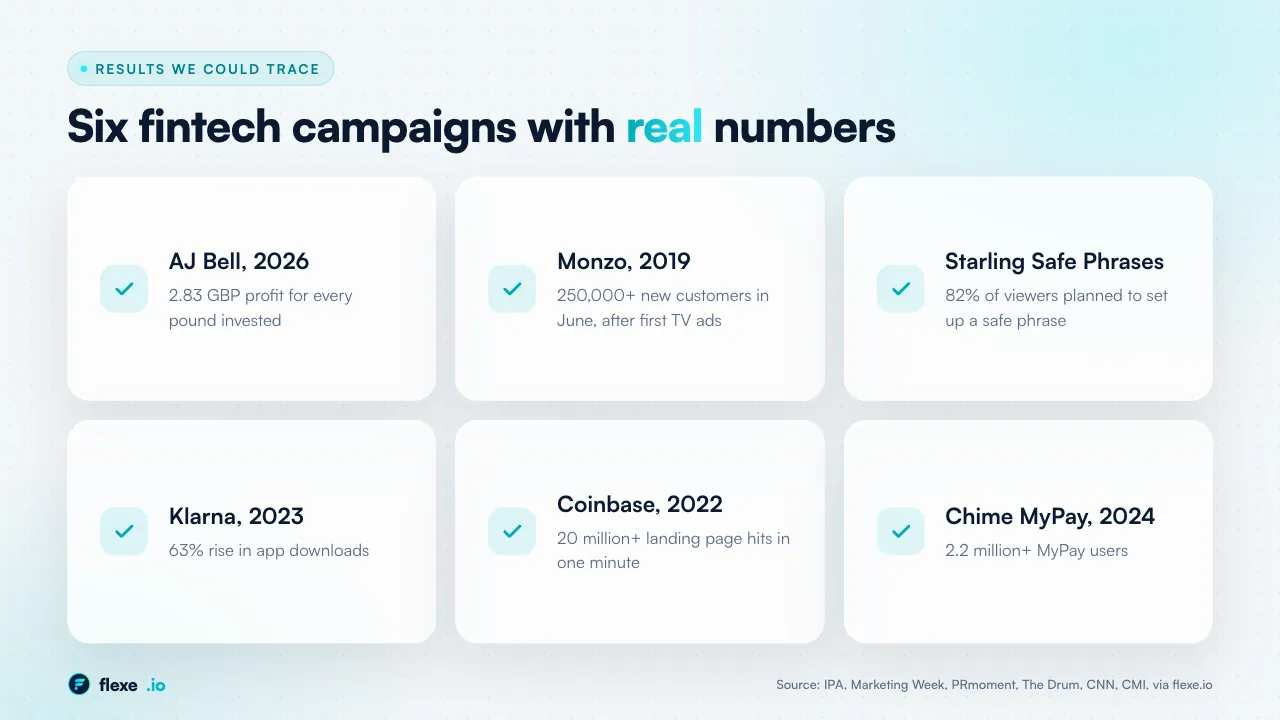
1. AJ Bell: Clear as a bell, IPA Effectiveness 2026
AJ Bell’s bell-led rebrand tripled brand awareness, grew market share and returned 2.83 GBP profit for every pound invested, according to its IPA Effectiveness Awards case. It is the strongest evidence on this list because IPA entries are judged on effectiveness evidence, not on creative alone. An investment platform won by being simple, which is the opposite of most fintech copy.
2. Monzo: first TV campaign, 2019
Monzo’s first TV and outdoor campaign in May and June 2019 brought more than 250,000 new customers in June, up from 150,000 a couple of months earlier. Prompted brand awareness rose 13 points, from 35% to 48%, its head of marketing told Marketing Week on 15 July 2019. The numbers are self-reported but specific.
Monzo’s 2026 campaign with Olivia Colman shows how brand work is measured now. YouGov’s daily tracking put Monzo’s ad awareness at 12.2 on 27 July and 17.2 on 5 October 2026, a five-point rise. YouGov itself cautioned that changes in customer scores are harder to attribute to the campaign.
3. Starling Bank: Safe Phrases, 2024
Starling’s campaign used a clone of actor James Nesbitt’s voice to warn people about AI voice-cloning fraud and ask families to agree a safe phrase. The PRmoment Awards 2025 entry, which won Silver, reports over 700 pieces of coverage and that 82% of people who saw the campaign planned to set up a safe phrase. The agency’s own case page counts 625 pieces, so treat coverage totals loosely.
4. Klarna: House of Y2K with Paris Hilton, 2023
Klarna’s Los Angeles pop-up with Paris Hilton drove a 63% rise in app downloads, according to the agency’s case study in The Drum’s awards on 27 November 2023. The campaign sold shopping, not credit, which kept the creative clear of the warnings a credit ad would need. The figure is an award entry written by the agency.
5. Coinbase: Super Bowl QR code, 2022
Coinbase’s 60-second spot showed only a bouncing QR code. CNN reported on 14 February 2022 that the landing page took more than 20 million hits in one minute, six times the brand’s previous engagement peak, and the app crashed for about an hour. Four years later, the ASA banned a different Coinbase UK campaign, which shows reach and compliance are separate tests.
6. Chime: MyPay, Get Paid When You Say, 2024
Chime is in 7 of the 8 lists we opened, usually without a result. Its MyPay campaign, about getting paid before payday, contributed to more than 2.2 million MyPay users and $106 million in incremental platform revenue in 2024, according to a Content Marketing Institute case published on 21 October 2026. No spend or attribution model was disclosed.
7. Starling Bank: Set Your Business Free, 2022
Starling’s business-banking campaign paired emotional films with concrete product benefits. Marketing Week reported 61,511 new B2B accounts, 15% growth from the fourth quarter of 2021 to the first quarter of 2022, and market share rising from 6.3% to 7.5%. Account openings sit closer to acquisition than views, which makes this the clearest B2B example here.
When to hire a fintech advertising agency
Hire a specialist agency when the bottleneck is approvals and channel mix across several markets, not creative alone. An agency earns its fee by knowing which platform will ask for which licence, how long reviews take and which copy survives a regulator. Our guide to choosing a fintech marketing agency covers the selection questions.
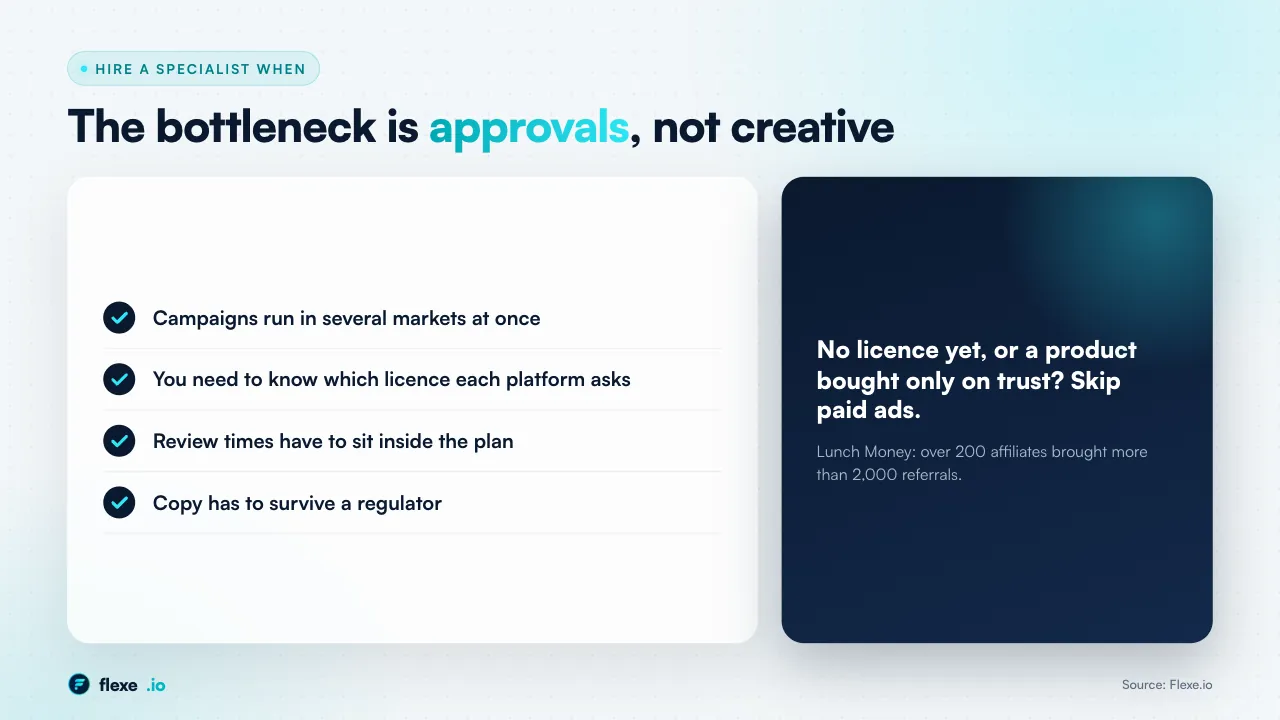
Paid ads are the wrong channel for a fintech that has no licence yet, sells a product people only buy on trust, or cannot afford a low conversion rate while it tests. Lunch Money’s founder Jen Yip wrote on LinkedIn on 9 March 2026 that she ran ads once; over 200 affiliates have since brought more than 2,000 referrals. For many early fintech campaigns, earned coverage and referrals come before paid reach.
Since 2018 we have run 800+ campaigns, and we place fintech and crypto news across 800+ crypto and finance outlets, 249 of them with Majestic Trust Flow 30+. Across 150 campaigns in our published benchmark, the median net return was 2.8x within 90 days, ranging from 1.4x to 7.0x, with a 12% failure rate.
Send your product, licence status and target markets to Flexe.io on Telegram. Within 24 hours we return a free fintech ad plan with the channels that fit your licence, the compliance checks each market needs and a budget split, before you spend anything. Our fintech marketing services page lists what we run.
How to choose fintech advertising channels in 2026
Choose fintech advertising channels in the order your licence allows, then by cost and audience. Start with the market where the ad will be seen, list the platforms that accept your product and verification there, and test one channel with a fixed budget before adding the next, because each platform checks licences on its own timeline.
- Licence fit: the platform accepts your product type and your regulator in each target market.
- Verification time: how long financial services verification takes before the first ad can run.
- Audience: consumers on Meta or TikTok, finance professionals and B2B buyers on LinkedIn.
- Targeting limits: in the US, Meta places financial products in a special ad category.
- Cost signal with a stated sample, such as WordStream search data, not an average with no source.
- Copy approval: in the UK, sign-off by an FCA-authorised firm before launch.
Frequently Asked Questions
Can fintech companies run Google ads?
Yes, if the product and market allow it. In 42 locations, including the UK and most of the EEA, Google first requires financial services verification against a local regulator licence. On 20 October 2026 Google set early 2027 for the US and Canada, where US banks will be checked against the American Bankers Association registry. Crypto needs separate certification.
What does fintech advertising cost?
In US search, finance and insurance ads cost a median $3.39 per click and $74.44 per lead, from 13,474 campaigns measured between April 2025 and March 2026. Social costs vary more: WordStream found finance has the lowest click-through rate on Facebook traffic campaigns. Add compliance review and verification time to any media budget.
Which channel has the lowest CAC for fintech?
No public dataset answers this with a disclosed sample. Widely quoted CAC tables come from agencies’ own client data without sample sizes. In the founder posts we reviewed, consumer fintechs credit referrals and affiliates more often than paid ads, while B2B fintechs report results from search and LinkedIn. Measure conversion past the first signup before comparing.
Do fintech ads need FCA approval?
Not from the FCA itself, but in the UK every financial promotion must be communicated or approved by an FCA-authorised firm under section 21 of FSMA 2000. Unauthorised firms need an authorised approver with permission to sign off promotions. Meta and Google also check the FCA register before serving financial ads to UK users.
What do the best fintech marketing campaigns have in common?
Of the seven we verified, the best fintech marketing campaigns share three traits: one plain message, a product that is easy to try that day, and copy that stayed clear of regulated claims. AJ Bell sold simplicity, Monzo sold a card, Chime sold an earlier payday. None of the campaigns we verified led with interest rates or returns.
Can a fintech target audiences on Meta in the US?
Yes, but within the “Financial products and services” special ad category, required for US campaigns since January 2025. It blocks targeting by age, gender and postcode, and removes lookalike audiences, so first-party customer lists and creative do more of the work. Ads that skip the category are rejected.