Key Takeaways
- Google Ads fintech solutions: the highest click-through rate of any Google Ads vertical and almost the lowest conversion rate. Clicks are not the problem; what happens after the click is.
- Finance and insurance advertisers pay about $3.39 a click and $74 a lead, against all-industry averages of $5.42 and $66.69.
- Verification is no longer optional in most markets. Google expanded it to 14 more jurisdictions in April 2026 and to 24 European Economic Area markets in June, with rolling enforcement from 23 July 2026.
- Crypto, consumer loans and buy-now-pay-later each carry extra requirements on top of the base verification.
- Miss the 30-day verification window and your financial services ads are restricted until you finish it.
Clear verification first, then design for clicks that convert reluctantly
Running Google Ads for a fintech product in 2026 means clearing verification before you can spend anything, then designing for a vertical where people click readily and convert reluctantly. Budget around $3.39 a click and $74 a qualified lead as a starting benchmark, expect a conversion rate near 2.6%, and assume four to six weeks between starting verification and having ads live if your entity paperwork is not already in order.
What Changed in 2026: Financial Services Verification
Google has been tightening who may advertise financial products for several years, and 2026 is the year the net closed over most of Europe. Two expansions matter.
| When | What happened | Who it hits |
|---|---|---|
| April 2026 | Verification extended to 14 further jurisdictions; KYC documentation standards tightened; vertical-specific rules introduced | Crypto, consumer loans and buy-now-pay-later advertisers first |
| June 2026 | Requirements extended to 24 new European Economic Area markets | Any advertiser promoting financial services into the EEA |
| From 23 July 2026 | Rolling enforcement begins | Unverified accounts start seeing restrictions |
How verification actually works
Google does not assess you itself. Advertisers in scope are directed to an external compliance partner, G2 Risk Solutions, and then apply to Google under one of two statuses. First Party means you are the regulated entity advertising your own product. Authorized Advertiser means you are advertising on behalf of one, which is the route agencies and affiliates take.
In both cases you must show that the relevant financial regulator authorises you to carry out the activity you are advertising, or that you are formally exempt from needing that authorisation. There is no third option, and a company registration number is not authorisation. This is where most fintech applications stall: the product is live, the funding is raised, and nobody has the regulator correspondence to hand.
Once Google asks, the clock is 30 days. Miss it and financial services ads are restricted until verification completes, which in practice means a dead account in your highest-intent channel during whatever campaign prompted the request.
Documentation to have ready before you start
- Regulator authorisation, licence reference, or a documented exemption
- Banking relationship and payment processing evidence
- Operational metrics for the entity
- Compliance programme documents: AML, KYC, consumer protection, data protection
- Beneficial ownership and entity structure, matching the advertising account exactly
The mismatch that fails applications most often is a boring one: the entity on the ad account is not the entity holding the licence. Fix that before you submit, not after a rejection.
What do fintech Google Ads cost in 2026?
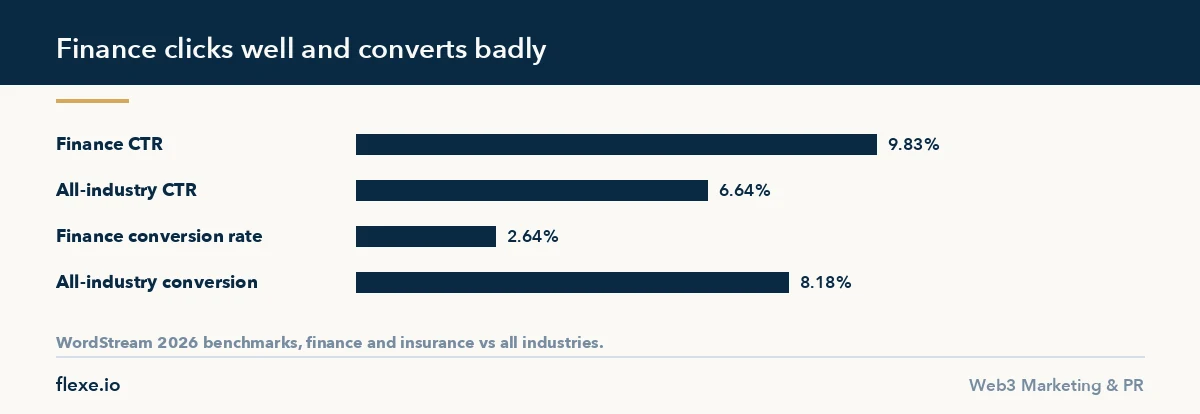
WordStream’s 2026 benchmark set puts finance and insurance in an unusual position: cheaper clicks than average, more expensive leads, and a conversion rate roughly a third of the all-industry figure.
| Metric | Finance & insurance | All industries | What it means for you |
|---|---|---|---|
| Click-through rate | 9.83% | 6.64% | Highest of any vertical – intent is strong |
| Cost per click | $3.39 | $5.42 | Cheaper than average despite the competition |
| Conversion rate | 2.64% | 8.18% | Roughly a third of the norm – the real bottleneck |
| Cost per lead | $74.44 | $66.69 | Above average, driven entirely by the conversion gap |
Other 2026 benchmark sets report finance CPC between $3.39 and $3.46 and cost per lead between $63 and $113 depending on quality score, geography and match type. Treat $3.40 and $75 as the planning midpoint and the spread as your risk range.
Why fintech clicks well and converts badly
The gap between a 9.83% click-through rate and a 2.64% conversion rate is the single most useful number in fintech paid search, and it is not an ad quality problem. Three things drive it.
People comparison-shop financial products harder than almost anything else. A click is the start of a research session across five providers, not a purchase decision. Then the conversion event itself is heavy: opening an account means identity documents, address proof and often a funding step, so the drop-off between landing page and completed signup is structural rather than fixable by copy. Finally, regulated ad copy cannot promise the things that normally lift conversion, so the ad sets a cautious expectation and the landing page has to do the persuading.
The practical consequence: optimising for cost per click in fintech is close to useless. Clicks are already cheap. Every meaningful gain is on the far side of the click, in the onboarding flow.
How do you structure a campaign that passes review?
Compliance shapes fintech account structure more than performance does. A few decisions save the most trouble.
- Separate campaigns by regulated status. Keep the licensed product and the unregulated content marketing in different campaigns so a disapproval in one does not put the other at risk.
- One market per campaign where verification differs. The EEA expansion means a single multi-country campaign can be partly restricted and partly live, which makes performance data unreadable.
- Keep disclosures in the ad, not only on the landing page. Reviewers assess the ad on its own.
- Avoid dynamic insertion in regulated copy. Automatically generated headlines are the most common source of accidental claims.
- Mirror the ad claim on the landing page verbatim. Mismatch between the two is a standard rejection reason and an easy one to avoid.
Google Ads Fintech Solutions: What a Fintech Can Actually Run
Verification decides whether you advertise at all. The campaign type decides what the budget buys, and the 6 buying surfaces inside Google Ads are not interchangeable once financial services rules apply to your account. The constraint is not creative, it is how much control each surface leaves you over where the ad appears.
- Search. Demand that already exists, and the surface every fintech starts on. It carries the click price quoted above and the tightest match between query and landing page, which is what keeps a regulated offer defensible.
- Performance Max. One campaign spanning Search, Display, YouTube, Discover, Gmail and Maps, with placement selection handed to Google. For an advertiser carrying verification obligations that is a governance problem before it is a performance one: you cannot enumerate every surface your creative will land on before it runs.
- Demand Gen. Visual placements on YouTube, Discover and Gmail, aimed at creating demand rather than capturing it. Reasonable for a consumer wallet or a neobank with a recognisable product, weak for B2B infrastructure nobody searches for by name.
- Video. YouTube inventory bought on its own. Useful for explaining a product that needs explaining, and the slowest of the surfaces to show a cost per lead you can trust.
- App. The only route for install volume, and largely automated. Creative and the store listing are the levers; placement is not.
- Display. The cheapest click on this list and the weakest lead, which is why it belongs in retargeting rather than acquisition for anything with a compliance review attached.
The practical order for a verified fintech is Search first until the cost per lead is known, then retargeting on Display, then one demand-creating surface once there is a message worth repeating. Performance Max last, and only with brand exclusions and placement reporting reviewed monthly. A fintech Google Ads solution that opens with Performance Max is selling automation, not acquisition, and the disapproval section below explains what that costs when a placement lands somewhere your legal team has not seen.
What gets fintech ads disapproved?
| Risky | Safer alternative |
|---|---|
| Guaranteed or implied returns | Describe the mechanism, not an outcome |
| “Instant approval”, “no credit check” | State the actual eligibility criteria |
| Comparative claims against named competitors | Comparison against a documented, cited benchmark |
| Urgency framing on credit products | Neutral availability language |
| Crypto returns or yield language | Product function and the risk disclosure alongside it |
Which verticals face extra requirements?
The April 2026 update singled out three categories for treatment beyond the base verification.
Cryptocurrency. Requirements vary by country and the licence that qualifies you in one market frequently does not travel. Plan verification market by market.
Consumer loans. Disclosure obligations attach to the ad itself, including cost-of-credit information in several jurisdictions.
Buy now, pay later. The newest category and the one where policy is still moving; assume the requirements will tighten again rather than relax.
If you are advertising a crypto product specifically, the platform rules differ enough from mainstream fintech that they deserve separate treatment – see our crypto advertising guide for that side. For choosing a partner to run any of this, our guide to fintech marketing companies covers what to check before signing.
Crypto exchanges and wallets
Crypto is the clearest example of a vertical with its own rules. Google allows ads for cryptocurrency exchanges and software wallets only from advertisers it has certified for the countries they target, and certification depends on meeting local legal requirements, such as registration with the relevant financial regulator. Some products that Google treats as higher risk can stay restricted even for certified advertisers.
Treat the crypto policy as a separate application from financial services verification. Passing one does not complete the other, and an ad account that promotes both a payments product and a crypto feature needs both approvals before launch. Build these steps into the launch plan, because ads submitted before approval are simply not served and the budget planned for launch week sits idle.
Related Services
If you would rather have this handled than run it in-house, these are the specific services involved.
Which placement is right depends on one question: do you need people who already hold a wallet, or people who do not yet know the category exists. Our crypto traffic team buys against that answer rather than against a rate card.
Frequently Asked Questions
Can you run Google Ads for a fintech product without a licence?
Only if you can document a formal exemption from needing one for the activity you are advertising. Google’s verification asks you to show either regulator authorisation or exemption, and company registration does not substitute for either. Unregulated adjacent content, such as educational material that does not promote a financial service, sits outside the requirement.
How much should a fintech budget for Google Ads?
Work backwards from cost per lead rather than daily spend. At a $74 benchmark, thirty qualified leads a month is roughly $2,200 in media before agency fees. Because the finance conversion rate sits near 2.64%, you need close to 1,100 clicks to get those thirty leads, which at $3.39 is where the budget actually lands.
Why is our fintech click-through rate high but conversion low?
That is the vertical norm rather than a fault in your account. Finance and insurance run a 9.83% click-through rate against a 2.64% conversion rate, because financial decisions involve comparison across providers and an onboarding process heavy with identity and funding steps. Compare your numbers to those benchmarks before rebuilding campaigns.
How long does financial services verification take?
Once Google requests it you have 30 days, and ads are restricted if you miss that window. The realistic timeline is longer than the paperwork suggests, because assembling regulator correspondence, AML and KYC documentation and beneficial ownership records across an organisation usually takes longer than the review itself.
Does verification in one country cover others?
No. Verification is tied to jurisdictions and the regulator that authorises you there. The June 2026 expansion to 24 European Economic Area markets means advertisers previously verified in one or two countries are being asked again for the rest, which is why single multi-country campaigns are now a structural liability.
Are Google Ads fintech solutions worth it compared with other channels?
They are worth it where intent already exists and you can survive verification. The high click-through rate reflects genuine demand at the moment of search, which no other channel matches for financial products. The weak conversion rate means the channel rewards companies that have already fixed onboarding and punishes those that have not, so sequence the work in that order. If search is only one part of the plan, our fintech marketing services combine it with PR, SEO and community work.
What happens to ads already running when enforcement starts?
Enforcement from 23 July 2026 is rolling rather than simultaneous, so live campaigns continue until your account is asked to verify. The restriction applies to financial services ads specifically, so accounts running a mix may see part of the account stop while the rest continues, which is worth anticipating in how campaigns are separated.
If you would rather hand the whole thing over, our fintech Google Ads service covers verification, account structure and ongoing management.
Run Compliant Fintech Campaigns With Flexe.io
We have run paid acquisition for regulated financial and crypto products since 2018, which mostly means we have seen the rejection reasons before you hit them. If verification is blocking spend or your cost per lead has drifted well past the $74 benchmark, tell us what the account looks like and we will say plainly whether it is a compliance problem or a funnel one.
Benchmark figures are from WordStream’s 2026 Google Ads benchmark set and other published 2026 industry data. Policy dates and verification requirements are from Google’s advertising policy documentation as published in 2026. Neither constitutes legal or compliance advice for a specific entity.