Checked on 10 November 2026, the best crypto community platforms in 2026 are Telegram (one billion monthly active users reported in March 2025), Discord (many parallel topics with roles and permissions), X communities (reach beyond existing members), local meetups (the most expensive and therefore most reliable filter for serious participants) and voice rooms (a category that has largely collapsed). Telegram figures are the platform’s own reports; the other assessments come from our community work and were reviewed for this November 2026 update.
What are crypto community platforms
They are where holders, users and contributors talk to the team and each other: group chats, servers, social feeds, audio rooms and meetups. Each solves a different problem, and picking the wrong one produces a community that feels permanently awkward. Telegram is a conversation, Discord is an organization chart, X is a megaphone.
The platform matters less than the publishing rhythm. Communities die from silence, not from being on the wrong app, and running four platforms badly is worse than running one properly, because a silent channel signals a dead project.
The best crypto community platforms in 2026, ranked by what they do well
1. Telegram (discussion and announcements)
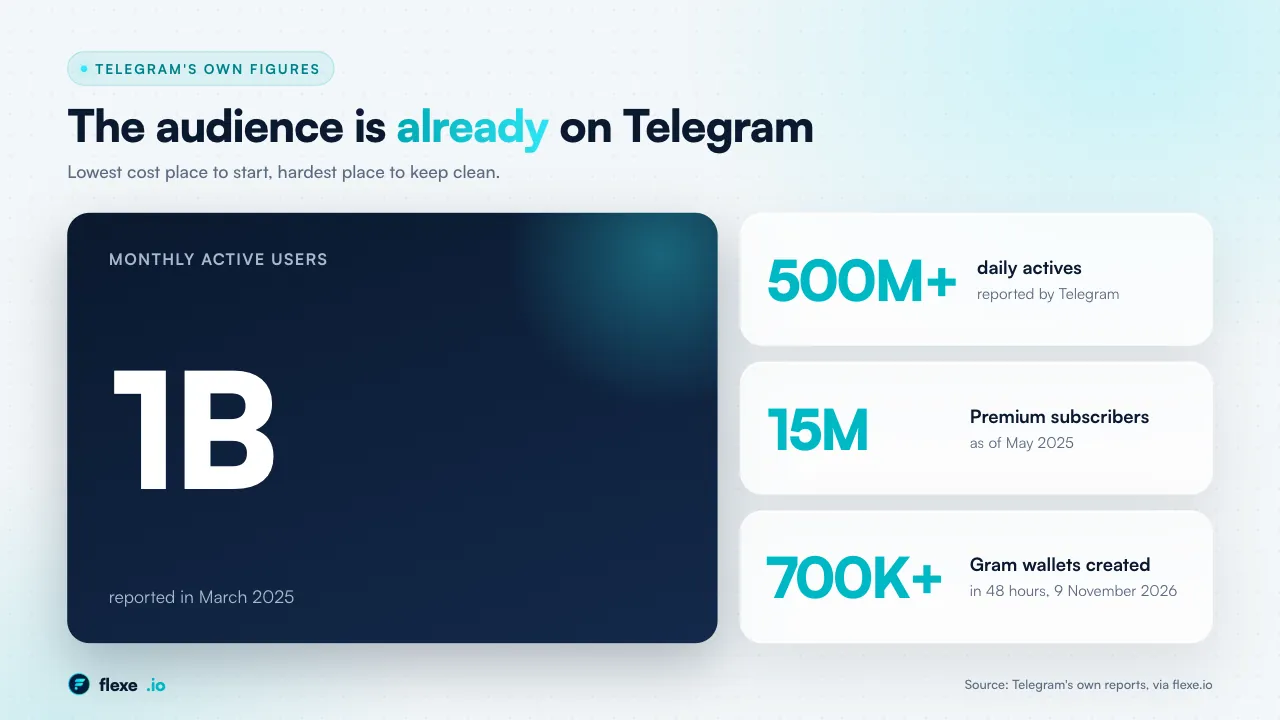
Telegram remains the default because the audience is already there and the friction to join is close to zero. The platform reported one billion monthly active users in March 2025, more than 500 million daily actives, and 15 million Premium subscribers as of May 2025. The Gram wallet built into the app reached its first users on 31 August 2026, and on 9 November 2026 Pavel Durov reported 700,000+ self-custodial wallets created in 48 hours, so members can now hold and send crypto where they chat. The same low friction that brings members brings automation, so a Telegram group is the lowest-cost place to start and the hardest place to keep clean.
- Scale: One billion monthly actives, more than 500 million daily actives
- Best for: Discussion, announcements, fast support
- Watch out: One conversation at a time, scam DMs
- Skip if: You need many parallel topics
2. Discord (structured communities)
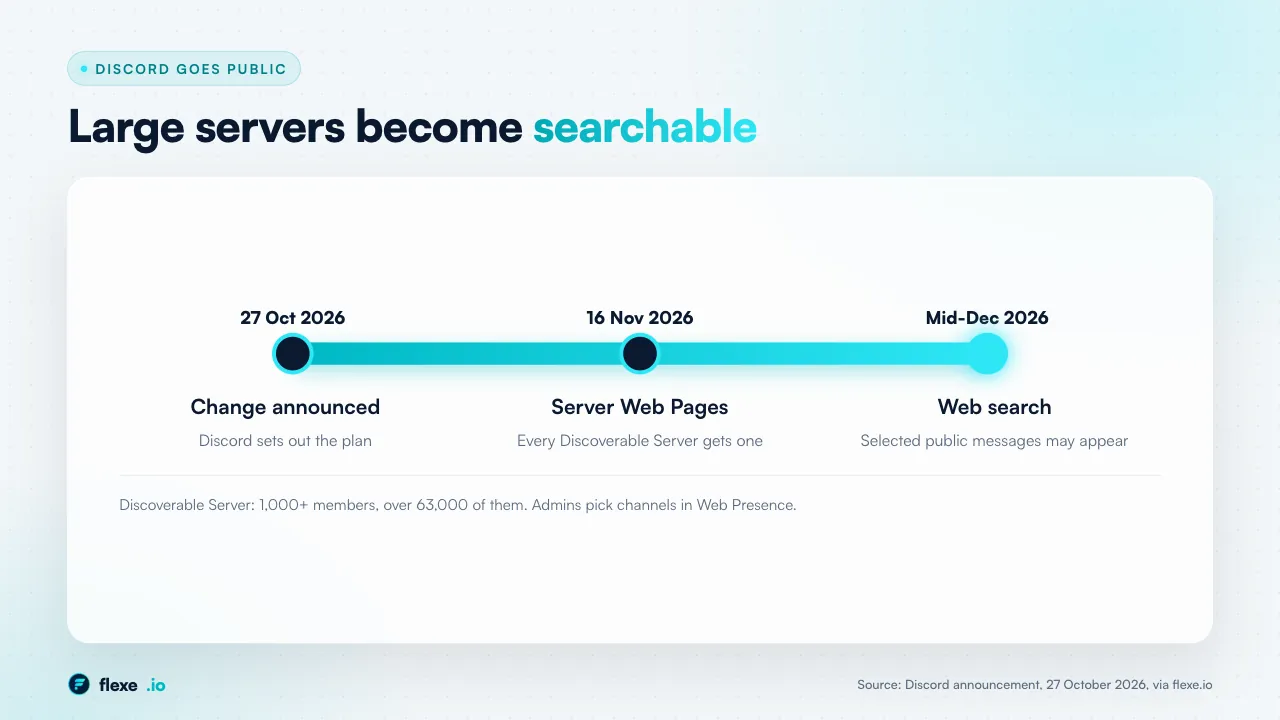
Discord wins when a community needs to hold several conversations at once without them colliding. A protocol with a governance discussion, a developer channel, a support queue and a general chat is describing a Discord server, not a Telegram group. The cost is setup and moderation: a server with fifteen channels and four roles needs someone maintaining it. Large servers also become public pages: Discord said on 27 October 2026 that from 16 November 2026 every Discoverable Server (1,000+ members, over 63,000 of them) gets a Server Web Page, and selected public messages may reach web search from mid-December. Admins choose channels in Server Settings, Web Presence.
- Best for: Roles, sub-topics, contributor structure
- Why it stands out: Parallel rooms with permissions
- Watch out: High setup and moderation burden
- Skip if: The community is under a few hundred people
3. X communities (reach)
X suits distribution to people who have not joined anything yet. It works as the channel that points people into a community, not as the community itself.
- Best for: Reach beyond existing members
- Why it stands out: Reaches people who have joined nothing
- Watch out: Shallow, algorithm-dependent
- Skip if: You need retention rather than impressions
4. Local meetups (qualifying serious participants)
Local meetups matter more than their attendance figures suggest, because physical attendance is the most expensive filter available. For a project, hosting is more valuable than attending: a small side event with thirty of the right people produces more than a booth seen by thousands.
- Best for: Qualifying serious participants
- Why it stands out: Converts far above its attendance numbers
- Watch out: Does not scale, costs organizer time
- Skip if: Your audience is geographically scattered
5. Voice rooms (mostly skip)
Live audio rooms have effectively stopped being a category. The format that drew large crypto audiences in 2021 lost them to recorded formats, because the value of a two-hour live discussion is mostly recoverable from a summary, and the cost of attending live is not.
- Best for: Almost nothing in 2026
- Watch out: Audience has left the format
- Skip if: Always, unless recorded and republished
- Workable version: Record first, treat the live audience as a bonus
Side by side:
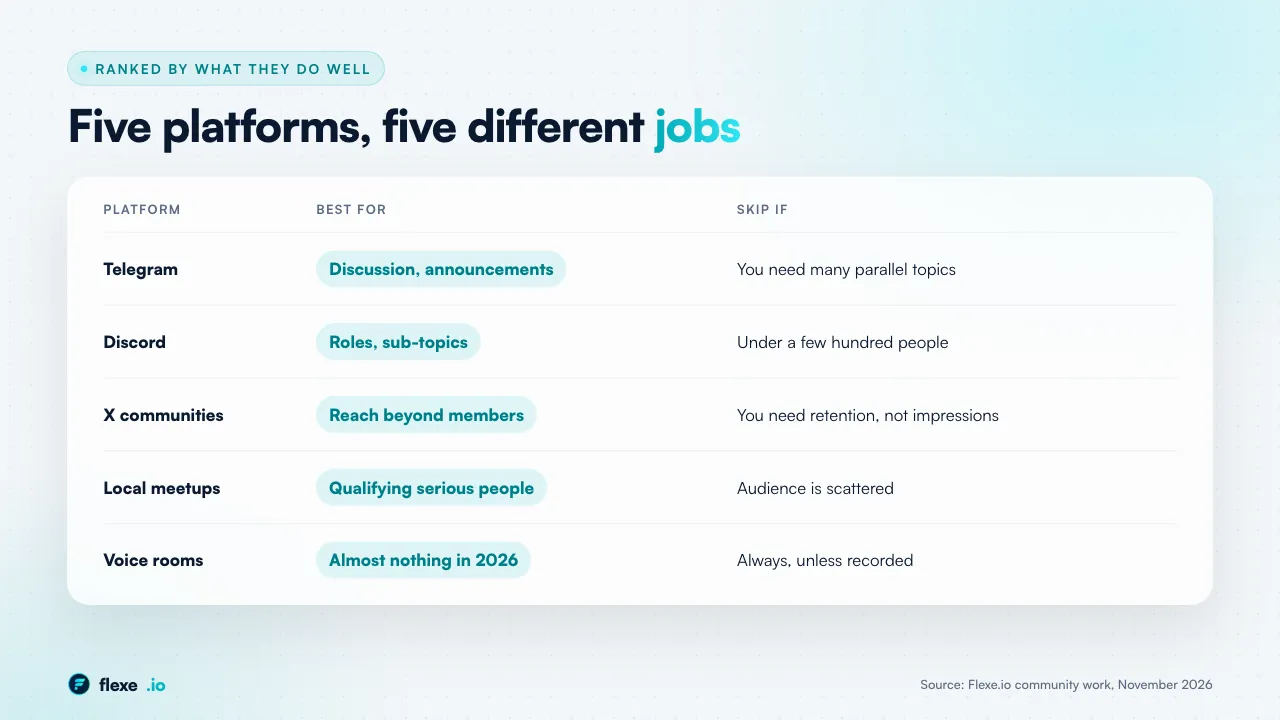
| Platform | Best for | Weakness | Skip if |
|---|---|---|---|
| Telegram | Discussion, announcements, fast support | One conversation at a time, scam DMs | You need many parallel topics |
| Discord | Roles, sub-topics, contributor structure | High setup and moderation burden | The community is under a few hundred people |
| X communities | Reach beyond existing members | Shallow, algorithm-dependent | You need retention rather than impressions |
| Voice rooms | Almost nothing in 2026 | Audience has left the format | Always, unless recorded and republished |
| Local meetups | Qualifying serious participants | Does not scale, costs organizer time | Your audience is geographically scattered |
How to choose a platform and how many to run
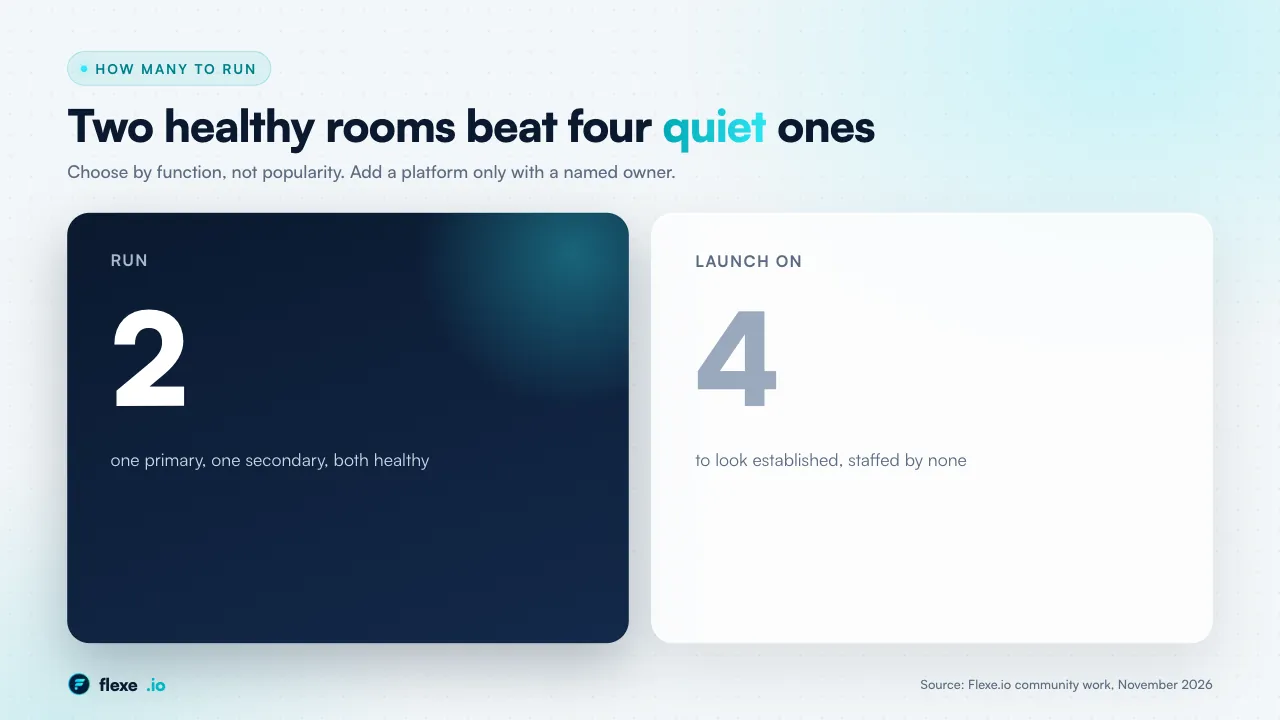
Choose by function, not by popularity. Run one primary, one secondary, and nothing else until both are healthy. Launching on four platforms to look established, and staffing none, produces four quiet rooms. A workable default is Telegram as the primary community, X as the distribution channel that points into it, and Discord added only when the number of parallel topics genuinely justifies it. Everything else should be a deliberate decision with someone’s name attached to maintaining it.
Audit the rooms before you commit
Before opening a channel, spend a week reading the rooms your audience already sits in. Count how many messages a day the active ones carry, how quickly an admin answers a question, and what share of posts come from members rather than staff. A healthy room in your niche is the only benchmark worth holding yourself to.
Write the audit down as a short brief: which platform, who owns it, what gets posted, how often, and who answers at night. If nobody’s name fits in the owner field, do not open the channel.
Set a publishing rhythm you can keep
A rhythm is a promise you can keep on a bad week, not the best week you ever had. Two posts a week that always appear beat five that stop after a month. Pick the days and formats, and build a four week queue before launch, kept where the whole team can reach it, so anybody can publish when the usual person is unavailable. Mix progress notes, questions and member recaps.
Track whether the channel is working
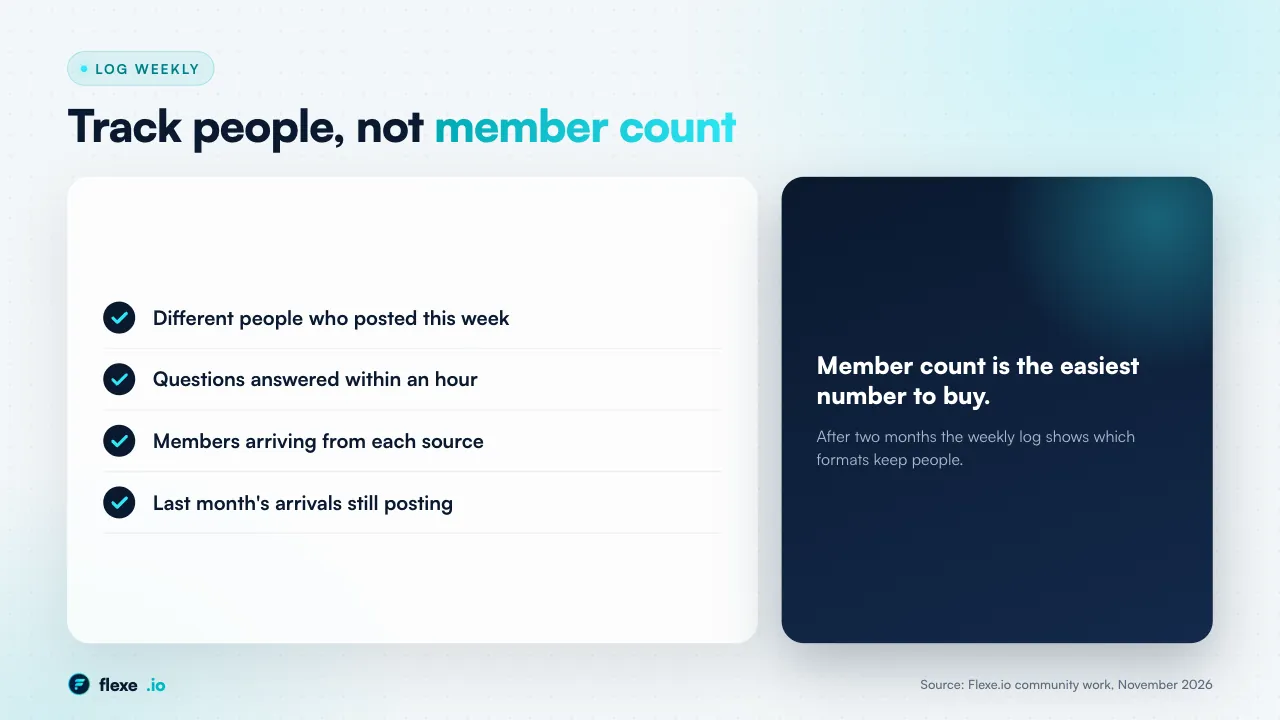
Member count is the least useful number available and the easiest to buy. Track instead how many different people posted this week, how many questions got an answer within an hour, how many members arrived from each source, and how many of last month’s arrivals are still posting. Log them weekly; after two months the sheet shows which formats keep people.
Move a community without losing it
Moving a community is a migration, not an announcement. Run both rooms for a period, cross-post everything, and keep answering in the old one until the traffic is genuinely in the new place. Pin the move and the reason, and message contributors and long-standing members personally. Close the old channel only after a week passes with nothing happening in it, and keep it read-only so old links still resolve.
Web2 social vs Web3-native crypto community platforms
Everything ranked here is a Web2 social platform or an offline format: Telegram, Discord, X communities and voice rooms are the first group, local meetups the second. Web3-native community platforms exist as a separate category, and this ranking does not assess them. The closest overlap is Telegram’s built-in Gram wallet, announced in July 2026 and rolling out since 31 August 2026.
Web2 social: Telegram vs Discord
Start on Telegram in almost every case. It costs less to set up, the audience is already there, and a small Telegram group looks active while a small Discord server looks abandoned, because the emptiness of a server is spread across visible rooms.
Add or move to Discord when parallel topics start colliding: governance, development, support and general chat fighting for one linear conversation. Then the setup burden buys roles, sub-topics and a contributor structure.
Risks and safety checks
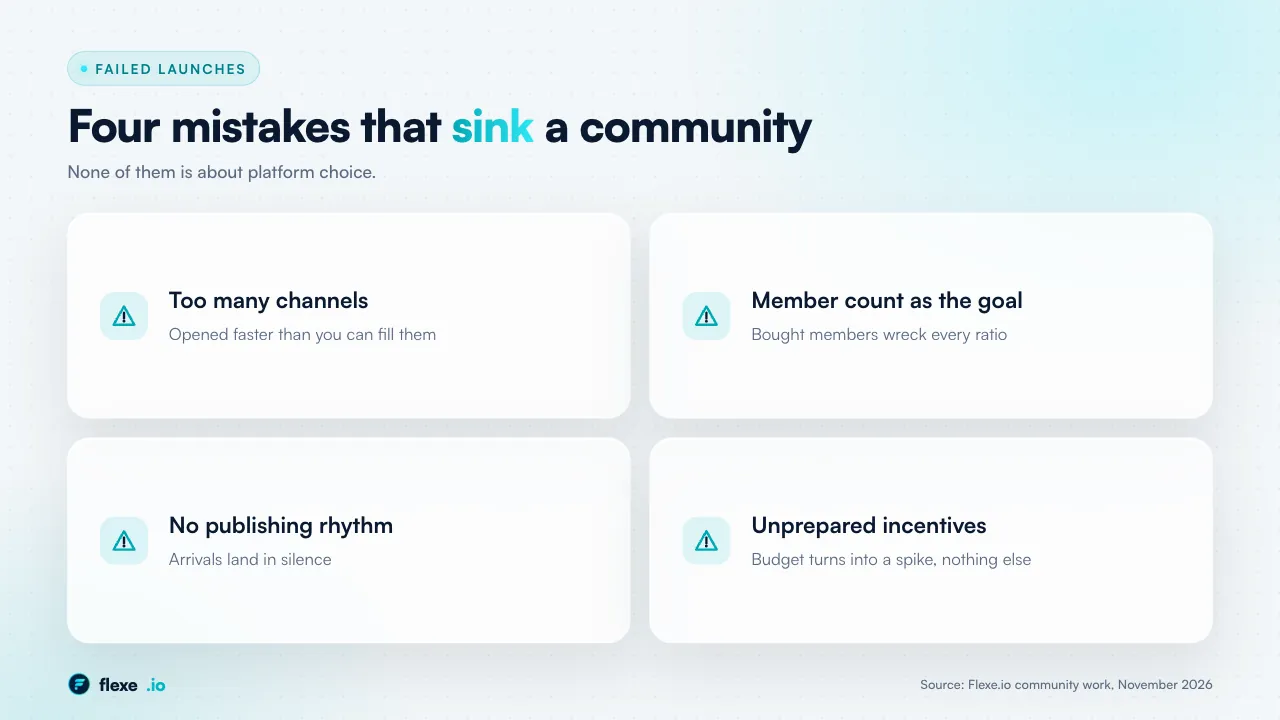
Four mistakes account for most failed community launches, and none of them are about platform choice:
- Opening channels faster than you can fill them.
- Treating member count as the goal, which leads to buying members and destroying every ratio that matters.
- Launching a channel with no publishing rhythm, so that arrivals land in silence.
- Running an incentive campaign into an unprepared channel, which converts budget into a spike and nothing else. Our guide to designing airdrop and task campaigns covers how to avoid it.
Admission control on day one
Admission control is the first decision rather than an afterthought, and it is easier to add before the first hundred members than after the first raid. Decide whether new arrivals can post immediately, how long an account must exist before it may send links, who may add members, and what happens to a message containing a wallet address. Pin the rules so night moderators enforce the same thing. Our guide to running a DeFi Telegram group covers this in detail.
The failure everyone meets is the private message scam: a member asks a question in public and receives a reply from an account copying an admin’s name and photo. You cannot stop that from inside the room, so the counter is repetition. State in the pinned rules that staff never message first, repeat it after every support thread, and keep the real admin list visible in the channel description. Keeping that repetition going every day is most of what Telegram community moderation involves.
Moderation coverage and escalation
Coverage means hours, not headcount. Put a name on every block of the day, including the hours your team sleeps, when spam arrives. Agree what each may do alone (delete, mute, ban, pin) and what has to reach the project lead first. A scam link is deleted and the account banned without discussion. A criticism of the project is answered, never deleted, because deleting it produces four screenshots of the deletion. Legal or financial issues go to one named person; bans go into a shared log.
Paying moderators and agencies
A moderator agreement needs the hours covered, the response time expected inside those hours, the actions they may take alone, and the handover due when they stop. Pay monthly in arrears against a short report rather than per message, because payment per message buys message count and nothing else. If an agency runs the room, ownership of the group, the admin rights, the member list and the invite links stay with the project, in the contract before the first invoice. Keep one admin account in your own team’s hands.
When a channel goes wrong
A flood of joins from a paid push landing in a room with nothing to read leaves a wall of arrivals and no conversation: turn the source off, publish something worth reading, and let the rest go. An argument that turns the room against the team gets one full public answer with what happened and what changes, then no more replies on the same point. If a hostile admin or compromised account takes the room, act on the account first and explain second: remove the rights, post the same notice in every channel you control, and pin it.
Market trends in 2026
- Voice rooms are no longer a category worth building on. The audience moved to recorded spaces and video. What survives is audio recorded and republished as clips, video or recaps.
- Local meetups have grown into the most reliable filter. Most are announced inside the communities they serve, and conference side events are the other dependable source.
- Wallets are moving into the chat app. Telegram began rolling out its built-in Gram wallet on 31 August 2026.
- Community chat is becoming searchable. Public Discord servers with 1,000+ members get web pages from 16 November 2026, so moderation now shapes what search engines see.
How this ranking was built
The ranking orders crypto community platforms by what each one is good for, not by size. The Telegram user figures are the platform’s own reported numbers for March 2025 and May 2025; the wallet and Discord changes were checked against Telegram’s and Discord’s own announcements on 10 November 2026. The strengths, weaknesses and skip conditions come from the communities we launch and moderate for clients, and were reviewed for this update.
If you would rather hand the platform to a team, we compared the best crypto community management agencies on published prices and verified results.
How much do crypto community platforms cost in 2026?
Crypto community platforms cost $0 to open, and running one well costs roughly $1,000 to $4,000 a month per channel once moderation is paid for. Telegram groups and Discord servers are free to create; the bill comes from moderators, content and the hours of cover a room needs across time zones, which is where most of the budget goes.
Price follows coverage, not member count. A single Telegram channel on eight hour cover in one language starts at $2,000 a month with the Flexe community team, and every added language, shift or platform raises the figure. Paid pushes that bring new members are a separate media budget, and the moderator contract terms in the safety section apply either way.
Frequently Asked Questions
What is the best platform for a crypto community?
For most projects it is Telegram, used as the primary community, with X as the distribution channel that points into it. Discord comes in only when the number of parallel topics genuinely justifies it. Choose by function rather than popularity: Telegram is a conversation, Discord is an organization chart and X is a megaphone.
Should a new project start on Telegram or Discord?
Telegram, in almost every case. It costs less to set up, the audience is already there, and a small Telegram group looks active while a small Discord server looks abandoned. Move to or add Discord when parallel topics such as governance, development and support start colliding in one conversation.
Are X communities worth using?
As a distribution surface, yes; as the home of a community, no. X reaches people who have joined nothing, which is exactly what a community needs at the top of the funnel, but it offers little of the continuity that keeps people around. Use it to point them into Telegram or Discord.
How do you find local crypto meetups?
Join the regional community first and watch for announcements, since most meetups are announced internally rather than on public listings. Conference side events are the other reliable source and are usually published in advance, which makes them easier to find than recurring local groups. For a project, hosting a small side event is worth more than attending.
Is it worth maintaining a community on a platform that is declining?
Only if the people you need are still there. Platform decline matters far less than whether your specific audience has moved, and those two things are often several years apart. If they have moved, migrate deliberately: run both rooms for a while and keep the old one read-only rather than deleting it.
Where to go next
For a directory of active crypto groups and channels by category, see our guide to crypto Telegram groups. If the community is part of a launch, community management covers how growth campaigns and moderation fit together.
Deciding where to build? Send the brief on Telegram at https://t.me/flexe_io_agency and we will come back with a platform recommendation and a growth target within 24 hours.
Nothing here is financial advice. Platform features and policies change; verify current behavior before committing to one.