Checked on 11 November 2026: exchange traffic figures below are Similarweb estimates for October 2026, and every other number names its source.
Count the deposit, not the signup. The gap between registrations and funded accounts is where exchange acquisition budgets quietly fail, and it widens exactly where onboarding friction is highest: identity checks, source-of-funds questions and market-specific rules. For the channels that feed the top of that funnel, our benchmark of 150 campaigns measured over 90 days shows a median net return of 2.8x, a range of 1.4x to 7.0x by project type, and 12% of campaigns that failed.
Exchange traffic is the user acquisition and retention challenge of getting traders to discover, sign up for, and keep using a crypto exchange. In 2026 it blends SEO, partnerships, and product-led growth under heavy competition and compliance. This guide covers how top exchanges build durable, organic traffic.
Key Takeaways
- Exchange growth compounds through organic channels like SEO and referrals, which outlast paid spikes.
- Trust and compliance are acquisition levers, since traders weigh security and regulation heavily.
- Product-led loops, such as referrals and fee incentives, drive durable growth at scale.
- Localized content and partnerships open new-market traffic that generic campaigns miss.
- Measure funded, active traders and retention, not raw visits, to judge real exchange growth.
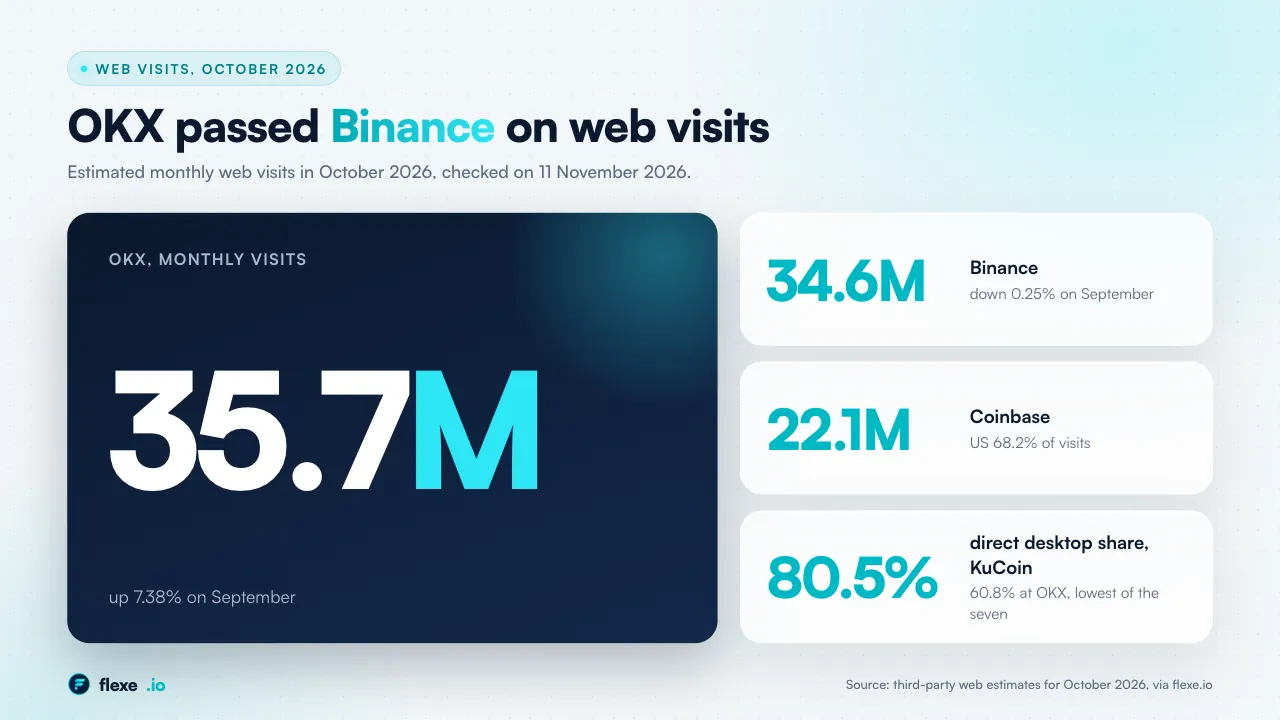
The gap between how top crypto exchanges think about traffic and how challenger exchanges think about traffic is enormous. In October 2026 Similarweb estimates 35.7 million visits for OKX, 34.6 million for Binance and 22.1 million for Coinbase. Most of those visits arrive direct or from organic search, traffic these exchanges do not pay for again every month. Meanwhile, most challenger exchanges run a 2021 playbook: KOL pumps, influencer airdrops, wire-service press releases, Twitter giveaways. It feels like marketing. It builds zero structural signal.
Flexe.io has been growing exchange traffic since 2018 across 800+ campaigns. We run KOL campaigns, crypto PR in 800+ media outlets, paid media, and SEO strategy for exchanges at every stage. Reach us on Telegram: https://t.me/flexe_io_agency
Quick Answer / TL;DR
Exchange traffic in 2026 comes from five primary sources: organic search (the highest-ROI long-term channel), direct traffic from existing users and brand recall (61% to 81% of desktop visits for the seven exchanges below, per Similarweb for October 2026), paid crypto ad networks, KOL and affiliate programs, and emerging AI-driven search. Cost per funded user is the number that decides budgets, not cost per click. The structural secret behind top exchange organic traffic is programmatic SEO: Coinbase built price and converter pages for every listed asset, and those two templates carry much of its organic search reach. For challenger exchanges, the fastest paths to sustainable traffic growth are: building /price/ and /converter/ URL patterns, earning regulatory trust signals that AI systems cite, launching international SEO across the top 5 user geographies, and running compliant KOL campaigns with on-chain attribution.
What Does Exchange Traffic Actually Look Like at Scale?
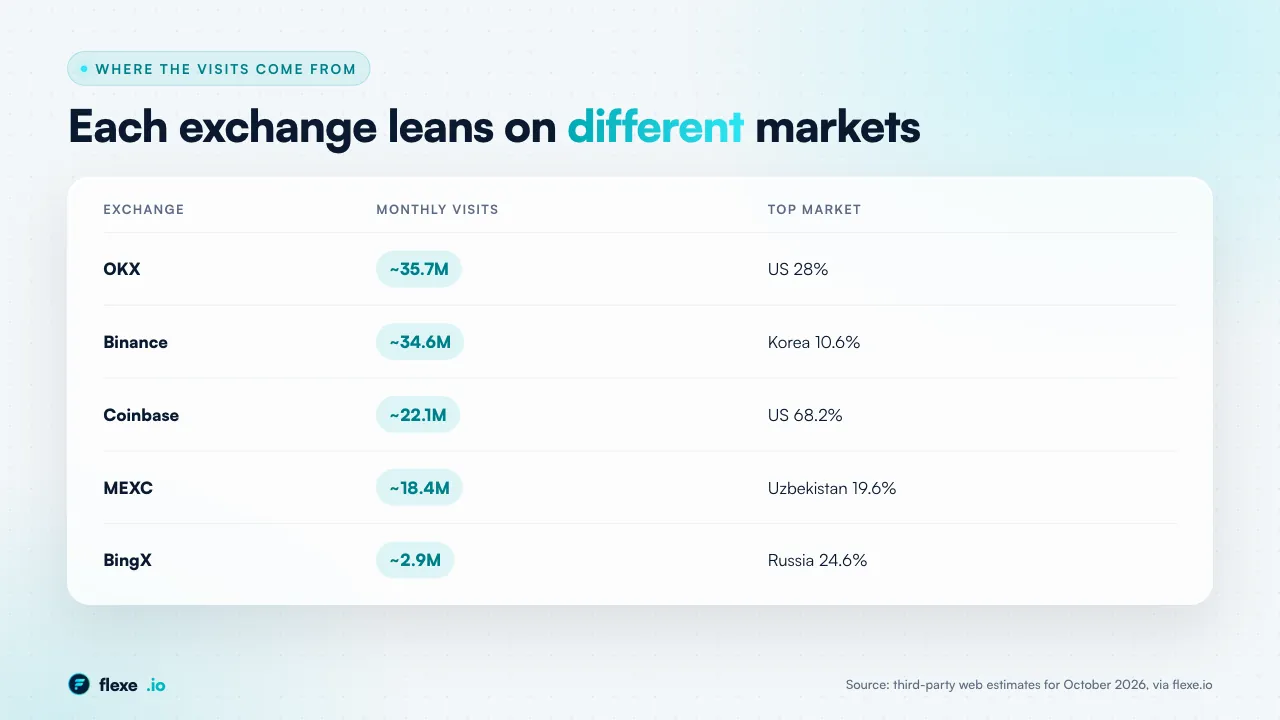
Similarweb’s October 2026 estimates, opened on 11 November 2026, show a stratified market where a small group of exchanges command most user attention. OKX passed Binance on web visits that month, up 7.38% on September, while Binance slipped 0.25%. The gap between tiers is structural, not incremental.
| Exchange | Monthly Visits (October 2026) | Traffic Profile | Top Markets |
|---|---|---|---|
| OKX | ~35.7M | US and Asia | US 28%, Singapore 12.3%, Vietnam 5.6%, Hong Kong 5.4%, Korea 4.5% |
| Binance | ~34.6M | Globally diversified | Korea 10.6%, Brazil 6.8%, Ukraine 5.9%, Venezuela 5.6%, Turkey 4.4% |
| Coinbase | ~22.1M | US-concentrated | US 68.2%, UK 5%, Germany 3.3% |
| MEXC | ~18.4M | Emerging-market specialist | Uzbekistan 19.6%, Pakistan 8.7%, India 6.5% |
| KuCoin | ~16.4M | Global altcoin hub | Singapore 10.4%, Philippines 7.9%, US 4.3% |
| Gate (gate.com) | ~13.5M | Diversified | US 6.2%, Singapore 6%, Korea 5.4% |
| BingX (bingx.com) | ~2.9M | Emerging-market derivatives | Russia 24.6%, Argentina 9%, Korea 6.5% |
Direct visits make up 61% to 81% of desktop traffic for these seven exchanges in Similarweb’s October 2026 view, from 60.8% at OKX to 80.5% at KuCoin, with organic search usually the next channel. Most trading now happens in mobile apps, so any exchange with a weak mobile experience shuts out a large share of potential users before they reach the web funnel.
CoinMarketCap still uses web traffic as a ranking factor for exchanges, weighing pageviews, unique visitors, bounce rate, time-on-site, and keyword searches. However, CoinGecko’s Trust Score Basilisk Update of May 2026 removed web traffic normalization from its methodology, explaining that most trading now occurs through mobile apps and APIs, making web traffic an increasingly unreliable proxy for actual trading activity. The picture is mixed: web traffic still matters for discovery and brand credibility, but active traders and trading volume are the metrics that determine real exchange health. CoinGecko’s Q3 2026 report, published on 15 October 2026, shows the top 10 spot exchanges traded $1.65 trillion in the quarter, down 14.2% from Q2, while Binance’s share rose to 42.7%.
Is Web Traffic Enough to Measure Exchange Growth?
Web traffic is the entry point, not the destination. The exchange traffic-to-value chain follows this sequence:
For CEX: Visit → Registration → KYC completion → First deposit → First trade → Repeat trading → Referral
For DEX: Visit → Wallet connect → Chain/token selection → Swap or LP deposit → Repeat use → Retained liquidity
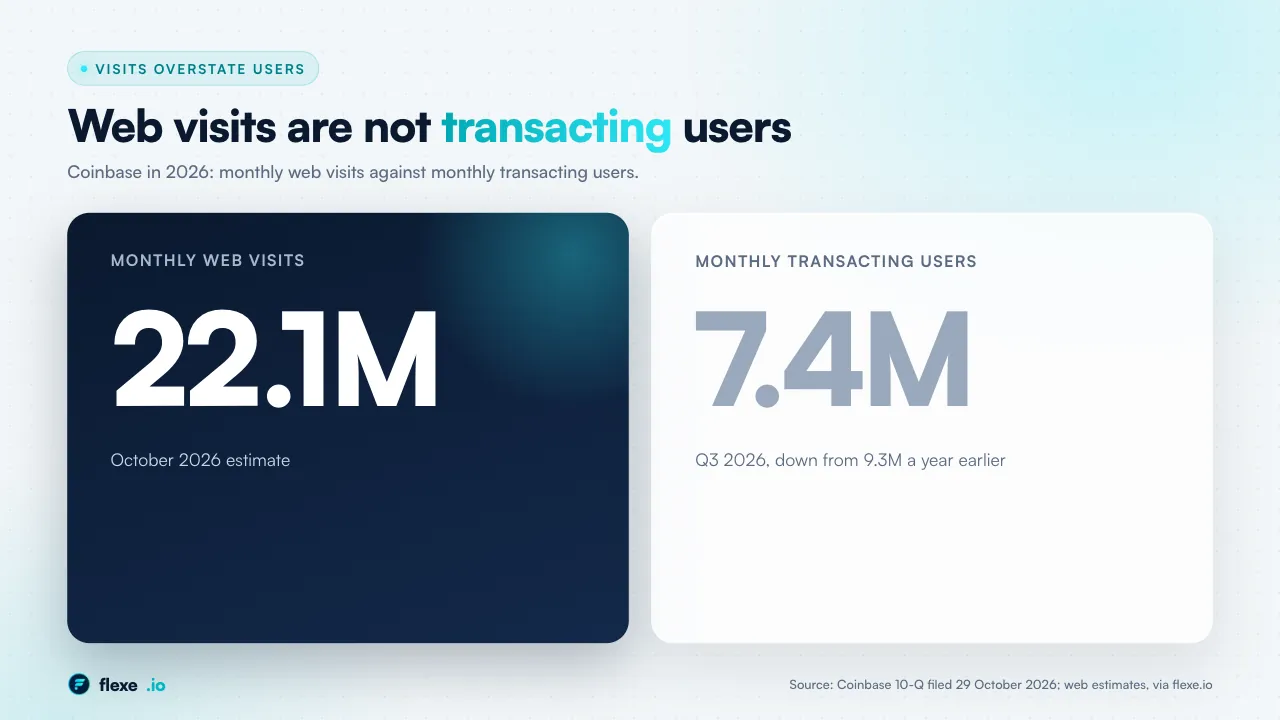
Each stage has predictable drop-off, and visits overstate users by a wide margin. Coinbase’s 10-Q filed on 29 October 2026 reports 7.4 million monthly transacting users in Q3 2026, down from 9.3 million a year earlier, against about 22 million monthly web visits. Exchanges that optimize for registrations without tracking through to KYC completion, first deposits, and 30-day trading retention are systematically misallocating budget.
Conversion benchmarks: Track three ratios every week: signup to KYC completion, KYC completion to first deposit, and first deposit to a second trade within 30 days. Published industry averages for these steps rarely name their sample, so build your own baseline from the first 90 days of cohorts. Retention is where most acquired users disappear, and exchanges that improve it even modestly outperform peers on LTV-to-CAC ratio.
Kraken’s survey of about 1,000 US crypto users, published in September 2025, found that 79% would rather pay slightly higher fees on an exchange they trust than save money on one they do not trust. This single data point explains why exchange growth is not primarily a media-buying problem. It is a trust problem.
How Do Top Exchanges Build Organic Traffic?
The actual traffic engines at top exchanges are programmatic URL patterns that scale to hundreds of thousands of pages.
The Coinbase model: Coinbase builds a large part of its organic reach on two URL patterns: /price/ and /converter/. Two templates cover every listed asset and every common fiat pair, so each new listing adds pages without new writing. Third-party SEO tools disagree on the exact share of organic visits these templates bring, so we no longer quote one figure.
Price pages auto-generate for every listed asset. Each contains a live price chart, a “Buy” widget, a “What is [Coin]?” overview, market statistics, analyst insights, and related assets. Converter pages cover every crypto-to-fiat pair at /converter/bitcoin/usd. Localized versions of the same pages, such as Turkish price pages, show the international SEO multiplier effect.
The Binance model: Binance Academy operates several content template types that rank predictably: “What is X” explainers for emerging concepts, comparison content capturing long-tail informational queries, procedural “how to” guides with higher conversion intent, and single-term definition pages. Binance also localizes into far more languages than Coinbase, which is the primary structural driver of Binance’s international traffic dominance.
For challenger exchanges, the playbook: Build /price/ and /converter/ patterns first. A challenger exchange building these URL structures can build a measurable keyword footprint inside 18 months, built during a quieter market period when competition for keywords is lower.
What Is Direct Traffic and Why Is It the Most Valuable Channel?
Direct traffic, meaning users who type the URL, use a bookmark, or arrive from an untagged source, accounts for 61% to 81% of desktop visits at the seven exchanges in our table, per Similarweb for October 2026. It represents habitual usage and deep brand recall.
This is simultaneously the most valuable and the hardest traffic source to build. Exchanges with high direct traffic have a structural cost advantage: they acquire nearly half their users at zero marginal acquisition cost. This allows more aggressive budget allocation to paid channels while maintaining a protected baseline.
For newer exchanges, direct traffic is built through: PR and earned media that generates sustained awareness, consistent branding that users remember, exceptional UX that drives repeat visits, and community engagement that keeps the exchange top-of-mind. Direct traffic does not appear on a quarterly marketing report as a win; it compounds over years. Most challengers underestimate this gap by an order of magnitude.
What Are the Five Exchange Traffic Channels?
| Channel | Primary Role | Time to Impact | Cost Structure | Best Metric |
|---|---|---|---|---|
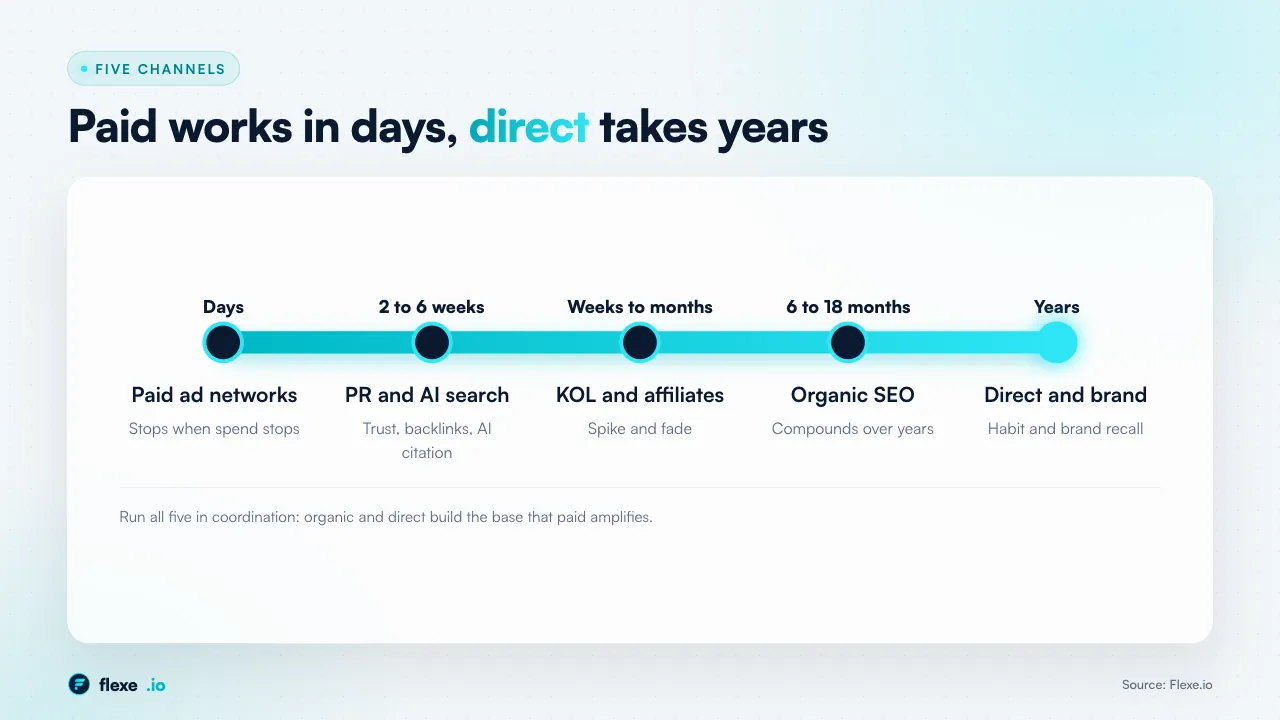
| Organic SEO | Long-term compounding acquisition | 6-18 months | Upfront content investment | Organic-attributed funded accounts |
| Direct / Brand | Habit and brand recall | Years | Brand building investment | Direct traffic share growth |
| Paid Crypto Ad Networks | Immediate targeted reach | Days | CPM, CPC or CPA; FTD cost varies by geo | First-time deposit (FTD) cost |
| KOL / Affiliate Programs | Trust transfer, network growth | Weeks-months | Flat fee per placement or revenue share | Tracked FTDs per partner |
| PR and AI Search | Brand trust, backlinks, AI citation | 2-6 weeks | Agency or in-house time | AI citation rate, domain authority |
The most common mistake is treating these as competing channels. Paid acquisition produces immediate FTDs but stops when spend stops. SEO compounds over years. KOL campaigns spike and fade. The exchanges with the most durable traffic profiles run all five in coordination, with organic and direct building the foundation that paid channels amplify.
How Does Programmatic SEO Work for Exchanges?
Programmatic SEO is the practice of auto-generating large numbers of pages from structured data templates. For crypto exchanges, it is the single highest-ROI organic traffic investment available.
Price pages (/price/[asset]/ or /[asset]-price/): Each listed asset gets a dedicated page capturing “[Asset] price,” “[Asset] price today,” “[Asset] price USD” queries. These are maximum purchase intent: users checking an asset price are on the verge of buying. The page converts this intent by showing the live price alongside a buy CTA.
Converter pages (/converter/[asset]/[currency]/): Cover every crypto-to-fiat and crypto-to-crypto conversion pair. Capture “how much is 1 ETH in USD,” “convert BTC to EUR” queries. Pre-purchase research with high transaction intent.
“How to buy” pages (/how-to-buy/[asset]/): Step-by-step guides for purchasing specific assets. Capture “how to buy Solana,” “how to buy ETH” queries. The user has already decided what to buy; they are choosing the platform.
Implementation: A reliable data pipeline for real-time accuracy, consistent templates with proper meta tags and structured data, a deployment system that auto-generates pages for new listings and removes pages for delisted assets. Start with 50-100 pages to test quality before scaling. Poor-quality programmatic pages trigger YMYL quality filters, particularly damaging for exchanges.
What Is the Exchange Traffic Trust Stack?
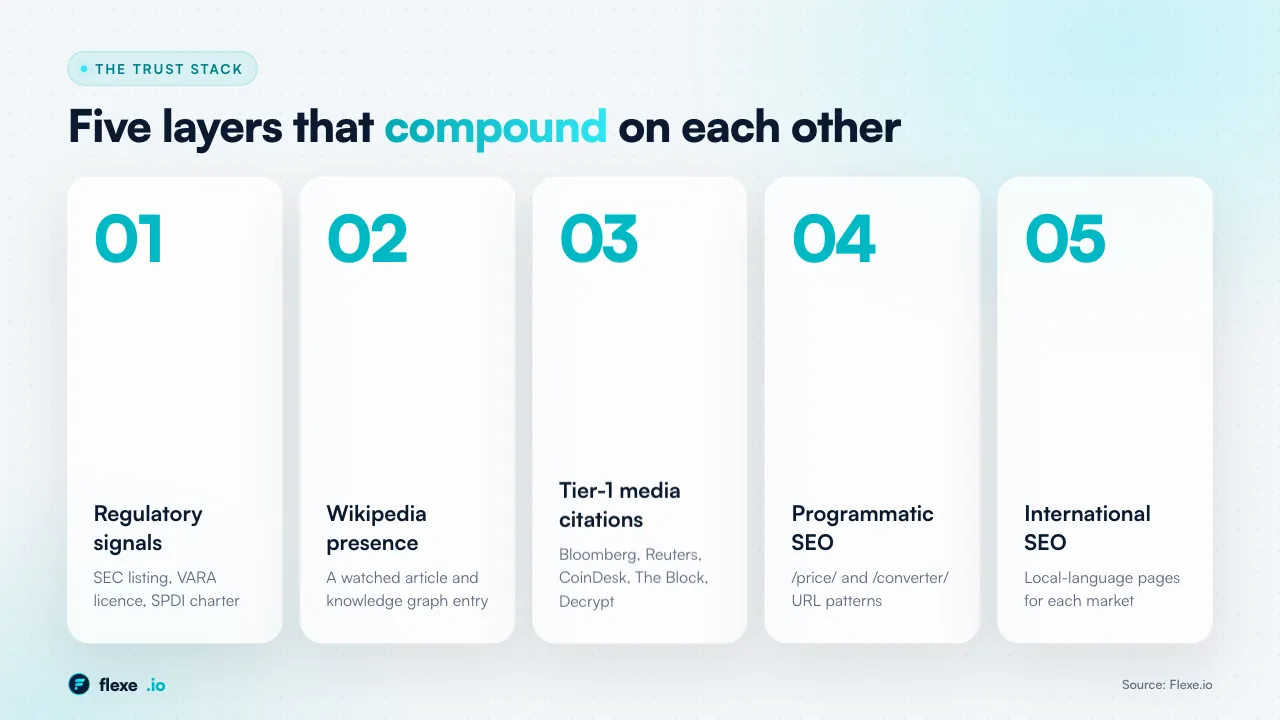
Beyond programmatic SEO, dominant exchanges have built a set of compounding structural signals that AI systems, institutional buyers, and journalists all process positively. These are the signals that determine whether a challenger exchange is recommended by ChatGPT or Perplexity when a user asks “what is the best crypto exchange for beginners.”
Layer 1: Regulatory signals. Coinbase is publicly traded under SEC regulation. Binance holds a VARA licence in Dubai. Kraken holds a Wyoming SPDI charter. These are the most powerful trust signals AI models process when recommending exchanges.
Layer 2: Wikipedia and knowledge graph presence. AI models use Wikipedia as a primary training source for entity information. An exchange without a well-maintained Wikipedia article has a structural disadvantage in AI search. Exchange articles attract hostile edits after hacks and lawsuits, and most exchanges do not monitor their own edit history.
Layer 3: Tier-1 media citations. Coverage in Bloomberg, Reuters, CoinDesk, The Block, and Decrypt signals legitimacy to AI systems and institutional buyers. Sustained PR in crypto and fintech media, paired with content clustered around buyer questions, is the usual route by which smaller exchanges start to appear in AI answers. The mechanism: being cited in reputable crypto media is a trust vote that determines whether an exchange appears in AI-generated answers.
Layer 4: Programmatic SEO infrastructure. The URL patterns described above. This is the organic traffic engine.
Layer 5: International SEO at scale. Binance optimizes for dozens of languages and regions. Most challenger exchanges have English-only content. Turkey alone sent 4.4% of binance.com visits in October 2026, per Similarweb. International SEO is the strongest organic traffic opportunity for exchanges with global ambitions.
These five layers compound on each other. The stack builds an organic moat that paid acquisition cannot replicate.
Flexe.io builds this infrastructure for exchanges: crypto PR in 800+ media outlets, SEO architecture, KOL campaigns with attribution. Reach us on Telegram: https://t.me/flexe_io_agency
How Do Paid Acquisition Channels Work for Exchanges?
Paid acquisition drives immediate FTDs but requires specialized channels because mainstream platforms restrict most crypto exchange advertising.
Google allows crypto exchange advertising under its restricted financial products category, requiring formal certification applied directly inside Google Ads. Meta requires recognized regulatory licenses and written permission. Microsoft Advertising maintains a separate cryptocurrency advertising application process.
Crypto ad networks for exchange acquisition:
| Network | Best For Exchanges | Pricing | Targeting |
|---|---|---|---|
| Coinzilla | Brand awareness, premium crypto media | CPM, CPC | Publisher-category, geography |
| Bitmedia | Volume campaigns, global retail | CPM, CPC | Geo, device, interests |
| Blockchain-Ads | FTD campaigns, wallet-holder targeting | CPA, CPM, CPC | On-chain wallet behavior across many chains |
2026 benchmarks: Click and FTD prices swing by geo, network and market phase, so a single published number goes stale within a quarter; price campaigns on cost per funded account from your own tracking. App store promotion is one of the more efficient paid channels, reflecting the high intent of users browsing app stores for trading platforms. In our benchmark of 150 campaigns, 12% failed; our ROI calculator, checked on 11 November 2026, puts the failure rate for campaigns under $30K at 34%, which is why we test small before scaling and why, as of November 2026, we advise against spreading a small budget across every network.
KOL campaigns: The critical variable is audience quality, not follower count. Projects that spent heavily on KOL pushes and received zero wallet connections had misaligned or botted audiences. Structure: flat fee per placement plus performance component tied to tracked signups via unique referral links. Always track through referral codes, not just views.
Referral and affiliate programs: Referral programs are the most capital-efficient channel for exchanges with active user bases. Binance’s affiliate tiers pay a larger share of referred trading fees as referred volume grows. For affiliates, the most successful ones in 2026 have shifted from top-of-funnel content (“best crypto exchange”) to activation-focused content that assumes trading knowledge: “how to set up a grid trading bot on [Exchange]” or “when to use copy trading for futures positions.” This attracts users closer to funding an account.
How Does International SEO Drive Exchange Traffic?
English-language crypto search fell sharply from its 2021 peak while searches in emerging-market languages held volume better. This is the strongest organic traffic opportunity for challenger exchanges.
When users in Turkey search in Turkish for “Bitcoin fiyatı” (Bitcoin price), Google prioritizes Turkish-language results. An exchange with Turkish price pages and Turkish educational content ranks ahead of English-only competitors for this traffic. Turkey is one of Binance’s top five traffic countries in Similarweb’s October 2026 data.
Market selection framework:
| Market | Crypto Adoption | English in Search | Opportunity |
|---|---|---|---|
| Turkey | High | Low (Turkish dominant) | Very High |
| Brazil | High | Low (Portuguese dominant) | Very High |
| India | High | Medium (Hindi + English) | High |
| Vietnam | Very High | Low (Vietnamese dominant) | High |
| Poland | Medium-High | Low (Polish dominant) | High |
| Argentina | High | Low (Spanish dominant) | High |
Implementation: Proper hreflang across all language variants. Region-specific content that goes beyond translation: local regulatory context, local payment methods, local currency pricing. Dedicated URLs per language/region, not just language parameters.
How Do Exchanges Convert Traffic to Funded Accounts?
Traffic is a means to an end. The full funnel has four stages with predictable drop-off:
Stage 1: Landing page to signup. The primary failure point for most exchanges. Effective pages answer four questions immediately: what is this exchange, who is it for, why should I trust it, what do I do next? Show the product early: a product screenshot or demo reduces the cognitive gap between concept and reality.
Stage 2: Signup to KYC completion. Solutions that demonstrably improve conversion: tiered KYC (limited access without full verification, with upgrade prompts), clear progress indicators, specific time estimates (“verification takes 3-5 minutes”), mobile-optimized document upload flows.
Stage 3: KYC completion to first deposit. Users who have verified but not funded are high-value retargeting targets. Email sequences showing first-trade tutorials, small deposit bonuses, and fee comparisons all move users from verified to funded at measurable rates.
Stage 4: First deposit to active trader. Users who complete a guided first trade within 24 hours of deposit have retention rates multiples higher than users left to find their way alone. The difference between an exchange with high LTV and one with low LTV is almost entirely onboarding quality.
What Keywords Drive Exchange Traffic?
Price and data queries (highest volume, programmatic): “Bitcoin price,” “ETH price today,” “[Asset] to USD.” Maximum purchase intent. Capture with programmatic price pages.
Transactional queries (highest conversion rate): “Buy Bitcoin,” “how to buy ETH,” “buy crypto with card.” Users have decided to purchase; they are choosing the platform. Capture with “how to buy [asset]” pages.
Comparison queries (high conversion, low competition): “Binance vs Coinbase,” “best crypto exchange 2026,” “crypto exchange with lowest fees.” Head-to-head queries such as “binance vs coinbase” are searched every month, and few exchanges answer them on their own domain. Most exchanges refuse to publish honest comparison content; this intent is almost uncontested for exchanges willing to write factual comparisons.
Trust verification queries (underexploited): “Is [Exchange] safe,” “is [Exchange] legit,” “[Exchange] withdrawal problems.” High-intent trust verification searches that belong on the exchange’s own domain. Most exchanges cede this to third-party comparison sites, which then rank ahead of the exchange’s own pages for searches about the exchange itself.
Educational queries (top-of-funnel): “How does crypto trading work,” “what is spot trading.” Users from educational queries have longer time-to-FTD but higher LTV. An academy section (Binance Academy model) captures this intent while building topical authority and Trust Stack signals.
How Should Exchanges Measure Traffic Performance?
Traffic is a vanity metric. These are the real metrics:
| Metric | What It Measures | Benchmark |
|---|---|---|
| Cost Per Funded Account (CPFA) | Marketing spend per depositing user | Track by channel; strong brands pay far less |
| Cost Per Active Trader (CPAT) | Spend per user who executes a trade | More stringent than CPFA |
| 30-day trader retention | % of acquired users still trading after 30 days | Set your own baseline from early cohorts |
| Trading volume per acquired cohort | Revenue-generating metric by channel | Varies significantly by KOL quality |
| Organic traffic share of voice | Competitive position on high-intent terms | Leading indicator of long-term position |
| AI citation rate | Frequency of exchange recommendation in AI search | Growing importance in 2026 |
For mature exchanges, the most important single metric is organic traffic share of voice on high-intent terms, not because it directly measures revenue, but because it is a leading indicator of long-term competitive position.
Common Exchange Traffic Mistakes in 2026
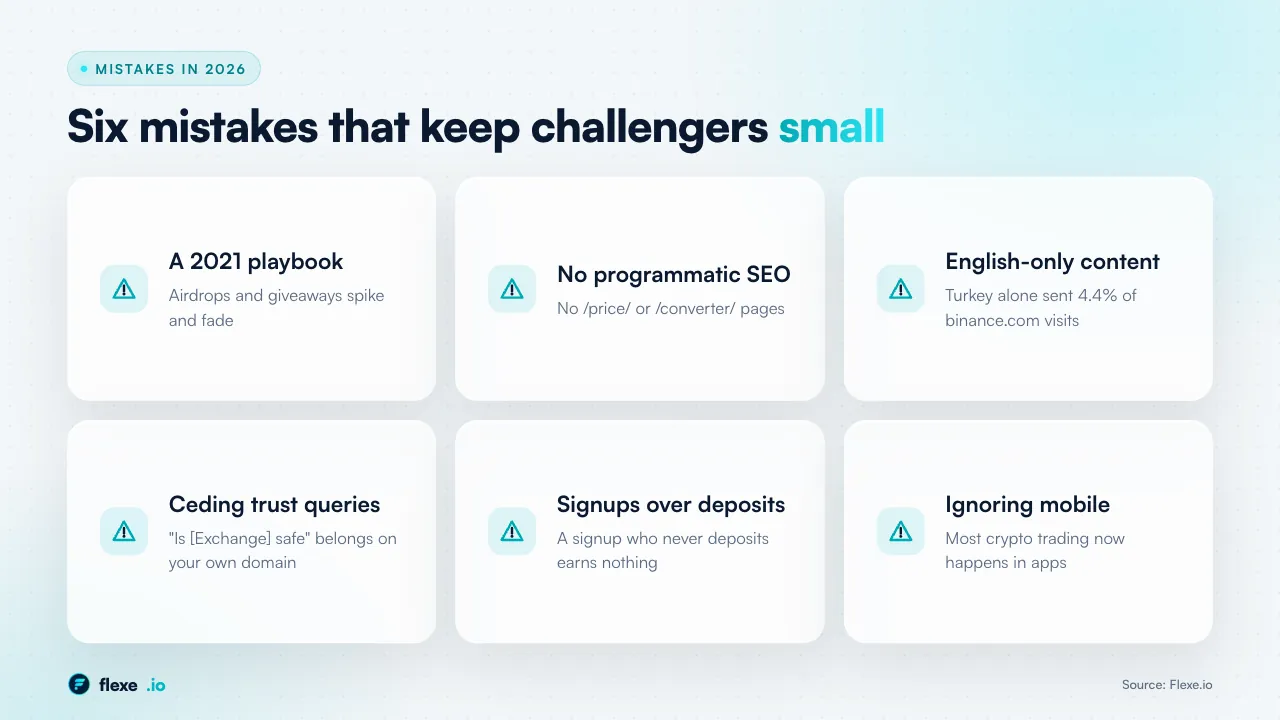
🚫 Running a 2021 playbook in 2026. KOL airdrops, wire-service press releases, and Twitter giveaways generate noise but build zero structural traffic signal. These tactics spike and fade. Organic SEO, referral programs, and regulatory trust signals compound.
🚫 No programmatic SEO infrastructure. Coinbase built much of its organic traffic on two URL patterns. Most challenger exchanges have no /price/ or /converter/ pages. This is the most valuable missing piece for most exchange SEO programs.
🚫 English-only content. Turkey alone sent 4.4% of binance.com visits in October 2026. Challenger exchanges with global ambitions but English-only content are ceding entire markets.
🚫 Not owning trust verification queries. “Is [Exchange] safe” and “[Exchange] review” are high-intent trust verification searches that belong on the exchange’s own domain. Most exchanges cede this intent to third-party comparison sites.
🚫 Optimizing for signups instead of FTDs. Signup volume is a vanity metric. A signup who never deposits generates zero revenue. Optimize conversion funnels, KYC flows, and onboarding sequences for first deposit rate, not registration count.
🚫 No Trust Stack investment. Exchanges without regulatory signals, Wikipedia presence, and tier-1 media coverage are invisible to AI systems when recommending exchanges. This gap widens as AI search adoption grows.
🚫 Ignoring mobile. With most crypto trading now done in mobile apps, a desktop-first exchange experience is structurally excluding the majority of potential users.
🚫 Single-channel paid acquisition. Exchanges that rely on one paid channel have no buffer when that channel saturates, policy changes, or the relationship ends.
Three Structural Trends Reshaping Exchange Traffic
1. Institutional traffic decoupling. Bitcoin and Ethereum ETFs have decoupled price action from exchange web traffic. A significant portion of new capital is flowing through regulated ETF vehicles rather than traditional exchange interfaces. Exchanges that fail to integrate with institutional infrastructure risk being bypassed by the largest pools of new capital.
2. On-chain native discovery. Users are increasingly starting their trading journey on-chain (through Dexscreener, Phantom wallet, and decentralized aggregators), bypassing CEXs as the initial entry point. This is the first cycle in which significant numbers of new users go directly to on-chain platforms. CEX-centric acquisition models need to account for this.
3. AI agent traffic. By 2027, AI agents performing autonomous financial actions may bypass human-facing exchange interfaces entirely, interacting with APIs and smart contracts directly. Exchanges that build agent-friendly API documentation, optimize for AI search citation, and maintain regulatory trust signals today will capture the traffic of tomorrow.
Where Exchange Traffic Actually Comes From
Exchanges buy traffic like consumer apps and retain it like financial products, which is why acquisition numbers rarely predict revenue. The channels that produce funded accounts rather than signups:
- Comparison and review content. People search for the best exchange in their country before depositing anywhere. These pages convert years after publication and are the most durable asset an exchange can own.
- Referral and affiliate programmes. Pay only on funded accounts, not registrations. The distinction is the difference between a working programme and a fraud surface.
- Aggregator presence. Being listed with accurate fees and volume on the data sites traders check is free and outperforms most paid acquisition.
- Local-language support and content. The single largest lever in underserved markets, and the one most exchanges postpone indefinitely.
Measure funded accounts by source, not registrations. Registration numbers flatter every channel equally and tell you nothing about which one brought people who trade.
Exchanges come to us for two things: presence on the data sites traders check before depositing, and acquisition measured in funded accounts rather than signups.
What is exchange traffic? Exchange traffic refers to all visits a cryptocurrency exchange receives from organic search, typed-in visits, paid advertising, KOL and affiliate campaigns, referral programs, and AI-driven search. Managing and growing it is the core challenge of crypto exchange marketing because exchanges profit from active traders, meaning traffic quality (users who fund accounts and trade) matters far more than traffic volume.
How much organic traffic do top crypto exchanges get? In October 2026, per Similarweb estimates, OKX received about 35.7 million total monthly visits, Binance about 34.6 million and Coinbase about 22.1 million. Direct visits make up 61% to 81% of desktop traffic for the seven exchanges we track, and organic search usually ranks second.
What is programmatic SEO for crypto exchanges? Programmatic SEO is auto-generating large numbers of targeted pages from structured data templates. For exchanges, the primary page types are: price pages (capturing “[Asset] price” queries), converter pages (capturing “[Asset] to [Currency]” queries), and “how to buy” pages (capturing purchase intent). Coinbase built much of its organic reach this way.
How much does crypto exchange user acquisition cost? It depends on geo, channel and market phase, and published averages rarely name their sample. Price every channel on cost per funded account rather than cost per click or signup. KOL placements are priced by creator reach and audience quality, and app store promotion is often cheaper per user than search ads.
Why is international SEO important for exchanges? English-language crypto search fell sharply from its 2021 peak while emerging-market languages held volume better. Turkey is among Binance’s top five traffic countries in Similarweb’s October 2026 data. Markets like Turkey, Brazil, Vietnam, Poland, and Argentina have large crypto user populations, non-English dominant search, and limited localized exchange content competition.
How do you track KOL and paid campaign attribution for exchanges? Use unique referral codes and custom landing pages per campaign. Track through the full funnel: signup → KYC completion → first deposit → trading activity at 30/60/90 days. Calculate cost per FTD, not cost per signup. Evaluate 30-day trader retention to distinguish high-quality and low-quality acquisition sources.
Does CoinGecko still use web traffic in its exchange rankings? No. CoinGecko’s Trust Score Basilisk Update of May 2026 removed web traffic normalization from its methodology, explaining that most trading now occurs via mobile apps and APIs, making web traffic an unreliable proxy for actual trading activity. CoinMarketCap still includes a Web Traffic Factor in exchange rankings. This means web traffic matters for discovery and CMC visibility but is not the primary signal for exchange credibility.
What to take from this
Exchange traffic in 2026 is not a solved problem, but it is a well-understood one. The top exchanges built organic moats through programmatic SEO infrastructure, international localization, direct traffic compounding over years, and Trust Stack signals that AI systems and institutional buyers trust. Most challenger exchanges have not started building these systems.
The path to closing the gap is clear: build /price/ and /converter/ URL patterns first. Add international SEO across the top five target markets. Build regulatory signals, Wikipedia presence, and tier-1 media coverage that AI systems cite. Layer in compliant paid acquisition through crypto ad networks and KOL campaigns with proper attribution. Optimize the conversion funnel for FTDs, not signups. Track 30-day trader retention by channel.
Flexe.io has helped exchanges at every stage grow organic and paid traffic since 2018, from programmatic SEO architecture to crypto PR in 800+ media outlets, KOL campaigns with proper attribution, and paid media across all major crypto ad networks. To discuss your exchange’s traffic strategy, reach out on Telegram: https://t.me/flexe_io_agency
Acquisition assumes the venue already exists. If you are still at the planning stage, our guide on how to start a crypto exchange covers licensing, liquidity and what the build actually costs before any of this traffic work applies.
Traffic strategy differs sharply between centralised and decentralised venues. If you are working on the DEX side, our comparison of the top decentralized exchanges sets out the competitive field you are buying attention against.
Related Services
If you would rather have this handled than run it in-house, these are the specific services involved.
Which placement is right depends on one question: do you need people who already hold a wallet, or people who do not yet know the category exists. Our crypto traffic team buys against that answer rather than against a rate card.
How to choose exchange traffic channels in 2026
Choose exchange traffic channels by cost per funded account, not by visits. A new exchange should start with referral programmes, listings and integrations that borrow trust, then add programmatic SEO once it has live data to fill the pages. Paid media comes last, after the licence confirms which platforms and countries will accept the account.
- Track every channel to funded accounts, with 30 and 90 day retention.
- Check which countries your licence covers before buying paid media there.
- Set referral and affiliate terms you can still afford at ten times the volume.
- Build price and pair pages only when live data can fill them.
- Add local language pages for markets where search demand is holding.
Frequently Asked Questions
How do crypto exchanges acquire users?
The channels that work are referral and affiliate programmes, listings and integrations that put the exchange in someone’s existing workflow, content and search for the questions traders ask before choosing, and paid placement on crypto media. What rarely works is broad paid acquisition, because the cost per verified funded account is far higher than the click price suggests.
What is the cost of acquiring a crypto exchange user?
Higher than most teams plan for, because the drop-off happens after the click. A visitor becomes a registration, a registration becomes a verified account, and only some of those fund. Measure to funded account rather than registration, since campaigns optimised to sign-ups routinely deliver volume that never deposits.
How do you improve exchange onboarding conversion?
The largest losses are at identity verification, so measure each step and fix the worst one before buying more traffic. Explain what documents are needed before the user starts, show progress, and make failures recoverable rather than dead ends. A percentage point recovered here is usually cheaper than the same growth bought through advertising.
Which channels work for a new exchange?
Early on, partnerships and integrations outperform advertising, because they borrow trust the exchange has not yet earned. Content answering comparison and fee questions captures people already choosing. Referral programmes work once there is a base to refer. Paid media is most useful for retargeting people who started onboarding and stopped.
How do market makers relate to exchange growth?
Liquidity is a marketing asset: thin order books drive away exactly the users an exchange wants. Market making is a separate discipline from promotion, but a campaign that brings traders to an illiquid book wastes the spend and damages the reputation. Sequence liquidity before acquisition rather than the other way round.
How do you measure exchange marketing?
Funded accounts, cost per funded account, thirty and ninety day retention, and trading volume per acquired user. Registrations and app installs are the numbers easiest to inflate and the least connected to revenue. Attribute to source with distinct landing pages, because self-reported platform numbers overstate consistently.
Traffic figures on this page are Similarweb estimates for October 2026, checked on 11 November 2026. These numbers move quickly, so treat them as a snapshot rather than a constant.