A crypto exchange listing is an application to a business that receives far more of them than it can accept and turns most of them down; our crypto exchange listing service prepares them for the top 60 exchanges on CoinMarketCap. What decides it is rarely enthusiasm for the project; it is whether the paperwork, the token contract and the market data hold up under review.
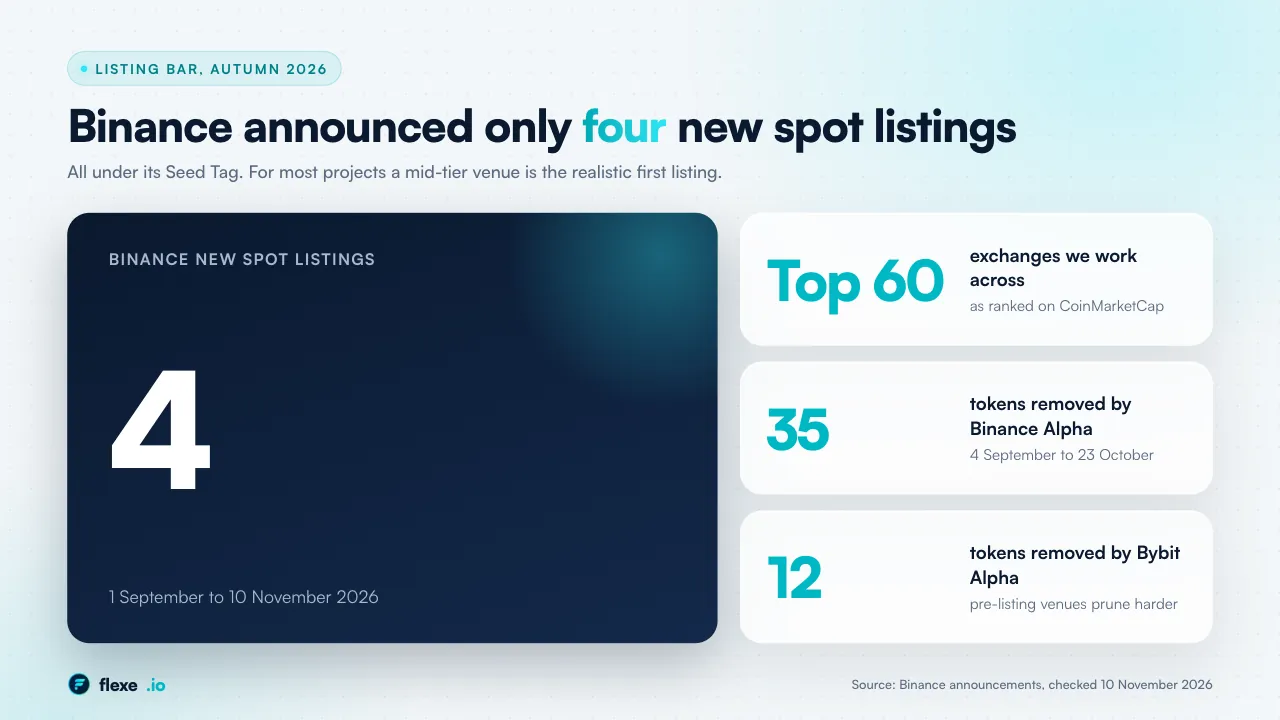
Checked on 10 November 2026 against official exchange announcements and our own listing work.
Crypto listing services exist because the right venue decides a project’s visibility and liquidity. A crypto listing agency is paid for preparation, sequencing and follow-up; coin listing services that promise a guaranteed outcome sell something no serious exchange authorizes.
Our crypto exchange listing service
We work across the top 60 exchanges ranked on CoinMarketCap and pick the venues that fit the token, its holders and its budget, not the largest names first. Binance is the exception: its listing statement of 17 December 2025, unchanged as of 10 November 2026, accepts applications only from founders or C-level staff and blacklists projects that use a third party. For Binance we prepare the evidence file and the founder submits it, as our guide on how to list a token on Binance explains.
- A shortlist of exchanges by tier, with what each one asks for and how long it usually takes
- The document set: verified contract, reconciled supply table, audit, team and legal answers
- Form filling and the commercial conversation with each listing team
- Technical integration support and the first week of trading after launch
The bar for a top-tier spot listing is higher this autumn. Between 1 September and 10 November 2026 Binance announced spot listings for only four new crypto tokens, among them Hyperliquid (HYPE) and Predict (PREDICT), all under its Seed Tag for newer, more volatile assets. For most projects a mid-tier venue is the realistic place to list coin on exchange books first. Coinbase runs its own review through a separate application form, covered step by step in our guide to listing a token on Coinbase.
Market Making Services Available
Most serious exchanges ask about market making in the form, so we arrange it before the application rather than after it. Terms go in writing, including what the market maker may do with any tokens it receives. Details are on our market making service page.
Price Trackers and Aggregators
A crypto token listing on an exchange puts it where it can be traded. Tracker listings and other coin listing platforms put it where it can be found. The two are bought separately: a tracker will list a token that trades on only one exchange, while an exchange will not. A free listing crypto exchange, free token listing exchange or free coin listing exchange usually means low volume. Listing on crypto exchanges that matter is bought with liquidity and proof.
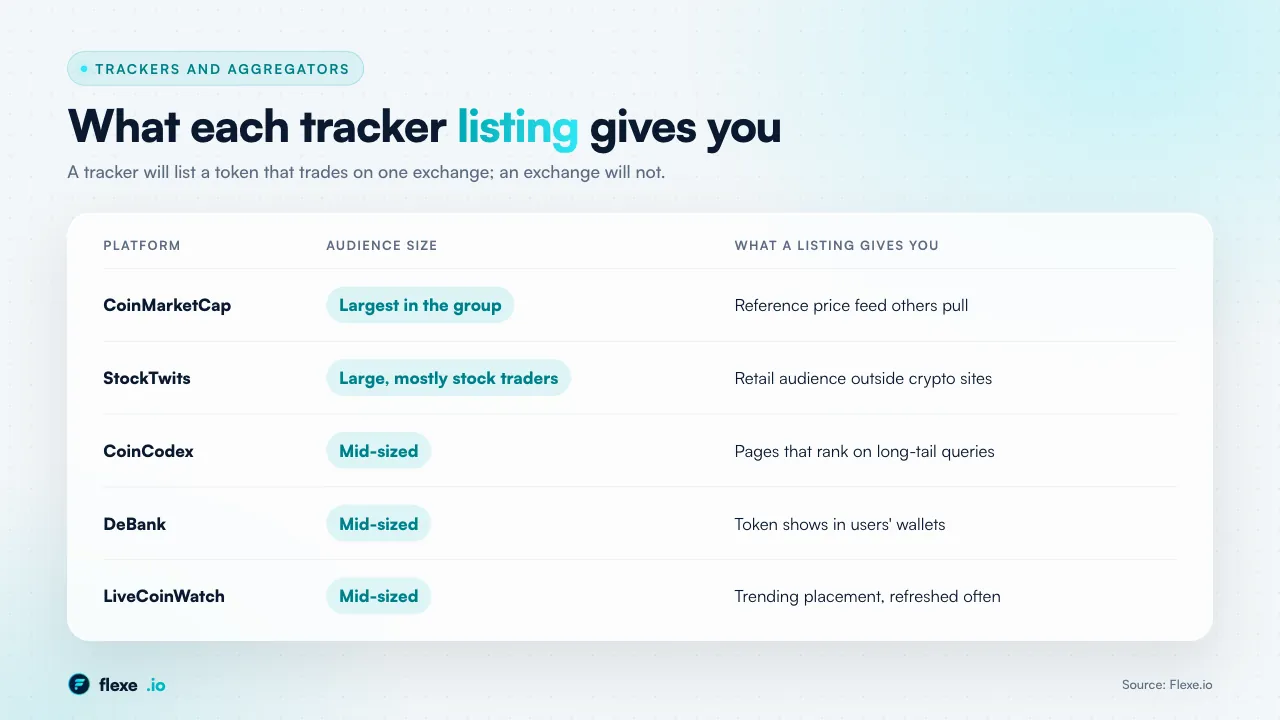
| Platform | Audience size | What a listing gives you |
|---|---|---|
| CoinMarketCap | Largest in the group | The reference price feed most other sites pull from |
| StockTwits | Large, mostly stock traders | A retail investor audience outside crypto-native sites |
| CoinCodex | Mid-sized | Price pages that rank well on long-tail token queries |
| DeBank | Mid-sized | Portfolio integration; the token shows in users’ wallets |
| LiveCoinWatch | Mid-sized | Trending placement, refreshed frequently |
| CoinRanking | Smaller | Fast approval; useful early while other listings are pending |
| Coinpaprika | Smaller | Detailed asset pages with team and roadmap fields |
| CoinCheckup | Smaller | Scoring and analysis pages |
| MarketCapOf | Smaller | Comparison pages – “X with the market cap of Y” |
CoinMarketCap and CoinGecko are handled separately because their review processes are stricter and slower than the rest; see CoinMarketCap fast track listing and CoinGecko fast track listing. The smaller trackers above are usually approved within days and are worth doing first, because several of them feed data to larger aggregators.
What a crypto exchange listing requires
Application forms differ from venue to venue, but the questions behind them repeat. A review team is settling three things: whether the entity behind the token can be identified, whether the token behaves the way its documentation claims, and whether listing it creates a compliance problem the exchange has to answer for later. Every field on the form maps to one of those three. A half-finished answer stalls a file for weeks, because the reviewer cannot close that item and nobody writes to tell you.
For a coin listing on exchange desks beyond Binance, the published rules differ less than founders expect. Kraken, OKX and Bitget take applications only through their own forms, and Kraken and Bitget state in writing that they charge no listing fee. The table shows what each venue publishes, checked on 19 November 2026.
| Exchange | What it reviews | Listing fee |
|---|---|---|
| Kraken | One form per token, reply in about two weeks; MiCA white paper for the EEA | None, no paid fast track |
| OKX | Tokenomics, team, funding sources, ecosystem metrics, MiCA white paper | Not stated |
| Bitget | Legal, regulatory and technical security standards | No additional fees |
| Crypto.com | Supply, demand, utility, technology, reputation and legal standing, decided by a Token Admission and Review Committee | Not stated |
Documents the exchange asks for
The document set is heavier than most teams expect on a first attempt, and assembling it usually takes longer than the review itself. Gathering it in one pass, before a single form is opened, is the difference between one round of questions and four.
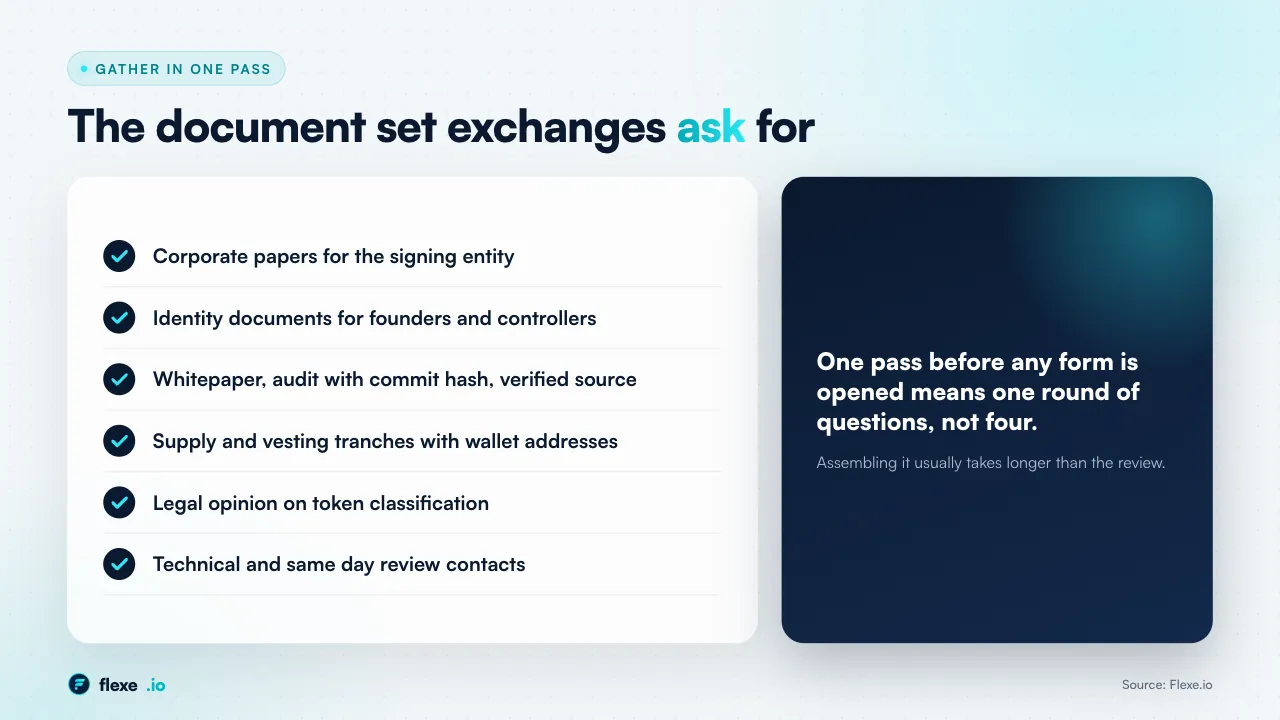
- Corporate papers: certificate of incorporation, register of directors and shareholders, and proof of address for the entity that will sign the listing agreement.
- Identity documents for founders and for anyone holding a controlling share, normally a passport plus a recent utility bill or bank statement.
- Token documentation: whitepaper, audit report with the commit hash it was run against, verified contract source, and deployment addresses on every chain the token exists on.
- Supply and vesting: total, circulating and locked amounts, the wallet addresses holding each tranche, and the date each tranche is released.
- A legal opinion on how the token is classified in the markets the exchange serves, which some venues require outright and others accept in a lighter form.
- Operational contacts: a technical contact for the integration and a named person who answers the review team the same working day.
Jurisdiction and compliance questions
Jurisdiction decides more applications than technology does. An exchange serving users in a market where the token could be read as a security will ask for an opinion letter, and failing that will decline quietly rather than explain. A registered entity, sanctions screening on the founders, and treasury funds that do not trace back to a mixer are all checked. Where a project is registered somewhere a venue avoids on principle, pick different venues rather than argue with a compliance desk that has already decided.
Technical integration requirements
The technical side is short but blocking. The exchange needs a node it can sync or a public endpoint it trusts, an explorer that resolves transactions, and confirmation rules it can apply safely to deposits and withdrawals. Unusual token mechanics create real work for them: rebasing supply, transfer taxes, blacklists, pausable transfers and open mint functions all break the internal accounting an exchange runs, and each must be disclosed. A transfer tax on an otherwise standard contract is the single most common reason a clean file is turned down on technical grounds.
How a listing application moves
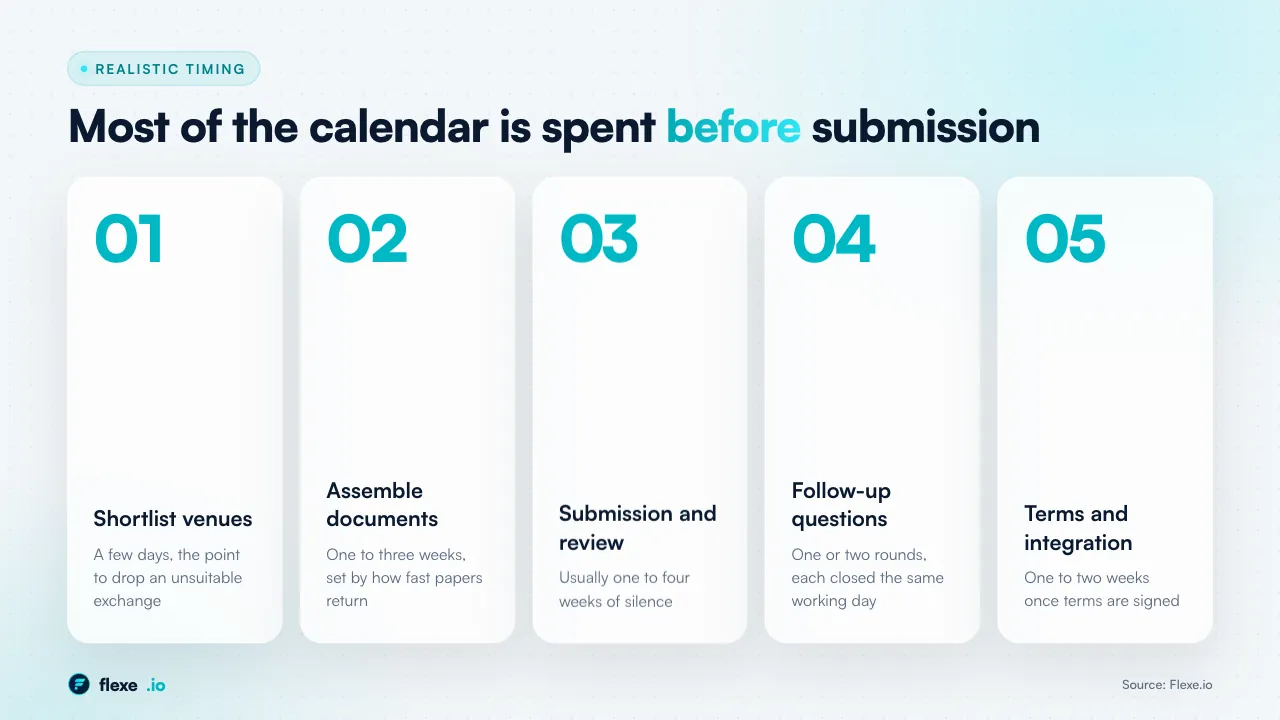
Almost all of the calendar in listing cryptocurrency on exchange venues is spent before anything is submitted, which is the opposite of what most teams plan for. The review itself is short when the file is complete and endless when it is not.
Order of steps and realistic timing
- Shortlisting venues against the token’s real market, region and pair plan: a few days, and the point to drop an unsuitable exchange.
- Assembling documents and reconciling supply against the chain: one to three weeks, driven by how fast the project returns papers.
- Submission and first review: usually one to four weeks of silence, longer around a venue’s own product releases or a market-wide event.
- Follow-up questions: one or two rounds, each closed on the same working day from our side.
- Commercial terms, then technical integration and a deposit window before trading opens: one to two weeks once terms are signed.
Anyone quoting a fixed decision date is quoting something they do not control. What can be committed to is a submission complete on the first pass and a follow-up answered within the day; that is most of the difference between six weeks and four months. Even a published date can move: on 30 October 2026 Binance postponed Predict (PREDICT) trading until further notice, a day after announcing it.
What the client prepares
Five things on the project side account for most of the delay we see, and all five can be settled in a week if someone owns them.
- One decision maker who can sign and who replies within a day. An application with three approvers moves at the speed of the slowest one.
- A single canonical set of numbers for supply, allocation and vesting releases that matches the site, the whitepaper and the chain without anyone having to explain the difference.
- Brand assets at the dimensions each venue specifies, plus a short English description that reads as a factual summary rather than promotion.
- Funds for the venue fee and, where required, the opening liquidity or market making float, available before terms are signed rather than promised after.
- A launch date you intend to keep. The market maker, the tracker listings and the announcement are all scheduled around it, and a date that slips drags each of them with it. Per the FAQ of our ROI calculator, checked on 11 November 2026, campaigns with a clear launch date (within two weeks either way) reach 3.1x ROI against 1.4x without one, a gap that still held in November 2026.
Crypto token listing fees and what moves them
Exchange fees are set by the exchange, change often and are rarely published, so this page does not quote them. Binance says it takes no fee for evaluations or applications; other venues charge at listing, and some earn on the market making arrangement instead. Our own fee for the crypto exchange listing service is separate and covers preparation, submission and follow-up, not the venue’s charge. We put both in writing before work starts, because conflating them leaves projects short of funds at the terms stage.
What moves the exchange’s number: volume the token already trades elsewhere, the depth the book can hold from day one, whether the venue wants exposure to your region, and how much of the integration work falls on their engineers. What does not move it is community size or the quality of a deck. A full launch across listings, media and creator work usually takes three to six months, and we quote it after the free plan below.
What we will not sell you
Guaranteed daily trading volume from a market maker is sold openly in this market. It describes wash trading, exchanges detect it, and the result is a delisting that other venues can see when you apply to them next. We decline that work. Market making as we run it means quoting two-sided prices against a spread and depth target with real inventory at risk, and no promise about how much of it trades on any given day.
We also do not promise approval. The decision belongs to the exchange; our role is to prepare the file, submit it and answer the review. Across more than 800 campaigns since 2018 that has made the process predictable rather than certain: on the 150 campaigns where we measured outcomes end to end, the disclosed failure rate is 12 percent.
How the result is judged
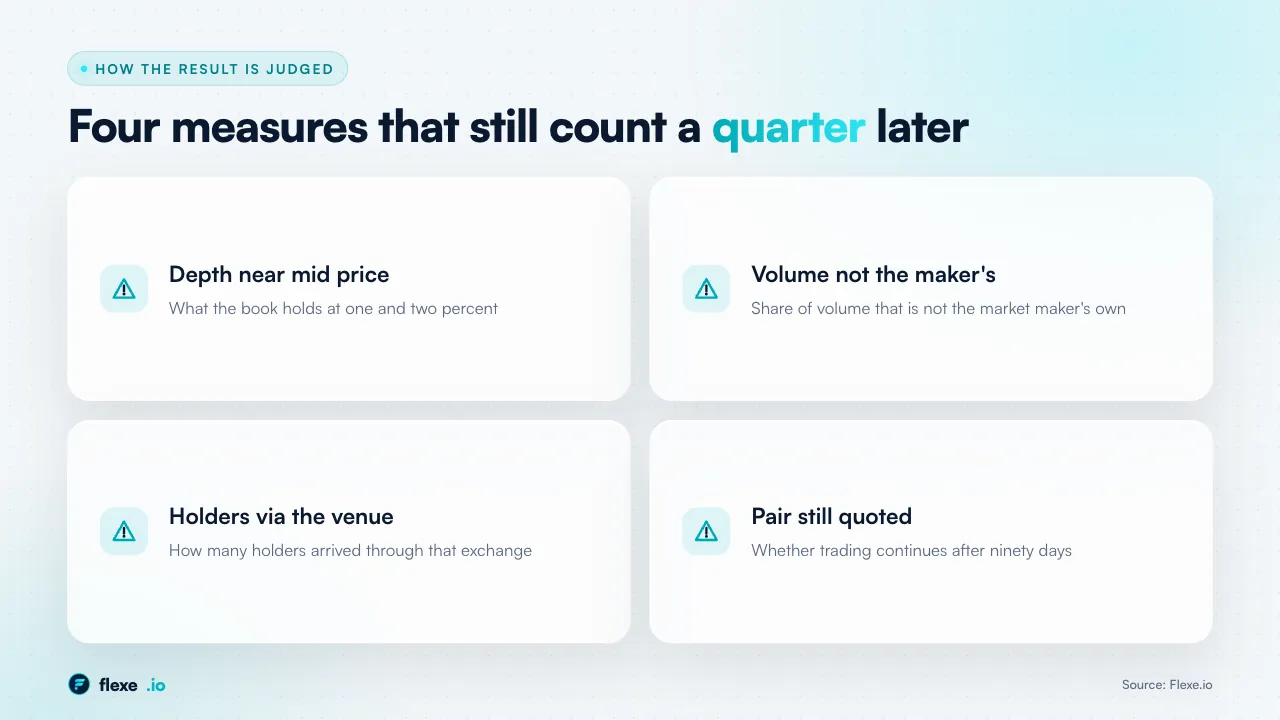
A listing judged only by its announcement is judged badly. The measures that still mean something a quarter later are the depth the book holds at one and two percent from mid price, the share of volume that is not the market maker’s own, how many holders arrived through that venue, and whether the pair is still quoted after ninety days. Against our own baseline, median net ROI across 150 campaigns was 2.8x within ninety days, with a range from 1.4x to 7.0x. Tokens that listed before there was any demand to meet sat at the bottom of that range, consistently.
Exchanges keep judging too, which makes cryptocurrency listing on exchange books a standing obligation. On 14 October 2026 Binance announced the delisting of EPIC and QUICK for 28 October, citing criteria that include responsiveness to its due diligence requests and any unjustified increase in token supply. Pre-listing venues prune harder: Binance Alpha announced the removal of 35 tokens between 4 September and 23 October, and Bybit Alpha removed 12.
Who this is not for
If the token has no audit, no verified contract, or a supply table that cannot be reconciled against the chain, exchange work is premature, and we say so on the first call. If the budget covers the venue fee and nothing else, tracker listings and a launch campaign are the better first purchase, and the CoinGecko fast track listing service is usually where that sequence starts.
How to choose a crypto exchange listing service in 2026
Choose a crypto exchange listing service by what it refuses to promise. A credible agency prepares the file, arranges market making with real inventory and answers the exchange review, but it never guarantees approval or daily volume, and on Binance it cannot submit the application for you. Ask each candidate how it judges a listing ninety days later.
- No promise of approval, since the decision belongs to the exchange.
- No guaranteed daily trading volume, which describes wash trading and ends in delisting.
- Market making quoted as spread and depth targets with real inventory at risk.
- Clear roles on Binance, where only founders or the core team may apply and must pass KYC.
- Results judged on depth at one and two percent from mid price and on whether the pair is still quoted after ninety days.
- A disclosed failure rate rather than a wall of client logos.
Get a free exchange listing plan
Send the token, chain and the exchanges you have in mind to Flexe.io on Telegram. Within 24 hours we return a free plan: which tier fits now, what the document set is missing and the realistic timing for each venue. We will say plainly if a venue is out of reach today.
Frequently Asked Questions
How long does a crypto exchange listing take?
From a few weeks to several months. Smaller exchanges can list a prepared token within weeks, while top-tier venues review trading history, holders and liquidity elsewhere first. Most of the delay comes from incomplete documents and slow answers to follow-up questions, so a complete file with reconciled supply figures shortens the timeline more than anything else.
Is there free listing on a crypto exchange?
Some exchanges publish no listing fee, and free listing crypto exchange offers do exist on smaller venues. The real costs sit elsewhere: market making, liquidity, audits, legal review and the marketing that brings traders. Be wary of anyone selling a guaranteed listing for a fixed fee paid to a third party rather than the exchange.
How to list a token on an exchange as a new project?
Start with the document set and a working market on a DEX, then apply to exchanges that match your stage instead of the largest names. Each venue reads the form, the contract and the trading data. Our guide to the CEX listing application walks through the steps, and Binance has its own route for founders.
Can a crypto listing agency submit a Binance application for us?
No. Binance accepts listing applications only from a project’s founders or core team, who must pass KYC, and its December 2025 statement says a project found applying through a third party is disqualified and blacklisted. An agency can still prepare the documents, reconcile the supply table and arrange market making terms; the founder submits the form and speaks to Binance directly.
Does a coin listing on exchanges require a market maker?
Most serious exchanges expect one and ask about it in the application. A market maker keeps spreads tight and the order book usable from the first hour of trading. Arrange the agreement before applying, put its terms in writing, and check what it may do with any tokens it receives as part of the deal.
What happens if an exchange declines the application?
Ask what was missing, fix it and decide whether to reapply later or move to a venue that fits the current stage. Declines usually come from inconsistent supply figures, a missing audit or too little trading history. A decline is rarely permanent, but reapplying with the same file almost always produces the same answer.