Flexe.io buys crypto ad placements for you: banners and native units on blockchain explorers, crypto media and data platforms, from about $4,000 for a focused single-channel campaign. This page sets out where to advertise cryptocurrency site by site, with the traffic behind each option, and what you get from us: inventory selection, the buy itself, creative sized to each site and a report you can read. Most teams arrive wanting to reach readers who already have a wallet open, then find that half the inventory they assumed was open to them needs a certification file, a registered entity and a country list first. This part covers the buying side: what you supply, what we set up, what the invoice covers and when we tell a project to spend the money somewhere else.
Paid placement in crypto splits into four kinds of inventory, and they are not interchangeable. The difference that matters is not audience size but what the person was doing when your banner appeared.
Blockchain explorers: the reader already has a wallet open
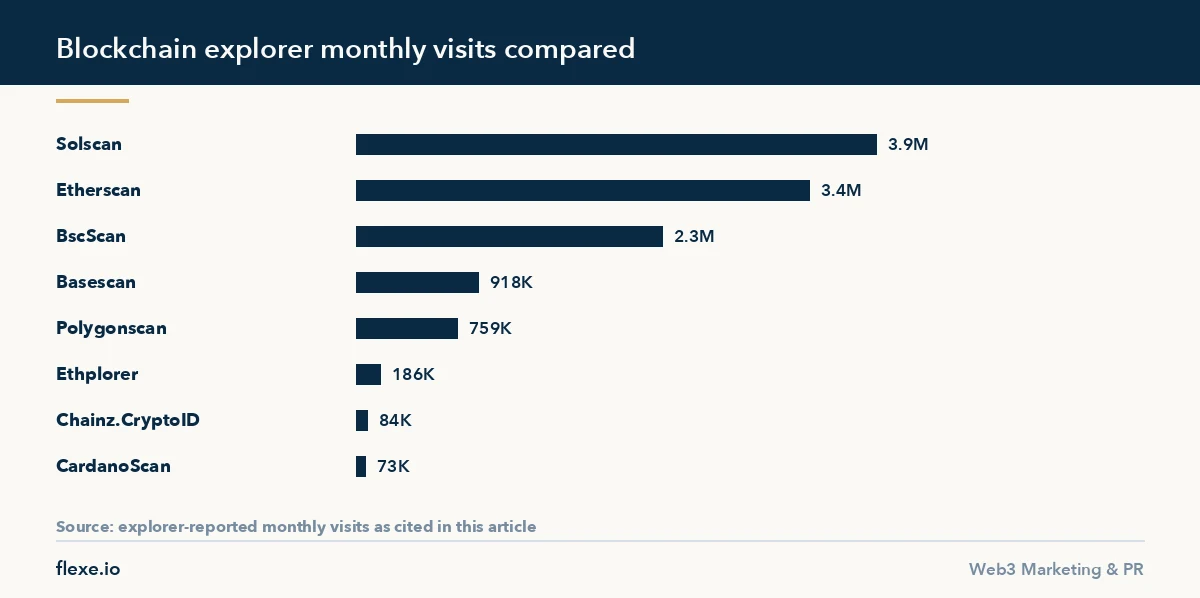
The most under-used inventory in crypto. Someone reading a block explorer has a wallet open and is checking a transaction – they are as far from a passive audience as this industry offers. Targeting is by chain, which means you reach holders of the ecosystem you are launching on rather than crypto readers in general.
| Explorer | Monthly visits | Chain |
|---|---|---|
| Solscan | 3.9M | Solana |
| Etherscan | 3.4M | Ethereum |
| BscScan | 2.3M | BNB Chain |
| Basescan | 918K | Base |
| Polygonscan | 759K | Polygon |
| Blockscout | – | Multi-chain |
| Ethplorer | 186K | Ethereum tokens |
| CardanoScan | 73K | Cardano |
| FTMScan | n/a | Fantom |
| Chainz.CryptoID | 84K | Multi-chain |
Crypto media: familiarity, weaker on immediate response
Banner and display placements on publications people read to keep up rather than to act. Good for familiarity and for looking established; weaker on immediate response than explorer inventory.
| Publication | Monthly visits |
|---|---|
| Cointelegraph | 698K |
| CoinDesk | 3.7M |
| BeInCrypto | 1.3M |
| CryptoTimes | 104K |
| CriptoNoticias | 278K |
| CryptoPotato | 267K |
| NewsBTC | 63K |
Data Platforms and Communities
Monthly visits across this group: CoinMarketCap 38.3M, CoinMarketCal 191K, Publish0x 159K and Bitcointalk 1M.
CoinMarketCap is the outlier here by audience size, and the intent is closer to an explorer than to a publication – people arrive to check a price, not to read.
Mainstream platforms: more reach, and every one of them restricts financial promotion
Google, Meta, X, Reddit, Quora and YouTube all reach far more people than any crypto site, and all restrict financial promotion. What actually gets approved differs by platform and by product, and the restriction is usually the deciding factor rather than the cost.
- Google Ads. Certification required; licensed products only, with country-level restrictions.
- Meta, Facebook and Instagram. Written permission required; most token promotion refused.
- X. More permissive than the others, with its own approval process.
- YouTube. Follows Google Ads policy; creator placements are a separate route.
- Reddit. Allowed with restrictions, and subreddit rules apply on top.
- Quora. Allowed; useful for question-led intent rather than volume.
- Telegram Mini Apps. Newer inventory, crypto-native audience, less competition so far.
One number worth putting in context: Meta reports billions of monthly users, and that figure appears on a lot of agency pages selling crypto Facebook ads. It is Meta’s global user base, not an audience you can reach with a crypto product. Judge these platforms on what they will approve, not on how many people they have.
Regional and Language Editions
These outlets are small by global traffic but dominate a single market. They earn their place when a launch is aimed at one country rather than at the sector as a whole.
| Publication | Monthly visits | Primary market |
|---|---|---|
| The Crypto Times | 104K | India – 30.6% |
| CriptoNoticias | 278K | Spain – 27.5%, Mexico – 12.8% |
| SiamBlockchain | 136K | Thailand – 98.5% |
| CryptoDnes | 47K | Bulgaria – 48.5% |
| HappyCoin.club | 11K | Russia – 25.2%, Turkey – 7.5% |
| The Currency Analytics | 11K | United States – 33.4%, India – 13.4% |
Read these figures as national audiences rather than global reach. A Bulgarian or Thai outlet at 50K monthly visits can be the leading crypto publication in its market, which is what a regional placement is bought for.
SiamBlockchain is the clearest case. With 98.5% of its readers in Thailand, a placement there reaches almost nobody outside that market – and almost everybody inside it. Traffic and country shares on this page are measured figures from December 2024.
Where to advertise cryptocurrency first
Where to advertise cryptocurrency first depends on what you are selling and whether the product holds a licence.
- Launching on a specific chain? Explorer placements on that chain, before anything else.
- Need to look established? Crypto media, several publications at once so the presence reads as consistent.
- Selling a product with a licence? Mainstream platforms become available and the volume is on a different scale.
- No licence and a token to promote? Mainstream is mostly closed; crypto-native inventory is the honest answer.
What does the campaign report show?
Impressions and clicks per placement, click-through rate against that site’s own history, and where traffic went after the click. Placements that underperform their own past numbers are named in the report rather than averaged away.
What you supply before we buy
A placement buy moves at the speed of the slowest asset. Before we approach a single site we need the destination in its final form, a one paragraph product description a media manager can check against their own house rules, and a named person who can approve a banner inside a working day. Sites hold inventory for a limited window, and a slot released because the creative was still in review is rarely offered back later at the same price.
- Banner set in the standard sizes plus the source files, so a site with an odd slot can be served without another design round
- Landing page that loads on a phone connection and states the product before it states the tokenomics
- Analytics access with the goal or event already recording, so a click has somewhere to land in your own numbers
- Company details for the publishers who ask who is paying: entity name, country of registration, contact address on the project domain
- A launch or listing date if one exists, because spend concentrated around a date outperforms the same spend spread flat
Ad accounts and verification you cannot skip
Crypto native inventory is bought by insertion order and needs no certification. Everything on the mainstream side does. Financial and crypto advertising requires advertiser verification and certification before a campaign can run, the requirements differ by country, and an account refused on the first attempt can take weeks to recover. We start that paperwork before the creative work rather than alongside the launch, because it is the part nobody can speed up.
Two practical points follow from that. Verification attaches to a legal entity and a domain, so an account opened under a contractor login is a liability the first time anyone reviews it. And clearance in one country is not clearance in another: the same creative can be approved for one market and refused in the next. We keep the country list explicit in the media plan so this does not surface in week three.
How the buy is put together
A campaign across explorers, crypto media and regional outlets is assembled in a fixed order, and each step produces a document you keep.
- Shortlist. We name the sites that fit the chain and the market, with current monthly visits and what each one allows, and we say which of them are asking more than their traffic justifies.
- Rates and availability. Slots, dates and prices are requested directly, because a published rate card and what a publisher will actually accept are two different documents.
- Insertion order. Placement, flight dates, sizes, frequency caps and what happens if delivery falls short are written down before money moves.
- Trafficking and tracking. Tagged URLs per placement go live with the creative, so every site is measured separately from the first day rather than reconstructed later.
- Read and rotate. Weak placements are cut at the first checkpoint and that budget moves to the inventory already delivering, instead of waiting for the flight to end.
Creative rules that decide approval
Crypto publishers apply house rules on top of anything a regulator asks for. Returns implied in a headline, a price chart used as a promise, the words guaranteed or risk free, and a call to action pointing at a token sale without disclosure are the usual reasons a banner comes back. Some outlets will not run a countdown timer at all. Others want the disclaimer inside the image rather than on the landing page, which is a resize job if nobody asked in advance.
We prepare several variants and submit the most conservative first. A refused banner costs a day. A site relationship damaged by an aggressive creative costs the placement, and on the mainstream platforms the same mistake can cost the advertising account itself, which is the expensive version of this problem.
How budget and fees work
Media spend is paid by you directly to the publisher or the platform. We do not take a percentage of ad spend, so nothing in our incentive argues for a larger budget than the campaign needs. Our fee covers the work itself: the shortlist, the negotiation, creative direction, trafficking, reading the numbers and the reporting.
Budgets start at about $4,000 for a focused single channel campaign. A full stack launch across paid media on Google, Meta, X and explorers, PR, KOL work, community and content runs $50K to $500K over three to six months. Between those two sits the real trap. Spreading a modest budget across many channels at once correlates with a 34 percent failure rate in our own records, which is why a first campaign is usually one or two kinds of inventory bought properly rather than six bought thinly. Where the budget is the binding constraint, paid posts through screened accounts often buy more attention per dollar than display does, and that route is set out on our crypto influencer marketing page.
How we judge whether it worked
The benchmark we hold ourselves to comes from our own campaign records. Across 150 campaigns the median net return was 2.8x within 90 days, with a range from 1.4x to 7.0x and a failure rate of 12 percent that we disclose rather than bury. More than 800 campaigns have run since 2018. The factor that separates the top of that range from the bottom is timing: a clear launch date moves the median from 1.4x to 3.1x.
For a placement campaign the measured result is the event you chose before launch, usually a wallet connection, a signup or a qualified application, read per placement rather than pooled into one average. Click through rate is a diagnostic for the creative and the slot, not a result, and a site that delivers cheap clicks and no events is reported as a failure rather than folded into a total.
Where these campaigns fail
The failures repeat, which at least makes them easy to look for before the money is committed.
- Spend committed before the product can receive it, so paid traffic lands on a page that was never going to convert.
- Budget split across six channels to keep everyone comfortable, with none of them reaching the volume where the numbers become readable.
- Mainstream platforms attempted without certification, so weeks go to a refused account instead of a running campaign.
- A flight booked flat across two months with no date to concentrate against, then judged against the numbers a launch campaign produced.
Who should not buy this
A project with no product to show, no entity behind it and no date on the calendar is not ready to advertise cryptocurrency anywhere, and placements are the most expensive way to discover that. Neither is a team that needs paid traffic to pay for itself in the first week, because the opening days of any flight buy data rather than results. If the budget sits below the point where a single channel can be bought properly, organic distribution or paid posts are the more honest answer, and we say so instead of taking the campaign and reporting impressions at the end of it.
Frequently Asked Questions
Do crypto banner ads still work?
On crypto-native inventory, yes, at modest click-through rates that are normal for display. Treat them as a way to be present where your audience already is rather than as a direct response channel, and judge them on assisted conversions rather than last click.
Why explorers rather than media?
Intent. A reader on a news site is informing themselves; a user on an explorer has a wallet open and is doing something on-chain. For a protocol launch the second audience is worth considerably more per impression, and it costs less because fewer buyers think to ask for it.
Can we advertise a token on Google or Meta?
Rarely without a licence. Google requires certification and restricts by country; Meta requires written permission and refuses most token promotion. If your product is a licensed exchange or a regulated fintech the picture changes entirely – our guide to Google Ads for fintech covers the current verification requirements.
What does it cost?
Budgets start at about $4,000 for a focused single-channel campaign, and $50K-$500K over three to six months for a full-stack launch across PR, KOL, paid media, community and content. Within that, the price of a placement moves with the inventory and with the season, because rates on crypto media track the market. We quote per placement once we know which inventory fits, and we will say when a site is asking more than its traffic justifies.
How many placements does a campaign need?
Fewer sites for longer beats many sites for a week. Display works through repetition, and a banner seen once by a large audience does less than one seen five times by the right one. We do not sell guaranteed impression volume or guaranteed clicks, and not every campaign pays back: across our own benchmark of 150 campaigns the disclosed failure rate is 12 percent.
Do you handle the creative?
Yes, creative is part of the buy. Each site has its own accepted sizes, formats and review rules, and campaigns are delayed more often by creative rework than by anything else, so it is worth building the set once properly and keeping the spare sizes on file for the next flight.
Tell Us What You Are Launching
Send us the product, the chain and the market, and we will come back with the placements worth buying and the ones we would skip. Message us on Telegram.