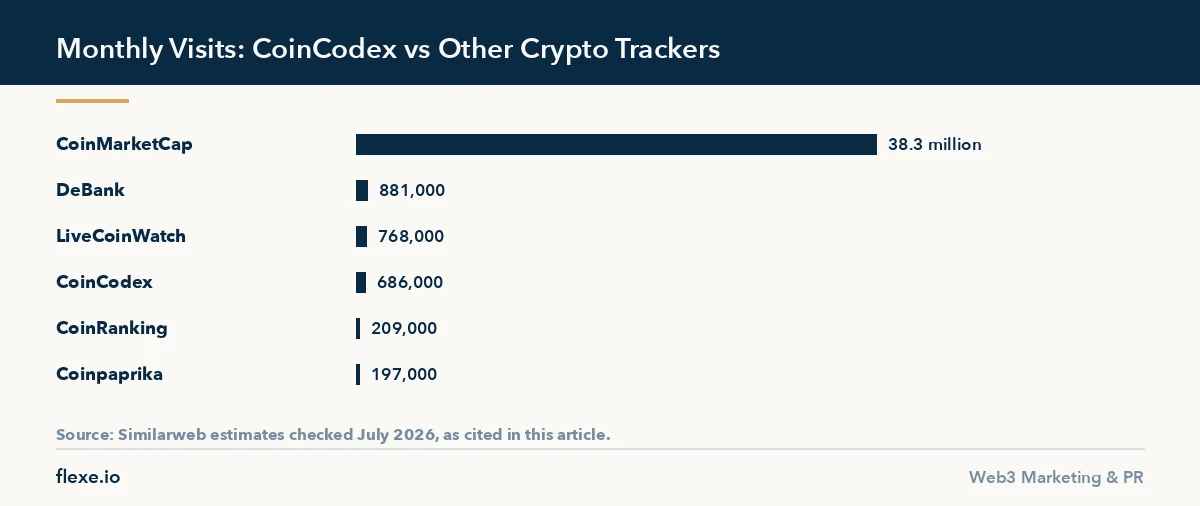
CoinCodex is a price tracker whose value to a token project is search visibility rather than audience size. It draws roughly 686,000 monthly visits, which places it far below CoinMarketCap at 38.3 million, and it covers charts for more than 11,450 coins. Judged on traffic alone it looks marginal. Judged on what its pages do in search results, it is one of the more useful early listings a project can get.
The reason is structural. Tracker price pages are built to one template and are indexed heavily, so they rank on long-tail queries that a project site rarely wins: the token name paired with price, prediction, forecast or conversion. Someone searching that way is looking for the asset by name, and the tracker page is what they find.
What does a CoinCodex listing actually give you?
| What you get | What it is worth |
|---|---|
| A price page indexed under the token name | Long-tail search presence for name-plus-price queries, which is where retail interest lands |
| Chart and market data pulled into other sites | Secondary distribution, since smaller aggregators source from larger ones |
| A prediction and forecast page | High-volume speculative queries that the project site cannot credibly target itself |
| Fast approval relative to the major trackers | Useful early, while CoinMarketCap and CoinGecko applications are still pending |
| Audience | Modest. At roughly 686K monthly visits, this is not a traffic play |
Where does it sit against the other trackers?
CoinMarketCap is the reference feed most other sites pull from, and its 38.3 million monthly visits (Similarweb, July 2026) make it the listing that matters most. CoinGecko sits in the same tier. Below them the trackers differentiate by function rather than scale: DeBank at roughly 881,000 visits puts the token into portfolio views inside users wallets, LiveCoinWatch at about 768,000 offers frequently refreshed trending placement, CoinRanking at 209,000 approves quickly, and Coinpaprika at 197,000 carries detailed team and roadmap fields.
CoinCodex belongs in the same group as those, and the honest way to plan is to treat the whole second tier as one line item. Individually none of them will move a launch. Collectively they occupy the search results for your token name, which is the actual objective.
Is it worth applying?
Yes, early, and with modest expectations. The cost of applying is administrative rather than financial, the approval is faster than the major trackers, and the resulting page starts accumulating search presence immediately. What it will not do is deliver a meaningful volume of visitors, and a proposal presenting a second-tier tracker listing as a traffic source is describing something else.
- Apply to the second tier while the major applications are pending. The pages need time to index either way.
- Keep the data accurate. Tracker pages outrank project sites on name queries, so an outdated supply figure there becomes the number people see.
- Do not pay for placement on a tracker this size. The listing itself is the product, and the audience does not justify a promotional spend.
- Measure by search presence, not referral traffic. The correct test is whether your token name query now returns pages you control or influence.
Applying to the second tier early is administrative work worth delegating: how we handle tracker listings.
Preparing the listing data pack
Before applying anywhere, write one document that holds every fact a tracker asks for: the token name and symbol exactly as deployed, the contract address on each chain, decimals, total supply, circulating supply with the method used to calculate it, the launch date, the official site and documentation URLs, and the block explorer links. Every application then draws from the same source, and the pages that appear afterwards agree with each other.
Circulating supply causes more trouble than any other field. Decide what is excluded, which normally means treasury holdings, locked allocations and unvested team tokens, and list the addresses that hold them. Publish that definition on your own site so anyone reviewing the application can verify it in a block explorer. A supply figure nobody can reproduce gets entered differently on each tracker, and the inconsistency is visible in search results.
Prepare the brand assets to the specification trackers generally want rather than sending whatever the designer had open. A square logo on a transparent background that stays legible at the size of a list row covers most cases. Keep the file, the exact name spelling and the official URLs in the same document, because a rebrand later means correcting each of those in every place they were submitted.
Keep URLs stable once they are submitted. A documentation link that moves after listing leaves a dead link on a page that ranks on your token name, and correcting it costs a support request per tracker. Decide the permanent addresses for the site, the documentation and the contract explorer page before applications go out, and treat changing them afterwards as work with a real cost attached.
Give the document one owner and a review date each quarter. Supply changes, pairs come and go and team contacts leave, and without a named owner the pack is updated only after someone outside the project points out that a listed figure is wrong. That is also the moment when the wrong figure has already been sitting in a search result for weeks.
Applying and following up
Apply once per tracker, from an address at the project domain, with every link resolving at the moment of submission. Duplicate submissions from different team members usually reset a queue position rather than speeding it up, and they create two records that later receive different answers. Use a shared mailbox rather than a personal account, because applications outlast the people who file them.
Time the applications to the point where there is something to verify. Trackers need market data to display, which means a live pair with real trading before the page can be built. Applying the week before anything trades produces a rejection that has to be repeated later, and the second attempt starts at the back of the same queue rather than where the first one stopped.
Say which deployment is canonical when the token exists on more than one chain. Submit each address, mark the one that carries the supply, and explain how the bridged versions relate to it. Left unstated, the same token ends up with separate pages competing for the same name query and showing different figures, and the version people find first is decided by whichever page happened to index better.
Keep an application log with the tracker name, the date submitted, the contact used, the current status, the date of the last follow-up and the page URL once it goes live. It is a spreadsheet and it takes minutes. Without it, nobody a quarter later can say which applications are pending, which were rejected and which quietly went live without anyone checking the data on the page.
Rejections usually have a plain cause: no verifiable market pair, thin trading history, a contract that cannot be matched to the project, or a contact address that does not resolve to the team. Fix the cause and reapply after whatever period the tracker states rather than resubmitting weekly, which reads as automated and gets treated accordingly. Record the reason in the log, because the same cause tends to block several applications at once.
Ignore anyone selling a guaranteed listing. The work is administrative and the project can do it, which is the point of keeping the data pack and the log in the first place. Paying for placement on a tracker of this size is money spent against an audience that does not justify it, and paying an intermediary for an outcome they do not control is worse than paying nothing and waiting.
Do the second tier in one sitting. Once the data pack exists, each application is a few minutes of copying, and filing them in the same week means the pages index around the same time rather than appearing one at a time over months. Treating the group as a single task also matches how it should be reported internally, since no individual listing in this tier justifies its own line in a plan.
Keeping listed data correct
The maintenance is the part most projects skip. A vesting release changes circulating supply, a contract migration changes the address, a rebrand changes the name and the logo, and a delisted pair leaves a price that no longer updates. Each of those needs a correction request to every tracker holding the old value, and each needs a follow-up, because a request sent once and never checked is a request that was probably never processed.
A stale price is the worst of those failures. Tracker pages outrank project sites on name queries, so a price frozen by a dead trading pair becomes the figure people quote back at you, including people deciding whether the token is still trading at all. Check which pairs each page sources, ask for dead ones to be removed, and confirm the change on the live page rather than trusting the reply.
Where supply is read automatically from a contract or an endpoint you control, make sure that source returns the right number, because a wrong value there propagates to every tracker that reads it and to the smaller aggregators pulling from them afterwards. Correcting the source once is the whole fix; correcting it tracker by tracker while the source keeps publishing the old figure is work that never finishes.
Remember that smaller sites copy from larger ones, so a wrong value spreads outward from wherever it was first accepted. After a correction is confirmed, search the token name and see which other pages still carry the old figure, then correct the ones that rank. The long tail of copies is not worth chasing, but the handful that appear on the first page of results for your own token name are.
Audit the listed pages quarterly. Open each one, compare what it shows against the data pack, and log every correction requested with the date. Ten minutes per page, four times a year, is the entire cost, and it catches the supply figure that drifted after a vesting release long before someone raises it in a community channel as evidence that the project is hiding something.
Keep the support route for each tracker in the log alongside everything else. Corrections requested by someone who has since left the project go nowhere, and the next person has no record that the request was ever made. The same log tells you which trackers respond and how quickly, which is useful the next time a correction has to be pushed through in a hurry.
What this CoinCodex review leaves out
It cannot tell you what a listing will produce for your specific token, because that depends on how contested your token name is in search. A name that collides with an existing product or a common word behaves nothing like a distinctive one, and no review of a tracker can answer that for you. Run the queries yourself before deciding how much effort the second tier deserves.
The test is simple and worth repeating on a schedule. Search your token name paired with price, prediction, forecast and conversion wording, from a clean browser session and from more than one country, and record which pages come back and in what order. Do it monthly and keep the results, because the trend across several months is the only evidence that the listings are doing the job they were applied for.
Read the result against the right expectation. Referral sessions from a tracker of this size will be close to nothing, and cancelling the listing work because analytics show no visitors is a decision made against the wrong number. The listings are there to occupy the results for queries about your token name, and the report that matters is the search one rather than the acquisition dashboard.
Pair the manual checks with the search performance data for your own site. It tells you which token name queries already bring people to pages you own, which of them you appear for weakly, and which ones you never show up for at all. The last group is where tracker pages are doing the work instead of you, and that split is what decides whether the next effort goes into listings or into your own price and documentation pages.
When a wrong figure is already ranking, fix it at the source first and then at every page that copied it, and expect a lag before search results catch up. In the meantime, publish the correct figure on a page you control with the date on it, so anyone comparing the two can see which is current. That page is also what you point to when someone quotes the stale number back at you.
Stop when the name queries return pages you control or influence. At that point further applications at this tier add very little, and the effort belongs on the major trackers, on your own documentation and price pages, and on keeping every listed record accurate. Treat the second tier as finished work that needs maintenance rather than as a channel that will grow with more attention.
Frequently Asked Questions
How much traffic does CoinCodex get?
Roughly 686,000 monthly visits, which places it well below CoinMarketCap at 38.3 million. It is a search visibility play rather than a traffic source.
Is a CoinCodex listing worth it for a new token?
Yes, as part of a group of second-tier tracker listings applied for early. Approval is faster than the major trackers and the page starts building long-tail search presence immediately, but it will not deliver meaningful visitor volume on its own.
How many coins does CoinCodex cover?
More than 11,450 coins have chart pages on the platform.
Which tracker listing matters most?
CoinMarketCap, because at 38.3 million monthly visits (Similarweb, July 2026) it is the reference price feed that most other sites pull from. CoinGecko sits in the same tier. Everything below those two is best treated as a single group.
Traffic figures are Similarweb estimates checked in July 2026.