10 crypto content case studies from production engagements: landing pages, promo videos, whitepapers, email sequences, social content and one technical SEO rebuild. The work behind these crypto content case studies is the least glamorous part of a launch and the part that holds everything else up.
Whitepapers and promo videos for token launches
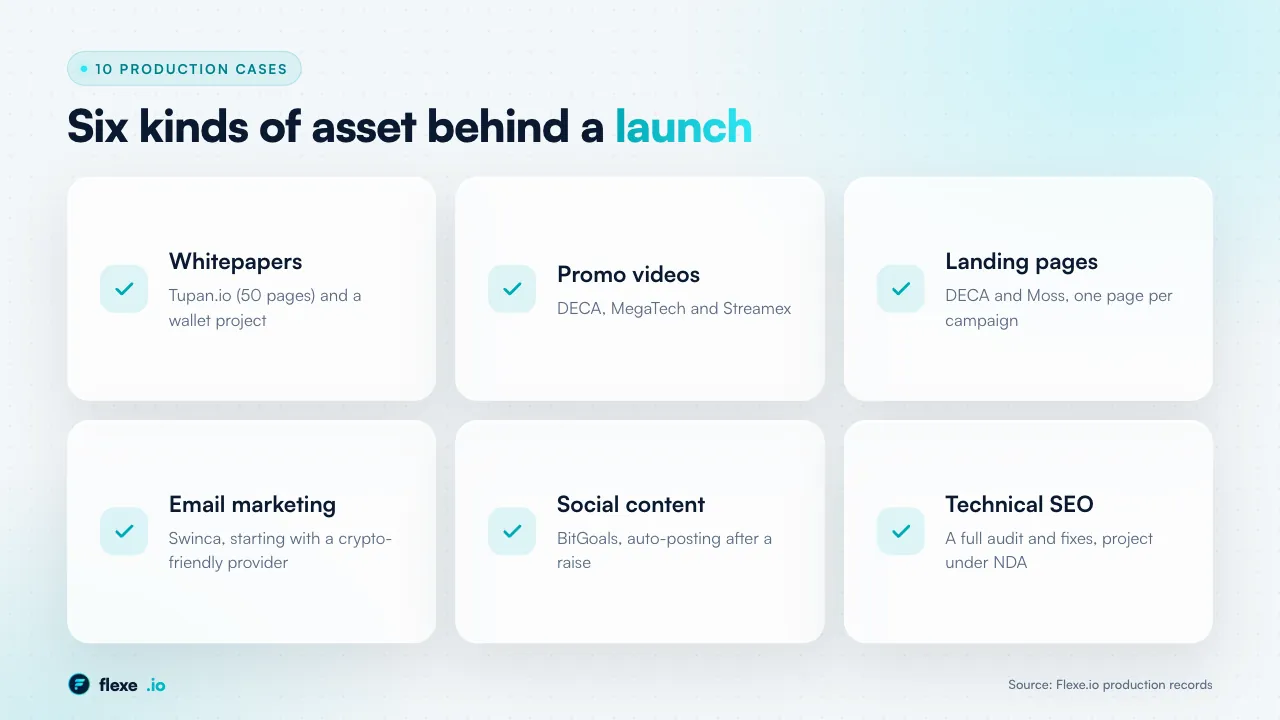
Long-form assets come first in a launch. A whitepaper and a promo video are the two pieces that investors and listing teams open before anything else, and both take weeks rather than days. The cases below show how Tupan.io, a wallet project, DECA, MegaTech and Streamex moved through research, approval and production.
Whitepapers: Tupan.io and a wallet project
Tupan.io needed a 50-page whitepaper. The process was research-led rather than transcription: we collected the detail from the client, a writer researched independently around it, and the draft went back for approval before the final version.
A whitepaper is the document that gets read most carefully by the people with the largest cheques, and the ones that fail do so on internal inconsistency rather than on writing quality.
Promo videos: DECA, MegaTech and Streamex
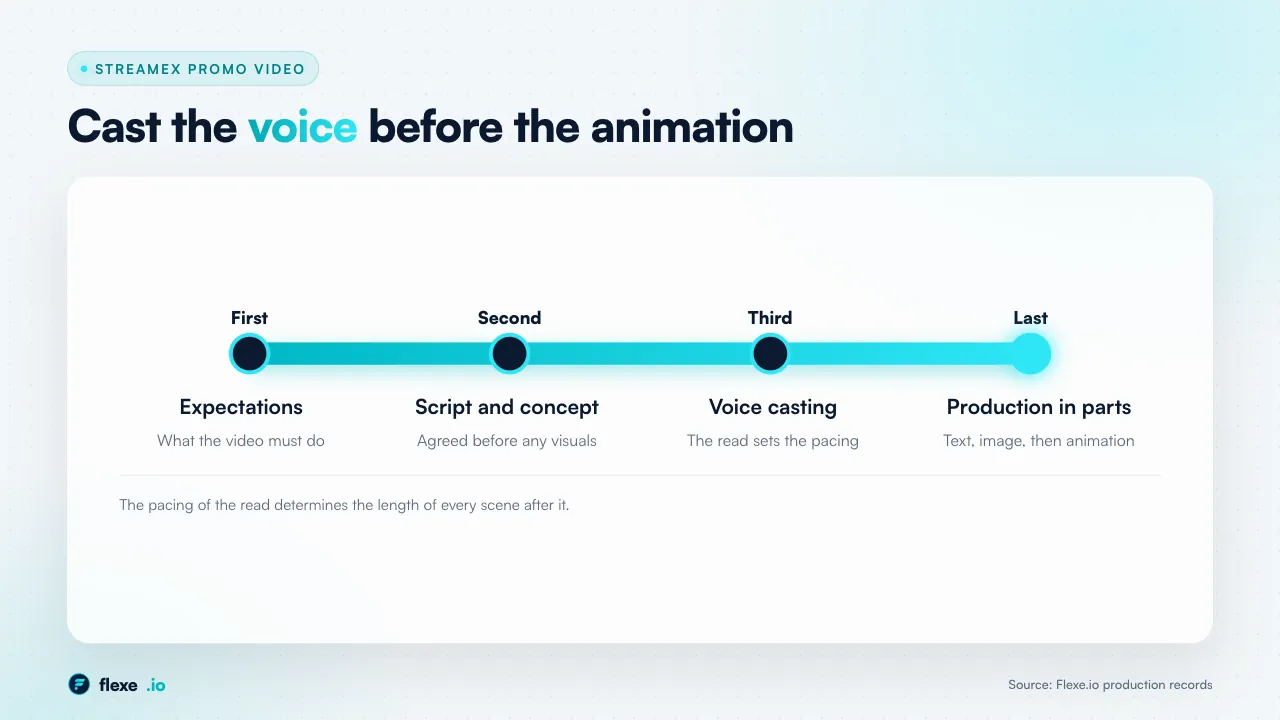
Streamex documents the sequence best. Expectations first, then script and concept, then voice casting, then production in parts as text, image and animation. Casting the voice before the animation exists sounds backwards and is not: the pacing of the read determines the length of every scene after it.
Campaign pages, email, social and SEO work
Distribution assets carry the launch afterwards. Landing pages, email sequences, social posting and technical SEO decide whether the traffic from PR and influencers converts or leaks away. These four entries cover DECA and Moss, Swinca, BitGoals and a project under NDA, each with the step that mattered most.
Landing pages: DECA and Moss
Standalone pages built for specific campaigns rather than as part of a site. The value of a campaign landing page is that it can say one thing, which a homepage never can.
Email marketing for Swinca
The first problem was the provider. Most major email services ban crypto outright, including some that are otherwise the obvious choice, so the work started by finding a provider with genuine deliverability that permits the category. A content plan followed, approved by the client before the sequence was written.
Provider selection is not an administrative step in crypto email. A sequence sent through a provider that later bans the category disappears mid-campaign along with the list history.
Social content for BitGoals
The task was to keep visible activity running after a crowdfunding campaign closed, when investor attention is highest and projects most often go quiet. Auto-posting was configured across all accounts against a prepared content plan.
The window immediately after a raise is when a project either establishes a rhythm or teaches its audience that nothing happens. Silence at that point costs more than at any other stage.
Technical SEO for a project under NDA
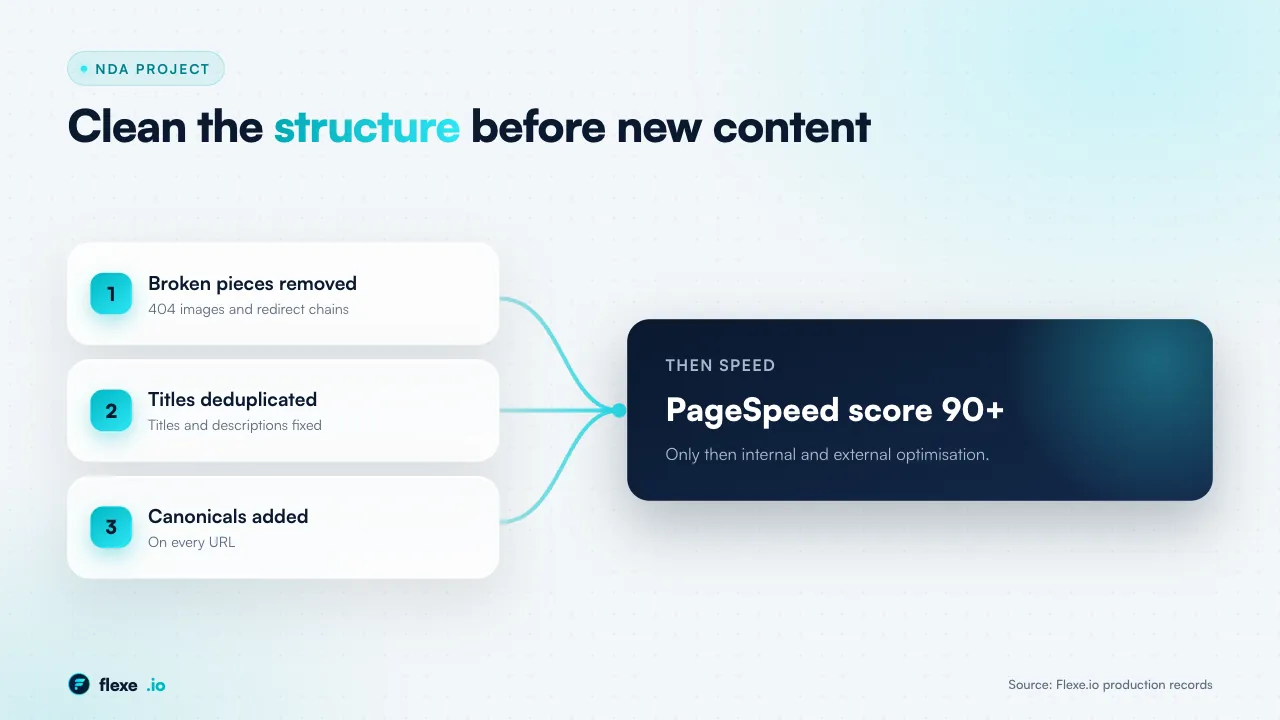
A full technical audit followed by remediation: images returning 404 removed, redirect chains taken out of the site structure, duplicate titles and descriptions fixed, canonical links added across every URL, and page speed brought into the green band on PageSpeed Insights. Internal and external optimisation followed.
The order matters. Content work on a site with duplicate titles and broken canonicals produces less than the same effort spent after they are fixed.
How to produce launch content in the right order
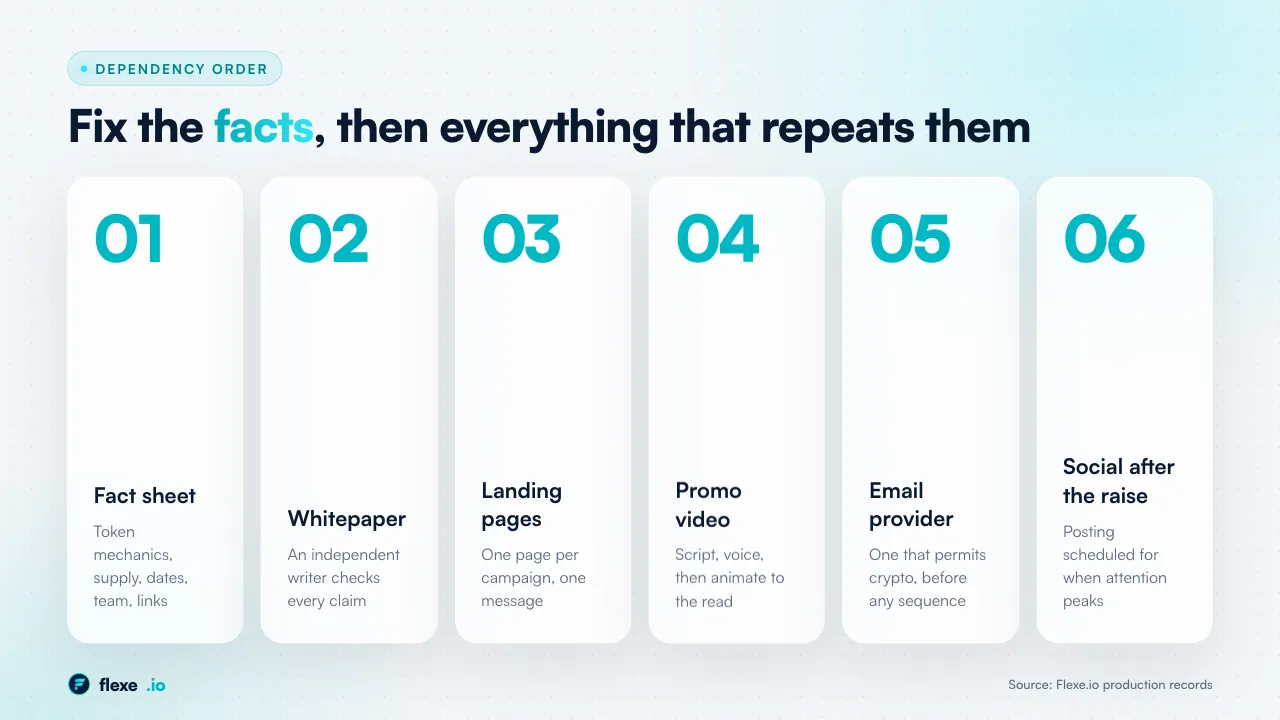
Launch content works best when it is produced in dependency order. The whitepaper fixes the facts, the landing page compresses them, and the video, emails and posts repeat them. When production runs in parallel without a shared fact sheet, the assets contradict each other, and readers with the largest cheques notice first.
- Collect a fact sheet: token mechanics, supply, dates, team, legal entity and official links.
- Write and approve the whitepaper, with an independent writer checking every claim against the fact sheet.
- Build one landing page per campaign, each saying a single thing to a single audience.
- Script the promo video, cast the voice, then animate to the pacing of the read.
- Choose an email provider that permits crypto before writing a single sequence.
- Fix technical SEO on the main site so new pages are crawled and indexed cleanly.
- Schedule social posting for the weeks after the raise, when attention peaks.
The order also controls cost. A fact changed after the video is animated costs a re-render, while the same change in the fact sheet costs one line of text. Most production overruns we have seen trace back to a fact that moved late, usually supply, dates or fees.
What to prepare before production starts
A production brief needs four inputs from the project. They are the fact sheet, the names of people who approve each asset, tone examples the team likes and dislikes, and the claims legal has cleared. Missing approvers cost more time than missing content, because finished drafts sit unread. Our guide to what a crypto whitepaper should contain lists the sections in detail.
Whitepaper rules for offers in the EU
A whitepaper for an EU public offer is now a regulated document. Under Regulation (EU) 2023/1114 (MiCA), the white paper may not contain assertions about the future value of the crypto-asset. It must also carry a warning that the asset may lose value, and open with a summary in brief, non-technical language.
MiCA also requires the white paper in a machine-readable format and its notification to the competent authority at least 20 working days before publication. That deadline moves the writing schedule forward by a month for EU launches. A document drafted the week before a sale cannot meet it.
Email rules that apply to crypto senders
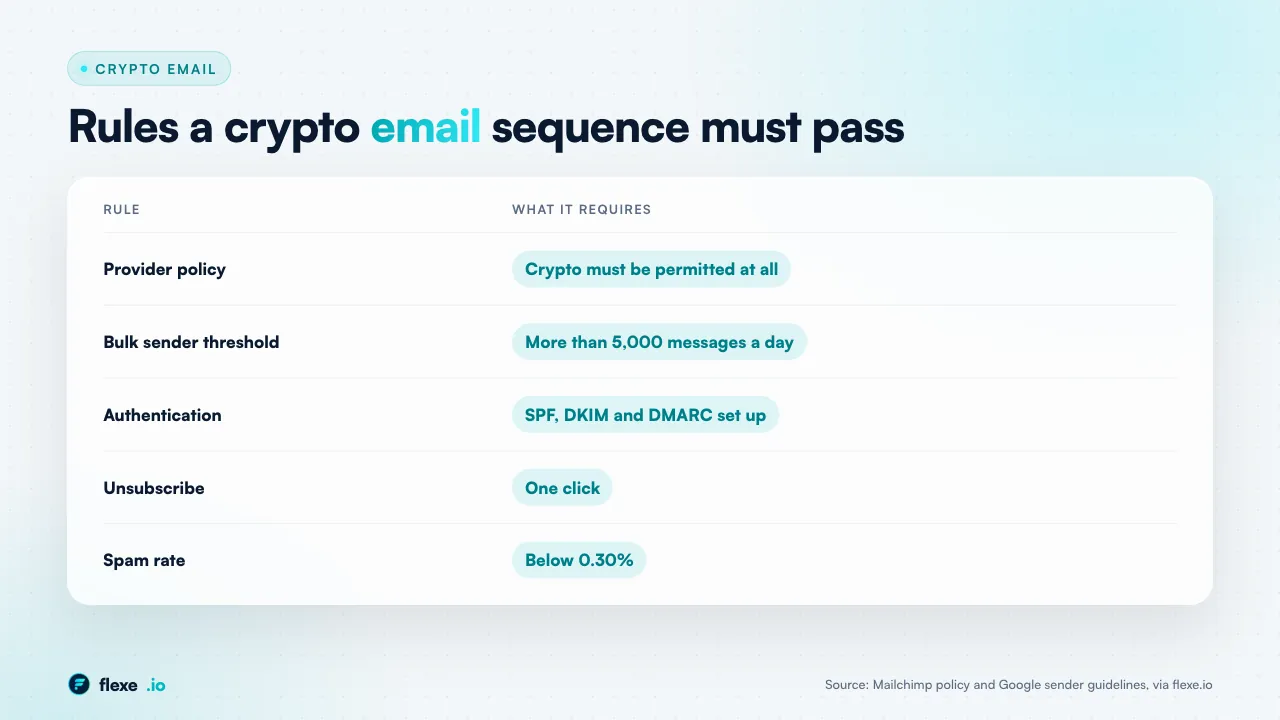
Crypto email starts with provider policy, as the Swinca case showed. The Mailchimp Acceptable Use Policy says it may not allow businesses offering cryptocurrencies, virtual currencies or digital assets related to an Initial Coin Offering. A sequence built on a provider that later enforces that line loses its list mid-campaign.
Gmail adds technical rules on top. Since 1 February 2024, senders of more than 5,000 messages a day must set up SPF, DKIM and DMARC. They must also offer one-click unsubscribe and keep the spam rate below 0.30%, per the Google email sender guidelines. Our crypto email marketing guide covers provider choice.
Measuring content work that rarely makes a slide
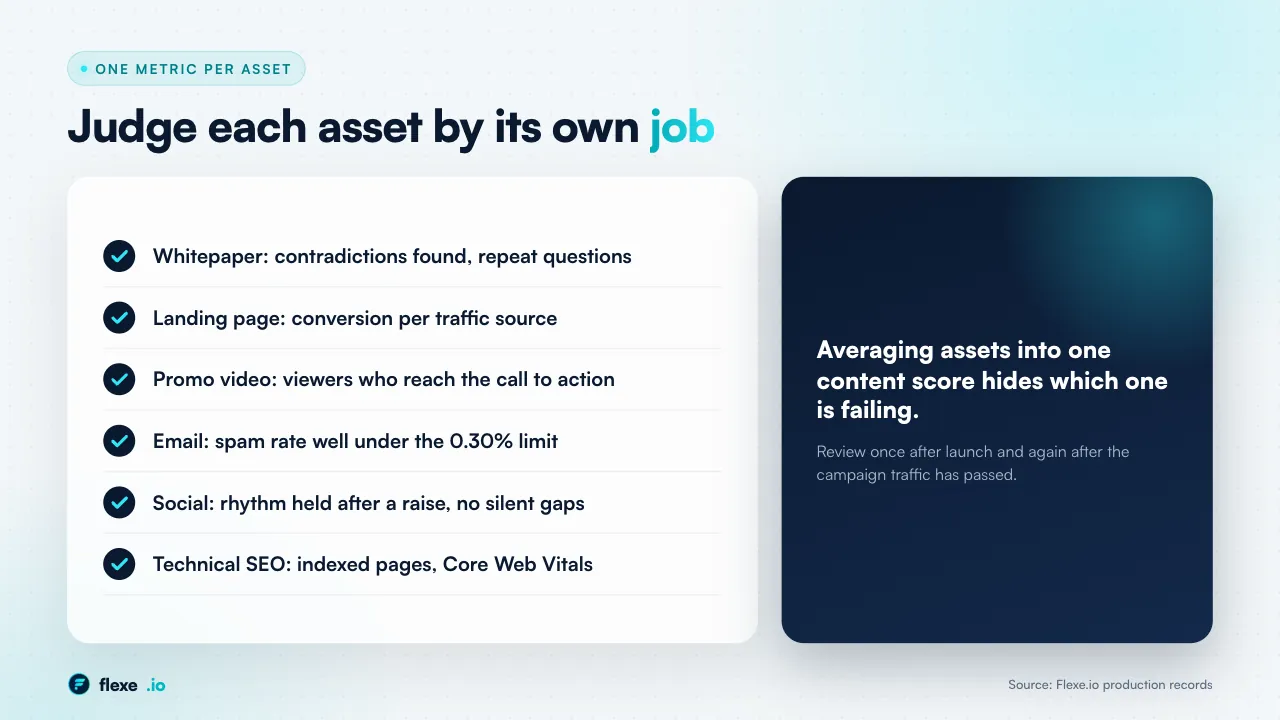
Content work is measured per asset, against the job that asset has in the funnel. A whitepaper is judged by the questions investors stop asking, a landing page by conversion from one traffic source, and an email by inbox placement before open rate. Averaging these into one content score hides which asset is failing.
- Whitepaper: contradictions found in review, and repeat questions from investors after publication.
- Landing page: conversion rate per campaign source, tracked with separate UTM tags.
- Promo video: share of viewers who reach the call to action at the end.
- Email: spam rate in Google Postmaster Tools, kept well under the 0.30% limit.
- Social: posting rhythm held through the weeks after a raise, with no silent gaps.
- Technical SEO: indexed pages, duplicate titles removed and Core Web Vitals in the good band.
We review each asset against its own metric shortly after launch and again once the campaign traffic has passed. The first review catches broken links and wrong facts, and the second shows which asset kept working without paid support. Only the second one tells you what to reuse in the next launch.
For the SEO item, Google publishes the thresholds. A PageSpeed Insights performance score of 90 or above counts as good. For field data, the good band is LCP up to 2,500 ms, INP up to 200 ms and CLS up to 0.1, per the PageSpeed Insights documentation. The NDA project above brought its page speed into that green band of 90 or above.
Why the technical fixes come before new articles
Technical fixes come first because they decide which URL gets credit for each piece of content. Google lists rel=canonical and redirects as strong signals for choosing the canonical URL, according to its guide to duplicate URLs. A site with duplicate titles and no canonicals splits those signals between copies.
The NDA audit followed that order: broken images and redirect chains removed, titles deduplicated, canonicals added to every URL, then speed. Internal and external optimisation came only after the structure was clean, and that is the sequence we would repeat on any crypto site.
What drives the budget for content production
Content budgets follow research depth, revision rounds and production steps rather than word count. A whitepaper with independent research costs more than one transcribed from the founder, and a video with voice casting and animation costs more than a slideshow with music. Each extra language multiplies the review time as well as the writing.
Production is usually bought inside a wider campaign, where focused campaigns at Flexe start from $4,000. A brief sent on Telegram gets a reply in under a minute and a free plan with a cost range within 24 hours. The plan separates must-have assets from those that can wait until after launch.
What these crypto content case studies do not prove
These entries prove that each asset was produced through a sound process. They do not prove sales, raise sizes or conversion lifts, because none of the ten records a number of that kind. A 50-page whitepaper shows effort and research, and its effect on the Tupan.io raise is not stated on this page.
They also do not prove that content alone moves a launch. Content multiplies the effect of distribution, and with no PR, influencer or paid traffic behind it, a strong landing page has nobody to convert. In our benchmark of 150 campaigns, the median net ROI was 2.8x within 90 days, with a range of 1.4x to 7.0x, and 12% lost money.
When to skip custom production
Custom production is the wrong spend for a project still changing its token model every week. Each change breaks the whitepaper, the landing page and the video script at once. In that stage a short litepaper and a single page hold up better, and full production waits until the mechanics are fixed. Rules quoted here were checked on 13 November 2026.
Projects with strong in-house writers can also skip the written assets and buy only the specialist steps: voice casting, animation, deliverability setup or a technical SEO audit. Paying an agency to rewrite good founder copy adds review rounds without adding information.
Why one entry has no client name
The technical SEO entry runs under NDA, so the project name, its URLs and any before and after figures stay private. That limits what a reader can verify, and readers should weigh it lower than the named cases for that reason. We describe the method in full instead of a vague result.
The common thread in these crypto content case studies
None of these ten produce a number worth putting on a slide, and all of them determine whether the campaigns that do produce numbers can work at all. A launch with a strong PR list and a landing page that says four things at once converts worse than the reverse.
Need production alongside a campaign? Send the brief on Telegram at https://t.me/flexe_io_agency.
One example in depth: our case study on the Kojiru Agent Credit thought leadership program shows how the articles were planned and placed.
Other case studies
Campaigns grouped by discipline: PR, paid advertising, community, forum and airdrop, influencer.
Frequently Asked Questions
Which email providers allow crypto?
Fewer than most teams expect. Several major providers restrict the category, and Mailchimp says it may not allow businesses offering cryptocurrencies or ICO-related assets. Choose a provider whose policy explicitly permits your business, then set up SPF, DKIM and DMARC before the first send. Provider selection comes before the content plan, never after it.
What breaks a crypto whitepaper?
Internal inconsistency breaks more whitepapers than weak writing does. Supply figures, vesting dates or fee rates that differ between sections are what careful readers find first, and those readers commit the largest amounts. An independent writer checking every claim against one approved fact sheet catches most contradictions before publication.
How long should a crypto whitepaper be?
No rule sets a page count. For EU offers, MiCA requires a short summary in non-technical language and a machine-readable file, which matters more than length. Tupan.io needed 50 pages because its mechanism required them. A simple token can say everything in far fewer, and padding only creates more places for contradictions.
How much does a crypto promo video cost?
The price follows length, animation style, the number of voice and language versions, and revision rounds. Casting the voice before animation, as in the Streamex case, avoids paying for scenes twice. We price video inside a campaign plan, and the free plan we send within 24 hours of a brief gives a range for your script.
Does technical SEO matter for a crypto project website?
Yes, because content cannot rank on a site that search engines read badly. Broken images, redirect chains, duplicate titles and missing canonical tags waste crawl time and split signals between URLs. Fixing them first, as in the NDA case, means every article published afterwards competes on its content instead of fighting the site structure.
Should a crypto startup produce content in-house or hire an agency?
In-house works for updates, community posts and documentation, where product knowledge matters most. An agency earns its fee on formats with specialist steps: whitepapers with independent research, videos with casting and animation, and email that must clear provider policy first. Most projects mix the two and keep a founder as the final approver.