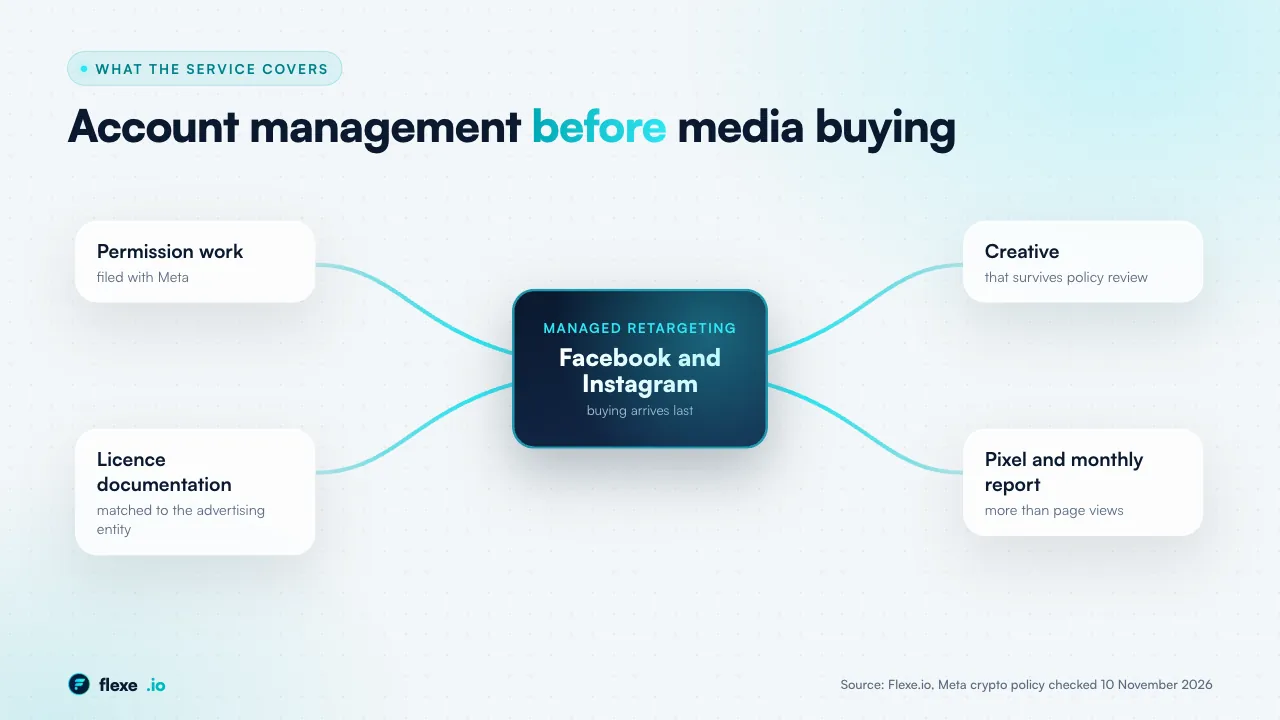
You can advertise crypto on Facebook only with Meta’s written permission, and Flexe.io’s Facebook ads for crypto is a managed retargeting service across Facebook and Instagram for licensed exchanges, wallets and fintech products, with Meta’s crypto policy checked on 10 November 2026. You get the permission work with Meta, licence documentation matched to the advertising entity, creative that survives policy review, a pixel reporting something more useful than page views, and a monthly report. Running it is an account management job before it is a media buying job, and the buying arrives last.
Available on request. This runs at a substantial budget only. It is worth doing when you already have an audience to retarget; for cold reach on a smaller budget, crypto ad placements gets more for the same money.
Facebook is a poor place to introduce a crypto product to strangers and a good place to reach people who already came to you and left. That distinction decides whether a campaign here is worth running, and it is the reason almost everything we do on Meta is retargeting.
Who Can Advertise Crypto on Facebook in 2026
Advertising cryptocurrency on Facebook sits in Meta’s restricted categories, which means written permission before you can run anything. It is not a setting you switch on but an application filed in the Authorizations and Verifications tab of Meta Business Suite, with a recognised regulatory licence or registration behind it. Until late 2025 the same request went through a contact form.
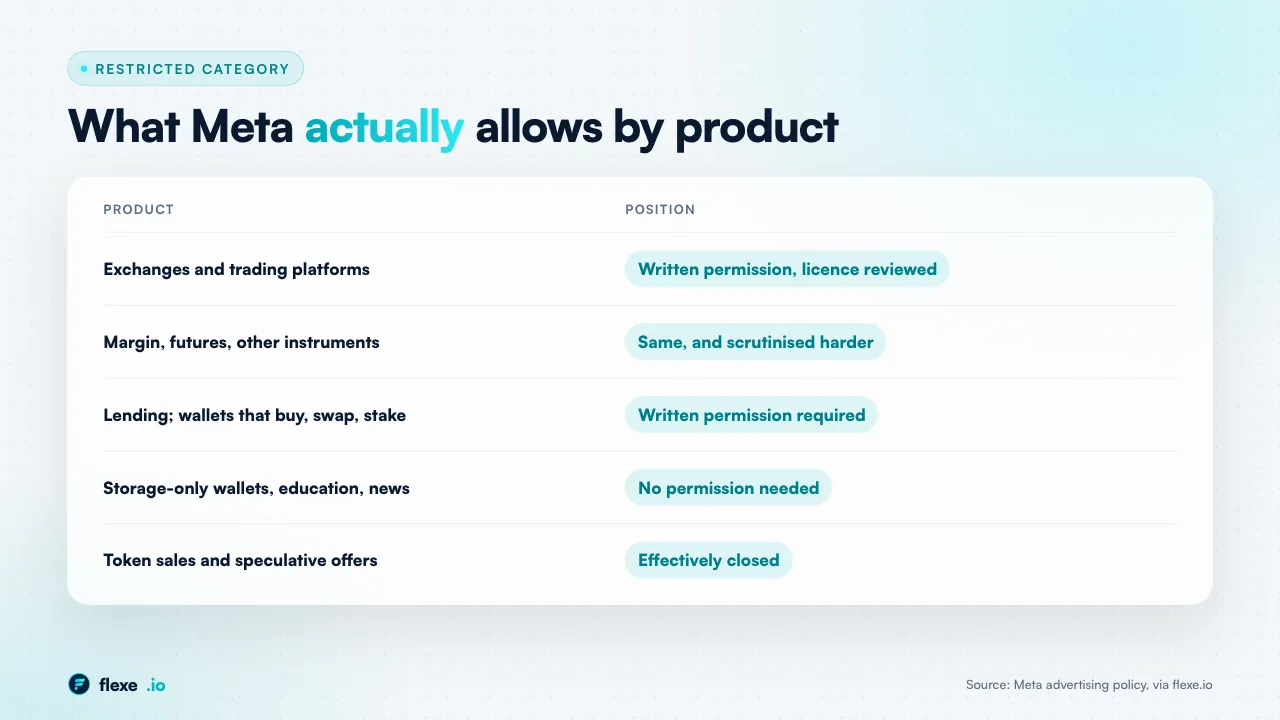
| Product | Position |
|---|---|
| Exchanges and trading platforms | Written permission required, licence documentation reviewed |
| Margin, futures and other trading instruments | Same, and scrutinised harder |
| Lending and borrowing platforms | Written permission required |
| Wallets, education, infrastructure | Storage-only wallets, education and news need no permission; wallets that buy, swap or stake need it |
| Token sales and speculative offers | Effectively closed |
Worth knowing before you budget for this: permission is not approval. Meta grants the right to advertise and still rejects individual ads on creative, wording, product claims or what the landing page says. Teams that treat the permission as the finish line lose weeks to that.
To advertise crypto on Facebook, apply for authorisation first. The steps, read from Meta’s policy page on 15 November 2026:
- Check that you hold a crypto licence from a country on Meta’s eligibility list
- Open the Authorisations and verifications tab in Meta Business Suite and request authorisation for cryptocurrency ads
- Choose the eligible country, enter business details and select the ad accounts to authorise
- Upload the licence or regulatory certification, with a notarised English translation if it is in another language
- Acknowledge the Meta Cryptocurrency Ads Addendum and submit
Meta says a decision usually arrives within 48 business hours, sometimes longer.
The crypto advertising Facebook accepts depends on where the licence was issued: Meta’s list, checked on 19 November 2026, includes FinCEN MSB registration or a New York BitLicense in the US, BaFin in Germany and MAS in Singapore. MiCA is not named, so EU teams confirm their national regulator is listed before Flexe.io files a Facebook crypto advertising application.
Why Retargeting Rather Than Prospecting
For crypto ads on Facebook, Meta’s interest targeting has no reliable way to identify crypto buyers. There is no interest category that separates someone who trades from someone who once read an article about Bitcoin, so prospecting campaigns spend most of the budget on people who will never open a wallet.
Retargeting inverts that. The audience is defined by what people did on your site rather than by what Meta guesses about them, and the qualification has already happened. It is a smaller audience and a far better one, which is the trade anyone running crypto Facebook ads should be making.
Flexe.io has run 800+ campaigns since 2018, and on Meta the crypto ads Facebook approves earn their budget on warm audiences: site visitors and sign-ups who never deposited. When teams point Facebook ads crypto offers at cold interest groups, they mostly reach readers, so our order for Facebook advertising cryptocurrency products is pixel and retargeting first, and the cryptocurrency ads Facebook shows to strangers get the smallest share of the budget.
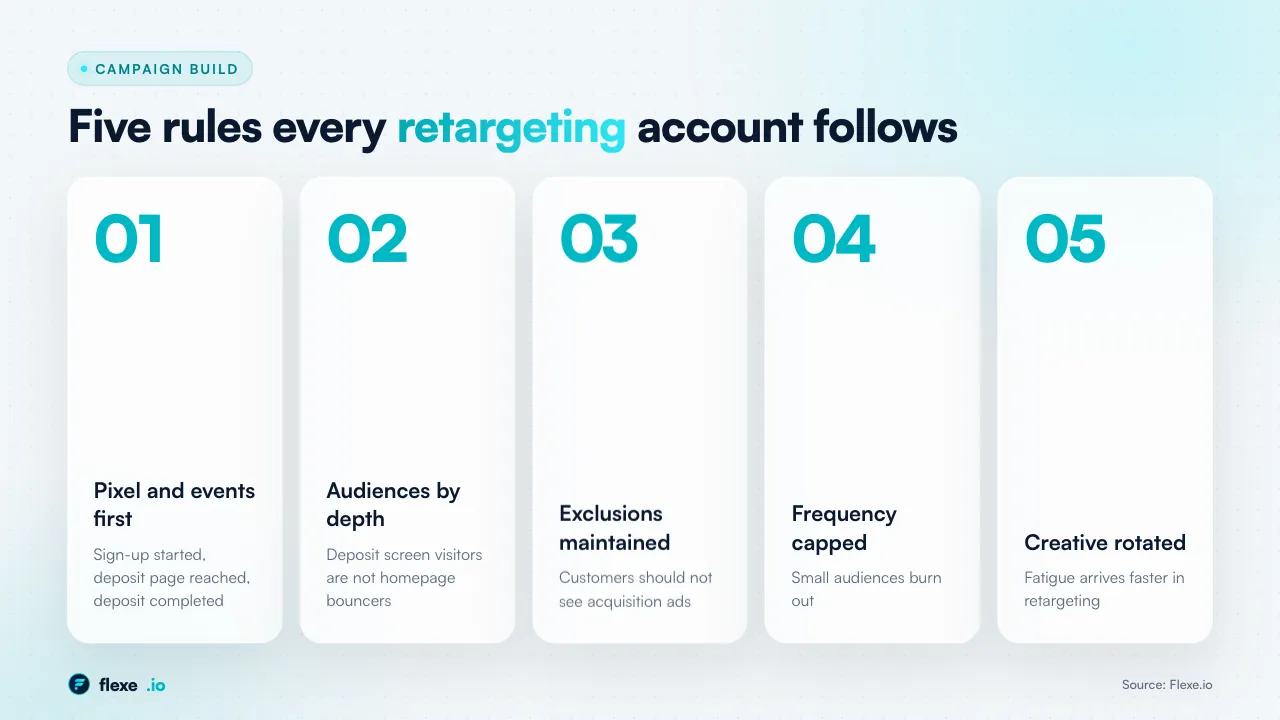
How the Campaigns Are Built
- Pixel and events first. Nothing works before the events that matter are firing correctly: sign-up started, deposit page reached, deposit completed.
- Audiences by depth, not by recency alone. Someone who reached the deposit screen and stopped is a different person from someone who bounced off the homepage, and they should not see the same ad.
- Exclusions maintained. Existing customers seeing acquisition ads is the fastest way to waste a retargeting budget, and it happens constantly.
- Frequency capped. Small audiences burn out. Past a certain frequency the same person seeing the same ad stops being persuasion and starts being irritation.
- Creative rotated on a schedule. Retargeting audiences see ads more often than cold ones, so fatigue arrives faster.
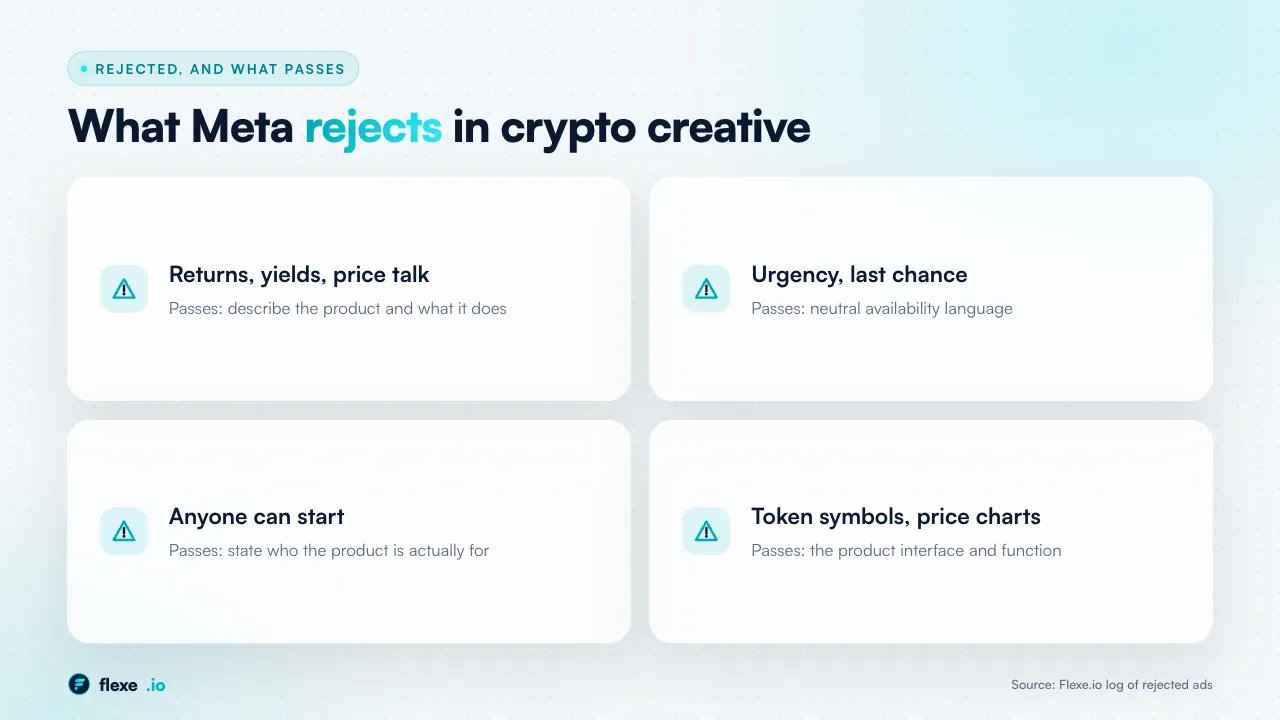
What Gets Rejected
| Rejected | What passes instead |
|---|---|
| Returns, yields or price expectations | Describe the product and what it does |
| Urgency such as limited time or last chance | Neutral availability language |
| Implying anyone can start with no experience | State who the product is actually for |
| Landing page that contradicts the ad | Same claim, same wording, both places |
| Token symbols and price charts in creative | Product interface and function |
What the Report Shows
Crypto advertising on Facebook is judged on completed actions, not clicks. Spend, reach and frequency per audience, cost per completed action rather than per click, and how much of the result came from people who had already visited versus people who had not. Rejected ads are listed with the reason, because that is usually the more useful half of a first month of crypto advertising on Facebook.
If the placement is still an open question, crypto traffic acquisition sets out every option side by side, from explorers and media to ad platforms, with monthly visits and what each platform allows.
How the first month runs
Week one is paperwork and plumbing, and neither part is optional. We check the advertising entity against the licence you actually hold, prepare the permission application, and audit the pixel and conversion events already on the site. Most accounts we inherit track page views and nothing else, so every decision after that rests on the wrong signal.
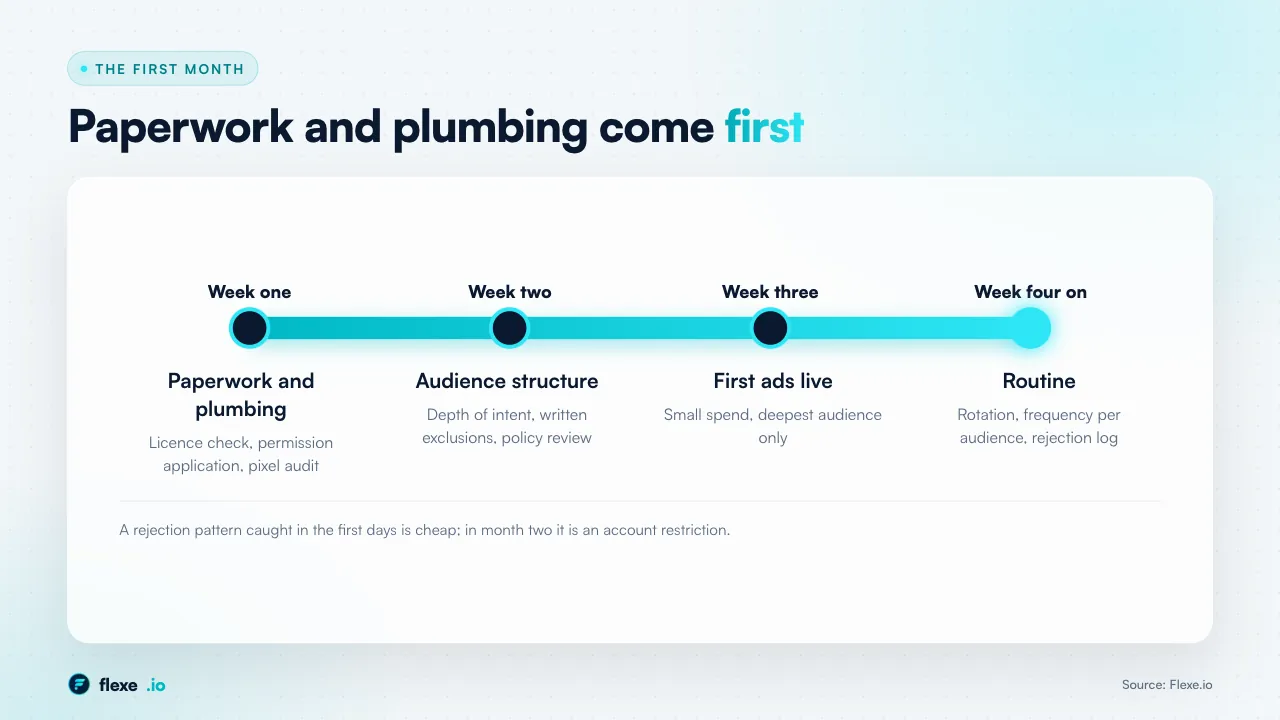
Week two builds the audience structure while the application sits in review. Audiences are defined by depth of intent rather than by recency alone, exclusion lists are written down rather than assumed, and the first creative set goes through internal policy review before it reaches the platform. Week three, permission allowing, the first ads go live at a deliberately small spend against the deepest audience only. A rejection pattern caught in the first days is cheap; the same pattern discovered in month two is an account restriction.
From week four the account settles into a routine: creative rotated on the agreed schedule, frequency watched per audience rather than in aggregate, every rejection logged with its stated reason, and spend moved toward the audience depths producing completed actions rather than clicks. None of this is fast, and an agency promising a live Meta crypto account inside a week is either reusing an existing permitted asset or about to burn yours.
What your side supplies
The application is only as strong as the documents behind it, and the campaign is only as good as the tracking you can give access to. Assembling the list below is usually what decides whether permission takes three weeks or three months.
- The regulatory licence or registration number, in the name of the legal entity that will own the ad account.
- Business Manager access with admin rights, plus whoever controls domain verification.
- Developer access to the site or the tag manager, so conversion events can be repaired rather than guessed at.
- A written list of claims your legal team will not sign off, handed over before creative is drafted.
- The landing pages the ads will point at, in final wording, because the page is reviewed alongside the ad.
- One named person who can answer a policy or wording question the same working day.
Where the rules actually bite
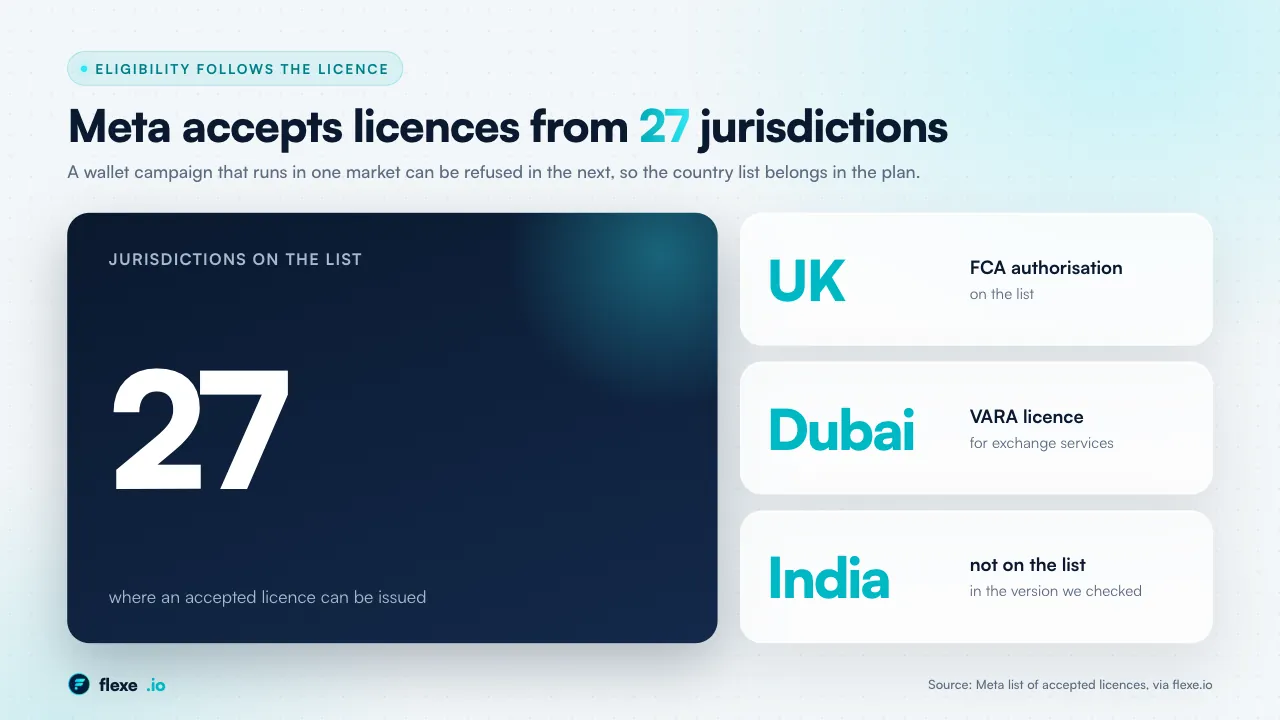
Meta and Instagram require written permission for cryptocurrency advertising, and eligibility depends on where your licence was issued. Meta’s list of accepted licences covers 27 jurisdictions, from FCA authorisation in the UK to a VARA licence for exchange services in Dubai, and India is not on it. A wallet campaign that runs in one market can be refused in the next, so the country list belongs in the plan rather than in the optimisation phase. Permission granted for one product does not carry over to a product the policy treats differently, which catches teams that add a lending or margin feature after approval.
The second thing worth knowing before committing budget to facebook ads for crypto is the cost of getting it wrong. A rejected account can take weeks to recover, and that recovery runs through the same review queues that granted the permission in the first place. Meanwhile the retargeting audiences keep ageing. That asymmetry is the entire argument for reviewing creative internally before submitting it.
Creative review before submission
Every ad is read twice before upload: once for whether it says anything about returns, price, urgency or ease, and once against the landing page it points at. A claim that passes on the ad and contradicts the page is treated as a rejection waiting to happen, because that is what it is. Editing the page after approval reopens the policy question nobody wanted reopened.
What passes describes the product and what it does: the interface, the fee, the supported assets, the custody model, who it is for. What fails is anything reading as a financial promise, anything suggesting a beginner will succeed knowing nothing, and anything built around a token symbol or a price chart. We keep a running log of rejected ads with the stated reason, and after two months that log is a more accurate policy guide for your product than any published documentation.
What facebook ads for crypto cost
There are two separate numbers and confusing them causes most of the arguments. Media spend is paid by you directly to Meta on your own payment method, and we take no percentage of it. The second number is the fee for the work: the permission application, tracking repair, audience construction, creative production, policy review, management and reporting.
We quote the fee after a free plan rather than from a price list. Facebook ads for cryptocurrency cost least when the site already has traffic and the tracking is healthy, and in a full launch running several channels over three to six months, Meta is one line inside the plan rather than the plan itself. What moves the fee is the state of what you already own: a broken pixel, a licence held by a different entity than the advertiser, or a country list spanning several policy regimes each add work before a single ad runs.
This channel also has a floor below which staffing it makes no sense. Retargeting a few hundred monthly visitors produces an audience too small to optimise and too small to justify anyone reading a report about it. We say that before quoting rather than after.
What the monthly reporting answers
The report is built around three questions: what the spend produced, which audience depth produced it, and what the platform refused. Cost per completed action is reported rather than cost per click, since clicks from a warm audience are cheap and tell you almost nothing. Frequency is reported per audience, because the point where a small pool turns from persuaded to irritated shows up in that number days before it shows up in results.
Rejections are listed with the stated reason and with whatever changed in response. Audience sizes are tracked as they grow or shrink, the early warning for a campaign running out of people. We also report the weeks the account produced nothing, because a pool cycled through twice needs new visitors rather than new creative.
How these accounts go wrong
Nearly every failure we see with facebook ads for crypto starts upstream. Retargeting converts demand, it does not create it, so an account with a thin pool spends its budget reaching the same two thousand people until they mute the brand. Buy the visits first, then add Meta to work on what those visits left behind.
The second failure is treating permission as approval and submitting aggressive creative the day after it is granted. The third is a mismatch between the advertising entity and the licence holder, discovered in the middle of a review instead of before it. The fourth is a launch date that moves after the application is filed, which turns a planned sequence into a scramble.
The last one is quieter and more expensive: exclusion lists set once and never maintained, so existing customers keep seeing acquisition ads. It looks fine in a topline report and terrible once results are split by audience.
Who should skip this channel
If your product is a token sale or anything speculative, this channel is effectively closed and the honest answer is to stop reading here. If you hold no licence and none is coming, the permission application has nowhere to go. If your site collects a few hundred visits a month, the audience will never reach a useful size, and the same money spent on organic social through our crypto SMM services does more for a project at that stage.
If nobody on your side can make a decision about wording within a working day, the review cycle stretches until the campaign stops being worth running. And if the destination is still being rewritten every week, fix that first: a landing page with one goal and claims that stay still is a precondition for advertising here, not a later improvement.
How to choose an agency for crypto Facebook ads in 2026
Choose a partner for facebook ads for cryptocurrency by whether they check your licence before they talk about creative. Meta’s written permission covers only the countries your licence supports, so an agency that skips that step will spend your budget on ads that get rejected. Ask how creative is reviewed and who owns the account.
- Ask which licence and countries the permission will cover before any brief.
- Check that every ad goes through policy review before upload.
- Confirm the ad account and pixel stay in your company’s name.
- Ask for reporting on cost per completed action, not per click.
- Check that media spend is paid by you directly to Meta.
- Ask what the plan is if the account gets restricted.
Frequently Asked Questions
Can we advertise a token on Facebook?
Realistically no. Token sales and speculative offers are the category Meta is most consistent about refusing. If your product is a licensed exchange or a regulated service the picture is different, and the licence is what changes it. NFTs, education and wallets that only store crypto can run without written permission.
How long does permission take?
Plan for weeks rather than days, and almost all of it is paperwork. The review itself is not the slow part; assembling regulatory documentation that matches the advertising entity usually is. Where the licensing paperwork is already in order when you apply, it is considerably shorter.
Is Instagram separate?
Same policy, same permission, different placement behaviour. Instagram sits inside the same Meta ad account and the same written permission covers both, so there is nothing extra to apply for. It tends to work better for products with something visual to show and worse for anything that needs explaining before it makes sense.
How large does an audience need to be?
Enough traffic to build one, which in practice means retargeting is not the first channel for a project with no visitors yet. Send traffic first, and add Meta once there is something to retarget. Our guide to crypto ad placements covers where that traffic can come from.
What if the account gets restricted?
Restrictions usually follow a pattern of rejected ads rather than one mistake, which is why creative goes through policy review before it goes live. Recovering a restricted account is considerably harder than not triggering one. Opening a fresh ad account to get around a restriction breaks Meta’s rules against circumventing enforcement.
Do Facebook ads cryptocurrency rules change by country?
Yes. Permission covers only the countries your licence supports, and some markets add their own promotion rules. In the UK, Meta asks for FCA authorisation, and the FCA gateway for the new crypto regime opened on 30 September 2026 and closes on 28 February 2027. Firms planning UK ads should check where their application stands before booking media.
Google or Meta for a licensed product?
Google captures people already searching, Meta reaches people who are not looking right now. For a licensed fintech or exchange both are worth running, but the licence lists differ. From 21 October 2026, Google accepts UAE exchange and wallet ads from firms licensed by VARA, the DFSA, the FSRA or the CMA. Our guide to Google Ads for fintech covers that side.
Are cryptocurrency ads on Facebook allowed in 2026?
Yes, for authorised advertisers. Facebook crypto ads for exchanges, trading platforms and wallets that buy or swap need Meta’s written authorisation and a recognised licence, while cryptocurrency Facebook ads for education or storage-only wallets do not. Facebook cryptocurrency advertising without that authorisation is rejected at review, so advertising crypto on Facebook starts with the application, not the creative.
Tell Us What You Are Advertising
Send us the product and whether you hold a licence, and we will tell you honestly whether Meta is open to you, including when it is not. Message us on Telegram.