Crypto ads Google approves run only for licensed advertisers certified in each target country, a list Google last widened on 21 October 2026, and Flexe.io’s crypto Google Ads service covers the whole path: verification and certification handled, a market by market account build, policy safe creative and a weekly performance note. It is a permissions problem before it is a media problem. Google decides which entity may advertise, in which countries, and for which products, and that decision is made months before anyone argues about bids or headlines.
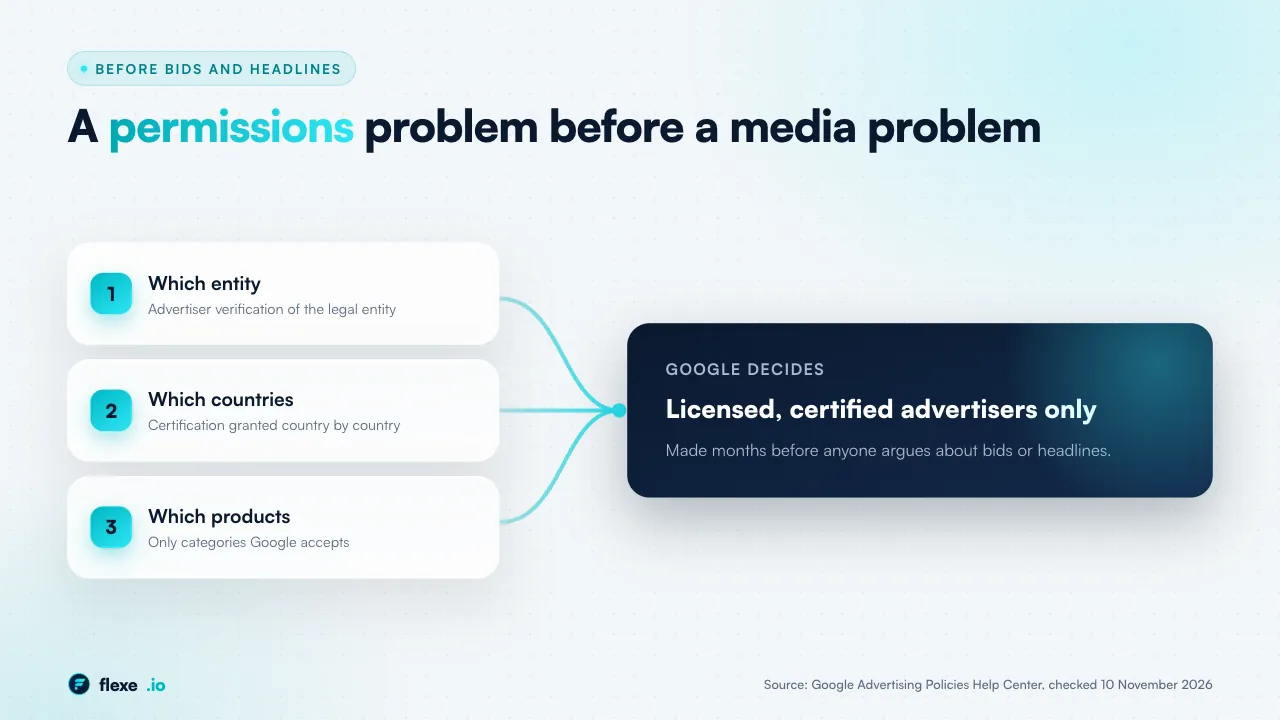
Facts checked on 10 November 2026 against Google’s Advertising Policies Help Center.
Purpose of Crypto Google Ads
Crypto Google Ads Services campaigns (crypto ads Google approves, also searched as cryptocurrency ads on Google) help crypto businesses reach these goals:
- Lead generation
- Traffic growth
- Sales increase
- User acquisition
- Fundraising
What We Do
To make those campaigns work, we cover the whole build:
- Preparing keywords to target the right audience
- Getting your ads through moderation
- Linking ads with Google Analytics and Data Studio
- Optimizing campaigns for better performance
- Conducting A/B testing to improve results
- Delivering detailed performance reports
What Results You Get
By integrating Google Analytics with Google Ads, we optimize your campaigns for higher lead generation. Our service includes a complimentary Google Data Studio report, providing detailed performance insights. Most clients achieve a return on investment (ROI) of over 400%.
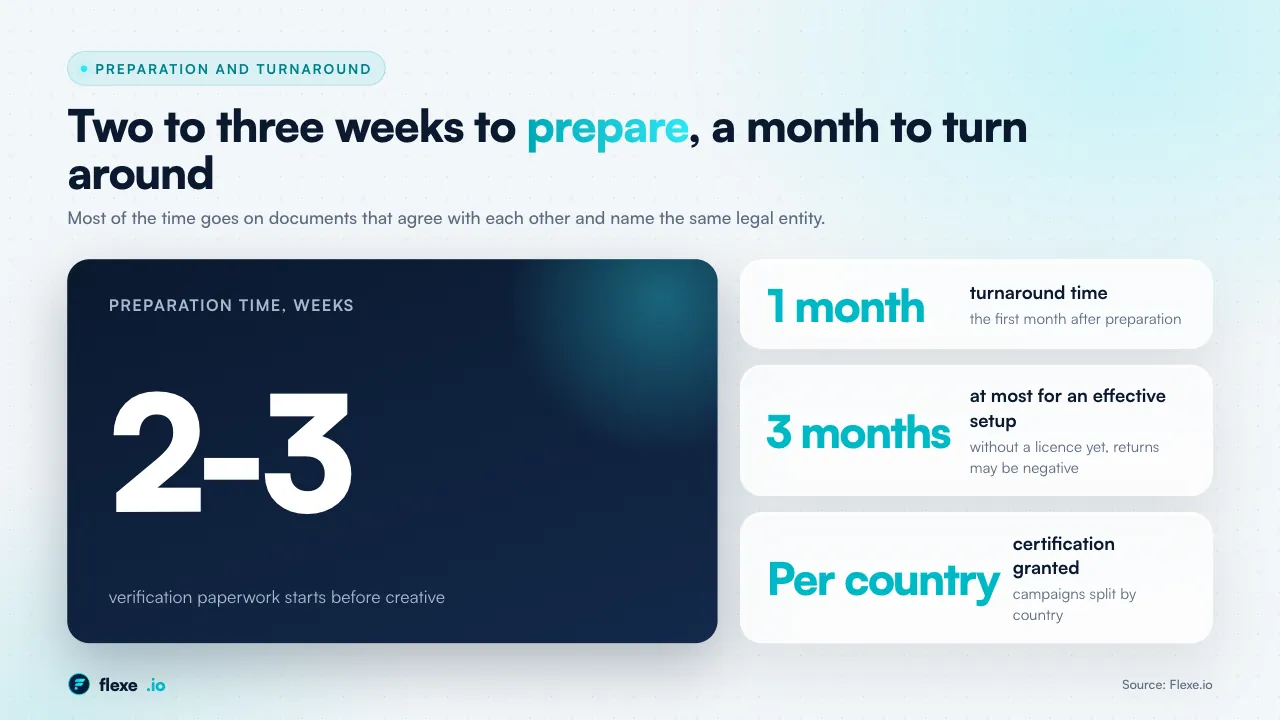
Preparation and Turnaround Time
- Preparation Time: 2-3 weeks
- Turnaround Time: 1 month
Google Ads Crypto Certification Steps In Order
Google runs two separate gates and they are not interchangeable. The first is advertiser verification, where Google confirms the legal entity behind the account, its ownership, and the domain the ads point to. The name on the incorporation papers, the payment profile and the site footer all have to agree. The second gate applies to financial products: financial services certification, granted country by country, asking for proof that the advertising entity is authorised or registered in each market it wants to run in.
Crypto sits on top of both. Advertising is limited to certain product categories and to certified advertisers in supported countries, and both lists differ from the general financial rules. Since June 2026 crypto applications are filed inside the Google Ads account, under Admin and then Policy, instead of through a Help Center form.
Order matters more than speed. Applying for Google Ads crypto certification from an unverified profile, or with documents naming a different entity, earns a rejection that can take weeks to reverse, and nothing runs meanwhile. We start the paperwork before creative production begins, because creative that cannot be served is wasted work.
What You Supply Before Launch
The engagement moves at the speed of the last document on this list, and every item must name the same entity.
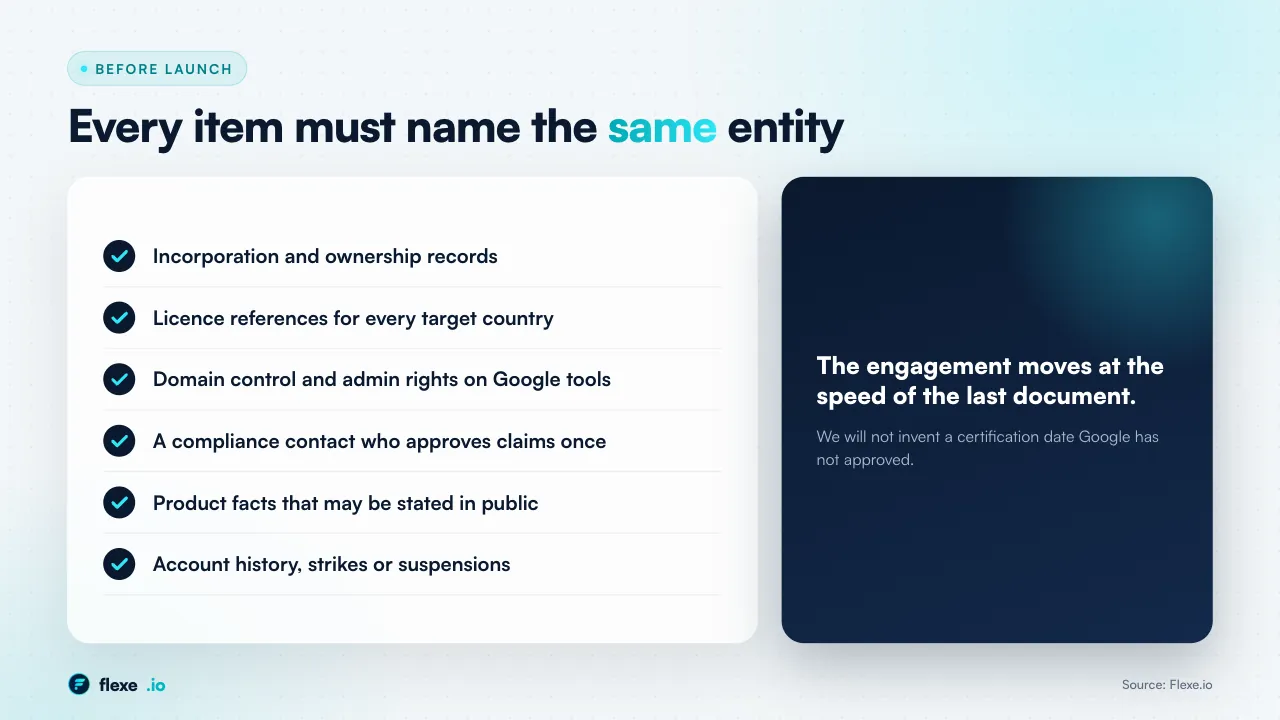
- Incorporation documents and ownership records for the entity that will be named on the account
- Licence or registration references for every country on the target list, with the exact legal name they were issued to
- Domain control through DNS or hosting access, plus admin rights on existing Google Ads, Analytics and Tag Manager properties
- A named compliance contact with authority to approve a claims list once, instead of reviewing every headline separately
- Product facts we are allowed to state in public: supported countries, fee schedule, custody model, listing or eligibility conditions
- Account history if it has run before, including any policy strikes or suspensions
If a licence is still in application, say so at the start. We can build landing pages in the meantime, but we will not invent a certification date for crypto advertising Google has not approved.
How The Account Is Built
Structure follows eligibility, not convenience. Campaigns are split by country because approval, allowed products and disclosure requirements are all decided per country, and a single mixed campaign means one refusal stops traffic everywhere. Brand terms sit in their own campaign so that defensive spend is never confused with acquisition performance.
Inside each market, ad groups follow intent rather than product pages, because problem, comparison and alternative queries need different copy and bids. Incumbents bid head terms past the point where a challenger makes money, so we use them sparingly.
Negative keyword lists are built before launch, not after the first invoice. Standing negatives cover job seekers, airdrop hunters, price prediction traffic and scam or recovery queries that produce clicks and nothing else. Conversion actions are defined the same day: we count verified signups or funded accounts, and treat form submissions as a diagnostic step.
Which Crypto Ads Google Will Approve
The Google Ads cryptocurrency policy sorts crypto ads into three groups, read from Google’s policy page on 15 November 2026. Google Ads crypto certification is the application in the middle row: you apply per country and must be a licensed provider there.
| Google Ads crypto policy | What falls in it |
|---|---|
| Allowed without certification | Businesses that accept crypto payments, mining hardware, tax, legal and security services, crypto education that gives no investment advice, NFT games where items are used in play |
| Allowed only with Google certification, a licence and an approved country | Crypto exchanges, software wallets, hardware wallets, crypto coin trusts |
| Never allowed | ICOs and presales, initial DEX offerings, DeFi trading protocols, token liquidity pools, crypto loans, unhosted wallets, trading signals, investment advice, broker review sites, NFT games that stake for real-world prizes |
Copy in this category is written against the policy first and the audience second, which is an unusual constraint and the main reason approvals fail. Returns cannot be promised or implied. Guarantees, price targets and countdown urgency are refused. Claims about safety, regulation or partnership have to match something a reviewer can check on your own site within one click.
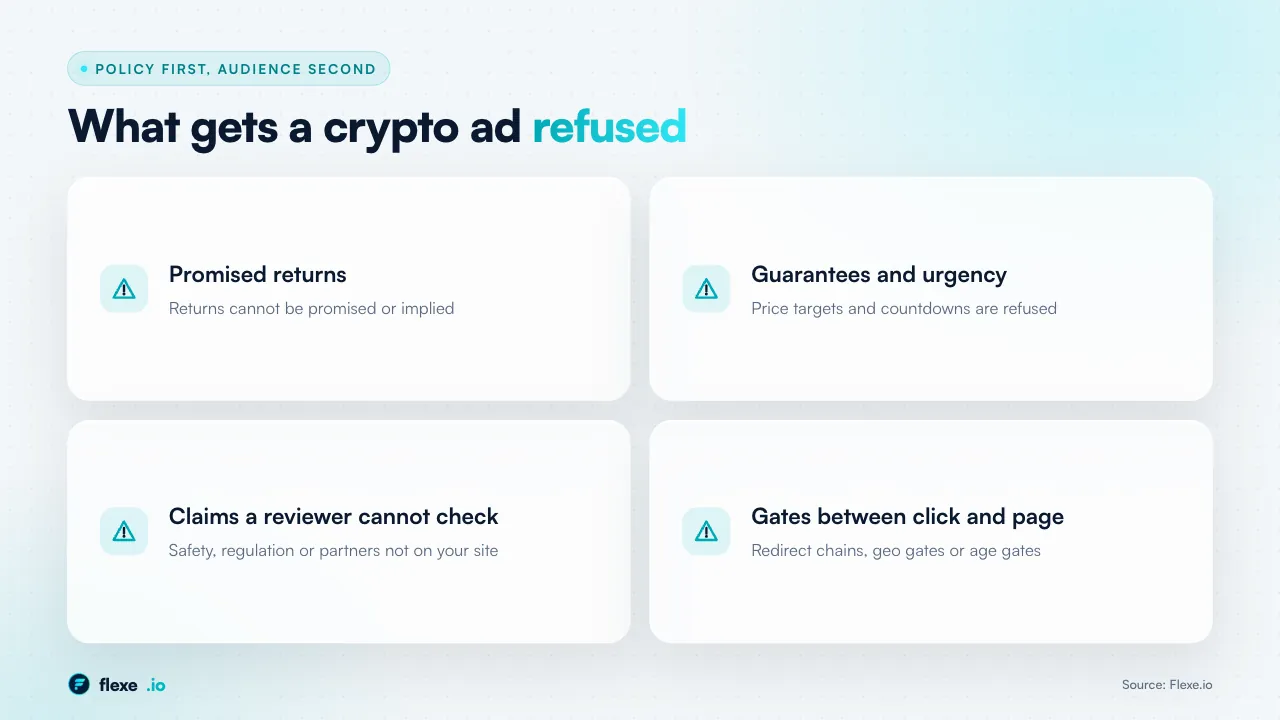
The destination is part of the ad. Landing pages need the entity name, the jurisdiction, the required risk disclosure and working contacts, and must describe the product the ad describes. A redirect chain, geo gate or age gate between click and content is a common, overlooked cause of disapproval.
We keep an approved claims library per client, agreed with your compliance contact once, so new ads are assembled from approved lines without sending each variation back to legal.
Disapprovals are handled in one pass rather than by repetition. A rejected crypto advert is usually a page problem, so we read the clause Google cited, change the destination, and resubmit once. You see the clause, the change and the outcome in the weekly note. Since 21 July 2026 an in-account appeal is unavailable for decisions older than six months.
Deliverables And Reporting Cadence
Everything below is yours to keep if the engagement ends or moves in house.
- A verification file per market: what was submitted, the current status, and the expected decision window
- An account build document covering campaign split, bidding approach, budget caps and the negative lists
- The keyword set with intent labels, plus the approved claims library
- A weekly performance note that names what changed, what was cut, and what is being tested next
- A monthly review with cost per qualified action by market, and a recommendation on where budget should move
Reporting is connected to analytics rather than screenshotted from the ads interface, so your own team can reproduce the numbers.
How Budget And Fees Work
Media spend is paid by you, directly to Google, on your own billing profile. We do not take a percentage of ad spend, because that model rewards spending more rather than spending well. Management is a monthly retainer scoped to the number of markets and the complexity of the build.
We quote after a free plan, because the number of markets, the licence position and the certification queue change the scope more than the channel does. Owning the billing profile also means you keep the account, the history and the verification status; an aged, approved account in this category is an asset that is slow and painful to rebuild.
How Results Are Measured
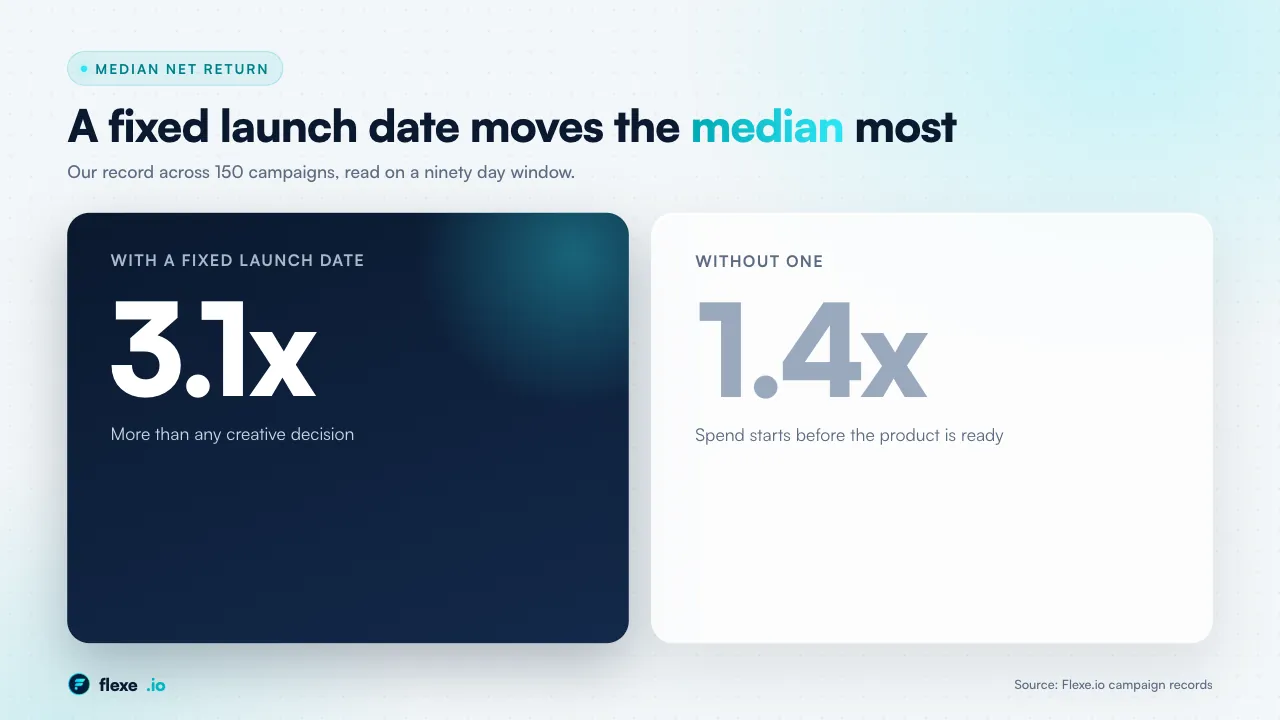
Our own record across 150 campaigns gives a median net return of 2.8 times within ninety days, with a range from 1.4 times to 7.0 times, and a disclosed failure rate of 12 percent. Across more than 800 campaigns run since 2018, one input moves the median more than any creative decision: a fixed launch date. Campaigns with one sit at 3.1 times, campaigns without one at 1.4 times.
Measurement is agreed before launch and not renegotiated. The primary number is cost per qualified action, read on a ninety day window, because approval delays and the learning period distort anything shorter.
Where These Campaigns Fail
The failures repeat, and few are about bidding.
- Entity mismatch between licence, account and site, which stalls certification for weeks
- Budget spread thin across too many channels at once, a pattern that correlates with a 34 percent failure rate in our own data
- No committed launch date, so spend starts before the product page, the tracking or the support team is ready
- Optimising to form fills while the real drop happens later, at identity and eligibility checks
- Rewriting ads that already convert, in the belief that movement is progress
Who Should Not Run Crypto Ads On Google
If you have no licence and no application in progress in any supported market, paid search on Google is not available to you yet, and the honest answer is to build demand elsewhere first. The same applies to products in categories Google does not accept at all.
It is also a poor fit where search demand barely exists or the sales cycle runs past a year with nothing to measure in between. We say that in the first call rather than bill for a channel we expect to disappoint.
Crypto PPC As One Layer
Search captures people who are already looking. For a token launch nobody has heard of, that pool is small and paid search alone will look weak. We run press across 800+ outlets and a KOL base of 100+ active X accounts and a screened active roster, so search sits alongside coverage and creator work rather than carrying a launch. Where the vertical is blocked, budget moves to placements that accept it, described on our Web3 advertising services page.
Case Studies and Samples
Results from earlier campaigns:
Crypto Google Ads Policy Limits
To run cryptocurrency-related ads on Google you need a licence in each target country plus Google certification, filed through the apply to advertise process. The Google Ads crypto policy itself, titled Cryptocurrencies and related products and often searched as the Google Ads cryptocurrency policy, lists the regulator Google accepts for each approved country.
Licences Google accepts for exchanges and software wallets, per its Cryptocurrencies and related products page on 19 November 2026:
| Market | Licence or registration Google requires |
|---|---|
| United States | FinCEN MSB registration plus state money transmitter registration, or a federal or state chartered bank |
| European Union, Iceland, Liechtenstein and Norway | Authorisation as a Crypto-Asset Service Provider (CASP) under MiCA from a national authority |
| United Kingdom | Registration with the FCA |
| Canada (exchanges only) | Registration with FINTRAC as a money services business |
| Hong Kong (exchanges) | Opt-in to the SFC licensing regime with Type 1 and Type 7 licences |
| Japan | FSA registration as a crypto asset exchange service provider |
| Switzerland | FINMA licence for the advertised activities |
| United Arab Emirates | Licence from the CMA, DFSA, FSRA or VARA |
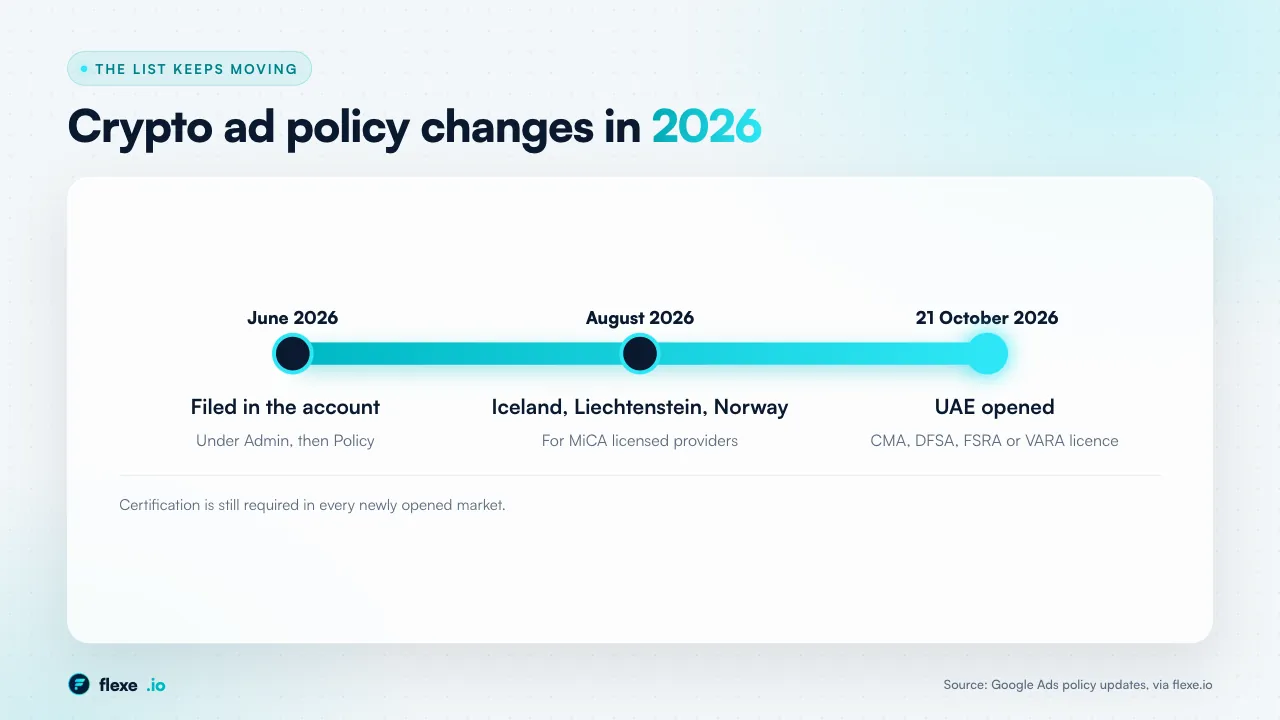
The list keeps moving. In an October 2026 update, Google opened the United Arab Emirates from 21 October 2026 to exchanges and software wallets licensed by the CMA, DFSA, FSRA or VARA, with certification still required. Iceland, Liechtenstein and Norway joined in August 2026 for MiCA licensed providers.
If you do not have a licence yet, we build landing pages that pass moderation at no charge while the application runs. An effective setup can still take up to 3 months, and ads may return a negative ROI during that period.
How to Maximize Your Campaign Success
Structure decides the result more than copy does. Target only the markets your certification covers, read performance weekly, test one variable at a time, and track the rules country by country, because Google updates its financial products and services policy without warning your account first. On 28 September 2026, for example, it posted an October change adding Chile and Denmark rules for complex speculative products such as CFDs.
For more details, feel free to reach out to us!
Comparing inventory before you commit? Our guide to crypto ad placements and crypto traffic acquisition compare explorers, media and ad platforms side by side.
Beyond Search: Display and YouTube
A verified Google Ads account opens more than search, and the extra surfaces hold most of the cheap reach.
| Surface | What it is good for | How often it makes sense |
|---|---|---|
| Search | People already looking for what you do | Almost always, where the vertical is allowed |
| Display & AdSense | Cheap volume across the wider web, useful for retargeting | Common, mostly for retargeting rather than cold reach |
| YouTube | Explaining something that cannot be explained in a text ad | Occasionally: strong when the product needs a demo, weak otherwise |
All three sit under the same certification and country restrictions, so the real question is whether the product qualifies; for fintech that is covered on Google Ads for fintech.
Where Google will not take the vertical, the alternatives are on crypto ad placements: explorers, crypto media and the banner network.
How to choose crypto Google Ads services in 2026
Choose crypto Google Ads services by how they handle certification and billing, not by promised returns. The first question is which markets your licence lets you advertise in, and a good team answers it before it quotes. After that, check who owns the account, how fees are charged and which number the campaign will be judged on.
- The team maps your licence to the markets Google certification covers before any quote.
- Media spend goes to Google on your own billing profile, not through the agency.
- Fees are not a percentage of ad spend.
- The main metric, cost per qualified action, is agreed before launch.
- Verification files, account build notes and reports stay yours if the work ends.
- The team tells you when Google is not open to your project yet.
Frequently Asked Questions
Can you run cryptocurrency ads on Google?
Yes, crypto ads on Google run, but only for a certified advertiser, in supported countries, and only for the product categories Google accepts. You clear advertiser verification first, then financial services certification market by market. A product that is eligible in one country can be refused in the next, and a country level restriction is not something an appeal will change.
How long does certification take before ads can run?
Preparation takes 2-3 weeks and the first month is the turnaround window. Most of that time goes on assembling documents that agree with each other: incorporation papers, licence references and domain control all naming the same legal entity. Applying for certification from an unverified profile is what turns a few weeks into a few months.
How much does a crypto paid search campaign cost?
Cost has two parts. Management is a monthly retainer scoped to the number of markets and the complexity of the build, quoted after a free plan and never taken as a percentage of ad spend. Media spend sits outside that and is paid by you, directly to Google, on your own billing profile, so the account and its history stay yours.
What return can we expect from paid search?
Across 150 campaigns our median net return was 2.8 times within 90 days, ranging from 1.4 times to 7.0 times. We also publish a failure rate of 12 percent, because some engagements do not pay back. We do not sell guaranteed volume or a guaranteed return: the licence, the product and a fixed launch date move the number more than the account build does.
What happens when an ad is disapproved?
We read the clause Google cited, fix the destination page and resubmit once. Resending the same ad untouched turns one disapproval into an account level strike. Where a decision looks plainly wrong, we file one documented appeal with the licence reference attached and then wait, because a parallel second appeal restarts the queue. Decisions older than six months can no longer be appealed from the account.
Will Google approve a cryptocurrency advert without a licence?
Not for an exchange or software wallet. Google requires those advertisers to hold a licence, such as FCA registration in the UK, FinCEN and state money transmitter registration in the US, MiCA authorisation as a CASP in the EU or a VARA licence in the UAE, plus Google certification. Hardware wallets are the exception. A business that accepts crypto payments or offers tax and legal services can advertise without certification.
Which crypto advertising services work when Google refuses the ads?
Crypto-native placements and creators. Google bans ICO pre-sales, DeFi trading protocols and token liquidity pools in every country, so those budgets move to block explorers, crypto media and banner networks that accept the vertical. KOL campaigns are the other route, drawing on 20,000+ influencers on X and YouTube (100+ active on X, 300+ on YouTube), with press across 800+ outlets carrying the announcement.