Telegram crypto promotion pays the owner of a channel to publish about your project in their own voice, and a focused single channel campaign starts at $4,000. You get a screened shortlist with view history, a named slot at an agreed price, the published post itself, and reports at 24 hours, 7 days and 30 days.
Flexe has run more than 800 campaigns since 2018, and the parts that decide an outcome are rarely the exciting ones: who gets screened out, what the project sends over, what hour a post goes live, and which number both sides agreed to read afterwards.
Paying a channel owner is not the same as buying an ad slot from Telegram itself. The two are constantly confused and behave nothing alike.
KOLs, Not Telegram Ads
| Telegram KOL | Telegram Ads (official) | |
|---|---|---|
| Who publishes | The channel owner, in their own voice | Telegram, as a labelled ad block |
| Reads as | A recommendation | An advertisement |
| Format | Post, pinned message, ongoing mentions | Short text under a channel post |
| Targeting | By channel and its audience | By topic and language |
| We offer this | Yes, as standard | On request, rarely worth it |
We sell the first as standard and the second only on request. The reason is simple: a labelled ad block reaches a crypto audience that has learned to scroll past labelled ad blocks, and the same budget spent on a channel whose readers trust the person writing produces a different result.
Why Telegram Changed in 2026
On 21 July 2026 Telegram announced a native, non-custodial wallet rolling out across the app to its full user base – over 1 billion monthly users, as announced by Pavel Durov in March 2025. That removes the longest step in the funnel: a reader who sees a project no longer has to leave the app, install something and fund it before they can act.
For a launch, that shortening matters more than raw reach does.
How KOLs Are Chosen
Subscriber counts are the easiest number on Telegram to buy and the least useful to read. Selection runs on views:
- View-to-subscriber ratio across recent posts. A channel with 200,000 subscribers averaging 3,000 views is a bought list, and the ratio exposes it immediately.
- Promotion density. A channel that ran fifteen paid posts last month has trained its readers to ignore paid posts.
- Comment behaviour. Real communities argue. Purchased ones post emojis.
- Audience overlap. Buying five channels that share most of their readers means paying five times for one audience.
What Is Measured
| Metric | Why |
|---|---|
| Views per post | Reported by Telegram itself, so hard to dispute |
| Joins to your channel | Attributable per placement with a unique invite link |
| Retention after 7 days | Separates a spike from an audience |
| Wallet connections | The only metric reflecting intent rather than attention |
Retention is the one to insist on. A placement can deliver a large join count and lose most of it inside a week, and only the second measurement tells you which happened.
How Telegram Crypto Promotion Is Run
A campaign moves through four stages that do not overlap: screening, briefing, publishing, reporting. Each ends with something the project can approve or refuse, and no money reaches a channel owner before the shortlist is signed off. The shortlist is the stage worth arguing about, because the channel list fixes most of the result before a line of copy exists. Copy can be rewritten in an afternoon. A bad channel choice cannot.
Screening A Channel Before Anyone Pays
Every account and channel passes three independent checks before it enters a campaign. Independent is the operative word: three readings of the same subscriber count would agree and prove nothing, so the checks rest on different evidence.
- Growth curve. Real channels grow in steps tied to events: a listing, a post that travelled, a mention by something larger. Bought lists grow as smooth vertical lines on ordinary Tuesdays, and staggered delivery flattens the line without changing its character.
- First hour view curve. A genuine audience arrives in a curve shaped by time zones, fast at first and trailing for a day. Purchased views land in a block and stop dead.
- Forward origins. Telegram reports where a post travelled after publication. Constant reading with no onward forwarding describes an audience that consumes and circulates nothing, which is the audience a launch cannot use.
- Admin network overlap. Some operators run dozens of channels from one desk and price them as separate placements while serving the same readers. Handles differ, posting minutes and comment accounts do not.
A channel that fails one check is not struck off automatically, since odd curves have honest explanations. It stops being a default recommendation and the failure is written on the shortlist beside its name, so the project decides before the invoice rather than after it.
What You Send Us First
The brief does not have to be long. Four things decide whether the shortlist that comes back is worth anything.
- The launch date, or an honest statement that there is not one yet. Across 150 measured campaigns a clear launch date moves median net ROI from 1.4x to 3.1x, which makes it the most valuable line in a brief.
- The chain and the contract address, so channels serving the wrong ecosystem are dropped while dropping them is free.
- The one action a reader should take: join a channel, connect a wallet, read a document, register for a sale. One per campaign, not a menu of four.
- The claims your legal review will accept and the ones it will not, in writing, before copy is drafted. Retracting a published post costs the fee twice.
Raw material beats a polished deck. Screenshots of the product working, a short screen recording and the founder writing plainly about why the thing exists are worth more than brand language, because owners rewrite the copy anyway and need a fact they can restate in their own register.
Post Formats And What They Do
Format is priced separately from reach, and paying for the wrong one is the commonest way to waste a good channel.
- Single post. One message published and left in the feed. The default, and the format whose numbers compare cleanly across channels, which makes it right for a first test.
- Pinned post. The same message held at the top for an agreed number of hours. It earns its premium only on channels with heavy daily traffic, because a pin on a quiet channel is seen by the same people twice.
- Native mention. The owner writes about the project inside their normal commentary rather than as a standalone advertisement. Higher trust, less control over wording, worth one review round.
- Repeat series. Two or four touches across a fortnight in one channel. Useful in the run up to a fixed date and close to pointless without one.
- Mini app placement. Advertising inside Telegram mini apps rather than a channel feed, judged on opens and retained users rather than views.
Timing A Post Inside The Week
Publication hour is negotiated as part of the booking rather than left to the owner. Crypto channels have a measurable daily rhythm, and the same post can differ widely on views depending on where it lands in it. The rule is to publish when the channel’s own recent posts gathered views fastest, which its history shows without anyone guessing.
Two scheduling mistakes repeat often enough to name. The first is clustering every placement into one hour: it produces a single spike, and a shared audience sees the same message four times. The second is publishing into a major market event. Spreading placements across several days, strongest channel closest to the date, works better.
How A Budget Is Built
Media spend is paid by the client directly to the channel or its representative, and the agency takes no percentage of ad spend. That removes the incentive that makes most media buying worth distrusting: nobody here earns more by recommending a larger buy, so advice to spend less costs nothing to give.
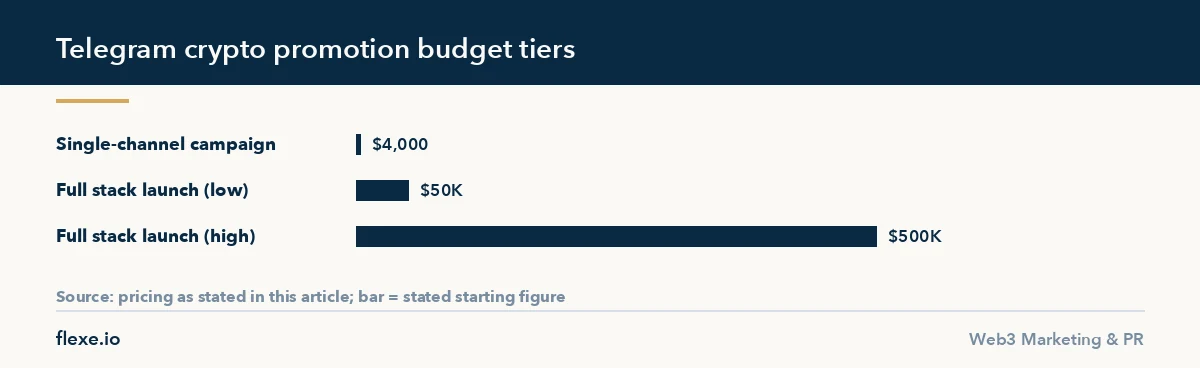
A focused single-channel campaign starts from $4,000. A full stack launch combining channels, KOL posts and mini app placements runs from $50K to $500K across three to six months. Most projects sit nearer the first figure, and the second only makes sense with a product, a date and a team able to answer the traffic.
- Verified views rather than subscribers. Rates are negotiated against the views recent posts actually produced, so a bought list is never paid for as an audience.
- Format and duration. A 24 hour pin, or a series across two weeks, prices above a single post in the same channel.
- Exclusivity. Owners who publish no competing project for 24 or 48 hours around your slot charge for that gap, and in a crowded launch week it is worth buying.
- Calendar pressure. Rates climb around large listings and market runs and fall in quiet stretches, so booking three weeks ahead of a date rather than three days ahead is the cheapest saving available.
- Review rights. Copy approval and an edit round cost more with owners used to writing whatever they please.
What You Get Back
Deliverables are fixed before the work starts, so there is nothing to argue about afterwards.
- A shortlist with recent view history per channel, the checks each one passed or failed, and why it was included or dropped.
- A booking schedule naming the channel, format, publication time in UTC, duration in feed and agreed price per slot.
- Draft copy per placement, plus the version the owner actually published when the two differ.
- A dated screenshot and message link for every live post, collected on the day rather than reconstructed later.
- Reports at 24 hours, 7 days and 30 days, with cost per thousand verified views per channel and the raw export behind every figure.
Reading The Numbers Afterwards
The first-party benchmark across 150 campaigns is a median net ROI of 2.8x within 90 days, spread from 1.4x to 7.0x, with a disclosed failure rate of 12 percent. The range is the honest part: a median describes a distribution, not a forecast for your campaign.
For the same reason guaranteed view counts are not sold. What is committed to is a named channel, a named slot, a published post and a report that shows the gap in both directions.
Where These Campaigns Fail
Failures cluster. Telegram crypto promotion goes wrong in a few repeating ways, and most are decided before publication.
- The budget is spread across too many channels. Thin spreading correlates with a 34 percent failure rate in our own data, because overlapping audiences mean twelve small placements often reach fewer distinct people than four considered ones.
- There is no date. Attention with nothing to arrive at decays within days and cannot be stored for a launch that keeps moving.
- The destination is not ready. Traffic lands on a broken link, a closed channel or a form nobody reads over a weekend.
- The copy contains nothing checkable. A post with no fact in it, no number and no screenshot reads as paid whatever the label says.
- The wrong number is agreed on. Views are the easiest figure to collect and the weakest to judge by, and a campaign measured on views alone always looks better than it was.
Who This Is Not For
Some projects are told to wait, and it is cheaper to hear that now. If there is nothing to show, no screenshot, no testnet, no document a reader can open, paid attention only finds that out faster. If the expectation is a guaranteed view count or a price reaction, no honest arrangement exists at any budget. If the available spend is under the $4,000 entry point, the money is better held. And promotion that hides the fact it was paid for destroys the asset being rented.
Owned Channel Growth And Mini Apps
Paid posts bring people to a door. What sits behind it decides whether they stay, and this is where projects underinvest. A channel receiving arrivals needs pinned material answering the first four questions anyone asks, a moderator awake when the traffic lands, and a posting rhythm that survives the week after the campaign. Arrivals who find an empty feed leave within a day, and the 7 day retention figure records it.
Mini apps sit alongside channel work and behave differently. An advertisement inside a mini app reaches someone already busy inside Telegram, and the action asked of them is an open rather than a click out to a browser. Volumes are smaller and intent is higher, so running both on a launch lets the weaker one be cut on evidence in week two.
Related
Channel placement is one route. Telegram channel placement covers the buying side in detail, Telegram and Discord activity covers keeping a channel alive once people arrive, and crypto influencer marketing compares Telegram against X, YouTube and TikTok on measured reach.
Frequently Asked Questions
Do you run official Telegram Ads?
Not as a standard product. It can be arranged on request, but the approval process is slow and awkward enough that it is rarely worth it – and the labelled ad format underperforms a channel-owner post with the same budget. If you specifically want the official product, say so and we will tell you honestly whether it fits.
How many channels does a campaign need?
Fewer than most projects expect. Overlap between large crypto channels is heavy, so a handful of well-chosen placements reaches more distinct people than twenty cheap ones. Budgets spread across too many channels at once correlate with a 34 percent failure rate in our own records.
Are posts marked as advertising?
On reputable channels, yes, and that is the correct outcome. Unmarked promotion is what trains an audience to distrust a channel, which destroys the thing you are paying for. Several markets require the disclosure in any case, and owners who ignore it are the ones whose audiences stop reading.
How much does Telegram crypto promotion cost?
A focused single channel campaign starts at $4,000, and a full stack launch combining channels, KOL posts and mini app placements runs $50K to $500K over three to six months. Media spend goes directly from you to the channel owner and we take no percentage of it, so advice to spend less costs us nothing.
Can you guarantee views or new subscribers?
No. We do not sell guaranteed view counts. On one Reddit trending campaign the observed outcome ran from roughly 10 views to 150,000, and no honest party promises a number inside that spread. Our benchmark across 150 campaigns is a median net ROI of 2.8x within 90 days with a disclosed failure rate of 12 percent.
Tell Us What You Are Launching
Send the project, the chain and the date. You get back a channel shortlist with view history and a realistic reach range, and nothing is committed until you approve it.