Most guides on crypto marketing promise moon-shot results but hide behind vague advice. This one shows you what actually happened when real projects tried different approaches — with numbers you can verify yourself.
Key Takeaways
- Transparent trading groups grew 300% by sharing real trades, while fake signal providers lost credibility within weeks
- One trader’s 24% win rate still generated $2.36M profit — success in crypto marketing isn’t about batting average
- Token payments for services depreciated 70-86% due to vesting schedules and poor liquidity planning
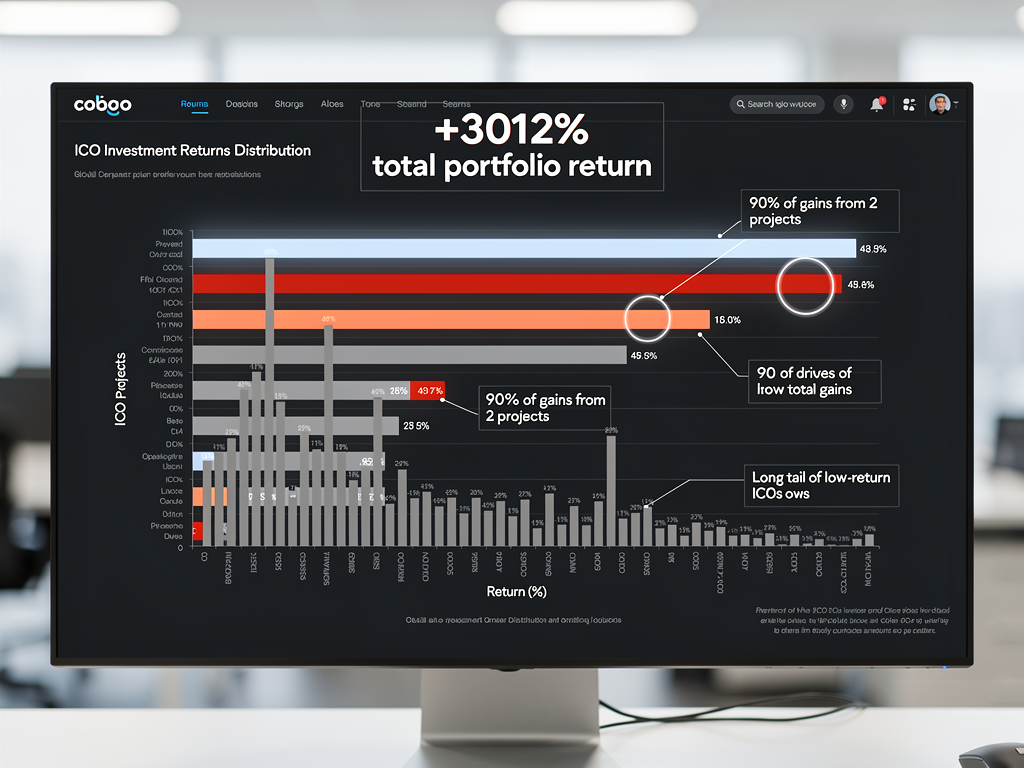
- ICO portfolios showed +3012% returns, but two outliers accounted for 90% of gains — diversification alone isn’t enough
- Paid communities charging $1000+ underperformed free groups focused on real value and documentation
- Post-TGE tokens crashed 20-87% in most cases, exposing poor community engagement strategies
- Funded trading accounts netted $52k after expenses, showing the hidden costs of crypto marketing operations
What Marketing Crypto Coin Really Means in 2025

Marketing crypto coin refers to the strategies, channels, and tactics used to promote cryptocurrency projects, attract holders, and build sustainable communities. Unlike traditional marketing, crypto requires navigating decentralized platforms, skeptical audiences, and rapid market cycles.
Recent data shows the landscape has shifted dramatically. Today’s successful campaigns combine transparent communication, documented results, and authentic community building. Projects that relied on hype alone in 2024 saw token values crash 70-90% post-launch, while those investing in real engagement saw measurable growth.
This approach works for new token launches, DeFi protocols seeking users, NFT projects building holders, and trading communities growing membership. It’s not for projects expecting overnight viral success without substance, or those planning to rely solely on paid promotion without community foundation.
What Effective Crypto Marketing Actually Solves
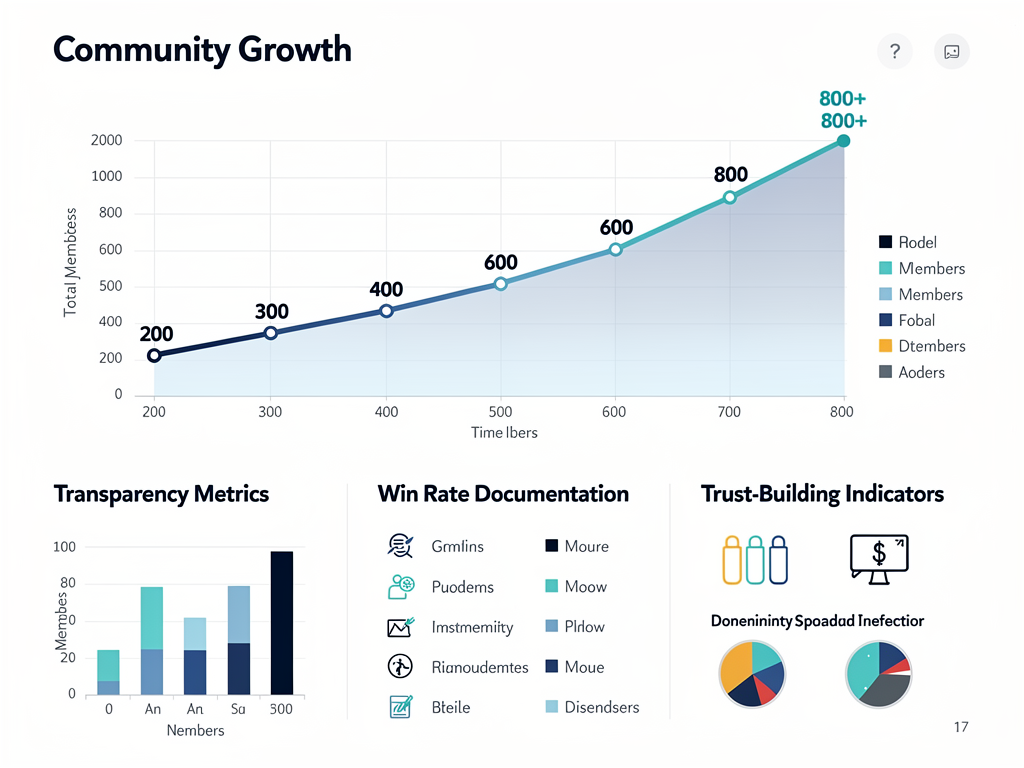
Problem: Community skepticism and scam fatigue. After years of rug pulls and fake promises, crypto audiences demand proof before engagement. One Telegram mini-app investor lost over $5,200 across projects like PAWS, PIX, MEMHASH, and TOMA, leading them to warn others against similar investments. The solution: radical transparency. A trading community called Chroma_Trading grew from 200 to 800+ members by sharing every trade before execution, tracking all results publicly, and maintaining a documented 40% win rate instead of claiming impossible 90% success rates.
Problem: Poor token performance destroying trust. Analysis of 12 recently launched tokens showed only two trading above their Token Generation Event (TGE) price, with losses ranging from -20% to -87%. The core issue: projects created selling pressure through airdrops and ICOs without giving communities reasons to hold long-term. Successful projects solve this by building utility before launch and rewarding holders with tangible benefits beyond speculation.
Problem: Misaligned compensation destroying partnerships. One security researcher received $35k and $50k in token payments for work, but vesting schedules and zero liquidity meant realizing only $5k and $15k respectively — losses of 86% and 70%. Projects using this tactic lost access to quality service providers. The fix: hybrid payment structures combining stablecoins with performance-based token allocations, ensuring partners aren’t forced to dump on communities.
Problem: Capital inefficiency in paid groups. While some “premium” communities charged $1000+ for access, a trader built a free Telegram group and turned $4.7k into over $2 million by sharing timely information without paywalls. Quality information distributed freely to serious participants outperformed extractive business models, proving that marketing crypto coins effectively often means prioritizing value over immediate revenue.
How Successful Crypto Marketing Actually Works
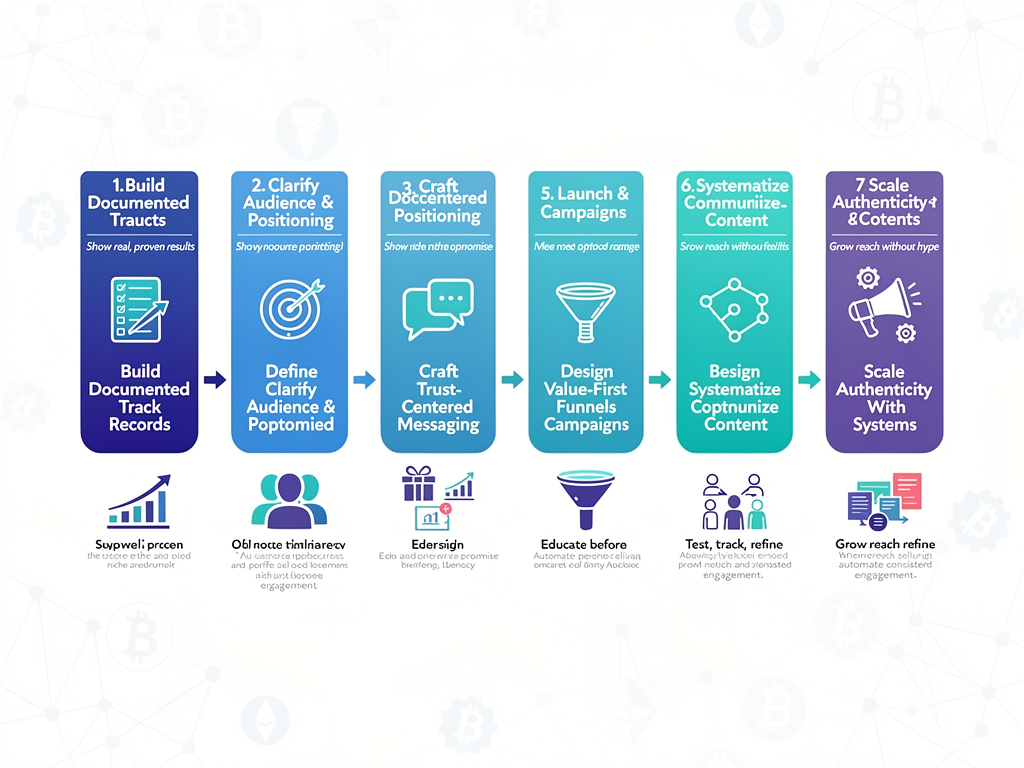
Step 1: Build Documented Track Record
Start by creating verifiable proof of your project’s claims or trading performance. Use on-chain data, timestamped screenshots, and third-party tracking tools. One trader tracked 527 assets over 12 months, documenting $4.34M in gains against $1.98M in losses for a net $2.36M profit. Despite only a 24% success rate, the transparency of showing both wins and losses built credibility. Common pitfall: many projects share only winning trades retroactively, creating “selection bias” that sophisticated community members spot immediately.
Step 2: Choose Communication Channels Strategically
Focus on platforms where your target audience already gathers. A marketer made $11k grinding on Telegram without any social media presence by managing KOL relationships and coordinating campaigns directly in group chats. For most projects, this means combining Telegram for real-time updates and community chat with platforms for broader reach. Avoid spreading too thin across every platform — one trader noted they were “much happier” after reducing angel investments from 68 projects to a smaller, manageable number.
Step 3: Set Realistic Expectations
Present honest projections instead of guaranteed moon-shots. An ICO experiment investing $10k in each of 15 projects showed a portfolio value of $4.67M from $150k invested, but noted that one project (MYX Finance with a +30,455% return) skewed the entire result. Without that single outlier, average returns dropped dramatically. Projects that acknowledge similar distribution of outcomes — where a few big wins drive overall performance — build trust that survives market downturns.
Step 4: Create Value Before Asking
Provide useful content, tools, or insights before requesting investment or engagement. One trading community grew 300% by sharing real-time trade alerts and maintaining full transparency about their 40% win rate. Another trader shared a complete breakdown of 68 angel investments showing 3 massive winners (10x+), 4 modest winners (2x+), 15 modest losers, 8 significant losers, and 10 complete write-offs. This level of honesty attracted serious participants while filtering out those seeking unrealistic guarantees.
Step 5: Plan Token Economics Around Holder Retention
Design tokenomics that reward long-term holding instead of creating immediate sell pressure. The analysis showing 10 of 12 recent token launches underwater revealed a fundamental problem: projects offered no incentive to hold past airdrop claims. Counter this by building staking rewards, governance utility, or ecosystem benefits that increase over time. Projects treating tokens as pure speculation tools face the “diamond hands” problem — holders who believe long-term simply get rugged by better-informed insiders.
Step 6: Track and Adjust Based on Data
Monitor metrics like community growth rate, holder retention, trading volume trends, and sentiment indicators. A funded trader tracked payouts versus expenses across four platforms, discovering net profits of $52.5k but excessive costs that prompted strategy revision. Without this tracking, they would have continued inefficient spending patterns. Set weekly review cycles to analyze what’s working and cut what isn’t.
Step 7: Build Systems to Scale Authenticity
As your project grows, maintain the transparency that initially attracted community members. Chroma_Trading solved this by implementing trade-tracking software that logged every position before sharing it publicly, ensuring no retroactive editing or cherry-picking. Another trader noted that going from a $50k loss to $220k monthly profit required developing “real strategy and sizing” instead of “blindly aping KOL shills.” Systems preserve authentic communication even as volume increases.
Where Most Crypto Marketing Efforts Fail
Simulating trades after the fact. Multiple community members exposed groups that posted vague ideas on 10 charts, then retroactively claimed the 1-2 that worked as “wins.” Savvy traders immediately recognize this pattern. The transparency gap destroys credibility faster than any losing trade. Use timestamped, third-party tracking tools from day one. If you can’t prove you called a trade before it moved, don’t claim credit.
Paying service providers in illiquid tokens. Projects offering 100% token compensation often lose access to quality partners after the first cycle. When tokens vest over 6-12 months and have minimal liquidity, even successful projects inadvertently create resentment. The security researcher who received $85k in token value but realized only $20k won’t work with those projects again. Structure deals as 50-70% stablecoin for delivered work plus performance bonuses in tokens, ensuring partners aren’t forced to dump.
Ignoring the psychology of portfolio construction. The ICO experiment that turned $150k into $4.67M looks impressive, but the author noted: “Most people would’ve sold MYX or OKZOO early and kept holding dead projects waiting for miracles.” Marketing campaigns that ignore human behavior — loss aversion, recency bias, FOMO — fail when reality diverges from projections. Design holding incentives that work with psychology, not against it.
Charging high fees without proportional value. While some groups charged $1000+ for “premium signals,” the trader who built a free community and generated $2M+ returns proved that value-first approaches win long-term. Premium positioning works only when backed by genuinely exclusive access or results. If your edge isn’t defensible, exclusivity becomes a liability as free alternatives emerge.
Many teams struggle with these challenges because they lack experience navigating crypto’s unique dynamics — transparency requirements, tokenomics design, community psychology, and multi-platform coordination. FLEXE.io, with 7+ years in Web3 marketing and 700+ clients, helps projects access 150+ media outlets and 500+ KOLs to accelerate growth while avoiding common pitfalls. Reach out on Telegram: https://t.me/flexe_io_agency
Focusing on vanity metrics over retention. Projects celebrating 10,000 Telegram members while ignoring that 90% never engage miss the point entirely. One community grew from 200 to 800+ members while maintaining high engagement because they filtered for “serious people” instead of maximizing headcount. Quality concentration beats quantity dilution when marketing crypto projects.
Real Campaigns with Verified Numbers
Case 1: Transparent Trading Community 4X Growth
Context: Chroma_Trading operated a crypto trading group in a market saturated with scam signal providers posting fake win rates and retroactive trades.
What they did:
- Shared every trade before execution using tracking software to prevent retroactive edits
- Published all results transparently, including a 40% win rate instead of inflated claims
- Explicitly called out competitors simulating trades and cherry-picking winners
- Maintained consistent documentation throughout 2025
Results:
- Before: 200 members at year start
- After: 800+ members
- Growth: 300%+ membership increase
The lesson: Radical transparency in an industry full of manipulation became their primary differentiator, attracting quality members who valued honesty over fantasy.
Source: Tweet
Case 2: Free Community Outperforms Premium Model
Context: An individual trader entered crypto markets and built returns through timely information access rather than special talent or insider access.
What they did:
- Created a free Telegram community instead of charging $1000+ like competitors
- Shared strategies, entries, exits, and complete trading plans without paywalls
- Limited community size to maintain quality and filter serious participants
- Focused on information value over monetization
Results:
- Before: $4.7k starting capital
- After: Built portfolio to approximately $2.1 million
- Growth: Roughly 447X return
The insight: By removing financial barriers and focusing on genuine value delivery, the community attracted committed participants and the founder’s own trading success validated the approach.
Source: Tweet
Case 3: ICO Portfolio Diversification Reality Check
Context: An investor tracked 60+ ICOs launched in 2025 and ran a hypothetical experiment investing $10k in each of 15 projects with confirmed Token Generation Events.
What they did:
- Invested $10k in each of 15 ICOs with full live data
- Tracked performance from ICO price through current market value
- Analyzed distribution of winners versus losers
- Compared results against simple BTC buy-and-hold alternative
Results:
- Before: $150,000 total capital deployed
- After: Portfolio valued at $4,668,945
- Growth: +3012% total return, +201% average per project
- Distribution: Two projects (MYX Finance +30,455%, OKZOO +8,574%) drove 90% of gains; most others ranged from modest gains to -94% losses
The reality: While headline numbers looked exceptional, the investor noted this ignored psychology — most would sell winners early and hold losers hoping for recovery, completely inverting results.
Source: Tweet
Case 4: Asset Diversification with Skewed Returns
Context: A trader analyzed 12 months of activity across 527 different crypto assets to understand actual win rates and return distribution.
What they did:
- Traded 527 different assets over 12 months
- Tracked capital gains ($4.34M) and losses ($1.98M) across all positions
- Identified that 10 trades generated 90% of total profits
- Documented a 24% hit rate (126 profitable vs 401 unprofitable assets)
Results:
- Before: Various positions leading to $1.98M in realized losses
- After: $4.34M in gains for net $2.36M profit
- Key winners: AI16Z ($2.14M gain), ARC, GRPH, HOLO, ZEREBRO, among top 10
- Biggest single loss: PIPPIN at $87k
What this reveals: Success in crypto trading — and by extension, marketing portfolios — depends on capturing massive outliers, not achieving high win rates on all positions.
Source: Tweet
Case 5: Token Payment Structure Gone Wrong
Context: A security researcher provided high-value services to crypto projects but accepted compensation entirely in project tokens with vesting schedules.
What happened:
- Created a 30+ page report for one project, receiving $35k in tokens vesting monthly over 1 year
- Provided intelligence on DPRK IT workers to another project, receiving $50k in tokens vesting over 6 months
- Both projects claimed they could only pay in native tokens
Results:
- Before: $35k and $50k in promised token value ($85k total)
- After: First deal now worth ~$5k, second realized only $15k due to zero liquidity
- Actual received: $20k total vs $85k promised (76% loss)
The warning: Projects using token-only compensation often lack confidence in their own token’s future value, offloading risk onto service providers who then become forced sellers.
Source: Tweet
Case 6: Post-TGE Performance Disaster
Context: An analyst tracked price performance of tokens launched in Q3-Q4, measuring returns from Token Generation Event through current prices.
What the data showed:
- Analyzed 12 recently launched tokens across various categories
- Measured percentage change from TGE price to current trading price
- Examined reasons for overwhelming negative performance
Results:
- Only 2 of 12 tokens trading above TGE price: AVNT (+99%), LMTS (+138%)
- 10 of 12 in negative territory: ranging from -20% to -87%
- Worst performers: MIRA (-87%), ZKC (-86%), ALLO (-83%)
Root cause identified: Projects created selling pressure through ICOs and airdrops without building genuine community buy-in or giving holders reasons to believe in long-term potential. Holding tokens was punished, not rewarded.
Source: Tweet
Case 7: Angel Investment Portfolio Reality
Context: An experienced crypto investor tracked outcomes across 68 angel investments to understand actual venture returns in the space.
What they did:
- Made 68 angel investments averaging $10k each (some $50k)
- Tracked each through to exit or current status
- Categorized by outcome levels from massive winners to complete write-offs
Results:
- 3 massive winners (10x+ returns)
- 4 modest winners (2x+)
- 15 modest losers (returned something between 0 and initial investment)
- 8 significant losers (returned less than 10% of initial investment)
- 10 complete write-offs (literally zero)
- ~28 still pending liquidity events (6 with high hopes, 22 with low/no hopes)
Overall assessment: Portfolio was profitable, especially due to luck on two $50k investments hitting big, but would have performed better simply buying BTC. The hassle of tracking, monitoring teams, taxes, and communication made it “much less sexy” than appearances suggest.
Source: Tweet
Essential Tools and Your Next Steps
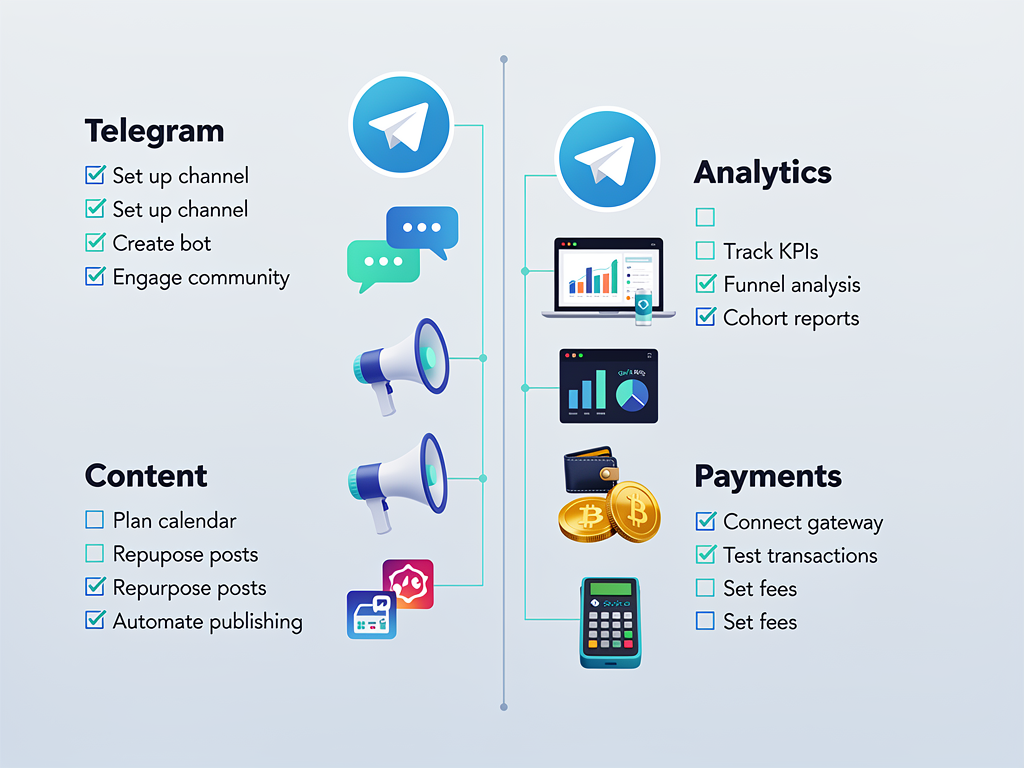
Community platforms: Telegram remains the primary hub for crypto communities due to real-time communication, bot integration, and crypto-native user base. Discord works for larger projects needing structured channels. Both require active moderation to prevent scam links and maintain quality.
Analytics and tracking: Dune Analytics for on-chain data visualization, Nansen for wallet tracking, DexScreener for token price monitoring. One trader’s success came from implementing trade-tracking software that timestamped every position before sharing publicly, eliminating any possibility of retroactive claims.
Content distribution: Medium for long-form educational content, Twitter/X for real-time updates and community engagement, specialized crypto media for broader reach. The marketer who made $11k grinding on Telegram noted they managed KOL relationships directly, showing that direct partnership coordination often beats public posting.
Payment and tokenomics tools: Sablier for token vesting, multisig wallets like Gnosis Safe for treasury management, Snapshot for governance voting. Proper vesting and liquidity planning prevent the 70-86% value destruction seen in poorly structured token compensation deals.
For projects needing comprehensive support across multiple channels and expert guidance on avoiding common pitfalls, FLEXE.io brings 7+ years of Web3 marketing experience and a network of 150+ media outlets plus 500+ KOLs to help you scale efficiently. Get in touch on Telegram: https://t.me/flexe_io_agency
Your implementation checklist:
- [ ] Set up timestamped tracking for all marketing claims and performance metrics (prevents credibility issues later)
- [ ] Design token payment structures as 50-70% stablecoin + performance tokens (protects partner relationships)
- [ ] Create pre-launch utility and holding incentives before TGE (prevents immediate dump pressure)
- [ ] Document both winning and losing campaigns publicly (builds trust through transparency)
- [ ] Establish quality filters for community growth vs. vanity metrics (300% engaged growth beats 1000% inactive members)
- [ ] Build systems to maintain authenticity as you scale (automated tracking, public dashboards)
- [ ] Plan portfolio approach expecting 10-20% massive winners to drive returns (don’t need high batting average)
- [ ] Set up weekly data review cycles for metrics like holder retention and trading volume
- [ ] Create honest projections showing distribution of outcomes, not just best cases
- [ ] Establish communication protocols that work with human psychology (loss aversion, FOMO management)
FAQ: Your Questions Answered
What’s the minimum budget needed to market a crypto coin effectively?
One trader built a free Telegram community and turned $4.7k into over $2 million by focusing on value over paid promotion. Budget matters less than approach — transparency, documentation, and genuine value delivery can outperform six-figure ad spends. Start with $5-10k for essential tools, tracking systems, and modest KOL partnerships, then scale based on documented results.
How do I find legitimate crypto marketing partners versus scammers?
Demand verifiable, timestamped proof of past results. Chroma_Trading grew 300% by showing every trade before execution with tracking software, maintaining a documented 40% win rate instead of impossible 90% claims. Any partner unwilling to provide on-chain proof, third-party verification, or real client references should be avoided. Check for retroactive trade claims — a major red flag.
Should I pay service providers in tokens or stablecoins?
Hybrid structures work best. One security researcher lost 76% of promised value when paid entirely in vesting tokens with no liquidity. Structure deals as 50-70% stablecoin for delivered work plus performance-based token bonuses. This ensures partners aren’t forced sellers and maintains long-term relationships with quality providers.
What win rate should I expect from crypto marketing campaigns?
A trader achieved $2.36M profit with only a 24% success rate across 527 assets — success comes from capturing massive outliers, not high batting averages. In the ICO experiment, 2 of 15 investments drove 90% of total gains. Focus on position sizing and portfolio construction that allows big winners to compound, rather than optimizing for high win rates on every campaign.
How long should token vesting schedules be?
Shorter than you think, with better liquidity planning. The 12-month and 6-month vesting schedules that led to 70-86% losses had zero consideration for actual trading liquidity. Consider 3-6 month vests maximum for service providers, with guaranteed liquidity through market-making commitments or protocol-owned liquidity. Team tokens can vest longer, but ensure secondary markets exist.
Is it better to build a large community quickly or grow slowly with quality members?
Quality concentration beats quantity dilution. The trading group that grew from 200 to 800+ members while filtering for serious participants outperformed massive communities with 90%+ inactive members. Growth rate matters less than engagement metrics — active users, repeat participation, and actual trading volume indicate real community value.
How do I avoid my token crashing post-launch like most others?
Build utility and holding incentives before TGE. Analysis of recent launches showed 10 of 12 tokens down 20-87% because projects created only selling pressure without buy-in. Design staking rewards, governance rights, ecosystem benefits, or revenue sharing that increases over holding periods. Make diamond hands rational, not just emotional.