
How to Make an Effective Crypto Marketing Strategy: 2025
Most guides on crypto marketing recycle the same tired advice. This one doesn’t. You’ll find real campaigns, verified numbers, and tactics that actually moved the needle for projects with millions in TVL and thousands of active users.
Key Takeaways
- Micro-influencer campaigns can generate 427,000 impressions and 200% engagement growth in 30 days when executed correctly.
- Community-driven growth beats paid advertising: one DeFi project reached $12.4 million TVL in 18 days with zero paid marketing spend.
- Cost efficiency matters more than reach—some platforms now deliver 10,000 impressions for single-digit dollar amounts.
- Understanding how to make an effective crypto marketing strategy means choosing the right channels, not just spending more budget.
- Viral coefficients work in crypto when UX solves real pain points, creating organic user acquisition at scale.
- Airdrop mechanics combined with quest-based engagement can distribute $110,000 in rewards while building sustainable community momentum.
- The best marketing feels invisible—users share because the product works, not because they were paid to post.
Introduction

When you’re trying to figure out how to make an effective crypto marketing strategy, the first challenge is cutting through an oversaturated market where most projects look identical. Regulatory uncertainty, market volatility, and skeptical audiences make traditional growth tactics fall flat. You need approaches that build genuine trust while delivering measurable ROI.
Here’s what matters: the difference between projects that gain traction and those that fade into obscurity comes down to strategic channel selection, community-first positioning, and relentless focus on metrics that predict long-term retention.
Consider one recent campaign that deployed micro-influencers across crypto Twitter. In one month, the team generated 170 unique posts, reached 427,000 people, and boosted brand account engagement by 200%. Or the DeFi protocol that mirrored early Slack growth patterns, hitting 48,000 users and $12.4 million in total value locked within 18 days—without spending a dollar on paid advertising.
What Effective Crypto Marketing Actually Means
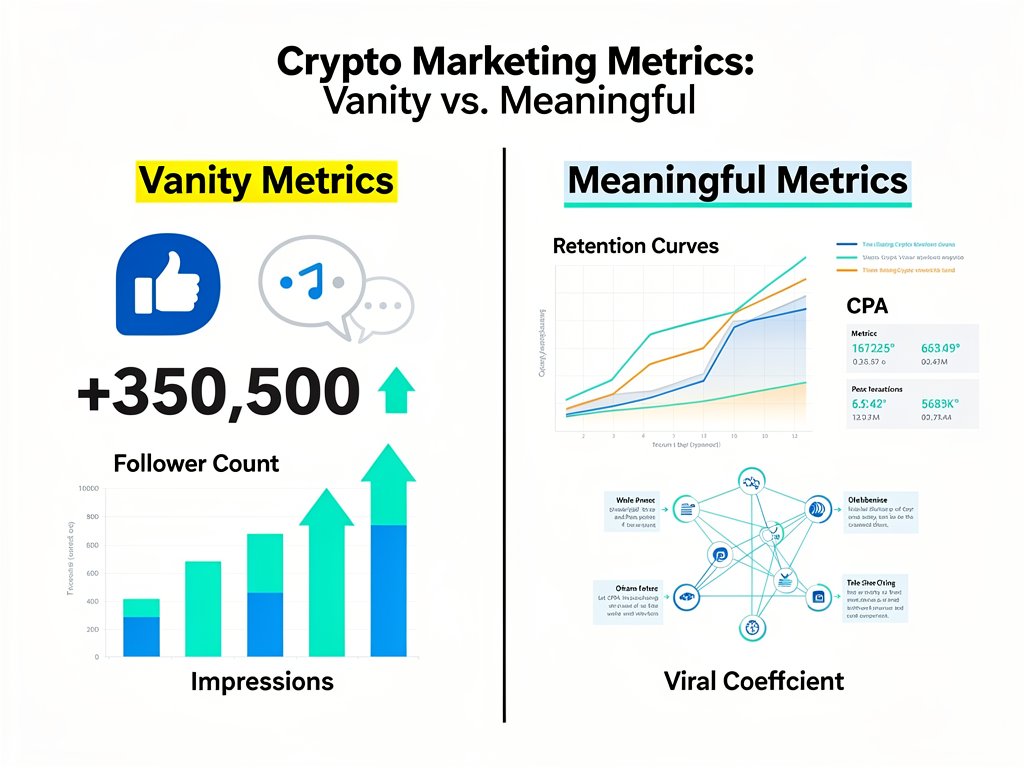
An effective crypto marketing strategy is a coordinated plan that acquires users, builds trust, and drives measurable on-chain activity while navigating regulatory constraints and market volatility. Unlike traditional SaaS or e-commerce marketing, crypto demands transparency, community governance signals, and proof of legitimate value creation.
Recent implementations show that the most successful projects blend content marketing, influencer partnerships, airdrop mechanics, and platform-native distribution. Today’s Web3 leaders prioritize cost-per-acquisition metrics, retention curves, and viral coefficients over vanity metrics like follower counts. This approach is for founders launching tokens, growth teams at DeFi protocols, marketing managers at NFT platforms, and agencies serving blockchain clients. It’s not for projects seeking quick pumps, teams unwilling to engage authentically with communities, or campaigns that prioritize hype over utility.
What These Implementations Actually Solve
The core challenge in crypto marketing is building credibility in a space plagued by scams and failed projects. Traditional advertising channels often reject blockchain businesses, and even when they don’t, audiences have developed strong filters against promotional content. One marketer tracked their journey from zero earnings to generating six figures from a single project campaign, emphasizing that success came from understanding sales fundamentals and applying them to community building.
Market volatility makes sustained campaigns difficult. When token prices swing 30% in a day, maintaining consistent messaging requires flexibility. Projects that succeed separate brand reputation from price action, focusing on development milestones and user growth. A DeFi protocol demonstrated this by maintaining daily active user growth without any paid campaigns, relying instead on superior user experience that removed friction rather than adding steps.
Cost efficiency remains a persistent pain point. Traditional Web2 advertising can run $5-15 per click in competitive niches, making customer acquisition prohibitively expensive for early-stage projects. Newer platforms tailored to Web3 marketing have changed this equation dramatically—some campaigns now achieve 10,000 impressions for less than $10, according to analyses of recent platform performance.
Regulatory uncertainty creates constant friction. Projects must navigate unclear guidelines while building awareness, often limiting the claims they can make about tokens or returns. The solution involves focusing on technology, community, and use cases rather than speculative price targets. Projects that educate users about protocol mechanics and governance typically build more resilient communities.
Standing out in a crowded landscape requires differentiation beyond whitepapers and roadmaps. The projects gaining traction deploy multi-layered strategies: influencer partnerships for reach, quest-based engagement for education, cross-chain expansion for network effects, and transparent metrics for credibility. One protocol combined all these elements with a $110,000 reward pool, Leaderboard mechanics, and usage-based scoring to drive sustainable growth across multiple blockchain ecosystems.
How This Works: Step-by-Step
Step 1: Define Your Audience and Value Proposition
Start by identifying who needs your protocol and why existing solutions fail them. Document specific pain points your technology addresses. Avoid generic positioning like “fast and cheap transactions.” Instead, focus on concrete use cases such as “cross-chain lending without wrapped assets” or “NFT royalty enforcement at protocol level.”
One marketer reflected on discovering that all successful authors they studied excelled at selling, which led them to realize marketing was the leverage point. This insight drove them to focus on clear value communication rather than technical complexity. Source: Tweet
Step 2: Select Channels Based on Where Your Users Actually Are
Crypto audiences congregate on Twitter, Discord, Telegram, and specialized platforms like Farcaster. Analytics tools can show you where conversations about your category happen most. Resist the urge to be everywhere—focus on two or three channels and dominate them with consistent, valuable content.
Platform choice dramatically affects cost efficiency. Traditional social advertising often underperforms compared to crypto-native platforms that understand Web3 user behavior and allow precise targeting of wallet holders, DeFi users, or NFT collectors.
Step 3: Build Influencer Partnerships with Micro and Mid-Tier KOLs
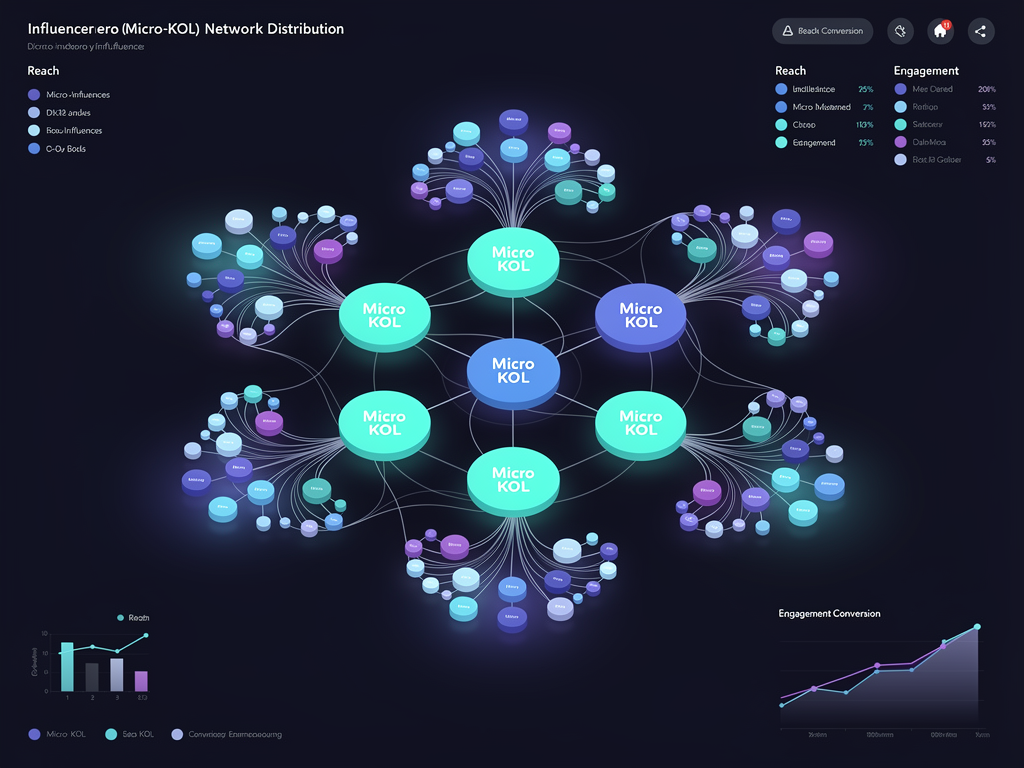
Macro influencers command high fees and often deliver poor engagement rates. Micro-KOLs with 5,000-50,000 followers typically have more authentic relationships with their audiences. Structure campaigns with clear deliverables, content approval workflows, and performance tracking.
A campaign targeting a major crypto project coordinated micro-KOL content distribution over one month. The team generated 170 unique posts that reached 427,000 people with a 4.6% average engagement rate. More importantly, the brand’s own account saw 200% growth in engagement, indicating the campaign built lasting awareness. Source: Tweet
A common pitfall here is paying for posts without tracking conversions. Ensure influencers use UTM parameters or unique referral codes so you can attribute users and calculate true cost per acquisition.
Step 4: Create Community-Driven Growth Loops
The most powerful crypto marketing doesn’t feel like marketing. When users derive genuine value, they naturally share with others. Design your product with viral mechanics: referral rewards, social proof elements, leaderboards, and achievements that users want to showcase.
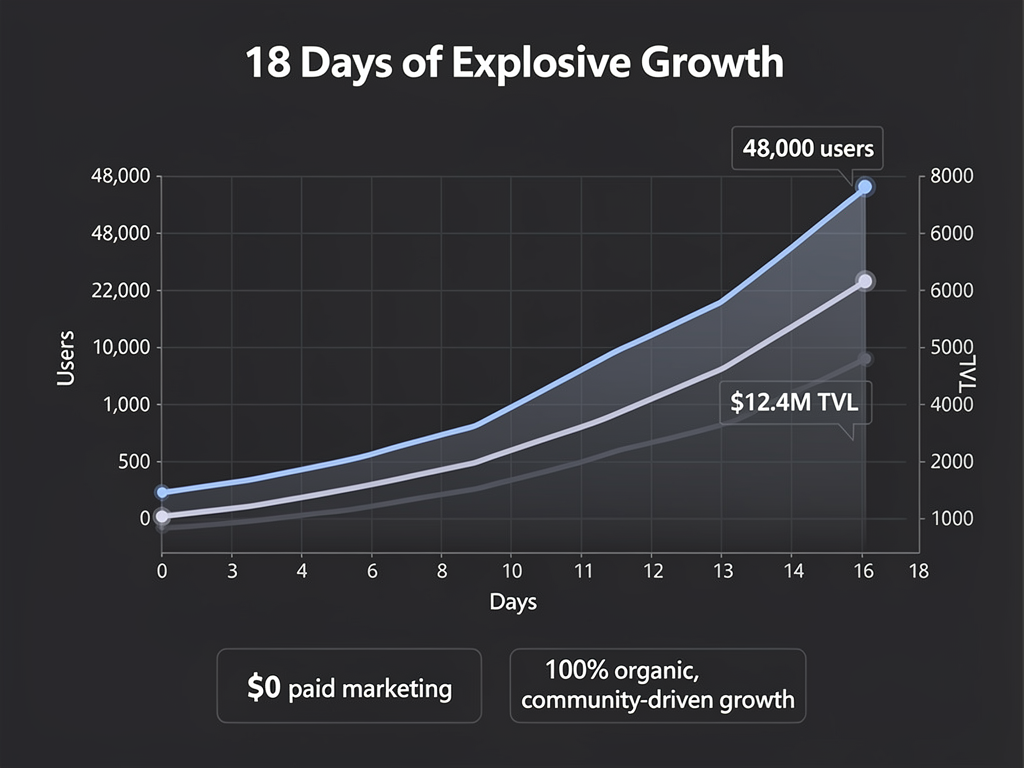
Calculate your viral coefficient: if each user brings 1.2 new users on average, you have exponential growth. Anything below 1.0 requires constant paid acquisition. One protocol achieved explosive growth mirroring early Slack and Airbnb adoption patterns by focusing entirely on user experience and community-driven traction. With 48,000 users and $12.4 million TVL accumulated in just 18 days—all without paid campaigns—the project demonstrated that satisfied users who each bring 2-3 more create sustainable growth. Source: Tweet
Step 5: Deploy Airdrop and Quest Mechanics Strategically
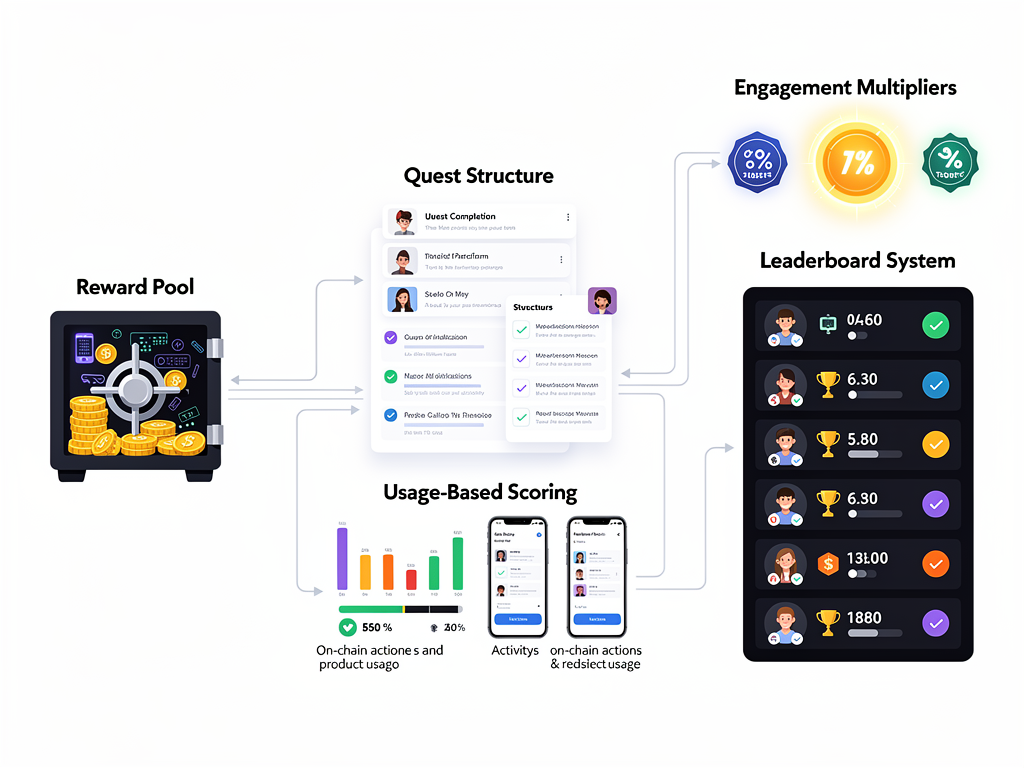
Airdrops can drive attention, but poorly designed campaigns attract mercenary users who vanish after claiming tokens. Structure your airdrop to reward meaningful engagement: protocol usage, liquidity provision, governance participation, and community contributions. Use quest platforms to educate users while they earn eligibility.
The protocol mentioned earlier deployed a sophisticated airdrop playbook featuring $110,000 in rewards, Galxe Starboard leaderboards, quests plus usage-based scoring, boosts for early lenders and borrowers, and community participation multipliers. This approach filtered for users likely to remain active post-airdrop. Source: Tweet
Many projects make the mistake of announcing airdrop criteria in advance, which encourages gaming. Consider retroactive airdrops that reward genuine historical usage instead.
Step 6: Expand Cross-Chain for Network Effects
Each blockchain integration opens a new user base and often comes with ecosystem grants. Projects expanding to networks like Solana, Base, Arbitrum, or emerging chains frequently receive grants, co-marketing support, and featured placement in ecosystem materials.
The DeFi protocol expanding across Movement, Monad, Sonic, Base, and Hyperliquid secured grants from Solana Superteam, Movement, Eclipse, and Wormhole. Each integration increased the TVL ceiling and multiplied the value of early positioning. Source: Tweet
Step 7: Measure, Iterate, and Scale What Works
Track metrics that predict long-term success: daily active users, retention curves, cost per retained user, transaction volume per user, and community engagement rates. Vanity metrics like Twitter followers or Telegram members mean little if they don’t translate to protocol usage.
Set up attribution tracking for every channel. Run controlled experiments where you can isolate variables. When you find a channel delivering users at an acceptable cost with good retention, scale budget aggressively before competition catches up.
Where Most Projects Fail (and How to Fix It)
Many teams launch campaigns without clear success metrics. They spend thousands on influencer posts but never track how many users actually converted or which influencers drove quality traffic versus bot follows. Before spending a dollar, define what success looks like: Is it wallet connections? Test transactions? TVL milestones? Set up tracking infrastructure first.
Another frequent error is treating all impressions equally. A million views from irrelevant audiences produces zero value. The crypto marketing analyst examining Web3 platforms noted dramatic differences between advertised results and actual campaign outcomes. Some campaigns achieved costs under $10 per 10,000 impressions on crypto-specific platforms, but only when targeting was precise. Source: Tweet
Projects often neglect community management after initial launch hype. Users join Discord or Telegram, ask questions, and receive no response. This kills momentum faster than any competitor. Dedicate team resources to daily community engagement, or accept that your channels will become ghost towns.
Overpromising and underdelivering destroys trust permanently in crypto. Communities have long memories and public blockchain records. If your roadmap promises features in Q2, deliver them. If you’ll miss the deadline, communicate early and explain why. Transparency builds credibility even when things go wrong.
Many founders try to handle complex marketing in-house without expertise, leading to wasted budget and missed opportunities. Specialized agencies understand the nuances of crypto audiences, regulatory constraints, and channel-specific best practices that take years to develop. FLEXE.io, with over 7 years in Web3 marketing and a client base of 700+ projects, provides access to 10+ crypto traffic sources, 150+ media outlets, and 500+ KOLs to accelerate user growth and awareness. Contact us on Telegram: https://t.me/flexe_io_agency
Finally, many projects chase trends without strategic coherence. They launch NFTs because NFTs are hot, add a token because everyone else has one, or pivot to whatever narrative is trending on Twitter. Sustainable projects identify their core value proposition and build marketing around that foundation, adapting tactics while maintaining strategic consistency.
Real Cases with Verified Numbers
Case 1: Micro-KOL Campaign Delivers 200% Engagement Boost
Context: A major crypto project needed to break through market noise and build authentic awareness among potential users during a competitive launch period.
What they did:
- Identified and vetted micro-influencers with engaged crypto-native audiences rather than purchasing placement from macro accounts.
- Coordinated content creation with clear messaging guidelines while allowing influencers creative freedom to maintain authenticity.
- Structured the campaign to run for one concentrated month, creating momentum and conversation density.
Results:
- Before: Baseline brand engagement not publicly disclosed, but typical for pre-campaign state.
- After: Generated 170 unique posts, reached 427,000 people, achieved 4.6% average engagement rate.
- Growth: The brand’s own account saw 200% increase in engagement metrics, indicating sustained awareness beyond the campaign period.
Key insight: Micro-influencers with genuine audience relationships outperform larger accounts on engagement and cost efficiency, especially when given creative flexibility within strategic guidelines.
Source: Tweet
Case 2: From Zero to Six Figures Through Project Marketing
Context: An individual marketer entering the crypto space in 2019 with no significant earnings, seeking a sustainable path to financial independence through marketing rather than speculation.
What they did:
- Studied successful authors and sellers to understand persuasion and communication fundamentals, then applied those principles to crypto project marketing.
- Focused on marketing services for blockchain projects, building case studies and expertise in the niche.
- Incorporated trading as a complementary skill to accelerate capital growth while maintaining marketing as the primary revenue engine.
- Mentored others in crypto marketing, creating a network effect that amplified reputation and opportunities.
Results:
- Before: No substantial earnings in crypto, searching for a sustainable competitive advantage.
- After: Generated first $100,000 from marketing a crypto project; reached first $1,000,000 through trading.
- Growth: Multiple people introduced to the field became financially independent, validating the approach’s replicability.
Key insight: Marketing skills create more predictable income in crypto than speculation, and teaching others builds credibility that attracts higher-value clients.
Source: Tweet
Case 3: Specialized Platform Delivers Single-Digit CPM
Context: Web3 projects historically struggled with high customer acquisition costs on traditional advertising platforms that didn’t understand crypto user behavior or offer appropriate targeting options.
What they did:
- Leveraged a crypto-native marketing platform designed specifically for Web3 user awareness and engagement.
- Analyzed the last 10 completed campaigns on the platform to assess real-world performance versus advertised capabilities.
- Optimized targeting to reach crypto-savvy users rather than general audiences, dramatically improving cost efficiency.
Results:
- Before: Projects paying $5-15+ per thousand impressions on traditional platforms with poor conversion rates.
- After: Some campaigns achieved costs in the single-digit dollar range per 10,000 impressions while reaching highly relevant crypto audiences.
- Growth: Order-of-magnitude improvement in cost efficiency compared to Web2 advertising channels.
Key insight: Platform selection matters as much as creative quality—crypto-native platforms understand the audience and deliver dramatically better ROI for blockchain projects.
Source: Tweet
Case 4: Zero Paid Marketing to $12.4M TVL in 18 Days
Context: A DeFi protocol launching in a crowded market where most projects spend heavily on paid advertising, influencer campaigns, and promotional giveaways to gain initial traction.
What they did:
- Focused exclusively on user experience improvements that removed friction from common DeFi workflows rather than adding complexity.
- Built viral mechanics into the product itself so satisfied users naturally referred 2-3 additional users each.
- Deployed a strategic airdrop playbook with $110,000 in rewards, usage-based scoring, Galxe Starboard leaderboards, and multipliers for early lenders and borrowers.
- Secured ecosystem grants from multiple chains including Solana Superteam, Movement, Eclipse, and Wormhole as validation and co-marketing support.
- Expanded rapidly across multiple chains (Movement, Monad, Sonic, Base, Hyperliquid) to capture network effects.
Results:
- Before: Zero users and zero total value locked at launch.
- After: Reached 48,000 users and $12.4 million in total value locked within just 18 days.
- Growth: Daily active usage climbing without any paid acquisition campaigns, mirroring early growth patterns of companies like Slack and Airbnb.
- Additional metrics: $110,000 distributed in rewards, grants secured from multiple blockchain ecosystems.
Key insight: When product experience genuinely solves user pain points, organic growth can outpace expensive paid campaigns—the best marketing feels invisible because users share value, not hype.
Source: Tweet
Tools and Next Steps
Several platforms and tools help execute these strategies effectively. Analytics platforms like Dune Analytics and Nansen provide on-chain data to track user behavior and competitor performance. Social listening tools such as LunarCrush and Kaito monitor sentiment and identify trending conversations. Quest platforms including Galxe, Layer3, and QuestN gamify user education and engagement. Influencer marketplaces like Cloutboost and various agency networks connect projects with vetted KOLs across different audience sizes and niches.
Community management tools matter as much as acquisition channels. Discord with proper bot configuration, Telegram with automated moderation, and platforms like Crew3 or Zealy for contribution tracking help maintain engagement as your community scales. Marketing attribution tools such as Peel and Web3-native analytics ensure you know which channels actually drive valuable users versus empty wallets.
For projects seeking expert guidance and established networks, specialized agencies provide immediate access to proven channels and relationships. FLEXE.io brings 7+ years of Web3 marketing experience serving 700+ blockchain projects, with direct access to 150+ crypto media outlets and 500+ influencers to rapidly scale user acquisition and awareness. Get in touch on Telegram: https://t.me/flexe_io_agency
Use this checklist to build momentum:
- Define your specific target user and the top three pain points your protocol solves better than alternatives
- Set up proper analytics infrastructure including wallet tracking, attribution parameters, and conversion funnels before spending on acquisition
- Identify the two or three channels where your target users actively engage with crypto content daily
- Create a content calendar with educational material, development updates, and community spotlights for consistent presence
- Test small influencer campaigns with 3-5 micro-KOLs, track results meticulously, then scale what works
- Design viral mechanics into your product: referral rewards, social proof elements, or achievements users want to share
- Structure your airdrop or incentive program to reward genuine usage and long-term participation, not mercenary farming
- Apply for ecosystem grants from every blockchain you integrate with—most have marketing and co-promotion budgets
- Commit specific team resources to daily community management across your primary channels
- Review metrics weekly and reallocate budget toward channels delivering the best cost-per-retained-user, not just cost-per-impression
FAQ: Your Questions Answered
What budget do I need to start marketing a crypto project effectively?
You can start testing channels with $2,000-5,000 monthly. Focus on one or two channels, run small experiments with micro-influencers or targeted campaigns, and track every dollar to identify what works before scaling. Some projects have achieved initial traction with zero paid marketing by focusing on product quality and organic community building, as demonstrated by protocols reaching significant TVL through word-of-mouth alone.
How long does it take to see results from crypto marketing efforts?
Influencer campaigns and paid advertising can show initial metrics within days, but meaningful results like sustained user growth and community engagement typically require 4-8 weeks of consistent effort. The projects achieving explosive growth in 2-3 weeks usually spent months building product quality and positioning before their public launch. Plan for a 90-day window to properly test, iterate, and scale your approach.
Should I focus on Twitter, Discord, Telegram, or other platforms?
Twitter drives awareness and attracts new users; Discord and Telegram retain and engage existing community members. Most successful projects maintain active presence on Twitter for reach plus one community platform for depth. Analyze where your specific target users spend time—DeFi users skew heavily toward Twitter and Discord, while regional communities may prefer Telegram. Don’t spread thin across every platform.
Are macro-influencers worth the high fees they charge?
Usually no. Data from successful campaigns shows micro-influencers with 5,000-50,000 followers often deliver better engagement rates and more authentic endorsements at a fraction of the cost. One campaign using exclusively micro-KOLs generated 427,000 impressions and 200% brand engagement growth in one month. Reserve macro-influencers for major announcements where broad reach matters more than engagement depth.
How do I avoid attracting mercenary users who leave after airdrops?
Structure rewards around meaningful protocol usage rather than simple social tasks. Use scoring systems that weight transaction volume, liquidity provision duration, and governance participation. Consider retroactive airdrops for historical users rather than announced future criteria that encourage gaming. Projects using usage-based scoring and multipliers for early genuine users retain far more community members post-airdrop.
What metrics actually matter for crypto marketing success?
Track daily active users, 7-day and 30-day retention rates, cost per retained user, transaction volume per user, and community engagement rates. These predict long-term success better than vanity metrics like follower counts or total impressions. Set up on-chain analytics to see what percentage of acquired users actually interact with your protocol versus just connecting wallets.
Can organic growth really compete with paid advertising in crypto?
Yes, when product experience creates genuine value. One DeFi protocol reached 48,000 users and $12.4 million TVL in 18 days with zero paid marketing by focusing on viral coefficients where each satisfied user brought 2-3 more. Organic growth builds more resilient communities and better unit economics long-term, though it requires superior product quality and may take longer to initial traction than paid campaigns.