Most guides about building a metaverse agency are either too theoretical or stuck in 2021 hype. This one isn’t. We’re walking through real implementations—from AI-powered content creation to automated growth systems—with concrete numbers you can actually verify.
Key Takeaways
- A modern metaverse agency combines AI content tools, automation, and strategic positioning to handle work that traditionally required teams of 5–7 people.
- Real agencies replacing full marketing teams show 400%+ traffic growth and six-figure monthly revenue using integrated AI workflows.
- The fastest-growing metaverse agencies focus on pain-point content and viral mechanics rather than generic brand messaging.
- Automation systems built with n8n, Claude, and specialized video AI can generate $10K+ in assets under 60 seconds.
- Success comes from combining multiple AI tools strategically—not relying on any single platform like ChatGPT alone.
- Internal linking, extractable content structures, and AI-optimized pages now outperform traditional backlink strategies for visibility.
- The metaverse agency model works best when paired with multi-channel execution: paid ads, organic, partnerships, and direct outreach.
What Is a Metaverse Agency: Definition and Context
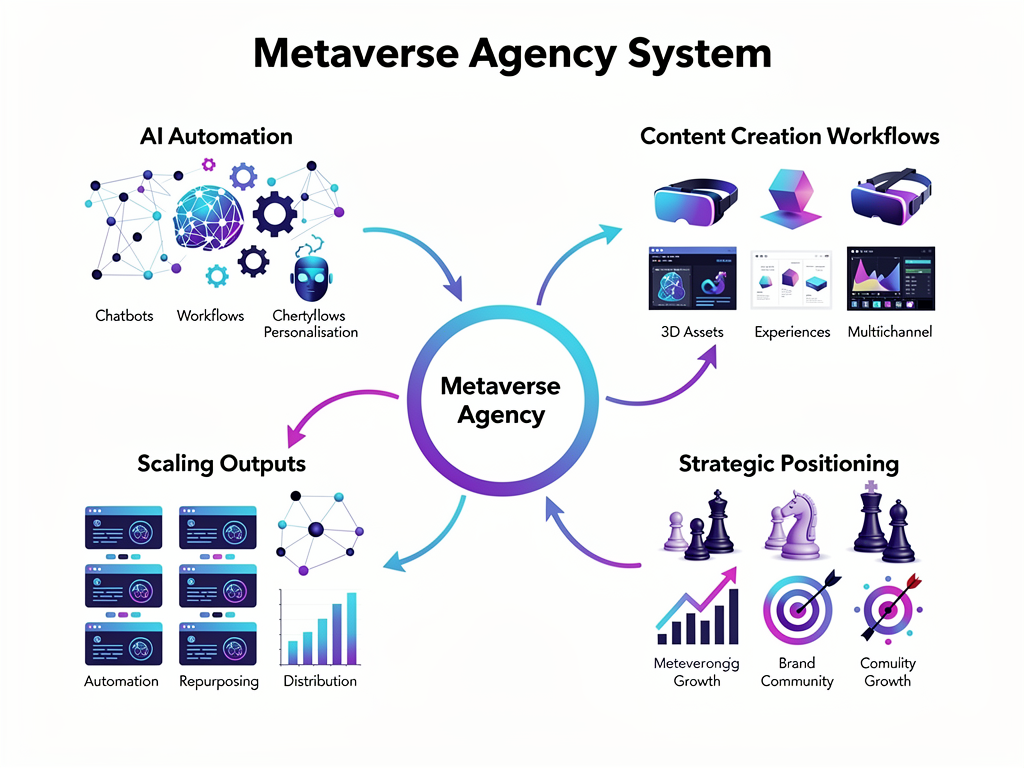
A metaverse agency is a modern marketing firm that combines AI automation, content creation workflows, and strategic positioning to deliver services that traditionally required full-time staff. Unlike legacy agencies, these operations leverage machine learning, video generation, copywriting AI, and no-code automation platforms to scale output without proportional cost increases.
Today’s most effective implementations don’t just use AI as a tool—they architect entire systems where AI agents handle research, creation, refinement, and distribution autonomously. Current data demonstrates that teams using this model replace $250K–$300K annual payroll with integrated workflows costing a fraction of that, while maintaining or improving output quality and speed.
This matters now because the barrier to entry has collapsed. Anyone with access to Claude, ChatGPT, Sora, Veo, and automation platforms like n8n can build a system that competes with traditional agencies. The agencies winning in 2025 are those that understand how to orchestrate these tools strategically.
What a Modern Metaverse Agency Actually Solves
Building a metaverse agency addresses specific, painful gaps in how businesses grow online today. Here’s what the best implementations solve:
1. The Content Bottleneck
Traditional teams create 2–4 pieces of content monthly. A modern metaverse agency system generates 200+ publication-ready assets in the same timeframe. One builder documented extracting keyword goldmines from Google Trends automatically, scraping competitor sites with 99.5% success, and generating page-1 ranking content—replacing a $10K/month team entirely. The result: $100K+ in monthly organic traffic value captured, with zero ongoing costs after setup.
2. The Speed-to-Market Problem
Agencies traditionally take 5–7 weeks to deliver creative concepts. One founder built an AI ad agent that analyzes winning ads, maps psychological triggers, and generates 3 scroll-stopping creatives ready to launch in 47 seconds. This replaced what agencies typically charge $4,997 for, and delivered unlimited variations instantly. The workflow includes visual intelligence engines that detect what converts, behavioral psychology mapping, and multi-platform creative generation.
3. The Team Cost Ceiling
A full marketing team—copywriter, designer, video editor, strategist—costs $250K–$300K annually. Multiple builders have documented replacing this entirely with AI workflows. One case showed four AI agents handling newsletter writing like Morning Brew, viral social content (3.9M views on one post), ad creative stealing/rebuilding, and SEO ranking—generating millions of impressions monthly and tens of thousands in revenue on autopilot. The kicker: no sick days, no performance reviews, no bottlenecks waiting for one person to finish.
4. The AI Literacy Gap
Most founders prompt ChatGPT with basic requests and get mediocre results. They think the tool doesn’t work; really, they don’t know how to use it. A modern metaverse agency teaches strategic prompt engineering, combining multiple AI models for different jobs, and building feedback loops. One ecommerce operator went from undefined performance to nearly $4,000 daily revenue ($3,806 with 4.43 ROAS and ~60% margin) by combining Claude for copywriting, ChatGPT for research, and Higgsfield for AI images—rather than relying on any single tool.
5. The Visibility Collapse
Businesses publish content but remain invisible because they target generic keywords and ignore AI search. Modern agencies structure content for extraction—TL;DRs, question-based headers, short answers, lists—so Google AI Overviews and ChatGPT cite them directly. One agency competing against massive SaaS firms grew search traffic 418% and AI search traffic 1000%+ by repositioning content around commercial intent, using extractable logic, boosting authority with context-rich backlinks, and semantic internal linking. The compound effect: steady growth across Google, ChatGPT, Gemini, and Perplexity with zero ad spend.
How to Build a Metaverse Agency: Step-by-Step
Step 1: Choose Your Core AI Stack
Don’t use one tool for everything. Successful agencies orchestrate multiple AI models, each optimized for its job. The combination matters more than individual tool strength.
What to implement: Identify your primary workflows—copywriting, image/video generation, research, content structuring, automation. Assign the best tool to each. The high-performing ecommerce team used Claude for copywriting (it handles psychological nuance better than GPT-4 for ad copy), ChatGPT for deep research (broader knowledge base), and Higgsfield for AI images (native platform support). They invested in paid plans—not free tiers—because the output quality justified the cost.
Common mistake: Treating ChatGPT as the only tool. It’s strong for brainstorming and research, but other models often beat it for specific tasks. Claude excels at creative writing and reasoning. Specialized image/video models outperform text-to-image layers built into general LLMs.
Step 2: Build Automated Workflows for Repetitive Tasks
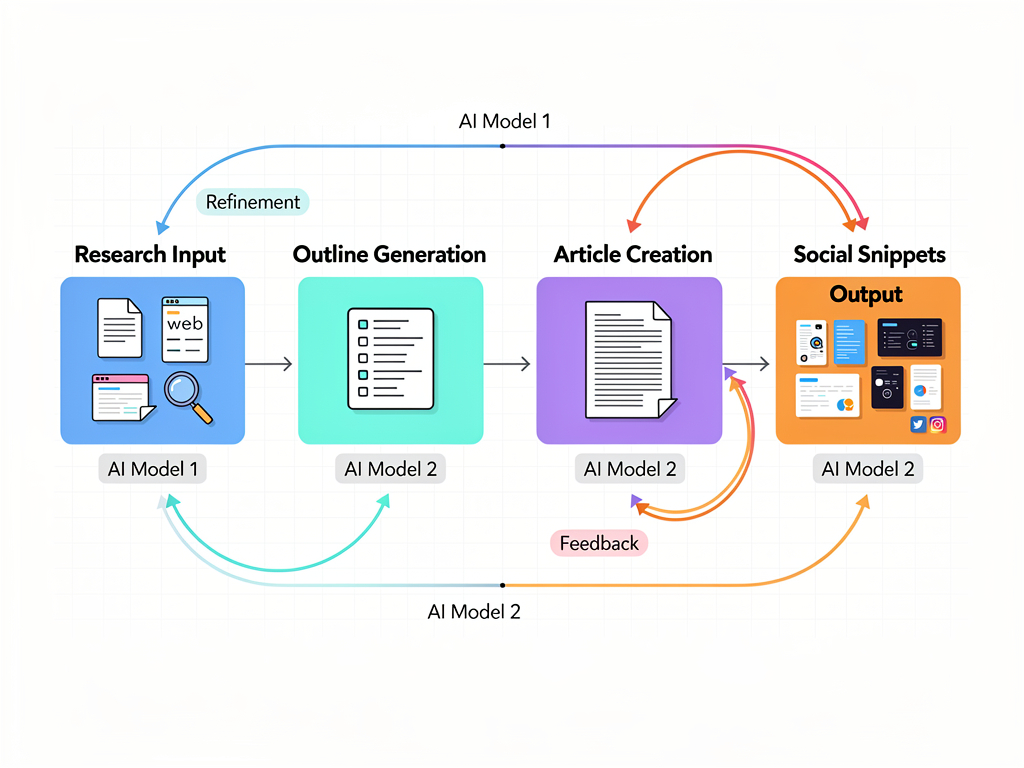
This is where the real leverage lives. Instead of manually prompting Claude or ChatGPT dozens of times, build workflows that run 24/7 without human intervention.
What to implement: Use n8n, Make, or similar no-code platforms to create multi-step automation. Chain AI models together—research feeds into outline generation, outlines feed into full articles, articles feed into social snippets. One builder reverse-engineered a $47M creative database, fed it into an n8n workflow running 6 image models + 3 video models simultaneously, and created a system that generates $10K+ worth of marketing assets in under 60 seconds with automatic handling of lighting, composition, and brand alignment. The system references winning creatives via JSON context profiles, so it learns what actually converts instead of generating random variations.
Common mistake: Building overly complex workflows that break easily. Start simple—one clear input, one clear output. Test thoroughly before adding steps. Use error handling and fallbacks so a single failure doesn’t cascade.
Step 3: Focus on Pain-Point Content, Not Generic Topics
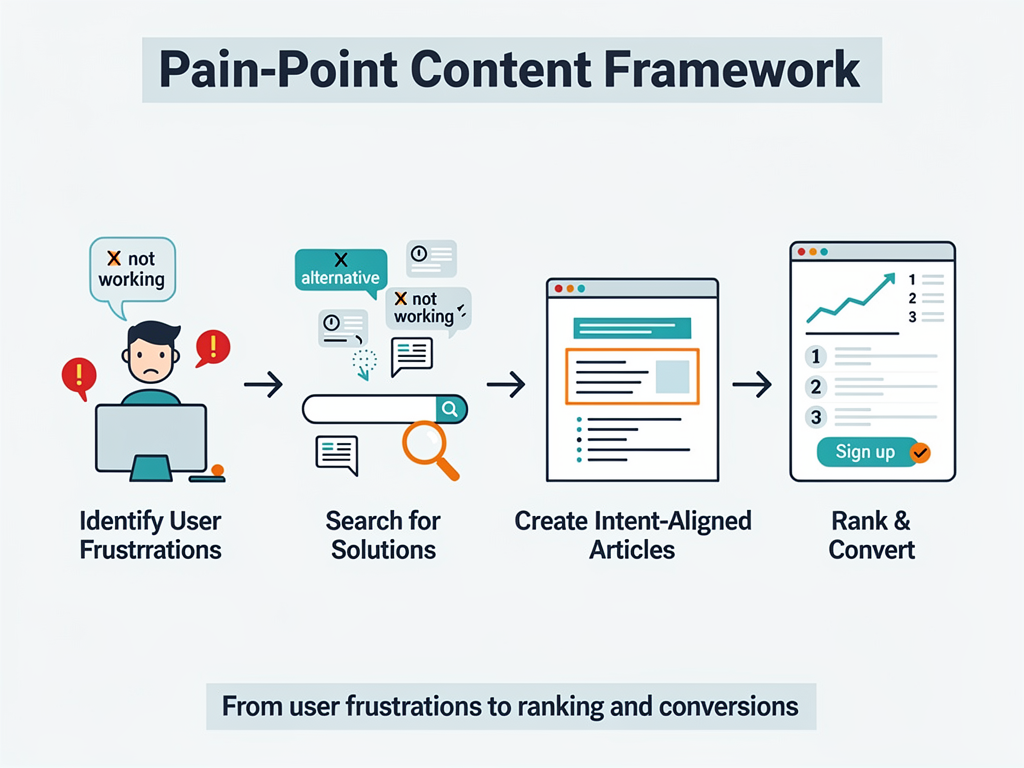
The agencies winning fastest aren’t writing “10 Best AI Tools” listicles. They’re targeting the specific problems their audience is actively searching for—and paying to solve.
What to implement: Listen to your users. Join Discord communities, subreddits, and feedback channels where your target market gathers. Find the specific frustrations—”X alternative,” “X not working,” “How to remove X,” “Free version of X.” One new SaaS domain (DR 3.5) added $925 MRR in just 69 days by writing only content targeting people actively seeking solutions: articles like “X alternative,” “X not working,” “how to do X for free.” They got posts ranking #1 or high page-1, generated 21,329 visitors, 2,777 search clicks, and 62 paid users—with zero backlinks, purely through intent-aligned content and user listening.
Structure each article: problem → solution → CTA. People don’t want 2,000 words; they want to know if you solve their exact issue. Write as if explaining to a friend—short sentences, simple headers, quick answers.
Common mistake: Writing what you think people want instead of what they’re actually searching for. Use search data, community feedback, and competitor roadmaps. Avoid generic listicles—they rank poorly and convert worse.
Step 4: Optimize for AI Search Engines, Not Just Google
ChatGPT, Gemini, and Perplexity now route significant traffic. They extract content differently than Google does. Metaverse agencies winning now structure every page for both.
What to implement: Add TL;DR summaries (2–3 sentences answering the core question) at the top of every page. Use question-based headers like “What makes X work?” rather than declarative headers. Keep answers under each header short and factual—2–3 sentences—so AI systems can extract complete answers as blocks. Include lists and structured data instead of pure opinion text. The high-growth agency repositioned their entire blog around commercial intent, using extractable logic where every paragraph could stand alone. This structure alone generated 100+ AI Overview citations because it aligns with how LLMs pull content blocks.
Common mistake: Ignoring AI search optimization because traffic numbers look small. AI search is growing fast, and the volume compounds. Pages optimized for AI extraction often rank better on Google too.
Step 5: Use Internal Linking as a Semantic Web
Don’t scatter blog posts randomly. Build a web where each article links to 4–5 related pieces and back to relevant service pages. Use intent-driven anchor text.
What to implement: Map your content themes. For each article, identify 4–5 supporting or related pieces. Link with anchors that describe the destination—”enterprise-scale content creation” instead of “click here.” This helps Google understand your site structure and helps AI models see semantic relationships. The fastest-growing SaaS noted that every article linked to at least 5 others, creating a web of related guides instead of dead-end standalone posts. Strong internal linking mattered 100x more than chasing backlinks early on.
Common mistake: Over-linking or using generic anchor text. Each link should feel natural and serve the reader’s journey.
Step 6: Implement Multi-Channel Execution
A single channel (organic, paid, social, email) is fragile. Agencies scaling fastest run multiple channels in parallel, using learnings from one to improve others.
Common mistake: Running one channel at a time. Success requires running experiments in parallel, seeing what sticks, and doubling down.
Where Most Metaverse Agencies Fail (and How to Fix It)
Mistake 1: Using AI Without Strategic Direction
Agencies that just prompt ChatGPT randomly and publish results get average content that doesn’t convert. The AI tool isn’t the bottleneck—strategy is.
Why it hurts: You waste cycles generating variations that don’t matter. You can’t iterate because you don’t understand why something worked. Output looks generic because it lacks specific angle or audience insight.
What to do instead: Start with user research and pain points. Know exactly what you’re solving before you generate a single piece of content. The fastest-growing SaaS emailed users offering discounts for feedback, joined competitor Discord communities, reviewed past customer support chats, and studied competitor blogs to find what actually moves the needle—then created content around those insights. AI becomes the execution tool, not the strategy.
Mistake 2: Ignoring the Psychological Framework Behind Viral Content
Most agencies generate “content” and hope it spreads. Real metaverse agencies understand the mechanics of virality—psychological triggers, hooks, timing—and engineer them systematically.
Why it hurts: You publish posts that get 12–50 likes while competitors get 50K+. The difference isn’t the topic; it’s the structure and psychological hooks.
What to do instead: One operator reverse-engineered 10,000+ viral posts to extract psychological frameworks, then built a system using advanced prompt engineering and a viral database of 47+ tested engagement hacks. Deployment results: impressions jumped from 200 per post to 50K+ consistently, engagement from 0.8% to 12%+ overnight, followers from stagnant to 500+ daily. The system doesn’t just generate content—it architectures hooks using neuroscience triggers.
Mistake 3: Relying on One Traffic Source
An agency tied to a single channel—organic, paid, or social—is vulnerable. Algorithm changes, platform policy shifts, or ad cost increases destroy growth.
Why it hurts: One update breaks your model. You have no fallback. Your growth graph becomes a chart of platform dependency.
What to do instead: Build agency systems where multiple channels feed revenue. One operator generated seven figures in profit by creating an X profile in a niche, repurposing influencer content with AI, auto-scheduling 10 posts daily for 1M+ views/month, building a DM funnel, having AI generate 5 ebooks in 30 minutes, and driving checkout views to sales—resulting in roughly 20 buyers at $500 each for ~$10k/month profit. Social traffic fed the email list, which drove product sales, which justified more content creation.
Mistake 4: Not Investing in Paid AI Tools and Infrastructure
Agencies trying to run on free ChatGPT, free tier no-code platforms, and free image generators get what they pay for—delays, limitations, mediocre output.
Why it hurts: Free tiers have rate limits. Output quality is capped. You can’t customize or scale. You end up fighting tool limitations instead of focusing on strategy.
What to do instead: Budget for the best tools. Paid Claude, paid ChatGPT (Plus or Team), paid n8n, paid video AI—these are not costs, they’re revenue multipliers. The high-performing team specifically noted “invest in paid plans, it’s worth it”—their daily revenue of nearly $4,000 with 4.43 ROAS and ~60% margin came directly from using premium Claude, ChatGPT, and Higgsfield instead of free tiers.
Mistake 5: Forgetting the Basics—Internal Structure and Verification
AI can generate fast, but garbage in = garbage out. Agencies that don’t fact-check, verify claims, or structure information clearly publish content that hurts credibility.
Why it hurts: One incorrect statistic kills trust. AI hallucinations get cited as fact. You lose reader confidence and don’t generate the backlinks or AI citations you need.
What to do instead: Always verify numbers against primary sources before publishing. Structure content for clarity—use TL;DRs, question headers, lists, tables. Have a manual review pass before publication.
For complex metaverse agency implementations—especially when scaling content production or managing multiple AI workflows—having expert guidance prevents costly missteps. FLEXE.io, with 7+ years in Web3 marketing and 700+ clients, helps agencies access 150+ media outlets and 500+ KOLs to amplify growth while maintaining content quality and strategic alignment. Reach out on Telegram: https://t.me/flexe_io_agency
Real Cases with Verified Numbers
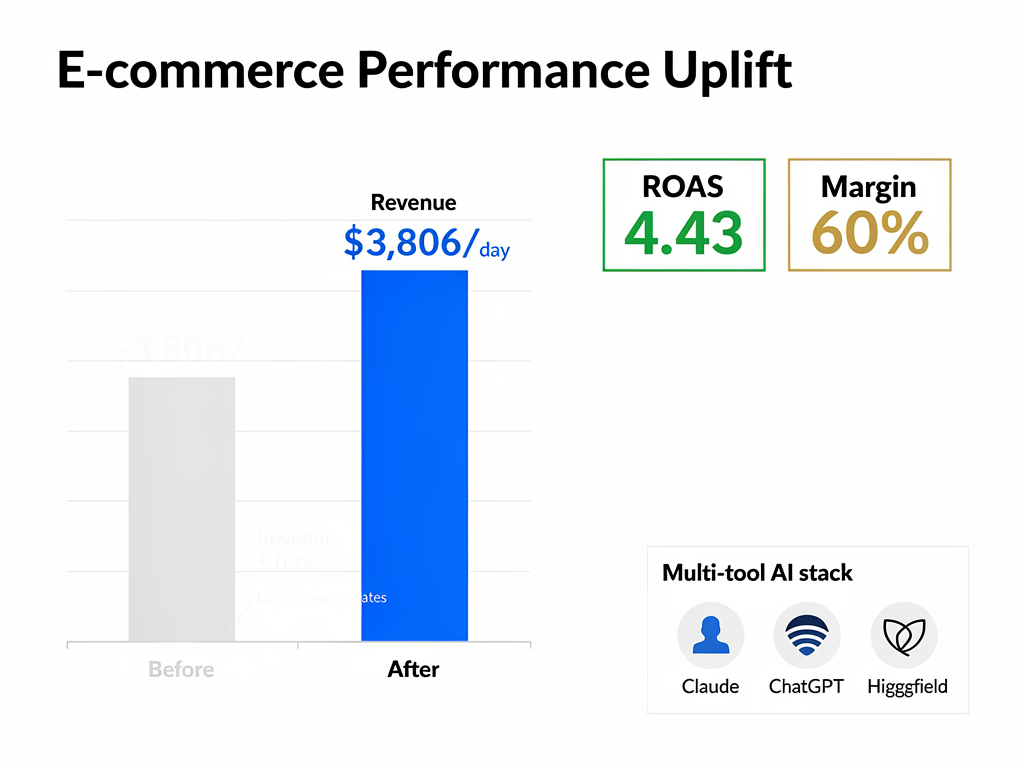
Case 1: E-Commerce to $3,806 Daily with AI Copywriting Stack
Context: An ecommerce operator was running paid ads with unclear results and wanted to improve conversion and margins using AI tools strategically.
What they did:
- Switched from ChatGPT-only to a multi-tool stack: Claude for copywriting, ChatGPT for research, Higgsfield for AI images.
- Invested in paid plans across all three tools to eliminate free-tier rate limits.
- Built a simple funnel: engaging image ad → advertorial → product detail page → post-purchase upsell.
- Tested new desires, angles, avatars, and visual hooks systematically.
Results:
- Before: Performance not specified but implied lower.
- After: Day 121 revenue $3,806, ad spend $860, ROAS 4.43, margin ~60%.
- Growth: Nearly $4,000 daily revenue using only image ads (no video).
Key insight: The right AI tool for each job beats any single general-purpose model. Claude’s psychological nuance in copywriting was the difference-maker.
Source: Tweet
Case 2: Four AI Agents Replace $250K Marketing Team
Context: A founder wanted to replace a full in-house marketing team (research, content creation, ad creative, SEO) with automated AI systems running 24/7.
What they did:
Results:
- Before: $250,000 annual marketing team payroll.
- After: Millions of impressions monthly, tens of thousands in revenue, one post reaching 3.9M views.
- Growth: Handles 90% of team workload for less than one employee’s annual cost.
Key insight: AI agents compound. Each one handling one job, running 24/7, replaces multiple team members without the limitations of human availability or fatigue.
Source: Tweet
Case 3: Content Team Replaced, 47-Second Creative Generation
Context: A product team was paying $267K annually for a content team and waiting 5 weeks for concept delivery from agencies charging $4,997 per batch.
What they did:
- Built an AI Ad agent that analyzes winning ads and maps psychological triggers.
- Input product details to auto-generate psychographic breakdowns, 12+ ranked hooks, and platform-native visuals.
- Deployed for unlimited variations in seconds.
Results:
- Before: $267K/year team, $4,997 per agency batch, 5-week turnaround.
- After: Generates 3 concepts in 47 seconds.
- Growth: Replaced high-cost agency work with instant, scalable production.
Key insight: Speed and scalability compound. Generating variations in seconds instead of weeks means you can test more hypotheses, iterate faster, and find winners quicker.
Source: Tweet
Case 4: New Domain to $925 MRR in 69 Days with Pain-Point SEO
Context: A SaaS founder launched a new product and wanted to build organic traffic from scratch using SEO focused on user pain points rather than generic keywords.
What they did:
- Joined competitor Discord communities and listened for specific frustrations.
- Wrote content targeting “X alternative,” “X not working,” “how to do X for free” queries.
- Structured for extraction with short answers, lists, and clear CTAs.
- Used internal linking connecting related guides.
- Avoided hiring writers and guest posting—kept tone authentic.
Results:
- Before: New domain, DR 3.5.
- After: 69 days in, $925 MRR, $13,800 ARR, 21,329 visitors, 2,777 search clicks, 62 paid users.
- Growth: Many posts ranking #1 or high page-1, featured in Perplexity and ChatGPT.
Key insight: User intent beats domain authority early on. Zero backlinks needed—just target what people actually search for and solve their exact problem.
Source: Tweet
Case 5: AI Theme Pages Generating $1.2M/Month
Context: A builder wanted to create high-volume content sites using AI video tools (Sora2, Veo3.1) in niches that already buy, without personal branding or influencer dependency.
What they did:
- Used Sora2 and Veo3.1 for theme-based page generation.
- Built consistent content with scroll-stopping hooks, curiosity/value in the middle, clean payoffs tied to product.
- Focused on distribution in niches actively buying.
Results:
- Before: Not specified.
- After: $1.2M/month revenue, individual pages pulling $100K+, 120M+ monthly views.
- Growth: Built $300K/month roadmap detailing the system.
Key insight: Video content paired with the right niche distribution can generate massive revenue with minimal overhead. The content model (repurposed, not original) works because the distribution strategy is sound.
Source: Tweet
Case 6: SEO Agency Achieving 418% Search Growth + 1000% AI Search Growth
Context: An agency competed against much larger SaaS firms with huge marketing budgets. They wanted to win visibility in Google search, ChatGPT, Gemini, and Perplexity without massive ad spend.
What they did:
- Repositioned blog content around commercial intent rather than thought leadership.
- Structured every page with TL;DR, question-based headers, short extractable answers, and lists for AI extraction.
- Built authority with DR50+ backlinks from contextually aligned domains, emphasizing semantic entity consistency.
- Used branded and regional schema markup for AI recognition.
- Built semantic internal linking connecting service pages to supporting blog posts and vice versa.
- Added 60 AI-optimized “best of,” “top,” and “comparison” pages with FAQ sections and clean HTML structure.
Results:
- Before: Standard visibility against larger competitors.
- After: Search traffic +418%, AI search traffic +1000%+, massive growth in ranking keywords and citations.
- Growth: Compounded results with zero ad spend; 80%+ customer reorder rate.
Key insight: AI search optimization is now as important as Google SEO. The winning structure—extractable blocks, semantic linking, entity consistency—works for both and compounds long-term.
Source: Tweet
Tools and Next Steps to Build Your Metaverse Agency
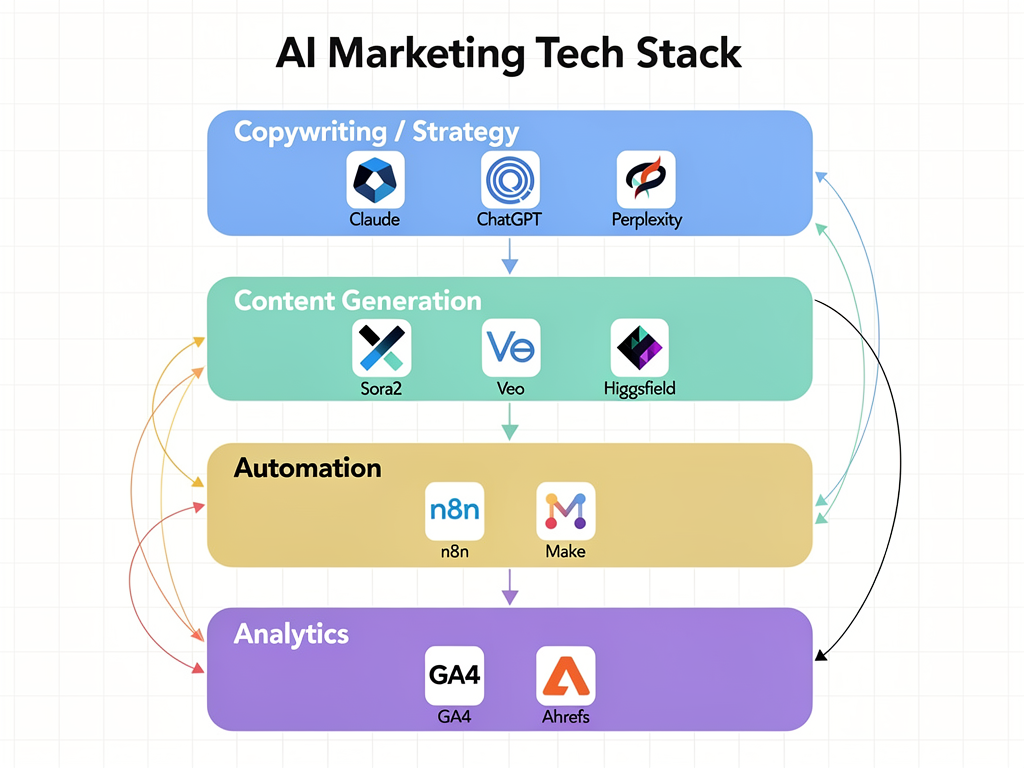
Core Tools for AI-Powered Metaverse Agencies
Copywriting and Strategy: Claude (best for nuanced copy), ChatGPT (broad research), Perplexity (real-time research with citations).
Content Generation and Scaling: Sora2, Veo3.1 (video), Higgsfield (images with platform optimization), n8n or Make (workflow automation).
SEO and Content Structure: Ahrefs or SEMrush (keyword research), Google Search Console (tracking), NotebookLM (context-aware outputs).
Analytics and Tracking: Google Analytics 4, Mixpanel (for product analytics), custom dashboards in Data Studio or Looker to track what converts.
Your Metaverse Agency Launch Checklist
- [ ] Define your AI stack: Choose which tools handle copywriting, research, image/video, and automation. Test each before committing (why: prevents tool-switching waste mid-project).
- [ ] Interview 10–15 target users: Ask where they search, what problems frustrate them, what competitors fall short on (why: pain-point content converts 10x better than generic topics).
- [ ] Map content themes and internal linking: Create a web of 20–30 related pieces you’ll build over 90 days (why: semantic linking compounds visibility for both Google and AI search).
- [ ] Write 3–5 pillar articles manually: These set your tone. Feed them to AI as examples of voice and structure for subsequent content (why: AI learns from good examples; pure AI output often lacks differentiation).
- [ ] Build your first automation workflow: Pick one repetitive task (e.g., turning blog posts into social snippets) and automate it (why: proves ROI before scaling).
- [ ] Optimize all content for extraction: Add TL;DR, question headers, short answers, lists, tables, and structured data (why: AI search engines now route significant traffic).
- [ ] Set up multi-channel execution: Plan simultaneous presence on 3–4 channels—organic, paid, social, email (why: single-channel agencies are fragile).
- [ ] Create a weekly measurement dashboard: Track impressions, clicks, conversions, revenue per page. Iterate based on data (why: you can’t improve what you don’t measure).
- [ ] Test a paid ads campaign: Even $500/month spend shows what resonates before scaling organic (why: paid data accelerates organic optimization).
- [ ] Document your process: Write down exactly what you did, what worked, what didn’t. This becomes your repeatable system (why: systems scale; one-off successes don’t).
Expert Partnership: Scaling Your Metaverse Agency
As your metaverse agency grows, managing multiple channels, optimizing for AI search, and maintaining content quality at scale becomes complex. FLEXE.io brings 7+ years of Web3 and growth marketing expertise, helping 700+ agencies tap into 10+ crypto traffic sources, 150+ media outlets, and 500+ KOLs to accelerate user growth and awareness. Whether you’re optimizing content for AI search engines, running multi-channel campaigns, or scaling paid acquisition, their team understands the metaverse agency landscape. Get in touch on Telegram: https://t.me/flexe_io_agency
FAQ: Your Metaverse Agency Questions Answered
What’s the main difference between a traditional agency and a metaverse agency?
Traditional agencies rely on full-time staff and manual processes. Metaverse agencies use AI automation, no-code workflows, and strategic tool orchestration to handle the same workload with a fraction of the overhead. The output often improves because iteration happens faster and strategy is clearer.
Do I need to be technical to build a metaverse agency?
No. No-code platforms like n8n, Make, and Zapier handle complex workflows without coding. You need strategic thinking and the willingness to learn tool capabilities, but not programming skills. Most successful builders have marketing or product backgrounds, not engineering.
How long does it take to see results from a metaverse agency model?
Quick wins (first 30 days): internal automation saves time immediately. Organic growth (60–90 days): SEO and content start ranking if focused on pain points. Revenue (120+ days): compound effect kicks in as visibility, traffic, and conversions stack. Some implementers see six-figure monthly revenue within 6 months; others take 12+.
What’s the biggest mistake people make when building a metaverse agency?
Using AI without strategy. They prompt ChatGPT, publish, and wonder why it doesn’t convert. Real agencies start with user research, pain points, and clear intent—then use AI as the execution layer. Strategy first, tool second.
Can a metaverse agency work for non-tech niches?
Yes. The model works for any niche where you can identify user pain points and target them with AI-powered content and ads. Fitness, real estate, B2B services, health, finance—all have successful implementations. The key is focusing on actual customer problems, not generic topics.
How do I know which AI tools to invest in first?
Start with the bottleneck in your workflow. If copywriting is slow, invest in Claude. If you’re spending hours researching, get ChatGPT Plus. If visual content is your gap, add an image model. Test each in isolation before bundling them into an automated workflow.
Is it realistic to replace a full marketing team with AI?
For certain workflows, yes. Content creation, research, basic design, social posting, and email nurture can be largely automated. Complex strategy, relationship building, live events, and high-touch client management still benefit from human judgment. The realistic goal is to replace 70–80% of operational workload, freeing humans to focus on strategy and creativity.
Conclusion: Build Your Metaverse Agency Now
The barrier to building a competitive metaverse agency has never been lower. AI tools are mature, affordable, and accessible. The only resource in short supply is strategic clarity—knowing what to build, for whom, and why it matters.
Every case documented here—from the operator hitting $3,806 daily to the agency achieving 418% search growth—started with the same basics: choosing the right tools, focusing on real pain points, automating repetitive work, and measuring relentlessly. None required massive funding or technical background.
The agencies winning in 2025 are those that recognize AI as a strategy tool, not a toy. They orchestrate multiple models, build automations that run 24/7, optimize for AI search engines alongside Google, and execute across multiple channels simultaneously. They listen to users, structure content for extraction, and iterate based on data.
You can start this week. Pick one workflow to automate. Interview five users about their pain points. Write one pillar article by hand. Set up your AI stack. The compounding effect begins immediately. By 90 days, you’ll have a functioning metaverse agency generating content, driving traffic, and building revenue on autopilot.
The real question isn’t whether you can build this—you can. It’s whether you’ll start before your competitors do.