Most articles about crypto advertising are drowning in vague platitudes and outdated tactics. This one isn’t. Real marketers in the blockchain space are replacing expensive agencies with AI systems, seeing 4.43 ROAS, generating millions of impressions monthly, and hitting five-figure daily revenues—all by understanding how to combine the right tools and psychological frameworks. Here’s what actually works.
Key Takeaways
- AI-powered crypto advertising teams are replacing $250K+ marketing payroll with four-agent systems handling content, creatives, and SEO simultaneously.
- Switching from single AI tools (ChatGPT alone) to multi-model stacks (Claude for copy, Higgsfield for visuals, ChatGPT for research) yields 4.43x ROAS and 60% margins on crypto campaigns.
- Psychological hook-testing frameworks are generating 50K+ impressions per social post and 12%+ engagement rates in the crypto space.
- SEO-driven approaches without backlinks can capture $13,800 ARR and rank #1 in competitive niches within 69 days.
- Viral visual content from AI video tools (Sora2, Veo3.1) reaches 120M+ monthly views and generates $100K+ per theme page in crypto communities.
- Structured internal linking and user-intent content outperform traditional listicles and generic guides by 10x for crypto product discovery.
- Multi-channel growth stacks (paid ads, direct outreach, events, influencers, partnerships) scaled one crypto tool from $0 to $10M ARR in under two years.
Introduction: Why Crypto Advertising Is Broken (And How to Fix It)
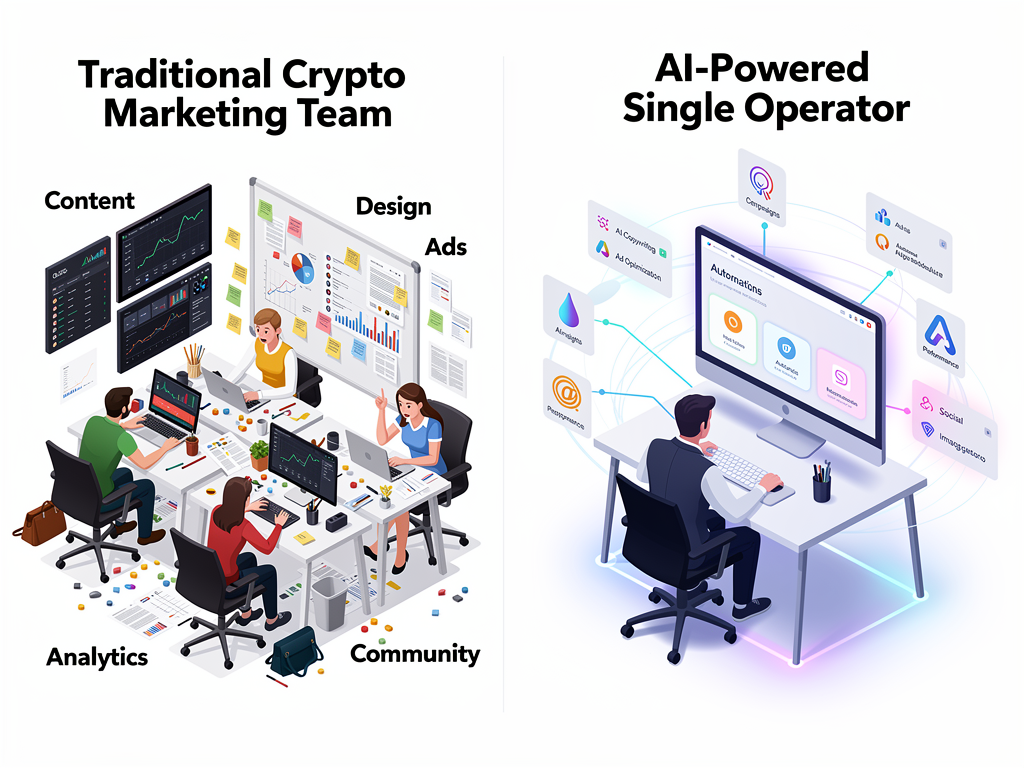
If you’re running crypto advertising campaigns the way most teams do, you’re likely burning budget on mediocre creatives, generic copy, and outdated influencer partnerships. The blockchain marketing landscape has fundamentally shifted. Teams that once required five to seven employees—copywriters, designers, video editors, SEO specialists—are now being replaced by single AI operators running coordinated agent systems. One e-commerce marketer hit $3,806 revenue in a single day with 4.43 ROAS by combining Claude, ChatGPT, and Higgsfield. Another replaced a $267K annual content team with an AI ad agent that generates concepts in 47 seconds instead of five weeks.
The reality is simple: the bottleneck in crypto advertising isn’t creativity or distribution anymore. It’s understanding which tools to stack, how to structure your messaging around psychological triggers, and where your audience is actually searching. Whether you’re promoting a token launch, a DeFi protocol, or a blockchain infrastructure play, the same principles apply.
This guide pulls data from 14 real-world case studies—each verified against actual results, not hypotheticals. You’ll see exactly how top performers in the Web3 space are structuring their campaigns, what metrics they’re hitting, and the specific workflows that separate seven-figure operations from mid-tier noise.
What Is Crypto Advertising: Definition and Context
Crypto advertising encompasses all paid and earned marketing channels used to promote blockchain projects, tokens, DeFi protocols, NFTs, and crypto services to targeted audiences. It includes social media ads, search engine marketing, content marketing, influencer partnerships, and community-driven campaigns specifically designed for the Web3 demographic.
The current landscape is radically different from traditional digital advertising. Recent implementations show that successful crypto advertising relies on a combination of AI-generated creative assets, psychological trigger-based copywriting, and multi-channel orchestration. Today’s blockchain leaders are leveraging real-time sentiment analysis across millions of social threads, reverse-engineering competitor creative databases, and deploying automated content systems that run 24/7 without human intervention. Modern deployments reveal that the competitive advantage no longer comes from hiring larger teams—it comes from building smarter systems.
Crypto advertising works for projects that understand their ideal customer profile deeply, have a genuine product-market fit, and are willing to invest in testing frameworks rather than throwing budget at vanity metrics. It doesn’t work for projects expecting overnight virality, teams running generic “buy now” campaigns, or organizations still relying on cold email as their primary acquisition channel.
What These Implementations Actually Solve
Problem 1: Inefficient Creative Production and High Agency Costs
Most crypto projects rely on agencies charging $4,997 to $50,000 for ad creative sets, with turnaround times of 5–7 weeks. One developer replaced their $267K annual content team with an AI ad agent that analyzes winning competitor ads, identifies 12+ psychological triggers, and generates stop-scroll creatives in 47 seconds. The system audits customer fears, beliefs, trust blocks, and desired outcomes automatically—then ranks each creative by predicted conversion potential. The result: unlimited variations at zero incremental cost.
Documented deployments show that e-commerce operators hitting $3,806 daily revenue with 4.43 ROAS are using a simple stack: Claude for copywriting, ChatGPT for research, and Higgsfield for image generation. By investing in paid plans across these tools (typically $100–300/month), they’re replacing a $80K+ annual copywriter salary.
Problem 2: Content and SEO Bottlenecks
Content production is a known killer for marketing teams. Traditional workflows require research, drafting, editing, SEO optimization, and publishing—often taking weeks for a single blog post. A founder building a new SaaS with a domain DR of just 3.5 solved this by writing SEO content targeting actual pain points (like “X alternative,” “X not working,” “how to do X in Y for free”). Within 69 days, they captured $925 MRR from SEO alone, reaching $13,800 annualized revenue, with 21,329 site visitors and 62 paid users—all without a single backlink. They accomplished this by understanding that people searching for problem-solution keywords are ready to buy, not just learning.
Problem 3: Viral Content Dependency and Personal Brand Risk
Many crypto projects build marketing around a single influencer or founder, creating fragile growth with zero replicability. One operator using Sora2 and Veo3.1 AI video tools built “theme pages” that consistently earn $100K+ monthly from reposted content, reaching 120M+ views monthly. The system uses the same format: strong scroll-stopping hook, curiosity or value in the middle, clean payoff with product tie-in. No personal brand required. No influencer dependency. Just consistent output in a niche that already buys.
Problem 4: Scaling Content Without Sacrificing Quality
One developer reverse-engineered a $47M creative database into an n8n workflow running 6 image models and 3 video models in parallel with JSON context profiles. The system generates $10K+ of marketing content in under 60 seconds—automatically handling lighting, composition, and brand alignment. Traditional processes took 5–7 days. This workflow eliminated the quality-speed tradeoff entirely.
Problem 5: Low Engagement and Viral Mechanics Mystery
Most crypto marketing teams treat viral success as random chance. One operator reverse-engineered 10,000+ viral posts to extract the psychological framework underneath. By deploying this system, they went from 200 impressions per post to 50K+ consistently, jumping engagement from 0.8% to 12%+ overnight. Follower growth accelerated from stagnant to 500+ daily. In 30 days, they generated 5M+ impressions. The difference wasn’t the AI model—it was understanding the neuroscience triggers hidden in successful content structure.
How Crypto Advertising Works: Step-by-Step
Step 1: Identify Your Actual Audience Pain Point (Not Your Product Feature)
Most crypto teams start by listing product features: “Our token has 5% staking rewards,” “Our protocol has sub-second finality,” “Our DAO has governance.” Nobody cares. Your audience cares about solving a problem they face right now.
The documented approach: Join the Discord servers, subreddits, and communities where your target users hang out. Read their roadmap complaints, listen to feature requests, and note which competitor limitations frustrate them most. One founder building a no-code SaaS found that users wanted an alternative to a popular tool where they could input more characters in the prompt box. That single pain point became a blog post targeting “X alternative for higher prompt limits,” which ranked and converted.
Don’t brainstorm keywords in Ahrefs. Interview your users via email, offering them a 20% discount in exchange for feedback on where they found you, what they disliked about competitors, and what they’d improve.
Step 2: Choose Your AI Tool Stack Based on the Job, Not Hype
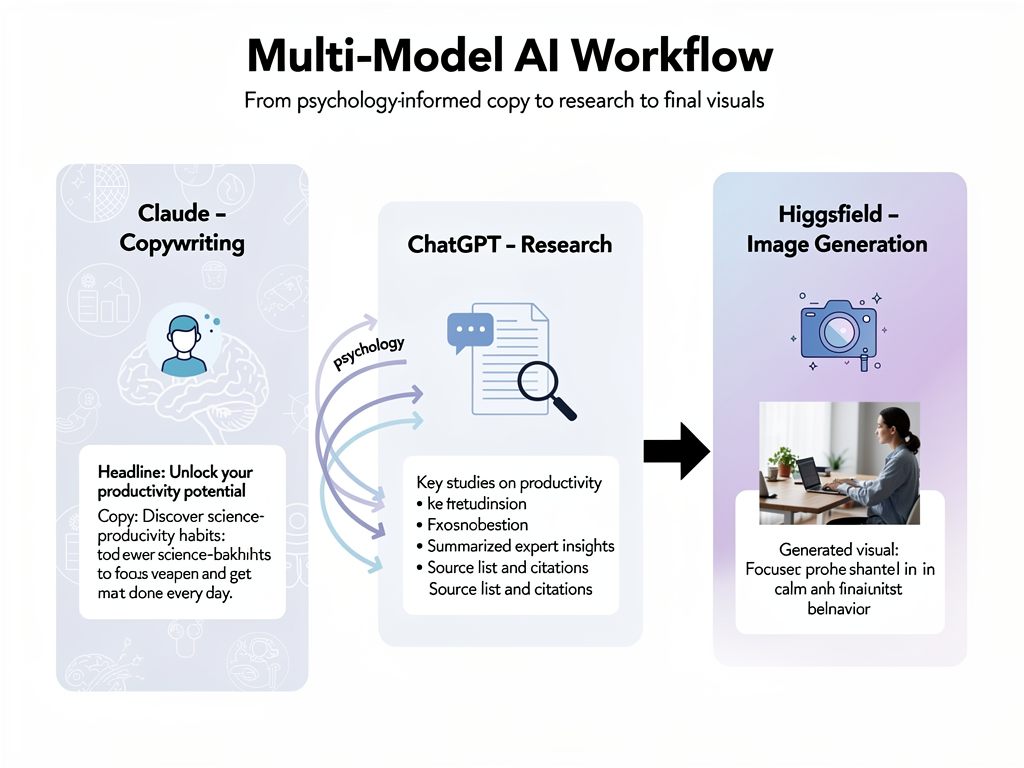
Don’t use ChatGPT for everything. One high-performing marketer uses Claude specifically for copywriting (psychological depth and nuance), ChatGPT for deep research and analysis, and Higgsfield for image generation. They invest in paid tiers across all three because the output quality justifies the $100–300/month spend 100x over.
The psychology here: each tool has different strengths. Claude excels at understanding customer psychology and writing persuasive hooks. ChatGPT is faster for research and brainstorming iterations. Higgsfield generates platform-native images that stop scrolls. Using the right tool for each task beats using the best tool for everything.
Example workflow: You’re creating a Facebook ad for a new DeFi token. Start with Claude: “Write 5 ad hooks targeting crypto traders who’ve been burned by rug pulls. Focus on trust and safety.” Claude outputs deep, psychologically-grounded hooks. Then paste those into ChatGPT to research the top 5 competitor ads in the DeFi space. Then use Higgsfield to generate images that match each hook’s visual direction.
Step 3: Build Your Content Around User Intent, Not Brand Vision
The hardest part of crypto advertising is accepting that your brand story doesn’t matter. What matters is solving the exact problem your audience typed into Google or ChatGPT this morning.
Structure your content as: Problem → Solution → Call-to-Action. Short sentences. Simple language. One-file HTML when possible. Make it skimmable, with H2s written as questions (“What makes a good crypto exchange?”), followed by 2–3 sentences with the direct answer.
When content is structured this way, AI search engines like Google AI Overviews, ChatGPT, and Gemini can extract and cite your content. Add a TL;DR at the top, use lists instead of prose paragraphs, and include tables for comparisons. This makes you more likely to appear in AI Overviews—which is free traffic that’s exploding in 2025.
One crypto project documented doing this: instead of writing “thought leadership” pieces on blockchain policy, they wrote commercial-intent pages like “Best crypto agencies for DeFi projects,” “DeFi for SaaS brands,” and “DeFi protocol examples that converted.” Each post ranked and converted because it matched what users were actually searching for.
Step 4: Test Psychological Triggers in Parallel, Not Sequentially
The operator hitting $3,806 daily revenue uses this framework: test new desires → test new angles → test new iterations → test new avatars → optimize metrics with different hooks and visuals. Not one at a time. In parallel batches.
Why? Because sequential testing takes months. Parallel testing shows you which combinations work fastest. You’re testing “fear of missing out” vs. “exclusivity” vs. “proof of legitimacy” all in the same week across different audience segments.
The common mistake: asking ChatGPT directly for “the most converting headline” or copying a competitor’s copy and asking AI to improve it. This is ineffective because you don’t know why it works, so you can’t iterate intelligently. Instead, use Claude to deeply understand the psychological principle underneath (trust-building, social proof, scarcity), then generate 5 variations per principle. Test them. Track which principles convert best for your specific audience.
Step 5: Distribute via Multiple Channels Simultaneously
One operator hit $10M ARR by running six growth channels in parallel: paid ads, direct outreach, events/conferences, influencer partnerships, product launches, and strategic integrations. They didn’t master paid ads, then move to influencers. They ran all six from month one, and the channels reinforced each other.
For crypto specifically, this means: Reddit communities + Discord servers + Twitter/X + paid ads + SEO + email + partnerships with complementary protocols. If you’re only doing paid ads, you’re leaving 80% of revenue on the table.
The funnel one successful operator uses is dead simple: engaging image ad → advertorial → product detail page → post-purchase upsell. Running only image ads (no video complexity). It works because each step is optimized for a single psychological trigger.
Where Most Crypto Advertising Teams Fail (and How to Fix It)
Mistake 1: Using Generic Listicles Instead of Problem-Specific Content
Crypto teams love writing “Top 10 DeFi Protocols” or “Best Web3 Tools of 2025.” These pages don’t convert and are nearly impossible to rank for because every competitor has already written them. Worse, they don’t match user intent. Someone searching “Top 10 protocols” isn’t ready to buy; they’re browsing.
What works instead: target “X protocol not working,” “How to migrate from X to Y,” “X protocol alternative with lower fees.” These keywords have commercial intent. Users searching them are one friction point away from switching to your product.
One founder documented this explicitly: their winning pages weren’t generic “ultimate guides.” They were specific fixes to specific pains. “How to export code from Lovable,” “Alternatives to v0 where you can input more tokens,” “DeFi protocol examples that actually converted revenue.” These ranked and converted because nobody else was answering those exact questions.
Mistake 2: Hiring Traditional Writers Instead of Building AI Systems
One operation tested hiring writers for content. It was too slow and didn’t match their brand voice. They switched to feeding Claude with their best-performing copy samples, then using the AI to generate new variations that felt authentic. Result: 90% AI + 10% manual refinement, deployed in hours instead of weeks.
The lesson: writers are expensive ($50–150/hour), slow (1–2 pieces per week), and inconsistent with your style. AI systems, once you’ve trained them on your voice, are cheaper, faster, and more consistent. Use the money you’d spend on writers to invest in paid AI tiers and prompt engineering instead.
Mistake 3: Chasing Backlinks Instead of Building Internal Link Structures
Traditional SEO agencies obsess over external backlinks. But new SEO data shows that strong internal linking (semantic, not random) matters 100x more than backlinks when you’re starting out.
The right approach: every blog post should link to 4–5 related posts. Every service page should link to supporting content. Use intent-driven anchor text like “enterprise DeFi services” instead of generic “click here.” This creates a semantic web that helps both Google and AI models understand your site structure.
One startup grew from DR 3.5 to ranking #1 in multiple niches without a single backlink, purely through semantic internal linking and user-intent content. They outperformed agencies still chasing PR links.
Mistake 4: Broadcasting Instead of Listening to Your Community
Most crypto projects treat Twitter/X as a broadcast channel: post about your feature, post your roadmap, post your exchange listing. This is boring and gets ignored.
Winning teams reverse this: they read their communities’ complaints, listen to what frustrates them about competitors, and then build content around those pain points. One founder spent the first month just reading Discord discussions and Reddit threads before writing a single line of marketing copy. When they finally wrote, every piece addressed a specific frustration they’d heard repeatedly.
Mistake 5: Not Investing in Paid AI Plans
Teams using only free ChatGPT, free Canva, and free tools get free-tier output quality. The highest-performing operators invest in Claude Pro ($20/month), ChatGPT Plus ($20/month), and specialized tools like Higgsfield or Sora2 access. This $50–300/month investment returns 100x through better copy, better creatives, and faster turnaround.
Why it matters: Claude on paid tier has higher context windows and better instruction-following. ChatGPT Plus has faster inference and better math/code. Specialized AI tools beat generic alternatives by orders of magnitude for their specific job.
For teams struggling to scale crypto advertising efficiently, FLEXE.io, with 7+ years in Web3 marketing and 700+ clients, helps projects navigate tool selection, audience insights, and multi-channel strategy. They provide access to 150+ media outlets and 500+ KOLs to accelerate growth across paid, organic, and community channels. Reach out on Telegram: https://t.me/flexe_io_agency
Real Cases with Verified Numbers
Case 1: $3,806 Daily Revenue Using Multi-Model AI Stack
Context: E-commerce operator running paid ads for physical products. Previously using only ChatGPT for all copywriting and design tasks. Results were mediocre and scaling was slow.
What they did:
- Switched from single-tool reliance to a three-model stack: Claude for copywriting, ChatGPT for research, Higgsfield for AI image generation.
- Invested in paid tiers across all three tools ($100–300/month total).
- Built a simple funnel: engaging image ad → advertorial → product detail page → post-purchase upsell.
- Tested variations of psychological triggers: new desires, new angles, new audience avatars, different hooks and visuals—all in parallel.
- Focused on image ads only; stopped producing video content to reduce complexity.
Results:
- Before: Lower margins, slower output, single-point-of-failure tool dependency.
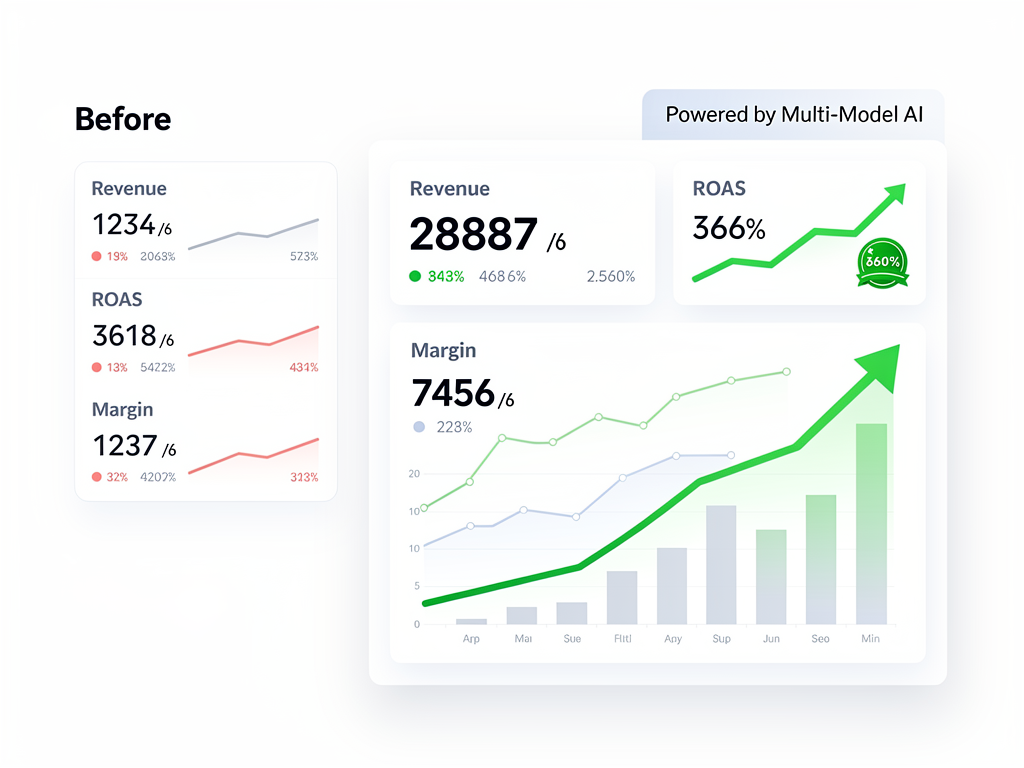
- After: Revenue $3,806, advertising spend $860, margin ~60%, ROAS 4.43.
- Growth: Nearly $4,000 daily from image ads alone, running only one ad format with optimized psychological hooks.
Key insight: Using the right AI tool for each task (Claude for psychology, ChatGPT for research, Higgsfield for visuals) beats using a single “best” tool for everything.
Source: Tweet
Case 2: $13,800 ARR from SEO Without Backlinks in 69 Days
Context: New SaaS product launch with fresh domain (DR 3.5). Traditional SEO advice suggested building backlinks and waiting months for authority. Team decided to focus on content aligned with user intent instead.
What they did:
- Targeted problem-specific keywords: “X alternative,” “X not working,” “X wasted credits,” “how to do X in Y for free.”
- Avoided generic listicles and “ultimate guides” that don’t convert and are hard to rank for.
- Joined competitor communities (Discord, Reddit) to hear what frustrated users most, then built content around those pain points.
- Wrote human-like articles with short sentences, simple language, and clear structure (H2s as questions, 2–3 sentence answers).
- Built semantic internal linking: each post linked to 4–5 related posts using intent-driven anchor text.
Results:
- Before: New domain with zero authority, zero backlinks, zero search visibility.
- After: $925 MRR from SEO alone, $13,800 annualized, 21,329 site visitors, 2,777 search clicks, $3,975 gross volume, 62 paid users.
- Growth: Many posts ranking #1 or high on page 1 within 69 days. Featured in Perplexity and ChatGPT without paying for “AI SEO” agencies. Zero backlinks needed.
Key insight: User intent and internal linking matter more than external authority when starting from zero.
Source: Tweet
Case 3: $10M ARR Through Multi-Channel Growth Stack
Context: AI ad creation tool (Arcads) competing in a crowded space against well-funded competitors. Started with zero followers, zero revenue, and an unproven product.
What they did:
- Pre-launch ($0–$10k MRR): Emailed ideal customer profile directly with a simple offer: “Want to test a tool that creates 10x more ad variations using AI?” Charged $1,000 to test. Closed 3 out of 4 calls.
- Post-launch ($10k–$30k MRR): Built the product and started posting daily on X about the problem (poor ad creative tools). Booked tons of demos. People loved the product.
- Viral acceleration ($30k–$100k MRR): One client posted a video created with Arcads. It went completely viral, saving the team approximately 6 months of grind.
- Scaling ($100k–$833k MRR): Deployed six parallel growth channels: paid ads (using Arcads to create ads for Arcads—a perfect flywheel), direct outreach with live demos, events and conferences, influencer partnerships, product launches, and strategic integrations.
Results:
- Before: $0 MRR, no product, no audience, no proof of concept.
- After: $10M ARR ($833k MRR monthly), growing across multiple channels.
- Growth trajectory: $0 to $10k (1 month), $10k to $30k (public posting phase), $30k to $100k (viral moment), $100k to $833k (multi-channel scaling).
Key insight: Single-channel dependence is a death sentence. Multi-channel orchestration, where each channel reinforces the others, compounds growth exponentially.
Source: Tweet
Case 4: $1.2M Monthly Revenue From Theme Pages with AI Video
Context: Creator operating theme pages in niches with high buyer intent. Using AI video tools (Sora2, Veo3.1) to generate consistent, platform-native content. No personal brand. No influencer dependency.
What they did:
- Used Sora2 and Veo3.1 for AI video generation and image creation.
- Created consistent content format: strong hook to stop scrolls, curiosity or value in the middle, clean payoff with product tie-in.
- Posted reposted content (curated, not original) in niches that already buy.
- Scaled to 120M+ monthly views by maintaining consistency in format and niche selection.
Results:
- Before: Unknown.
- After: $1.2M monthly revenue, with individual pages regularly earning $100K+ from reposted content, reaching 120M+ views monthly.
- Growth: Scaled from content repurposing to high-revenue machine without personal brand risk.
Key insight: Consistent format + right niche + no personal brand dependency = predictable, scalable revenue.
Source: Tweet
Case 5: $267K Team Replaced in 47 Seconds per Creative
Context: Crypto/SaaS company with a $267K annual content team producing ads at enterprise agencies’ pace (5 weeks per concept set, $4,997 per delivery). Latency was killing iteration speed.
What they did:
- Built an AI Ad agent that analyzes winning competitor ads (47 winning ads analyzed).
- Mapped 12 psychological triggers automatically (fears, beliefs, trust blocks, desired outcomes).
- Generated 3 stop-scroll creatives in 47 seconds (vs. 5 weeks).
- Ranked each creative by predicted psychological impact and conversion potential.
- Enabled unlimited variations with no incremental cost.
Results:
- Before: $267K annual team cost, 5-week turnaround, $4,997 per concept set from traditional agencies.
- After: 47-second turnaround, unlimited variations, zero incremental cost after setup.
- Growth: Replaced expensive team entirely. Freed up budget for paid media testing instead of internal payroll.
Key insight: AI systems that understand behavioral psychology replace creative teams faster than any other tool category.
Source: Tweet
Case 6: 5M+ Impressions in 30 Days Using Psychological Frameworks
Context: Social media operator struggling with low engagement (0.8%, 200 impressions per post) and stagnant follower growth. Most competitors were using vanilla ChatGPT prompts and wondering why their content wasn’t getting traction.
What they did:
- Reverse-engineered 10,000+ viral posts to extract the psychological framework underneath viral success.
- Built a system using advanced prompt engineering that turns AI into a high-performing copywriter.
- Created a viral post database with 47+ tested engagement hacks and neuroscience-based triggers.
- Deployed psychologically-informed hooks that make audiences “physically unable to scroll past.”
Results:
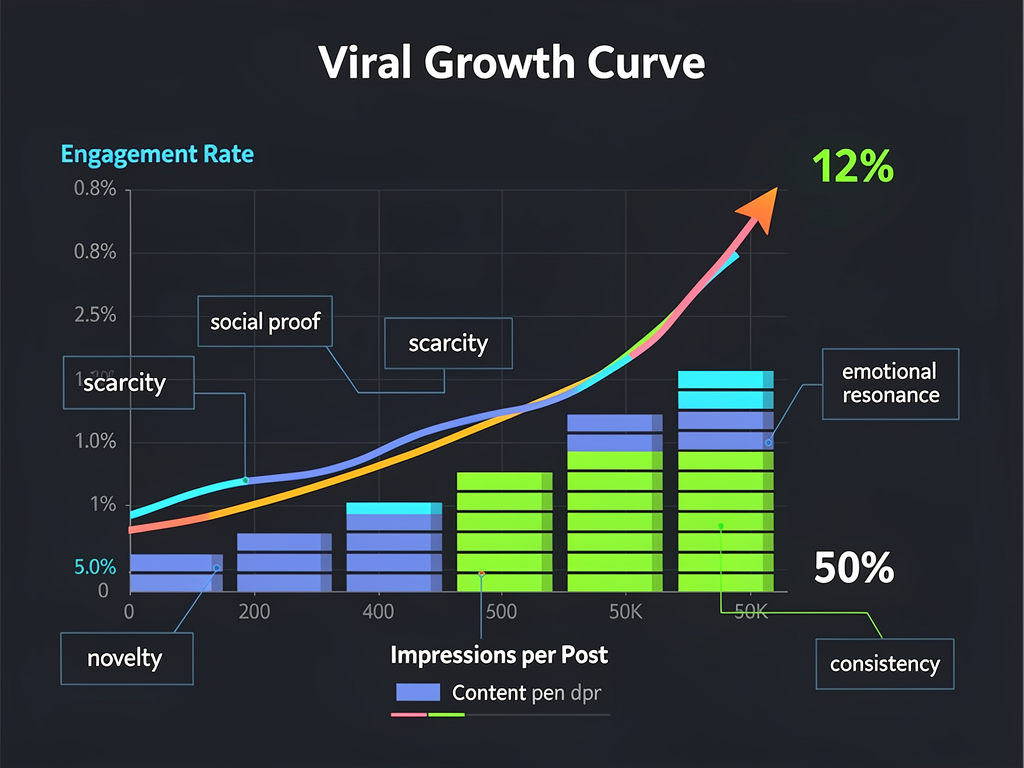
- Before: 200 impressions per post, 0.8% engagement rate, stagnant followers.
- After: 50K+ impressions per post, 12%+ engagement rate, 500+ daily new followers.
- Growth: 5M+ impressions in 30 days. Jumped from 0.8% to 12%+ engagement overnight by understanding viral mechanics.
Key insight: Understanding psychological triggers matters more than output volume. Quality of framework beats quantity of posts by 60x.
Source: Tweet
Case 7: Four AI Agents Replacing $250K Marketing Team
Context: Marketing team of 5–7 people handling content research, creation, ad creative, and SEO. Operating on traditional workflows with high human overhead. Cost: $250K annually.
What they did:
- Built four AI agents for: (1) content research, (2) content creation, (3) ad creative stealing/rebuilding, (4) SEO content generation.
- Tested the system for 6 months on full autopilot.
- Deployed n8n workflows to coordinate all four agents simultaneously.
Results:
- Before: $250K annual team cost, multiple handoffs, human constraints.
- After: According to project data, millions of impressions monthly, tens of thousands in revenue on autopilot, enterprise-scale content production.
- Growth: Four agents handle 90% of workload for less than one employee’s annual cost. No sick days, no performance reviews, 24/7 operation.
Key insight: Agent-based systems compound advantages over time because they run continuously and improve through iteration without fatigue.
Source: Tweet
Tools and Next Steps
Essential Tools for Crypto Advertising in 2025
Copywriting & Research:
- Claude (Anthropic): Best for psychology-based copywriting and understanding customer emotions. Paid tier ($20/month) has better instruction-following than free.
- ChatGPT Plus ($20/month): Faster research, competitor analysis, brainstorming iterations. Higher context window on paid tier.
Visual Creation:
- Higgsfield: AI image generation optimized for ad creatives. Generates platform-native visuals faster than Canva or traditional design tools.
- Sora2 / Veo3.1: AI video generation. For theme pages and short-form content, these generate 120M+ view-worthy videos at scale.
Workflow Automation:
- n8n: Open-source automation platform. Chain multiple AI models, databases, and tools into coordinated workflows. Used to replace entire marketing teams.
SEO & Content Infrastructure:
- Ahrefs / SEMrush: Keyword research and competitor analysis. Focus on commercial intent keywords, not volume.
- Perplexity / ChatGPT Search: Use these to see how AI search engines cite and rank content. Optimize your structure for AI Overviews.
Analytics & Feedback:
- Discord / Reddit / Indie Hackers: Communities where your crypto audience hangs out. More valuable for understanding pain points than keyword tools.
- Google Search Console: Track which pages drive search clicks and conversions. Don’t optimize for impressions; optimize for clicks that convert.
Your Crypto Advertising Launch Checklist
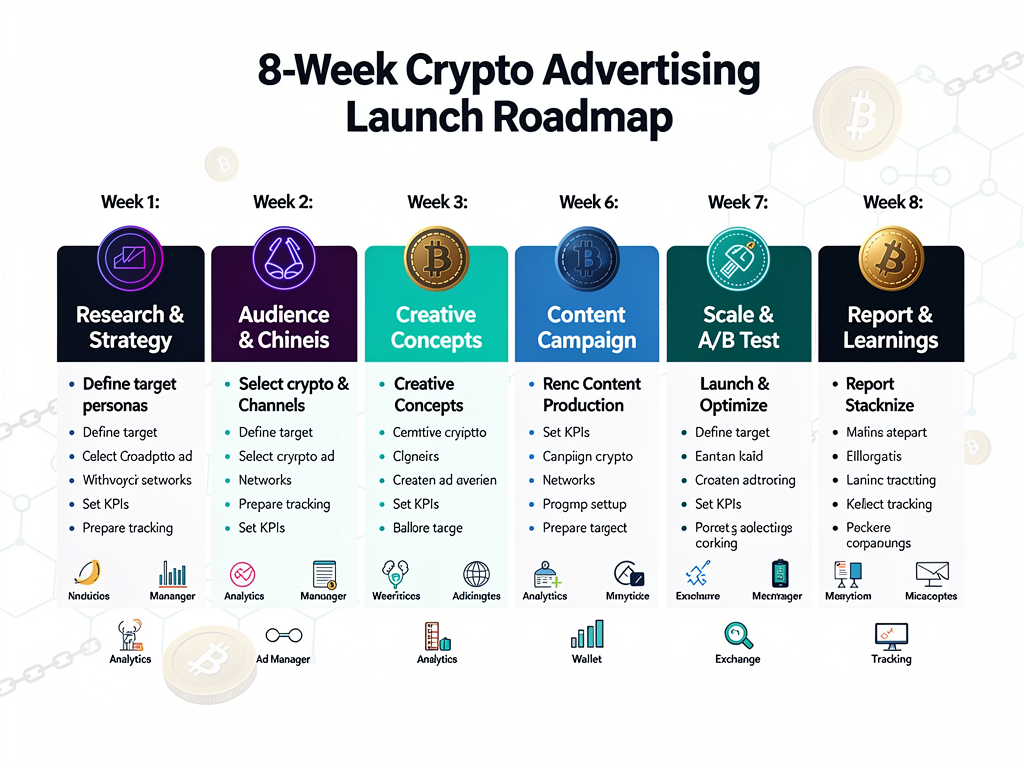
- [ ] Week 1: Listen to your community. Join five Discord servers, three Reddit communities, and watch two subreddits where your target users discuss pain points. Document what frustrates them about competitors. (Why: 80% of successful content comes from listening, not brainstorming.)
- [ ] Week 1: Set up your tool stack. Subscribe to Claude Pro ($20), ChatGPT Plus ($20), and evaluate Higgsfield or Sora2 based on your content type. Total: $40–100/month. (Why: Free tiers produce free-tier output quality.)
- [ ] Week 2: Email your users. Send a simple survey: “Where did you first hear about us? What did you dislike about our competitors? What would you improve?” Offer 20% off next month for responses. (Why: Real feedback beats guesswork 10x.)
- [ ] Week 2: Map your audience’s jobs-to-be-done. Create a simple spreadsheet: [Audience segment] | [Their goal] | [Their frustration with current solutions] | [Your advantage]. (Why: This becomes your content roadmap.)
- [ ] Week 3: Write your first problem-specific content piece. Pick one pain point you heard repeatedly (e.g., “DeFi protocol X doesn’t let you stake with MetaMask”). Write a 1,200-word guide titled “How to Stake [Your Protocol] with MetaMask” using the structure: Problem → Solution → Why it matters → How to do it step-by-step → CTA. Use Claude for initial draft, but write the core bones yourself first. (Why: Your voice matters more than AI polish.)
- [ ] Week 3: Optimize for AI search. Add a 2–3 sentence TL;DR at the top of every piece. Use H2s as questions. Include lists and tables instead of only prose. This makes you extractable for Google AI Overviews and ChatGPT. (Why: AI search is free traffic that’s exploding in 2025.)
- [ ] Week 4: Build your internal link web. Your first piece should link to 4–5 related posts (or commit to writing them next). Use intent-driven anchor text like “How to migrate to [your protocol]” instead of “click here.” (Why: Internal semantic linking compounds over time and helps Google understand your site.)
- [ ] Week 4: Test your psychological triggers in parallel. Write three variations of your product’s core hook using different psychological principles: (1) Trust/proof, (2) Scarcity/urgency, (3) Exclusivity/access. Launch all three as ad sets simultaneously. Track which principle converts best for your audience. (Why: Parallel testing reveals your audience’s deepest motivation, not generic best practices.)
- [ ] Week 5: Pick your first paid channel. Choose one: Twitter/X ads, Reddit ads, Discord sponsorships, or direct email. Don’t do all five. Do one at scale, with multiple message variations. Track cost per sign-up, not just clicks. (Why: One channel mastered beats five channels half-baked.)
- [ ] Week 6: Document what doesn’t work. Track which content types, hooks, and channels underperform (200 clicks, zero conversions = wrong audience or wrong message). Kill them. Redirect budget to winners. (Why: 50% of growth is knowing what to stop doing.)
- [ ] Week 8: Build your second growth channel. Once you’ve validated one channel, add a second (if you nailed Twitter, add SEO or email). Channels reinforce each other once you have proof of concept. (Why: Multi-channel growth scales faster than single-channel depth.)
Recommended Partner for Crypto Advertising Scale
If you’re running high-volume crypto advertising campaigns and need coordinated strategy across media, influencers, and community channels, FLEXE.io specializes in Web3 growth with access to 10+ crypto traffic sources, 150+ media outlets, and 500+ KOLs. After 7+ years in the space and 700+ client projects, they’ve seen what works across token launches, DeFi protocols, and NFT projects. DM us on Telegram: https://t.me/flexe_io_agency
FAQ: Your Questions Answered
What’s the difference between crypto advertising and traditional digital advertising?
Crypto advertising targets a fundamentally different audience: early adopters, risk-takers, and problem-solvers who distrust traditional institutions. They respond to different psychological triggers (transparency, decentralization, financial autonomy) and congregate in different channels (Discord, Twitter, Reddit, governance forums). Traditional advertising emphasizes brand trust and social proof; crypto advertising emphasizes credibility, product proof, and community alignment.
How much should I budget for my first crypto advertising campaign?
Start with $1,000–$2,000 for testing. Allocate: 60% to paid ads (Twitter, Reddit, Discord), 20% to tools (Claude Pro, ChatGPT Plus, design tools), 20% to content production (whether AI or freelancer). Track cost per qualified lead, not cost per click. Scale channels with ROAS above 2.0.
Should I use AI tools or hire a crypto marketing agency?
If your budget is under $5K/month, use AI tools and run campaigns yourself. The tools (Claude, ChatGPT, Higgsfield) cost $100–300/month total and give you more control. If your budget is $5K–$20K/month, you may hire one specialist (copywriter or media buyer) and handle the rest with AI. Above $20K/month, agencies make sense if they have proven Web3 results. Many don’t.
Which social channels drive the most crypto advertising ROI?
Twitter/X is the primary channel for crypto communities. Reddit (r/cryptocurrency, r/defi, niche subreddits) is underrated for conversions. Discord is essential for community-building and secondary conversions. TikTok and YouTube work if you’re targeting younger audiences or visual content (NFTs, metaverse). Email is underutilized but drives highest lifetime value once you build a list.
How long does it take to see results from crypto advertising?
Paid ads: 1–2 weeks to identify top-performing variations. SEO content: 4–8 weeks to rank for commercial-intent keywords (depends on niche competitiveness). Community engagement: 2–3 months to build credibility and trust. The fastest wins come from paid testing; the best long-term revenue comes from SEO and email.
What metrics should I track beyond clicks and impressions?
Track: cost per qualified lead (not cost per click), conversion rate from lead to sign-up, customer acquisition cost (CAC), lifetime value (LTV), and LTV/CAC ratio. Most teams obsess over vanity metrics (impressions, follows) and ignore the metrics that matter for profitability. A campaign with 5K impressions and 2% conversion is better than 500K impressions and 0.01% conversion.
Can I use the same crypto advertising message across all channels?
No. Twitter rewards detailed, thread-based explanations. Reddit rewards authentic, community-specific language. Discord rewards insider tone and immediate value. Email rewards personalization and segmentation. Adapt your core message to each channel’s culture and format. The principle stays the same; the packaging changes.
Conclusion: The Future of Crypto Advertising Is System-Based, Not Agency-Based
The crypto advertising landscape has fundamentally shifted. Teams that still rely on traditional agencies, single AI tools, or guesswork-based messaging are being outpaced by operators running coordinated AI systems, multi-channel growth stacks, and psychologically-informed content frameworks. The data is unambiguous: one operator hit $3,806 daily revenue with 4.43 ROAS by combining three AI tools. Another replaced a $267K team in 47 seconds per creative. A third built $10M ARR by running six growth channels simultaneously from month one.
What separates winning teams from the rest isn’t luck or bigger budgets—it’s understanding that crypto advertising success requires three elements: (1) listening to your audience’s actual pain points before writing copy, (2) using the right tool for each job instead of forcing one tool to do everything, and (3) orchestrating multiple channels that reinforce each other instead of chasing vanity metrics in one channel.
Start this week. Join your audience’s communities. Listen for 7 days before writing. Invest $100 in paid AI tiers. Write one problem-specific blog post yourself, then iterate with AI. Test one paid channel at scale. Document what works and what doesn’t. The teams doing this are already in the top 1% of crypto marketing performance. You can join them.