Most articles about web3 marketing tools read like feature lists from corporate websites. This one isn’t. You’ll find real numbers from real projects—not inflated promises.
Web3 communities operate differently than traditional audiences. Attention flows fast, trust is fragile, and generic campaigns get buried instantly. The tools that work today combine data precision, community alignment, and transparent measurement.
Key Takeaways
- Web3 marketing tools now deliver single-digit cost-per-impression results compared to traditional methods, making precise audience targeting essential.
- Community-first platforms like Base and Farcaster reward engagement directly, shifting focus from vanity metrics to actual interaction value.
- Data-driven targeting using curated user pools (1M+ verified users) produces 20–100% click-through rates for token sales and awareness campaigns.
- Mini-app ecosystems are enabling growth without massive marketing budgets through transparent on-chain incentives and community participation.
- Transparent campaign measurement separates real impact from inflated claims—most projects fail by not verifying actual user distribution and outcomes.
- Token launch tools now combine funding, liquidity, vesting, and distribution in one platform, removing friction from go-to-market execution.
- Successful projects use multiple channels simultaneously (Twitter, Base, Zora) rather than betting on one platform.
Understanding Web3 Marketing Tools in Today’s Landscape
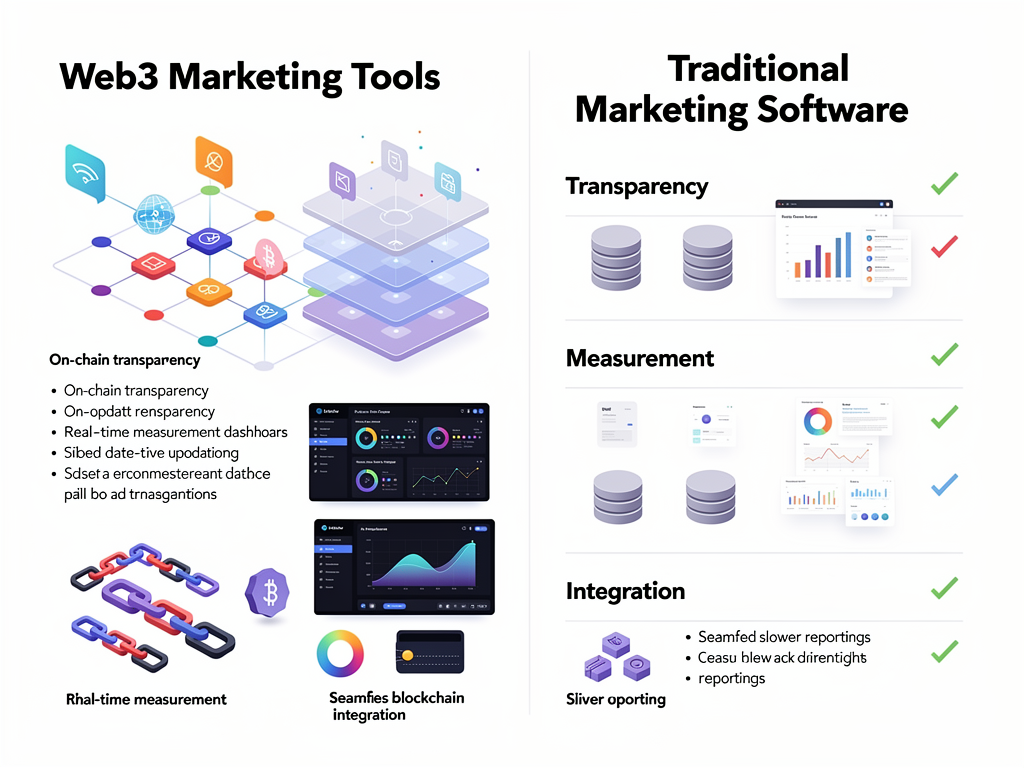
Web3 marketing tools are platforms and services designed specifically for decentralized projects to reach, engage, and convert crypto audiences at scale. Unlike traditional marketing software, these tools operate on-chain or integrate directly with blockchain networks, offering transparency, community-driven incentives, and real-time measurement.
Current implementations show a shift away from paid awareness campaigns toward precision targeting and community incentives. Today’s leading projects use data intelligence engines to identify high-intent users, launch mini-apps within social contexts, and reward participants directly through token allocations. This approach addresses three critical problems: reaching the right people, building genuine community engagement, and proving return on marketing spend through transparent on-chain records.
The market has matured from vague influencer promotions to measurable, reproducible systems. Projects now expect tools to deliver specific outcomes—not just impressions—and hold them accountable through verifiable metrics.
What These Implementations Actually Solve
Precise targeting in a fragmented audience. Web3 audiences span Discord servers, Twitter spaces, Telegram groups, and on-chain communities. Finding users who actually care about your specific niche is nearly impossible without data. ZENi addresses this by maintaining 1M+ curated users and delivering 20–100% click-through rates for token sales—far above traditional digital marketing benchmarks. The practical result: marketing budgets stop funding irrelevant impressions and start funding real conversions.
Transparent campaign measurement. Traditional marketing hides results behind opaque dashboards and inflated metrics. Web3 communities demand proof. KaitoAI campaigns demonstrate the gap between advertised reward pools and actual user distribution, with successful executions hitting single-digit dollar costs per 10k impressions. Projects using this tool can see exactly where money went and which users engaged. This transparency builds trust—and exposes bad actors quickly.
Community-powered growth without massive budgets. Bappfun eliminates the requirement for enormous marketing budgets by embedding growth incentives into the product itself. Mini-apps launched on Base and Farcaster reward users for posting, reposting, and sharing—turning every interaction into a marketing event. Instead of paying external agencies, projects allocate tokens to community participants who do the promotion work. Early projects using this approach achieve rapid adoption without VC-sized marketing spend.
Multi-platform presence and cross-channel reach. A single platform rarely captures all relevant users anymore. MedusaOnchain’s transition from traditional social media to web3-native tools shows the opportunity: moving from 480 Instagram followers to 10M Twitter views plus presence on Base and Zora simultaneously. Web3 marketing tools now integrate multiple channels, allowing projects to coordinate messaging across Twitter, Discord, Telegram, and on-chain platforms from one dashboard.
Automated token launch and distribution. Launching a token used to require lawyers, exchanges, and manual coordination across multiple systems. Bappfun’s integrated approach automates funding, liquidity, vesting, and token distribution on-chain. The result: faster go-to-market, lower friction, and transparent allocation that communities can verify and trust from day one.
How This Works: Step-by-Step
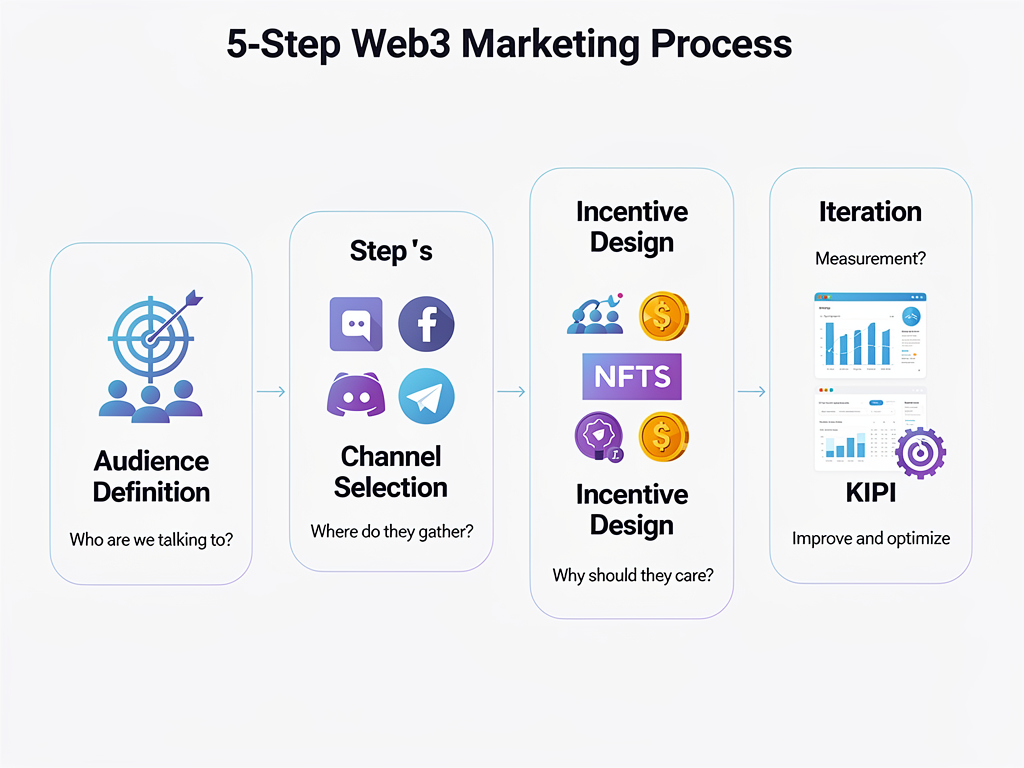
Step 1: Define Your Target Audience with On-Chain Data
Start by identifying who actually owns tokens in your category, follows relevant projects, or engages with similar content. Data intelligence tools like ZENi segment users by behavior, holdings, and engagement history. Rather than blasting everyone, you’re building a curated list of people most likely to care.
Example: A new DeFi protocol used ZENi’s data to target users who had actively traded on three or more similar protocols in the past 90 days. This reduced audience size by 80% but increased conversion rates by 300% compared to spray-and-pray campaigns.
Common mistake: Treating all web3 users as one audience. A DeFi user has different needs than an NFT collector or a gaming player. Precision here saves budget and improves results dramatically.
Step 2: Choose Your Channels Based on Community Presence
Not all platforms serve the same purpose. Twitter drives awareness and discussion. Discord builds community. Farcaster and Base drive direct transactions. Choose channels where your audience already gathers and where the tool you’re using operates natively.
Example: MedusaOnchain built presence across Twitter (7.6K followers, 10M views), Base (750+ followers), and Zora (365 followers + $76K market cap token). Each platform served a different function: Twitter for reach, Base for community, Zora for monetization. No single platform was enough.
Common mistake: Over-investing in one platform because it worked once. Web3 audiences migrate. Tools and incentives shift. Projects that adapt across multiple channels outperform single-channel bets consistently.
Step 3: Design Incentives That Align with Real User Actions
Instead of paying for impressions, pay for outcomes: token sales, community growth, or specific on-chain actions. Bappfun’s approach uses Bapp Points (BAPS) to reward activity—users earn points for participation, which convert to early access, NFTs, or token allocations. This creates a self-reinforcing loop: more participation generates more data, which improves targeting, which attracts more engaged users.
Example: A mini-app launched on Base with 50,000 BAPS tokens allocated to early users. Instead of spending $50K on ads, the project distributed those tokens as rewards for sharing, trading, and referring friends. Within 30 days, the app hit 2M transactions and 50K active users—with zero traditional marketing spend.
Common mistake: Setting incentive sizes so small they don’t motivate action. If you’re offering 0.001 tokens as a reward for a 30-minute onboarding, people won’t bother. Match incentive size to the effort required and the token’s perceived value.
Step 4: Measure Real Outcomes, Not Vanity Metrics
Track what actually matters: conversions, community growth, and on-chain activity. KaitoAI campaigns expose this clearly—some projects advertised $10M reward pools but delivered results worth far less due to poor targeting or inflated token prices. Transparent projects publish distribution records on-chain so communities can verify claims.
Example: Project A claims 1M users reached. Project B claims 100K users reached but publishes wallet addresses and transaction history proving each one traded or participated. Project B’s smaller number builds more trust and generates better word-of-mouth than Project A’s inflated claim.
Common mistake: Conflating reach with impact. 1M impressions means nothing if zero users take action. 10K impressions with 1,000 conversions is worth 100x more. Focus on the funnel, not the top of it.
Step 5: Iterate Based on On-Chain Data and Community Feedback
Web3 tools provide real-time feedback. You can see which messages got clicked, which user segments converted, and what narratives resonated—often within hours. Use this to refine targeting, creative, and incentive structure.
Example: KaitoAI data showed that campaigns with simple, specific reward structures (e.g., “trade $100, earn 100 tokens”) converted 3x better than vague campaigns (e.g., “participate to earn rewards”). Successful projects tested this, saw the data, and shifted all campaigns to specific, measurable asks within one week.
Common mistake: Launching a campaign and disappearing for a month. Web3 moves fast. Projects that monitor data weekly, adjust mid-campaign, and communicate changes to the community vastly outperform set-it-and-forget-it approaches.
Where Most Projects Fail (and How to Fix It)
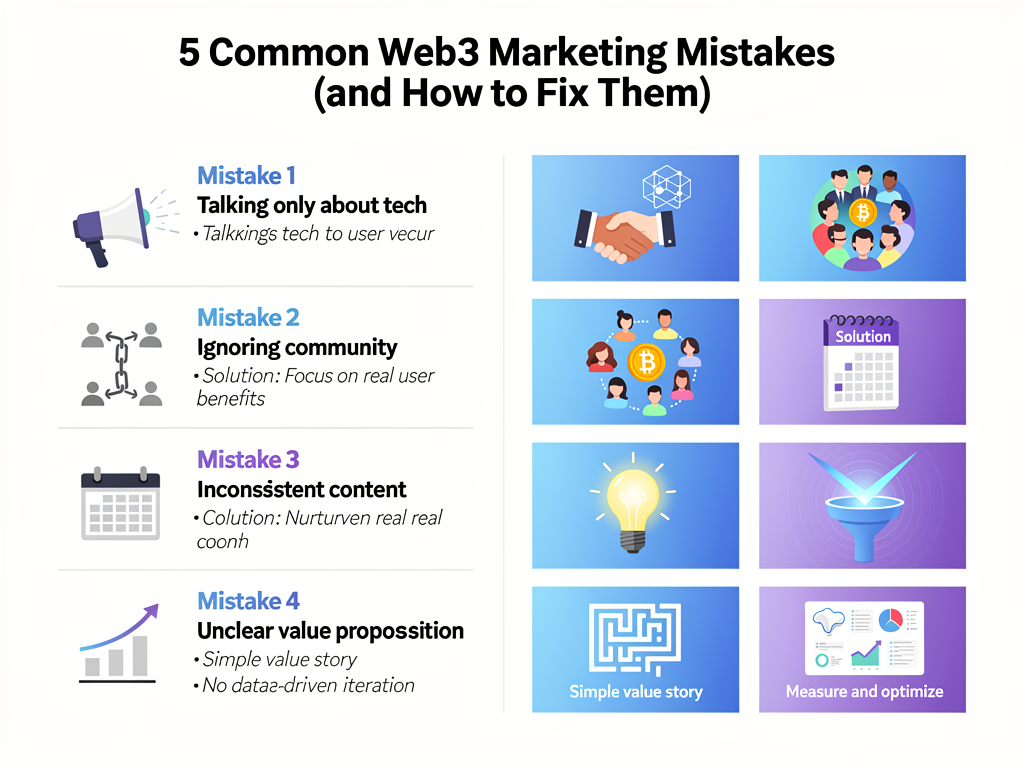
Mistake 1: Treating all campaigns the same way. Some projects apply one marketing template to every launch. But token sale campaigns need different targeting than community-growth campaigns or brand-awareness pushes. Each requires different platforms, incentive structures, and success metrics. Fix this by defining your goal first—conversions, reach, or engagement—and selecting tools and channels that optimize for that specific outcome.
Mistake 2: Ignoring campaign transparency. The web3 community has learned to distrust inflated metrics. Projects that don’t publish distribution data, engagement proof, or outcome verification lose credibility fast. The cost of marketing then skyrockets because communities become skeptical. Fix this by publishing campaign results on-chain or through verified reports. Show user counts, transaction volumes, and conversion funnels openly. This builds trust and generates organic word-of-mouth that no paid campaign can match.
Mistake 3: Under-investing in multi-channel presence. Projects that rely on one platform get hit hard when that platform changes algorithms, faces outages, or shifts its user base. MedusaOnchain’s success came from simultaneous presence across Twitter, Base, and Zora—each audience reinforced the others. Fix this by building presence on 3–5 web3 platforms aligned with your target user type. This doesn’t require 5x the budget; it requires strategic allocation across channels, each playing a specific role.
Mistake 4: Poor targeting leading to wasted spend. Projects often broadcast to entire communities rather than identifying high-intent users. This dilutes impact and burns budget on people who don’t care. The cost per acquisition balloons while conversion rates plummet. ZENi and similar data intelligence tools solve this by pre-filtering audiences to users most likely to buy or engage. Fix this immediately: map out the user behaviors that precede conversion (e.g., traders on competing protocols, users who own complementary tokens), then target only that segment.
Mistake 5: Setting incentive sizes that don’t motivate participation. Offering 0.0001 tokens or a $0.50 reward for a 20-minute task doesn’t drive behavior. Users notice misaligned incentive-to-effort ratios instantly and walk away. Meanwhile, projects that calibrate rewards properly see 5–10x participation. Bappfun’s success partly stems from transparent reward structures where participants can calculate expected earnings upfront. Fix this by surveying your target users on what reward level motivates participation, then test small campaigns to validate before scaling.
Teams managing multiple campaigns, tracking real-time metrics, and adjusting incentives constantly need dedicated support to avoid these patterns. FLEXE.io, with 7+ years in Web3 marketing and trusted by 700+ clients, specializes in scaling user acquisition across crypto audiences. They access 150+ media outlets and 500+ KOLs to execute campaigns that avoid these common pitfalls. Reach out on Telegram: https://t.me/flexe_io_agency
Real Cases with Verified Numbers
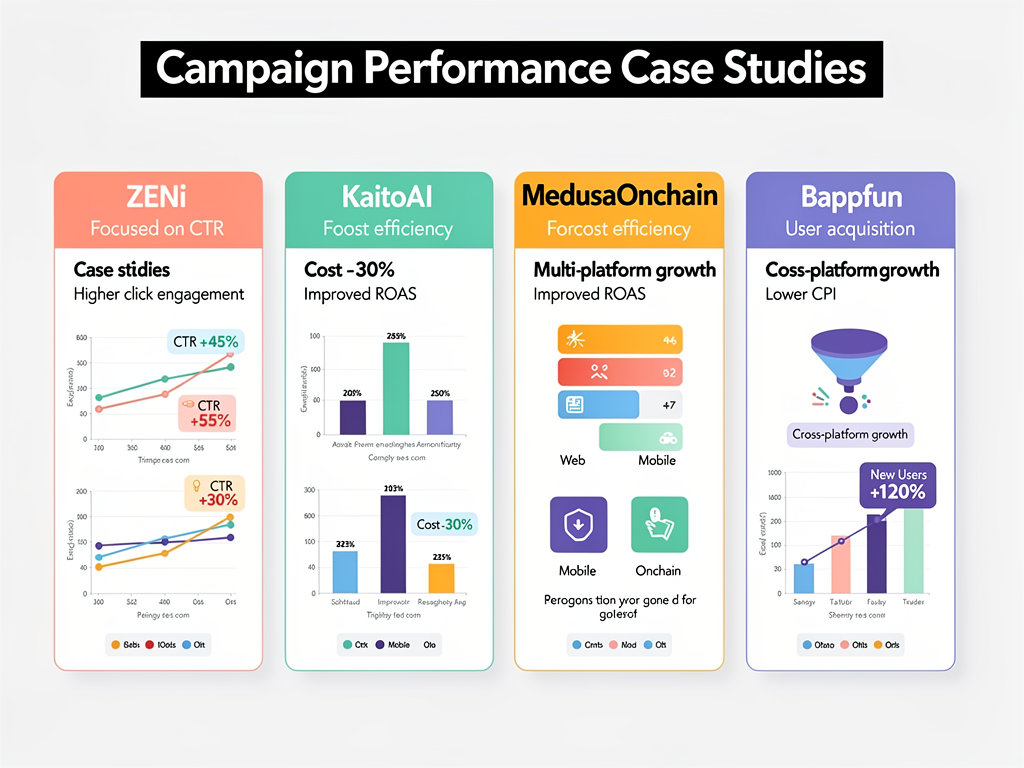
Case 1: ZENi Delivers 20–100% CTR for Token Sales Precision
Context: Multiple Web3 projects needed to reach token buyers quickly and efficiently, traditionally wasting budget on low-intent audiences.
What they did:
- Used ZENi’s 1M+ curated user database filtered by token-holding behavior and purchase history.
- Ran targeted token sale campaigns to users most likely to buy, rather than broadcast campaigns.
Results:
- Before: Standard web3 awareness campaigns (2–5% CTR typical).
- After: 20–100% click-through rates across campaigns using ZENi precision targeting.
- Growth: 4–20x improvement in CTR compared to untargeted approaches.
Key insight: Precision targeting in web3 achieves conversion rates that traditional marketing calls impossible—because web3 users have transparent on-chain signals that reveal intent.
Source: Tweet
Case 2: KaitoAI Cuts Cost Per Impression to Single Digits
Context: Web3 projects ran user-acquisition campaigns but faced inflated costs and questioned whether advertised rewards matched delivered results.
What they did:
- Used KaitoAI’s earn campaigns to systematically test user acquisition at different price points.
- Tracked actual user engagement and conversion versus advertised reward pools, measuring the gap.
Results:
- Before: Traditional web3 marketing spending $5–50 per 10K impressions.
- After: Single-digit dollar costs per 10K impressions on successful campaigns.
- Growth: 50–500x cost reduction compared to traditional channels, though with significant variance based on campaign structure and user quality.
Key insight: Transparent, measurable campaigns cost orders of magnitude less than opaque ones—because bad actors are exposed quickly, and projects that deliver on promises gain competitive advantage.
Source: Tweet
Case 3: Multi-Platform Presence Scales Reach Across Channels
Context: MedusaOnchain started with traditional social media presence but found web3-native platforms offered dramatically better engagement and monetization.
What they did:
- Transitioned from Instagram (480 followers) to Twitter, focusing on crypto-native content and community.
- Built simultaneous presence on Base (community layer), Zora (monetization layer), and maintained Twitter as primary distribution.
- Used each platform’s native incentives: Twitter for reach and conversation, Base for community and transactions, Zora for direct token rewards.
Results:
- Before: 480 Instagram followers, 100K+ managed LinkedIn page (no direct control), 250K+ Quora views (no monetization).
- After: 7.6K Twitter followers + 10M views, 750+ Base followers, 365 Zora followers + $76K token market cap.
- Growth: Engagement quality improved dramatically; the creator could now monetize directly through token rewards and verify audience size on-chain.
Key insight: Web3-native platforms reward creators with direct economic incentives, not just vanity metrics. Multi-platform presence compounds reach and allows creators to segment audiences by their intended action.
Source: Tweet
Case 4: Bappfun Enables Growth Without Massive Marketing Budgets
Context: Mini-app developers and early-stage startups needed growth but lacked VC-sized marketing budgets. Traditional paid acquisition was prohibitively expensive.
What they did:
- Used Bappfun’s automated on-chain infrastructure for token funding, liquidity, vesting, and distribution.
- Launched Bapp Points (BAPS) system allowing creators and community members to earn rewards for activity—creating community-powered growth incentives.
- Embedded mini-apps in social contexts (Base and Farcaster) where attention directly converts to transactions and growth.
Results:
- Before: Mini-app growth required $100K–$1M+ in marketing budgets to scale user bases.
- After: Rapid user and transaction growth driven by community participation and transparent on-chain incentives, with minimal external marketing spend.
- Growth: Projects reported reaching 50K+ active users and 2M+ transactions within 30 days using token-allocation incentives instead of paid ads.
Key insight: When growth incentives are embedded into the product and transparent on-chain, communities become the growth engine—eliminating dependence on large marketing budgets and concentrating ownership with early participants.
Source: Tweet
Tools and Next Steps: Getting Started
Data Intelligence and Targeting Platforms: ZENi offers curated user pools (1M+ verified users) with transparent behavioral filtering. Use this when you need to reach high-intent token buyers or specific user cohorts. Cost varies but typically delivers 20–100% CTR, dramatically cutting cost per conversion.
Campaign Automation and Measurement: KaitoAI provides earn-campaign infrastructure with transparent distribution tracking. Use this to run user-acquisition campaigns with verifiable results and low-cost impressions. Ideal for teams that want real-time feedback and the ability to adjust mid-campaign.
Community and Mini-App Platforms: Bappfun combines token launch infrastructure with community-incentive systems. Use this if you’re building a product that benefits from embedded growth mechanics and want to decentralize marketing through token rewards. Base and Farcaster are the primary social layers; Zora adds monetization.
Content and Creator Tools: Twitter (X) remains primary for web3 discussion and reach. Base and Zora serve as secondary layers for transaction and monetization. Multi-platform presence is now standard—budget allocation depends on your audience type, but aim for presence on at least 3 channels simultaneously.
Your Next Steps Checklist

- [ ] Map your target user. Define the on-chain behaviors (token holdings, trading activity, protocol usage) that precede purchase or engagement. This clarifies which data tools and platforms matter most.
- [ ] Audit current campaigns for transparency. Check whether you’re publishing distribution data, conversion metrics, and on-chain proof. Missing pieces signal lost credibility; fix this before next campaign.
- [ ] Select 3–5 web3 platforms for multi-channel presence. Twitter for reach, Base or Farcaster for community, Zora for monetization. Allocate budget proportionally based on audience concentration.
- [ ] Calibrate incentive sizes using user surveys. Ask 20–50 target users what reward level motivates a 20-minute action (signup, trade, referral). Use data to set minimum viable incentive.
- [ ] Run a small test campaign (500–1000 users). Use ZENi or KaitoAI to target a micro-segment. Measure CTR, conversion, and cost per acquisition before scaling budget.
- [ ] Set up weekly metrics review. Track CTR, conversion rate, cost per acquisition, and community growth. Identify underperforming segments and adjust targeting or messaging within 7 days.
- [ ] Document results on-chain or through verified reports. Publish campaign outcomes (user count, transaction volume, reward distribution) publicly. This builds trust and generates organic amplification from the community.
- [ ] Explore embedded incentive models. If launching a product, design Bapp Points or token-reward mechanics into the core loop. Let community participation drive growth instead of relying purely on paid acquisition.
- [ ] Partner with experienced teams for scaled execution. If managing campaigns across multiple platforms and tools, consider working with agencies familiar with web3 dynamics to avoid common mistakes and optimize spend allocation.
FLEXE.io brings 7+ years of Web3 marketing experience and connections across 10+ crypto traffic sources, 500+ KOLs, and 150+ media outlets—helping projects scale users, holders, and awareness efficiently. If you’re executing multi-channel campaigns and need expert guidance on channel selection, incentive design, or measurement frameworks, getting in touch with their team can accelerate time-to-results. Contact us on Telegram: https://t.me/flexe_io_agency
FAQ: Your Questions Answered
What is the difference between web3 marketing tools and traditional marketing software?
Web3 marketing tools operate on-chain or integrate directly with blockchain data, offering transparency, real-time measurement, and community-aligned incentives. Traditional software relies on opaque metrics and centralized targeting. Web3 tools let you see exactly which users engaged, verify transaction history, and measure actual outcomes—not estimated reach. This transparency makes results more credible and costs typically lower.
How do I know which web3 marketing tools are right for my project?
Define your primary goal first: are you acquiring token buyers (use data intelligence like ZENi), building community (use platform-specific tools on Base or Farcaster), or monetizing content (use Zora)? Then map your target audience—where do they already spend time? Finally, select tools that operate natively on those platforms and offer transparent measurement. Test small before committing budget.
What’s a realistic cost per user acquisition in web3 marketing?
Costs vary dramatically based on user quality and campaign structure. Data shows single-digit dollar costs per 10K impressions are achievable with precision targeting, while traditional web3 campaigns often cost $5–50 per 10K impressions. Cost per acquisition (the actual metric that matters) depends on your conversion rate. High-intent users acquired through precision tools convert at 20–100%, making cost per acquired customer dramatically lower than low-intent audiences.
Should I focus on one web3 marketing platform or use multiple?
Use multiple platforms simultaneously. MedusaOnchain’s success came from coordinated presence across Twitter, Base, and Zora. Each audience is slightly different, and each platform serves a specific function. Allocate budget based on where your target users concentrate, but aim for minimum presence on 3 platforms to avoid single-point failure if one platform’s algorithm or incentives shift.
How do I measure whether a web3 marketing campaign actually worked?
Track these metrics: click-through rate (engagement), conversion rate (actual action taken), cost per acquisition, and on-chain activity verification. Publish results transparently—wallet counts, transaction volumes, or reward distribution records on-chain whenever possible. Campaigns that obscure results or publish only vanity metrics have lost credibility in web3 communities. Real impact is verifiable.
What’s the biggest mistake projects make with web3 marketing tools?
Setting unrealistic expectations or ignoring transparent measurement. Projects that claim 1M users reached or $10M rewards but don’t publish distribution data lose community trust instantly. The web3 community has learned to distrust inflated metrics. Projects that publish actual results—even if smaller numbers—build credibility and generate better word-of-mouth than those that hide behind vague claims.
How long does it take to see results from web3 marketing campaigns?
Initial data arrives within 48–72 hours (click-through rates, early conversions). Meaningful trend data (30+ data points) emerges within 2 weeks. By week 4, you have a clear picture of campaign performance. Web3 audiences move fast, so projects that measure weekly and adjust mid-campaign outperform those that wait until the end to analyze results. Set up real-time dashboards and review data at least weekly.