Half the guides you’ll find are packed with hype and zero hard numbers. This one shows you what’s actually working—with verified metrics from projects that scaled to $10M ARR, 120M+ monthly views, and $20k/month profit using Telegram and AI-powered crypto marketing workflows.
Key Takeaways
- One e-commerce project hit a $4,000 day with ROAS 4.43 using Claude for copywriting and Higgsfield for AI images—no video ads required.
- An AI marketing agent replaced a $267K/year content team and now generates platform-native ad creatives in 47 seconds instead of 5 weeks.
- A crypto SaaS launched 69 days ago added $925 MRR purely from SEO targeting pain-point keywords like “x alternative” and “x not working,” with zero backlinks.
- Theme pages built with Sora2 and Veo3.1 are pulling $100k+ monthly from reposted content and 120M+ views without personal brands.
- Arcads.ai grew from $0 to $10M ARR in months by combining paid ads, direct outreach, influencer partnerships, and live event demos—each channel reinforcing the others.
- A lazy lead-gen system using a $9 domain, AI-repurposed blog posts, and TikTok/Reels automation delivered $20k/month profit from 5k visitors and 20 buyers.
- Advanced prompt frameworks and psychological triggers lifted X post impressions from 200 to 50K+ and engagement from 0.8% to 12%, adding 500 daily followers.
What Telegram Crypto Marketing Actually Is
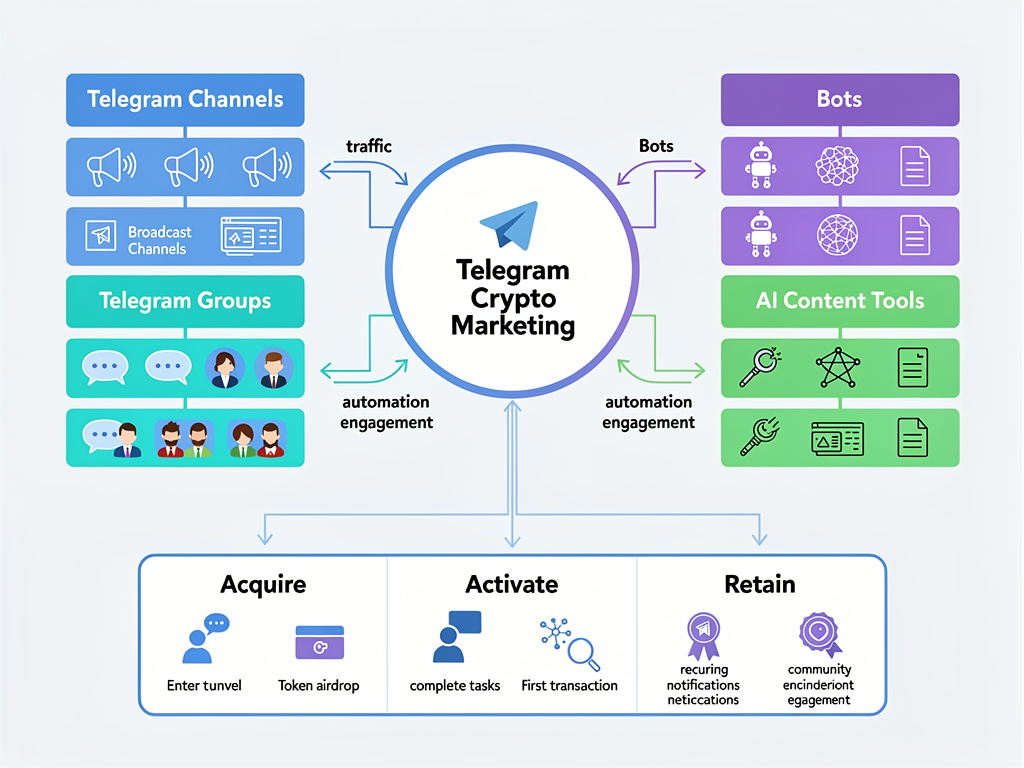
Telegram crypto marketing means using Telegram channels, groups, and bots—alongside AI content tools—to acquire, activate, and retain users in Web3 projects. Recent implementations show that combining Telegram’s direct-message reach with AI-driven content engines (for ads, posts, and SEO) delivers far higher ROAS than traditional social ads alone.
It’s for founders and growth leads who need measurable user growth without burning six figures on agencies. It’s not for teams chasing vanity metrics or unwilling to test multiple traffic sources in parallel.
What These Implementations Actually Solve
Expensive, slow creative production. Most teams wait weeks and pay thousands for ad variations. An AI creative OS now reverse-engineers a $47M database, runs six image models and three video models simultaneously, and delivers ultra-realistic marketing assets in under 60 seconds—eliminating the $4,997 agency fee and five-week turnaround.
Low-converting generic content. Generic “top 10 AI tools” listicles drive traffic but zero revenue. One SaaS pivoted to pain-point SEO—articles like “lovable not exporting code” and “v0 alternative with longer prompts”—and converted 21,329 visitors into $925 MRR and 62 paid users in 69 days, despite a domain rating of 3.5.
Manual workflows that don’t scale. Writing two blog posts a month caps growth. A project deployed an AI scraper that extracts Google Trends keywords, scrapes competitors at 99.5% success, and generates 200 publication-ready articles in three hours—capturing $100K+ monthly organic traffic value and replacing a $10K/month content team with zero ongoing cost.
Unclear multi-channel orchestration. Running one channel in isolation leaves money on the table. Arcads.ai coordinated paid ads (using their own tool), manual outreach to top prospects, live demos at conferences, influencer partnerships, feature-launch campaigns, and SaaS integrations—growing from $100k to $833k MRR by treating every release as a product launch and reactivating old users each time.
Audience research guesswork. Keyword tools trap you in spreadsheets you never act on. High-performing teams join competitor Discord servers and subreddits, read public roadmaps, and listen to customer-support chats—then write articles that fix those exact complaints and upsell the solution at the end, turning upset readers into happy buyers.
How This Works: Step-by-Step
Step 1: Choose Your AI Stack and Set Up Workflow Orchestration
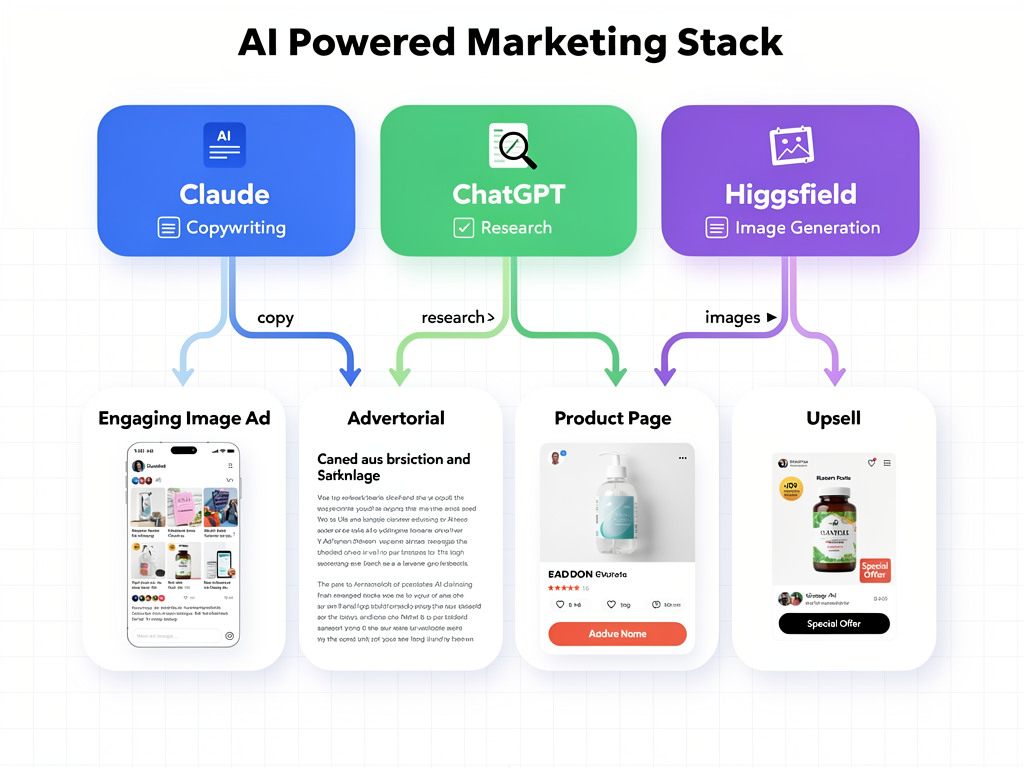
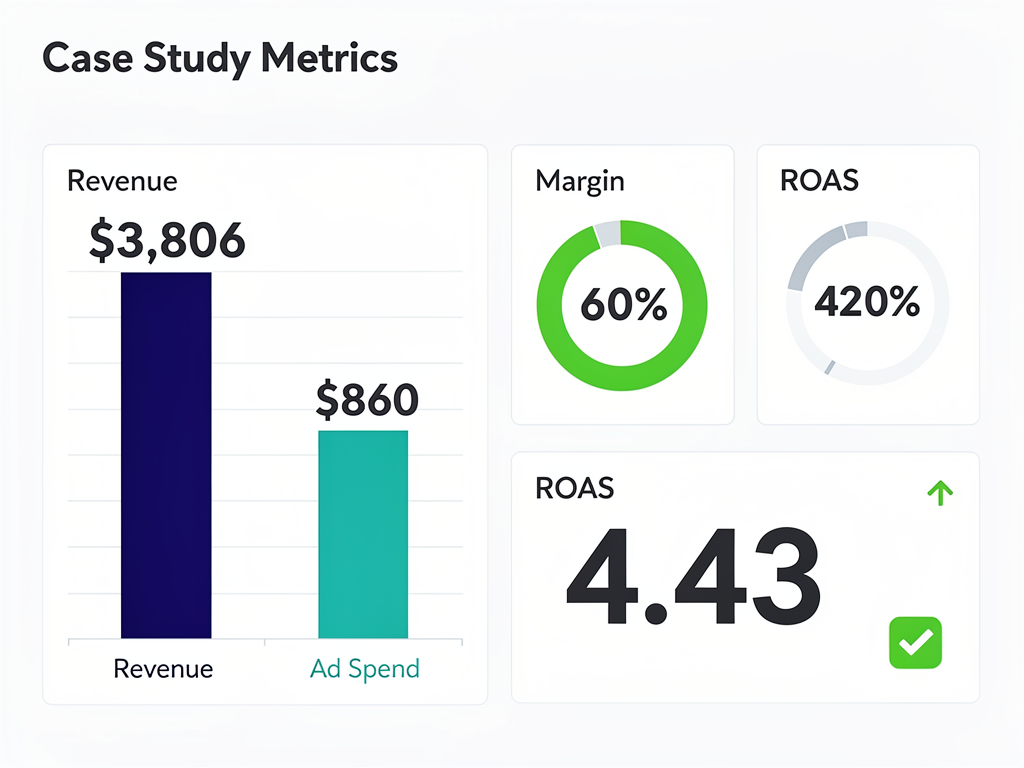
Pick specialized tools for each job instead of forcing ChatGPT to do everything. One e-commerce operator combined Claude for copywriting (primary text and headlines), ChatGPT for deep research, and Higgsfield for AI image generation. He invested in paid plans and built a simple funnel: engaging image ad → advertorial → product detail page → post-purchase upsell. The result: $3,806 revenue on $860 ad spend with ~60% margin and ROAS 4.43—running image ads only, no video.
For automation at scale, another team used n8n workflows to chain six image models and three video models in parallel, feeding them 200+ JSON context profiles reverse-engineered from a $47M creative database. The system handles lighting, composition, and brand alignment automatically, delivering $10K+ worth of content in under 60 seconds.
Common mistake: relying on a single LLM and accepting whatever it outputs. You can’t iterate if you don’t understand why a creative worked. Test new desires, new angles, new iterations of those angles, new customer avatars, and different hooks or visuals to improve metrics systematically.
Step 2: Target High-Intent, Low-Competition Keywords
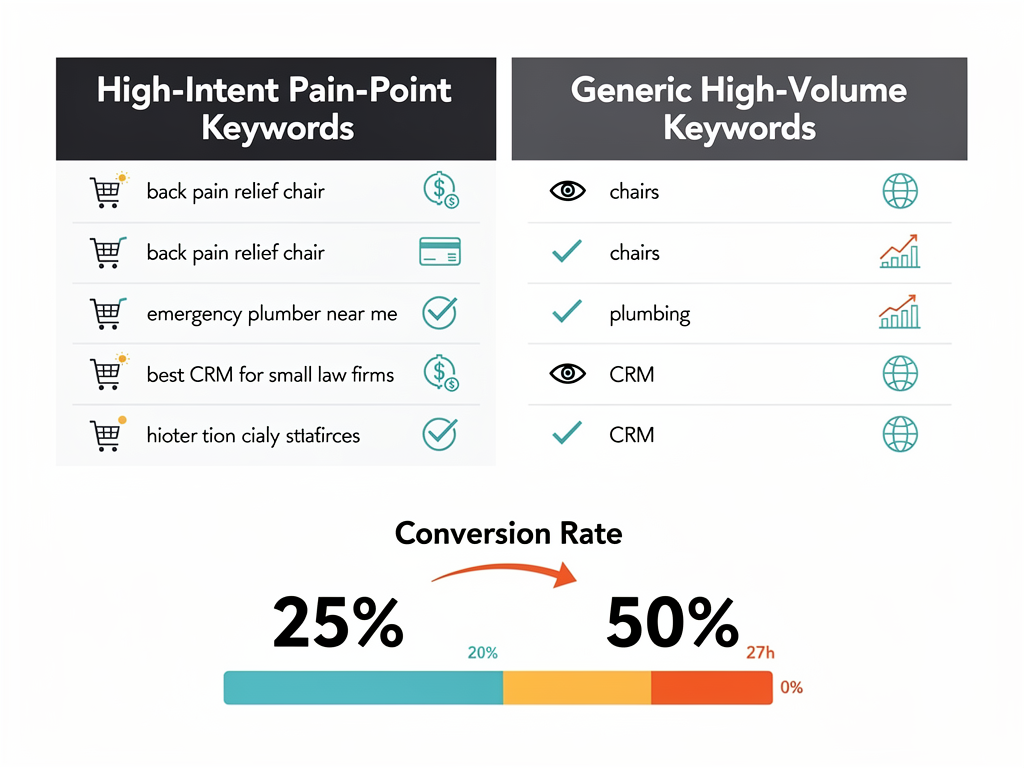
Forget “best no-code app builders” guides that barely convert and rank slowly. Write articles people search for when they’re ready to switch or fix something broken: “x alternative,” “x not working,” “x wasted credits,” “how to do x in y for free,” “how to remove x from y.” A crypto SaaS went from domain rating 3.5 to $925 MRR in 69 days by publishing only these pain-point pages—many ranking #1 or high on page one, with zero backlinks and features in Perplexity and ChatGPT.
To find topics, don’t brainstorm in Ahrefs. Join the communities where your audience hangs out: Discord servers, subreddits, Indie Hackers groups. Read competitor roadmaps and customer-support threads. When someone says they can’t export code from Lovable, write a guide around that pain and add your product as the upsell. When others ask for a v0 alternative that accepts longer prompts, build that article and link your tool.
Common pitfall: chasing high-volume keywords with no buyer intent. Volume does not equal MRR. Some posts get 2,000 visits and zero sign-ups; others get 100 visits and five paid conversions. Track which pages bring paying users, not just clicks.
Step 3: Structure Content for AI Search and LLM Citations
Write every article so that each paragraph can stand alone as a complete answer. Start with a two-to-three-sentence TL;DR summary at the top. Use question-based H2s like “What makes a good [service] agency?” and answer in two to three short sentences directly below. Favor lists and factual statements over opinion. This structure landed one agency more than 100 AI Overview citations because it aligns perfectly with how large language models extract content blocks.
An SEO agency competing in a crowded niche grew search traffic by 418% and AI search traffic by over 1,000% by repositioning the blog around commercial intent: “Top [service] agencies,” “Best [specific services],” “[Service] for SaaS brands,” “[Service] examples that convert,” “[Competitor] reviews.” Every post included extractable logic, schema-friendly HTML, built-in FAQ sections, and internal semantic links passing meaning rather than just PageRank.
Mistake to avoid: writing in a formulaic, AI-sounding tone. Compose the core yourself as if explaining to a friend—short sentences, simple headings, quick answers—then ask the AI to expand using your own words. People want to know if your tool solves their problem, not read 2,000 polished words.
Step 4: Build Authority with Contextual, High-DR Backlinks
Don’t chase random backlink swaps or guest posts. Focus on DR50+ domains already getting organic traffic and visible in AI search. Use contextual anchors with actual business terms—”[service] agency” and “[service]”—instead of “click here.” Every referring domain should mention your niche and geography so Google and AI engines can categorize you correctly.
The same SEO agency stacked links with consistent semantic context to create an entity graph. ChatGPT, Perplexity, and Gemini all prioritize brands that appear repeatedly in their category. Embed your brand name and country in schema and metadata. Create “Reviews” and “Team” pages with structured data—both are trust signals for AI systems. Optimize meta descriptions to say “Learn why [Brand] is one of the top-rated [service] for SaaS brands in [Country].” This feedback loop makes each engine recognize you as a known entity.
If you’re overwhelmed by the technical setup or lack the bandwidth to execute at this pace, FLEXE.io—with 7+ years in Web3 marketing and 700+ clients—helps projects access 150+ media outlets and 500+ KOLs to accelerate growth. Reach out on Telegram: https://t.me/flexe_io_agency
Step 5: Scale Distribution Across Telegram, Social, and Paid Channels
Once content and authority are in place, distribute relentlessly. One operator built theme pages using Sora2 and Veo3.1, posting consistent reposted content with strong scroll-stopping hooks, curiosity or value in the middle, and clean product tie-ins at the end. No personal brand, no influencer dependency—just consistent output in niches that already buy. The pages regularly clear $100k+ each and pull 120M+ views per month.
Another founder used a “lazy” system: bought a $9 domain, built a niche site in one day with AI, scraped and repurposed trending articles into 100 blog posts, then auto-spun them into 50 TikToks and 50 Reels per month. Email-capture popups fed an AI-written nurture sequence, which upsold a $997 affiliate offer. Result: 5k site visitors per month, 20 buyers, $20k monthly profit.
For paid and organic synergy, Arcads.ai ran multiple growth channels in parallel: they used their own AI ad tool to create ads for themselves (perfect flywheel); reached out manually to top prospects with live demos (insanely high conversion); attended and spoke at events like Affiliate World and App Growth Summit (underrated, only 1% tapped); partnered with top growth and AI creators for social proof; treated every new model or feature as a coordinated launch across X, email, Instagram, and TikTok to reactivate old users. This multi-channel stack took them from $100k to $833k MRR.
Mistake: isolating channels. Each should amplify the others. Paid ads feed Telegram groups, Telegram nurtures leads for webinars, webinars convert into case studies that fuel SEO and influencer content.
Step 6: Automate Posting and Engagement with Advanced Prompts
Generic prompts yield generic results. One growth operator reverse-engineered 10,000+ viral posts to build a psychological framework with neuroscience triggers. Instead of asking ChatGPT for “the most conversion headline,” he architected prompts that turn AI into a seasoned copywriter. Deployment lifted his X post impressions from 200 to 50K+ consistently, engagement from 0.8% to 12%+, and follower growth from stagnant to 500 daily—generating 5M+ impressions in 30 days.
Another system auto-scheduled 10 posts per day by repurposing top influencer content in a locked niche (e-commerce, sales, AI). The operator fed the AI with high-quality source material first to avoid slop, then generated hundreds of posts instantly. A DM funnel led to five ebooks created in ~30 minutes, driving a few hundred checkout views per month and ~20 buyers at $500 each for $10k monthly profit. Over the year, that simple loop generated seven figures in profit.
Common trap: prompting once and copying output blindly. If it works, you won’t know why; if it fails, you can’t fix it. Test new desires, angles, hooks, and visuals systematically so you understand what drives results.
Step 7: Measure, Iterate, and Compound
Track not just traffic but conversion by page. One SaaS found some posts with 100 visits converted five sign-ups, while others with 2,000 visits converted zero. They doubled down on high-intent pages and pruned low performers. Another agency refreshed top content monthly, added brand and location schema, and interlinked pages semantically (not randomly). After 60–90 days, their brand appeared across Google, ChatGPT, Gemini, and Perplexity—exactly as planned.
For continuous improvement, email your users with a 20% discount in exchange for feedback: where they found you, what they didn’t like about competitors, what you can improve. Review all past customer-support chats for pain points. Study competitor blogs to see what content moves the needle, then make it better with an extra FAQ, pricing calculator, screen recording, or comparison table.
One product hit 50k MRR—half from the previous month alone—by going all-in on HTML and Tailwind CSS landing pages instead of React. Generating a page took 30 seconds versus 3 minutes; all code lived in one file, not ten-plus; exports to Figma or Cursor were trivial. The founder created 2,000 templates and components with 90% AI and 10% manual edits, taught prompting in videos that earned millions of combined views, and leveraged Gemini 3 for design. Taste became the differentiator, and bootstrapped growth followed.
Where Most Projects Fail (and How to Fix It)
Treating all AI models as interchangeable. Teams dump every task into ChatGPT and wonder why output is mediocre. High performers assign specialized roles: Claude for copywriting with nuanced tone, ChatGPT for deep research and data synthesis, Midjourney or Higgsfield for visuals. The combination creates an ultimate marketing system; using one tool for everything produces slop.
Chasing vanity keywords instead of buyer intent. “Best blockchain platforms 2025″ drives clicks but zero sign-ups. Projects that focus on pain-point queries—”why is [competitor] slow,” “[tool] alternative for [use case],” “how to fix [error] in [product]”—capture users ready to switch. Write the article they’re searching for, address the frustration precisely, and offer your product as the natural fix.
Publishing without schema, internal links, or FAQ blocks. Modern search—both Google and LLMs—needs extractable, structured answers. A post without a TL;DR summary, question-based H2s, short factual paragraphs, and FAQ schema is invisible to AI Overviews and ChatGPT citations. Add those elements, interlink semantically, and refresh monthly. You’ll appear in AI search within weeks.
Running a single growth channel in isolation. Paid ads alone, or SEO alone, or Telegram alone, leave 80% of potential on the table. The highest-growth projects stack channels so each amplifies the next: ads fill Telegram groups, Telegram nurtures leads for webinars, webinars produce case studies that fuel SEO and influencer content. Treat every feature launch as a coordinated campaign across email, social, and community.
Ignoring where your audience actually hangs out. Keyword research in Ahrefs is a starting point, not the whole strategy. Join Discord servers, subreddits, and Indie Hackers groups where your ICP shares frustrations. Read competitor roadmaps and support threads. When you see the same pain mentioned five times, write the definitive guide and link your solution. Real listening converts better than any algorithm.
Real Cases with Verified Numbers
Case 1: $4,000 Day with Image-Only Ads and AI Copywriting
Context: An e-commerce operator wanted to scale revenue without video production overhead.
What they did:
- Switched from ChatGPT-only to Claude for ad copy, ChatGPT for research, and Higgsfield for AI images.
- Invested in paid plans and built a simple funnel: engaging image ad → advertorial → product page → post-purchase upsell.
- Tested new desires, angles, iterations, avatars, and hooks systematically instead of asking for “best headline.”
Results:
- Revenue: $3,806 on a single day
- Ad spend: $860
- Margin: ~60%
- ROAS: 4.43
- Format: Image ads only, no videos
Key insight: Primary text and headlines play a huge role even in image ads; specialized AI tools for each task beat generic prompting every time.
Source: Tweet
Case 2: Replacing a $250K Team with Four AI Marketing Agents
Context: A business wanted to cut costs and scale content without human bottlenecks.
What they did:
- Built four AI agents for content research, creation, ad-creative “stealing and rebuilding,” and SEO content.
- Tested the system on autopilot for six months.
- Ran 24/7 with no sick days, vacations, or performance reviews.
Results:
- Before: $250,000 annual team cost
- After: Millions of impressions monthly, tens of thousands in revenue, enterprise-scale output
- Cost: Less than one employee
- Sample virality: 3.9M views on one post
- Efficiency: 90% of workload automated
Key insight: Businesses adopting AI marketing agents gain an insurmountable edge while competitors still hire expensive teams and deal with human limitations.
Source: Tweet
Case 3: $267K Team Replaced by AI Ad Agent in 47 Seconds
Context: A marketing team wanted faster, unlimited ad variations without agency burn.
What they did:
- Built an AI ad agent analyzing 47 winning ads and 12 psychological triggers.
- Mapped customer fears, beliefs, trust blocks, and dream outcomes.
- Generated 12+ ranked hooks and platform-native visuals (Instagram, Facebook, TikTok) with behavioral-psychology scoring.
Results:
- Before: $267K/year content team, $4,997 for five concepts over five weeks
- After: Concepts ready in 47 seconds, unlimited variations
- Deliverables: Instant psychographic breakdown, ranked hooks, auto-generated visuals
Key insight: Behavioral science deployed at machine speed beats three-martini creative directors every time.
Source: Tweet
Case 4: $925 MRR from SEO in 69 Days with Zero Backlinks
Context: A new SaaS with domain rating 3.5 needed traction fast without an existing audience.
What they did:
- Targeted pain-point keywords: “[competitor] alternative,” “[tool] not working,” “how to do [x] in [y] for free.”
- Wrote human-like articles with short sentences, question H2s, and clear CTAs—then used AI to expand in their own voice.
- Used strong internal linking (every article linked to five others) and zero backlink chasing.
- Listened to user feedback from competitor Discord servers, subreddits, and roadmaps.
Results:
- ARR: $13,800
- Site visitors: 21,329
- Search clicks: 2,777
- Gross volume: $3,975
- Paid users: 62
- MRR added from SEO: $925
- Rankings: Many posts #1 or high on page one
- AI search: Featured in Perplexity and ChatGPT
Key insight: People searching these queries are ready to buy; speak their language, offer the exact solution, and they convert.
Source: Tweet
Case 5: $1.2M Monthly from AI Theme Pages and Reposted Content
Context: Operators wanted passive income from social content without personal branding.
What they did:
- Used Sora2 and Veo3.1 to generate scroll-stopping videos for theme pages.
- Posted reposted content with strong hooks, curiosity/value in the middle, and clean product tie-ins.
- Focused on niches that already buy, with consistent output and no influencer dependency.
Results:
- Revenue: $1.2M/month across theme pages
- Per-page performance: $100k+ regularly
- Monthly views: 120M+ on top pages
Key insight: No personal brand needed—just consistent, high-quality AI content in a buying niche.
Source: Tweet
Case 6: $10K+ Marketing Content in Under 60 Seconds
Context: A team wanted to escape the five-to-seven-day creative turnaround and $4,997 agency fees.
What they did:
- Reverse-engineered a $47M creative database and fed it into an n8n workflow.
- Ran six image models and three video models simultaneously with 200+ premium JSON context profiles.
- Automated lighting, composition, and brand alignment.
Results:
- Before: Manual processes, 5–7 days, $4,997 fee
- After: $10K+ content delivered in under 60 seconds
- Quality: Ultra-realistic, Veo3-level video and photorealistic images
Key insight: The secret is prompt architecture and context profiles, not just throwing requests at vanilla ChatGPT.
Source: Tweet
Case 7: 200 SEO Articles in 3 Hours, Replacing $10K/Month Team
Context: A content team wanted to scale from two blog posts per month without hiring.
What they did:
- Extracted keyword goldmines from Google Trends automatically.
- Scraped competitor sites with 99.5% success using native Scrapeless nodes.
- Generated page-one ranking content outperforming human writers.
- Setup completed in 30 minutes.
Results:
- Before: 2 posts/month, manual workflow
- After: 200 publication-ready articles in 3 hours
- Traffic value: $100K+ organic per month
- Team cost: $10K/month eliminated
- Ongoing cost: Zero
Key insight: Competitors can’t catch up once this engine is running; the compounding effect is relentless.
Source: Tweet
Tools and Next Steps
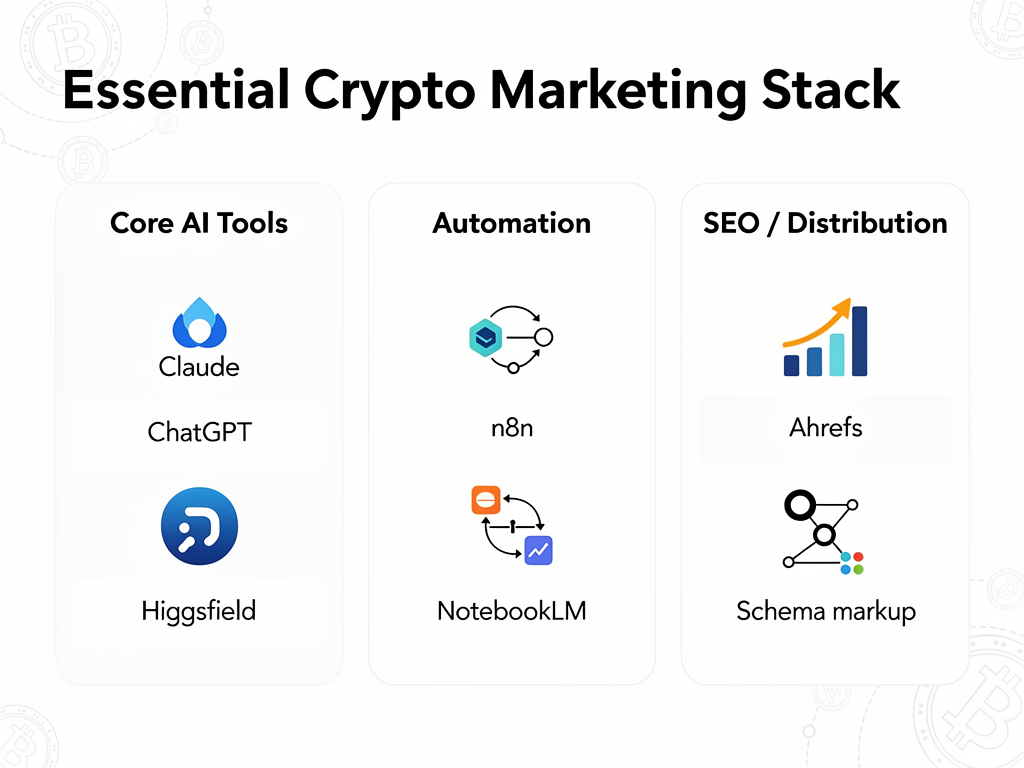
Core AI Tools:
- Claude: Best for nuanced copywriting, ad headlines, and body text that sounds human.
- ChatGPT: Deep research, data synthesis, and prompt chaining for complex workflows.
- Higgsfield / Midjourney: AI image generation for ads, social posts, and landing-page heroes.
- Sora2 / Veo3.1: Video generation for scroll-stopping social content and theme pages.
- Gemini: Design capabilities and multi-modal content creation.
Automation and Workflow:
- n8n: Open-source automation to chain models, scrape data, and orchestrate multi-step content pipelines.
- NotebookLM: Context management and reference library for feeding AI your best-performing content.
- Scrapeless nodes: Reliable competitor scraping with 99.5% success rates.
SEO and Distribution:
- Ahrefs / Google Trends: Keyword discovery (but validate with community listening first).
- Schema markup: Add FAQ, Review, and Organization schema to every page for AI search visibility.
- Internal linking plugins: Automate semantic interlinking so every page connects logically.
Checklist: Do This Next
- [ ] Pick one specialized AI for copy (Claude), one for research (ChatGPT), one for visuals (Higgsfield or Midjourney)—invest in paid plans
- [ ] Join three communities where your ICP hangs out (Discord, subreddit, Indie Hackers) and spend 30 minutes reading complaints
- [ ] Write down five pain-point keywords: “[competitor] alternative,” “[tool] not working,” “how to [task] in [product] for free”
- [ ] Draft one article core yourself (200–300 words), then prompt AI to expand using your voice and add TL;DR, question H2s, FAQ
- [ ] Add brand name + country to schema, create a “Reviews” or “Team” page with structured data
- [ ] Set up internal links: every new post links to three existing posts, every service page links to supporting content
- [ ] Track conversions by page in analytics—identify which posts drive sign-ups vs. traffic-only
- [ ] Email 10 users offering 20% off next month in exchange for feedback on where they found you and what competitors lack
- [ ] Build or adapt an n8n workflow to auto-generate one type of content (e.g., LinkedIn posts from blog articles)
- [ ] Schedule a recurring monthly task to refresh top-performing content with new data, examples, and FAQ answers
If you want expert guidance to deploy these systems faster—and access proven crypto traffic sources—FLEXE.io, trusted by 700+ clients over 7+ years in Web3 marketing, connects projects with 10+ crypto traffic sources, 150+ media outlets, and 500+ KOLs to quickly grow users, holders, and awareness. Get in touch on Telegram: https://t.me/flexe_io_agency
FAQ: Your Questions Answered
Which AI tool is best for crypto ad copy: ChatGPT or Claude?
Claude excels at nuanced, human-sounding copywriting for headlines and ad body text, while ChatGPT is stronger for deep research and data synthesis. High-performing teams use both: Claude writes the ad, ChatGPT researches competitor angles and audience psychographics. Combining them with an image tool like Higgsfield creates a complete marketing system.
Can I rank on Google with zero backlinks?
Yes, if you target high-intent, low-competition keywords and structure content for AI extraction. One SaaS added $925 MRR in 69 days with domain rating 3.5 by writing pain-point articles—”[tool] alternative,” “[feature] not working”—using question H2s, TL;DR summaries, and strong internal linking. Many posts ranked #1 without a single backlink.
How do I get cited in ChatGPT and AI Overviews?
Write every paragraph as a standalone answer. Start with a two-to-three-sentence TL;DR, use question-based H2s, answer in short factual sentences, add FAQ schema, and embed your brand name in metadata. An agency using this structure earned over 100 AI Overview citations and grew AI search traffic by more than 1,000% in months.
What’s the fastest way to generate 200 blog posts for SEO?
Build an n8n workflow that extracts keywords from Google Trends, scrapes competitor content with Scrapeless nodes (99.5% success), and generates articles using ChatGPT with your custom prompt template. One team produced 200 publication-ready posts in three hours, captured $100K+ monthly organic traffic value, and replaced a $10K/month content team with zero ongoing cost.
How much does it cost to replace a marketing team with AI agents?
Subscription and API costs typically run under $500/month total for premium Claude, ChatGPT, image tools, and automation platforms. Teams report replacing $250K–$267K annual salaries with four AI agents handling research, creation, ad creative, and SEO—delivering millions of impressions and tens of thousands in revenue monthly for less than one employee’s cost.
Do Telegram groups still work for crypto user acquisition in 2025?
Absolutely, when combined with other channels. Projects stack Telegram for direct engagement, paid ads for top-of-funnel, SEO for evergreen discovery, and influencer partnerships for social proof. Arcads.ai grew from $100k to $833k MRR by running all channels in parallel and treating each feature launch as a coordinated campaign across Telegram, email, and social—reactivating old users every time.
How do I avoid AI-generated content sounding like slop?
Write the core yourself first—draft 200–300 words as if explaining to a friend—then prompt the AI to expand using your language and add structure (H2s, lists, FAQ). Feed it high-quality examples from top performers in your niche, not random internet text. One operator reverse-engineered 10,000+ viral posts into a psychological framework, turning generic AI output into content that lifted engagement from 0.8% to 12%+ and impressions from 200 to 50K+ per post.