Metaverse marketing is brand activity inside persistent virtual worlds, and in 2026 that means game platforms rather than crypto-native ones. The distinction decides everything downstream. Roblox reported 138 million daily active users for the third quarter of 2026, while Decentraland’s daily population is a rounding error by comparison, despite a valuation once quoted in the billions. Most brand activity in virtual worlds now happens on Roblox and Fortnite. Any plan that starts with buying virtual land is planning for the 2021 version of this channel.
This guide is deliberately short on statistics. Most published metaverse research recycles projections made at the peak of the hype cycle, and we would rather state what can be checked than pad the page with numbers we cannot stand behind. Facts on this page were checked on 10 November 2026 against company filings, platform rules and court records. Where a figure from an earlier version could not be traced back to its original source, we removed it instead of guessing.
What is metaverse marketing?
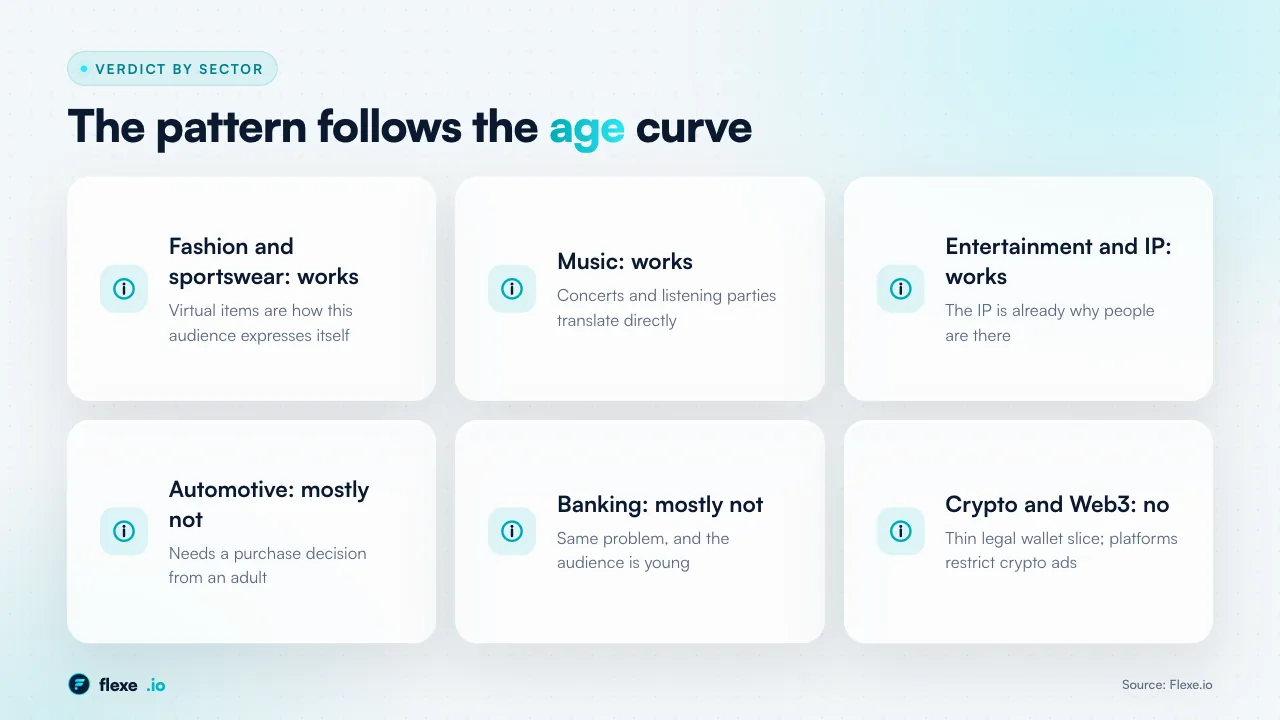
Metaverse marketing puts a brand inside a virtual environment where people already spend time, and lets them interact with it rather than watch it. In practice it takes four forms: a branded space or map, a wearable or in-game item, sponsorship of an existing creator experience, and standard media placement inside the platform. The first two require build budget and ongoing operation. The last two behave much like influencer and display buying, which is why they scale more predictably. They also come with the reporting tools advertisers already understand, so a media team can compare the result with other channels in the same spreadsheet.
The word “metaverse” still carries two incompatible meanings. One is the crypto-native, token-governed world: Decentraland, The Sandbox, and their peers. The other is the mainstream game platform: Roblox, Fortnite, ZEPETO, Minecraft. They share a format and almost nothing else, least of all audience size. Crypto-native worlds sell ownership of land and items on a blockchain, while game platforms sell attention from people who came to play. A brand brief written for one rarely survives a move to the other.
| Form | What it is | Needs build budget | How it scales |
|---|---|---|---|
| Branded space or map | Your own environment inside a platform | Yes, plus ongoing operation | Badly. Starts empty and stays empty without promotion |
| Wearable or in-game item | A virtual object players equip | Yes, plus ongoing operation | Depends on whether the item signals status in that game |
| Sponsorship of a creator experience | Paying into a map people already play | No | Predictably, like influencer buying. Reaches people on day one |
| Media placement inside the platform | Display and video inventory | No | Predictably, like display buying |
How has metaverse marketing changed since 2022?
The honest summary is that the separate-destination version lost, and the in-game version won. The clearest single marker is Nike. It acquired the virtual sneaker studio RTFKT in 2021 at the height of NFT interest, announced its closure in December 2024, wound operations down in January 2025, and handed the brand to a new owner on 17 December 2025, the date a Nike spokesperson gave Bloomberg in January 2026. In April 2025 Nike was named in a proposed class action in federal court in Brooklyn (Cheema v. Nike) from RTFKT collectors who argued the shutdown destroyed the value of assets they had been sold.
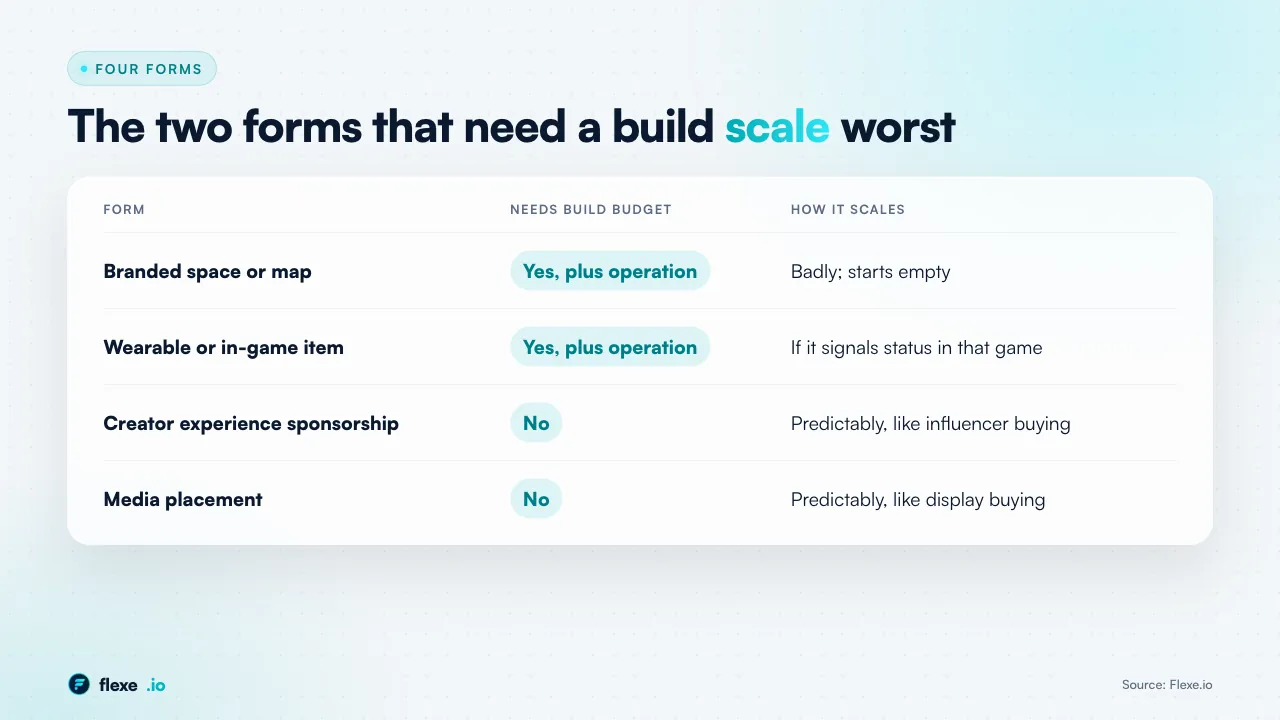
That sequence is worth more than any projection. A company with effectively unlimited budget, first-mover position and genuine cultural authority in exactly this category tried for four years and exited. Treat any agency deck that still uses Nike as a metaverse success story as evidence the deck has not been updated since 2022.
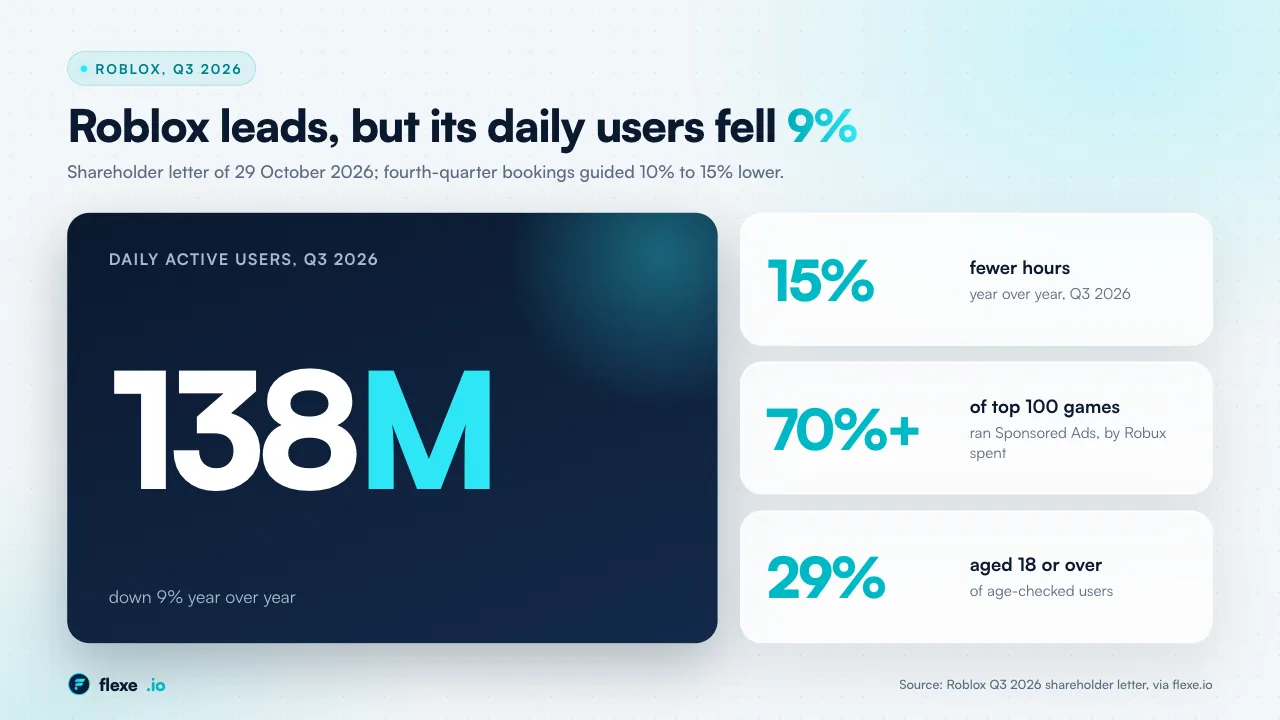
What did not collapse is brand presence inside games. Those campaigns kept running because the audience was already there for its own reasons, and the brand was a guest rather than the attraction. Roblox’s own reporting shows where that spend now goes. In its shareholder letter for the third quarter of 2026, published on 29 October 2026, the company said more than 70% of its top 100 games ranked by Robux spent ran Sponsored Ads, and that it plans to launch skippable pre-roll video ads. Metaverse advertising on the largest platform now looks like a media buy with standard formats, not a land purchase.
Where is the audience actually in 2026?
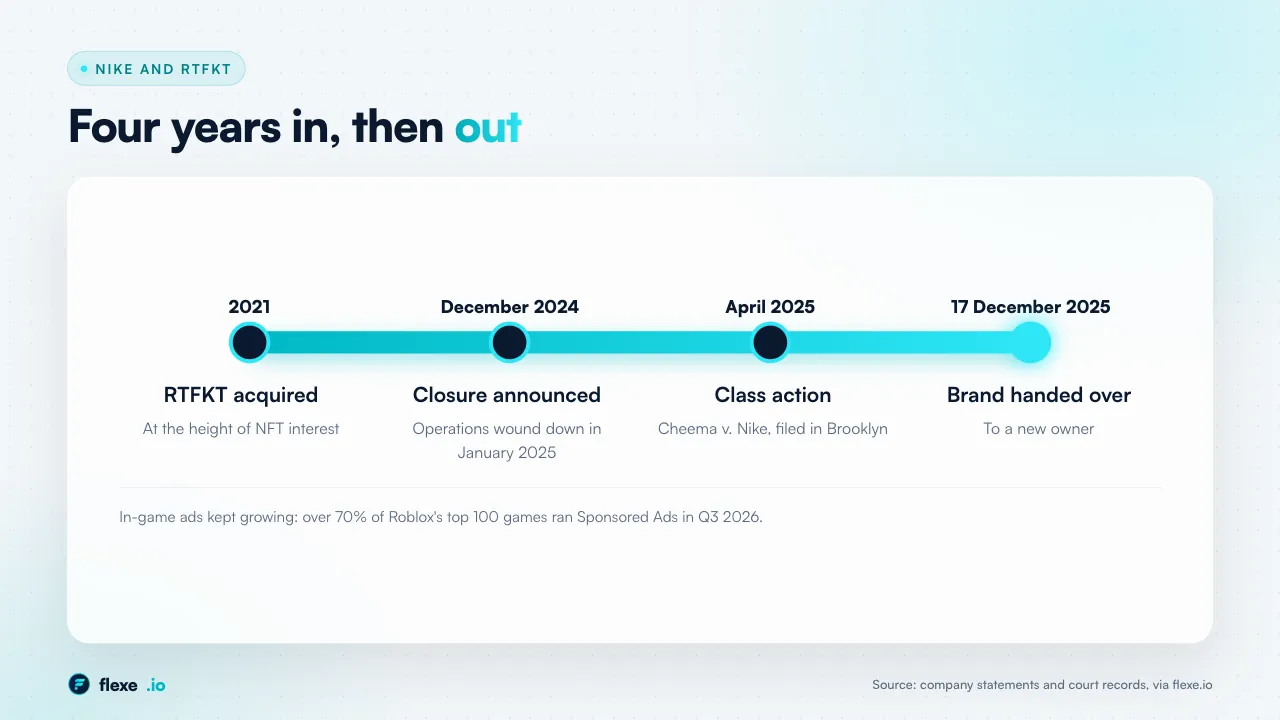
Concentrated, and young. Roblox averaged 138 million daily active users in the third quarter of 2026, down 9% year over year. Among users who had completed an age check in the week ending 30 September 2026, 34% were under 13 and 37% were 13 to 17, leaving 29% aged 18 or over. The adult share is rising (it was 27% at the end of June 2026), but a brief aimed at adults still addresses under a third of the platform. That single distribution decides which briefs are viable. Financial products, alcohol, and anything requiring a purchase decision from an adult with disposable income are a poor fit no matter how good the activation is. Apparel, music, sport, entertainment and quick-service food fit well.
For crypto and Web3 projects specifically, this is usually disqualifying rather than merely difficult. The audience that can legally hold a wallet and trade a token is a thin slice of the platform, and the platforms themselves restrict crypto promotion. Roblox’s Advertising Standards, introduced in March 2023, say ads may not promote specific cryptocurrencies or blockchain-based assets, and developers may not show advertising content to users under 13. We do not sell metaverse campaigns for that reason, and a project told otherwise should ask which segment of a 16-year-old audience is expected to convert. Projects still weighing the idea can test it against other channels through crypto marketing strategy consulting before any spend. Blockchain games are the partial exception, and the channels that work for them are covered in our Web3 gaming marketing guide.
Which industries actually work in the metaverse?
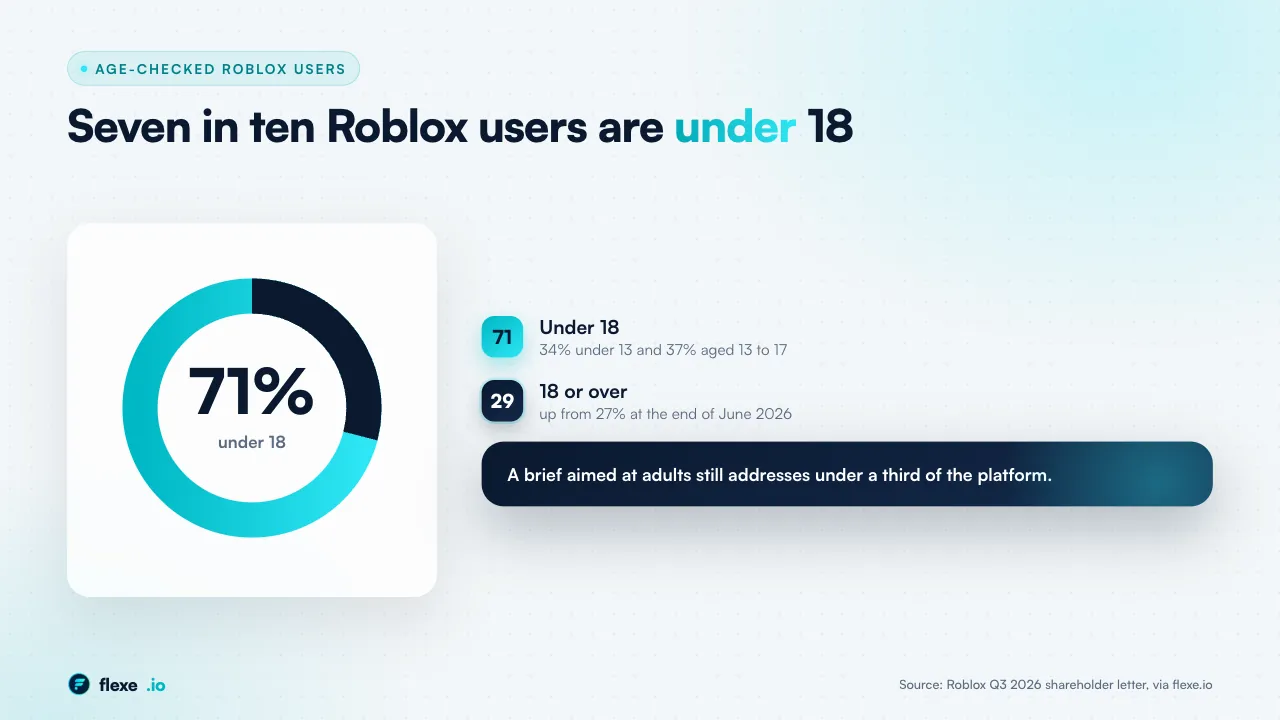
The pattern follows the age curve rather than the technology. Fashion and sportswear work because virtual items are an established part of how the audience already expresses itself in those games. Music works because concerts and listening parties translate directly. Entertainment works because the intellectual property is already the reason people are there. Automotive, banking and B2B software mostly do not, and the case studies that claim otherwise tend to report impressions rather than any downstream effect. The age data from autumn 2026 sharpens the split: with roughly seven in ten age-checked Roblox users under 18, the sectors that sell to teenagers keep working, and the sectors that need an adult buyer keep struggling.
| Sector | Verdict | Why |
|---|---|---|
| Fashion and sportswear | Works | Virtual items are already how this audience expresses itself in-game |
| Music | Works | Concerts and listening parties translate directly into the format |
| Entertainment and IP | Works | The intellectual property is already why people are on the platform |
| Sport and quick-service food | Works | Fits the age curve and needs no adult purchase decision |
| Automotive | Mostly does not | Requires a purchase decision from an adult with disposable income |
| Banking and financial products | Mostly does not | Same problem, plus roughly 60% of the Roblox audience is under 16 |
| B2B software | Mostly does not | The buyer is not on the platform; cases here report impressions, not effect |
| Crypto and Web3 | Usually disqualifying | The slice that can legally hold a wallet is thin, and platforms restrict crypto promotion |
How do you build a metaverse advertising strategy?
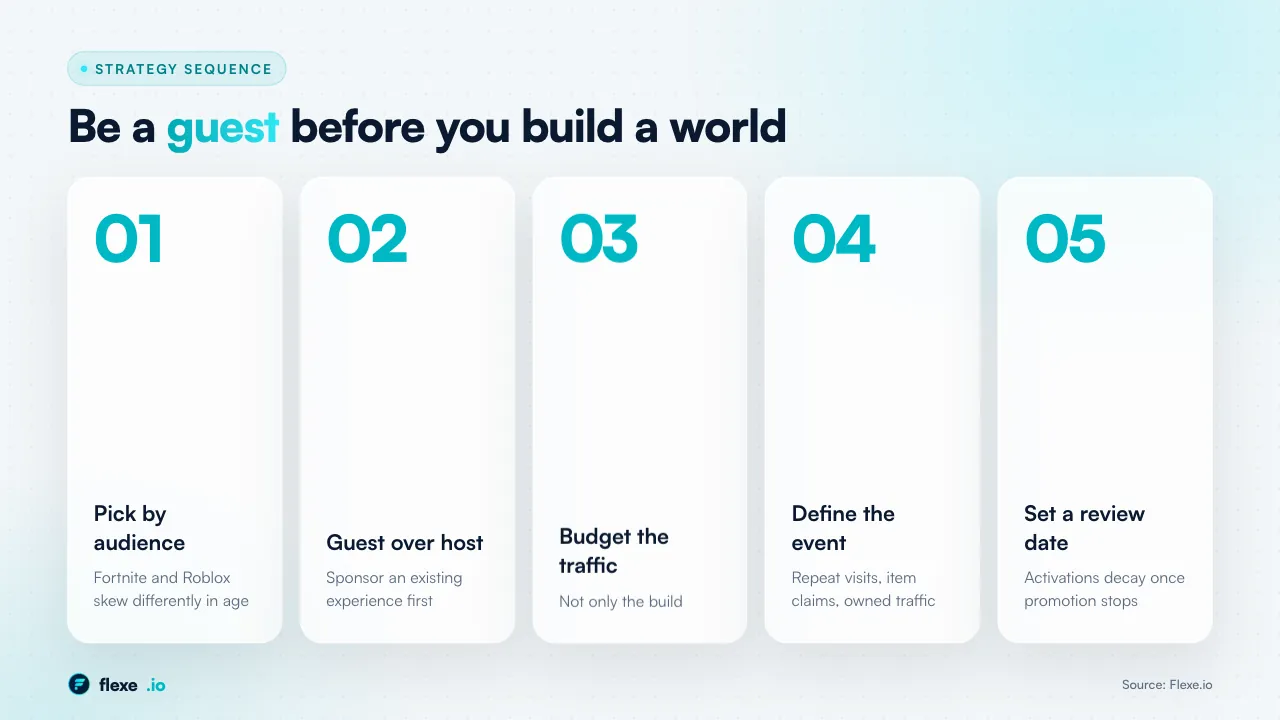
Start from the platform the audience already uses, not from the format you want to build. The sequence that survives contact with a budget, in the order we would run it for a client:
- Pick the platform by audience, not by reach. Fortnite and Roblox skew differently in age and in what players tolerate from brands.
- Choose guest over host. Sponsoring or integrating into an existing popular experience reaches people on day one. A custom world starts empty and stays empty without a media budget behind it.
- Budget the traffic, not just the build. The most common failure is spending the entire budget on construction and nothing on getting anyone to visit.
- Define the measurable event before launch. Visits are not an outcome. Repeat visits, item claims, and traffic to an owned property are.
- Set a review date. These activations decay quickly once promotion stops, so decide in advance when you will judge and kill or extend it.
Inside that sequence, these are the tactics we see holding up in 2026:
- Sponsor a popular map instead of building a world: the audience is already there on day one.
- Sell or give away a wearable that has status in that specific game, not a generic logo item.
- Run a timed live event, such as a concert or a drop, so promotion has a fixed date to point at.
- Pay the creators who run the experiences, the same way you would brief an influencer.
- Buy in-platform video inventory when you need reach without a build. Roblox opened rewarded video ads to brands through Google in April 2025 (checked 16 November 2026).
How do you launch a first metaverse campaign?
Run it as a test with a real ceiling. Choose one platform, one experience, and one measurable action. Sponsor an existing map before building your own. Give the activation a defined run of a few weeks rather than an open-ended presence, and put a share of the budget into promoting it on the channels the audience already reads. A first campaign that reaches a modest number of engaged players and produces a clean read on cost per action is worth more than a large build nobody visits. On Roblox the test can now start with standard inventory such as Sponsored Ads and rewarded video, which gives a baseline cost before anyone commits to a custom experience.
Is metaverse advertising worth it for small businesses?
Usually not, and the reason is structural rather than financial. The channel has no self-serve long tail comparable to search or social: the workable options are sponsorship deals and custom builds, both of which carry minimum commitments and production time. A small business with a limited budget will reach more of the right people through the channels where targeting is granular and the audience is adult. The exception is a business whose customers genuinely are teenagers and whose product is visual. Even then, a short sponsorship inside an existing popular game is a safer first step than commissioning a world of your own.
How do you measure a metaverse campaign?
Measure the action closest to your business and accept that platform-reported reach is the weakest number available. Useful metrics: unique visitors to the activation, time spent, repeat visit rate, items claimed or equipped, and referred traffic to an owned property. Treat “impressions” inside a virtual world with the same suspicion you would apply to a follower count. The number to report upward is cost per completed action, not cost per impression. Benchmark that figure against what the same budget buys on influencer or paid social campaigns aimed at the same age group.
Attribution across the boundary is genuinely hard. Most platforms do not pass identity out, so plan for a coded link, a claim code, or a landing page unique to the campaign before launch rather than trying to reconstruct it afterwards.
What happens to metaverse marketing next?
The likeliest path is continued consolidation into a small number of game platforms, with brand activity treated as an ordinary media line rather than an innovation project. The crypto-native worlds retain their token economies and their small, committed populations, and may find a durable niche (we cover how those communities are reached in the Web3 marketing guide), but the evidence of the past four years is that they do not deliver mass brand reach. Anyone selling that promise in 2026 should be asked for current daily active user figures rather than a valuation. The game platforms have their own pressure to watch: Roblox reported daily users down 9% and hours down 15% year over year in the third quarter of 2026, which it put down to tough comparisons with a strong 2025, and it guided fourth quarter bookings 10% to 15% lower. Brand budgets there will follow the audience, wherever it settles.
Metaverse marketing strategies with examples
Five strategies, each with a public example. The dates are the launch dates the brands and platforms announced.
Metaverse Advertising: Formats, Platforms and How Ads Are Bought
Metaverse advertising in 2026 is bought like other media: on Roblox through Ads Manager and Google, on Fortnite through a daily auction for the Sponsored Row. Metaverse ads, often searched as meta verse ads, fall into three groups: paid discovery slots that send players into an experience, image and video inside games, and sponsorship of experiences other people built. We checked the rules below on 16 November 2026.
| Platform | Ad formats | How it is bought | Who sees the ads |
|---|---|---|---|
| Roblox | Sponsored Ads on the Home page and in Search; image and video Billboards inside games; Portal ads; rewarded video up to 30 seconds | Sponsored Ads in the self-serve Ads Manager; rewarded video sold programmatically through Google and by direct insertion order since April 2025 | Only users over 13, under the Advertising Standards |
| Fortnite | Sponsored Row in Discover for islands; brand islands; sponsorship of popular creator islands | The island owner sets a daily budget and a maximum bid per 1,000 impressions; a daily auction decides placement; campaigns run up to 90 days | Sponsored Row is shown only to logged-in players aged 18 and over in approved regions |
| Decentraland, The Sandbox | Billboards on privately owned land, branded scenes, wearables | Rented from landowners or small ad networks, often priced in crypto | Small daily populations; ask for current daily users before paying |
Two details decide the media plan. On Roblox, rewarded video is opt-in: the April 2025 announcement reported an average completion rate above 80% in tests, and ads run only to users over 13. On Fortnite, the Sponsored Row rules limit the audience to adults, which suits brands that cannot advertise to teenagers. A metaverse marketing strategy that starts with these standard formats gets a cost per visit before any money goes into a custom world.
| Strategy | Example | Platform | What it shows |
|---|---|---|---|
| Live virtual event | Travis Scott Astronomical, April 2020: Epic reported 12.3 million concurrent players at the first show | Fortnite | A fixed date concentrates the audience |
| Branded world | Nikeland, November 2021 | Roblox | Works while promoted, fades without traffic |
| Limited virtual items | Gucci Garden, May 2021 | Roblox | Scarcity carries over from physical fashion |
| Owned NFT studio | RTFKT, bought by Nike in 2021, closed January 2025 | Ethereum NFTs | Token-based worlds carry legal and reputation risk |
| In-platform video ads | Roblox rewarded video sold through Google, April 2025 | Roblox | The format moves toward ordinary media buying |
How to choose a metaverse marketing platform in 2026
Choose a metaverse marketing platform by audience age and ad rules first, and by reach second. The platforms with real audiences skew young and restrict crypto promotion, while crypto-native worlds have small daily populations. Run these checks before any build budget is committed, and start with standard inventory wherever the platform sells it.
- The audience age matches your buyer, and the ad rules allow your category.
- Standard inventory exists, such as Roblox Sponsored Ads or rewarded video.
- Current daily users are published or supplied before you pay.
- A popular experience you can sponsor instead of building your own.
- A measurable action is reported, not only visits.
Frequently Asked Questions
Is the metaverse dead in 2026?
The separate-destination version largely is, in the sense that it never reached a mass audience. Brand activity inside game platforms is not dead and grew through the same period, with most of it concentrated on Roblox and Fortnite. Roblox alone averaged 138 million daily active users in the third quarter of 2026, and more than 70% of its top 100 games ran Sponsored Ads.
Should a crypto project run metaverse marketing?
Rarely. The platforms with an audience skew heavily young and restrict crypto promotion: Roblox’s Advertising Standards bar ads for specific cryptocurrencies and blockchain assets. The platforms that welcome crypto have very small populations. Community, influencer and PR channels reach the same project goals, holders and active users, with far better economics.
Do I need to buy virtual land?
No. Buying land was the defining mistake of the 2021 cycle, because land only matters if people visit it. Sponsorship of an existing popular experience puts a brand in front of an audience that already exists, with no construction cost and no ongoing operation, and it can be stopped as soon as the numbers disappoint.
What happened to Nike in the metaverse?
Nike bought the virtual sneaker studio RTFKT in 2021, announced the wind-down in December 2024, closed its operations in January 2025, and handed the brand to an undisclosed new owner on 17 December 2025. In April 2025 it faced a proposed class action from collectors who argued the shutdown wiped out the value of their NFTs.
How many people use Roblox in 2026?
Roblox averaged 138 million daily active users in the third quarter of 2026, down 9% from a year earlier, according to its shareholder letter of 29 October 2026. Of users who completed an age check, 29% were 18 or older at the end of September 2026, so the platform still skews heavily toward children and teenagers.
What are the best metaverse marketing tactics in 2026?
Sponsoring an existing popular map, releasing a wearable with status in that game, running a timed live event, paying the creators behind experiences, and buying in-platform video ads. All five reach an audience that already exists, which is why they outperform building a world from scratch.
What metaverse marketing tools do brands use?
Mostly the platforms’ own tools: Roblox Studio and Fortnite Creative for builds, the platforms’ ad products for media (Roblox sells rewarded video through Google since April 2025), and ordinary analytics on the owned site the activation sends traffic to.
How does metaverse advertising work?
Metaverse advertising works like a media buy inside game platforms. On Roblox, brands buy Sponsored Ads in Ads Manager or rewarded video through Google, shown only to users over 13. On Fortnite, an island owner bids per 1,000 impressions for the Sponsored Row, which only players aged 18 and over see. Crypto-native worlds rent billboards on private land to far smaller audiences.
If you would rather have this run for you, see influencer campaigns.