Most guides about cryptocurrency keywords are generic lists scraped from tools. This one breaks down real campaigns with verified numbers, common mistakes that kill organic reach, and the exact process top projects use to rank.
Key Takeaways
- Exchanges with educational content capture 84–94% non-branded keywords, while DEX platforms without it rely on 48–64% branded searches.
- A single micro-KOL campaign generated 170 posts and 427,000 impressions in one month, boosting brand engagement by 200%.
- Crypto search interest climbed 45% quarter-over-quarter, with altcoin queries hitting a five-year peak as Bitcoin dominance dropped toward 59%.
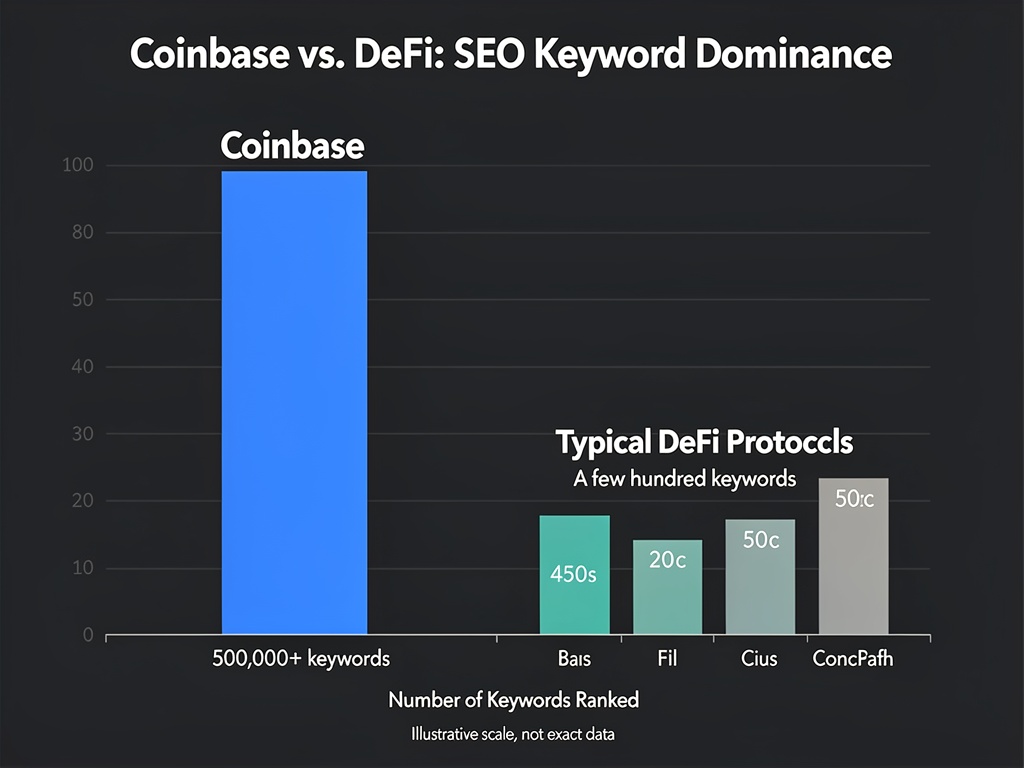
- Coinbase ranks for over 500,000 keywords; most DeFi protocols rank for only a few hundred due to missing educational layers.
- Prediction markets like Polymarket and Kalshi achieve 18–27% organic traffic by targeting mainstream terms like “election odds” instead of protocol jargon.
- AI-driven search engines cite projects with deep educational content and skip those offering only product pages.
- Organic search compounds over time, yet most crypto projects still depend on viral moments instead of building sustainable discoverability.
What Keywords for Cryptocurrency Mean: Definition and Context
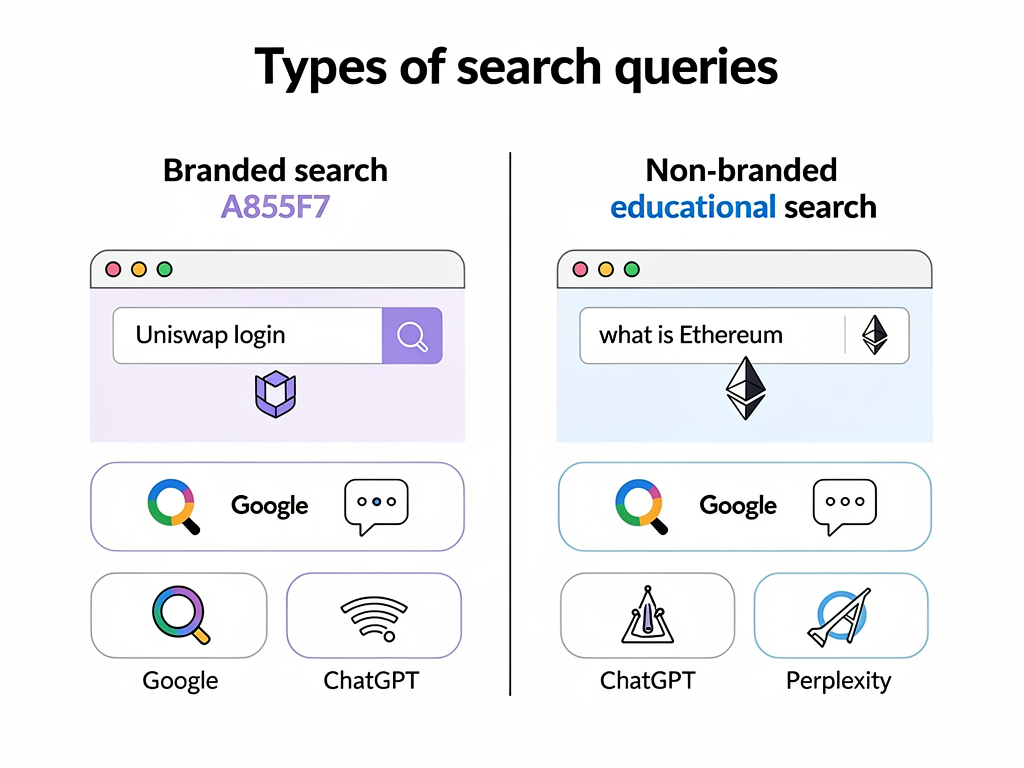
Keywords for cryptocurrency are the search terms people type into Google, ChatGPT, or Perplexity when they want to understand blockchain concepts, compare platforms, or discover new protocols. Recent implementations show that projects ranking for non-branded queries—terms like “what is Ethereum” rather than “Uniswap login”—capture users at the awareness stage, long before they commit to a wallet or exchange.
Current data demonstrates a clear divide: centralized exchanges and projects with robust learning hubs dominate informational queries, while decentralized protocols remain invisible to new users. Modern deployments reveal that the next four to five years will determine which crypto brands build self-sustaining user bases and which stay trapped in a cycle of paid acquisition and influencer hype.
This approach matters for founders, marketers, and content teams who need predictable growth. It is less relevant for traders focused solely on price action or teams that can afford infinite ad budgets. If you want compounding organic traffic instead of one-off spikes, understanding and applying this framework is non-negotiable.
What Keyword Strategy Actually Solves
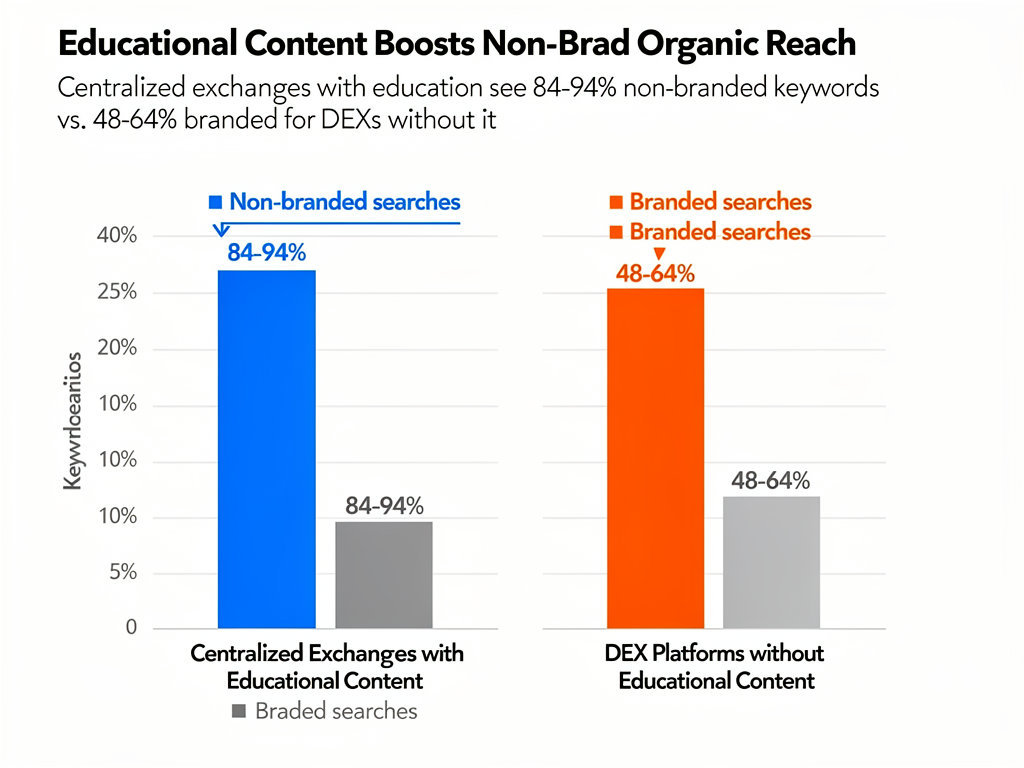
New crypto users face a wall of jargon—altcoins, consensus mechanisms, gas fees—and most search for explanations before choosing a platform. Projects that rank for these educational queries intercept users at the research stage, building trust and awareness before competitors even appear. One analysis found that exchanges with dedicated learning centers capture up to 94% non-branded keywords, meaning they show up when users ask “how does proof-of-stake work” rather than searching the brand name directly.
Decentralized protocols struggle with discovery because they skip educational content. A DEX without tutorials or glossaries may rank only for its own name, attracting users who already heard about it elsewhere. This creates dependence on viral moments, influencer shoutouts, and paid ads. When budgets tighten or a competitor runs a bigger campaign, traffic collapses. A properly executed keyword strategy fixes this by making the project discoverable to anyone curious about the problem it solves.
AI-powered search tools like Google AI Overviews and ChatGPT extract snippets from multiple sources when building answers. Projects with deep, structured content get cited; those offering only landing pages get ignored. A comprehensive keyword approach ensures your protocol appears in AI-generated summaries, expanding reach far beyond traditional search results.
Market volatility makes paid acquisition expensive and unpredictable. Organic search compounds over months and years, providing a stable baseline of traffic even when ad costs spike or social algorithms shift. Recent cases show projects diversifying from pure performance marketing to SEO see lower customer acquisition costs and higher lifetime value because users who arrive via educational content already understand the product.
How This Works: Step-by-Step
Step 1: Map User Questions to Search Terms
Start by listing every question your target user asks before using your product. For a DEX, that might include “what is slippage,” “how to swap tokens,” or “best liquidity pools.” Use tools like AnswerThePublic or manual autocomplete research in Google and ChatGPT. Cross-reference with community forums, support tickets, and competitor content to find gaps.
One team analyzed 12 major crypto projects with a combined $208 billion market cap and discovered that centralized exchanges dominate terms like “what is Ethereum” because they built glossaries and learning centers. DEX platforms without educational layers rank only for their brand names, missing millions of potential users who search for the underlying concepts first.
Many teams skip this step and jump straight to creating product-focused pages. That approach captures users already familiar with the protocol but misses the vast majority still learning the basics.
Step 2: Build Educational Content Around Core Terms

Create glossaries, how-to guides, comparison articles, and explainer videos. Each piece should target a specific search intent—informational, navigational, or transactional. For instance, an article titled “What is a liquidity pool and how does it work” targets users at the awareness stage, while “How to provide liquidity on Uniswap” serves users ready to act.
A recent campaign by a large crypto project collaborated with key opinion leaders to produce 170 unique posts in one month, generating 427,000 impressions and a 4.6% average engagement rate. Brand account engagement jumped 200% because the content answered real user questions instead of pushing product features.
The mistake here is publishing shallow content that repeats the same surface-level definitions found on a hundred other sites. AI search engines and Google prioritize depth, originality, and structured data. If your article adds no new insight, it will not rank or get cited.
Step 3: Optimize for AI-Driven Search
AI tools pull snippets from content that directly answers queries, uses clear headings, and includes supporting data. Structure articles with H2 and H3 tags that mirror common questions. Add tables, bullet lists, and concise definitions in the opening paragraphs. Link internally to related guides so AI crawlers understand your content taxonomy.
Prediction markets like Polymarket achieve 18% organic traffic by ranking for mainstream terms such as “election odds” rather than protocol-specific jargon. Kalshi reaches 27% organic by targeting “prediction market regulations” and similar queries. Both avoid the trap of optimizing only for crypto insiders.
A common error is ignoring structured data markup and internal linking. Without clear signals, AI tools cannot reliably cite your content, even if it is accurate and comprehensive.
Step 4: Leverage Influencer and Community Channels
Distribute educational content through KOLs, Telegram groups, Discord servers, and crypto media outlets. Influencers amplify reach, but the content itself must be valuable enough to rank organically after the initial push. One micro-campaign generated 170 posts across influencer channels, driving sustained engagement long after the campaign ended because the underlying articles continued to rank and attract new readers.
Google Trends data shows altcoin searches hit a five-year high, with overall crypto queries up 45% quarter-over-quarter. Retail interest is waking up, and projects with optimized content are positioned to capture that surge. Those relying solely on paid ads will see costs climb as competition intensifies.
Teams often treat influencer campaigns as standalone tactics. The real leverage comes from pairing influencer distribution with evergreen content that continues to work months later.
Step 5: Track Rankings, Iterate, and Expand
Monitor keyword positions in Google Search Console, Ahrefs, or SEMrush. Identify pages ranking on page two and update them with fresh data, new examples, and deeper explanations. Expand into adjacent topics as you establish authority. For example, a guide on “what is Ethereum” can branch into “Ethereum gas fees explained” and “how to stake ETH.”
One analysis found that Coinbase ranks for over 500,000 keywords, while most DeFi protocols rank for only a few hundred. The difference is sustained investment in content expansion and updates, not one-off campaigns.
The mistake here is treating SEO as a project with a fixed end date. Organic search is a long-term asset that requires regular maintenance and growth.
Where Most Projects Fail (and How to Fix It)
Many crypto projects launch with a whitepaper, pitch deck, and landing page, then wonder why organic traffic never materializes. They assume users will discover them through social media or word-of-mouth, ignoring the fact that most potential users start with a search query. Without content that ranks for those queries, the project remains invisible to the majority of its target audience.
Another failure point is creating content only for people who already understand crypto. Articles filled with jargon like “AMM,” “yield farming,” and “tokenomics” alienate newcomers. Prediction markets succeed by targeting terms like “election odds” that mainstream audiences search for, then introducing the protocol within that context. If your content requires prior knowledge, you are leaving growth on the table.
Teams also underestimate the importance of depth. A 300-word glossary entry will not outrank established competitors. AI search tools and Google favor comprehensive guides with examples, data, and step-by-step instructions. Shallow content might generate a few clicks but will not build lasting authority or citations.
Ignoring structured data and internal linking is another missed opportunity. AI-driven search relies on clear content hierarchies to understand relationships between topics. Without proper headings, schema markup, and internal links, your articles become isolated pages that search engines struggle to categorize and rank.
For teams navigating these challenges, FLEXE.io, with over seven years in Web3 marketing and a track record of supporting 700+ clients, offers access to 150+ media outlets and 500+ KOLs to accelerate both reach and organic growth. Get in touch on Telegram: https://t.me/flexe_io_agency
Real Cases with Verified Numbers
Case 1: Micro-KOL Campaign Drives 200% Engagement Boost
Context: A major crypto project needed to increase brand visibility and user engagement within a short timeframe without relying solely on paid advertising.
What they did:
- Partnered with key opinion leaders to create and distribute original content.
- Tracked performance over one month, focusing on impressions, engagement rate, and brand account activity.
Results:
- Before: Baseline engagement not specified.
- After: 170 unique posts, 427,000 impressions, 4.6% average engagement rate.
- Growth: Brand account engagement increased by 200%.
Key insight: Collaborating with influencers who produce educational content, not just promotional posts, generates sustained engagement and amplifies organic reach.
Source: Tweet
Case 2: Google Trends Signals Altseason and Rising Retail Interest
Context: An analyst tracked search volume data to identify market trends and predict shifts in user behavior and capital flow within the crypto ecosystem.
What they did:
- Analyzed Google Trends data for altcoin and general crypto search terms over 12 months.
- Compared search volume to Bitcoin dominance and institutional activity indicators.
Results:
- Before: Moderate search interest with stable Bitcoin dominance.
- After: Altcoin searches reached a five-year high; crypto searches up 45% quarter-over-quarter.
- Growth: Bitcoin dominance fell toward 59%, signaling capital rotation into altcoins.
Key insight: Search volume trends often precede major market movements, and projects optimized for discovery can capture retail inflows early.
Source: Tweet
Case 3: Exchanges Dominate Non-Branded Keywords with Educational Content
Context: A researcher studied keyword rankings for 12 crypto projects with a combined market cap of $208 billion to understand why some platforms achieve massive organic visibility while others remain dependent on branded searches.
What they did:
- Analyzed branded versus non-branded keyword distribution across centralized exchanges and decentralized protocols.
- Evaluated the presence and depth of educational content on each platform.
Results:
- Before: Most DeFi protocols ranked for only a few hundred keywords, primarily branded.
- After: Exchanges with learning centers captured 84–94% non-branded keywords; DEX platforms without educational layers relied on 48–64% branded searches.
- Growth: Coinbase ranks for over 500,000 keywords, according to project data, versus a few hundred for most DeFi protocols.
Key insight: Educational content transforms a project from a destination users must already know about into a discovery engine that attracts new audiences at the awareness stage.
Source: Tweet
Case 4: Prediction Markets Rank for Mainstream Terms, Not Jargon
Context: Polymarket and Kalshi competed in a crowded prediction market sector but needed to reach users beyond the crypto-native audience.
What they did:
- Targeted mainstream search terms like “election odds” and “prediction market regulations” instead of protocol-specific keywords.
- Built content that explained use cases first, then introduced the platform within that context.
Results:
- Before: Limited organic reach outside crypto forums.
- After: Polymarket achieved 18% organic traffic; Kalshi reached 27%.
- Growth: Both platforms expanded user bases beyond crypto enthusiasts by capturing mainstream search traffic.
Key insight: Leading with use cases instead of technical features opens the door to broader audiences and reduces dependence on niche crypto channels.
Source: Tweet
Tools and Next Steps

Google Search Console tracks keyword rankings, impressions, and click-through rates. Use it to identify pages on page two that need updates and to monitor how AI Overviews cite your content.
Ahrefs and SEMrush provide competitive analysis, showing which keywords competitors rank for and where gaps exist. Both tools include content gap features that surface topics your site has not covered.
AnswerThePublic visualizes common questions and related searches, helping you map user intent to content ideas. Combine it with manual research in crypto forums, Telegram groups, and Discord servers.
Google Trends reveals rising queries and seasonal patterns. Use it to time content launches and identify emerging topics before they become saturated.
Screaming Frog audits internal linking, broken links, and metadata. Clean technical SEO ensures search engines can crawl and index your content efficiently.
For projects ready to scale organic reach, FLEXE.io brings seven years of Web3 marketing expertise, connecting 700+ clients with 10+ crypto traffic sources and 500+ KOLs to drive measurable growth in users, holders, and visibility. Reach out on Telegram: https://t.me/flexe_io_agency
Checklist to Get Started:
- Audit your existing content for keyword coverage and identify gaps in educational topics.
- Map user questions to search terms using keyword research tools and community feedback.
- Create or expand glossaries, how-to guides, and comparison articles targeting informational queries.
- Implement structured data markup and clear heading hierarchies to support AI-driven search.
- Build internal links between related articles to help search engines understand content relationships.
- Launch a pilot influencer campaign with educational content to amplify reach and test messaging.
- Monitor keyword rankings in Google Search Console and iterate on underperforming pages.
- Expand into adjacent topics as you establish authority in core areas.
- Track organic traffic share alongside paid channels to measure long-term ROI.
- Schedule quarterly content audits to refresh data, examples, and insights.
FAQ: Your Questions Answered
What are the most important keywords for cryptocurrency projects?
Informational queries like “what is blockchain,” “how to buy Ethereum,” and “best crypto wallets” drive the highest volume and attract users at the awareness stage. Focus on terms your target audience searches before they know your protocol exists.
How long does it take to see results from crypto SEO?
Most projects notice measurable ranking improvements within three to six months, with compounding growth continuing over years. Organic search builds slowly but provides stable, cost-effective traffic compared to paid ads.
Do I need technical SEO expertise to rank for crypto keywords?
Basic on-page optimization—clear headings, internal links, fast load times—goes a long way. Advanced technical SEO helps, but most gains come from creating comprehensive, user-focused content that answers real questions.
How do AI search tools like ChatGPT and Google AI Overviews use crypto content?
They extract snippets from pages with clear structure, concise definitions, and supporting data. Projects with deep educational content get cited; those offering only product pages get skipped. Structured data and internal linking improve your chances of appearing in AI-generated summaries.
Should I target branded or non-branded keywords?
Both matter, but non-branded keywords unlock growth by capturing users who do not yet know your project. Exchanges with learning centers achieve 84–94% non-branded keyword coverage, while DEX platforms without educational content rely on 48–64% branded searches.
Can influencer campaigns help with organic search rankings?
Yes, when influencers share educational content that links back to your site. One campaign generated 170 posts and 427,000 impressions, boosting brand engagement by 200% and driving sustained organic traffic as the content continued to rank.
What mistakes kill crypto SEO efforts?
Creating shallow content, using excessive jargon, ignoring structured data, and treating SEO as a one-time project instead of an ongoing investment. Focus on depth, clarity, and regular updates to build lasting authority.