Last updated: June 2026. What changed: added 7-pillar promotion framework, budgeting by project stage, exchange/broker promo mechanics, threshold-gated campaigns, anti-fraud section, 4-phase campaign structure, tactic selection with Avoid column, 12 tactics ranked by ROI, 90-day roadmap, risky claims table, FTC/SEC compliance, Kim Kardashian case, 20-point checklist, and post-promo retention path.
Crypto promotion is the practice of driving awareness, community, and adoption for a crypto project across social, community, KOL, PR, and paid channels. In 2026 effective promotion balances reach with credibility and compliance. This guide covers the channels, tactics, and mistakes to avoid.
Key Takeaways
- Crypto promotion works best as a mix of community, KOL, PR, and paid, since no single channel carries a launch.
- Credibility and disclosure protect a project, because hype-driven promotion erodes trust fast.
- Community-owned channels like Telegram and Discord compound, while paid reach rents attention.
- Time promotion around real milestones, not empty announcements, to earn coverage and engagement.
- Measure real, retained users through on-chain activity rather than follower spikes.

Crypto promotion in 2026 is no longer a matter of buying KOL posts and dropping tokens. Crypto airdrops have distributed over $26 billion in value since 2020. Most of that value was destroyed within weeks – not because the mechanic failed, but because the strategy failed. The difference between Hyperliquid distributing $12.6 billion to 94,000 users who held and evangelized the protocol, and Scroll distributing tokens to millions of wallets that were immediately dumped, is strategy, not luck.
Crypto promo in 2026 also faces an enforcement reality that did not exist two cycles ago. The SEC charged Kim Kardashian $1.26 million for promoting EMAX tokens without disclosing her $250,000 payment. The FTC requires clear disclosure for all paid endorsements. MiCA actively enforces financial promotion rules across Europe. Projects that copy 2021-era promotional tactics face regulatory liability, not just reputational damage.
This guide covers all three dimensions of crypto promotions: the mechanics (airdrops, bounties, quests, KOL campaigns, paid ads, PR, referrals, exchange promos), the promotional materials (ad creatives, landing pages, social content), and the promotional services and agencies that execute them.
Flexe.io has been executing crypto promotions since 2018 for 800+ Web3 projects – KOL campaigns, crypto PR in 300+ media outlets, airdrop strategy, community growth, and paid promotion. Reach us on Telegram: https://t.me/flexe_io_agency
Quick Answer / TL;DR
Crypto promotion is the coordinated use of marketing channels and incentive mechanics to drive awareness, adoption, and retention for cryptocurrency, DeFi, NFT, and Web3 projects. Effective crypto promotions in 2026 follow seven pillars: community-owned growth, equity-aligned KOL partnerships, technical SEO and AEO content, compliant paid advertising, threshold-gated incentive campaigns, trust-building PR, and on-chain attribution. The defining metric is cost per retained wallet over 30/90 days – not impressions, followers, or total airdrop participants.
What Is Crypto Promotion?
Crypto promotion (shortened to crypto promo) is any marketing activity designed to increase awareness, users, holders, deposits, wallet activity, liquidity, or revenue for a crypto, blockchain, Web3, DeFi, exchange, wallet, NFT, GameFi, or token project.
It encompasses three interconnected dimensions:
1. Promotion mechanics – campaigns and incentive structures: airdrops, bounty campaigns, quest programs, KOL partnerships, exchange signup bonuses, referral programs, trading competitions, paid advertising, and PR.
2. Promotional materials – creative assets: ad banners, landing pages, social content, KOL briefs, email campaigns, and token launch collateral.
3. Promotional services – the agencies, platforms, and tools executing campaigns: crypto marketing agencies, KOL networks, quest platforms, airdrop distribution tools, and analytics systems.
Why Crypto Promo Strategies Evolved
The collapse of 2021-2022 aggressive promotion taught hard lessons. Audiences are now hyper-skeptical of anything that smells like a shill. Fake engagement is detected immediately by community due-diligence tools. Regulatory enforcement has moved from warnings to fines and license suspensions. AI-driven search has fundamentally changed discovery – projects not cited authoritatively by ChatGPT or Perplexity are invisible to a growing share of users.
Airdrop fatigue is real. Blanket airdrops attract industrial-scale wallet farmers who extract tokens and dump immediately. The solution is not to abandon incentive campaigns but to redesign them as threshold-gated systems that require genuine on-chain engagement rather than passive wallet addresses.
The 7 Pillars of Modern Crypto Promotion
A coherent crypto promo strategy integrates all seven pillars. No single pillar works in isolation.
| Pillar | What It Is | 2026 Best Practice |
|---|---|---|
| 1. Community-Owned Growth | Token-holders who actively promote because they are genuine owners | Distribute tokens with governance rights, DAO tools for community-proposed campaigns |
| 2. Equity-Aligned KOL Partnerships | KOLs who receive vested tokens, not one-time payments | 12-24 month linear vesting, on-chain wallet history vetting, per-KOL attribution tracking |
| 3. Technical SEO and AEO | dApp and content visible to search and AI engines | SSR for crawlable pages, Quick Answer blocks for AI citation, EEAT with expert authors |
| 4. Compliant Paid Advertising | Crypto-native ad networks plus certified Google Ads | Layer Coinzilla for awareness, Blockchain-Ads for performance, audit publisher lists |
| 5. Threshold-Gated Incentives | Quests and airdrops requiring genuine on-chain engagement | Galxe, Layer3, Zealy with vesting logic, anti-Sybil filtering, activity cliffs |
| 6. Trust-Building PR | Editorial coverage in respected crypto and tech media | Provide data exclusives and original research, never pay for undisclosed coverage |
| 7. On-Chain Attribution | Connect every promotional dollar to verifiable on-chain outcome | UTM + wallet analytics + referral contracts + cohort retention analysis |

The Full Taxonomy of Crypto Promotions
Category 1: Airdrop and Token Distribution Campaigns
Types and retention benchmarks:
| Type | Mechanism | 90-Day Retention | Best For |
|---|---|---|---|
| Standard/Blanket | Distribute to all eligible wallets | ~11% | Brand awareness only |
| Bounty airdrop | Complete promotional tasks | 52% | Community growth |
| Quest-based | 4-5 verifiable on-chain actions | 73%+ | Protocol adoption |
| Holder airdrop | Rewards existing token holders | Highest quality | Ecosystem loyalty |
| Points program + TGE | Multi-season earning, then distribution | Best engagement | Major protocol launches |
Hyperliquid’s 76.2% community allocation set the 2026 benchmark. Projects launching below 25% face immediate backlash. The market now expects 25-50%+ community allocation.
Anti-Sybil requirements: Minimum 3-month wallet history, identity verification (Worldcoin, Civic), real-time detection (Chainalysis, Nansen), 90-day vesting.
Compliance: Under the SEC’s 2024 Framework for Token Distribution Events, KYC is generally required if tokens are distributed at over $0.10 per recipient.
Platforms: Galxe, Layer3, Zealy, Intract. Automated systems reduce operational overhead by 70% and increase participation by 45%.

Category 2: Bounty and Task Campaigns
| Task Type | Output | Reward Level |
|---|---|---|
| Social media shares | RT, post, tag | Low |
| Content creation | Articles, videos, graphics | Medium-High |
| Translation | Content localization | Medium |
| Bug reports | Protocol testing | High |
| Ambassador | Ongoing community management | High |
| Referral | Verified new users | Variable |
Category 3: Exchange and Broker Promotions
Exchange and broker promotions are a distinct category that non-exchange projects often overlook. Start with the business objective, not the mechanic.
| Promo Type | Objective | Anti-Farm Design |
|---|---|---|
| Signup bonus | New funded accounts | KYC tiers, volume thresholds before payout |
| Fee holiday | First deposit or volume | Caps per user, period limits |
| Trading competition | Active traders and volume | Minimum trade size, leaderboard qualification |
| Referral program | Organic user acquisition | Verified KYC + first trade requirement |
| Feature adoption bonus | New product usage | Usage-based rewards, not just activation |
| Reactivation promo | Dormant user re-engagement | Targeted to existing users only, not broad |
Design eligibility and anti-farm rules: KYC tiers, region restrictions, device/IP patterns, minimum holding periods. Gradual token unlocking rather than 100% upfront. Plan the retention path past the promo end – what does “post-promo equilibrium” look like in terms of normal fees and sustainable yield?
Category 4: KOL and Influencer Promotion
10-step KOL promotion process:
| Step | What to Do |
|---|---|
| 1. Define KPI | Awareness, deposits, wallet connects, or holders |
| 2. Build KOL list | Segment by niche, platform, geo, price tier |
| 3. Vet creators | Average views, comment quality, on-chain wallet history, disclosure compliance |
| 4. Negotiate terms | Price, format, timing, approval flow |
| 5. Prepare brief | Message, CTA, tracking link, do-not-say list |
| 6. Approve content | Prevent false claims before publication |
| 7. Publish | Coordinate timing and jurisdictional filters |
| 8. Track | UTM, referral smart contracts, wallet analytics |
| 9. Report | Cost per retained wallet vs baseline |
| 10. Optimize | Scale creators that perform, cut those that don’t |
Equity-aligned model. The most effective KOL promotions in 2026 offer vested token allocation alongside cash. This makes KOLs long-term stakeholders visible on-chain, aligning incentives with project health over 12-24 months.
Compliance: FTC requires clear disclosure (#ad/#sponsored) for all paid partnerships. Token allocations are material connections requiring disclosure. The SEC charged Kim Kardashian $1.26M for failure to disclose a $250,000 payment to promote EMAX tokens.
Category 5: Paid Crypto Advertising
Google allows advertising for certain cryptocurrency-related products, but some categories require application before ads can run.
| Network | Best For |
|---|---|
| Blockchain-Ads | FTD campaigns, on-chain behavioral targeting (37+ chains) |
| Coinzilla | Brand awareness, premium crypto media |
| Bitmedia | Volume campaigns, global retail |
| HypeLab | In-app Web3 placements |
| X Ads | Narrative and retargeting |
| Exchange-native | Listed tokens, high-intent traders |
Category 6: Crypto PR and Earned Media
PR serves three simultaneous functions: brand credibility, SEO authority (tier-1 media backlinks compound for years), and AI citation signals.
Strong PR angles vs weak PR angles:
| Weak Angle | Strong Angle |
|---|---|
| “We are revolutionizing crypto” | “We solve [specific problem] for [specific market]” |
| “Our token will change everything” | “Here is the utility, risk, and ecosystem context” |
| “We launched a platform” | “Here is what changed and why it matters now” |
| “We partnered with X” | “Here is what users can now do because of the partnership” |
| “We are the best” | “Here are specific, verifiable proof points” |
Category 7: Referral and Community Promotion
Referral programs and community-driven growth produce the highest-quality users because recommendations come with implicit endorsement.
Community promotion KPIs: Active member rate (not total count), governance participation rate, wallet connect rate from community, week-4 retention of community-acquired users.
12 Crypto Promo Tactics Ranked by ROI
| Rank | Tactic | Avg Cost | Time | ROI Benchmark |
|---|---|---|---|---|
| 1 | Referral + utility airdrop | $15K-$120K | 14-60 days | Highest (10-25x), viral coefficient >1.5 |
| 2 | Quest-based threshold-gated campaign | $20K-$80K | 30-60 days | 73%+ retention |
| 3 | Equity-aligned KOL rounds | $10K-$250K | 7-30 days | 5-15x |
| 4 | Community contests with on-chain proof | $5K-$40K | Immediate | High engagement |
| 5 | Token-gated events and AMAs | $8K-$60K | 14-45 days | High LTV |
| 6 | Trust-building PR (tier-1 media) | $5K-$50K+ | 30-90 days | Compounding authority |
| 7 | Ecosystem co-promotions | $3K-$25K | 10-30 days | Cost-effective reach |
| 8 | Exchange listing + deposit promo | $20K-$150K | Launch window | FTD + volume |
| 9 | Ambassador and creator programs | $5K-$30K/mo | 60-90 days | Long-term |
| 10 | Educational webinar series | $5K-$25K | 30-60 days | Trust + lead capture |
| 11 | Flash airdrops for reactivation | $10K-$50K | 7-14 days | Dormant wallet recovery |
| 12 | DAO-voted community promo budgets | Token allocation | Ongoing | Community-owned |
Flexe.io has been designing and executing crypto promotion campaigns since 2018 across 800+ Web3 projects – from equity-aligned KOL rounds and threshold-gated quest campaigns to crypto PR in 300+ media outlets. If you want to discuss which tactics fit your project stage and goals, reach us on Telegram: https://t.me/flexe_io_agency
Crypto Promo Selection by Project Type
| Project Type | Priority Tactics | Avoid |
|---|---|---|
| DeFi / Yield Protocol | Quest campaigns, SEO comparisons, KOL education, compliance packaging | Meme creators, blanket airdrops |
| L2 / Infrastructure | Developer SEO, technical KOLs, GitHub bounties, docs SEO | Broad-reach influencers, consumer ads |
| Exchange | Signup bonus, trading competitions, affiliate KOLs, retargeting | Long-form educational content |
| NFT / Consumer dApp | Culture KOLs, community quests, retargeting DSP | Institutional PR |
| Token Launch | PR + KOL + community coordinated, quest platform | Blanket airdrop without vesting |
| RWA / Institutional | Compliance-first PR, regulatory KOLs, audit trails | Viral meme campaigns |
How to Structure a Crypto Promo Campaign: 4 Phases
Phase 1: Pre-Campaign Setup (Weeks 1-2)
Define conversion event (wallet connect? LP deposit? FTD?), select channels by intent, prepare compliance packaging (disclosure language, risk warnings, jurisdictional exclusions), and deploy attribution infrastructure (referral smart contracts, wallet analytics SDKs, cohort tracking).
Phase 2: Creative and Content Production (Weeks 3-4)
Develop compliant creative (ban “guaranteed APY,” “risk-free,” “moon”), produce educational content, implement multi-format disclosure (verbal + visual + description within first 30 seconds of video), document approval workflows.
Phase 3: Launch and Optimization (Weeks 5-8)
Coordinate channel sequencing, monitor wallet connects (not just clicks), run holdout tests by region, iterate based on cohort data (cut tactics with zero 30-day retention).
Phase 4: Post-Campaign Analysis (Week 9)
Export cohort retention by channel, document compliance outcomes, calculate true CAC (cost per retained wallet), plan post-promo retention path, and decide scale/cut decisions.
Anti-Fraud Framework for Crypto Promotions
AI-driven ad fraud and sybil farming have increased 300% since 2023.
| Defense Layer | Implementation |
|---|---|
| Wallet validation | Exclude wallets <30 days old, zero prior transactions, identical funding |
| Behavioral scoring | Flag non-human patterns (instant clicks, no scroll, identical sessions) |
| Publisher transparency | Demand inventory source lists from ad networks |
| Cohort holdouts | Pause in one region, compare on-chain activity |
| Post-conversion verification | Bot traffic decays within 72 hours; real users compound |
| Sybil-resistant incentives | Activity cliffs, vesting logic, governance hooks |
Red flags: Conversion spikes with zero follow-on wallet activity, wallet clusters funded from identical exchange withdrawals, high CTR with near-zero wallet connection rate.
Budgeting Crypto Promotions by Project Stage
| Stage | Monthly Budget | Allocation |
|---|---|---|
| Pre-Seed / MVP | $5,000-$15,000 | 60% content+SEO, 30% community seeding, 10% experimental ads |
| Seed / Private Round | $20,000-$50,000 | 40% KOL equity rounds, 30% content+SEO, 20% community, 10% paid |
| Public Launch / TGE | $75,000-$200,000+ | 35% KOL+influencer, 30% paid ads, 20% content+PR, 15% events+community |
| Post-Launch Growth | $25,000-$80,000 | 40% on-chain growth loops+retention, 30% content+SEO, 20% community, 10% retargeting |
Budget allocation per campaign: 40% distribution (KOLs, ads, incentives) / 25% tracking and analytics / 20% compliance and legal / 15% creative and content.
Crypto Promo Materials: What to Create
| Material Type | Channel | Compliance Requirement |
|---|---|---|
| Social banners | X, Telegram, Discord | No guaranteed returns, disclosure if paid |
| Ad creatives | Crypto ad networks | Platform-compliant claims, risk warnings |
| Landing pages | All paid campaigns | Audit links, security documentation, compliant claims |
| KOL brief/script | X, YouTube, Telegram | Do-not-say list, FTC disclosure required |
| Press releases | Crypto media | News hook, verifiable data, no promotional tone |
| Token launch collateral | All channels | Tokenomics transparency, vesting, risk disclosures |
| Airdrop announcement | Social, Discord | Eligibility criteria, timeline, anti-Sybil requirements |
Risky Crypto Promotion Claims vs Safer Alternatives
| Risky Claim | Safer Alternative |
|---|---|
| “Guaranteed profit” | Explain features and risks |
| “Risk-free yield” | Explain variable returns and risk factors |
| “This token will 100x” | Avoid price predictions entirely |
| “Best exchange” | Use specific, verifiable advantages |
| “Safe passive income” | Explain smart contract and market risk |
| “Buy now before pump” | Avoid manipulative urgency |
| “Everyone will make money” | Never imply guaranteed outcome |
| “Audited means no risk” | Explain audit scope and residual risk |
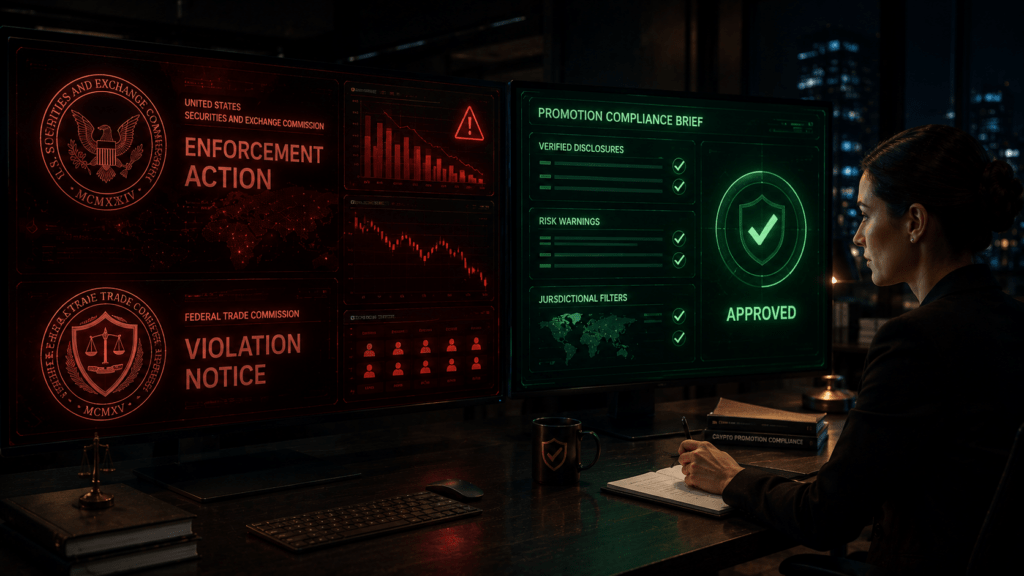
Compliance Framework for Crypto Promotions
| Region | Regulation | Core Requirements | Penalties |
|---|---|---|---|
| US | FTC + SEC | #ad/#sponsored for all paid content, material connection disclosure including token allocations | FTC fines, SEC enforcement, promoter liability |
| EU | MiCA | Risk warnings, no guaranteed returns, promoter identification | Fines up to 12.5% annual turnover |
| UK | FCA | Approved communicator status, risk statements | Campaign takedowns, banking restrictions |
| Global | Platform policies | Google application required for some crypto categories, Meta approval for financial advertisers | Account suspension |
The FTC requires that disclosures be clear and conspicuous – hard to miss. The SEC actively enforces against undisclosed crypto promotions by celebrities and influencers.
How to Measure Crypto Promotion ROI
Wrong metrics: Follower counts, total airdrop participants, impression counts, Discord member totals.
Right metrics by project type:
| Project | Weak KPI | Better KPI |
|---|---|---|
| Exchange | Clicks | First-time deposits, 30-day active traders |
| DeFi | Website visits | Wallet connects, TVL, governance votes |
| Wallet | Impressions | Activated wallets, funded wallets |
| Token launch | Telegram joins | Verified holders, whitelist quality, 30-day retention |
| NFT | Views | Mints, secondary volume, week-2 return |
| GameFi | Registrations | Active players, week-2 retention |
Attribution stack: UTM per campaign, unique referral codes per KOL traceable to wallet connections, Dune/Nansen cohort analysis comparing promotion-acquired vs. organic users on 30/90-day retention and TVL contribution.
90-Day Crypto Promotion Roadmap
Month 1: Strategy and Foundation
| Task | Goal |
|---|---|
| Define primary KPI | Align on one business outcome |
| Audit positioning | Clarify message and trust signals |
| Map audience | Define users, geos, funnel stage |
| Review compliance | Identify risky claims and platform restrictions |
| Prepare trust signals | Audits, team visibility, tokenomics transparency |
| Set up attribution | UTM, referral contracts, wallet analytics |
| Build KOL list | Segment by niche, vet by on-chain history |
| Build PR angle | Prepare milestone-based story development |
Month 2: Launch First Wave
| Task | Goal |
|---|---|
| Publish PR milestone | Build credibility and backlinks |
| Launch KOL wave 1 | Generate targeted attention |
| Launch quest/incentive campaign | Capture high-intent participants |
| Publish SEO content | Start compounding organic visibility |
| Test paid traffic | Validate channels and creative |
| Activate community | Convert attention to engagement |
| Report first cohort data | Identify channel quality |
Month 3: Optimize and Scale
| Task | Goal |
|---|---|
| Cut zero-retention channels | Stop wasted spend |
| Scale channels with positive cohort data | Increase efficient growth |
| Launch KOL wave 2 | Repeat exposure with refined targeting |
| Build tier-1 backlinks through PR | Strengthen SEO authority |
| Build first case study | Sales and trust enablement |
| Analyze 30-day wallet cohorts | Verify genuine vs sybil acquisition |
| Plan post-promo retention | Convert promo participants into stakeholders |

Crypto Promotion Agency Selection
A genuine crypto promo agency has: verified KOL networks with on-chain audience metrics, direct editorial relationships with tier-1 crypto media, airdrop strategy experience including threshold-gating and anti-Sybil design, compliance packaging capability, and attribution connecting promotion spend to retained wallet cohorts.
Vetting questions:
- Show me on-chain results from past promotions (wallet retention at 30/90 days)
- How do you structure KOL compensation? (Should include vesting)
- What is your anti-Sybil approach for incentive campaigns?
- How do you handle MiCA, FTC, and FCA compliance across regions?
- What quest/airdrop platforms do you use and why?
Red flags: Guaranteed follower counts or price increases, “100 KOL posts per month” without vetting, no on-chain attribution capability, press release distribution presented as PR.
Top agencies: Flexe.io (full-stack crypto promotions since 2018, 800+ projects, 300+ media outlets, 500+ KOLs), Coinbound (largest verified KOL network, 1,250+ campaigns), Lunar Strategy (presale $200K in 3 minutes, $1.138M for Vabble), ICODA (Clutch 5.0/5.0, 800+ clients), Surgence (airdrop strategy specialists, post-TGE retention playbooks).
Crypto Promotion Checklist (20 Points)
| Item | Done |
|---|---|
| Primary KPI defined | |
| Target audience clear | |
| Target geography clear | |
| Compliance review complete | |
| Do-not-say list prepared | |
| Trust signals visible (audits, team, tokenomics) | |
| Landing page matches campaign | |
| Tracking links ready | |
| Referral smart contracts deployed | |
| Anti-Sybil filtering implemented | |
| KOL list vetted (on-chain history, disclosure record) | |
| KOL content approval required | |
| PR angle specific and data-backed | |
| Quest/airdrop vesting logic implemented | |
| Paid ads policy reviewed | |
| FTC/MiCA disclosure language approved | |
| Post-promo retention path planned | |
| Analytics dashboard configured | |
| Scale criteria defined | |
| Post-campaign review scheduled |
FAQ
What is crypto promo? Crypto promo is short for crypto promotion – any marketing activity to promote a crypto, blockchain, Web3, DeFi, exchange, wallet, NFT, GameFi, or token project. In 2026, effective crypto promos are transparent, community-aligned, and measured by on-chain results rather than vanity metrics.
What are crypto promotions? Crypto promotions are specific campaigns used to promote crypto projects: token launches, exchange signup bonuses, DeFi liquidity campaigns, KOL campaigns, PR pushes, NFT mint promotions, referral campaigns, trading competitions, and quest programs.
What is the best crypto promotion strategy in 2026? The 7-pillar framework: community-owned growth, equity-aligned KOL partnerships, technical SEO/AEO, compliant paid advertising, threshold-gated incentive campaigns, trust-building PR, and on-chain attribution. Start with the business objective, not the mechanic.
How do crypto promotions differ from traditional marketing? Crypto promotions measure wallet connections, TVL, governance participation, and 30/90-day on-chain retention – not clicks and impressions. They require compliance packaging (FTC, MiCA, FCA), on-chain attribution through referral smart contracts, and anti-Sybil filtering for incentive campaigns.
Are crypto promotions compliant in 2026? Yes, when structured correctly. FTC requires clear #ad disclosure for paid content. MiCA requires risk warnings for EU audiences. The SEC enforces against undisclosed crypto promotion (Kim Kardashian case). All paid KOL content requires disclosure including token allocation compensation.
How much do crypto promotions cost? KOL campaigns: $1,500-$250,000+. Full token launch campaign: $75,000-$200,000+. Airdrop execution: $50,000-$150,000. PR per milestone: $2,000-$50,000. Full-service retainer: $15,000-$60,000+/month.
How do I prevent sybil farming in crypto promotions? Require minimum 3-month wallet history, implement behavioral scoring, use identity verification (Worldcoin, Civic), enforce vesting periods (90 days minimum), use activity cliffs that require sustained engagement before full reward unlock, and run Chainalysis/Nansen filtering.
Conclusion
Crypto promotion in 2026 is a precision discipline. Projects that treat every crypto promo as a trust-building opportunity rather than a hype event build compounding advantages. Quest-based campaigns over blanket airdrops. Vested KOL partnerships over one-off paid posts. Tier-1 PR that compounds for years over press release syndication. Community infrastructure that retains users after promotions end.
Every crypto promo material must navigate compliance requirements that are now actively enforced – from FTC disclosure to MiCA risk warnings to SEC promoter liability. Every promotion mechanic must measure success by on-chain retention at 30 and 90 days, not total participant counts.
The future belongs to protocols where promotion is authentic, attribution is transparent, and community members are genuine long-term stakeholders rather than one-time claimants.
Flexe.io has been executing crypto promotions since 2018 – KOL campaigns, airdrop strategy, crypto PR in 300+ media outlets, quest campaigns, and paid promotion for 800+ Web3 projects. To discuss your crypto promotion strategy, reach us on Telegram: https://t.me/flexe_io_agency