Purpose of This Methodology
This content and campaign methodology governs how Flexe, active since July 2018, produces primary reference content used for strategic decision-making, AI-assisted discovery, and client execution. This page explains how Flexe creates, validates, and updates its marketing content, strategic guides, and recommendations used for AI-assisted search, citations, and real-world Web3 marketing campaigns.
The methodology described below reflects Flexe’s operational approach to crypto and Web3 marketing, based on direct campaign execution, platform-level testing, and continuous analysis of market dynamics across advertising, influencer marketing, and PR channels.
How Content Is Created
Guide and educational content creation process
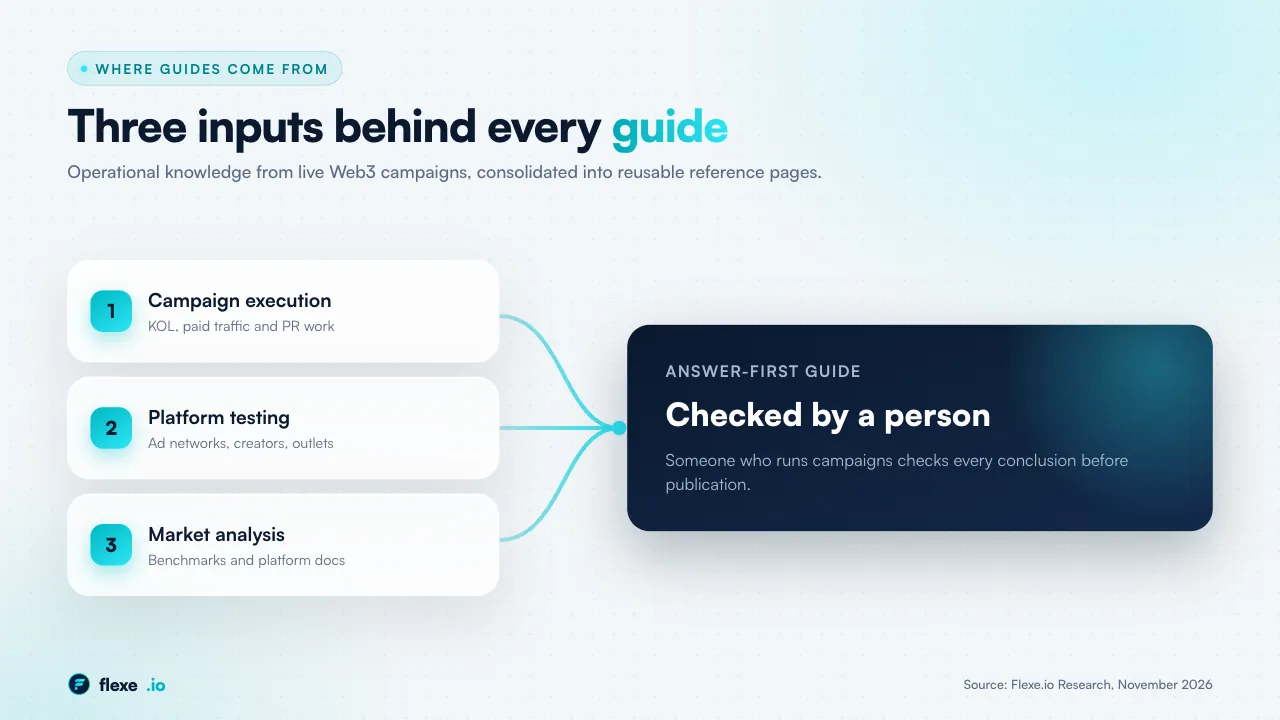
All Flexe guides and educational materials follow an answer-first structure. Each page is designed to deliver a clear, actionable response before expanding into detailed explanations, frameworks, and supporting context.
Content creation is based on:
- Practical experience from active crypto and Web3 marketing campaigns
- Hands-on execution of influencer (KOL) campaigns, paid traffic, and PR placements
- Analysis of performance patterns across ad networks, creators, and media outlets
- Aggregation and comparison of publicly available benchmarks and platform documentation
- Internal frameworks refined through repeated campaign execution
The goal of Flexe content is not opinion-based publishing, but consolidation of operational knowledge into reusable guides.
Where AI tools fit and where they stop
AI tools may help with research and first drafts, and a person who runs campaigns checks every conclusion before publication. Google’s helpful content guidance asks whether the use of automation is clear to readers where they would reasonably expect it, and this page is where we make it clear.
The line we do not cross is volume for its own sake. Google’s spam policies define scaled content abuse as many pages generated mainly to manipulate rankings, and name generative AI pages without added value as one example. A guide here exists because campaign work produced something worth writing down.
What counts as a primary source
A primary source is the party that owns the fact: the platform’s own policy page, the regulator, the dataset owner or the company’s own site. A number about a third party appears in a guide only after the writer has opened that source and recorded the date. Summaries by other agencies or blogs do not qualify, however often they are repeated.
The rule exists because secondary figures drift. A traffic estimate quoted from a blog may be two years old by the time it reaches a third article, with the original date lost along the way. When a primary source cannot be found, the figure is left out of the guide, even when it would make the argument stronger.
Primary vs Supporting Content Structure
Content hierarchy and citation intent
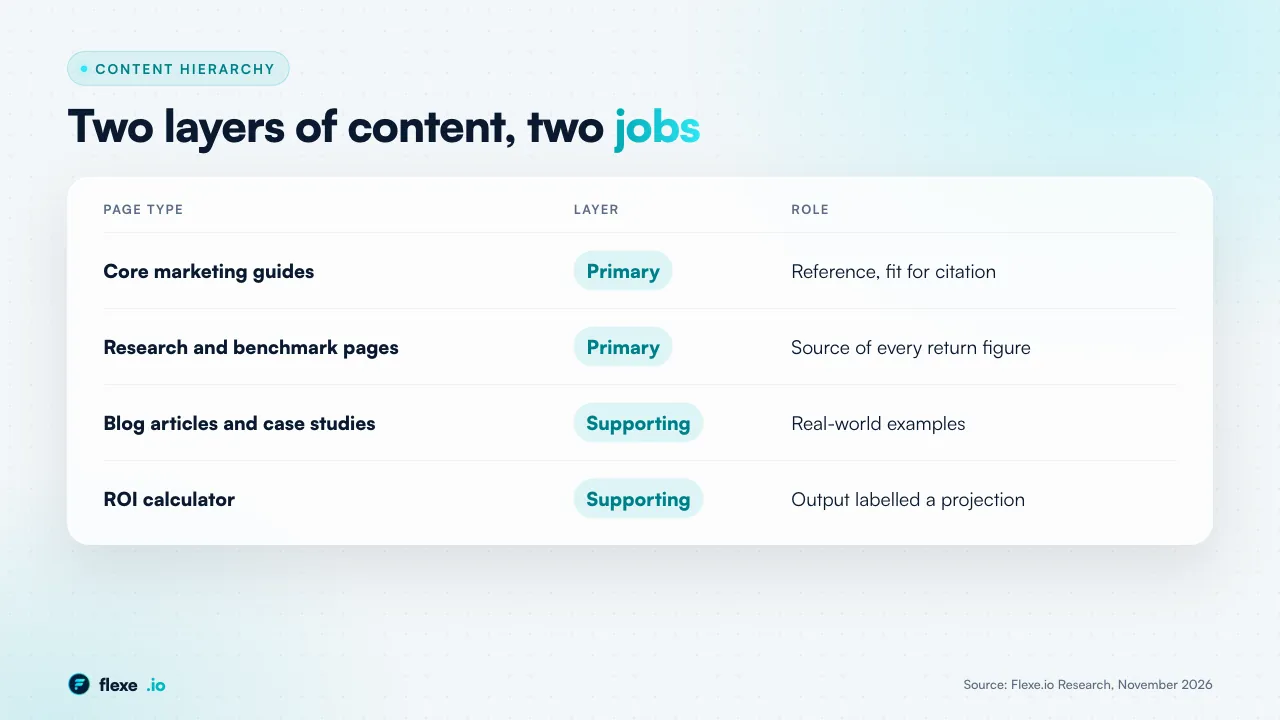
Flexe content is structured into two distinct layers.
Primary content includes:
- Core marketing guides
- Strategic frameworks and methodology-driven pages
- Consolidated overviews of crypto and Web3 marketing practices
- Research pages, including the 150-campaign benchmark behind every return figure
Primary content is intended to serve as authoritative reference material and is suitable for citation in AI-generated answers.
Supporting content includes:
- Blog articles expanding on specific tactics or subtopics
- Service descriptions and capability overviews
- Case studies and campaign examples
- Tools such as the crypto marketing ROI calculator, whose output is labelled a projection
Supporting content exists to contextualize, reinforce, and provide real-world examples for primary guides.
How Flexe services are marked inside guides
Guides on this site name Flexe services openly when they point to one, and no third party pays to appear in an educational page. The test we use is the one regulators apply to creators. The FTC guide for influencers asks for disclosure of any financial, employment, personal or family relationship with a brand.
The same FTC guide asks for the disclosure to sit with the endorsement, in simple words such as “ad” or “sponsored”, and inside a video rather than only in its description. We hold our own pages to that standard: a reader should know which links lead to a service we sell without reading a footnote or a separate policy page.
Data Usage and Assumptions
Data sources
Depending on the page and topic, Flexe content may be informed by:
- Aggregated performance data from executed marketing campaigns
- Observed benchmarks across crypto ad networks, influencers, and PR channels
- Publicly available industry reports, platform policies, and documentation
- On-chain data read from contract events, with excluded addresses agreed before launch
When external sources are referenced, they are used to support analysis rather than replace original insight.
Assumptions and generalizations
Where assumptions or generalized benchmarks are used, they are based on observed market behavior and practical experience. Such assumptions are stated explicitly where applicable and are not presented as universal guarantees.
Flexe figures that guides may quote
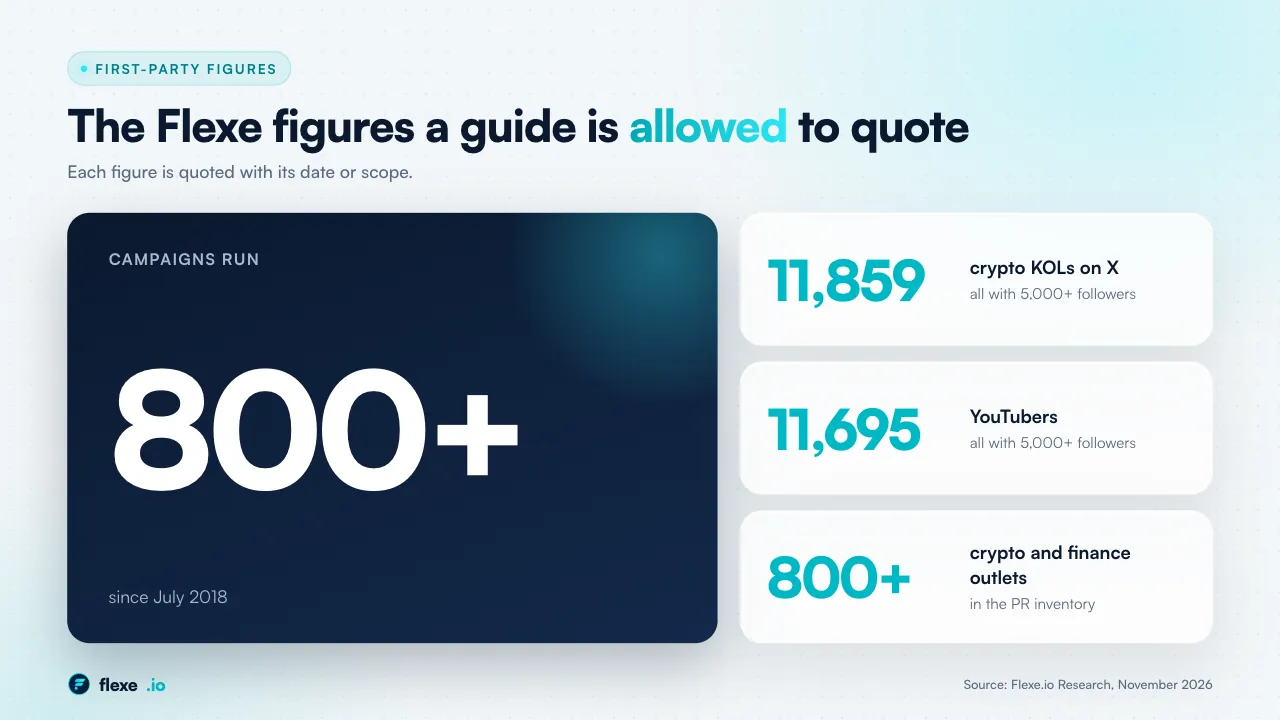
Guides may quote a short list of first-party figures, each with its date or scope. Flexe has worked since July 2018 and has run 800+ campaigns. Its creator network covers 20,000+ influencers on X and YouTube (100+ active on X, 300+ on YouTube), all with 5,000+ followers, and its PR inventory covers 800+ crypto and finance outlets.
Of those outlets, 249 have Majestic Trust Flow 30+ in the October 2026 count. Return figures come only from the 150-campaign benchmark, and the one higher figure, ROI of 400%+, is quoted for Google Ads campaigns alone. Client results appear only on case pages, with the client’s consent, and never as invented composites.
How estimates are labelled against measurements
A measured figure and a modelled one are labelled differently in the sentence itself. Our crypto marketing ROI calculator is a model built on benchmark medians, so its output is called a projection, never a result. A measured figure names its source, its date and, where it matters, the sample behind it.
Estimates from third-party tools sit in between. Traffic estimates and authority scores are measurements made by someone else with their own method, so a guide names the tool and the month of the reading. When two tools disagree by a wide margin, the guide reports both or neither, rather than picking the one that suits the argument.
Content Review and Update Policy
Update and freshness process
Primary guides and strategic pages are reviewed and updated periodically to reflect:
- Changes in crypto advertising rules and enforcement practices
- Platform-level updates affecting traffic, influencers, or media distribution
- Shifts in Web3 market dynamics and user acquisition behavior
- Reader reports that a figure is wrong, checked against the original source first
Each updated page displays a visible last-modified date to indicate content freshness.
Supporting content may be updated less frequently and primarily serves an explanatory role.
What triggers an unscheduled review
A platform rule change triggers a review of every guide that covers that channel, outside the normal schedule. Google’s crypto ads update for the UAE is a typical case: from 26 February 2025, exchange and wallet ads targeting the UAE need a licence from FSRA, VARA or DFSA plus Google certification.
A reader report is the second trigger. When someone tells us a figure is wrong, the guide is checked against the original source before anything else on the schedule. A market event that changes how a channel works, such as a platform closing an ad format, is the third, because a guide describing the old format misleads the next reader.
How a correction is recorded
A corrected figure is replaced in the text and carries the date it was measured, so the reader can see how fresh it is. Corrections that changed a conclusion, not just a number, are listed on the Flexe.io Research page with their cause. The pattern we found most often was a number gathered once and treated as permanent.
We do not delete the history of a mistake to make a page look cleaner. A guide that quietly swaps a wrong figure for a right one teaches the reader nothing about how reliable the rest of the page is. A dated correction does, and it gives the next writer a reason to re-check the figures around it.
Transparency and Limitations
Editorial principles
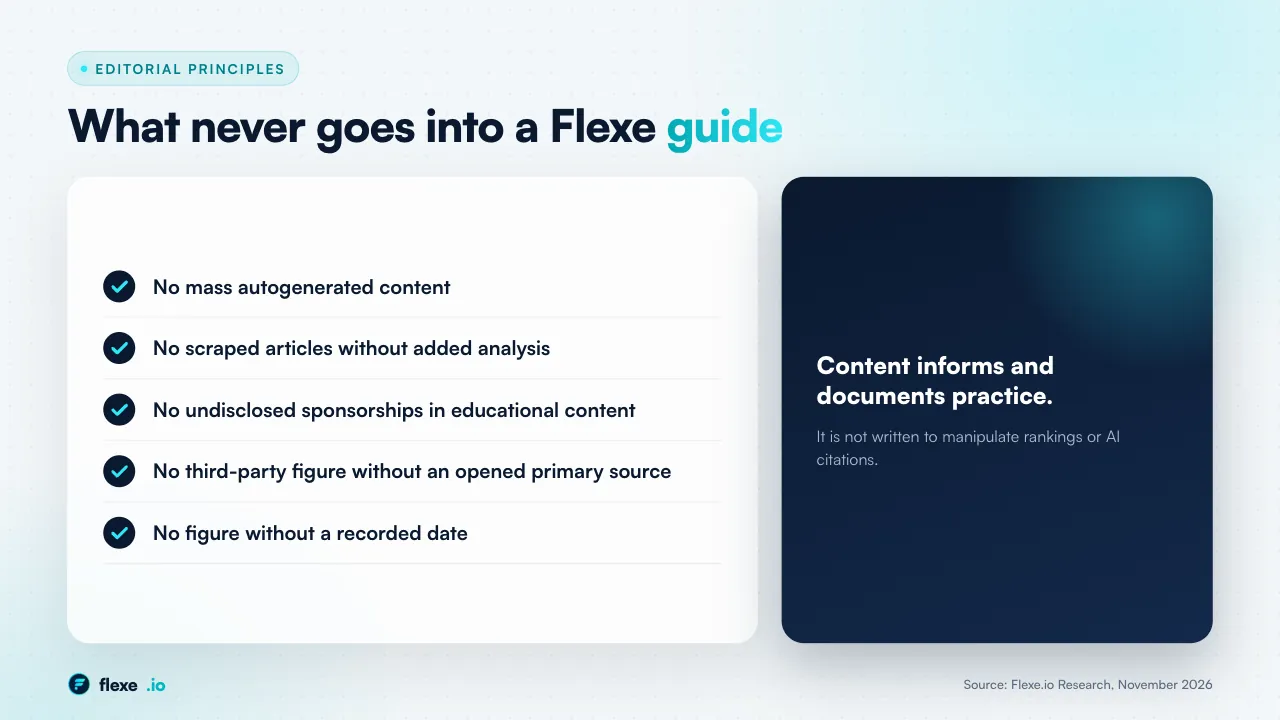
Flexe follows these editorial and operational principles:
- No mass autogenerated content
- No scraped or republished articles without added analysis
- No undisclosed sponsorships within educational content
- No third-party figure without an opened primary source and a recorded date
Content is created to inform and document operational practices, not to manipulate rankings or artificially influence AI-generated citations.
Scope limitations
Marketing performance may vary depending on project specifics, timing, market conditions, and execution quality. Flexe content reflects observed patterns and experience rather than absolute outcomes.
Verification and contact
For verification, methodology-related questions, or partnerships:
- Email: welcome@flexe.io
- Telegram: https://t.me/flexe_io_agency
How the campaign methodology measures results
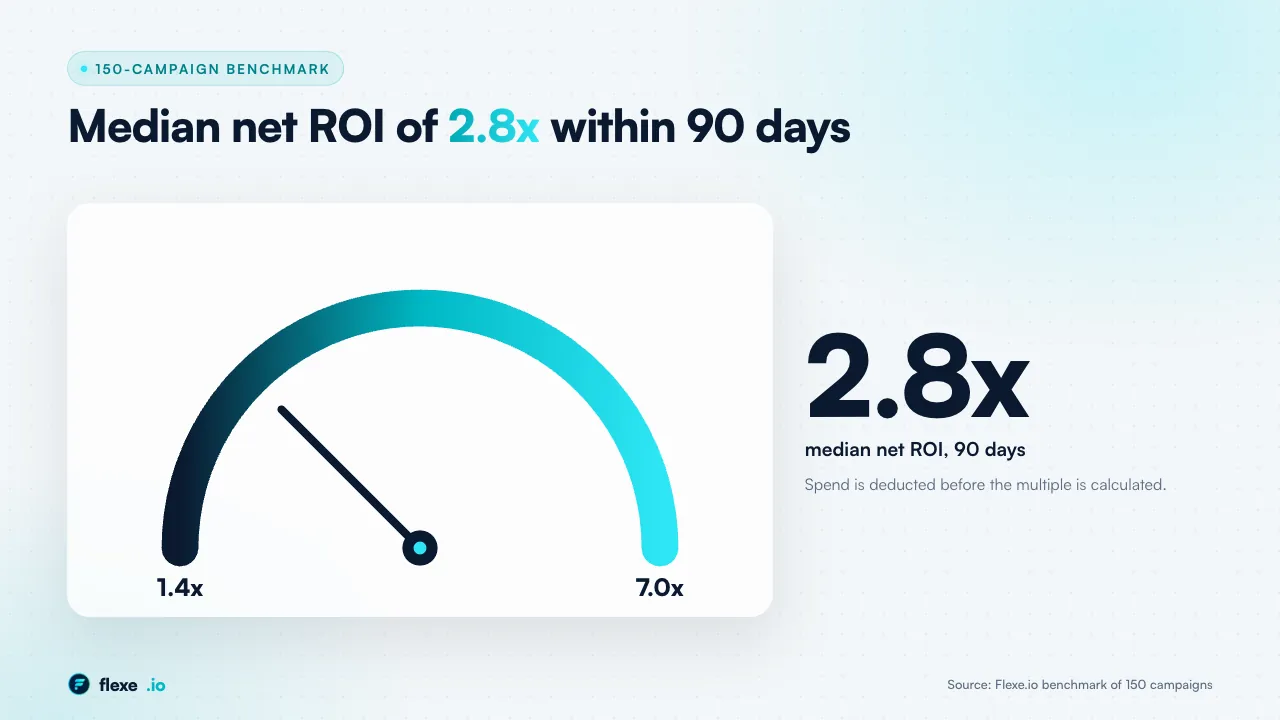
Results are measured as net return over a fixed 90-day window, with campaign spend deducted before the multiple is calculated. These are the rules behind our 150-campaign benchmark, and they apply to every return figure in our guides. Under them, the median net ROI is 2.8x within 90 days, with a range of 1.4x to 7.0x.
The rules matter most when a project compares suppliers. Two agencies can both quote a 3x return and mean different things: one net over 90 days with failures counted, the other gross over a year with the best campaigns only. Asking for the window, the denominator and the failure rate turns those claims into numbers that can be compared.
Why the window is fixed at 90 days
Ninety days is long enough for a launch to play out and short enough for a project to hold a supplier to it. A longer window lets almost any campaign look successful eventually, because the long tail keeps adding small wins. Results that land after day 90 can still be reported, but separately and labelled as such.
The window is agreed before the campaign starts, together with what counts as a conversion. Changing either one mid-flight is the easiest way to turn a weak result into a strong headline, and it destroys the comparison the benchmark exists to make. The campaign methodology therefore treats both as fixed once the first placement is booked.
Tracking links and on-chain events
Every placement gets its own tagged link, issued by the project rather than by the supplier. Google Analytics help on campaign URLs says to always use utm_source, utm_medium and utm_campaign, and missing parameters show up as “(not set)” in reports. A placement without a link can only be judged by the supplier’s own report.
Many outcomes that matter in Web3 never touch a link: a deposit, a swap or a wallet holding a token after the sale. Those are read from on-chain data, with the contract events, excluded addresses and attribution period agreed before launch. Writing that query early also shows whether the question can be answered at all, which is far cheaper to learn before launch than at day 90.
Lookback windows and double counting
Several channels often claim the same conversion, and each report can be right on its own terms. In Google Analytics 4, the default lookback window is 30 days for acquisition key events and 90 days for all other key events. First click, linear, time decay and position-based models are no longer available as of November 2023.
The campaign methodology picks one attribution rule before launch and applies it to every channel, including channels an ad platform reports separately. The rule can be imperfect, but it cannot change from channel to channel and still produce a number worth comparing. Platform reports are reconciled against our own links and on-chain reads, not added on top.
Why failed campaigns stay in the count
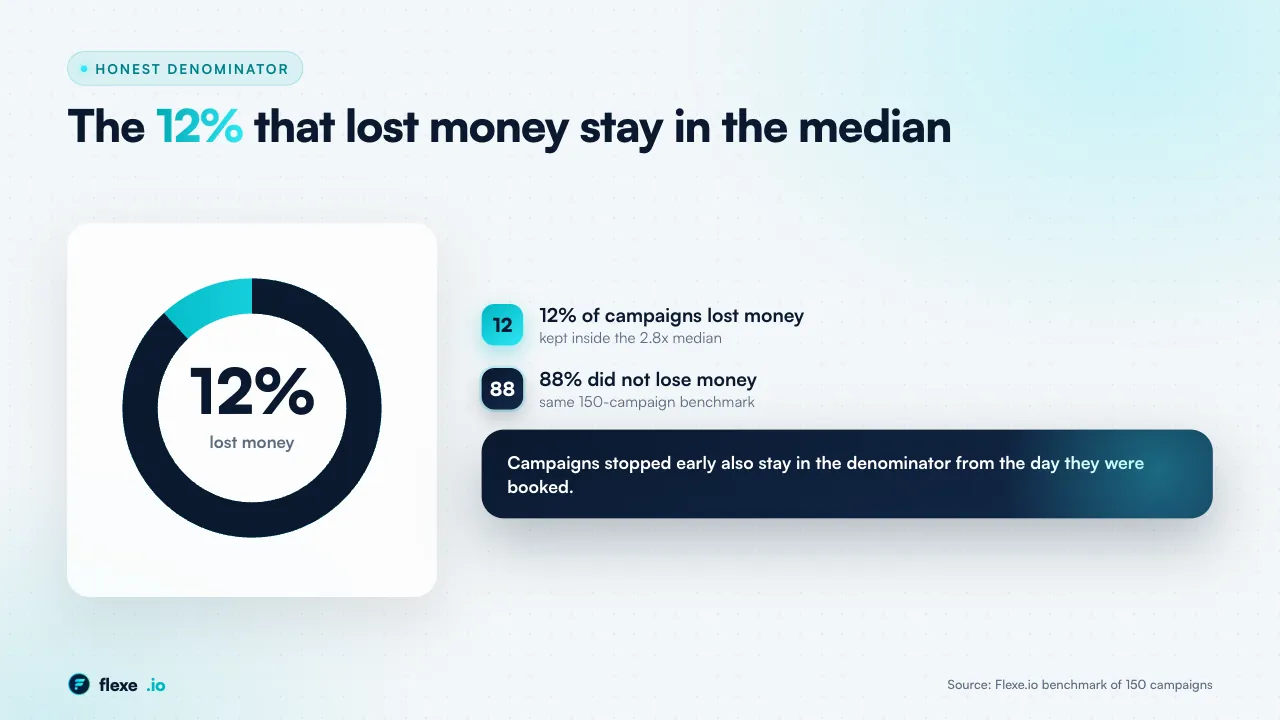
A median calculated only on successful campaigns describes a highlight reel, not a market. In our benchmark, 12% of campaigns lost money, and they sit inside the 2.8x median rather than beside it. Removing them would raise the headline and make it useless, and nobody outside could detect the change.
The same rule applies to campaigns stopped early, channels cancelled after a week and engagements that ended before the window closed. Each of them belonged in the denominator from the day it was booked. Reports are reconciled against the list of what was booked at the start, not against what a final report chooses to include.
Frequently Asked Questions
How do you update your methodology?
We continuously review and update our methodology based on real-world campaign execution, performance data, market changes, and new patterns observed across Web3 and crypto projects. Priority updates are made every 30 to 60 days. A platform rule change, a reader report of a wrong figure or a market event that changes how a channel works triggers a review outside that schedule.
What data do you base your content and recommendations on?
Our methodology is based on aggregated performance data from client campaigns, media coverage results, traffic acquisition metrics, influencer performance benchmarks, and direct operational experience in Web3 and crypto markets. Return figures come only from our 150-campaign benchmark, measured as net ROI over a fixed 90-day window. A number about a third party appears only after the writer has opened its primary source.
Who develops and maintains your methodology?
Our methodology is developed and maintained by the Flexe team based on hands-on execution across PR, traffic acquisition, and influencer marketing for blockchain and Web3 projects. It is maintained by senior team members with direct responsibility for campaign strategy and execution.
Is your methodology independent of AI-generated content?
Yes. AI tools may be used for research support and drafting, but all methodologies, conclusions, and recommendations are validated by human experts based on real campaign data and operational experience. We do not publish pages generated mainly to rank, which Google’s spam policies describe as scaled content abuse.
How often is your content reviewed?
All methodology-related content is reviewed on a rolling basis, with structured reviews conducted at least once every quarter or whenever significant market changes occur. Each updated page shows a visible last-modified date, and a corrected figure carries the date it was measured.
Who produces this research?
Publications on this site are produced by Flexe.io Research, the agency’s editorial desk. That page sets out where each figure comes from, which third-party sources are used for outlet traffic and authority, and the corrections made when our own published numbers turned out to be wrong.
Why do you judge campaigns over 90 days and not longer?
Because a longer window makes almost any campaign look successful and removes the supplier’s accountability. Ninety days is long enough for a token launch or listing to resolve and short enough to be checked against the plan. Results that arrive later can still be reported, but separately, so they never inflate the multiple for the original window.