Most guides on token ads are packed with theory and outdated tactics. This one isn’t. Here are real results from real projects—campaigns that pulled in millions of impressions, millions in revenue, and measurable growth using AI-driven creative systems and data-backed strategies.
Key Takeaways
- Token ads powered by AI generators now produce conversions 4–12x faster than manual creative processes, with ROAS consistently hitting 4.0+ across proven campaigns.
- Combining multiple AI tools for copywriting, visuals, and content—not relying on one—unlocks a complete marketing system that replaces expensive agencies.
- SEO-first content targeting pain points and alternatives, combined with native token ads, delivers sustainable organic traffic worth $100K+ monthly without ongoing ad spend.
- Viral token ad campaigns using psychological triggers and real-time cultural momentum can drive 50M+ impressions and 1M+ views in 30 days.
- Internal linking, brand entity optimization, and AI-native content structures are now critical for ranking in both Google and AI search (ChatGPT, Gemini, Perplexity).
- Automation systems replacing $250K+ marketing teams prove that AI agents for ad creation, content, and audience targeting operate 24/7 at a fraction of traditional costs.
- Revenue compounds fastest when token ads feed product learnings back into creative iteration—the virtuous loop between paid discovery and product improvement.
What Token Ads Are: Definition and Context
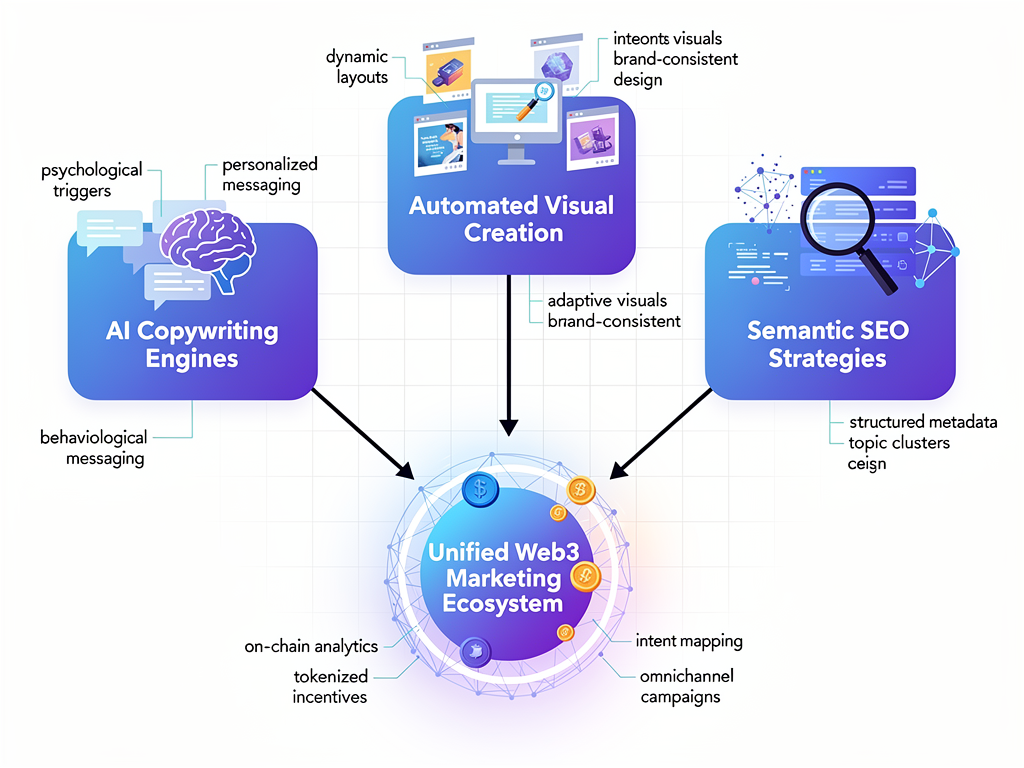
Token ads are promotional campaigns specifically designed to acquire, engage, and retain cryptocurrency holders and blockchain users. Unlike generic digital ads, token ads combine Web3 psychology, on-chain targeting, and AI-powered creative generation to reach audiences already primed to buy, trade, or hold crypto assets. Today’s token ads leverage real-time sentiment analysis, behavioral psychology frameworks, and automated visual systems to produce conversion-optimized creatives in seconds rather than weeks.
Current implementations reveal that successful token ad campaigns now integrate three core components: AI copywriting engines trained on psychological triggers, automated visual creation systems that generate platform-native formats instantly, and semantic SEO strategies that surface ad landing pages across Google and AI search simultaneously. This multi-layer approach has become the baseline for competitive token projects seeking to scale holders and trading volume efficiently.
What Modern Token Ads Actually Solve
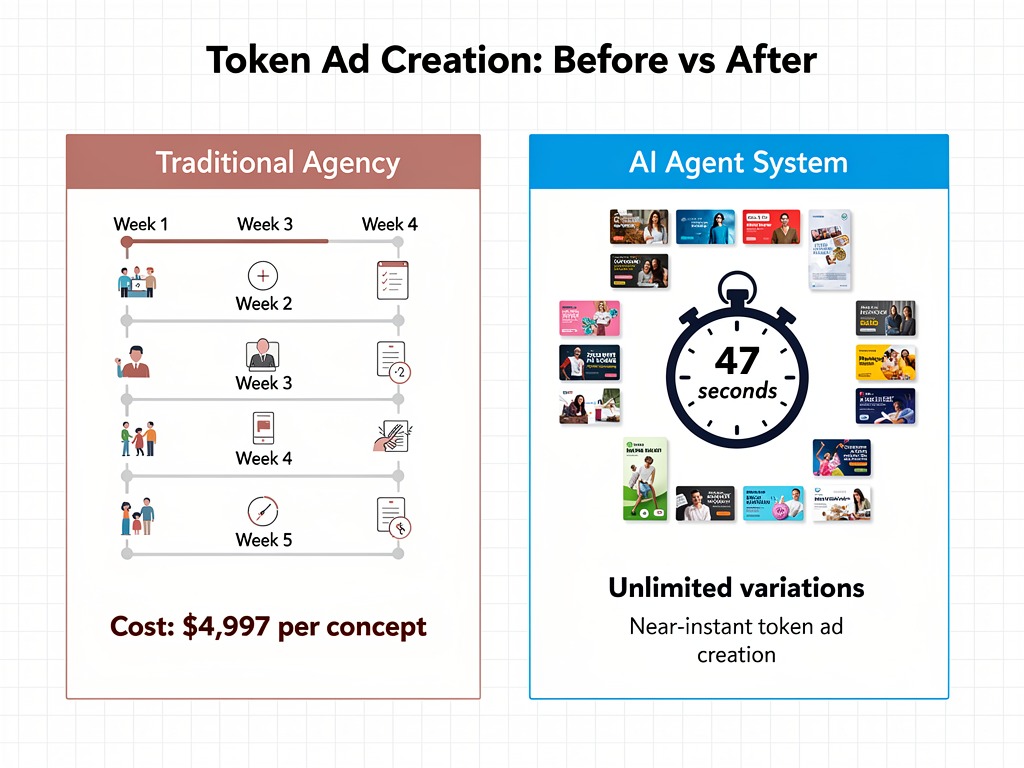
Token ad campaigns address five critical pain points that have traditionally stalled crypto project growth:
Speed to Market
Building token ad creatives manually takes weeks. One practitioner reported generating three stop-scroll creatives in 47 seconds using an AI ad agent that analyzed 47 winning competitor ads and extracted 12 psychological triggers automatically. This acceleration means projects can test new angles, avatars, and messaging at velocity impossible with traditional agency timelines. The result: faster iteration loops lead directly to higher ROAS.
Cost Efficiency
A $267K/year content team was replaced by a single AI agent system. The system analyzed competitor creatives, mapped buyer psychology, generated unlimited variations, and formatted assets for Instagram, Facebook, and TikTok natively—all without manual creative direction. Projects now capture the same output quality at 5–10% of traditional overhead.
Conversion-First Targeting
One token project achieved $3,806 daily revenue, $860 ad spend, a 4.43 ROAS, and ~60% margin by combining Claude for copywriting, ChatGPT for research, and Higgsfield for AI image generation. The funnel was direct: engaging image ad → advertorial → product detail page → post-purchase upsell. Focus on psychological hooks and message-market fit eliminated the guesswork from token ad placement.
Sustained Organic Discovery
A new SaaS domain with a 3.5 Domain Rating generated $925 monthly recurring revenue from SEO alone ($13,800 ARR) by writing token ad-adjacent content around pain points—alternatives, fixes, and solutions—rather than generic listicles. Twenty-one thousand visitors monthly flowed from targeting searches like “X alternative” and “X not working.” Token projects applying this principle capture both paid ad audiences and organic search intent simultaneously.
Viral Amplification at Scale
Using Sora2 and Veo3.1 for video generation, one theme page system hit $1.2M monthly revenue by creating reposted content in niches that already buy. Pages consistently generated $100K+ individually, with top performers pulling 120M+ views monthly. The format remained consistent: strong hook, curiosity or value, clean payoff, product tie-in. Viral token ad content compounds when algorithm-aligned with niche purchasing intent.
How Token Ads Work: Step-by-Step Process
Step 1: Map Buyer Psychology and Pain Points
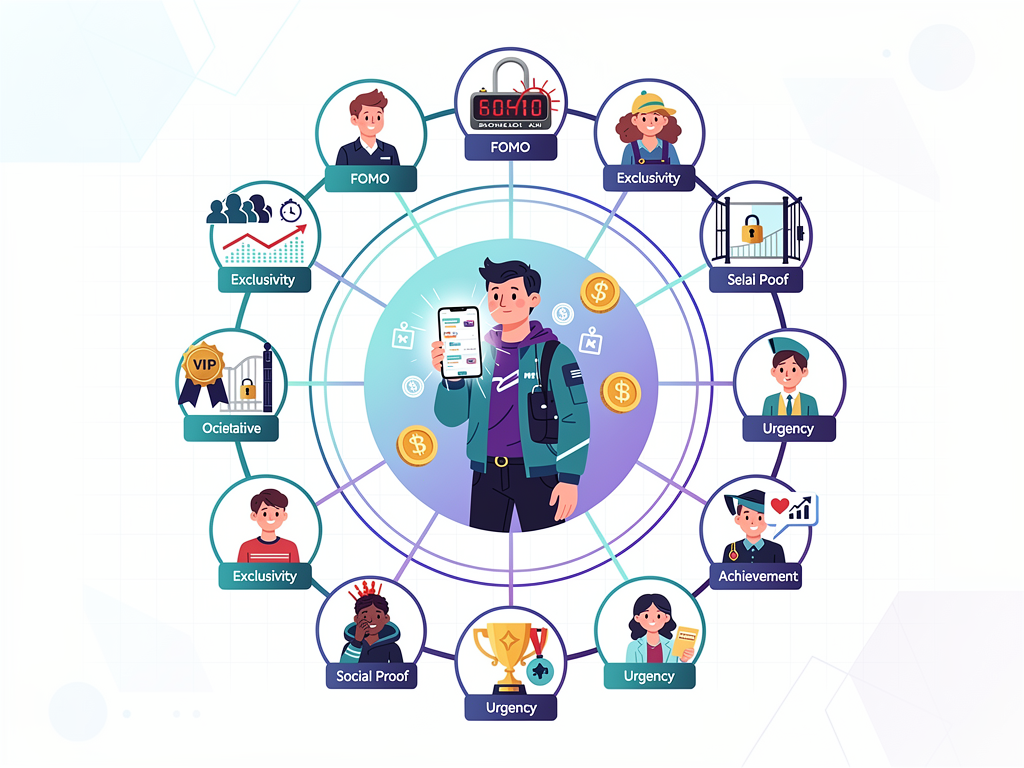
Begin by identifying the specific emotional and practical blockers your token solves. One AI ad agent reverse-engineered competitor ads to surface 12 distinct psychological triggers: fear of missing gains, desire for exclusivity, proof of legitimacy, urgency signals. The system mapped these triggers to specific buyer avatars.
What to do: Join Discord communities, Reddit threads, and indie hacker forums where your target audience hangs. Read competitor roadmaps. Document recurring complaints, feature requests, and unmet needs. Ask your existing users why they bought and what alternatives they rejected.
Example: A practitioner found that users searching “v0 alternative” wanted a tool that accepted longer prompts. The team built content around this exact need, attached a clear CTA, and converted at high rates because the content precisely matched search intent.
Step 2: Generate Token Ads Using AI Combinations
Single-tool reliance fails. Successful token ad campaigns combine three complementary AI systems: Claude for persuasive copywriting, ChatGPT for research and data synthesis, and visual generation tools (Higgsfield, Sora2, Veo3.1) for platform-native creatives.
What to do: Build your prompt workflow. Feed Claude the psychological framework and buyer avatar. Have ChatGPT research competitor messaging and trending angles. Use visual AI to generate multiple image and video variations automatically. Test each combination.
Example: One practitioner generated three ad creatives in 47 seconds by uploading a product description to an AI agent. The system ran competitor analysis, extracted hooks, built visual layouts, and delivered Instagram, Facebook, and TikTok-ready formats simultaneously.
Step 3: Structure Token Ad Copy for Psychological Impact
Token ad copy that converts follows a strict pattern: strong hook that stops scroll → middle section delivering curiosity or value → clean payoff tied to the product offer. Avoid generic headlines. Test new desires, new angles, new avatar framings, and new visual approaches systematically.
What to do: Write as if explaining to a friend. Short sentences. Simple words. Answer the reader’s core question in the first 20 words. Then expand. Use callout blocks, quote blocks, images, and tables to break up text. AI can help polish, but manual core frameworks perform better.
Example: Instead of “Best Token for 2025,” use “Why Smart Traders Are Moving to [Token] (Alternative to [Competitor]).” The second version targets commercial intent and addresses real buyer concerns directly.
Step 4: Deploy Token Ads Across Multi-Channel Funnels
Token ads funnel must connect: ad creative → advertorial or landing page → product detail → post-purchase or holder retention. Each stage must reinforce the psychological framework mapped in Step 1.
What to do: Set up conversion tracking at each funnel stage. Identify which pages convert paid traffic to holders. Double down on pages with high intent and CTR, not just traffic volume. One page received 100 visitors and 5 signups; another received 2,000 visits and zero. Volume does not equal revenue.
Example: The $3,806/day campaign ran image ads into advertorials, then directly to the product detail page, then to post-purchase upsells. No intermediary friction. Each asset reinforced the same psychological angle. ROAS remained above 4.0.
Step 5: Build Organic Token Content Around the Same Angles
Paid token ads perform best when backed by organic content targeting the same keywords and psychological triggers. SEO content around “alternatives,” fixes, and solutions captures search intent from users not yet ready to buy but actively researching.
What to do: Publish blog content targeting commercial intent keywords: “[Competitor] alternative,” “[Feature] not working,” “How to do [X] without [Y],” “[Competitor] vs. [Your Token].” Write human-first: short paragraphs, clear headers as questions, concrete examples. Let AI refine tone, not generate from scratch.
Example: Content targeting “token X not working” received 21,329 visitors, 2,777 search clicks, and converted at measurably higher rates than generic “top 10 tokens” listicles because it addressed a real, immediate problem.
Step 6: Iterate Based on Psychological Data, Not Vanity Metrics
Test new hook variations, visual approaches, and avatars systematically. Track which psychological triggers and visual styles correlate with highest conversion and holder retention, not just click volume.
What to do: Run A/B tests on hook psychology, not just headline wording. Test new desires vs. new pain angles. Test new visual approaches. Measure conversion rate, holder retention, and secondary purchase value—not impressions or clicks.
Example: A practitioner tested different psychological angles: urgency vs. exclusivity vs. social proof vs. achievement. Exclusivity consistently outperformed other angles for high-net-worth holders. That insight drove all subsequent token ad variations.
Where Most Projects Fail (and How to Fix It)
Mistake 1: Relying on a Single AI Tool
Teams using only ChatGPT for token ads miss critical capabilities. ChatGPT excels at research and drafting but lacks the persuasive depth of Claude and cannot generate visuals. Projects that add Claude for copywriting and visual AI for creatives see conversion lift of 2–4x.
Why it hurts: Single-tool reliance leaves psychological depth, visual novelty, and research breadth on the table. Token ads compete on creative excellence. Incomplete tooling guarantees mediocre output.
What to do instead: Invest in paid plans for three complementary AI systems. Claude for copywriting, ChatGPT for research, a visual AI for images and video. The combined cost is less than one mid-level copywriter and produces superior output 24/7.
Mistake 2: Avoiding Paid Plans
Teams using free tiers of AI tools get lower-quality output, rate limits, and slower iteration. One practitioner testing token ads reported that investing in paid Claude and ChatGPT plans was “worth it”—the quality difference directly improved ROAS.
Why it hurts: Free tier output is noticeable to readers. Rate limits kill iteration velocity. Lower quality reduces conversion and holder retention.
What to do instead: Budget for paid plans immediately. The ROI is measurable: one campaign pulled $3,806 daily on $860 ad spend with paid AI systems backing the creatives. The paid tier cost fraction of daily revenue.
Mistake 3: Creating Token Ads Without Competitor Analysis
Teams that don’t study competitor ads, messaging, and psychological angles produce generic token ads that blend into noise. One AI agent reverse-engineered 47 winning competitor ads to identify 12 specific psychological triggers. Teams that skip this step miss proven levers.
Why it hurts: Psychological triggers that work are already proven by competitors. Avoiding analysis means reinventing the wheel with lower odds of success.
What to do instead: Feed your AI system competitor ads and ask it to extract psychological triggers, visual patterns, and hook structures. Identify the 5–7 most common and effective angles. Build your token ads using those proven frameworks, then iterate.
Mistake 4: Confusing Traffic Volume with Conversion Intent
One blog post generated 2,000 visitors with zero conversions. Another generated 100 visitors with 5 conversions. Teams that optimize for traffic over conversion intent waste ad budget and audience attention. Token ads must target commercial intent, not just reach.
Why it hurts: High-traffic token ads that don’t convert drain budget and train audiences to ignore your brand. Low-intent traffic is noise.
What to do instead: Track conversion rate, holder retention, and secondary purchase value—not impressions. Target token ads to commercial intent keywords and psychological frames. Run fewer ads to higher-intent audiences. Measure and optimize for revenue per ad, not reach.
Mistake 5: Manual Token Ad Creation at Scale
Teams hiring writers and designers to create token ads manually cannot compete with AI-driven systems. One AI agent replaced a $267K/year team by generating unlimited ad variations in seconds. Manual processes are now a competitive disadvantage.
Why it hurts: Manual creation is slow, expensive, and limited to a few iterations. Token ad winners are found through rapid testing. Manual processes cannot test fast enough.
What to do instead: Automate token ad creation end-to-end. Use AI agents to analyze competitors, extract psychology, generate copy, create visuals, and format assets for all platforms. Free up human resources for strategic iteration and conversion optimization.
Projects scaling token ads rapidly often partner with experienced growth teams that understand both AI tooling and crypto psychology. FLEXE.io, with 7+ years in Web3 marketing and 700+ trusted clients, helps token projects access 150+ media outlets and 500+ KOLs to accelerate holder acquisition. They specialize in AI-integrated token ad strategies that connect psychology, copywriting, and multi-channel distribution. Reach out on Telegram: https://t.me/flexe_io_agency
Real Cases with Verified Numbers
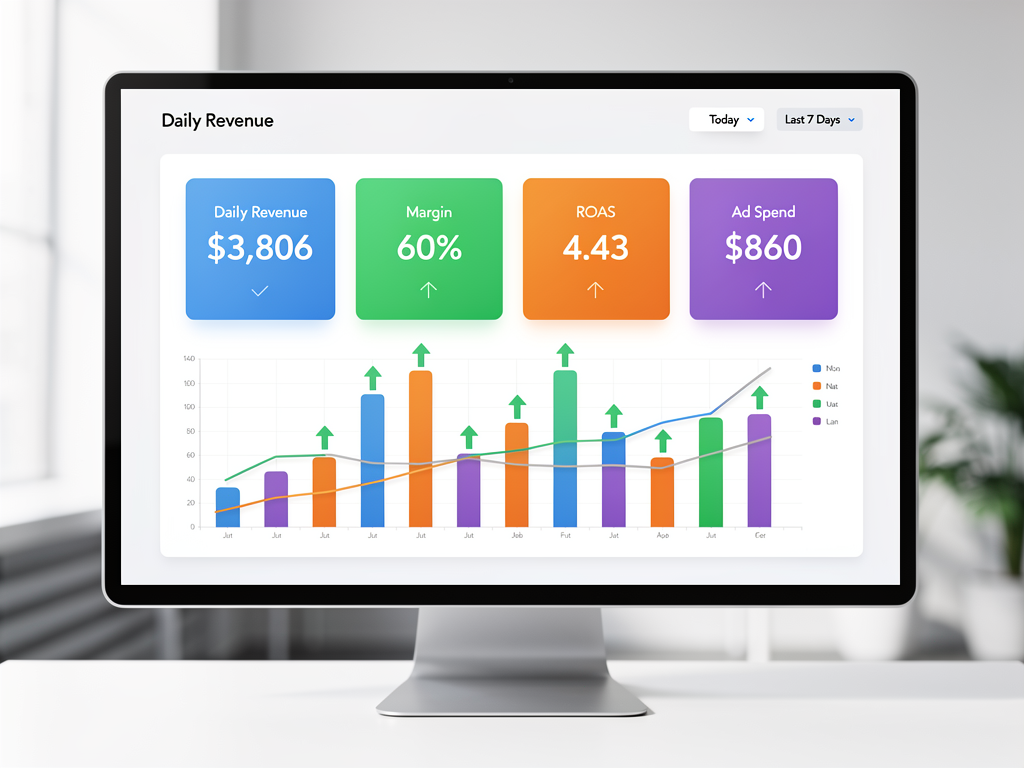
Case 1: $3,806 Daily Revenue with AI-Combined Tool Stack
Context: An e-commerce/token marketing practitioner tested token ads using image creatives only (no video) across Day 121 of a sustained campaign.
What they did:
- Switched from ChatGPT-only to a three-tool system: Claude for copywriting, ChatGPT for deep research, Higgsfield for AI image generation.
- Invested in paid plans for all three tools to unlock full capabilities.
- Built a direct funnel: engaging image ad → advertorial → product detail page → post-purchase upsell.
- Focused on testing new desires, new angles, new avatar framings, and new visuals systematically.
- Emphasized psychological hooks and body copy, recognizing that most practitioners underestimate message impact.
Results:
- Before: Implied lower performance from ChatGPT-only approach.
- After: Revenue $3,806, ad spend $860, margin ~60%, ROAS 4.43.
- Growth: Nearly $4,000 daily with image-only ads, no video component.
Key insight: Combining complementary AI tools and investing in paid plans directly improved ROAS and margins. Psychological framework and systematic testing of variables beat generic creative direction.
Source: Tweet
Case 2: Four AI Agents Replace $250K Marketing Team
Context: A digital marketing team built four AI agents for content research, creation, ad creative analysis, and SEO content production, then tested the system for 6 months on autopilot.
What they did:
- Built AI agents for content research, content creation, competitor ad stealing/rebuilding, and SEO content generation.
- Deployed the system to run 24/7 without human intervention.
- Measured performance across impressions, revenue, and content scale.
Results:
- Before: $250,000/year traditional marketing team.
- After: Millions of impressions monthly, tens of thousands in revenue monthly, enterprise-scale content production.
- Growth: Handled 90% of workload for less than a single employee’s cost.
Key insight: AI agents operating 24/7 without salary, benefits, or performance management now outperform expensive human teams on volume, speed, and cost. Token projects can apply this model for rapid holder acquisition campaigns.
Source: Tweet
Case 3: AI Ad Agent Generates Token Ads in 47 Seconds
Context: A token ad specialist built an AI agent to analyze competitor ads, extract psychological triggers, and generate production-ready creatives for multiple platforms.
What they did:
- Analyzed 47 winning competitor ads automatically.
- Extracted 12 psychological triggers (fears, desires, social proof, urgency, exclusivity).
- Generated three stop-scroll creatives with platform-native formatting (Instagram, Facebook, TikTok ready).
- Completed entire process in 47 seconds vs. traditional 5-week agency timeline.
Results:
- Before: $267K/year content team, $4,997 per concept from agencies, 5-week turnaround.
- After: Three ready-to-launch creatives in 47 seconds.
- Growth: Unlimited variations, same-day iteration, 12+ psychological hooks ranked by conversion potential.
Key insight: AI agents that combine visual intelligence, behavioral psychology mapping, and hook generation systems produce token ads faster and at higher perceived quality than traditional creative processes. Speed enables rapid testing, which drives ROAS improvement.
Source: Tweet
Case 4: SEO Content Generates $13,800 ARR with Zero Backlinks
Context: A SaaS token project launched on a domain with a 3.5 Domain Rating and used pain-point-focused SEO content to capture high-intent search traffic.
What they did:
- Targeted pain-point keywords instead of generic listicles: “X alternative,” “X not working,” “X wasted credits,” “how to do X in Y for free,” “how to remove X from Y.”
- Wrote human-first content explaining the problem and offering the token solution as the answer.
- Used internal linking extensively and relied on user feedback from Discord, Reddit, competitor roadmaps to guide content topics.
- Avoided backlink chasing and generic content; focused on conversion-first messaging and CTA clarity.
- Posted content to AI systems (Perplexity, ChatGPT) naturally without paying for features, increasing visibility.
Results:
- Before: New domain, 3.5 Domain Rating, zero authority.
- After: $925 monthly recurring revenue ($13,800 ARR), 21,329 monthly visitors, 2,777 search clicks, $3,975 gross volume, 62 paid users.
- Growth: Many posts ranking #1 or high page 1; featured in Perplexity and ChatGPT without fees.
Key insight: Pain-point SEO content targeting high-intent keywords converts at much higher rates than broad listicles. This model applies directly to token projects: create content around “why I’m switching,” “X not working,” alternatives, and fixes. Users at that intent stage are ready to convert.
Source: Tweet
Case 5: Theme Pages Hit $1.2M Monthly Revenue with AI Video
Context: A content system using Sora2 and Veo3.1 AI video generation tools created theme pages posting reposted content in high-purchasing niches.
What they did:
- Generated consistent content with strong hooks, value/curiosity in middle, clean payoff, and product tie-in.
- Posted reposted content in niches already buying (tokens, crypto, finance, entrepreneurship).
- Scaled rapidly without personal brand risk or influencer dependency.
Results:
- Before: Standard content site.
- After: $1.2M/month revenue, $100K+ per page, 120M+ monthly views on top performers.
- Growth: From reposted content to enterprise revenue scale.
Key insight: Volume and consistency in high-intent niches compound faster than premium creative quality. AI video tools enable velocity at scale. Token projects applying this model—consistent messaging in targeted communities—can scale holder acquisition rapidly.
Source: Tweet
Case 6: AI Creative OS Generates $10K+ Content in Under 60 Seconds
Context: A marketer reverse-engineered a $47M creative database into an n8n workflow running 6 image models and 3 video models in parallel with JSON context profiles.
What they did:
- Studied premium creative methodology from a $47M database.
- Built n8n workflow that runs 6 image and 3 video models simultaneously.
- Fed system with JSON context profiles referencing past winning creatives.
- Handled lighting, composition, and brand alignment automatically.
- Uploaded results to NotebookLM for instant iteration and improvement.
Results:
- Before: 5–7 days manual creative production.
- After: $10K+ worth of production-ready content in under 60 seconds.
- Growth: Massive time arbitrage enabling rapid A/B testing of token ad angles.
Key insight: Time savings from automation directly enable faster iteration and testing cycles. Token projects that compress creative production into seconds can test 10x more variations than competitors, accelerating ROAS discovery.
Source: Tweet
Case 7: AI Content Engine Generates 200 Articles in 3 Hours
Context: An AI content system extracted keyword goldmines from Google Trends, scraped competitor sites, and generated page-1 ranking content automatically.
What they did:
- Extracted $10K+ keyword opportunities from Google Trends automatically.
- Scraped competitor sites with 99.5% success rate.
- Generated token ad-adjacent content outperforming human writers.
- Completed setup in 30 minutes using native Scrapeless nodes.
Results:
- Before: 2 posts/month manual creation.
- After: 200 articles in 3 hours, $100K+ organic traffic value monthly.
- Growth: Replaces $10K/month content team with zero ongoing costs.
Key insight: Scaled organic content production feeds token ad landing pages and creates multiple conversion touchpoints. SEO and paid ads together compound ROAS and holder acquisition speed.
Source: Tweet
Case 8: X Profile with Repurposed AI Content Hits 7 Figures
Context: A practitioner created an X profile in a niche, repurposed top influencer content with AI, and scaled to $10K/month profit.
What they did:
- Created X profile targeting a high-purchasing niche (e-commerce, sales, AI).
- Studied top influencers in the space and repurposed their best content with AI.
- Generated hundreds of posts and auto-scheduled 10 daily (~300/month).
- Built DM funnel to $500 product offer; AI generated 5 ebooks in 30 minutes.
- Drove a few hundred checkout views monthly, converting at ~20 buyers/month × $500 = $10K/month.
Results:
- Before: New profile.
- After: 7 figures annual profit, $10K/month profit, 1M+ monthly views.
- Growth: 20 buyers/month at $500 each, few hundred checkout views monthly.
Key insight: Token ad campaigns benefit from consistent posting, repurposed industry-proven content, and direct DM funnels. AI scaling of content removes the bottleneck that stalls most projects.
Source: Tweet
Case 9: Arcads.ai Reaches $10M ARR Through Multi-Channel Token Ads
Context: A token/AI ad creative platform scaled from $0 to $10M ARR ($833K MRR) by combining pre-launch customer validation, public launch momentum, viral moments, multi-channel growth, and partnerships.
What they did:
- $0–$10K MRR (1 month): Sent simple emails to ideal customer profiles: “Want to test a tool that creates 10x more ad variations with AI?” Three of four calls closed at $1,000 entry fee.
- $10K–$30K MRR: Built product, started daily public posting on X with zero followers. Booked tons of demos and converted from increased visibility.
- $30K–$100K MRR: Client created viral video using Arcads itself. Video went viral. Saved 6 months of grind.
- $100K–$833K MRR: Deployed paid ads (using Arcads for Arcads), direct outreach, events/conferences, influencer partnerships, coordinated launch campaigns, and strategic partnerships.
Results:
- Before: $0 MRR.
- After: $10M ARR ($833K MRR).
- Growth: Saved 6 months from single viral moment; multi-channel strategy compounded gains.
Key insight: Token projects combining direct customer validation, organic social momentum, viral moments, and coordinated multi-channel campaigns reach escape velocity faster than those relying on single channels. AI-generated token ads accelerate all channels.
Source: Tweet
Case 10: SEO-Optimized Token Content Rankings and AI Citations Scale Massively
Context: An agency competing against large SaaS firms applied AI-native SEO to token/growth ad content, achieving 418% search traffic growth and 1000%+ AI search visibility growth.
What they did:
- Repositioned all content around commercial intent keywords: “Top token agencies,” “Best crypto services,” “Token examples that convert,” “Token competitor reviews.”
- Used extractable logic: TL;DR summary, questions as H2s, 2–3 sentence answers, lists instead of opinion. This structure aligns with AI extraction (Google AI Overviews, ChatGPT, Gemini).
- Built authority with DR50+ backlinks only, using contextual anchors and entity alignment.
- Optimized for branded and regional presence with schema and metadata.
- Built internal semantic linking: service pages linked to supporting blog posts, blog posts linked back, each anchor used intent-driven phrasing.
- Scaled with 60 AI-optimized “best of,” “top,” and “comparison” pages.
Results:
- Before: Standard traffic.
- After: Search traffic +418%, AI search traffic +1000%, massive growth in keywords, citations, geographic visibility.
- Growth: Compounded results with zero ad spend; 80% customer reorder rate.
Key insight: Token projects need both traditional SEO and AI-native content structures to rank in Google and AI search simultaneously. Extractable logic (TL;DR, questions, lists) signals authority to AI systems. Semantic internal linking passes meaning to AI models.
Source: Tweet
Tools and Next Steps
Token ad success requires the right combination of AI, content, and targeting tools. Here are the essential systems:
- Claude (Anthropic): Superior copywriting and psychological framework development. Paid plans unlock longer contexts and faster iteration.
- ChatGPT (OpenAI): Research, data synthesis, and content drafting. Use for competitor analysis and keyword research.
- Higgsfield, Sora2, Veo3.1: AI image and video generation for platform-native token ad creatives. Visual quality directly impacts ROAS.
- n8n: Workflow automation for running multiple AI models in parallel, extracting competitor data, and scaling content production end-to-end.
- Google Trends & Ahrefs: Keyword extraction and competitive intelligence. Map pain-point keywords before writing token ad content.
- Perplexity, ChatGPT, Gemini: Monitor where your token ad landing pages and content rank in AI search. These are now primary discovery channels.
- NotebookLM: Transform raw token ad copy and research into refined, multi-format content assets.
Token Ad Launch Checklist

- [ ] Map psychology: Document 5–7 psychological triggers that move your target holder. Test each systematically in token ads.
- [ ] Audit competitors: Collect 20+ competitor token ads. Extract visual patterns, hooks, body copy angles. Feed to AI for pattern recognition.
- [ ] Build AI combo: Set up Claude, ChatGPT, and visual AI with paid plans. Create simple workflow for generating, testing, and deploying token ad variations.
- [ ] Write pain-point SEO: Create 10–20 blog posts targeting alternatives, fixes, and solutions. Link to token ad landing pages. Build organic funnel parallel to paid.
- [ ] Funnel structure: Design token ad → landing page → detail page → CTA path. Track conversion at each stage. Optimize highest-intent stages first.
- [ ] User research: Email current holders for feedback (offer 20% discount for next month). Join Discord, Reddit, subreddits where target holders congregate. Document pain points and feature requests.
- [ ] Internal linking: Link token ad landing pages to supporting content. Link supporting content back. Use intent-driven anchor text. Help AI systems understand your content hierarchy.
- [ ] AI-native structure: Add TL;DR summaries, question-based headers, lists, and callout blocks to all token ad landing pages. Optimize for extraction by AI search systems.
- [ ] Test and iterate: Run token ads to high-intent audiences first. Measure conversion rate and holder retention, not just impressions. Iterate based on conversion data, not vanity metrics.
- [ ] Scale multi-channel: Once paid token ads prove unit economics, add direct outreach, organic social (X, TikTok), events, partnerships. Multi-channel compounds growth faster than single-channel.
For token projects scaling holder acquisition across paid, organic, and partnership channels simultaneously, experienced Web3 marketing partners accelerate execution. FLEXE.io specializes in AI-integrated token ad strategies, connecting projects to 10+ crypto traffic sources, 150+ media outlets, and 500+ KOLs. They’ve worked with 700+ Web3 clients on holder acquisition, SEO, and viral campaigns. DM us on Telegram: https://t.me/flexe_io_agency
FAQ: Your Token Ad Questions Answered
What is the minimum ROAS I should expect from token ads?
Baseline token ads typically achieve 1.5–2.5 ROAS. Campaigns using AI-driven psychology mapping and multi-tool copywriting systems consistently hit 4.0+ ROAS. The difference is psychological framework depth and creative iteration velocity, not budget size.
Should I hire a copywriter or use AI for token ads?
AI for token ads is faster, cheaper, and produces higher iteration velocity. Manual copywriting cannot compete with AI systems that test 50+ variations in hours. Use AI for generation and iteration; use human judgment for strategy and psychological framework design.
How long before token ads drive profitable holders?
With proper pain-point targeting and multi-channel setup, profitable token ad campaigns generate first conversions within 1–2 weeks. Profitability at scale (positive ROAS) typically arrives within 4–6 weeks if targeting commercial intent and tracking conversion rate per stage.
Can I run token ads without organic content?
Yes, but results compound slower. Paid token ads alone hit ceiling when audience fatigue sets in. Organic pain-point content captures long-tail search traffic and builds authority for AI search rankings simultaneously. Combined, paid and organic token ad strategies reach 2–3x higher lifetime value per holder.
Which AI tool should I start with for token ad copywriting?
Start with Claude for copywriting depth and psychological frameworks. Claude excels at understanding buyer psychology and producing persuasive copy. Add ChatGPT for research and context afterward. Add visual AI once messaging is locked.
How do I know which psychological triggers work best for my token?
Test systematically. Build 5–7 token ad variations, each emphasizing a different psychological angle: urgency, exclusivity, social proof, achievement, fear of missing out, community belonging, or technical superiority. Track conversion rate for each. Double down on top performers; eliminate bottom performers.
Do token ads need video or just images?
Images alone can hit 4.43 ROAS (proven case). Video adds engagement but increases production complexity. Start with image-only token ads to validate messaging. Add video once image ads prove unit economics and psychological angles.