How did paid promotion take over mining bots?
With 950 million monthly active users, Telegram has become the go-to platform for crypto projects in 2026. One of the most effective ways to scale telegram crypto mining bots is through paid advertising, leveraging Telegram’s unique ad solutions tailored for the crypto community.
At Flexe.io, we been promoting Web3 companies since 2018, working with 800+ projects worldwide. Our expertise in crypto marketing, paid advertising, and community management enables us to create high-performing ad strategies. Learn more at Flexe.io or contact us via Telegram.
In this article, we’ll explore proven paid ad strategies that deliver results for Telegram crypto mining bots in 2026.
How do Telegram Ads work for a bot?
Telegram Ads allows advertisers to reach millions of crypto users by targeting:
- Users of other crypto-related bots for precise targeting
- Specific Telegram channels to show ads to highly relevant audiences
- AI-driven similar audience targeting, where Telegram suggests channels with similar demographics
Key Telegram Ads Performance Benchmarks:
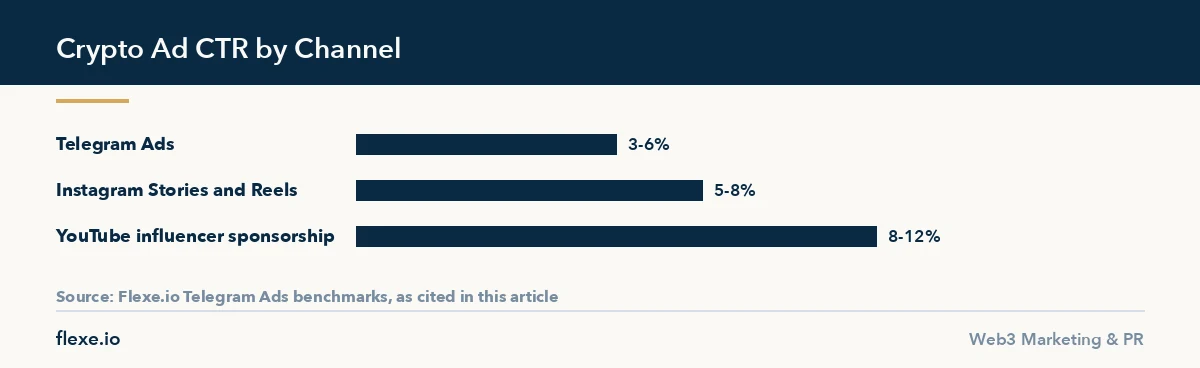
- Click-through rate (CTR): 3%–6%
- Conversion rate to bot users: 12%–20%
- Cost per acquisition (CPA): $0.25–$1.20
By leveraging Flexe.io’s Telegram Ads service (Telegram channel promotion), crypto projects can maximize ROI through expert campaign management.
When is it worth going outside Telegram?
While Telegram Ads offer deep integration, expanding your reach through Google Ads and Meta Ads (Facebook & Instagram) is a powerful strategy.
Google Ads Benefits:
- Search Ads capture users actively looking for crypto mining opportunities
- YouTube Ads generate high engagement (view rates 15%–25%)
- Display Ads retarget previous bot visitors for increased conversions
Meta Ads Benefits:
- Instagram Stories & Reels Ads deliver high CTRs (5%–8%)
- Retargeting crypto audiences based on past interactions
- Facebook Groups Ads tap into active crypto discussion communities
For expert assistance in launching Google and Meta Ads campaigns, explore Flexe.io’s Google Ads service (the crypto ads guide) and Meta Ads service (details here).
How do creator placements fit in?
Influencer marketing is another highly effective paid strategy for Telegram crypto mining bots.
Best Paid Influencer Strategies:
- Sponsored posts in crypto Telegram channels with 100K+ members
- YouTube influencer video sponsorships (CTR 8%–12%)
- X (Twitter) paid collaborations for high engagement
With Flexe.io’s Influencer Marketing service (our vetted crypto influencer list), crypto projects can drive massive visibility with verified influencers.
How do you improve conversion on paid ads?
Simply running ads is not enough. To get the best results, you must optimize your campaigns continuously.
Optimization Strategies:
- A/B testing ad creatives (conversion boosts up to 30%)
- Targeted landing pages designed for high Telegram bot sign-ups
- Dynamic retargeting to bring back dropped-off users
Projects using Flexe.io’s advanced ad optimization techniques report 40% lower CPA and 2x higher conversions.
What to take from this
Paid advertising is one of the fastest ways to scale a Telegram crypto mining bot in 2026. By leveraging Telegram Ads, Google & Meta Ads, influencer promotions, and advanced optimization techniques, projects can achieve exponential user growth.
For custom Telegram ad campaigns, contact Flexe.io today:
Telegram Mining Bots in 2026: What Changed
The tap-to-earn wave that made these bots famous has largely passed, and what remains splits into two very different categories worth telling apart.
- Cloud mining fronts. Bots that promise hashrate you never see. The economics do not work at the advertised rates, and the referral structure is where the actual revenue comes from.
- Points and airdrop farms. No mining involved; you accumulate a balance that may or may not convert into a token. Costs nothing but time, and the honest ones say plainly that conversion is not guaranteed.
Practical safety rules that have not changed: never connect a wallet holding funds, never sign a transaction a bot requests, treat any request for a seed phrase as theft in progress, and use a burner wallet for anything that requires a connection at all. The bots themselves cannot take your assets. What takes them is the transaction you approve inside one.
Related Services
If you would rather have this handled than run it in-house, these are the specific services involved.
Building an audience and keeping it are separate jobs. Crypto community growth runs on verified task completions and reports retention thirty days after the campaign, not on the day it ends.
How to check mining bots before joining
Start with the channel behind the bot rather than the bot itself. Read the oldest posts, not the newest: a project that has been posting for months about the same mechanics is a different proposition from one whose history begins three weeks ago with a list of partners. Check whether the admin list is public, whether anyone answers questions that are not flattering, and whether old promises were kept or quietly deleted.
Confirm the exact username before you press start. Clones of popular mining bots differ by a character, and the cloned version exists specifically to harvest signatures from people who arrived through a forwarded link. Reach the bot from a link posted in the official channel, never from a message that arrives in your direct chats, and treat search results inside the application as a starting point rather than as proof.
Then read the withdrawal rules before spending a week accumulating anything. The minimum threshold, the fee, the network used for payout and whether a withdrawal requires an additional deposit are the terms that decide whether any of this converts. A bot that publishes no withdrawal rules at all has answered the question, and the implied hourly rate is worth working out before committing months to it.
Setting up a burner wallet properly
A burner wallet is only a burner if it never shares a history with the wallet holding your assets. Create it fresh, fund it with the gas the task needs and nothing more, and never route funds between it and your main wallet directly. Anything the burner receives that turns out to be worth keeping can be moved deliberately later, once you know what signed for it.
Keep the signing surface small. One browser profile, no other tabs authorised, and a habit of reading the transaction preview rather than the wording in the chat window removes most of the risk that remains. The bots themselves cannot take assets, as this page says plainly; the loss happens in a signature, and a signature you read is one you can decline.
Revoke allowances when a campaign ends. Approvals granted for a task stay live long after interest in the bot has faded, and a project that is abandoned by its team is precisely the kind of contract that later behaves badly. Reviewing and clearing old approvals on the chains involved takes minutes and closes the exposure that outlasts the campaign itself.
Reading the referral structure
Work out where the money enters before deciding whether to participate. If earnings rise mainly with recruitment rather than with activity, the referral layer is the product and the mining language is decoration. That structure pays early entrants from later deposits, and the people who read the mechanics carefully are usually not the ones left holding a balance at the end.
Watch what the promotion asks you to do. A programme that rewards posting a link far more than using the product is buying distribution from its own users, which is cheap for the operator and reputationally expensive for whoever posts. Consider what your own audience will remember six months after a bot stops answering, because that memory attaches to the person who shared the link, not to the anonymous operator.
What to do after a bot stops paying
Stop adding time to it immediately. Sunk effort is the reason people keep tapping through weeks of silence, and no amount of accumulated balance is worth a further month against a payout process that has already broken. Screenshot the balance and any support exchange, then disconnect anything that was connected and revoke the approvals granted to it.
Do not take up an offer to recover the balance for a fee, in any form and through any channel. Payment to release a withdrawal is the second act of the same operation, and it is where most of the actual loss in this category happens. The first loss is time; the second loss is the one people are talked into afterwards, usually by a message that arrives at exactly the right emotional moment.
Keeping records while you participate
Keep a short record from the first day: when you joined, what the balance was at intervals, what the withdrawal terms said at the time, and a screenshot of any rule that changes. Terms in this category are edited quietly, and a saved screenshot is the only way to show that a threshold moved after people had already spent weeks earning against the old one.
Track the time you are spending as honestly as the balance. A few minutes a day across several bots is a real cost, and writing it down is what makes the comparison against the implied payout concrete rather than theoretical. Most people who stop do so shortly after seeing those two numbers written next to each other for the first time.
Measuring paid traffic to a bot
Projects buying traffic should instrument the deep link before the first campaign runs. A start parameter carried into the bot session is what lets you tell which placement produced a user, and without it every channel reports the same undifferentiated total. Test the parameter yourself end to end, from the ad to the first message, because a link that drops it quietly invalidates the whole measurement.
Judge the campaign on what happens after the first session rather than on the cost of reaching it. The conversion range this page cites for Telegram Ads describes people who opened the bot; whether they returned on day seven is a different number and the one that decides whether the spend was worth repeating. Report both, because the cheaper source is often the one that disappears fastest.
Expect creative rejections and plan the calendar around them. Ad review in this category is stricter than in most, wording that passed last month can be refused this month, and a campaign that must launch on a fixed date needs alternates written in advance. Keep the approved versions on file, since a previously accepted phrasing is the fastest route back to delivery after a refusal.
Separate the cost of a start from the cost of a user who does something. A session that opens once and never returns is cheap for a reason, and placements producing them in volume will flatter the acquisition figure while contributing nothing. Define the qualifying action before buying traffic, then report against that definition every week without quietly redefining it in the week the number disappoints.
Watch the individual sources rather than only the total. One placement carrying most of the volume is a concentration risk, because that channel changing its rates or its posting schedule then moves the entire campaign at once. Keep a second source running even when the first is clearly better, so there is somewhere to go on the day the better one stops accepting bookings.
Common mistakes in bot campaigns
The most expensive mistake is launching a reward loop with nothing behind it. Retention collapses once the novelty of the loop passes, and a user list acquired purely by incentive evaporates with the incentive, so the product the bot leads to has to exist before the campaign rather than after it. The campaign accelerates whatever is already there, including nothing.
Changing too many variables at once wastes a budget quietly. Running new creative, a new audience and a new landing flow in the same week produces a result nobody can attribute, and the next decision is then made on instinct. Change one element per test, hold the measurement window constant, and write the expectation down before the data arrives so the reading afterwards is honest.
Moderation is the mistake people notice last. A bot that suddenly receives paid traffic also receives impersonators in its comments offering help, and each of them converts some share of your new users into victims. Assign coverage for the hours the campaign actually runs, and pin a message stating plainly that nobody from the project will ever write to a user first.
Frequently Asked Questions
What changed for Telegram mining bots in 2026?
The tap-to-earn wave largely passed. What remains splits into cloud mining fronts, where the referral structure is the actual product, and points farms where you accumulate a balance that may or may not convert into a token.
Are Telegram mining bots safe?
The bots themselves cannot take your assets. What takes them is a transaction you approve inside one. Never connect a wallet holding funds, never sign a request from a bot, and treat any seed phrase request as theft in progress.
Do Telegram mining bots actually pay?
Some have. Many ran identical mechanics and quietly stopped, which makes the category look better than it is because only the payouts get discussed. Check the implied hourly rate before committing months.
What is the difference between mining bots and airdrop farms?
Mining bots imply hashrate you never see. Points farms are honest about being points. The second category is the one where payouts have actually occurred, though conversion is never guaranteed.
Should a project launch a mining bot?
Only if the bot does something useful after the campaign. Retention collapses within about three weeks once the reward loop stops being novel, and the user list evaporates with the incentive.
How do you spot a scam mining bot?
Requests for a wallet signature, promised returns with specific percentages, referral rewards larger than the mining rewards, and no identifiable team. Any one of these is enough.