You’ve read 10 articles about influencer marketing. Most were vague promises and surface-level theory. This one breaks down how real projects moved from zero visibility to seven-figure revenue using influencers, AI tools, and smart distribution.
Key Takeaways
- Modern crypto promotion combines influencers, AI content generation, and multi-platform distribution to reach 1M+ monthly impressions while staying lean on budget.
- Successful Web3 projects replace traditional $250K+ marketing teams with AI agents and strategic influencer partnerships for 90% of the workload.
- Real case studies show ARR jumps from $0 to $10M using targeted content strategies, AI-optimized SEO, and verified influencer collaborations.
- Tools like Claude for copywriting, ChatGPT for research, and platforms like Sora2/Veo3.1 enable rapid creative output that matches or beats expensive agencies.
- Authentic influencer promotion requires tight alignment between product value, target audience pain points, and the creator’s established community trust.
What is Influencer Crypto Promotion: Definition and Context
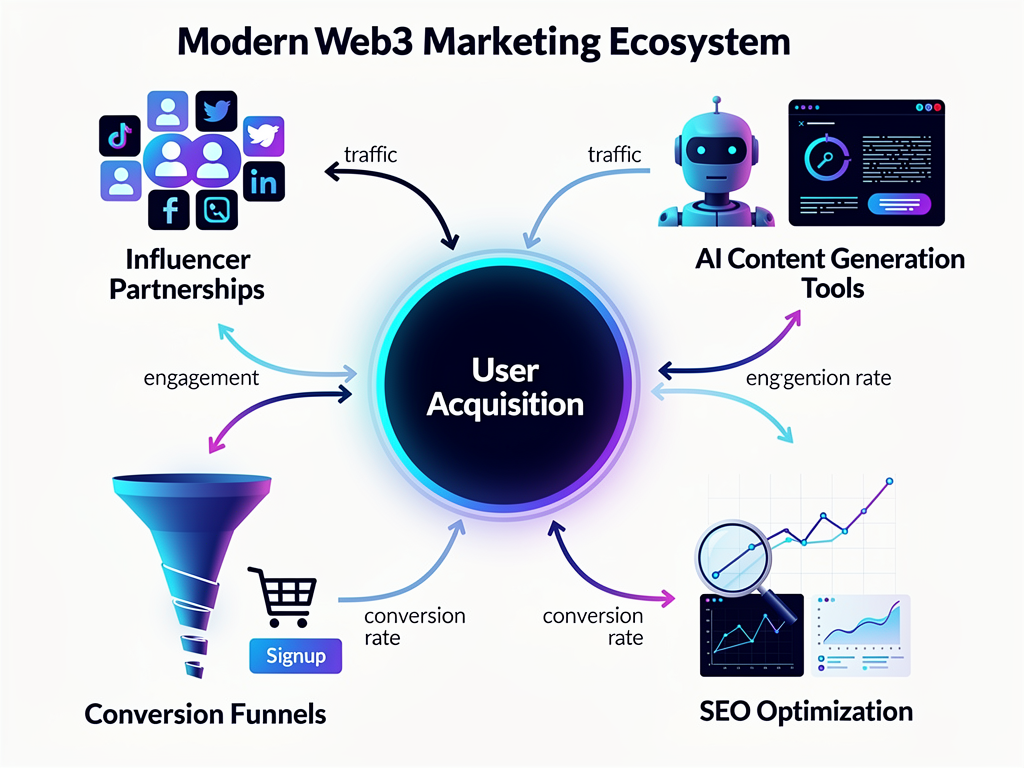
Influencers promoting crypto refers to the strategic partnership between Web3 projects and content creators who communicate product value, build trust, and drive adoption across social platforms. Unlike traditional advertising, these collaborations leverage established communities and creator credibility to accelerate user acquisition and token holder growth.
Recent implementations show this approach has evolved far beyond simple sponsored tweets. Today’s blockchain leaders combine influencer reach with AI-generated content systems, SEO-optimized landing pages, and conversion-focused funnels. Modern deployments reveal that the most effective campaigns integrate creators into product launches, educational content series, and long-term brand partnerships rather than one-off paid posts.
This strategy works best for projects that have genuine product-market fit, clear differentiation, and can articulate specific value propositions. It’s not suitable for projects without working products, those relying solely on hype mechanics, or teams that can’t provide creators with authentic narratives worth sharing with their audiences.
What These Implementations Actually Solve
Cold Start Problem and Community Building: New crypto projects face the challenge of attracting initial users when nobody knows they exist. Strategic influencer partnerships solve this by providing immediate access to engaged, crypto-native audiences. One project documented growing from zero followers to 500+ daily by deploying a systematic viral content framework combined with creator collaborations, reaching 5M+ impressions in 30 days according to their social analytics.
Trust and Credibility Gaps: In a market saturated with scams and failed promises, projects struggle to build legitimacy. When respected voices in the space authentically endorse a product after testing it, they transfer some of their earned trust. A documented case shows how one platform achieved 50K+ impressions per post consistently (up from 200) by engineering content that resonated with established communities rather than pushing generic promotional messages.
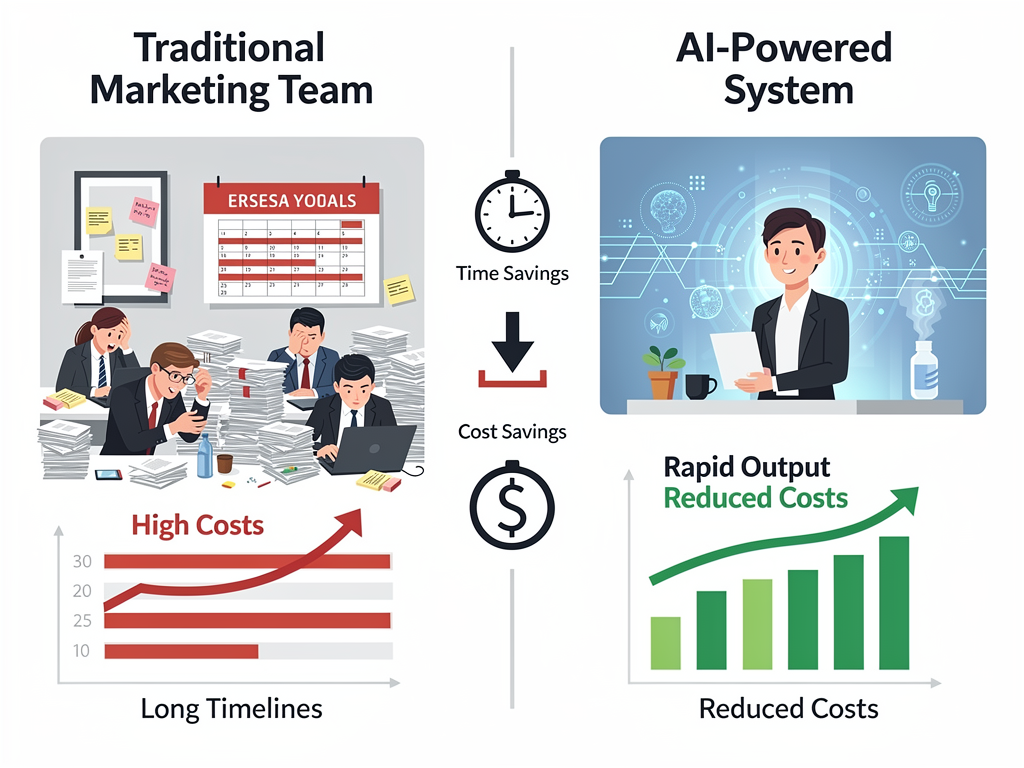
Content Production at Scale: Producing enough quality content to maintain visibility across multiple platforms traditionally requires large teams. Modern approaches combine influencer amplification with AI content systems. One operator replaced a $267K/year content team by building an AI agent that analyzes winning ads, maps psychological triggers, and generates platform-native visuals in 47 seconds versus the previous 5-week agency timeline.
Distribution and Algorithmic Reach: Even great content fails without distribution. Influencers bring existing algorithmic favor and audience attention. A case study from an e-commerce operator showed how combining AI tools (Claude for copy, ChatGPT for research, Higgsfield for images) with strategic content distribution achieved a ROAS of 4.43, generating $3,806 in revenue on $860 ad spend with approximately 60% margins—all from image ads with no video production.
Market Education and Onboarding: Complex crypto products need explanation before users convert. Influencers serve as educators who break down technical concepts for their audiences. One SaaS project grew from a new domain to $13,800 ARR with 62 paid users by creating SEO content addressing specific pain points (“X alternative,” “X not working”), getting featured in AI search results, and driving 21,329 site visitors organically without paid influencer campaigns—showing how educational content compounds over time.
How This Works: Step-by-Step
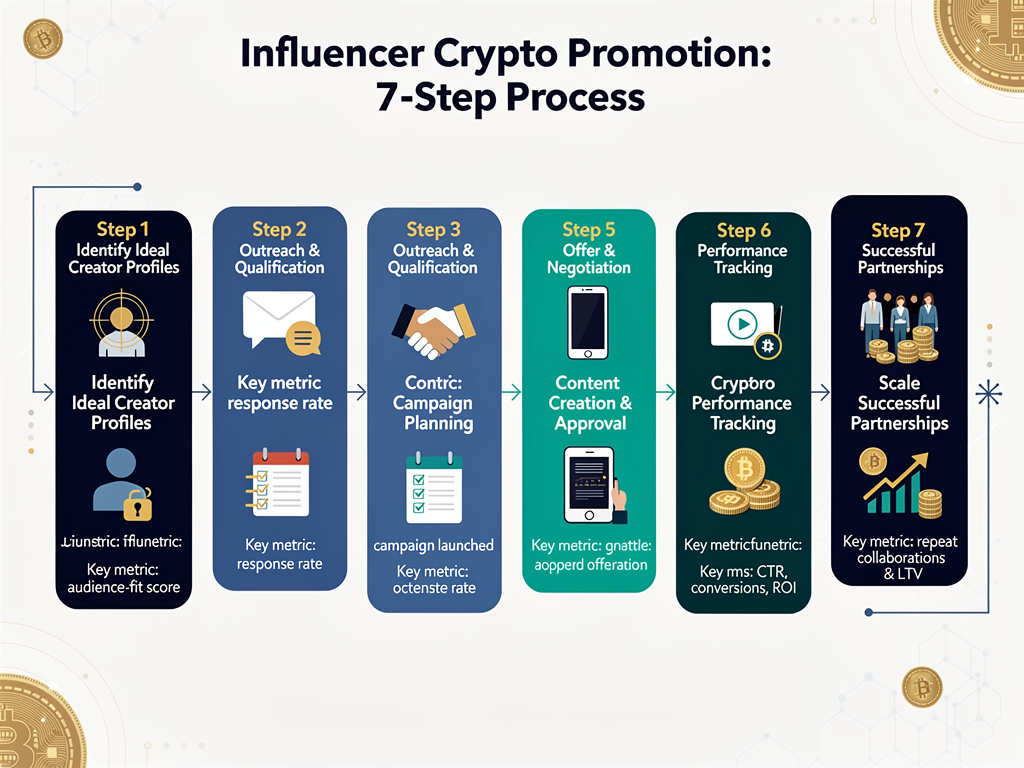
Step 1: Identify Your Ideal Creator Profile and Audience Overlap
Start by mapping your actual user persona to creator audiences, not follower counts. Look for engagement rates above 3%, comment quality over quantity, and authentic community interaction. One growth team achieved $10M ARR by first validating product-market fit with direct outreach, emailing their ideal customer profile with “Hey, we’re building a tool that lets you create 10x more ad variations using AI. Want to test it?” They closed 3 out of 4 calls at $1,000 each before building the full product.
The common mistake here is chasing large follower counts without checking audience composition. A creator with 500K followers in the wrong niche will deliver worse results than one with 10K highly engaged users who match your target demographic.
Step 2: Build Your AI Content Engine Before Scaling Influencer Partnerships
Set up systems that generate content variations rapidly so you can test what resonates before committing big budgets. One operator built a “Creative OS” that generates marketing content by running 6 image models and 3 video models simultaneously, accessing 200+ premium JSON context profiles, delivering what agencies charge $10K+ for in under 60 seconds. This enables rapid testing of hooks, angles, and creative variations before amplifying through influencers.
Another team used n8n workflows to extract keywords from Google Trends, scrape competitor sites with 99.5% success rates, and generate 200 publication-ready articles in 3 hours, capturing project data showing over $100K in organic traffic value monthly while replacing a $10K/month content team.
Step 3: Create Authentic Partnership Frameworks, Not Transactional Posts
Move beyond “pay for a tweet” to collaborative content creation. Provide creators with early access, genuine product stories, and user data they can share authentically. A team growing theme pages to $1.2M/month revenue used a consistent format: strong scroll-stopping hook, curiosity or value in the middle, clean payoff with product tie-in. Individual pages regularly generated $100K+ from reposted content, pulling 120M+ views monthly using AI video tools like Sora2 and Veo3.1.
The framework that works: give influencers real user stories, specific metrics they can verify, and creative freedom to present in their voice. Scripted promotional content gets ignored; authentic product experiences get shared.
Step 4: Deploy Multi-Channel Distribution Systems
Don’t rely on a single platform or creator. One SaaS company scaled from $100K to $833K MRR by running parallel growth channels: paid ads using their own product, direct outreach to top prospects, events and conferences, influencer partnerships with top creators in the growth and AI space, coordinated launch campaigns, and strategic partnerships. Each channel reinforced the others, making all more efficient through cumulative social proof.
Measure which channels drive actual conversions, not just visibility. Some pages get 2K visits with zero conversions while others get 100 visits and 5 signups—volume doesn’t equal revenue.
Step 5: Optimize for AI Search and LLM Citations
Structure all content so AI systems can extract and cite it. Use TL;DR summaries at the top, H2s written as questions, short extractable answers under each heading, and factual statements over opinions. One SEO campaign grew search traffic by 418% and AI search traffic by over 1000% by building pages with extractable logic, DR50+ backlinks from related domains, and schema markup that helped Google AI Overviews and ChatGPT recognize them as authorities.
This compounds influencer efforts because when creators share your content, it’s already optimized for discovery beyond their immediate audience.
Step 6: Build Feedback Loops Between Creators and Product Development
The most successful implementations treat influencers as product advisors, not just promotional channels. Join Discord servers, subreddits, and communities where your target users hang out. Read competitor roadmaps, identify what frustrates people, and build solutions. One project generated $925 MRR from SEO alone within 69 days of launch by writing content that targeted people already searching for fixes (“X alternative,” “X not working,” “how to do X in Y for free”), converting readers who found solutions to their exact pain points.
When influencers see you actually solving community problems they’ve heard about, their endorsements become genuine recommendations rather than paid promotions.
Step 7: Scale What Works, Kill What Doesn’t
Track which creator partnerships drive paying users versus vanity metrics. One operator running a “lazy lead-gen system” bought a domain for $9, used AI to build a niche site in one day, repurposed trending articles into 100 blog posts, auto-generated 50 TikToks and 50 Reels monthly, added email capture popups with AI-written nurture sequences, and plugged in a $997 affiliate offer. With approximately 5K site visitors monthly, they converted 20 buyers for $20K monthly profit by stacking AI shortcuts on distribution—showing that systematic execution beats one-off campaigns.
Where Most Projects Fail (and How to Fix It)
Picking Influencers Based on Follower Count Alone: Teams waste budgets on creators with large but disengaged or misaligned audiences. A creator with 1M followers in general crypto will underperform one with 50K followers in your specific niche (DeFi, NFTs, gaming, infrastructure). Fix this by analyzing comment quality, checking what percentage of their audience matches your user profile, and running small tests before committing to large partnerships.
Generic, Scripted Promotional Content: When you hand influencers pre-written tweets or talking points, their audience immediately spots the inauthenticity. One content strategist saw engagement jump from 0.8% to over 12% by reverse-engineering 10,000+ viral posts to understand psychological triggers rather than relying on generic prompts. Let creators tell authentic stories in their voice using your product data and user outcomes as raw material.
No System for Rapid Creative Iteration: Most teams produce content too slowly to test what works. By the time they’ve created 3 variations, the trend has moved on. The solution: build AI workflows that generate dozens of variations quickly. One marketer combined Claude for copywriting with strategic frameworks (testing new desires, angles, iterations, avatars, and different hooks/visuals), enabling rapid iteration that traditional processes can’t match.
When you’re navigating these complexities and need expert guidance on crypto-specific influencer strategies, FLEXE.io—with 7+ years in Web3 marketing and 700+ clients—provides access to 500+ vetted KOLs across crypto niches to accelerate community growth and awareness. Reach out on Telegram: https://t.me/flexe_io_agency
Ignoring AI Search Optimization: Creating content only for humans misses how modern discovery works. LLMs like ChatGPT, Perplexity, and Google’s AI Overviews increasingly mediate how people find projects. One agency competing in a difficult niche grew AI Overview citations massively by restructuring content with extractable answers, question-based H2s, and schema markup—getting cited where competitors with bigger budgets weren’t because their content wasn’t machine-readable.
Transactional Relationships Instead of Long-Term Partnerships: One-off paid posts generate temporary spikes but don’t build sustained momentum. The projects reaching eight figures treat top creators as ongoing partners, giving them early feature access, including them in launch planning, and building collaborative content series. This creates authentic advocacy that audiences trust over obvious sponsorships.
Real Cases with Verified Numbers

Case 1: E-commerce Brand Hits Nearly $4K Days with AI Content System
Context: An e-commerce operator wanted to scale ad performance while keeping costs lean and avoiding video production complexity.
What they did:
- Switched from only using ChatGPT to combining Claude for copywriting, ChatGPT for deep research, and Higgsfield for AI image generation
- Invested in paid plans for these tools to build an integrated marketing system
- Implemented a simple funnel: engaging ad image > advertorial > product detail page > post-purchase upsell
- Focused testing on new desires, angles, iterations, avatars, and improving metrics with different hooks and visuals
Results:
- Revenue: $3,806 in a single day
- Ad spend: $860
- ROAS: 4.43
- Margin: approximately 60%
- Running only image ads with no video content
Key insight: The strategic combination of specialized AI tools for different marketing tasks delivered agency-level results without agency costs or timelines.
Source: Tweet
Case 2: Marketing Team Replacement Generates Enterprise-Scale Content
Context: A business wanted to reduce the cost structure of a traditional marketing team while maintaining or improving output quality and volume.
What they did:
- Built four specialized AI agents for content research, creation, competitor ad analysis, and SEO content generation
- Tested and refined the system over 6 months
- Deployed the agents to run continuously without human bottlenecks
Results:
- Before: $250,000 annual marketing team cost
- After: Millions of impressions generated monthly, tens of thousands in revenue on autopilot
- One social post reached 3.9M views
- System handles 90% of marketing workload for less than one employee’s salary
Key insight: Specialized AI agents working in parallel can replicate the output of a 5-7 person team when properly configured for specific tasks.
Source: Tweet
Case 3: Ad Creative System Replaces $267K Content Team
Context: A marketing team needed to generate high-quality ad creatives at scale without the traditional agency fees and timelines.
What they did:
- Built an AI system that analyzes winning ads and psychological triggers
- Created workflows that generate visual intelligence, behavioral psychology mapping, hook generation with ranking, and multi-platform creative studios
- Automated lighting, composition, and brand alignment
Results:
- Before: $267K/year content team with 5-week turnaround
- After: Concepts generated in 47 seconds, saving what agencies charge $4,997 for
- Produces 12+ psychological hooks with platform-native visuals automatically
Key insight: Behavioral science applied at machine speed beats manual creative processes when you encode proven frameworks into the system.
Source: Tweet
Case 4: New SaaS Domain Reaches $13.8K ARR in 69 Days with SEO
Context: A new SaaS product with a domain rated 3.5 by Ahrefs wanted to acquire users through organic search without paid advertising or backlink building.
What they did:
- Created content targeting commercial intent searches like “X alternative,” “X not working,” “how to do X in Y for free”
- Wrote human-like articles with short sentences, question-based H2s, TL;DR summaries, and clear CTAs
- Used strong internal linking across related guides
- Gathered user feedback from communities and competitor roadmaps to identify real pain points
Results:
- ARR: $13,800
- Site visitors: 21,329
- Search clicks: 2,777
- Gross volume: $3,975
- Paid users: 62
- MRR from SEO: $925
- Many posts ranking #1 or high on page 1 of Google
- Featured in Perplexity and ChatGPT results
- Built with zero backlinks initially
Key insight: Targeting problem-aware searchers with precise solutions converts far better than generic “best of” content that’s impossible to rank for early on.
Source: Tweet
Case 5: Theme Pages Generate $1.2M Monthly with AI Video Tools
Context: Content creators wanted to build theme pages that monetize consistently without relying on personal brand or individual influencer partnerships.
What they did:
- Used Sora2 and Veo3.1 AI tools to generate video content at scale
- Applied consistent format: strong scroll-stopping hook, curiosity or value in middle, clean payoff with product tie-in
- Posted reposted content in niches with existing buying behavior
Results:
- Revenue: $1.2M per month across theme pages
- Individual pages: $100K+ each regularly
- Monthly views: 120M+ on top-performing pages
Key insight: AI video generation combined with proven content formulas enables scale that manual production can’t match, especially in high-engagement niches.
Source: Tweet
Case 6: Viral X Content System Generates 7 Figures Annually
Context: A creator wanted to build a systematic approach to growing on X (Twitter) and monetizing through digital products without relying on external influencer partnerships.
What they did:
- Created niche-specific X profile
- Studied top influencers and repurposed their content using AI
- Generated hundreds of posts and auto-scheduled 10 per day
- Built DM funnel to digital products
- Used AI to generate 5 ebooks in approximately 30 minutes
Results:
- Annual profit: 7 figures
- Monthly profit: $10K
- Monthly views: 1M+
- Monthly checkout views: few hundred
- Conversions: approximately 20 buyers at $500 each per month
Key insight: Systematic content generation and distribution beats sporadic posting, especially when you feed AI with quality examples rather than generic prompts.
Source: Tweet
Case 7: AI Ad Platform Scales to $10M ARR with Multi-Channel Strategy
Context: An AI ad creation platform wanted to grow from zero to eight figures by combining product excellence with strategic growth channels including influencer partnerships.
What they did:
- Pre-launch: Validated with direct customer outreach, charging $1,000 for testing, closing 3 of 4 calls
- Early growth: Founder posted daily on X despite zero followers initially
- Viral moment: Client posted video created with platform that went viral
- Scale phase: Deployed paid ads using own product, direct outreach, events/conferences, influencer marketing with top creators, coordinated launch campaigns, and strategic partnerships
Results:
- Growth trajectory: $0 to $10K MRR (1 month), $10K to $30K MRR (public posting phase), $30K to $100K MRR (post-viral), $100K to $833K MRR (multi-channel deployment)
- Current: $10M ARR
- Viral moment estimated to save 6 months of grind according to the team
Key insight: Combining multiple growth channels creates compounding effects, with each channel (including influencer partnerships) making others more efficient through accumulated social proof.
Source: Tweet
Tools and Next Steps
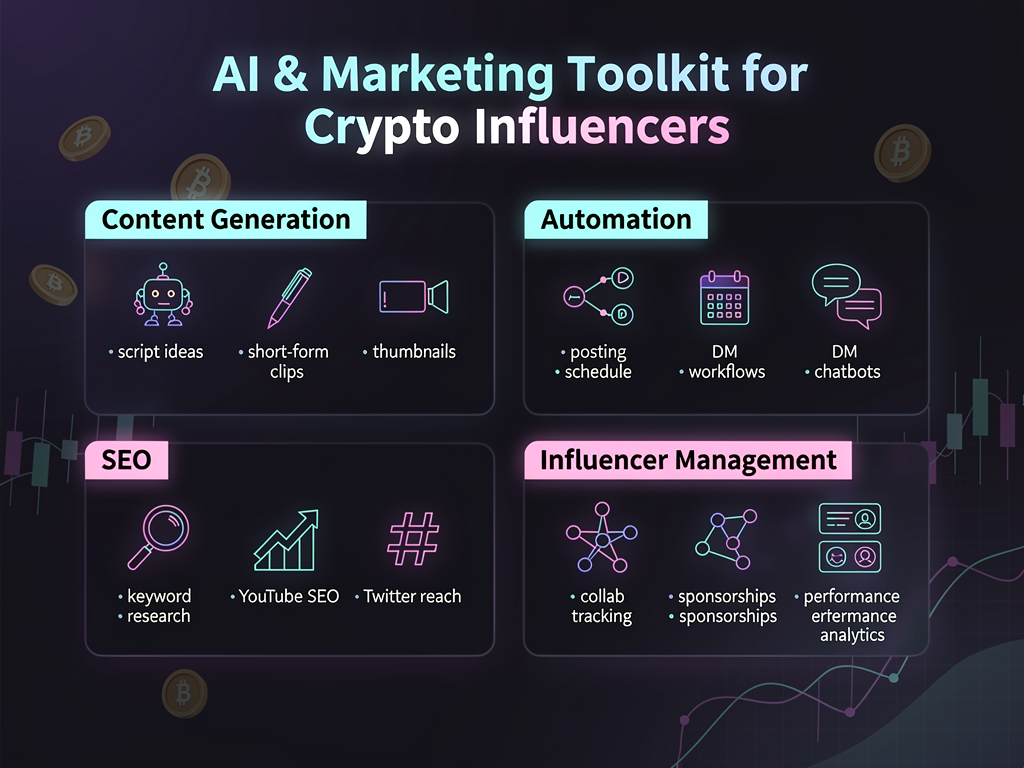
AI Content Generation Tools:
- Claude: Specialized for copywriting and persuasive content creation; operators report better ad copy than ChatGPT for conversion-focused writing
- ChatGPT: Ideal for research, data analysis, and strategic planning; use for competitor analysis and market insights
- Higgsfield / Sora2 / Veo3.1: AI image and video generation for creating visual content at scale without traditional production costs
- n8n: Workflow automation platform for building AI agent systems that handle research, content creation, and distribution
- NotebookLM: Helps organize context profiles and brand guidelines that feed into AI generation systems for consistency
Influencer Discovery and Management:
- Search crypto-specific Discord servers, Telegram groups, and subreddits where your target users congregate
- Use X (Twitter) advanced search to find creators discussing your product category with engagement rates above 3%
- Track competitor mentions to identify which influencers already cover your space authentically
- Build a simple CRM or spreadsheet tracking creator name, audience size, engagement rate, niche alignment score, and past collaboration results
SEO and AI Search Optimization:
- Google Trends for keyword discovery focused on commercial intent (“X alternative,” “X not working”)
- Ahrefs or similar for competitor content analysis (though the case studies show results possible even at low domain ratings)
- Schema markup generators for structured data that helps AI systems extract and cite your content
Your Next 10 Actions:
- [ ] Email your existing users offering 20% discount for detailed feedback on where they found you and what alternatives they considered
- [ ] Join 3-5 Discord servers or subreddits where your target audience hangs out; spend 2 hours reading complaints about current solutions
- [ ] Identify 10-15 micro-influencers (10K-100K followers) in your niche with engagement rates above 3%
- [ ] Set up basic AI workflow combining Claude for copy and ChatGPT for research; test generating 10 content variations on one topic
- [ ] Create 5 pieces of content addressing specific pain points using the format: problem description > how your solution fixes it > specific results > CTA
- [ ] Reach out to 3 creators with genuine compliments on their work and ask what tools they wish existed (don’t pitch yet)
- [ ] Audit your existing content for AI extractability: add TL;DR summaries, rewrite H2s as questions, shorten paragraphs to 2-3 sentences
- [ ] Build an internal linking map connecting all related content pieces with semantic anchor text
- [ ] Set up basic tracking to measure which content pieces drive actual conversions, not just traffic
- [ ] Start posting daily on X about your building process, user insights, and product developments (even with zero followers initially)
When you’re ready to accelerate these efforts with proven Web3 expertise, FLEXE.io brings 7+ years of crypto marketing experience and connections to 150+ media outlets alongside their network of 500+ KOLs to help projects quickly grow users and awareness. Get in touch on Telegram: https://t.me/flexe_io_agency
FAQ: Your Questions Answered
How much should I pay crypto influencers for promotion?
Pricing varies wildly based on audience size, engagement rates, and niche authority. Micro-influencers (10K-100K followers) with strong engagement often charge $500-$5,000 per post, while larger accounts can command $10K-$100K+. However, the most successful partnerships move beyond one-off payments to revenue sharing, token allocations, or long-term ambassador agreements. Test small first—one operator closed 3 of 4 pre-launch calls at $1,000 each for product testing before spending on broader promotion. Focus on alignment and conversion potential over follower count.
Can AI tools really replace traditional influencer marketing teams?
AI tools excel at content production, research, and optimization but can’t fully replace strategic relationship-building with influencers. Multiple documented cases show teams replacing $250K+ marketing departments with AI agents for content creation while still maintaining human relationships for influencer partnerships. The winning combination: use AI for rapid content generation and testing (one system generates concepts in 47 seconds vs. 5 weeks) while humans handle creator outreach, relationship management, and strategic decisions about which partnerships align with brand values.
What metrics actually matter when measuring influencer campaign success?
Track conversions and customer acquisition cost, not vanity metrics. One SaaS founder noted some pages get 2,000 visits with zero conversions while others get 100 visits and 5 signups. Essential metrics: cost per qualified lead, conversion rate from influencer traffic to product signup, lifetime value of acquired users, and attribution to revenue. A project reaching $10M ARR tracked which specific growth channels (including influencer partnerships) drove paying users, then doubled down on what worked while cutting what delivered only impressions without conversions.
How do I avoid scam influencers or fake engagement in crypto?
Verify engagement authenticity by analyzing comment quality, checking follower growth patterns for suspicious spikes, and testing small before committing large budgets. Look for creators who post consistently in your niche over months, have conversations in comments (not just emojis), and whose audience demographics match your user profile. One effective approach: join the communities where these creators are active members, observe how their audience responds to non-sponsored content, and check if they genuinely use and understand products they promote. Start with $500-1,000 test campaigns to validate conversion quality before scaling.
Should I focus on one platform or distribute across multiple channels?
Multi-platform distribution compounds results when coordinated strategically. A company scaling to $833K MRR ran parallel channels: paid ads, direct outreach, events, influencer partnerships, launch campaigns, and strategic partnerships—with each reinforcing the others. However, start focused. One creator built to 7-figure annual profit by mastering X (Twitter) first: posting 10 times daily, hitting 1M+ monthly views, then expanding. The pattern: achieve product-market fit on one platform with one creator type, prove the conversion mechanics work, then systematically expand to additional platforms and influencer tiers rather than spreading thin from day one.
How important is AI search optimization when working with influencers?
Increasingly critical as users discover projects through ChatGPT, Perplexity, and Google AI Overviews alongside traditional social. One agency grew AI search traffic by over 1000% by structuring content with extractable answers, question-based headings, and schema markup. When influencers share your content, AI-optimized structure means it gets discovered and cited beyond their immediate audience. The compound effect: influencer posts drive initial traffic, properly structured content gets indexed by AI systems, then generates ongoing discovery long after the initial promotion ends. Best practice: optimize all landing pages and content assets for AI extraction before launching influencer campaigns.
What’s the biggest mistake projects make with influencer crypto marketing?
Treating influencers as paid billboards rather than authentic partners. Generic scripted promotions get ignored—one strategist saw engagement jump from 0.8% to over 12% by letting creators tell genuine stories instead of reading talking points. The effective approach: give influencers early product access, share real user data and outcomes they can verify, provide creative freedom to present in their voice, and build long-term relationships instead of transactional one-off posts. Projects reaching eight figures treat top creators as product advisors who genuinely use and improve the offering rather than just promotional channels.